
Breast Biopsy System Market Growth, Share & Trends by 2034
Coverage: By Product Type (Needle Aspiration (FNA) Biopsy, Core Needle Biopsy, Surgical Biopsy, Biopsy Markers); Guidance Technology (Ultrasound-Guided, Mammography-Guided, Magnetic Resonance); End User (Hospitals, Ambulatory Surgical Centers, Diagnostic Centers, Research Laboratories, Others), and Geography (North America, Europe, Asia Pacific, and South and Central America)
- Status : Data Released
- Report Code : TIPRE00021648
- Category : Life Sciences
- No. of Pages : 150
- Available Report Formats :


- Last update date : August 04, 2026


2025 Market Size
US$ 930.17 Mn
Base year value
2034 Forecast
US$ 1,652.43 Mn
Projected by 2034
CAGR 2026-2034
7.45 %
Growth rate
Addressable Market
US$ 12,197.90 Mn
(2026-2034)
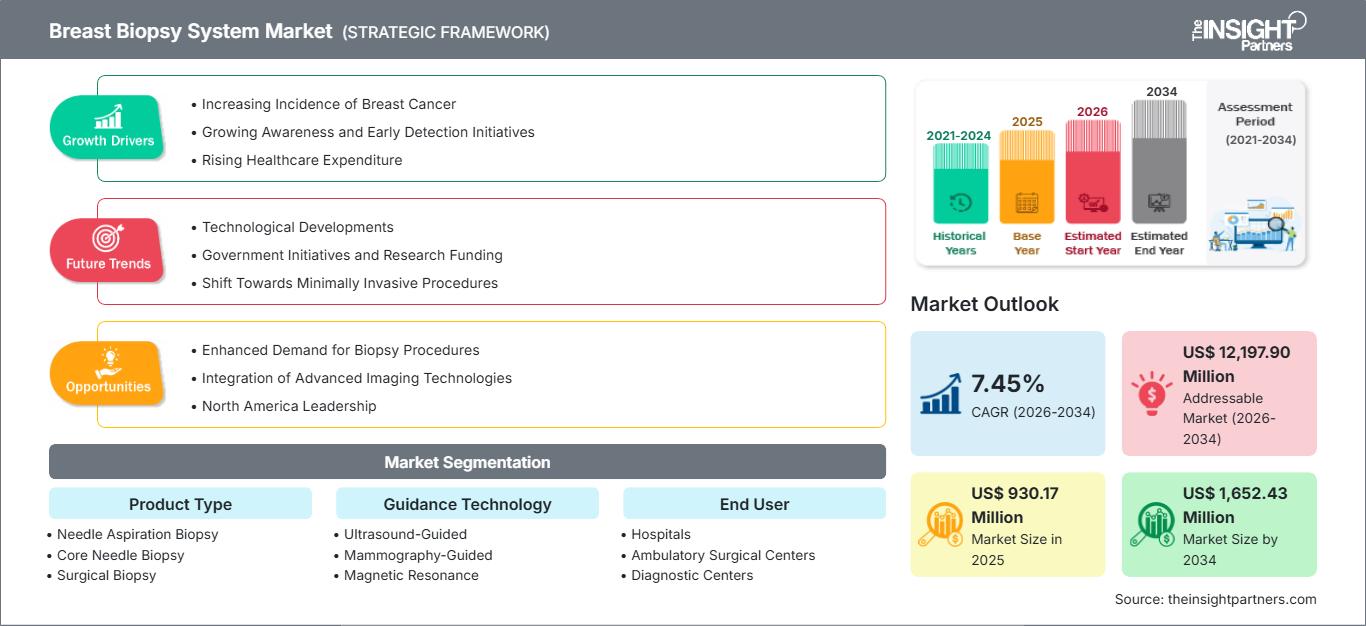
The Breast Biopsy System Market is a regulated procedure-based diagnostic device market driven by cancer detection pathways, imaging capabilities, and minimally invasive sampling. The market size was US$ 930.17 million in 2025 and it is expected to grow to US$ 1,652.43 million by 2034; it is estimated to register a CAGR of 7.45% between 2026 and 2034.
North America continues to be the maturest market for demand, backed by structured screening, density notification laws, established imaging technology, and fast adoption of vacuum-assisted and image-guided biopsies. The Breast Biopsy System Market size in North America is estimated to grow at a CAGR of 6.8-7.4% between 2026 and 2034, as healthcare facilities emphasize process optimization and lesion localization accuracy.
Breast Biopsy System Market Assessment and Insights
- North America accounted for 38–41% share in 2025 and is projected to grow at a CAGR between 6.8–7.4% during 2026–2034, supported by advanced breast imaging penetration, trained radiology networks, and strong reimbursement for minimally invasive biopsy.
- US represented 82–86% of North America in 2025 and is projected to grow at a CAGR between 6.9–7.5% during 2026–2034, led by dense breast legislation and high diagnostic procedure volumes.
- Europe held 27–30% share in 2025 and is projected to grow at a CAGR between 6.5–7.1% during 2026–2034, with Germany, France, the UK, Italy, and Spain leading adoption through screening programs and breast units.
- Asia Pacific accounted for 21–24% share in 2025 and is projected to grow at a CAGR between 8.3–9.1% during 2026–2034, led by China, Japan, South Korea, India, and Australia amid imaging investments and oncology infrastructure expansion.
- Largest Segment Core Needle Biopsy held 42–46% market share in 2025 and is projected to grow at a CAGR between 7.0–7.6% during 2026–2034 because it balances tissue yield, cost, and clinical familiarity.
- High Growth Segment Magnetic Resonance guidance held 10–13% market share in 2025 and is projected to grow at a CAGR between 8.7–9.5% during 2026–2034 as MRI-detected lesions increase in high-risk screening.
- Key companies analyzed in detail: Biomed Diagnostics, Inc.; Bard Peripheral Vascular Inc.; F. Hoffmann-La Roche Ltd.; Hologic, Inc.; Leica Biosystems Nussloch GmbH; OncoCyte Corporation; Laboratory Corporation of America Holdings; Becton, Dickinson and Company; Danaher Corporation; Medtronic plc; Scion Medical Technologies LLC; Cook Medical LLC; Argon Medical Devices, Inc.; STERYLAB S.r.l.; Planmed Oy.
Source: The Insight Partners' analysis based on proprietary research, government publications, company annual reports, investor presentations, industry databases, and expert interviews.
The migration of procedure techniques from open surgical excision towards image guided percutaneous sampling has led to significant changes in the design of products for Breast Biopsy System Market. The vendors have started shifting focus from independent needles to systems with automatic needle firing and specimen capturing and marking capabilities. The focus on production includes sterility, different gauge size, MRI compatibility, and supply chain validation from the vendor end, especially after shortages of devices highlighted the reliance on limited needle inventory at high-throughput breast centers.
It is anticipated that during the forecast period, the capital investment would gain strength in emerging diagnostic networks with improved integration of mammography and ultrasound and oncology referral services. The regulatory support includes national screening programs, quality assured breast units, and accreditation of hospitals that support standardization of biopsy processes.
Breast Biopsy System Market Report Scope
| Report Attribute | Details |
|---|---|
| Market size in 2025 | US$ 930.17 Million |
| Market Size by 2034 | US$ 1,652.43 Million |
| Global CAGR (2026 - 2034) | 7.45% |
| Historical Data | 2021-2024 |
| Forecast period | 2026-2034 |
Breast Biopsy System Market Analysis
Increasing numbers of abnormal tests have led to the creation of the Breast Biopsy System market especially when tomosynthesis and ultrasound tests increase the visibility of the lesions. According to statistics, there were 2.3 million patients diagnosed with breast cancer in 2022 among women in the world. This created a constant need for confirmation after suspicious findings. The supply chain consists of imaging OEMs, biopsy companies, pathology laboratories, radiologists, breast surgeons, and payers.
Supply is dependent on sterilization capability, sourcing of needle components, and documentation. Hospitals are beginning to look for suppliers who offer the full package including multi-gauge probes and biopsy markers. This is an advantage for companies with proven quality systems and regional distribution presence. However, specialties continue to have an opportunity with products that help procedures specific accessories, localization equipment, and MRI compatible disposable.
The Breast Biopsy System Market Report indicates a competitive market structure that is divided into broad medtech players and specialized breast care players. Hologic, Inc. holds good positioning in terms of imaging guided biopsy and breast health systems. Becton, Dickinson and Company enhances its positioning through multi-modality vacuum assisted biopsy systems. Danaher Corporation, Leica Biosystems Nussloch GmbH, and Laboratory Corporation of America Holdings make a link between biopsy system demands and their downstream pathology interpretation.
Investments are geared towards workflow integration and not device replacement only. Planmed Oy provides stereotactic biopsy systems using mammography systems. Cook Medical LLC and Argon Medical Devices, Inc. are competitors in needles and localization. STERYLAB S.r.l. and Scion Medical Technologies LLC provide solutions for the specialized products. The strategic positioning requires clinical education, supply availability, compatibility with current imaging suites, and evidence for reduction of repeat biopsy risks.
● REPORT CUSTOMIZATION
Tailor This Report To Align With Your Specific Business Requirements
This report can be customized to align precisely with your business objectives, scope, and target markets. Customization options include tailored segmentation, geography, competitive analysis, and strategic insights to support informed decision-making.
Customize This Report →WHAT YOU CAN ADJUST
- ● Segmentations
- ● Geography
- ● Competitive Analysis
- ● Language Preferences
Breast Biopsy System Market: Strategic Insights
Regional Insights
North America Breast Biopsy System Market
North America held 38–41% of global revenue in 2025 and is expected to grow at a CAGR range of 6.8–7.4% during 2026–2034. The Breast Biopsy System Market share in this region is supported by high mammography utilization, dedicated breast imaging centers, dense breast notification rules, and strong adoption of vacuum-assisted and stereotactic biopsy systems.
This region will also benefit significantly from the rapid adoption of the same-day diagnostics approach, whereby suspicious findings from mammograms can be immediately upgraded to ultrasound or mammography-guided tissue sampling. The shortage of stereotactic needles that were felt in 2026 clearly showed the importance of diversification of vendors and inventory dashboard, as well as alternative modes of testing in case of a heavy load at clinics.
U.S. Breast Biopsy System Market
The U.S. accounted for 82–86% of North America in 2025 and is projected to grow at a CAGR range of 6.9–7.5% through 2034. The country’s demand base is supported by high breast cancer screening volumes, regulatory attention to device safety, and broad availability of breast imaging specialists across hospitals and outpatient diagnostic networks.
Company presence is primarily centered on Hologic, Inc., Becton, Dickinson and Company, Laboratory Corporation of America Holdings, Danaher Corporation, Cook Medical LLC, and Argon Medical Devices, Inc. Application trends include increased utilization of multimodality systems, vacuum-assisted sampling for calcifications, and biopsy marking. Supply availability and practical procedural efficiency are becoming important factors for consideration by procurement groups, in addition to purchase costs.
Europe Breast Biopsy System Market
In 2025, Europe had a 27% to 30% market share, with a forecasted growth rate for 2026 to 2034 of 6.5% to 7.1% CAGR. Germany is a major country in the region due to well-organized screening, specialty breast centers, and well-established diagnostic imaging facilities. European guidelines for well-organized mammography screening are also driving continuous referral flow into biopsies.
The UK is fueling demand via centralized cancer referral pathways, breast screening recovery initiatives, and investments into diagnostic hubs. Adoption of biopsy procedures is driven by capacity targets, availability of healthcare professionals, and need to reduce the turnaround time between abnormal imaging and pathology results. Ultrasound guided and core needle biopsies are still key due to being clinically familiar and cost-efficient.
France, Italy, and Spain drive demand in the region via national screening programs, state-owned hospitals, and increasing utilization of tomosynthesis for diagnostic evaluation. France has high radiology density, while Italy and Spain have growing outpatient imaging capacity. In Europe, increased focus on MDR regulation promotes choice in favor of companies that can prove their quality management and post-market surveillance systems.
APAC Breast Biopsy System Market
APAC held 21–24% share in 2025 and is projected to grow at a CAGR range of 8.3–9.1% during 2026–2034. China is the leading country by procedure potential because of large urban hospital networks, rising cancer detection, and investment in advanced imaging. Japan, South Korea, and Australia show mature adoption patterns.
India should make contributions incrementally as diagnostic chains, oncology hospitals, and public awareness campaigns increase opportunities beyond the major metros. The policy push factors could be cancer screening, women's health, and upgrades in hospitals. In terms of industry, the distribution partnerships in India are significant because training, sterility, and after sales are the key adoption challenges.
Middle East & Africa Breast Biopsy System Market
MEA is forecast to experience a CAGR growth of between 6.6 and 7.3% from 2026 to 2034. Saudi Arabia is expected to dominate, driven by hospital developments, female screening programs, and oncology services. The UAE focuses on private diagnostics, whereas South Africa is the major sub-Saharan market.
Funding for infrastructure development, hiring of specialists, and collaborations in diagnostics in public and private sectors are slowly making image-guided biopsy accessible. Energy-financed fiscal resources in Gulf countries facilitate the purchase of high-end imaging devices; however, the implementation of the technology in RoMEA is still inconsistent. Training and pathology delays, as well as cost factors, influence the utilization of the systems outside tertiary hospitals.
Segmentation Analysis
Product Type
Product Type is projected to grow at a CAGR range of 7.1–7.7% during 2026–2034, reflecting consistent demand for tissue acquisition, lesion marking, and procedure-specific disposables. The Breast Biopsy System Market scope across this segment is shaped by the shift from surgical sampling to minimally invasive biopsy, with product choice influenced by lesion type, imaging visibility, expected tissue volume, and pathology requirements.
- Needle Aspiration Biopsy remains relevant for cystic lesions, rapid cytology, and low-cost assessment settings, although its strategic role is narrower where histological core samples are preferred for treatment planning.
- Core Needle Biopsy is the largest product area because it provides reliable tissue architecture, supports receptor testing, and enables outpatient procedures with limited recovery time and broad physician familiarity.
- Surgical Biopsy is used when percutaneous sampling is inconclusive, technically unsuitable, or discordant with imaging findings, making it clinically important despite declining routine diagnostic use.
- Biopsy Markers support lesion tracking after sampling, surgical localization, and treatment response assessment, especially when neoadjuvant therapy or multiple biopsy sites require durable imaging visibility.
Guidance Technology
Guidance Technology is projected to grow at a CAGR range of 7.4–8.0% during 2026–2034 as imaging-guided precision becomes central to diagnostic confidence. Selection depends on lesion visibility, breast density, calcification patterns, local equipment availability, and physician expertise. Dual-modality and multi-modality systems are gaining attention because they simplify procurement and improve utilization across imaging suites.
- Ultrasound-Guided biopsy is widely adopted because it enables real-time visualization, avoids ionizing radiation, supports shorter procedure times, and is suitable for palpable or sonographically visible lesions.
- Mammography-Guided biopsy remains essential for microcalcifications and lesions visible on mammography or tomosynthesis, making stereotactic systems critical for comprehensive breast imaging centers.
- Magnetic Resonance guidance serves high-risk screening and MRI-only lesions, offering strategic value in tertiary centers despite higher procedure cost, longer scheduling time, and specialized equipment needs.
End User
End User is projected to grow at a CAGR range of 7.2–7.8% during 2026–2034, with procurement increasingly influenced by procedure volume, imaging assets, pathology links, and care pathway speed. Hospitals remain central for complex and MRI-guided cases, while outpatient diagnostic centers are gaining share in routine ultrasound-guided and mammography-guided biopsy.
- Hospitals handle complex lesions, multidisciplinary cancer boards, MRI-guided procedures, and surgical escalation, making them the most comprehensive procurement environment for advanced biopsy platforms and markers.
- Ambulatory Surgical Centers support lower-acuity procedures and cost-efficient care delivery, particularly when surgeons and radiologists coordinate biopsy, localization, and excision pathways in outpatient settings.
- Diagnostic Centers are expanding rapidly because they combine imaging access, patient convenience, and referral relationships, especially for high-volume ultrasound-guided and stereotactic biopsy procedures.
- Research Laboratories contribute demand through translational oncology, biomarker validation, and tissue-based studies requiring standardized sample integrity, although their revenue contribution is lower than clinical settings.
Opportunity Snapshot
| End User | Revenue Contribution | Trend Tag | Adoption Stage |
| Hospitals | High | Complex Care | Mature |
| Ambulatory Surgical Centers | Medium | Outpatient Shift | Scaling |
| Diagnostic Centers | High | Same-Day Pathway | Scaling |
| Research Laboratories | Low | Biomarker Tissue | Emerging |
| Others | Low | Referral Access | Emerging |
Breast Biopsy System Market Growth Drivers and Impact Analysis
Expansion of Organized Screening and Diagnostic Follow-Up
Screening programs offer a structured process where mammography leads to diagnostics and biopsy, thus becoming an important demand factor for the Breast Biopsy System Market. With the rise in the adoption of invitation-based screening, digital mammography, tomosynthesis, and risk-adapted follow-up in several countries, more suspicious lesions will be detected, leading to increased demand for core needle, vacuum-assisted, and marker-assisted biopsies. It can be seen in breast centers facing high volumes of recalls while maintaining a short time to diagnose. Procedures which allow for less procedure time, enhanced targeting, and reduced number of repeated samples will become preferred capital and disposable purchases. They will benefit from standard kits, training assistance, and ultrasound, mammogram, and MRI guidance platforms.
Shift Toward Minimally Invasive Tissue Diagnosis
As clinical practices move from an open to a percutaneous biopsy approach, the advantage includes reduced recovery period, scars, use of anesthesia, and cost of care. This is driving the adoption of devices such as needles, automated core biopsy, vacuum-assisted devices, and biopsy markers. It affects the whole value chain, including radiology departments, pathology labs, and breast surgeons who require a sufficient amount of tissue for receptor test, molecular profile, and treatment plan. Core needle biopsy becomes vital because it delivers tissue architecture through an outpatient process. Device makers that ensure sample adequacy, ease-of-use, and consistency of deployment during different imaging techniques have an advantage.
Rising Need for Workflow Resilience and Supply Assurance
The 2026 shortage of stereotactic breast biopsy needles in the U.S. emphasized that supply continuity is a clinical risk, not only a procurement issue. Breast centers depend on predictable availability of needles, probes, markers, and compatible accessories to avoid diagnostic delays. This is driving hospitals to diversify suppliers, monitor inventory more closely, and evaluate whether alternative gauges or prior-generation devices can maintain service continuity. The market impact is likely to favor manufacturers with redundant production capacity, transparent recall management, and strong distributor networks. Buyers may increasingly include supply assurance, field support, and substitution flexibility in tender scoring. As a result, reliability will become a competitive differentiator alongside accuracy and procedural efficiency.
Breast Biopsy System Market Future Trends
Multi-Modality Biopsy Platforms Become Procurement Priorities
The Breast Biopsy System Market trends point toward integrated systems that work across stereotactic, ultrasound, and MRI-guided procedures, reducing equipment fragmentation in breast centers. Providers want platforms that support multiple probe sizes, adaptable vacuum settings, clear specimen handling, and consistent training across radiology teams. This direction is particularly relevant for regional hospitals and outpatient networks that need broader capability without duplicating consoles. Multi-modality systems also support resilience when one imaging pathway or device supply line is constrained. Over time, procurement may shift from device-by-device purchasing to platform standardization, where clinical usability, service contracts, and disposable availability influence long-term vendor selection more than the initial capital price.
Biopsy Markers Evolve into Care Pathway Tools
Biopsy markers are expected to move beyond simple site identification toward broader roles in treatment planning, neoadjuvant therapy monitoring, and image-guided surgery coordination. As more patients receive systemic therapy before surgery, durable and modality-visible markers help clinicians identify the original tumor bed even after lesion shrinkage. This trend supports demand for markers visible under mammography, ultrasound, and MRI, with low migration and minimal artifact. Hospitals and diagnostic centers may increasingly bundle marker deployment into biopsy protocols to reduce downstream uncertainty. The opportunity favors manufacturers that can demonstrate deployment reliability, compatibility with localization systems, and clear visibility across dense breast tissue and post-treatment imaging conditions.
Breast Biopsy System Market Opportunities
Scaling Diagnostic Centers in High-Growth Urban Markets
Urban diagnostic centers in Asia Pacific, Latin America, and selected Middle East economies offer a strong investment opportunity because they sit between screening programs and oncology treatment pathways. Breast Biopsy System Market Forecasts indicate that these centers can absorb rising imaging referrals if they add ultrasound-guided and stereotactic biopsy capability. Investors should prioritize sites near oncology hospitals, women’s health clinics, and high-throughput imaging networks. The most attractive models combine radiologist training, pathology partnerships, and standardized consumable supply. Device makers can support adoption through procedure education, leasing structures, and bundled marker kits. This approach expands access while reducing pressure on tertiary hospitals and shortening diagnostic timelines.
Vendor Differentiation Through Training and Lifecycle Services
A practical opportunity exists for suppliers that package devices with clinical education, preventive maintenance, remote troubleshooting, and inventory planning. Many biopsy delays arise from workforce gaps, equipment downtime, or consumable mismatch rather than lack of demand. Vendors that help radiologists standardize lesion targeting, sample handling, and marker placement can influence repeat purchasing and contract renewal. Lifecycle services also matter in regions adopting MRI-guided or tomosynthesis-guided biopsy for the first time, where procedural confidence affects utilization. Companies with broad portfolios can create value by linking biopsy systems, localization products, pathology workflows, and quality documentation. This service-led model may become decisive in tenders where device specifications are increasingly comparable.
Recent Developments
- June 2026: Hologic, Inc. was linked to an FDA communication on disruptions in stereotactic breast biopsy needle availability after removal of Brevera Breast Biopsy System Disposable 9 Gauge Needle lots. The agency advised conservation strategies, supplier diversification, inventory centralization, and patient communication to reduce diagnostic delays during the expected shortage period.
- January 2026: Becton, Dickinson and Company received U.S. FDA 510(k) clearance for the EnCor EnCompass Breast Biopsy and Tissue Removal System. The multi-modality platform is designed for procedures across breast imaging platforms and includes variable sample notch, high and low vacuum strengths, 360-degree sampling, visualization features, and multiple probe options.
- January 2026: Planmed Oy announced CE MDR certification for its Planmed Clarity+ mammography product line, positioning the system for the European market. The certification supports broader compliance readiness for digital mammography and diagnostic workflows, including stereotactic biopsy capabilities available through Planmed’s mammography ecosystem.
Frequently Asked Questions

- Comprehensive Market Sizing and Forecast Analysis
- Detailed Segmentation Analysis
- In-Depth Market Dynamics Assessment
- Regional and Country-Level Insights
- Competitive Landscape and Company Benchmarking
- Strategic Business Intelligence
Recent Reports
Testimonials

The Insight Partners' SCADA System Market report is comprehensive, with valuable insights on current trends and future forecasts. The team was highly professional, responsive, and supportive throughout. We are very satisfied and highly recommend their services.
RAN KEDEM Partner, Reali Technologies LTDs
I requested a report on a very specific software market and the team produced the report in a few days. The information was very relevant and well presented. I then requested some changes and additions to the report. The team was again very responsive and I got the final report in less than a week.
JEAN-HERVE JENN Chairman, Future Analytica
We worked with The Insight Partners for an important market study and forecast. They gave us clear insights into opportunities and risks, which helped shape our plans. Their research was easy to use and based on solid data. It helped us make smart, confident decisions. We highly recommend them.
PIYUSH NAGPAL Sr. Vice President, High Beam Global
The Insight Partners delivered insightful, well-structured market research with strong domain expertise. Their team was professional and responsive throughout. The user-friendly website made accessing industry reports seamless. We highly recommend them for reliable, high-quality research services
YUKIHIKO ADACHI CEO, Deep Blue, LLC.
This is the first time I have purchased a market report from The Insight Partners.While I was unsure at first, I visited their web site and felt more comfortable to take the risk and purchase a market report.I am completely satisfied with the quality of the report and customer service. I had several questions and comments with the initial report, but after a couple of dialogs over email with their analyst I believe I have a report that I can use as input to our strategic planning process.Thank you so much for taking the extra time and making this a positive experience.I will definitely recommend your service to others and you will be my first call when we need further market data.
JOHN SUZUKI President and Chief Executive Officer, Board Director, BK Technologies
I wish to appreciate your support and the professionalism you displayed in the course of attending to my request for information regarding to infectious disease IVD market in Nigeria. I appreciate your patience, your guidance, and the fact that you were willing to offer a discount, which eventually made it possible for us to close a deal. I look forward to engaging The Insight Partners in the future, all thanks to the impression you have created in me as a result of this first encounter.
DR CHIJIOKE ONYIA MANAGING DIRECTOR, PineCrest Healthcare Ltd.Reason to Buy
- Informed Decision-Making
- Understanding Market Dynamics
- Competitive Analysis
- Identifying Emerging Markets
- Customer Insights
- Market Forecasts
- Risk Mitigation
- Boosting Operational Efficiency
- Strategic Planning
- Investment Justification
- Tracking Industry Innovations
- Aligning with Regulatory Trends





 Get Free Sample for