
Breath Actuated Inhalers Market Demand, Trends & Forecast by 2034
Coverage: By Type (Single Dose, and Multi Dose); Application (Asthma, COPD, and Others), and Geography (North America, Europe, Asia Pacific, and South and Central America)
- Status : Data Released
- Report Code : TIPRE00019626
- Category : Life Sciences
- No. of Pages : 150
- Available Report Formats :


- Last update date : August 10, 2026


2025 Market Size
US$ 3.06 Bn
Base year value
2034 Forecast
US$ 4.08 Bn
Projected by 2034
CAGR 2026-2034
3.25 %
Growth rate
Addressable Market
US$ 32.43 Bn
(2026-2034)
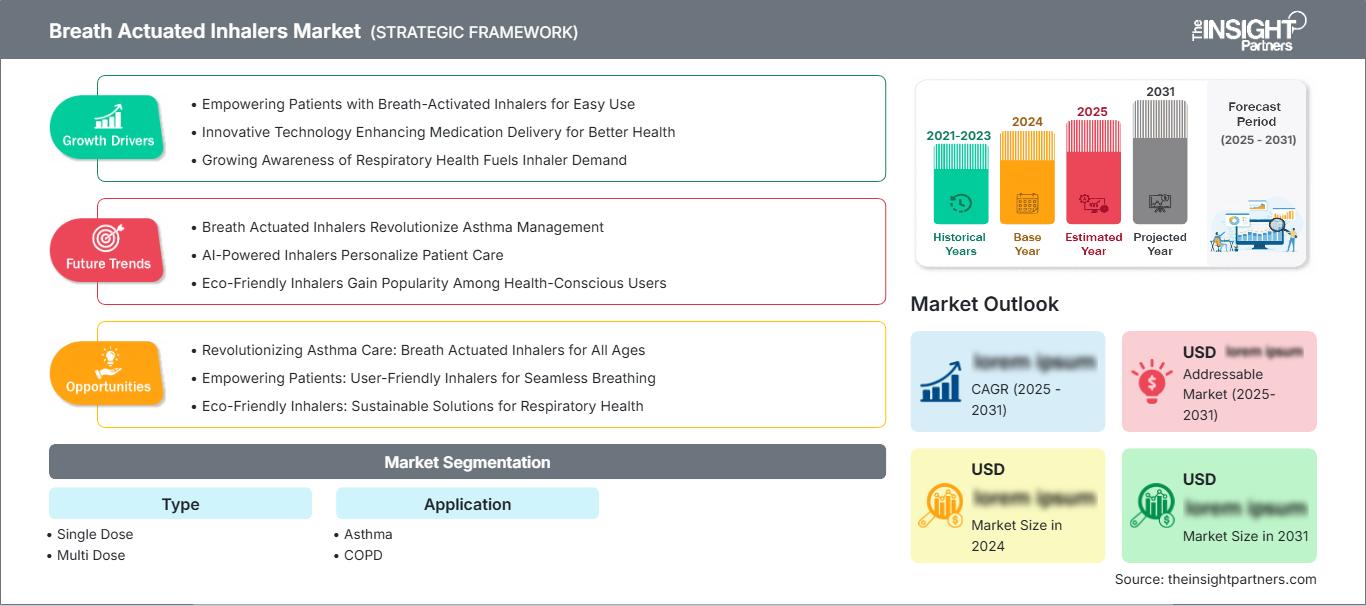
The global Breath Actuated Inhalers market was valued at US$ 3.06 billion in 2025 and is expected to reach US$ 4.08 billion by 2034; it is estimated to record a CAGR of 3.25% during 2026-2034.
Breath Actuated Inhalers Market Assessment and Insights
- North America: Breath Actuated Inhalers Market Share in 2025 is estimated at 38–42%, growing at a CAGR between 2026–2034 of 3.3–3.8%, supported by mature pulmonary care infrastructure, branded inhaler uptake, and access initiatives for asthma and COPD therapies.
- US: Share in 2025 is estimated at 78–82% of North America, growing at a CAGR between 2026–2034 of 3.4–3.9%, due to high prescription volumes and broad pharmacy access.
- Europe: Share in 2025 is estimated at 27–31%, growing at a CAGR between 2026–2034 of 3.0–3.5%, led by Germany, the UK, France, Italy, and Spain through guideline-led inhaler optimization.
- Asia Pacific: Share in 2025 is estimated at 19–23%, growing at a CAGR between 2026–2034 of 4.1–4.7%, with China, Japan, India, South Korea, and Australia advancing diagnosis, access, and manufacturing scale.
- Largest Segment: Multi Dose accounts for an estimated market share range of 62–66% in 2025, with CAGR range 2026–2034 of 3.5–3.9%, aided by chronic therapy convenience.
- High Growth Segment: COPD accounts for an estimated market share range of 43–47% in 2025, with CAGR range 2026–2034 of 4.0–4.4%, reflecting aging populations and exacerbation prevention needs.
- Key companies analyzed in detail: Meda AB, 3M Company, Cipla Limited, Hovione FarmaCiencia SA, Novartis AG, Merck & Co., Inc., Boehringer Ingelheim International GmbH, GSK plc, Chiesi Farmaceutici S.p.A., AstraZeneca plc.
Source: The Insight Partners' analysis based on proprietary research, government publications, company annual reports, investor presentations, industry databases, and expert interviews.
The development of devices has evolved from traditional pressurized systems to breath-actuated systems, which enhance ease of use and dose uniformity. Companies are focusing on valve design, dose counters, reduced carbon propellants, and formulation-device compatibility, whereas contract development partners contribute to scaling up, analysis, and regulatory compliance. The BAI market is supported by the respiratory portfolios of companies; however, manufacturing is vulnerable to actuator tolerances, canister supply, timing of change in propellants, and packaging qualification.
During the forecast period, growth will be fueled by emerging healthcare systems in Asia-Pacific and the Middle East where there are improvements in diagnosis of conditions and government purchase of treatments for chronic respiratory ailments. Favorable regulations on low-emitting inhalers, wide availability of fixed-dose combinations, and patient support programs will provide further impetus to growth. Growth in the BAI market will rely on the ability of companies to offer cost-effective products and sustainable devices along with consistent availability.
Breath Actuated Inhalers Market Report Scope
| Report Attribute | Details |
|---|---|
| Market size in 2025 | US$ 3.06 Billion |
| Market Size by 2034 | US$ 4.08 Billion |
| Global CAGR (2026 - 2034) | 3.25% |
| Historical Data | 2021-2024 |
| Forecast period | 2026-2034 |
Breath Actuated Inhalers Market Analysis
The clinical demand is increasing on account of doctors who prefer using devices which correct for inefficient inhaler use techniques and minimize unnecessary use of the reliever. The key factors driving Growth in the market include guidelines for asthma that focus on the use of inhalers containing inhaled corticosteroids and COPD care plans designed to minimize exacerbations. The demand goes through pulmonologists, allergists, primary care physicians, retail pharmacies, hospitals, payers, device manufacturers, and contract manufacturing organizations.
The supply side remains consolidated within established players of respiratory drugs and device manufacturers. Some of the inputs needed include precision plastics, valves, canisters, propellants, formulation know-how, and stability studies. Expansion in capacity is selective in light of the fact that respiratory drugs need validation and other factors.
Positioning will be driven by breadth of therapy, device familiarity, price, and regulatory enforcement. Market Analysis reveals that companies like AstraZeneca plc, GSK plc, Chiesi Farmaceutici S.p.A., Boehringer Ingelheim International GmbH, Merck & Co., Inc., Novartis AG, Cipla Limited, Meda AB, 3M Company, and Hovione FarmaCiencia SA operate in this space either via branded therapies, generics, ingredients, or research.
Current investments are geared towards lifecycle management, sustainable pMDIs, adherence devices, and regional manufacturing. Firms with an approved portfolio of respiratory products can protect their share through device innovations and indication expansion, whereas generic-oriented companies will have to play the affordable game. CDMOs in particular have strategic importance due to complexity in formulation-device interaction and release testing.
● REPORT CUSTOMIZATION
Tailor This Report To Align With Your Specific Business Requirements
This report can be customized to align precisely with your business objectives, scope, and target markets. Customization options include tailored segmentation, geography, competitive analysis, and strategic insights to support informed decision-making.
Customize This Report →WHAT YOU CAN ADJUST
- ● Segmentations
- ● Geography
- ● Competitive Analysis
- ● Language Preferences
Breath Actuated Inhalers Market: Strategic Insights
Regional Insights
North America Breath Actuated Inhalers Market
North America accounted for 38% to 42% of share in 2025 and is expected to witness a compound annual growth rate of 3.3% to 3.8% during 2026-2034. Mortality and resource utilization related to chronic lower respiratory diseases are prevalent, whereas asthma occurs in a significant portion of the adult and child population.
North America offers favorable pharmacy benefit programs, branded respiratory portfolio products, clinical studies, and patient affordability schemes. Higher uptake of devices is witnessed in cases when payers understand reduction in exacerbations, lower dependency on rescue drugs, and better techniques of use. The supply chain dynamics have become more predictable, owing to local stocking efforts, however, formulary pressure and generic substitutions continue to constrain premium devices.
U.S. Breath Actuated Inhalers Market
The US market accounts for an approximated share of 78-82% of North America and is anticipated to grow at a CAGR range of 3.4-3.9% over 2026-2034. The high incidence of asthma, COPD, network of specialists, and availability of pharmacy will make this nation the major revenue generator for the region. Market players are diverse, including AstraZeneca plc, GSK plc, Boehringer Ingelheim International GmbH, Merck & Co., Inc., and Chiesi Farmaceutici S.p.A.
Demand for applications comes from maintenance of asthma, and prevention of COPD exacerbation. Prescribers in the US prefer inhalers that ease the task of coordination of patients, especially the elderly, adolescents, and those having difficulty in handling the technique. Payer influence, co-pay, and substitution influence on products access call for proper balance between the clinical value and affordability of products.
Europe Breath Actuated Inhalers Market
Europe is estimated to have held 27-31% share in 2025 and is projected to exhibit a CAGR growth of 3.0-3.5% during 2026-2034. Germany is the market leader due to its significant respiratory prescriptions, reimbursements and ability to manage COPD patients. The United Kingdom is also another important player due to the fact that the choice of inhalers is increasingly becoming sustainable and effective, with regular inhaler reviews in primary care.
Germany and the United Kingdom form the backbone of demand for the region through their specialist clinics, pharmacies and optimized treatment through guidelines. Germany has premium therapies in the market, while the United Kingdom focuses on rational prescriptions and low carbon inhaler policies. France, Italy and Spain contribute through aging population and asthma control programs.
APAC Breath Actuated Inhalers Market
APAC had an approximate market share of 19–23% in 2025 and is anticipated to grow at a compound annual growth rate of 4.1-4.7% during 2026-2034. China is the dominant country in the region owing to size, increased diagnosis rates, and hospital-based respiratory care. Japan, South Korea, India, and Australia contribute to demand via demographics, pollution exposure, coverage increases, and use of chronic therapy.
The industrial environment is improving as India and China increase production of inhalation products, sources of active ingredients, and generic respiratory drugs. Noncommunicable diseases management policies, air quality regulations, and access to primary healthcare provide impetus for adoption, but cost issues and spirometry availability affect product choice.
Middle East & Africa Breath Actuated Inhalers Market
MEA is estimated to grow at CAGR of 3.6%-4.2% in the forecast period 2026-2034, with demand being driven by Saudi Arabia region-wise. UAE reaps the benefits of increasing private healthcare spend whereas South Africa drives access through public and retail routes. Demand in Rest of MEA is inconsistent due to varying availability of specialists and level of reimbursement.
Economies with energy production sectors are making investments in infrastructure development, procurement, and chronic disease management. Urbanization, dust exposure, smoking, and occupational hazards maintain the need for asthma and COPD therapies. Growth is contingent upon consistency in imports, training of physicians, and increased affordability of maintenance inhalers.
Segmentation Analysis
Type
The Type segment is projected to grow at a CAGR range of 3.4–3.9% during 2026–2034. Breath Actuated Inhalers Market scope across type is shaped by dose frequency, patient dexterity, chronic therapy duration, and prescriber preference for simplified administration. Multi-dose devices dominate because they align with ongoing maintenance therapy, while single-dose systems remain relevant where dose control, portability, or specific formulations are prioritized.
- Single Dose: Single dose devices serve patients requiring controlled administration and simplified handling, particularly in settings where therapy supervision, portability, or formulation-specific delivery supports clinical confidence and differentiation.
- Multi Dose: Multi dose devices hold the strongest position because chronic asthma and COPD management requires repeat dosing, convenience, dose tracking, and pharmacy-friendly dispensing across maintenance treatment pathways.
Application
The Application segment is projected to grow at a CAGR range of 3.6–4.1% during 2026–2034. Adoption is led by asthma because of broad diagnosed prevalence and the need to improve inhaler technique, while COPD is gaining strategic importance as aging populations increase exacerbation risk. Clinical pathways increasingly favor inhalers that support consistent delivery and reduce errors in unsupervised home use.
- Asthma: Asthma remains the largest application due to pediatric, adolescent, and adult use, with demand reinforced by controller therapy, reliever strategy changes, and patient education programs.
- COPD: COPD is strategically important because patients are often older, may have reduced coordination, and require reliable maintenance therapy to limit exacerbations, hospital visits, and symptom deterioration.
Opportunity Snapshot
| Segment Name | Revenue Contribution | Trend Tag | Adoption Stage |
| Asthma | High | Controller Use | Mature |
| COPD | Medium | Exacerbation Care | Scaling |
Breath Actuated Inhalers Market Growth Drivers and Impact Analysis
Rising Need to Reduce Inhaler Technique Errors
The issue of inadequate inhaler use is a common barrier to asthma and COPD management, especially for children, the elderly, and individuals using multiple devices. Breathing-actuated technology provides a solution to this problem by ensuring that inhalation of drugs is synchronized with breathing. The business implications of this innovation are more pronounced in chronic maintenance treatment settings, whereby even small gains in terms of ease of use lead to reduced use of rescue medications and avoidable treatment visits. Companies that provide human factors data can leverage this driver in the formulary setting, while health practitioners get a solution to their patients who fail the conventional pMDI technique test time after time.
Chronic Respiratory Disease Burden and Aging Populations
Asthma and COPD create durable demand because they require long-term management, repeated prescriptions, and reliable home-based drug delivery. Aging populations intensify this requirement as COPD prevalence rises with cumulative smoking exposure, occupational risks, and air pollution. Older patients also face dexterity, cognition, and inspiratory coordination limitations, making simplified inhalers clinically relevant. The market impact is visible in higher maintenance inhaler volumes, greater interest in combination therapies, and stronger payer attention to preventing exacerbations. Countries with expanding elderly populations and respiratory screening programs are expected to generate incremental prescriptions, especially where clinicians actively review inhaler technique and switch poorly controlled patients to devices that are easier to use consistently.
Lifecycle Management Through Device and Formulation Upgrades
Respiratory brands increasingly use device upgrades to extend product relevance after molecule-level innovation slows. Breath actuation, dose counters, improved ergonomics, connected sensors, and lower-carbon propellant compatibility can differentiate established therapies while preserving prescriber familiarity. This creates a pathway for companies to defend branded positions, support premium pricing where justified, and meet environmental expectations in regulated markets. Contract development partners also benefit as reformulation, analytical testing, and device validation become more complex. The impact is particularly important for companies with broad pMDI and DPI portfolios, because transition planning must maintain clinical continuity while demonstrating equivalent performance, safety, and patient usability under evolving regulatory expectations.
Breath Actuated Inhalers Market Future Trends
Lower-Carbon Inhaler Platforms
Breath Actuated Inhalers Market trends will be increasingly shaped by the transition to lower-carbon inhaler technologies, especially in Europe where health systems are measuring device-level environmental impact. Future competition will not depend only on clinical efficacy, but also on lifecycle footprint, propellant selection, recyclable components, and manufacturing emissions. Companies that complete regulatory submissions for lower-global-warming-potential pMDIs without compromising dose consistency can gain procurement advantages. This trend also creates technical complexity because reformulated products must prove stability, valve compatibility, plume behavior, and patient usability. Over time, sustainability could become a standard purchasing criterion rather than a niche differentiator.
Connected Adherence and Technique Monitoring
Digital add-ons and embedded sensors are expected to re-enter respiratory strategy more selectively after early commercial mixed results. Future models will focus on high-risk patients, payer-supported programs, and clinical workflows where inhalation data can trigger intervention. Breath-actuated devices are well positioned because inspiratory events can be paired with dose-use records to distinguish possession from proper use. Adoption will be strongest in severe asthma, frequent exacerbators, and value-based care settings. However, successful scaling will require privacy compliance, simple clinician dashboards, reimbursement clarity, and evidence that monitoring reduces avoidable emergency visits or improves controller adherence meaningfully.
Breath Actuated Inhalers Market Opportunities
Expansion in Emerging Respiratory Care Networks
Emerging markets offer an actionable opportunity as diagnosis, primary care coverage, and pharmacy access improve. Breath Actuated Inhalers Market Forecasts indicate that APAC and selected MEA countries can outperform mature regions when affordability and availability align. Companies can capture demand by offering tiered pricing, local packaging, clinician training, and partnerships with public health programs focused on asthma and COPD control. India, China, Saudi Arabia, and the UAE are particularly relevant because healthcare infrastructure investment is expanding alongside chronic disease planning. Winning strategies will combine reliable supply, simple patient education, and evidence that easier device handling improves long-term treatment persistence.
Specialist CDMO and Device Partnership Models
Complex inhalation products create opportunity for CDMOs, component specialists, and device engineering firms that can support formulation-device integration. Many pharmaceutical companies lack in-house capacity for aerosol characterization, stability testing, valve selection, actuator design, and regulatory documentation across multiple markets. Partnerships with firms such as Hovione FarmaCiencia SA and experienced device technology providers can shorten development timelines and reduce technical risk. Demand will rise as companies pursue generic respiratory launches, lower-carbon reformulations, and lifecycle upgrades. The most attractive partnership models will offer end-to-end services, from early formulation screening to commercial manufacturing support, while protecting intellectual property and ensuring scalable quality systems.
Recent Developments
- May 2026: Chiesi Farmaceutici S.p.A. announced that the US FDA approved TRIMBOW, its single-inhaler triple therapy containing beclomethasone dipropionate, formoterol fumarate, and glycopyrrolate, for maintenance treatment of asthma in adults. The approval was supported by TRIMARAN and TRIGGER Phase 3 studies involving more than 2,500 adults with uncontrolled asthma.
- April 2026: AstraZeneca plc announced US FDA approval of Breztri Aerosphere for the maintenance treatment of asthma in adults and pediatric patients aged 12 years and older. The decision expanded the product beyond COPD and was based on KALOS and LOGOS Phase 3 trials showing clinically meaningful lung function improvement versus inhaled dual therapy.
- December 2025: GSK plc entered an agreement with the US government to lower medicine prices and expand access to respiratory therapies. The agreement covered products used by patients with asthma and COPD, introduced direct purchasing savings for much of the inhaled respiratory portfolio, and included support for an albuterol active pharmaceutical ingredient reserve.
Frequently Asked Questions

- Comprehensive Market Sizing and Forecast Analysis
- Detailed Segmentation Analysis
- In-Depth Market Dynamics Assessment
- Regional and Country-Level Insights
- Competitive Landscape and Company Benchmarking
- Strategic Business Intelligence
Recent Reports
Testimonials

The Insight Partners' SCADA System Market report is comprehensive, with valuable insights on current trends and future forecasts. The team was highly professional, responsive, and supportive throughout. We are very satisfied and highly recommend their services.
RAN KEDEM Partner, Reali Technologies LTDs
I requested a report on a very specific software market and the team produced the report in a few days. The information was very relevant and well presented. I then requested some changes and additions to the report. The team was again very responsive and I got the final report in less than a week.
JEAN-HERVE JENN Chairman, Future Analytica
We worked with The Insight Partners for an important market study and forecast. They gave us clear insights into opportunities and risks, which helped shape our plans. Their research was easy to use and based on solid data. It helped us make smart, confident decisions. We highly recommend them.
PIYUSH NAGPAL Sr. Vice President, High Beam Global
The Insight Partners delivered insightful, well-structured market research with strong domain expertise. Their team was professional and responsive throughout. The user-friendly website made accessing industry reports seamless. We highly recommend them for reliable, high-quality research services
YUKIHIKO ADACHI CEO, Deep Blue, LLC.
This is the first time I have purchased a market report from The Insight Partners.While I was unsure at first, I visited their web site and felt more comfortable to take the risk and purchase a market report.I am completely satisfied with the quality of the report and customer service. I had several questions and comments with the initial report, but after a couple of dialogs over email with their analyst I believe I have a report that I can use as input to our strategic planning process.Thank you so much for taking the extra time and making this a positive experience.I will definitely recommend your service to others and you will be my first call when we need further market data.
JOHN SUZUKI President and Chief Executive Officer, Board Director, BK Technologies
I wish to appreciate your support and the professionalism you displayed in the course of attending to my request for information regarding to infectious disease IVD market in Nigeria. I appreciate your patience, your guidance, and the fact that you were willing to offer a discount, which eventually made it possible for us to close a deal. I look forward to engaging The Insight Partners in the future, all thanks to the impression you have created in me as a result of this first encounter.
DR CHIJIOKE ONYIA MANAGING DIRECTOR, PineCrest Healthcare Ltd.Reason to Buy
- Informed Decision-Making
- Understanding Market Dynamics
- Competitive Analysis
- Identifying Emerging Markets
- Customer Insights
- Market Forecasts
- Risk Mitigation
- Boosting Operational Efficiency
- Strategic Planning
- Investment Justification
- Tracking Industry Innovations
- Aligning with Regulatory Trends





 Get Free Sample for