
Breathable Membranes Market Share, Growth & Forecast by 2034
Coverage: by Type (PP, PE, Others); Application (Pitched roof, Walls) , and Geography (North America, Europe, Asia Pacific, and South and Central America)
- Status : Data Released
- Report Code : TIPRE00010008
- Category : Chemicals and Materials
- No. of Pages : 150
- Available Report Formats :


- Last update date : July 13, 2026


2025 Market Size
US$ 2.14 Bn
Base year value
2034 Forecast
US$ 4.91 Bn
Projected by 2034
CAGR 2026-2034
9.64 %
Growth rate
Addressable Market
US$ 31.38 Bn
(2026-2034)
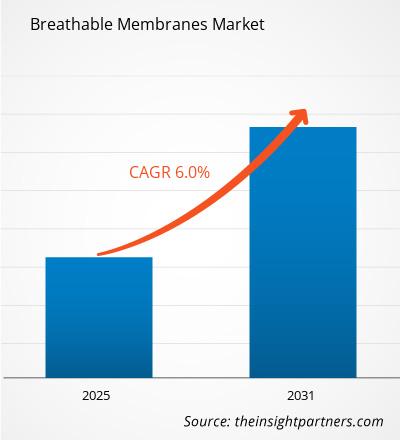
The Breathable Membranes Market was valued at US$ 2.14 Billion in 2025 and expected to reach US$ 4.91 Billion in 2034. The market growth would be at a CAGR of 9.64%. The increasing demand for vapor-permeable, waterproof products for applications like roofing, wall systems, medical textiles, protective clothing, and specialized packaging is driving the market growth.
In North America, the Breathable Membranes Market Size outlook is expected to grow with rising reroofing activities, stringent moisture management requirements, and increasing adoption of breathable protective membranes in the health care and performance textiles industries. The market size is expected to grow at a CAGR between 8.6% and 9.2%.
Breathable Membranes Market Assessment and Insights
- North America: Held 30–34% Breathable Membranes Market share in 2025 and is growing at a CAGR of 8.6–9.2% during 2026–2034, supported by building-envelope upgrades, healthcare material demand, and higher specification of vapor-open roof and wall systems.
- US: Represented 78–82% of North American revenue in 2025 and is expanding at a CAGR of 8.7–9.3% during 2026–2034, driven by reroofing, medical textiles, and advanced packaging applications.
- Europe: Accounted for 33–37% share in 2025 and is growing at a CAGR of 8.2–8.8% during 2026–2034, led by Germany, the UK, France, Italy, and Spain through energy-efficient renovation and façade compliance requirements.
- Asia Pacific: Held 22–26% share in 2025 and is growing at a CAGR of 10.4–11.1% during 2026–2034, with China, India, Japan, South Korea, and Australia benefiting from construction expansion and healthcare manufacturing.
- Largest Segment: Building and Construction held 51–55% market share in 2025 and is growing at a CAGR of 8.9–9.5% during 2026–2034, reflecting roof underlay and wall wrap demand.
- High Growth Segment: Healthcare held 14–18% market share in 2025 and is growing at a CAGR of 10.8–11.5% during 2026–2034, supported by breathable barrier gowns, drapes, and wound-care materials.
- Key companies analyzed in detail: DuPont de Nemours, Inc., Kingspan Group plc, Klober Ltd., Knauf Insulation GmbH, Compagnie de Saint-Gobain S.A., SOPREMA SAS, Riwega S.r.l., Porelle Membranes Ltd., GAF Materials LLC, Sunyond Technology Co., Ltd.
Source: The Insight Partners' analysis based on proprietary research, government publications, company annual reports, investor presentations, industry databases, and expert interviews.
The evolution of materials has progressed from basic underlays to engineered film materials that ensure an appropriate combination of water repellence, breathability, tear strength, and fire resistance. Polyethylene and polypropylene continue to be widely used substrate materials, whereas PTFE, polyurethane and thermoplastic polyester cater to more demanding applications such as the health care industry, textiles and specialty packaging. Dynamics in the production process tend to shift in favor of multilayer extrusion, coating, lamination, and quality control in accordance with the requirements of construction, health care, and converting industries within the Breathable Membranes value chain.
Future demand in the Breathable Membranes Market is likely to grow in new construction regions, hospitals' supply chains, and sportswear manufacturing centers. Focus on energy efficiency, moisture management, and fire classification regulations in Europe and North America is driving the specification of compliant membranes. On the other hand, Asia Pacific investments into health care industry production facilities and industrial textiles are generating new demand for breathable membranes.
Breathable Membranes Market Report Scope
| Report Attribute | Details |
|---|---|
| Market size in 2025 | US$ 2.14 Billion |
| Market Size by 2034 | US$ 4.91 Billion |
| Global CAGR (2026 - 2034) | 9.64% |
| Historical Data | 2021-2024 |
| Forecast period | 2026-2034 |
Breathable Membranes Market Analysis
Demands are grounded in construction assemblies that require vapor diffusion while preventing wind-driven rain entry, alongside healthcare and textile demands that require comfort and protection at once. Growth in the Breathable Membranes Market is driven by stricter implementation of energy codes, the renovation cycle, increased concern about condensation issues, and demand for lightweight protective fabrics. In addition, packaging converters are now turning to breathable membranes for packaging moisture-sensitive products.
This value chain in the Breathable Membranes Market includes resin manufacturers, nonwovens producers, film extrusion firms, coating companies, laminators, brand owners, distributors, roofing companies, textile producers, hospitals, and packaging converters. The supply situation is still influenced by polymer prices, the certification schedule, and the regional construction cycle. Manufacturers that can provide stable sources of resins, proof of vapor transmission properties, fire testing, and installation recommendations have a good chance of winning the specification based on both durability and user comfort.
The Breathable Membranes Market Competition landscape is influenced by material science, channel access, code compliance, and application expertise. The competition in building envelope systems includes companies such as DuPont de Nemours, Inc., and Kingspan Group plc, whereas Klober Ltd., Riwega S.r.l. and GAF Materials LLC are strong in membrane applications for roofing and construction. Porelle Membranes Ltd. and Sunyond Technology Co., Ltd. add to the specialization in textiles and the healthcare segment.
Investment trends in the Breathable Membranes Market are leaning towards the development of recyclable polyolefin structures, PFAS-free substitutes, enhanced fire ratings for façade materials, and breathable membranes for medical garments and protective gear. The companies that are benefiting from a wider portfolio of building products include Knauf Insulation GmbH, Compagnie de Saint-Gobain S.A. and SOPREMA SAS. Strategic positioning increasingly relies on the evidence of certification, installer training, geographic availability and applicability to building, healthcare, textiles and packaging markets.
● REPORT CUSTOMIZATION
Tailor This Report To Align With Your Specific Business Requirements
This report can be customized to align precisely with your business objectives, scope, and target markets. Customization options include tailored segmentation, geography, competitive analysis, and strategic insights to support informed decision-making.
Customize This Report →WHAT YOU CAN ADJUST
- ● Segmentations
- ● Geography
- ● Competitive Analysis
- ● Language Preferences
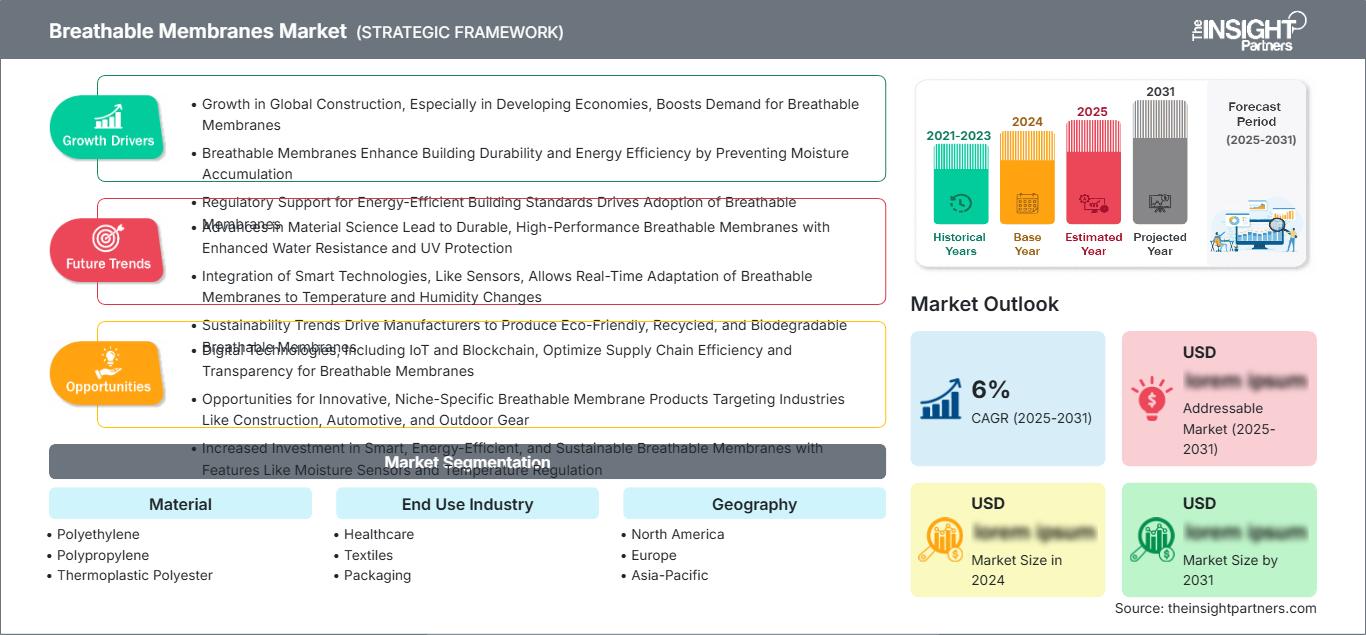
Breathable Membranes Market: Strategic Insights
Regional Insights
North America Breathable Membranes
North America accounted for 30–34% of the Breathable Membranes Market share in 2025 and is expected to grow at a CAGR of 8.6–9.2% during 2026–2034. Demand is supported by reroofing activity, wall-system upgrades, and builder preference for materials that reduce condensation risk while maintaining water resistance. Healthcare purchasing also supports breathable protective fabrics used in gowns, drapes, and wound-care applications.
Regional standards emphasize air leakage reduction, vapor management, and durability of building envelope membranes, providing stable prospects for the specification of high-performance membranes. There will be existing supply chains for roof membranes, insulation, and special textiles to help suppliers. This technology adoption will be more common in areas where tensile strength, waterproofing, UV stability, and compatibility with insulation systems are required.
U.S. Breathable Membranes Market
The US accounted for 78-82% of North America’s revenues in 2025, with an anticipated CAGR of 8.7-9.3% between 2026 and 2034. Reroofing, moisture management retrofitting, and the expanded application of vapor-permeable wrap in residential and commercial envelopes drive the need for the membranes. The need is supplemented by the growth in the segment of medical and protective textiles due to increased demand for breathable films with reliable barrier properties.
A wide range of companies produce membranes for various applications; DuPont de Nemours, Inc. and GAF Materials LLC serve the construction segment, while other players supply specialty membranes for the healthcare and clothing industries. Buyers pay particular attention to the installation time, moisture barrier, vapor transmission and insulation compatibility when choosing the membrane.
Europe Breathable Membranes Market
Europe has a market share of 33–37% in 2025 and is forecasted to grow at a CAGR of 8.2–8.8% for 2026–2034. Germany is a leader due to the extent of renovation, façade requirements, and the wide popularity of integrated insulation systems. The UK remains an important factor, as resistance to fire, moisture management, and roof underlayment requirements determine material selection in residential and non-residential buildings.
France, Italy, and Spain have contributed to the development of energy-efficient retrofitting, the renovation of pitched roofs, and the increased use of breathable wraps in wall systems. Beneficiaries of regional distribution are Compagnie de Saint-Gobain S.A., SOPREMA SAS, Kingspan Group plc, Klober Ltd., and Riwega S.r.l. Moisture, fire, and durability requirements enable the promotion of premium materials with supporting test documentation.
APAC Breathable Membranes Market
APAC held market shares of 22%-26% in 2025 and is forecasted to register a CAGR of 10.4%-11.1% from 2026-2034. Construction volume and the ability to manufacture in-country drive demand in China; Japan and South Korea focus on high-performance textiles and protective apparel and precision polymer conversion.
India and Australia drive growth through housing and infrastructure, healthcare, manufacturing, and building code modernization. Manufacturing incentives drive the development of capabilities in extrusion, lamination, and nonwoven integration. Sunyond Technology Co., Ltd. and other converters will be in place to meet the needs of textiles, medical materials, and construction membranes, in which affordability and performance scalability are both critical.
Middle East & Africa Breathable Membranes Market
The Middle East & Africa market is anticipated to grow at a CAGR of 7.1%–7.8% between 2026 and 2034. This region sees strong uptake from Saudi Arabia, driven by major infrastructure projects, healthcare investments, and contemporary building envelope requirements. The UAE drives up demand through commercial construction, hospitality projects, and high-performance waterproofing systems for tropical climates.
South Africa holds the most developed position among the Sub-Saharan countries due to well-developed construction distribution channels and government healthcare procurement. Demand in the Rest of MEA segment is gradually rising due to growing energy-efficient building practices, roof rehabilitation, and medical textiles imports.
Segmentation Analysis
Material
Material is projected to grow at a CAGR of 9.2–9.8% during 2026–2034. The Breathable Membranes Market scope is expanding as polyethylene and polypropylene serve cost-sensitive construction and packaging uses, while PTFE, polyurethane, and thermoplastic polyester address higher-performance healthcare and textile needs. Material selection increasingly depends on vapor transmission, hydrostatic resistance, flexibility, fire classification, and compatibility with lamination or coating processes.
- Polyethylene – Maintains the strongest volume position because it offers cost efficiency, moisture resistance, and processability for construction wraps, hygiene films, and packaging structures requiring controlled vapor movement.
- Polypropylene – Supports durable roof and wall applications through strength, thermal stability, and nonwoven compatibility, making it valuable where installers require tear resistance and consistent weather protection.
- Thermoplastic Polyester – Serves premium textile and specialty industrial uses where dimensional stability, durability, and breathability must remain consistent under repeated handling, washing, or laminated construction.
- PTFE – Addresses high-performance protective apparel and specialty filtration-like applications because it combines microporous breathability, chemical resistance, and strong waterproof performance in demanding operating environments.
- Polyurethane – Gains demand in healthcare, sportswear, and wound-care applications where soft feel, flexibility, moisture vapor transmission, and reliable liquid barrier properties influence product design.
End Use Industry
End Use Industry is expected to grow at a CAGR of 9.5–10.1% during 2026–2034, led by building and construction, while healthcare posts the fastest expansion. Demand is shaped by roof underlays, façade membranes, protective medical fabrics, performance apparel, and breathable packaging formats. Buyers increasingly require documented performance, regulatory suitability, product consistency, and reliable supply across multiple conversion routes.
- Healthcare – Demand is rising for breathable barrier gowns, drapes, wound-care layers, and hygiene-related materials that combine comfort, liquid resistance, microbial protection, and scalable disposable product manufacturing.
- Textiles – Performance apparel and protective clothing use breathable membranes to balance waterproofing, thermal comfort, flexibility, and durability, supporting premium outdoor, workwear, and industrial safety applications.
- Packaging – Breathable films are increasingly used for fresh produce, moisture-sensitive goods, and specialty packs where controlled gas or vapor exchange helps preserve quality during distribution.
- Building and Construction – Roof underlays, wall wraps, and façade membranes dominate revenue because builders require water resistance, vapor diffusion, wind protection, and compatibility with insulation systems.
Opportunity Snapshot
| End Use Industry | Revenue Contribution | Trend Tag | Adoption Stage |
| Healthcare | Medium | Barrier Care | Scaling |
| Textiles | Medium | Comfort Shells | Scaling |
| Packaging | Low | Fresh Packs | Emerging |
| Building and Construction | High | Roof Wraps | Mature |
Breathable Membranes Market Growth Drivers and Impact Analysis
Building-envelope standards increasing vapor-control specification
The need for increased efficiency and water safety is motivating architects, constructors, and building owners to use membranes that help prevent damage to insulation while allowing moisture to exit. In Europe, standards for façade and roof systems include criteria for assessing their waterproofing performance, vapor permeability, tensile strength, air resistance, and fire classification. As the same trends prevail in North America, with the growing importance of air and moisture management through envelope improvements, this motivates increased sales of certified products, higher prices for more efficient membranes, and technical support from manufacturers.
Healthcare and protective textiles requiring breathable barriers
Hospitals, makers of protective garments, and converters of hygiene products are all looking for fabrics that provide comfort, liquid repellency, and barrier properties. Breathable films made of polyurethane, PTFE, and polyolefins help reduce heat stress while providing protection in garments, drapes, wound dressings, and protective workwear. Increased preparedness among healthcare organizations and heightened demand for disposable and reusable protective clothing have also boosted demand. The effect is greatest on those who can provide roll-to-roll reliability, validated moisture vapor transmission, biocompatibility capabilities where necessary, and fabric lamination support.
Material innovation improving cost, durability, and sustainability
Manufacturers are improving the performance of breathable membranes through multilayer extrusion, microporous structures, coatings, and recyclable polyolefin designs. These innovations improve tear strength, UV stability, hydrostatic resistance, softness, and vapor permeability while helping customers reduce installation failures or product discomfort. Sustainability pressures are also increasing interest in mono-material structures, lower-solvent processes, and alternatives to chemistries under regulatory scrutiny. Better material performance expands use across roofing, façade systems, packaging, and apparel, while cost optimization makes advanced membranes viable in emerging markets where price sensitivity previously limited adoption.
Breathable Membranes Market Future Trends
Shift toward PFAS-conscious and recyclable membrane platforms
The next wave of Breathable Membranes Market trends will center on chemistries that preserve waterproof breathability while improving recyclability and regulatory resilience. Buyers in textiles, healthcare, and packaging are scrutinizing fluorinated additives, end-of-life pathways, and supplier transparency more closely. Polyolefin-based breathable structures, advanced polyurethane films, and mono-material laminates are likely to gain share where performance specifications permit substitution. This transition will not be uniform because PTFE still serves demanding applications, but procurement teams will increasingly reward suppliers that provide emissions data, compliance documentation, and credible circularity options.
Digital specification and tested system integration
Membrane procurement is expected to become more system-oriented as contractors, architects, and facility owners request digital product data, installation documentation, and compatibility evidence with insulation, tapes, fasteners, and façade components. Building Information Modeling libraries, performance declarations, and climate-specific guidance will influence product selection beyond unit price. Suppliers that support specifiers with tested assemblies can reduce project risk and improve approval rates. This trend favors companies with broader building-material portfolios and technical service teams capable of converting product performance into reliable field outcomes.
Breathable Membranes Market Opportunities
Localized production for Asia Pacific healthcare and construction demand
Asia Pacific offers an attractive investment window because construction growth, healthcare manufacturing, and textile conversion capacity are expanding together. Breathable Membranes Market Forecasts indicate that regional customers will increasingly require shorter lead times, competitive pricing, and product formats adapted to local climate and manufacturing processes. Companies can strengthen positions through local extrusion, coating, lamination, and technical service partnerships. This opportunity is especially relevant for suppliers targeting China, India, South Korea, and Southeast Asian converters that need reliable breathable materials for roofing, protective clothing, medical disposables, and specialty packaging.
Premium building-envelope systems for renovation markets
Renovation-driven demand in Europe and North America creates opportunities for membranes sold as part of tested envelope systems rather than standalone rolls. Suppliers can pair breathable membranes with insulation, tapes, fasteners, and installation guidance to reduce the risk of condensation and improve contractor confidence. Premium systems are especially attractive for reroofing, façade upgrades, and public-building retrofits, where documented energy, moisture, and fire performance can influence procurement decisions. Companies with training programs and distributor relationships can capture recurring demand from contractors seeking lower installation risk and specification certainty.
Recent Developments
- August 2025: W. L. Gore & Associates, Inc. partnered with Arc'teryx Equipment Inc. to introduce a next-generation waterproof breathable membrane for premium outdoor apparel. The collaboration integrates Gore-Tex technology with Arc'teryx's advanced garment engineering to improve waterproof protection, breathability, durability, and environmental performance for high-performance outdoor applications.
- September 2025: W. L. Gore & Associates, Inc. launched the next-generation GORE-TEX PRO fabric featuring expanded polyethylene (ePE) membrane technology. The new PFAS-reduced membrane delivers enhanced breathability, durability, and waterproof performance while supporting the company's sustainability objectives for technical outdoor apparel and equipment.
- October 2025: Milliken & Company (through its Polartec brand) introduced Polartec Aircore, a breathable, weather-resistant, stretch laminate incorporating a non-PFAS membrane technology. The innovation is designed to provide high moisture vapor transmission, weather protection, and flexibility while addressing increasing demand for fluorine-free performance textiles in outdoor apparel.
Frequently Asked Questions

- Comprehensive Market Sizing and Forecast Analysis
- Detailed Segmentation Analysis
- In-Depth Market Dynamics Assessment
- Regional and Country-Level Insights
- Competitive Landscape and Company Benchmarking
- Strategic Business Intelligence
Recent Reports
Testimonials

The Insight Partners provided valuable market intelligence that supported our global go-to-market strategy. Their team was professional, responsive, and attentive to our feedback, providing thoughtful analysis and helpful methodological clarifications throughout the project.
Junmo Kim Chief Financial Officer (CFO), Enertech Co., Ltd.
The Insight Partners' SCADA System Market report is comprehensive, with valuable insights on current trends and future forecasts. The team was highly professional, responsive, and supportive throughout. We are very satisfied and highly recommend their services.
RAN KEDEM Partner, Reali Technologies LTDs
I requested a report on a very specific software market and the team produced the report in a few days. The information was very relevant and well presented. I then requested some changes and additions to the report. The team was again very responsive and I got the final report in less than a week.
JEAN-HERVE JENN Chairman, Future Analytica
We worked with The Insight Partners for an important market study and forecast. They gave us clear insights into opportunities and risks, which helped shape our plans. Their research was easy to use and based on solid data. It helped us make smart, confident decisions. We highly recommend them.
PIYUSH NAGPAL Sr. Vice President, High Beam Global
The Insight Partners delivered insightful, well-structured market research with strong domain expertise. Their team was professional and responsive throughout. The user-friendly website made accessing industry reports seamless. We highly recommend them for reliable, high-quality research services
YUKIHIKO ADACHI CEO, Deep Blue, LLC.
This is the first time I have purchased a market report from The Insight Partners.While I was unsure at first, I visited their web site and felt more comfortable to take the risk and purchase a market report.I am completely satisfied with the quality of the report and customer service. I had several questions and comments with the initial report, but after a couple of dialogs over email with their analyst I believe I have a report that I can use as input to our strategic planning process.Thank you so much for taking the extra time and making this a positive experience.I will definitely recommend your service to others and you will be my first call when we need further market data.
JOHN SUZUKI President and Chief Executive Officer, Board Director, BK Technologies
I wish to appreciate your support and the professionalism you displayed in the course of attending to my request for information regarding to infectious disease IVD market in Nigeria. I appreciate your patience, your guidance, and the fact that you were willing to offer a discount, which eventually made it possible for us to close a deal. I look forward to engaging The Insight Partners in the future, all thanks to the impression you have created in me as a result of this first encounter.
DR CHIJIOKE ONYIA MANAGING DIRECTOR, PineCrest Healthcare Ltd.Reason to Buy
- Informed Decision-Making
- Understanding Market Dynamics
- Competitive Analysis
- Identifying Emerging Markets
- Customer Insights
- Market Forecasts
- Risk Mitigation
- Boosting Operational Efficiency
- Strategic Planning
- Investment Justification
- Tracking Industry Innovations
- Aligning with Regulatory Trends





 Get Free Sample for