
Bulldozer Market Size, Share & Forecast by 2034
Coverage: By Product Type (Crawler Bulldozer, Wheeled Bulldozers); Type (Small Dozers, Mid-Size Dozers, Large Dozers); Blade Type (U-blade, Semi-U, Sigma Dozer, Others); Applications (Construction, Mining, Military, Agriculture, Infrastructure, Forestry, Others), and Geography (North America, Europe, Asia Pacific, and South and Central America)
- Status : Data Released
- Report Code : TIPRE00016130
- Category : Manufacturing and Construction
- No. of Pages : 150
- Available Report Formats :


- Last update date : July 22, 2026


2025 Market Size
US$ 15.9 Bn
Base year value
2034 Forecast
US$ 31.05 Bn
Projected by 2034
CAGR 2026-2034
7.72 %
Growth rate
Addressable Market
US$ 211.40 Bn
(2026-2034)
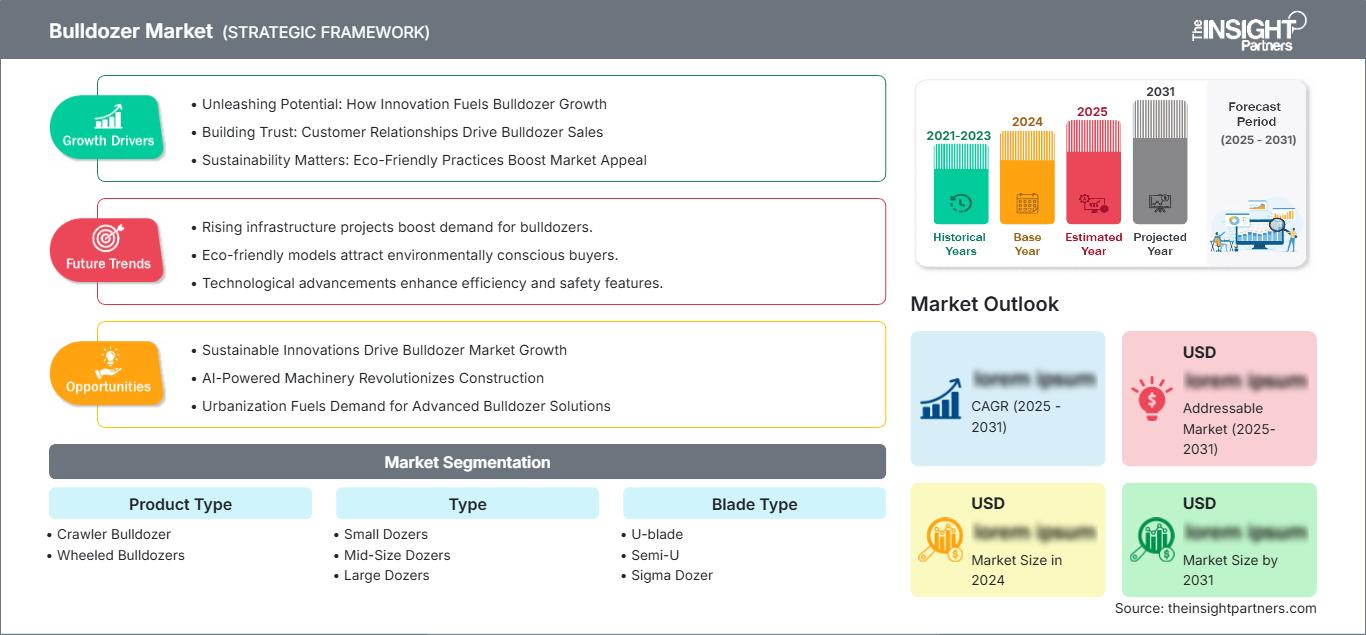
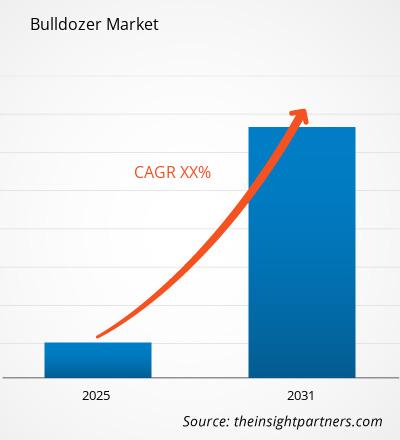
The bulldozer market was valued at US$ 15.9 Billion in 2025 and is projected to reach US$ 31.05 Billion by 2034, expanding at a CAGR of 7.72% during 2026–2034. Demand is being shaped by earthmoving intensity across construction, mining, infrastructure, agriculture, forestry, and defense applications, where operators require durable traction, precise grading, and higher utilization from crawler and wheeled machines.
North America continues to be one of the most attractive operating regions for the bulldozer market size on the back of fleet renewal, highway upgrades, mining overburden applications, and power plant site preparations. This region is expected to register a 6.8-7.4% CAGR during 2026-2034, primarily led by the US and Canada due to the adoption of telematics, grade control, and cleaner engines by contractors.
Bulldozer Market Assessment and Insights
- North America held 32–35% share in 2025 and is growing at a 6.8–7.4% CAGR between 2026–2034, supported by transport renewal, aggregates, oilfield access roads, and replacement of aging crawler fleets.
- US accounted for 74–78% of North America in 2025 and is growing at a 6.9–7.5% CAGR between 2026–2034, led by infrastructure and site-preparation work.
- Europe represented an 18–21% share in 2025 and is growing at a 5.9–6.6% CAGR between 2026–2034, with Germany, France, the UK, Italy, and Spain leading fleet upgrades.
- Asia Pacific captured 34–38% share in 2025 and is growing at a 8.3–9.1% CAGR between 2026–2034, driven by China, India, Japan, South Korea, and Australia.
- Largest Segment Crawler Bulldozer held 72–76% of the bulldozer market in 2025 and is growing at a 7.4–8.0% CAGR between 2026–2034 due to traction-intensive applications.
- High Growth Segment Infrastructure held 20–24% market share in 2025 and is growing at a 8.7–9.5% CAGR between 2026–2034 as governments accelerate roads, ports, and utilities.
- Key companies analyzed in detail: Caterpillar Inc., China SINOMACH Heavy Industry Corporation, Komatsu Ltd., LiuGong Dressta Machinery Sp. z o.o., Shandong Haitui Heavy Industry Machinery Co., Ltd., Xuanhua Construction Machinery Co., Ltd. (HBXG), YTO Group Corporation, Deere & Company, CNH Industrial N.V., Zoomlion Heavy Industry Science and Technology Co., Ltd.
Source: The Insight Partners' analysis based on proprietary research, government publications, company annual reports, investor presentations, industry databases, and expert interviews.
The development of machinery is moving away from the use of mechanical push machinery to digital assistance in earthmoving. The companies are trying to ensure that their machinery is provided with electro-hydraulic controls, grade guidance systems, telematics, and operator assistance packages so that the number of changes can be reduced and fuel consumption minimized. There is a change in the production trends because Asian suppliers are now using export channels while existing suppliers are safeguarding their market share through distribution, spare parts support, financing, and life cycle packages, which are vital for purchasing in mines and public works projects.
In the future, there will be an increase in the demand for construction machinery as India, Southeast Asia, the Gulf region, and some parts of Africa will develop their infrastructure corridors, mineral resources, and urban land. Increasing regulation on environmental and site safety concerns will lead buyers to purchase new machines that have clean engines and automatic blade controls.
Bulldozer Market Report Scope
| Report Attribute | Details |
|---|---|
| Market size in 2025 | US$ 15.9 Billion |
| Market Size by 2034 | US$ 31.05 Billion |
| Global CAGR (2026 - 2034) | 7.72% |
| Historical Data | 2021-2024 |
| Forecast period | 2026-2034 |
Bulldozer Market Analysis
The main factors responsible for driving growth in the bulldozer market are public infrastructure rehabilitation, open-pit mining, and industrial site development. Machines have to be able to clear, push, rip and grade through unstable ground while keeping machine availability high. Additionally, increased demand is seen in cases where time frames for projects are shortened by road authorities, utilities, port authorities and renewable energy companies.
The value chain is made up of steel forming, powertrain procurement, hydraulics, undercarriage, blades, dealer network, rental operations, and after-sales services. The supply environment is still vulnerable to engine supply, electronics, logistics, and the cost of steel. The demand side in the bulldozer industry becomes more dependent on manufacturers with reliable components and local service delivery due to its direct impact on mine production, efficiency, and penalties.
The competition is focused on OEMs with strong crawling technology, an extensive network of dealerships, and advanced technologies. Among those, companies like Caterpillar Inc., Komatsu Ltd., Deere & Company, CNH Industrial N.V. and Zoomlion Heavy Industry Science and Technology Co., Ltd. will compete based on productivity, connectivity of their fleets, and assistance to operators. Chinese and specialized manufacturers will compete on price, exportation, and robust machinery.
The bulldozer market analysis reveals that investments are centered around automation, electric drive systems, emission reduction engines, and service lifecycle. Strategic positioning varies by region; where premium companies focus on reliability and digital control, value-based companies are catering to public contractors and small fleet owners. The factors of dealer finance, used equipment sales, and rentals are now critical since buyers are now looking at the cost per hour of operation.
● REPORT CUSTOMIZATION
Tailor This Report To Align With Your Specific Business Requirements
This report can be customized to align precisely with your business objectives, scope, and target markets. Customization options include tailored segmentation, geography, competitive analysis, and strategic insights to support informed decision-making.
Customize This Report →WHAT YOU CAN ADJUST
- ● Segmentations
- ● Geography
- ● Competitive Analysis
- ● Language Preferences
Bulldozer Market: Strategic Insights
Regional Insights
North America Bulldozer Market
North America held 32–35% of the bulldozer market share in 2025 and is forecast to expand at a 6.8–7.4% CAGR through 2034. The region profits from highway rehabilitation, bridge rebuilding, land-preparation services, aggregates, and energy production facilities. Increased labor expenses drive grade automation efforts, and existing rental programs facilitate the need for replacement of mid-sized and larger crawlers.
New equipment purchase activity occurs mainly within contractors that specialize in public infrastructure construction, mining services, and clearing land projects. The bulldozer market in North America is bolstered by solid dealer network coverage, financing options, and parts availability. Purchasers are emphasizing uptime, fuel economy, and operator assistance systems, as clients require quicker project completion and better grading results.
U.S. Bulldozer Market
The U.S. accounted for 74–78% of North America in 2025 and is growing at a 6.9–7.5% CAGR. The demand is concentrated around highways, industrial uses, residential uses, quarrying, dumping and energy project preparation work sites. Caterpillar Inc., Deere & Company, Komatsu Ltd. and CNH Industrial N.V. possess adequate penetration levels regarding distribution, financing and service capabilities in construction states.
The trends associated with utilization suggest that there will be greater demand for grade control technology, low ground pressure and telematics for maintenance. Equipment, which reduces passes made and fuel consumption, and increases sight lines of operators, is being sought after. Public projects financing of infrastructure, data centers and renewable energy access roads will drive demand through 2034.
Europe Bulldozer Market
Europe held 18–21% share in 2025 and is growing at a 5.9–6.6% CAGR, led by Germany. The UK is driven by road rehabilitation, housing repairs, quarrying, and flood prevention, with machinery requirements being compact and mid-sized types that emit low fumes and have accurate leveling controls.
Germany is the biggest player in the bulldozer market due to the presence of industry construction, aggregates, recycling, and transit corridors. The French, Italian, and Spanish markets contribute via motorway improvements, renewable energy plants, forestry, and municipal applications. The European customers seek compliance with Stage V standards, reduced noise, telematics systems, and dealer servicing programs.
APAC Bulldozer Market
APAC captured 34–38% share in 2025 and is expanding at a 8.3–9.1% CAGR, with China as the leading country in the bulldozer market. Demand in China, India, Japan, South Korea, and Australia is stimulated by transportation routes, mining, industrial zones, and disaster-resistant infrastructure.
In India, where road construction follows policy, in Australia, where mining dominates the investment environment, and in East Asian cities, where urban redevelopment projects are carried out, crawler-type equipment, which provides traction and low-cost ownership, is preferred.
Middle East & Africa Bulldozer Market
The Middle East & Africa region is witnessing a growth of 7.6% to 8.4% CAGR driven by Saudi Arabia. Saudi Arabia and UAE drive demand for projects related to mega projects, road construction, port construction, energy sites, and industrial sites that require earthmoving prior to vertical construction.
South Africa drives the demand through mining, quarrying, and municipal infrastructure, whereas the rest of MEA drives demand due to transportation and utilities needs. Tough terrains and high temperatures drive the need for durable undercarriages and cooling systems.
Segmentation Analysis
Product Type
Product Type is growing at a 7.3–8.1% CAGR during 2026–2034 as buyers choose between crawler traction and wheeled mobility. The bulldozer market scope is shaped by terrain conditions, cycle time, haul-road quality, and jobsite versatility. Crawler models dominate heavy-duty pushing, while wheeled designs serve road maintenance, stockyards, and operations requiring faster repositioning.
- Crawler Bulldozer remains the dominant product because tracks deliver high traction, stability, and pushing force on uneven terrain, making it essential for mining, land clearing, infrastructure grading, and forestry work.
- Wheeled Bulldozers serve operations where mobility, faster travel speed, and reduced surface damage matter, including ports, stockyards, municipal works, and road maintenance projects with firm operating surfaces.
Type
The Type segment is anticipated to grow at a 7.0–7.8% CAGR from 2026 to 2034 in the bulldozer market. This is due to varying requirements for equipment on account of the size of the site and material handling. The small type dozer handles small sites and landscaping, whereas the medium-sized dozer is both productive and mobile, while the large one tackles mining and infrastructure projects.
- Small Dozers are recommended for use on residential sites, in landscaping, agriculture, and utility applications where flexibility of operations, reduced transport costs, and ease of operation are more important than maximal drawbar pull.
- Mid-Size Dozers are the most versatile type for contractors due to their combination of grading, ripping, and reasonable costs of ownership for road, commercial, quarry, and mid-scale construction projects.
- Large Dozers play a critical role in mining, damming, port and corridor development due to their high blade capacities, durable undercarriages and prolonged duty cycles.
Blade Type
Blade Type is advancing at a 7.1–7.9% CAGR during 2026–2034 as users configure machines for material retention, grading accuracy, and productivity. Blade selection determines pass efficiency and fuel use, especially in high-volume earthmoving. U-blades support bulk pushing, Semi-U blades balance penetration and carry, and Sigma Dozer designs improve material flow in specialized applications.
- The U-blade is extensively used for high-volume material pushing owing to its curved wings that hold the material, such as soil, coal, or overburden, effectively.
- The Semi-U blade combines both the properties of penetration and carrying, which makes it appropriate for use in various construction, road building, and land development applications.
- The Sigma Dozer is designed for highly efficient pushing by enhancing the rolling and loading characteristics of material, making it possible for the operator to minimize material spillage.
Applications
Applications are growing at a 7.8–8.6% CAGR during 2026–2034 as bulldozers remain core machines across construction, mining, military, agriculture, infrastructure, and forestry. Each application values different attributes, including pushing force, mobility, protection, and attachment compatibility. Infrastructure is a high-growth application because public investment creates sustained grading, clearing, and embankment work.
- Construction requires constant supply from residential, commercial, and industrial areas that require clearance of land, rough grading, and spreading of materials through dependable equipment before the excavation, foundation, and paving operations.
- Mining uses crawler dozers for overburden removal, haul-road maintenance, management of stockpiles, and preparation of pits, and thus the robustness and availability of the dozer matter a great deal in their acquisition.
- The military uses sturdy dozers for engineering operations, route clearance, and obstacle preparation, among others.
- In agriculture, dozers are used for leveling, irrigation channels, farm roads, and clearing, particularly when tractor force and traction become inadequate.
- The strategic importance of the infrastructure sector arises due to the requirement of heavy earthmoving work for roadways, railways, ports, airports, power, and utility projects, which need large-scale earthmoving during the initial stages of construction and regular maintenance.
- The demand for forestry arises from the need for constructing access roads, creating fire lines, removing stumps, and land rehabilitation.
Opportunity Snapshot
| Application | Revenue Contribution | Trend Tag | Adoption Stage |
| Construction | High | Site Prep | Mature |
| Mining | High | Overburden | Mature |
| Military | Medium | Field Works | Scaling |
| Agriculture | Medium | Land Leveling | Scaling |
| Infrastructure | High | Corridor Build | Scaling |
| Forestry | Low | Firebreaks | Emerging |
Bulldozer Market Growth Drivers and Impact Analysis
Infrastructure Corridors and Urban Land Development
Roads, railways, ports, airfields, and utility installations by governments provide a consistent need for earthworks prior to concrete and steel installation. Bulldozers find application in clearing, embankment shaping, subgrade preparation, and maintenance of haul roads, thus qualifying as front-end machines in projects' execution. This driver finds relevance especially in cases where contractors have more than one corridor in construction, requiring machines that can adapt from rough pushing to accurate grading. This is also a favorable environment for rentals since government projects do not require permanent asset investments. Growth in the pipeline of civil infrastructure will positively influence the bulldozer industry through replacement, increased usage, and adoption of grade control technology.
Mining Expansion and Critical Minerals Activity
The mining industry relies on the use of bulldozers in order to remove overburden, control dumps, clean the pit floors, and build haul roads. The need for such machinery is increasing due to the growing demand for energy transition metals, steel products, coal in certain geographical locations, and aggregates, which need to be extracted from the surface of the earth and require expansion of sites. Machine reliability plays an important role in increasing the efficiency of a mining site since any downtime may disrupt truck cycles and material flow. It becomes necessary for miners to use large-sized dozers with robust undercarriages and blades, as well as remote monitoring capabilities.
Technology Adoption to Reduce Operating Cost
Telematics, machine control, assisted steering, payload management, and predictive maintenance are some examples of technologies being adopted by contractors in an attempt to enhance the economics of their projects. Bulldozers use a lot of fuel and work in harsh conditions; even little improvements in pass efficiency, idle time, and maintenance schedules will make the process more economical for them. Technology also helps overcome the shortage of operators through automation of operations and improved visibility on-site. This leads to a transformation in the purchasing strategy from "horsepower purchasing" to "productivity purchasing."
Bulldozer Market Future Trends
Electrified and Hybrid Dozer Platforms
Electrification will become a defining theme in the bulldozer market trends as regulators, public owners, and large contractors push lower-emission jobsites. Battery-electric adoption will initially suit compact and mid-size machines working in urban, tunneling, landfill, and municipal environments where noise and exhaust restrictions are stricter. Hybrid and diesel-electric architectures may scale faster in large dozers because they can reduce fuel burn while preserving duty-cycle endurance. The transition will require charging infrastructure, thermal management, and dealer capability, creating opportunities for partnerships between OEMs, battery suppliers, utilities, and rental companies seeking differentiated low-emission fleets.
Autonomous Earthmoving and Connected Fleets
With respect to self-operating capabilities, dozers will move from dozers with the assistance of blades and guiding of paths to doing dozing operations in repetitive mining, quarries, and infrastructure projects. Thanks to fleet connectivity, it will become easy to operate dozers, excavators, graders, and haul trucks without necessarily having to create idle periods between them. The adoption of this technology will depend on the accuracy of sensors, site mapping, cybersecurity, and the adoption of the operators. These will be the first organizations to adopt this technology owing to their ability to justify high upfront costs in the bulldozer market.
Bulldozer Market Opportunities
Aftermarket Services and Predictive Maintenance Packages
Aftermarket services offer a scalable opportunity because bulldozers operate under abrasive loads that accelerate wear in undercarriages, blades, hydraulic systems, and powertrains. OEMs and dealers can expand revenue by bundling inspections, remote diagnostics, rebuild kits, wear-part subscriptions, and uptime guarantees. Customers benefit from predictable maintenance budgets and reduced unplanned downtime, especially in mining and infrastructure fleets. This opportunity aligns with bulldozer market forecasts because installed-base growth through 2034 will increase demand for parts and service intensity. Suppliers that combine digital monitoring with local parts availability can capture value even when new-equipment cycles soften.
Rental Fleet Expansion in Emerging Economies
Rentals provide a good option in situations where contractors do not have sufficient capital but would require modern machines to undertake project work. In countries like India, Southeast Asia, Gulf countries, and infrastructure corridors in Africa, there is a demand for rentals of crawler and mid-sized machines. Differentiation could be provided through training of operators, maintenance, and the use of telematics to monitor machine utilization. OEMs will gain since their new machines would reach smaller contractors through the rental business and there would be predictable replacement schedules of the fleet of rental machinery.
Recent Developments
- July 2026: Rhino Equipment has officially introduced the 2027 RD8 Bulldozer, a compact crawler dozer engineered for earthmoving, grading, site preparation, road construction, and infrastructure projects.
- March 2025: Deere & Company — John Deere announced the launch of the all-new 850 X-Tier Dozer and significant upgrades to the 700, 750, and 850 P-Tier Dozers. These advancements enhance power, precision and efficiency, helping operators maximize productivity while minimizing downtime. Building on its legacy of E-Drive innovation, the 850 X-Tier Dozer sets impressive standards in power, efficiency and precision for dozer applications.
- December 2025: SDLG successfully concluded its new product launch event, officially unveiling three hydrostatic bulldozers, the D18H, D26H, and D82H, and marking the rollout of the world’s first D82H ultra-large hydrostatic bulldozer. This milestone signifies that SDLG has entered a phase of second entrepreneurship with full independence and is accelerating its internationalization process.
Frequently Asked Questions

- Comprehensive Market Sizing and Forecast Analysis
- Detailed Segmentation Analysis
- In-Depth Market Dynamics Assessment
- Regional and Country-Level Insights
- Competitive Landscape and Company Benchmarking
- Strategic Business Intelligence
Recent Reports
Testimonials

The Insight Partners provided valuable market intelligence that supported our global go-to-market strategy. Their team was professional, responsive, and attentive to our feedback, providing thoughtful analysis and helpful methodological clarifications throughout the project.
Junmo Kim Chief Financial Officer (CFO), Enertech Co., Ltd.
The Insight Partners' SCADA System Market report is comprehensive, with valuable insights on current trends and future forecasts. The team was highly professional, responsive, and supportive throughout. We are very satisfied and highly recommend their services.
RAN KEDEM Partner, Reali Technologies LTDs
I requested a report on a very specific software market and the team produced the report in a few days. The information was very relevant and well presented. I then requested some changes and additions to the report. The team was again very responsive and I got the final report in less than a week.
JEAN-HERVE JENN Chairman, Future Analytica
We worked with The Insight Partners for an important market study and forecast. They gave us clear insights into opportunities and risks, which helped shape our plans. Their research was easy to use and based on solid data. It helped us make smart, confident decisions. We highly recommend them.
PIYUSH NAGPAL Sr. Vice President, High Beam Global
The Insight Partners delivered insightful, well-structured market research with strong domain expertise. Their team was professional and responsive throughout. The user-friendly website made accessing industry reports seamless. We highly recommend them for reliable, high-quality research services
YUKIHIKO ADACHI CEO, Deep Blue, LLC.
This is the first time I have purchased a market report from The Insight Partners.While I was unsure at first, I visited their web site and felt more comfortable to take the risk and purchase a market report.I am completely satisfied with the quality of the report and customer service. I had several questions and comments with the initial report, but after a couple of dialogs over email with their analyst I believe I have a report that I can use as input to our strategic planning process.Thank you so much for taking the extra time and making this a positive experience.I will definitely recommend your service to others and you will be my first call when we need further market data.
JOHN SUZUKI President and Chief Executive Officer, Board Director, BK Technologies
I wish to appreciate your support and the professionalism you displayed in the course of attending to my request for information regarding to infectious disease IVD market in Nigeria. I appreciate your patience, your guidance, and the fact that you were willing to offer a discount, which eventually made it possible for us to close a deal. I look forward to engaging The Insight Partners in the future, all thanks to the impression you have created in me as a result of this first encounter.
DR CHIJIOKE ONYIA MANAGING DIRECTOR, PineCrest Healthcare Ltd.Reason to Buy
- Informed Decision-Making
- Understanding Market Dynamics
- Competitive Analysis
- Identifying Emerging Markets
- Customer Insights
- Market Forecasts
- Risk Mitigation
- Boosting Operational Efficiency
- Strategic Planning
- Investment Justification
- Tracking Industry Innovations
- Aligning with Regulatory Trends





 Get Free Sample for