
Burn Ointment Market Demand, Size & Forecast by 2034
Coverage: By Product (Topical Antibiotics, Silver Containing Agents, Iodine, Others); Application (First-degree Burns, Second-degree Burns, Third-degree Burns); End User (Hospitals and Clinics, Homecare, Laboratories, Others), and Geography (North America, Europe, Asia Pacific, and South and Central America)
- Status : Data Released
- Report Code : TIPRE00019979
- Category : Life Sciences
- No. of Pages : 150
- Available Report Formats :


- Last update date : August 12, 2026


2025 Market Size
US$ 1.18 Bn
Base year value
2034 Forecast
US$ 1.93 Bn
Projected by 2034
CAGR 2026-2034
5.67 %
Growth rate
Addressable Market
US$ 14.13 Bn
(2026-2034)
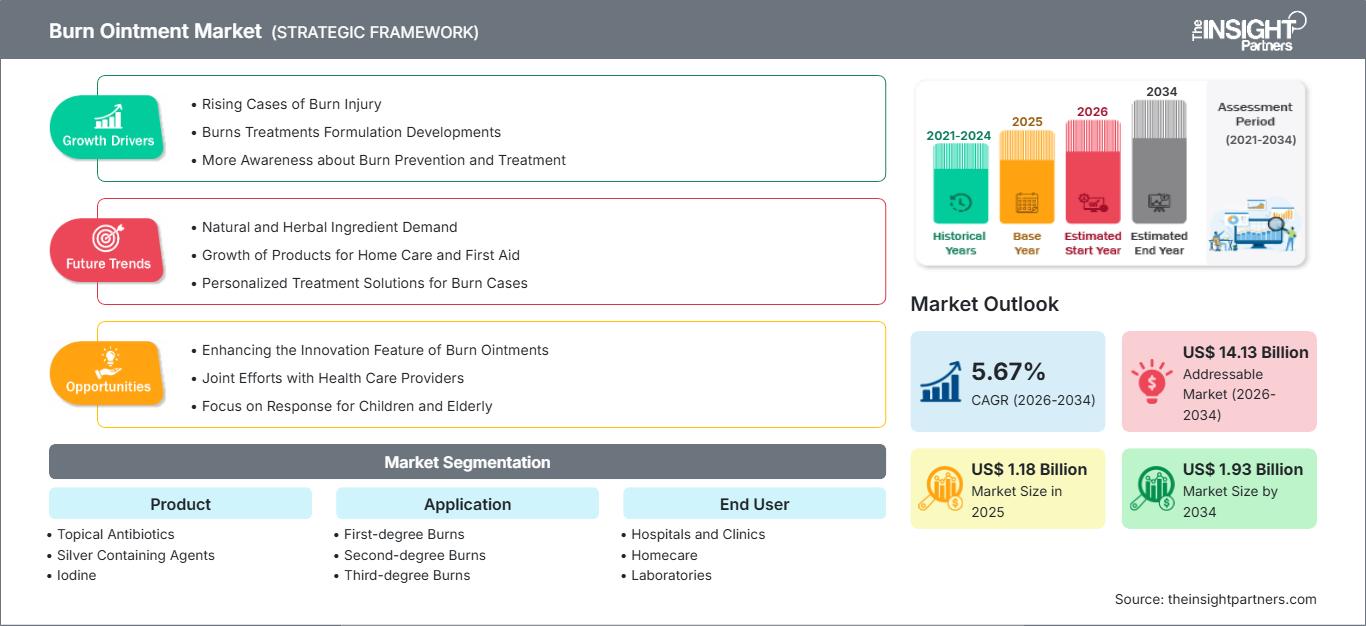
The Burn Ointment Market is valued at US$ 1.18 Billion in 2025 and is projected to reach US$ 1.93 Billion by 2034, expanding at a CAGR of 5.67% during 2026–2034. Demand will be impacted by the incidence rate of burn injuries, availability of topical antibiotics and clinicians’ preference for formulations that minimize the chances of contaminating the wound in first, second, and third-degree burns.
North America continues to be a mature yet growing region with the support of the presence of specialty burn centers, extensive use of emergency rooms, and existing reimbursement programs. North America has been forecasted to record a CAGR between 4.9% and 5.4% from 2026 to 2034 driven by American Burn Association figures of 32,540 inpatient burn center admissions in 2023 and 156,073 admissions in 2019-2023.
Burn Ointment Market Assessment and Insights
- North America accounted for 34–37% share in 2025 and is growing at a CAGR between 2026–2034 of 4.9–5.4%, supported by burn center protocols, outpatient treatment access, and branded wound care portfolios.
- US represented 78–82% of North America in 2025 and is growing at a CAGR between 2026–2034 of 4.8–5.3%, led by emergency care use and OTC accessibility.
- Europe held 24–27% share in 2025 and is growing at a CAGR between 2026–2034 of 4.6–5.1%, with Germany, the UK, and France leading hospital-led adoption.
- Asia Pacific captured 27–30% share in 2025 and is growing at a CAGR between 2026–2034 of 6.6–7.2%, driven by India, China, Japan, and South Korea.
- Largest Segment: Topical Antibiotics held 42–46% market share in 2025, with CAGR of 5.1–5.6%, due to broad use in infection prevention for minor and moderate burns.
- High Growth Segment: Homecare held 23–27% market share in 2025, with CAGR of 6.7–7.4%, supported by pharmacy access and rising self-care for first-degree burns.
- Key companies analyzed in detail: Johnson & Johnson Services, Inc.; Smith & Nephew plc; Pfizer Inc.; GSK plc; Morepen Laboratories Limited; Sanofi; Mankind Pharma Limited; Sun Pharmaceutical Industries Limited; Atlantis Consumer Healthcare Inc. (Betadine portfolio formerly Avrio Health L.P.); Solventum Corporation; Convatec Group PLC.
Source: The Insight Partners' analysis based on proprietary research, government publications, company annual reports, investor presentations, industry databases, and expert interviews.
The approach of clinical practice has changed from simple occlusive creams to antimicrobial topical products, silver-based products, iodine-based preparations, and auxiliary wound care solutions that suit severity-based approaches to treatment. The Burn Ointment Market size is positively impacted by the role played by pharmacies in dispensing burn ointments for the treatment of minor burns, while the influence of hospitals will remain unchanged in relation to second- and third-degree burns, where controlling contamination is critical.
Over the forecasted period, the industry will be driven by increasing demand from emerging Asia-Pacific countries, widespread adoption among households in first-aid kits, and policies focusing on the prevention and preparation for burns. It is estimated by the WHO that approximately 180,000 people die each year due to burns, and most of them belong to low- and middle-income nations. This will create a care accessibility challenge that topical treatments could partly solve.
Burn Ointment Market Report Scope
| Report Attribute | Details |
|---|---|
| Market size in 2025 | US$ 1.18 Billion |
| Market Size by 2034 | US$ 1.93 Billion |
| Global CAGR (2026 - 2034) | 5.67% |
| Historical Data | 2021-2024 |
| Forecast period | 2026-2034 |
Burn Ointment Market Analysis
Burn Ointment Market growth will be driven by a combination of acute care and common usage at home needs. According to WHO, non-lethal burns constitute one of the most common causes of morbidity due to extended stays in hospitals, disability, and disfigurements. These factors ensure steady demand for burn ointment products, which have protective and anti-infective properties as well as help in reducing dressing procedures.
The market supply will depend on the availability of the active ingredients, sterility of packaging, and channel segmentation. For example, silver sulfadiazine continues to be used for second- and third-degree burns and includes information about the product's auxiliary use for the prevention of wound sepsis.
The market for Burn Ointments is characterized by fragmented competition, with multinational pharmaceutical companies vying with India-based generics and consumer healthcare firms. Silver sulfadiazine-based products are represented in the market by Pfizer Inc., and Smith & Nephew PLC's products include ACTICOAT, SANTYL, BIOBRANE, and VERSAJET.
Evidence-based, distribution-focused, and contextually strategic positioning is gaining currency. This includes competition from Johnson & Johnson Services, Inc., GSK plc, Sanofi, Sun Pharmaceutical Industries Limited, Mankind Pharma Limited, Morepen Laboratories Limited, Solventum Corporation, Convatec Group PLC, and Atlantis Consumer Healthcare Inc.
● REPORT CUSTOMIZATION
Tailor This Report To Align With Your Specific Business Requirements
This report can be customized to align precisely with your business objectives, scope, and target markets. Customization options include tailored segmentation, geography, competitive analysis, and strategic insights to support informed decision-making.
Customize This Report →WHAT YOU CAN ADJUST
- ● Segmentations
- ● Geography
- ● Competitive Analysis
- ● Language Preferences
Burn Ointment Market: Strategic Insights
Regional Insights
North America Burn Ointment Market
North America had a market share of 34–37% in 2025 and is projected to have a CAGR of 4.9–5.4% from 2026–2034. Burn center density, trauma referral programs, and availability of outpatient pharmacies contribute to the high penetration rate of products. According to the ABA, there were 32,540 cases of burn center admissions in 2023, with 45% due to flame or flash burn injuries.
The Burn Ointment Market share in North America is strengthened by clinical familiarity with topical antibiotics, silver-based medications, and antiseptics. The most demand for products comes from emergency departments, hospital outpatient centers, and household first aid. Product selection has become less based on availability and more based on the wound depth, dressings used, and antimicrobial stewardship for second-degree burns.
U.S. Burn Ointment Market
The U.S. represented 78–82% of North America in 2025 and is projected to grow at a CAGR of 4.8–5.3% during 2026–2034. The American Burn Association cites CDC estimates of 398,000 fire or burn-related injuries in 2021 and 252,000 injuries related to hot objects or substances.
Company presence is wide-ranging, with firms like Pfizer Inc., Johnson & Johnson Services, Inc., Smith & Nephew plc, Solventum Corporation, Convatec Group PLC, and Atlantis Consumer Healthcare Inc. catering to hospital and consumer markets respectively. Applications are more popular for first and second-degree burns in home care; applications in hospitals are geared towards infections, deep burns, and debrided wound coverage.
Europe Burn Ointment Market
The Europe market held a market share of 24–27% in 2025 and is projected to grow with a CAGR of 4.6–5.1% from 2026 to 2034. Germany is the top country owing to specialist burn units, established reimbursement policies, and consistent consumption of antimicrobial wound products. The United Kingdom takes advantage of NHS burn networks and centralized purchases, while Germany encourages premium offerings via hospital wound protocols.
France, Italy, and Spain play an important role via public hospitals, dermatology services, and pharmacy access. Maturity of regulations works in favor of products having labels, safety data, and dressing compatibility. The demand here is not based on volume like Asia Pacific, but more on adherence to protocol and antibiotic resistance.
APAC Burn Ointment Market
Asia Pacific held 27–30% share in 2025 and is projected to grow at a CAGR of 6.6–7.2% during 2026–2034. China leads by volume, while India offers high growth through retail pharmacy expansion and domestic manufacturing. WHO notes India has over 1 million people moderately or severely burnt every year.
Protocol-driven adoption is seen in Japan, South Korea, and Australia where there is greater emphasis on quality and safety by hospitals. Attention to capacity in emergencies, workplace safety, and rural areas through policy drives further adoption. Affordability aids local production whereas international companies must compete with high acuity hospitals.
Middle East & Africa Burn Ointment Market
MEA & Africa market is projected to expand at a CAGR of 5.8% – 6.4% in 2026 – 2034. The Middle East nations of Saudi Arabia and the UAE drive the usage on account of hospital infrastructure, specialized treatment centers and trauma systems development. South Africa continues to be a key market due to burn injuries resulting from energy usage in households and public health care services.
Rest of MEA markets tend to be more sensitive to prices where usage of iodine products and generic topical antibiotics is more prevalent. The WHO estimates that 2/3rd of burn mortalities happen in the regions of Africa and South-East Asia.
Segmentation Analysis
Product
Product is projected to grow at a CAGR of 5.2–5.8% during 2026–2034. The Market scope across product types reflects a balance between infection control, affordability, and severity-specific use. Hospitals favor evidence-backed silver and antibiotic products for higher-risk wounds, while iodine and broad antiseptics remain important in first-aid, low-resource, and homecare settings.
- Topical Antibiotics hold the leading position due to clinician familiarity, broad availability, and use in infection prevention for first-degree and selected second-degree burns across pharmacy and hospital channels.
- Silver Containing Agents are strategically important in burns requiring sustained antimicrobial action, especially where dressing changes must be minimized and infection risk is higher.
- Iodine products remain relevant because of broad antiseptic activity, low relative cost, and usefulness in basic wound cleansing, particularly in homecare and resource-constrained settings.
Application
Application is expected to grow at a CAGR of 5.4–5.9% during 2026–2034. Product demand varies by depth, clinical urgency, and risk of infection. First-degree burns drive high-volume OTC usage, second-degree burns require more structured antimicrobial care, and third-degree burns rely on hospital-based protocols where ointments support broader wound bed management.
- First-degree Burns generate frequent consumer purchases because superficial household burns are commonly treated with accessible first-aid products, cooling protocols, and pharmacist-directed topical care.
- Second-degree Burns represent a high-value clinical category because blistering, partial-thickness damage, and infection risk often require antimicrobial ointments, dressings, and professional monitoring.
- Third-degree Burns are lower in volume but strategically critical, as care is hospital-led and ointments are used alongside debridement, grafting, infection control, and intensive wound management.
End User
End User is projected to grow at a CAGR of 5.6–6.2% during 2026–2034. Hospitals and clinics remain central for moderate and severe burns, but homecare is expanding as consumers seek immediate treatment for minor burns. Laboratories contribute through testing, formulation evaluation, and antimicrobial validation rather than direct treatment volume.
- Hospitals and Clinics dominate higher-acuity treatment because they manage infection risk, dressing protocols, surgical referral, and follow-up care for second-degree and third-degree burns.
- Homecare is the fastest-moving channel as consumers increasingly purchase OTC antiseptic and antibiotic products for kitchen burns, scalds, and minor thermal injuries.
- Laboratories support product development and quality assurance by evaluating antimicrobial activity, stability, sterility, and formulation performance for regulated topical burn products.
Opportunity Snapshot
| End User | Revenue Contribution (High/Medium/Low) | Trend Tag (MAX 2 words, specific) | Adoption Stage (Emerging/Scaling/Mature) |
| Hospitals and Clinics | High | Burn Protocols | Mature |
| Homecare | Medium | First Aid | Scaling |
| Laboratories | Low | Antimicrobial Testing | Emerging |
Burn Ointment Market Growth Drivers and Impact Analysis
High Global Burn Burden and Need for Early Antimicrobial Care
Burn injuries remain a persistent healthcare problem that creates demand for accessible topical treatment, particularly where patients first present in emergency departments, clinics, or pharmacies. WHO estimates 180,000 annual burn deaths worldwide, with the majority occurring in low- and middle-income countries. Non-fatal cases add further demand because complications include prolonged hospitalization, disability, and disfigurement. Ointments play an early role by reducing contamination risk, supporting moist wound protection, and bridging care before specialist intervention. The market impact is strongest for topical antibiotics and iodine products because these are widely understood, comparatively affordable, and suitable for both professional and consumer-led care settings.
Expansion of Burn Centers, Emergency Care, and Outpatient Wound Pathways
Specialized burn care infrastructure supports more consistent product use because treatment protocols define when antimicrobials, silver agents, and antiseptics are applied. In the U.S., ABA reported 113 burn data contributors across 38 states and Washington, DC in its 2024 Burn Injury Summary Report, showing the scale of organized inpatient burn data collection. As care shifts toward shorter stays, outpatient follow-up, and home dressing support, demand expands beyond acute wards. Manufacturers benefit when products fit both hospital formularies and discharge kits. This driver increases recurring purchases, strengthens professional recommendation patterns, and improves the commercial value of formulations that are easy to apply and compatible with dressings.
Growth of Consumer Self-Care and Pharmacy-Led Minor Burn Treatment
Minor burns are often treated before formal medical consultation, making retail availability a practical growth driver. Consumer behavior favors small-pack ointments, antiseptics, and topical antibiotics that can be stored in first-aid kits and used immediately after scalds or contact burns. ABA cites that 61% of all burn incidents in reported burn center data took place at a private residence, underlining the home as a key injury environment. This supports pharmacy merchandising, OTC education, and branded consumer trust. The impact is especially visible in homecare, where affordability, instructions for use, and perceived infection prevention strongly influence product choice.
Burn Ointment Market Future Trends
Shift Toward Evidence-Based Antimicrobial Stewardship
Burn Ointment Market trends will increasingly reflect selective use of antibiotics and antiseptics rather than routine, broad application across every burn type. Clinicians are balancing infection prevention with concerns about resistance, delayed healing, and product tolerability. Silver sulfadiazine remains widely available, but labeling and clinical debate encourage more wound-depth-specific decisions. Future portfolios will likely emphasize targeted antimicrobial claims, sustained-release protection, and compatibility with advanced dressings. Companies that can provide safety data, clear indications, and education for pharmacists and clinicians will be better positioned as procurement moves from habit-based selection to evidence-led pathway management.
More Integrated Burn Care Products for Home and Clinic Continuity
The market will move toward products that support continuity between emergency treatment, clinic follow-up, and home recovery. This includes easy-dispense tubes, low-pain removal, dressing-compatible ointments, and instructions that reduce misuse. Smith & Nephew’s burn portfolio highlights solutions across preparation, protection, and progression, including ACTICOAT, SANTYL, BIOBRANE, and VERSAJET. Such integrated positioning signals a broader industry trend: topical products will increasingly be marketed as part of wound care pathways rather than standalone creams. This approach can improve compliance, reduce dressing disruption, and support value-based purchasing in organized care systems.
Burn Ointment Market Opportunities
Affordable Antimicrobial Portfolios for High-Incidence Emerging Markets
The strongest investment opportunity lies in affordable, quality-assured topical antimicrobials for countries with high burn incidence and uneven access to specialist care. Burn Ointment Market Forecasts point to faster growth in Asia Pacific, where India and China combine large patient pools with expanding pharmacy networks. WHO reports that India has more than 1 million moderate or severe burn cases annually, supporting need for scalable treatment access. Companies can act by building local manufacturing, pharmacist education, and low-unit-cost SKUs. Partnerships with hospitals and public health programs can further improve distribution while preserving margins through volume-led models.
Homecare-Focused Education and Pharmacy Channel Expansion
Homecare offers a practical opportunity because early burn management often begins outside hospitals. Manufacturers can invest in pharmacist training, first-aid labeling, digital education, and bundled products that include ointments, sterile dressings, and usage guidance. ABA data show private residences accounted for 61% of burn incidents in its burn center reporting, reinforcing the need for household preparedness. Strategic action should focus on clear differentiation between minor burns suitable for self-care and deeper burns requiring medical referral. Brands that combine accessibility with responsible education can grow without encouraging inappropriate treatment of severe injuries.
Recent Developments
- March 2026: Smith & Nephew plc launched ALLEVYN COMPLETE CARE Foam Dressing, a next-generation five-layer wound dressing designed for wound management and pressure injury prevention, with technologies intended to manage exudate, limit leakage, extend wear time, and protect vulnerable skin in clinical care settings.
- September 2025: Sanofi announced that it would present 45 abstracts at the European Academy of Dermatology and Venereology Congress, including data across approved and investigational medicines for chronic inflammatory skin diseases, reinforcing its dermatology research focus and broader skin health capabilities.
- June 2025: Sanofi and Regeneron announced U.S. FDA approval of Dupixent for adult patients with bullous pemphigoid, a rare blistering skin disease, expanding the targeted dermatology treatment landscape and highlighting continued investment in therapies for severe inflammatory skin conditions.
Frequently Asked Questions

- Comprehensive Market Sizing and Forecast Analysis
- Detailed Segmentation Analysis
- In-Depth Market Dynamics Assessment
- Regional and Country-Level Insights
- Competitive Landscape and Company Benchmarking
- Strategic Business Intelligence
Recent Reports
Testimonials

The Insight Partners' SCADA System Market report is comprehensive, with valuable insights on current trends and future forecasts. The team was highly professional, responsive, and supportive throughout. We are very satisfied and highly recommend their services.
RAN KEDEM Partner, Reali Technologies LTDs
I requested a report on a very specific software market and the team produced the report in a few days. The information was very relevant and well presented. I then requested some changes and additions to the report. The team was again very responsive and I got the final report in less than a week.
JEAN-HERVE JENN Chairman, Future Analytica
We worked with The Insight Partners for an important market study and forecast. They gave us clear insights into opportunities and risks, which helped shape our plans. Their research was easy to use and based on solid data. It helped us make smart, confident decisions. We highly recommend them.
PIYUSH NAGPAL Sr. Vice President, High Beam Global
The Insight Partners delivered insightful, well-structured market research with strong domain expertise. Their team was professional and responsive throughout. The user-friendly website made accessing industry reports seamless. We highly recommend them for reliable, high-quality research services
YUKIHIKO ADACHI CEO, Deep Blue, LLC.
This is the first time I have purchased a market report from The Insight Partners.While I was unsure at first, I visited their web site and felt more comfortable to take the risk and purchase a market report.I am completely satisfied with the quality of the report and customer service. I had several questions and comments with the initial report, but after a couple of dialogs over email with their analyst I believe I have a report that I can use as input to our strategic planning process.Thank you so much for taking the extra time and making this a positive experience.I will definitely recommend your service to others and you will be my first call when we need further market data.
JOHN SUZUKI President and Chief Executive Officer, Board Director, BK Technologies
I wish to appreciate your support and the professionalism you displayed in the course of attending to my request for information regarding to infectious disease IVD market in Nigeria. I appreciate your patience, your guidance, and the fact that you were willing to offer a discount, which eventually made it possible for us to close a deal. I look forward to engaging The Insight Partners in the future, all thanks to the impression you have created in me as a result of this first encounter.
DR CHIJIOKE ONYIA MANAGING DIRECTOR, PineCrest Healthcare Ltd.Reason to Buy
- Informed Decision-Making
- Understanding Market Dynamics
- Competitive Analysis
- Identifying Emerging Markets
- Customer Insights
- Market Forecasts
- Risk Mitigation
- Boosting Operational Efficiency
- Strategic Planning
- Investment Justification
- Tracking Industry Innovations
- Aligning with Regulatory Trends





 Get Free Sample for