
Cabergoline Tablets Market Growth, Trends & Forecast by 2034
Coverage: By Type (0.5mg/Pcs, 1mg/Pcs, and 2mg/Pcs); End Use (Parkinson's Disease (PD), Hyperprolactinemia, and Other), and Geography (North America, Europe, Asia Pacific, and South and Central America)
- Status : Data Released
- Report Code : TIPRE00023929
- Category : Life Sciences
- No. of Pages : 150
- Available Report Formats :


- Last update date : August 12, 2026


2025 Market Size
US$ 1.32 Bn
Base year value
2034 Forecast
US$ 2.8 Bn
Projected by 2034
CAGR 2026-2034
8.65 %
Growth rate
Addressable Market
US$ 18.40 Bn
(2026-2034)
The Cabergoline Tablets Market stood at US$ 1.32 billion in 2025 and is anticipated to reach US$ 2.8 billion in 2034 at a CAGR of 8.65%. The Market is a reflection of increasing use of the treatment method with dopamine agonists, along with volume gains due to prolactin disorder diagnoses, generic drugs, and continued preference for oral tablets.
North America continues to be a high value regional base, with the Cabergoline Tablets Market size gaining from access in endocrinology, prescription monitoring, and generics substitution facilities in the region. North America is expected to grow at a CAGR of 8.2-8.8% in 2026-2034 due to screening for pituitary disorders, referrals in neurology, and consistent demand for once-weekly or twice-weekly oral treatment.
Cabergoline Tablets Market Assessment and Insights
- North America accounted for 34–37% share in 2025 and is growing at a CAGR between 2026–2034 of 8.2–8.8%, supported by endocrinology-led prescribing, broad pharmacy access, and mature generic reimbursement systems.
- US represented 78–82% of North America share in 2025 and is growing at a CAGR between 2026–2034 of 8.1–8.6%, led by FDA-regulated supply and specialty diagnosis pathways.
- Europe held 27–30% share in 2025 and is expanding at a CAGR between 2026–2034 of 7.6–8.2%, with Germany, the UK, France, Italy, and Spain leading demand through structured endocrine care.
- Asia Pacific captured 22–25% share in 2025 and is growing at a CAGR between 2026–2034 of 9.4–10.2%, led by China, India, Japan, South Korea, and Australia.
- Largest Segment 0.5mg/Pcs held 68–72% market share in 2025 and is expanding at a CAGR between 2026–2034 of 8.3–8.8%, reflecting dominant prescribing convenience.
- High Growth Segment Hyperprolactinemia held 74–78% market share in 2025 and is expanding at a CAGR between 2026–2034 of 8.8–9.4%, supported by diagnostic testing and fertility-linked care.
- Key companies analyzed in detail: Pfizer Inc., Teva Pharmaceutical Industries Ltd., Sun Pharmaceutical Industries Ltd., Mylan Pharmaceuticals Inc., Neon Laboratories Limited, Serum Institute of India Pvt. Ltd., TTK Healthcare Limited, Cipla Limited, Intas Pharmaceuticals Limited, Vivo Life Sciences Private Limited, Zydus Healthcare Limited, Cubit Healthcare Private Limited, Eris Lifesciences Limited, Amigoz Lifesciences Private Limited, Innovative Pharmaceuticals.
Source: The Insight Partners' analysis based on proprietary research, government publications, company annual reports, investor presentations, industry databases, and expert interviews.
The manufacturing industry has moved away from brand-dependent supplies to a much more diverse generic ecosystem via cost-based competition and controlled quality pathways. Small dose pills' manufacturing involves controlled management of potency, validated drug dissolution, and scoring process, mainly 0.5 mg tablets. Technological developments are focused on automation of compression process, impurities' tracking, and tracing of batches, while manufacturing dynamics are driven by quality of active pharmaceutical ingredient, control over ergot-derived medications, and country-specific pharmacovigilance programs.
During the forecast period, the growth rates will be expanded beyond existing prescription pills market due to expansion of endocrine diagnostics, infertility diagnostics and neurological treatments in developing regions. Investments will be made in companies that have validated ability to produce small batches, regional regulatory dossiers, and reliable independent of cold chain distribution networks. The regulatory developments will come from bioequivalence guidance development, generic review programs and national programs to increase availability of chronic oral medication via hospital, retail and Internet pharmacies.
Cabergoline Tablets Market Report Scope
| Report Attribute | Details |
|---|---|
| Market size in 2025 | US$ 1.32 Billion |
| Market Size by 2034 | US$ 2.8 Billion |
| Global CAGR (2026 - 2034) | 8.65% |
| Historical Data | 2021-2024 |
| Forecast period | 2026-2034 |
Cabergoline Tablets Market Analysis
Market growth for the Cabergoline Tablets will be driven by the prevalence of hyperprolactinemia, prolactinoma and adjunct treatment for Parkinson’s disease. This demand will be strengthened by serum prolactin testing, pituitary scan referrals and endocrine workups related to fertility concerns. Supply chains will continue to be sensitive to the API, since cabergoline is a very potent ergot alkaloid derivative.
In the value chain, competing products rely on strong dossiers, pricing integrity and consistent supply and not necessarily aggressive marketing campaigns. Wholesalers and hospital pharmacies focus on availability of scored tablets and standardization in pack sizes. In emerging markets, growth in prescriptions will be based on private endocrinology practices and laboratories that turn hormonal problems previously undiagnosed into ongoing prescriptions.
Cabergoline Tablets Market Report reveals fragmented yet strategically sound competition. While Pfizer Inc. continues to maintain its presence through DOSTINEX, Teva Pharmaceutical Industries Ltd., Mylan Pharmaceuticals Inc., Sun Pharmaceutical Industries Ltd., Cipla Limited, Intas Pharmaceuticals Limited, and Zydus Healthcare Limited provide generic competition in regulated and semi-regulated markets. The Indian companies make it easier for consumers to buy it cheaply, whereas the specialist distributors provide small-volume supplies for hospitals.
The investments have been made in upgrading of analytical methods, renewal of marketing authorizations, pharmacovigilance activities, and geographic registration. Neon Laboratories Limited, TTK Healthcare Limited, Eris Lifesciences Limited, Vivo Life Sciences Private Limited, Cubit Healthcare Private Limited, Amigoz Lifesciences Private Limited, and Innovative Pharmaceuticals are aligned in terms of domestic coverage, contract manufacturing, or specialty distribution. The strategic advantage will come through the quality of the tablets and labeling.
● REPORT CUSTOMIZATION
Tailor This Report To Align With Your Specific Business Requirements
This report can be customized to align precisely with your business objectives, scope, and target markets. Customization options include tailored segmentation, geography, competitive analysis, and strategic insights to support informed decision-making.
Customize This Report →WHAT YOU CAN ADJUST
- ● Segmentations
- ● Geography
- ● Competitive Analysis
- ● Language Preferences
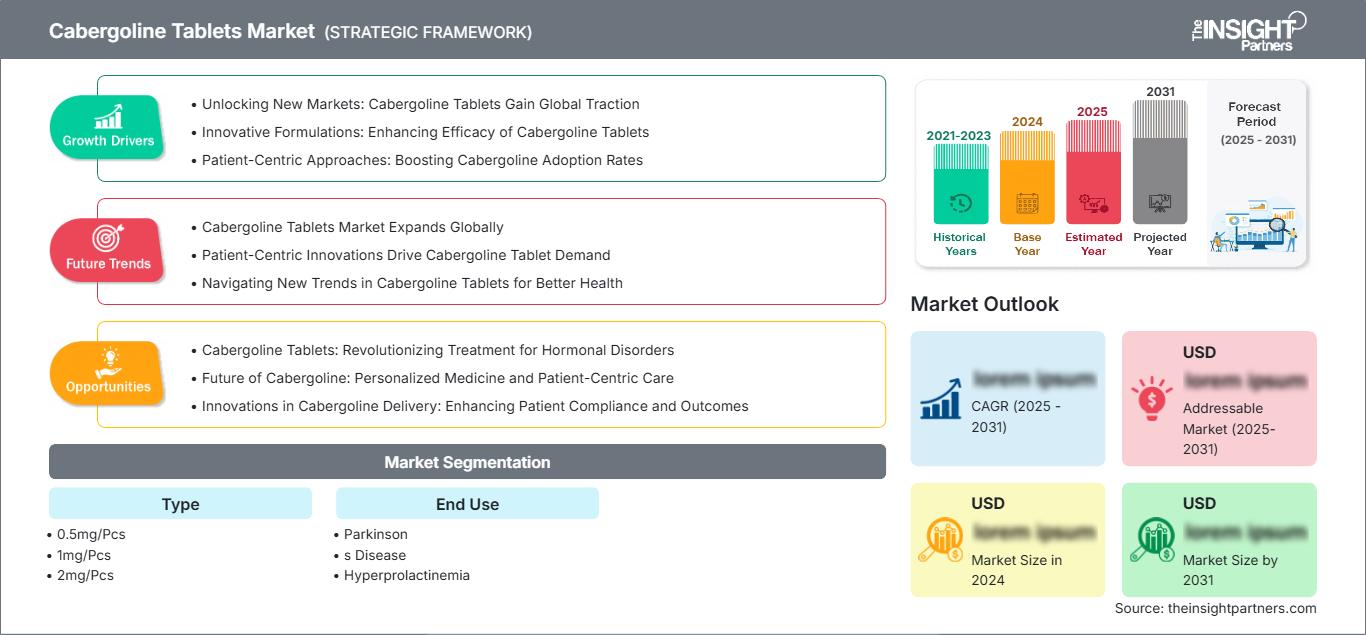
Cabergoline Tablets Market: Strategic Insights
Regional Insights
North America Cabergoline Tablets Market
In North America, the market size was valued at 34-37% in 2025 and has the potential to grow at a CAGR of 8.2-8.8% between 2026 and 2034. Endocrine specialty presence, neurology services, and serum prolactin screening facilities have helped drive demand in the region. Other factors include an advanced generic substitution system, pharmacovigilance mechanisms, and payers' preference towards cost-effective oral treatments.
The United States leads in the area of regional revenues, while Canada earns revenue from provincial drug and referral programs. New FDA labeling concerning valvular assessment and breast-feeding after pregnancy has made the prescription more disciplined without affecting the use of endocrine hormones. Wholesalers’ concentration is favorable for those manufacturers who hold inventories on a consistent basis.
U.S. Cabergoline Tablets Market
North American region accounted for 78–82% of the U.S. in 2025 and is expected to grow at a CAGR of 8.1–8.6% until 2034. High throughput in diagnostics for endocrine, reproductive medicine, and neurological clinics contributes to growth in the country. Application trends are focused on disorders of hyperprolactinemia with pituitary adenoma usage and require dose titration through serum monitoring.
Company penetration is wide with Pfizer Inc. being connected with DOSTINEX and Teva Pharmaceutical Industries Ltd., Mylan Pharmaceuticals Inc., and other generics as sources of competition in pricing. Labeling activities by FDA in 2025 included language around the safety profile in cardiac and post-partum indications, which was used as motivation for proper screening. US outlook is still linked to chronic prescription refills, e-prescription, and PBM.
Europe Cabergoline Tablets Market
The Europe segment is valued at 27–30%, and its forecasted CAGR for 2026-2034 is estimated at 7.6–8.2%. The main driving force in Europe is Germany. The UK has a highly organized market with endocrine referral guidelines, pituitary multidisciplinary units, and stable use of oral dopamine agonist treatment. Generic sourcing and hospital formularies help maintain prices and continuity of treatment.
Germany is the leader thanks to high concentration of specialists, good diagnostic access, and strong compliance with endocrine follow-up. Countries like France, Italy, and Spain also have a considerable contribution with national reimbursement mechanisms, gynecology-endocrinology collaboration, and pituitary disorders treatment. The market growth in Europe is modest compared to Asia Pacific.
APAC Cabergoline Tablets Market
The share of APAC was recorded at 22-25% in 2025 and estimated to increase at a CAGR of 9.4-10.2% till 2034. This makes APAC the fastest growing regional segment. While China holds top position in terms of potential volumes, India provides a robust manufacturing base as well as cost-effective products. Japan, South Korea, and Australia add value in terms of regulation and endocrine specialty care.
Industrial growth drivers are expected to be increasing manufacturing of generics, better diagnostics, and increased private spending on health care. Essential medicines policy, along with development of local manufacturing and wider insurance coverage increases access. Additionally, the market for Cabergoline Tablets in APAC is supported by increased fertility clinics and pituitary hormonal diseases.
Middle East & Africa Cabergoline Tablets Market
Middle East and Africa region is expected to witness a CAGR of 7.1-7.7% for the period 2026-2034, with Saudi Arabia being the top country with respect to healthcare expenditure scale. In the UAE, specialized access is enabled by means of private hospitals, whereas South Africa provides regional accessibility. Uneven RoMEA demand results from poor diagnosis and inconsistent reimbursement levels.
Oil-linked fiscal resources in the Gulf region enable hospital infrastructure development, generic drug imports, and increased specialty access. Infrastructural investments facilitate laboratory testing, access to imaging services, and chronic prescription distribution. Demand is lower than that in APAC due to poor endocrine diagnostics, however, urban hospital network builds up demand visibility.
Segmentation Analysis
Type
Type is expected to expand at a CAGR of 8.2–8.7% during 2026–2034. The Cabergoline Tablets Market scope by strength is shaped by physician titration preferences, tablet scoring, and availability of low-dose regimens. The 0.5mg/Pcs format remains dominant because it aligns with common starting and maintenance dosages, while higher strengths support selected cases that need dose consolidation.
- 0.5mg/Pcs leads demand because it supports standard titration, split-tablet flexibility, and broad regulatory familiarity. Its strategic importance is reinforced by pharmacy substitution, recurring prescriptions, and strong fit with hyperprolactinemia management.
- 1mg/Pcs serves patients requiring higher weekly exposure or simplified dosing. Demand is narrower but relevant for adherence strategies, particularly where physicians seek fewer tablets without changing monitoring intensity.
- 2mg/Pcs addresses limited high-dose use and specialized treatment needs. Its market position is smaller, but it remains strategically useful for manufacturers seeking broader dosage portfolios and hospital tender participation.
End Use
End Use is projected to grow at a CAGR of 8.6–9.1% during 2026–2034. Demand is led by endocrine applications, while neurological use remains selective because Parkinson’s disease treatment commonly relies on broader dopaminergic regimens. Hyperprolactinemia contributes the strongest prescription flow due to diagnostic clarity, fertility implications, and measurable treatment endpoints through serum prolactin monitoring.
- Parkinson,s Disease represents a selective use area where cabergoline may be considered when dopamine agonist therapy is clinically appropriate. Strategic relevance is tied to neurological specialist evaluation and safety monitoring.
- Hyperprolactinemia remains the principal end-use base, supported by pituitary adenoma diagnosis, infertility evaluations, menstrual disorder workups, and measurable biochemical response, making it the most commercially resilient application.
Opportunity Snapshot
| End Use | Revenue Contribution | Trend Tag | Adoption Stage |
| Parkinson’s Disease | Medium | Motor Control | Mature |
| Hyperprolactinemia | High | Fertility Care | Scaling |
Cabergoline Tablets Market Growth Drivers and Impact Analysis
Rising Detection of Prolactin-Related Endocrine Disorders
Increased availability of prolactin testing in serum, pituitary MRIs, and reproductive endocrinology has enabled the change of hormonal disorders from undiagnosed symptoms into treatable cases. The greatest effect is seen in hyperprolactinemia where the symptoms that lead to diagnostic workups include infertility, menstrual irregularities, galactorrhea, and hypogonadism. The convenience of Cabergoline, which can be taken once or twice a week, facilitates the adherence to the treatment regime compared to daily medications. Guidelines, which recommend dopamine agonists as the main form of treatment, also contribute to the demand.
Generic Availability and Regulated Pharmacy Substitution
The driver of generic competition is helping in making the product affordable and accessible without compromising on the quality standards set by dossiers, bioequivalency guidelines, and pharmacovigilance systems. It is a driver that directly impacts the market because cabergoline is prescribed for either chronic or semi-chronic conditions, in which case patients have to consider factors such as continuity of treatment and affordability, and retail pharmacies, tenders, and online prescriptions prefer companies that are able to manufacture consistently in 0.5mg dosages at lower costs.
Specialist Care Expansion in Emerging Healthcare Systems
New healthcare facilities have begun employing endocrinologists, neurologists, infertility specialists, and diagnostic centers, offering new routes for managing diseases that were being treated in a symptomatic way or had gone undetected altogether. This is especially relevant in cities in India, China, Southeast Asia, Gulf countries, and Latin American countries where private healthcare development has led to an increase in testing for hormones and imaging. Apart from increased volume of prescriptions, it offers better compliance, since patients are followed up with testing and dosage correction. Local registration, good distribution network, and cost-effective packaging are essential for success in this environment.
Cabergoline Tablets Market Future Trends
Safety-Led Labeling and Monitoring Integration
Cabergoline Tablets Market trends will increasingly reflect safety-led prescribing, with cardiac evaluation, postpartum lactation warnings, and fibrosis monitoring becoming embedded in clinical workflows. Rather than suppressing demand, clearer monitoring can improve physician confidence by defining appropriate patient selection. Digital health records, automated refill alerts, and lab-linked prescribing systems may help clinicians track prolactin response and adverse event risk. This will favor manufacturers with strong medical information systems and updated labels. Over time, safety transparency is expected to strengthen treatment persistence in appropriate endocrine patients while limiting off-label or poorly monitored use.
Localized Manufacturing for Small-Volume Potent Tablets
Future supply strategy will shift toward localized or regionally registered manufacturing for potent, low-dose oral tablets. Cabergoline requires careful handling, analytical validation, and impurity control, making supply reliability a competitive differentiator. Countries promoting domestic pharmaceutical resilience may encourage local packaging, technology transfer, or secondary manufacturing. This trend is particularly relevant for India, China, the Middle East, and selected European markets looking to reduce import delays. Companies that combine compliant quality systems with flexible batch economics will be better positioned for tenders, private-label contracts, and faster entry into regulated markets.
Cabergoline Tablets Market Opportunities
Expansion Through Fertility and Pituitary Care Networks
The strongest investment opportunity lies in connecting cabergoline access with fertility clinics, pituitary centers, and endocrinology networks. Cabergoline Tablets Market Forecasts indicate that hyperprolactinemia will remain the most attractive indication because diagnosis is test-driven and treatment response is measurable. Manufacturers can support growth by improving physician education, maintaining reliable 0.5mg supply, and aligning packs with common titration schedules. Partnerships with diagnostic laboratories and specialty pharmacies can improve patient initiation and refill persistence. This opportunity is especially relevant in APAC and Gulf markets where private reproductive medicine is expanding.
Portfolio Optimization for Regulated Generic Markets
Manufacturers can capture opportunity by strengthening regulated-market dossiers, updating labeling, and optimizing tablet quality for scored-dose reliability. Many buyers prioritize continuity of supply over aggressive pricing because cabergoline prescriptions are clinically specific and low-volume. Companies can differentiate through pharmacovigilance readiness, impurity control documentation, and stable shelf-life performance. Portfolio optimization also includes selective launches in Europe, North America, Australia, and high-income Asian markets where approval standards are demanding but pricing is more stable. This approach can create defensible revenue without relying on broad promotional expenditure.
Recent Developments
- August 2025: A-S Medication Solutions LLC received an FDA-listed effective date for Cabergoline Tablets, USP 0.5 mg under ANDA218618, adding another U.S. generic label entry for oral cabergoline. The listing supports competitive supply depth for hyperprolactinemic disorders and reflects ongoing regulatory activity around low-dose cabergoline tablet availability.
- June 2025: Teva Pharmaceuticals USA, Inc. updated its DailyMed cabergoline tablet label, including current prescribing information for adult hyperprolactinemic disorders, cardiac valvulopathy precautions, and postpartum lactation risk language. The update reinforces labeling consistency for generic suppliers and supports pharmacist and prescriber access to current safety information.
- April 2025: Pharmacia and Upjohn Company LLC, a Pfizer company, received updated DOSTINEX labeling with major changes to indications and usage, cardiac valvulopathy and pericardial fibrosis warnings, and postpartum lactation inhibition or suppression risk language. The update sharpened appropriate-use guidance for branded cabergoline prescribing.
Frequently Asked Questions

- Comprehensive Market Sizing and Forecast Analysis
- Detailed Segmentation Analysis
- In-Depth Market Dynamics Assessment
- Regional and Country-Level Insights
- Competitive Landscape and Company Benchmarking
- Strategic Business Intelligence
Recent Reports
Testimonials

The Insight Partners' SCADA System Market report is comprehensive, with valuable insights on current trends and future forecasts. The team was highly professional, responsive, and supportive throughout. We are very satisfied and highly recommend their services.
RAN KEDEM Partner, Reali Technologies LTDs
I requested a report on a very specific software market and the team produced the report in a few days. The information was very relevant and well presented. I then requested some changes and additions to the report. The team was again very responsive and I got the final report in less than a week.
JEAN-HERVE JENN Chairman, Future Analytica
We worked with The Insight Partners for an important market study and forecast. They gave us clear insights into opportunities and risks, which helped shape our plans. Their research was easy to use and based on solid data. It helped us make smart, confident decisions. We highly recommend them.
PIYUSH NAGPAL Sr. Vice President, High Beam Global
The Insight Partners delivered insightful, well-structured market research with strong domain expertise. Their team was professional and responsive throughout. The user-friendly website made accessing industry reports seamless. We highly recommend them for reliable, high-quality research services
YUKIHIKO ADACHI CEO, Deep Blue, LLC.
This is the first time I have purchased a market report from The Insight Partners.While I was unsure at first, I visited their web site and felt more comfortable to take the risk and purchase a market report.I am completely satisfied with the quality of the report and customer service. I had several questions and comments with the initial report, but after a couple of dialogs over email with their analyst I believe I have a report that I can use as input to our strategic planning process.Thank you so much for taking the extra time and making this a positive experience.I will definitely recommend your service to others and you will be my first call when we need further market data.
JOHN SUZUKI President and Chief Executive Officer, Board Director, BK Technologies
I wish to appreciate your support and the professionalism you displayed in the course of attending to my request for information regarding to infectious disease IVD market in Nigeria. I appreciate your patience, your guidance, and the fact that you were willing to offer a discount, which eventually made it possible for us to close a deal. I look forward to engaging The Insight Partners in the future, all thanks to the impression you have created in me as a result of this first encounter.
DR CHIJIOKE ONYIA MANAGING DIRECTOR, PineCrest Healthcare Ltd.Reason to Buy
- Informed Decision-Making
- Understanding Market Dynamics
- Competitive Analysis
- Identifying Emerging Markets
- Customer Insights
- Market Forecasts
- Risk Mitigation
- Boosting Operational Efficiency
- Strategic Planning
- Investment Justification
- Tracking Industry Innovations
- Aligning with Regulatory Trends





 Get Free Sample for