
Cannabis Market Size, Share & Trends by 2034
Coverage: By Product Type (Flower, Concentrates, and Others), Application (Medical and Recreational), and Compound (Tetrahydrocannabinol (THC)-Dominant, Cannabidiol (CBD)-Dominant, Balanced THC and CBD), and Geography (North America, Europe, Asia Pacific, and South and Central America)
- Status : Data Released
- Report Code : TIPRE00003973
- Category : Life Sciences
- No. of Pages : 215
- Available Report Formats :


- Last update date : August 24, 2026


2025 Market Size
US$ 45.08 Bn
Base year value
2034 Forecast
US$ 119.94 Bn
Projected by 2034
CAGR 2026-2034
11.48 %
Growth rate
Addressable Market
US$ 726.39 Bn
(2026-2034)
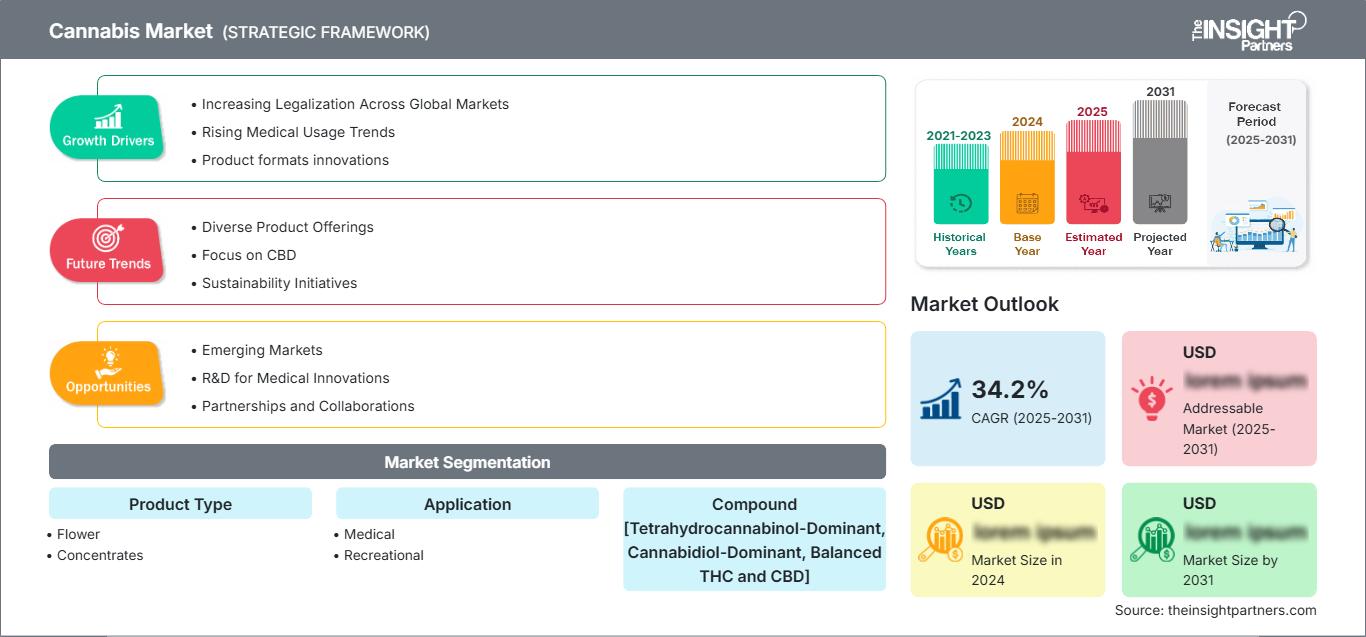
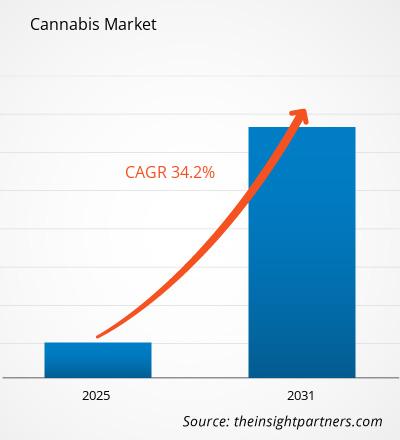
The Cannabis Market is projected to grow from US$ 45.08 Billion in 2025 to US$ 119.94 Billion by 2034, expanding at a CAGR of 11.48% during 2026–2034. Growth reflects broader medical access, adult-use legalization in select jurisdictions, product standardization, and rising demand for regulated formats across flower, concentrates, tetrahydrocannabinol-dominant, cannabidiol-dominant, and balanced THC and CBD products.
Across North America, regulated retail depth, mature cultivation infrastructure, and expanding medical acceptance position the region for an estimated CAGR of 9.8–10.8% through 2034. The Cannabis Market size in the region is supported by state-level licensing in the US, Canadian federal legalization, advanced testing standards, and consumer migration from illicit channels toward traceable branded products.
Cannabis Market Assessment and Insights
- North America held a 61–64% share in 2025 and is expected to grow at a CAGR of 9.8–10.8% during 2026–2034, supported by mature retail networks, high consumer awareness, and regulated medical access.
- US accounted for 82–86% of North America in 2025 and is projected to grow at a CAGR of 10.2–11.2% during 2026–2034, led by dispensary penetration and product innovation.
- Europe represented a 13–16% share in 2025 and is forecast to grow at a CAGR of 12.0–13.5% during 2026–2034, with Germany, the UK, Italy, France, and Spain shaping medical access.
- Asia Pacific captured a 7–10% share in 2025 and is expected to grow at a CAGR of 13.5–15.5% during 2026–2034, led by Australia, Japan, South Korea, India, and selective policy reforms.
- Largest Segment: Flower held a market share of 52–56% in 2025 and is projected to grow at a CAGR of 9.5–10.8% during 2026–2034 due to established consumer familiarity.
- High Growth Segment: Medical application held a market share of 38–42% in 2025 and is expected to grow at a CAGR of 12.5–14.0% during 2026–2034 as prescription routes expand.
- Key companies analyzed in detail: Aphria Inc., Aurora Cannabis Inc., Cannabis Science Inc., Canopy Growth Corporation, Medical Marijuana Inc., VIVO Cannabis Inc., Tikun Olam Ltd., Terra Tech Corp., Tilray Brands Inc., The Cronos Group Inc.
Source: The Insight Partners' analysis based on proprietary research, government publications, company annual reports, investor presentations, industry databases, and expert interviews.
The Cannabis Market has moved from small-scale cultivation and informal distribution toward controlled growing, pharmaceutical-grade processing, digital compliance systems, and branded retail. Climate control, fertigation control, genetic selection, and batch analysis are being used in greenhouse operations to increase consistency in cannabinoids. Discipline in production is also increasing because oversupply in Canada and the US markets has made growers consider the production of more expensive products such as medical marijuana, premium flowers, extracts, and derivatives.
In the future, the industry will invest in the development of medical channels abroad, exports, and technology in patient access. European, Australian, and selective Latin American medical systems have opened up new avenues for commerce. Tailwinds are still inconsistent, although there are expectations for better standards regarding testing, packaging, and the education of doctors.
Cannabis Market Report Scope
| Report Attribute | Details |
|---|---|
| Market size in 2025 | US$ 45.08 Billion |
| Market Size by 2034 | US$ 119.94 Billion |
| Global CAGR (2026 - 2034) | 11.48% |
| Historical Data | 2021-2024 |
| Forecast period | 2026-2034 |
Cannabis Market Analysis
Demand is increasingly shaped by regulated adult-use adoption, chronic pain management, oncology support, sleep-related use, and consumers shifting from smoking-only formats to precision products. Cannabis Market growth depends on creating reliable supply chains that connect genetics, cultivation, extraction, testing, distribution, dispensary operations, and medical consultation platforms without compromising compliance.
Supply dynamics remain bifurcated. Mature markets face price compression in commoditized flower, while medical-grade products command stronger margins because they require standardized potency, contaminant testing, and documented traceability. Operators with EU-GMP capacity, pharmaceutical distribution, and balanced portfolios are better positioned than cultivation-only businesses.
As per the Cannabis Market analysis, the competitive advantage seems to be shifting towards scale, regulation, brand architecture, and capital. The Tilray Brands Inc., Aurora Cannabis Inc., and Canopy Growth Corporation continue to focus on their international medical markets, whereas The Cronos Group Inc., VIVO Cannabis Inc., Tikun Olam Ltd., and Medical Marijuana Inc. maintain their strategic importance due to their specialization, research, and customer/patient positioning.
The allocation of capital has become more selective with the aggressive capacity building over the past few years. Companies with cash generation, light asset distribution, gross margin upside, and exposure to Europe have become the preferred choice for investors. Aphria Inc. has managed to remain relevant with its legacy in the Tilray platform, whereas Terra Tech Corp. and Cannabis Science Inc. demonstrate the fragmented base of specialists.
● REPORT CUSTOMIZATION
Tailor This Report To Align With Your Specific Business Requirements
This report can be customized to align precisely with your business objectives, scope, and target markets. Customization options include tailored segmentation, geography, competitive analysis, and strategic insights to support informed decision-making.
Customize This Report →WHAT YOU CAN ADJUST
- ● Segmentations
- ● Geography
- ● Competitive Analysis
- ● Language Preferences
Cannabis Market: Strategic Insights
Regional Insights
North America Cannabis Market
North America accounted for a 61–64% share in 2025 and is expected to grow at a CAGR of 9.8–10.8% during 2026–2034. The region benefits from deep dispensary infrastructure, strong product testing requirements, state and provincial licensing systems, and rapid acceptance of branded flower, vapes, beverages, edibles, and concentrates across regulated channels.
The Cannabis Market share in North America is anchored by the US and Canada, but growth is increasingly linked to retail normalization and medical integration rather than simple capacity expansion. Producers are shifting from bulk cultivation to premium strains, minor cannabinoid formats, terpene-led differentiation, and physician-supported medical access. Compliance technology, seed-to-sale tracking, and tax optimization remain central to regional profitability.
U.S. Cannabis Market
The US represented 82–86% of North America in 2025 and is projected to expand at a CAGR of 10.2–11.2% during 2026–2034. The legalization at the state level, medical programs, and adult-use dispensary launches are still creating disparities but substantial business opportunities. Flower, infused pre-rolls, concentrate products, and low-dose products that meet the needs of controlled consumption have the highest demand.
Firms are present in multiple states in the form of multistate operators and companies from Canada that prepare for upcoming legislation on the federal level. Tilray Brands Inc., Canopy Growth Corporation, Aurora Cannabis Inc., and The Cronos Group Inc. have strategic flexibility through the branding strategy, partnerships, experience in research, or preparation for federal legalization.
Europe Cannabis Market
Europe held a 13–16% share in 2025 and is forecast to grow at a CAGR of 12.0–13.5% during 2026–2034. Germany is the key nation, owing to medical prescription reforms, pharmacy distribution, and import demand. The UK will continue to grow its private prescription volume, while Italy retains institutional demand through regulated medical channels.
Germany is the key growth nation in the region because of increased physician acceptance, insurance pathways, and pharmacy distribution channels. Producers with EU-GMP accreditation, assured supply, and clinical justification have an edge. Tilray Brands Inc., Aurora Cannabis Inc., and Canopy Growth Corporation stand to benefit from growing product availability and patient education.
France, Italy, and Spain offer a multilayered prospect. France is conservative but still clinically relevant because of medical experimentation and policy analysis. Italy offers assured but controlled demand through public procurement and pharmacies. Spain's social club legacy and nascent medical framework offer promise, but commercial scale depends on established national policies.
APAC Cannabis Market
APAC accounted for a 7–10% share in 2025 and is projected to grow at a CAGR of 13.5–15.5% during 2026–2034. The country is pioneering the usage in the region because of the increasing prescriptions, access to telemedicine, and a wider range of products. In Japan, South Korea, India, and China, the approach has been selective with an emphasis on pharmaceutical, wellness, hemp, or research-related approaches.
There are huge differences in the factors driving policies in the region. The policy for Australia favors commercial development of the medicine, South Korea provides a regulated medical approach, while Japan develops its cannabinoid regulations. For India, it is a traditional and pharmaceutical approach, and for China, it is a hemp-based industrial approach.
Middle East & Africa Cannabis Market
The Middle East & Africa market is expected to grow at a CAGR of 8.5–10.0% during 2026–2034, with South Africa leading due to private-use reform, cultivation potential, and export ambitions. Saudi Arabia and the UAE remain highly restrictive, limiting near-term commercial prospects to research, pharmaceutical review, or monitoring of neighboring trade.
Energy and infrastructure factors shape regional competitiveness. Controlled-environment cultivation requires reliable power, water management, and cold-chain logistics, which favor export-oriented African hubs over restrictive Gulf markets. South Africa, Lesotho, and select Rest of MEA jurisdictions may attract cultivation investment where licensing, quality certification, and international buyer relationships align.
Segmentation Analysis
Product Type
Product Type is expected to grow at a CAGR of 10.5–12.0% during 2026–2034. The Cannabis Market scope across product formats is shaped by consumer familiarity with flower and rising demand for concentrates that offer controlled potency and efficient consumption. Mature regions are seeing premiumization, while emerging medical markets prioritize tested, standardized, and clinically acceptable formulations.
- Flower remains the largest product format because it is familiar to patients and adult-use consumers, supports strain differentiation, and provides dispensaries with a broad pricing ladder from value to premium tiers.
- Concentrates are strategically important as demand rises for high-potency, extract-based products used in vape cartridges, dabbing formats, infused products, and precision medical formulations requiring repeatable cannabinoid profiles.
Application
Application is projected to grow at a CAGR of 11.0–12.8% during 2026–2034. Medical and recreational demand follow different regulatory and commercial routes. Medical use depends on physician confidence, product consistency, and pharmacy or clinic access, while recreational adoption is driven by retail availability, brand trust, pricing, convenience, and substitution from illicit supply.
- Medical is the high growth application as regulatory acceptance improves and patients seek alternatives for pain, spasticity, sleep support, appetite stimulation, and therapy-adjacent symptom management under professional supervision.
- Recreational remains commercially significant in adult-use jurisdictions, where branded retail, experience-led formats, flower quality, low-dose products, and convenient concentrates support repeat purchasing and category expansion.
Compound
Compound is anticipated to grow at a CAGR of 10.8–12.3% during 2026–2034. Compound-level demand reflects patient needs, consumer tolerance, regulatory limits, and therapeutic positioning. THC-dominant products remain central in adult-use channels, CBD-dominant products support wellness-adjacent and medical demand, and balanced THC and CBD formulations are gaining relevance for users seeking moderated effects.
- Tetrahydrocannabinol-Dominant products support adult-use and several medical applications where potency, onset, and strain experience matter, making them important for premium flower, vapor, concentrate, and infused formats.
- Cannabidiol-Dominant products attract medical and wellness-oriented consumers seeking non-intoxicating options, with demand strongest where regulatory frameworks allow oils, capsules, topicals, and pharmaceutical-style preparations.
- Balanced THC and CBD products are strategically relevant for patients and cautious adult consumers because balanced formulations can support differentiated positioning, moderated consumption, and physician-guided treatment pathways.
Opportunity Snapshot
| Segment Name | Revenue Contribution | Trend Tag | Adoption Stage |
| Medical | High | Prescription Access | Scaling |
| Recreational | High | Low Dose | Mature |
Cannabis Market Growth Drivers and Impact Analysis
Expansion of Regulated Medical Access
Access to medical cannabis is perhaps the most impactful structural factor due to the way in which it makes the use of marijuana no longer discretionary but a monitored healthcare-related matter. As the number of countries that legalize prescription by doctors and pharmacy-based distribution, record-keeping, and imports of medical-grade cannabis increases, producers receive alternative revenue streams that are not as sensitive to pricing compared to the adult use retail market. The effect is seen through increased demand for EU-GMP cannabis flowers, oils, and formulations that encourage repeated visits from patients. This factor also enhances institutional involvement as health-related routes involve higher quality standards, adverse event reporting, and patient education.
Shift from Illicit Channels to Tested Retail Products
Retail legalization will directly influence market quality, taxation, and consumer safety through the channeling of demand into legally operated stores and legitimate websites. Today’s consumers look at potency markings, terpene content, testing for contaminants, and reputation before purchase, which places licensed sellers in a defendable position compared to illicit players. The effect is more significant in regions where tax, product selection, and density of shops are in balance sufficient to compete against black market offerings. Price competition is an issue, but legal sellers can counter it using premium flower strains, edibles, extracts, and strategic retail approaches based on customer loyalty.
Product Innovation Across Concentrates and Balanced Formats
Innovation is changing demand from conventional flowers in the form of products with improved accuracy of dosage, speed of effect, and a unique user experience. Concentrates provide for vapes, infused joints, extract, and medicine, whereas THC/CBD balanced products cater to users looking for controlled effects. Innovation is not just about operation, but about business as well, because innovation results in high-value products from biomass and allows better segmentation through branding. Yet, innovation comes with quality control, compliant packaging, and responsible promotion. Those operators who are able to combine scalable extraction, tested potency, and user education can create a product portfolio less dependent on flower.
Cannabis Market Future Trends
Data-Led Personalization in Medical Use
Cannabis Market trends are expected to move toward data-led patient matching, where consultation platforms, prescription histories, symptom tracking, and product response data inform formulation selection. While this paradigm will not displace doctors' discretion, it could help bring a higher degree of structure to prescribing practices and enhance patient retention. There is a possibility for medical operators to acquire digital intake software, train pharmacists, and track adverse events to develop clinically-proven processes. Personalization is expected to work in favor of companies with telehealth solutions, pharmacy affiliations, and standardized product offerings, since they would be able to match patients' needs with a consistent supply of products.
Premiumization of Flower and Derivative Formats
The coming era of product strategy is expected to be based on premium genetics, terpene distinction, craft farming, solventless extraction, and occasion-based packaging. In line with the crowdedness of value flowers, brands will require better indicators of high quality in order to justify prices and prevent customer turnover. Premiumization is also expected to go as far as beverages with lower doses, balanced capsules, and discreet packaging aimed at attracting new customers. It should help producers recover margins in case they can demonstrate the quality, freshness, and safety of their products through batch-level transparency.
Cannabis Market Opportunities
International Medical Export Platforms
Cannabis Market Forecasts indicate a meaningful opportunity for companies that can build export platforms serving Germany, the UK, Australia, and other regulated medical channels. The investment plan should concentrate on EU-GMP certification, sound genetics, validated dehydration and packaging, import licenses, and physician education partnerships. The export-focused approach is interesting due to the decreased dependence on fully developed domestic markets for adult use and the possibility of reaching higher-priced medical needs. Nevertheless, it demands discipline in document management, logistics, and local distributors. Companies having certified production facilities, good connections in the pharmaceutical market, and strong financials may leverage international medical need to generate income at scale without retail build-out of each target country.
Specialized Formulations for Specific Patient Needs
Specialized formulations offer the chance to go above and beyond traditional strain-based promotion, with specialized medical products becoming a possibility. Properly balanced THC and CBD oils, consistent dosage capsules, and condition-specific product education could all serve to build physician comfort and repeat usage by patients. Areas for investment include collaborative research efforts, stability testing, consistent dosing, and proper pharmaceutical packaging. Companies should steer clear of unfounded therapy claims and focus on quality and consistent dosages through their products. The chance is particularly pertinent in jurisdictions where pharmacists and physicians dictate access, as specialized formulation families can increase compliance and provide differentiation from flower-only competition.
Recent Developments
- August 2026: Aurora Cannabis Inc. announced voting results from its 2026 Annual General Meeting, with shareholders approving director nominees, auditor appointment, and advisory executive compensation matters. The company reiterated its medical-first strategy, global footprint across Canada, Europe, Australia, and New Zealand, and continued focus on GMP-certified manufacturing and patient-oriented product supply.
- July 2026: Tilray Brands Inc. reported record fiscal 2026 net revenue of US$ 915 million and highlighted 34% growth in international medical cannabis revenue for the year. The company also reported approximately US$ 235 million in cash, restricted cash, and marketable securities, reinforcing its ability to fund global medical and consumer platform expansion.
- June 2026: Canopy Growth Corporation reported fourth-quarter and fiscal 2026 results, including Q4 FY2026 growth of 27% in Canada medical cannabis net revenue and 68% in international cannabis net revenue. The company also completed the acquisition of MTL Cannabis, strengthening its position in Canada’s medical cannabis channel.
Frequently Asked Questions

- Comprehensive Market Sizing and Forecast Analysis
- Detailed Segmentation Analysis
- In-Depth Market Dynamics Assessment
- Regional and Country-Level Insights
- Competitive Landscape and Company Benchmarking
- Strategic Business Intelligence
Recent Reports
Testimonials

The Insight Partners provided valuable market intelligence that supported our global go-to-market strategy. Their team was professional, responsive, and attentive to our feedback, providing thoughtful analysis and helpful methodological clarifications throughout the project.
Junmo Kim Chief Financial Officer (CFO), Enertech Co., Ltd.
The Insight Partners' SCADA System Market report is comprehensive, with valuable insights on current trends and future forecasts. The team was highly professional, responsive, and supportive throughout. We are very satisfied and highly recommend their services.
RAN KEDEM Partner, Reali Technologies LTDs
I requested a report on a very specific software market and the team produced the report in a few days. The information was very relevant and well presented. I then requested some changes and additions to the report. The team was again very responsive and I got the final report in less than a week.
JEAN-HERVE JENN Chairman, Future Analytica
We worked with The Insight Partners for an important market study and forecast. They gave us clear insights into opportunities and risks, which helped shape our plans. Their research was easy to use and based on solid data. It helped us make smart, confident decisions. We highly recommend them.
PIYUSH NAGPAL Sr. Vice President, High Beam Global
The Insight Partners delivered insightful, well-structured market research with strong domain expertise. Their team was professional and responsive throughout. The user-friendly website made accessing industry reports seamless. We highly recommend them for reliable, high-quality research services
YUKIHIKO ADACHI CEO, Deep Blue, LLC.
This is the first time I have purchased a market report from The Insight Partners.While I was unsure at first, I visited their web site and felt more comfortable to take the risk and purchase a market report.I am completely satisfied with the quality of the report and customer service. I had several questions and comments with the initial report, but after a couple of dialogs over email with their analyst I believe I have a report that I can use as input to our strategic planning process.Thank you so much for taking the extra time and making this a positive experience.I will definitely recommend your service to others and you will be my first call when we need further market data.
JOHN SUZUKI President and Chief Executive Officer, Board Director, BK Technologies
I wish to appreciate your support and the professionalism you displayed in the course of attending to my request for information regarding to infectious disease IVD market in Nigeria. I appreciate your patience, your guidance, and the fact that you were willing to offer a discount, which eventually made it possible for us to close a deal. I look forward to engaging The Insight Partners in the future, all thanks to the impression you have created in me as a result of this first encounter.
DR CHIJIOKE ONYIA MANAGING DIRECTOR, PineCrest Healthcare Ltd.Reason to Buy
- Informed Decision-Making
- Understanding Market Dynamics
- Competitive Analysis
- Identifying Emerging Markets
- Customer Insights
- Market Forecasts
- Risk Mitigation
- Boosting Operational Efficiency
- Strategic Planning
- Investment Justification
- Tracking Industry Innovations
- Aligning with Regulatory Trends





 Get Free Sample for