
Caps and Closures Market Share, Size & Demand by 2034
Caps and Closures Market Size and Forecasts (2021–2034), Global and Regional Share, Trends, and Growth Opportunity Analysis Report Coverage : by Material (HDPE, PP, LDPE, PET, Aluminum); Production Process (Injection Molding, Compression Molding); Type (Screw Closures, Snap Closures, Push-Pull Closures, Tethered Caps); Application (Food and Beverages, Chemicals, Automotive, Personal Care and Cosmetics, Pharmaceuticals); and Geography (North America, Europe, Asia Pacific, and South and Central America)
- Status : Data Released
- Report Code : TIPRE00040537
- Category : Chemicals and Materials
- No. of Pages : 150
- Available Report Formats :


- Last update date : July 27, 2026


2025 Market Size
US$ 56.05 Bn
Base year value
2034 Forecast
US$ 82.5 Bn
Projected by 2034
CAGR 2026-2034
4.95 %
Growth rate
Addressable Market
US$ 647.30 Bn
(2026-2034)
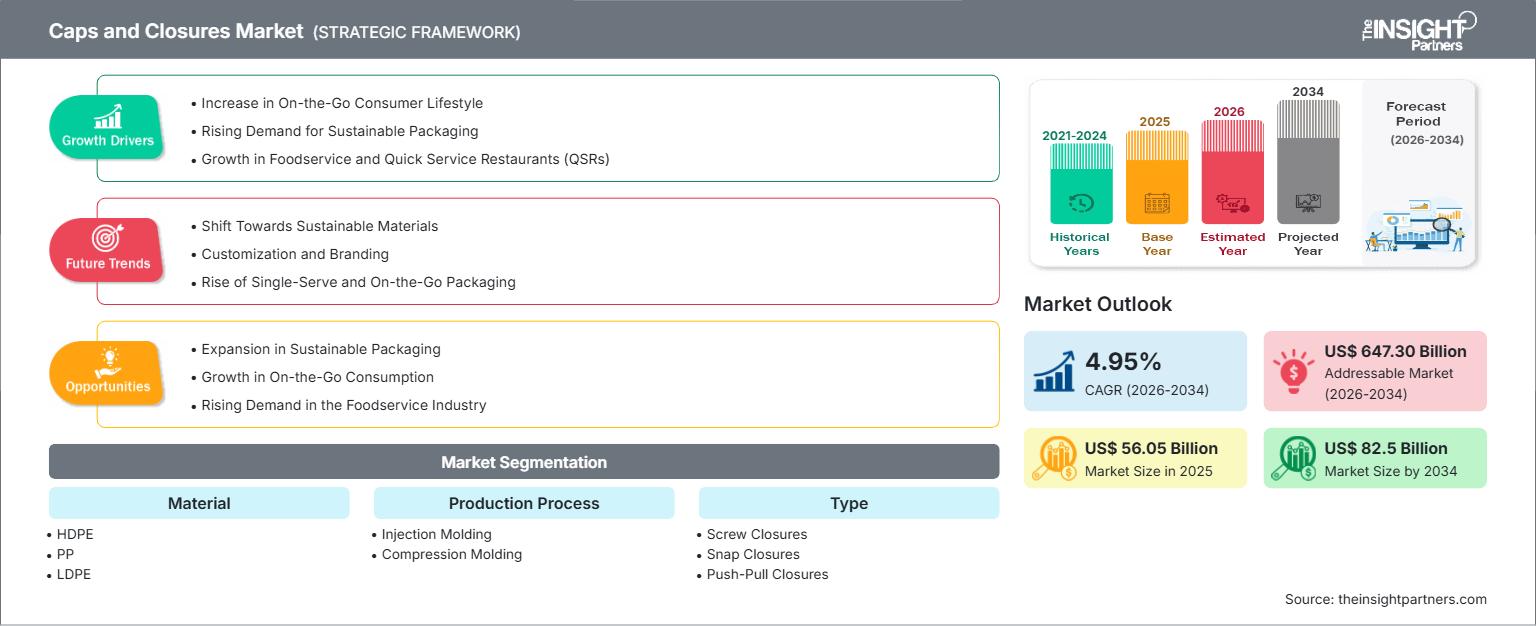
The Caps and Closures market was valued at US$ 56.05 Billion in 2025 and is estimated to be worth US$ 82.5 Billion by 2034 growing at a CAGR of 4.95%. Market growth will be driven by increased consumption of packaged foods, beverages, drugs, personal care, innovations in lightweight, recyclable, and tamper-proof closures. Suppliers will be investing in sustainable and tethered caps in light of changing environmental laws.
In North America, demand is anticipated to remain robust due to high consumption of packaged beverages, expansion in drug manufacture, and adoption of recyclable packaging options. Caps and Closures market size is expected to benefit from investment in high-speed injection-molded closures, premium dispensing solutions. The North American market is expected to grow at an estimated CAGR of 4.2%-4.8% between 2026-2034 fueled by sustainability initiatives by leading brand owners, increasing recycled resins and innovations in product categories.
Caps and Closures Market Assessment and Insights
- North America: Accounted for 29%–31% share in 2025 and is anticipated to register a CAGR of 4.2%–4.8% during 2026–2034. Strong beverage packaging demand, advanced manufacturing infrastructure, and sustainable packaging initiatives continue to reinforce regional competitiveness.
- U.S.: Represented 79%–82% of the North American market in 2025 and is projected to grow at a CAGR of 4.3%–4.9% during 2026–2034, supported by pharmaceutical packaging innovation, bottled water consumption, and premium personal care products.
- Europe: Held 26%–28% share in 2025 while advancing at a CAGR of 4.5%–5.1% during 2026–2034. Germany, France, Italy, and the UK remain leading manufacturing hubs, supported by strict packaging sustainability regulations and rapid adoption of tethered caps.
- Asia Pacific: Accounted for 32%–35% of the Caps and Closures market share in 2025 and is forecast to expand at a CAGR of 5.6%–6.2% during 2026–2034. China, India, Japan, and South Korea continue to benefit from expanding packaged food production, urbanization, and pharmaceutical manufacturing.
- Largest Segment: Food and Beverages represented 45%–49% market share in 2025 and is expected to register a CAGR of 5.0%–5.4% during 2026–2034, driven by increasing demand for bottled beverages, dairy products, edible oils, and convenience foods.
- High Growth Segment: Tethered Caps accounted for 9%–12% market share in 2025 while recording the highest CAGR of 8.0%–8.8% during 2026–2034, supported by sustainability regulations and recycling objectives across beverage packaging.
- Key companies analyzed in detail: Crown Holdings, Inc.; Amcor plc; Berry Global Group, Inc.; Silgan Holdings Inc.; AptarGroup, Inc.; Guala Closures S.p.A.; Jokey SE; Closure Systems International, Inc.; United Caps Luxembourg S.A.; O.Berk Company, LLC.
Source: The Insight Partners' analysis based on proprietary research, government publications, company annual reports, investor presentations, industry databases, and expert interviews.
Manufacturers of packaging materials are moving towards light weight, recyclable, and digitized closures, which increase product protection through minimal use of material. Growth drivers of the Caps and Closures Market include monomaterial packaging solutions, high cavitation injection molding, precision compression molding, and automated processing. Sustainability concerns regarding recyclability and use of recycling content are leading to the continuous development of caps that enable circularity while ensuring that seal performance and consumer safety are not affected. At the same time, the innovations in dispensing systems and tamper-evident technology are making the differentiation within foods, pharmaceuticals, and personal care segments.
Future investments in the market are forecasted to be accelerated in the Asia Pacific region, Latin America, and selected Middle Eastern nations owing to the expansion of global packaging companies' capacity near the end-users. The Caps and Closures market report shows that sustainability regulations, demand for luxury packaging, and rise in pharmaceuticals' production will continue to attract investments. Innovation in tethered closures, bio-polymer, aluminum, and dispensing technologies will be important in terms of competitiveness and circular packaging.
Caps and Closures Market Report Scope
| Report Attribute | Details |
|---|---|
| Market size in 2025 | US$ 56.05 Billion |
| Market Size by 2034 | US$ 82.5 Billion |
| Global CAGR (2026 - 2034) | 4.95% |
| Historical Data | 2021-2024 |
| Forecast period | 2026-2034 |
Caps and Closures Market Analysis
The demand for caps and closures is growing steadily due to the need for reliable sealing solutions that ensure food safety, increased shelf life, and improved protection of pharmaceutical products, cosmetics, and industrial chemicals. The main stages of the market value chain are raw material providers (resins and aluminum), mold makers, closure converters, packagers, fillers, distributors, and end-user brands. Polypropylene, HDPE, PET, and aluminum innovation enable manufacturers to decrease the weight of packages and maintain sealing performance and compliance with applicable regulations. Production lines that are automated increase efficiency and consistency of manufacture.
The supply of recycled polymers, regional resin prices, and investment into high-capacity injection and compression molding are becoming the key factors of supply. In addition, the beverage industry focuses on tethered caps and mono-material packages for better recyclability, and the pharmaceutical industry requires closures to be tamper-evident and child-resistant. The mentioned changes create incentives for partnership between packaging converters and consumer goods manufacturers.
Competition continues to be centered around multinational packaging firms that have a wide range of manufacturing capability, intellectual property and are connected to some of the best brands in the food and beverages, health care and cosmetics segments all over the world. Crown Holdings, Inc., Amcor plc, Berry Global Group, Inc., Silgan Holdings Inc., AptarGroup, Inc. and Guala Closures S.p.A. continue to invest in lightweight packaging, sustainable materials and dispensing innovations whereas companies like Closure Systems International, Inc., United Caps Luxembourg S.A., Jokey SE and O.Berk Company, LLC increase their regional manufacturing capabilities through customization of products and efficiency.
The trends show that investment focus is shifting towards digital manufacturing, automation, recycling capability and advanced mold technology that can support new regulations surrounding sustainability. Collaborations between packaging manufacturers, resin providers and consumer goods producers are leading to an increase in commercialization of next generation closure solutions that are recyclable, have less material requirements and provide consumer conveniences.
● REPORT CUSTOMIZATION
Tailor This Report To Align With Your Specific Business Requirements
This report can be customized to align precisely with your business objectives, scope, and target markets. Customization options include tailored segmentation, geography, competitive analysis, and strategic insights to support informed decision-making.
Customize This Report →WHAT YOU CAN ADJUST
- ● Segmentations
- ● Geography
- ● Competitive Analysis
- ● Language Preferences
Caps and Closures Market: Strategic Insights
Regional Insights
North America Caps and Closures Market
North America held 29%–31% of the market share globally in 2025 and is estimated to record a CAGR of 4.2%–4.8% from 2026 to 2034. The North American region has experienced the advantage of having matured food and beverages packaging sectors, a growing demand for bottled water and carbonated drinks, and an advanced pharmaceutical manufacturing sector. In addition, the increased demand can be attributed to the growing usage of recyclable packages, light weight closure solutions, and automation of manufacturing units.
Regulatory measures to promote circular packages, greater usage of post-consumer recycled plastic, and innovations in the tethered cap design continue to drive the growth of this market. Several major companies within the packaging industry maintain integrated production facilities in the United States, Canada, and Mexico. Growing expenditure on healthcare packaging and premium personal care segments is expected to support regional demand through the forecast period.
U.S. Caps and Closures Market
The United States accounted for 79%-82% of the North America market in 2025 and is expected to grow at a CAGR of 4.3%-4.9% during 2034. There is a well-established manufacturing environment in the United States which is powered by top packaging firms, molding techniques, and high demands from beverage companies, pharma industries, food processing plants, and household product manufacturers. Innovative developments in child resistant, tamper evident, and dispensing closures add value to the products in regulated industries.
High demand due to increasing consumption of bottled beverages, growing ready-to-drink products, and rising pharmaceuticals continue to drive the domestic market growth. Sustainability campaigns of consumer companies are encouraging recycling of polymers and lightweight packaging. Major companies like Crown Holdings, Inc., Silgan Holdings Inc., AptarGroup, Inc., Berry Global Group, Inc., and Closure Systems International, Inc. continue to innovate and make investments in manufacturing innovations.
Europe Caps and Closures Market
Europe held 26%-28% of the global market share in 2025 and is estimated to grow at a CAGR of 4.5%-5.1% between 2026 and 2034. Germany leads the regional market on account of its robust manufacturing base of packaging and extensive food, beverage, and pharmaceutical industries. The packaging sustainability policies and use of tethered caps in Europe have become more popular and will fuel product innovation and investments in recyclable closures.
The UK has steady demand on account of packaging for premium beverages, production of pharmaceuticals, and investments in recycled-content packaging. There is an emphasis on automation and production of lightweight closures which help in achieving the goals of a circular economy.
Germany leads regional production on account of its efficient plastics processing techniques, engineering skills, and exports of packaging machinery. The demand from bottled beverages, dairy, and healthcare packaging helps in driving technological innovations and production.
France, Italy, and Spain together generate significant demand because of the presence of the food processing industry, cosmetics, wine, edible oil, and pharmaceutical segments. The adoption of sustainable packaging materials along with alignment of policies within the European Union will drive future market growth.
APAC Caps and Closures Market
Asia Pacific represented 32%–35% of the global market in 2025 and is expected to record the fastest CAGR of 5.6%–6.2% during 2026–2034. China remains the largest producer and consumer, supported by its extensive packaging manufacturing industry, while India demonstrates strong growth through expanding packaged food and pharmaceutical production.
While Japan and South Korea continue to put their resources into precision dispensing technology and premium packaging applications, Australia has taken an interest in sustainable packaging innovation. These factors along with the government’s involvement in manufacturing, increasing disposable incomes, and urbanization contribute to the region’s growth potential.
Middle East & Africa Caps and Closures Market
The Middle East & Africa market is projected to expand at a CAGR of 4.7%–5.3% during 2026–2034. Saudi Arabia leads regional demand owing to investments in food processing, bottled water production, and industrial packaging, while the UAE benefits from expanding consumer goods manufacturing and logistics infrastructure.
South Africa will remain a major center for production of packaging materials for Sub-Saharan Africa. Increasing investments in production of beverages, healthcare products, and consumer goods, along with continuing industrial diversification in Gulf nations, is expected to fuel the use of caps & closures technology through the forecast period.
Segmentation Analysis
**Material**
The Material segment is projected to expand at a CAGR of 4.8%–5.2% during 2026–2034. Material selection remains a critical factor influencing product performance, cost efficiency, recyclability, and regulatory compliance. Manufacturers continue to optimize polymer formulations and aluminum usage to improve barrier properties, reduce package weight, and support circular economy objectives. Increasing demand for recyclable and food-safe materials is encouraging investments in advanced resin technologies and sustainable manufacturing practices. The Caps and Closures market scope continues to widen as material innovation enables customized closure solutions for diverse end-use industries.
- HDPE: Widely used for beverage, dairy, household chemical, and pharmaceutical packaging owing to its excellent chemical resistance, durability, and cost-effectiveness. Increasing recycled HDPE adoption supports sustainability objectives while maintaining reliable sealing performance.
- PP: Polypropylene remains a preferred material for lightweight closures because of its high fatigue resistance, dimensional stability, and compatibility with high-speed injection molding. It is extensively used in food, beverage, and personal care packaging applications.
- LDPE: LDPE offers superior flexibility and squeeze performance, making it suitable for dispensing closures and specialty packaging formats. Demand remains steady in applications requiring controlled product dispensing and consumer convenience.
- PET: PET closures are gaining adoption due to improved recyclability within mono-material packaging systems. Manufacturers are increasingly utilizing PET for beverage packaging to enhance recycling efficiency and reduce contamination during material recovery.
- Aluminum: Aluminum closures provide premium aesthetics, excellent barrier performance, and high recyclability. They are extensively utilized across wine, spirits, pharmaceuticals, edible oils, and premium food packaging applications requiring superior product protection.
**Production Process**
The Production Process segment is expected to register a CAGR of 4.9%–5.3% during 2026–2034. Production efficiency, precision molding, cycle-time reduction, and material optimization remain major competitive factors. Manufacturers continue investing in advanced automation, multi-cavity tooling, and digital quality inspection systems to improve throughput while reducing manufacturing costs and material waste.
- Injection Molding: The dominant manufacturing process due to its ability to produce complex closure designs with high dimensional accuracy, rapid production cycles, and excellent consistency across large-volume packaging applications.
- Compression Molding: Increasingly adopted for beverage closures because of lower material consumption, shorter production cycles, and improved lightweighting capabilities. The process supports cost optimization while maintaining sealing integrity and product quality.
**Type**
The Type segment is forecast to grow at a CAGR of 5.2%–5.7% during 2026–2034. Product innovation increasingly focuses on improving consumer convenience, regulatory compliance, product safety, and recyclability. Closure manufacturers continue introducing advanced dispensing systems, lightweight designs, and tamper-evident features to meet evolving requirements across food, beverage, pharmaceutical, and personal care packaging.
- Screw Closures: Represent the most widely adopted closure format due to reliable sealing performance, compatibility with diverse packaging materials, and suitability across beverages, food products, chemicals, pharmaceuticals, and cosmetics.
- Snap Closures: Preferred for products requiring convenient opening and closing mechanisms. These closures are commonly utilized in personal care products, household chemicals, and selected food packaging applications.
- Push-Pull Closures: Demand continues to increase for sports drinks, sauces, personal care products, and specialty beverages because they provide controlled dispensing, improved usability, and enhanced consumer convenience.
- Tethered Caps: Rapidly expanding owing to regulatory requirements promoting attached closures for beverage containers. These products improve collection rates during recycling while supporting circular economy initiatives and reducing plastic litter.
**Application**
The Application segment is anticipated to expand at a CAGR of 5.0%–5.4% during 2026–2034. Rising demand for safe, convenient, and sustainable packaging across multiple industries continues to strengthen the adoption of advanced closure technologies. Product customization, enhanced dispensing functionality, and regulatory compliance remain primary purchasing considerations across end-use sectors.
- Food and Beverages: The largest application owing to high global consumption of bottled beverages, dairy products, edible oils, sauces, packaged foods, and ready-to-drink products. Manufacturers prioritize leak-proof, tamper-evident, and lightweight closure solutions.
- Chemicals: Industrial and household chemical packaging requires closures offering chemical resistance, secure sealing, and spill prevention. Demand is supported by expanding specialty chemical production and industrial packaging requirements.
- Automotive: Lubricants, coolants, additives, and automotive fluids require durable closures capable of preventing leakage during transportation and storage while maintaining product integrity under demanding operating conditions.
- Personal Care and Cosmetics: Premium dispensing systems, flip-top caps, pumps, and aesthetically appealing closures continue to gain popularity as cosmetic brands emphasize convenience, product differentiation, and sustainable packaging.
- Pharmaceuticals: Pharmaceutical packaging increasingly utilizes child-resistant, tamper-evident, and precision dispensing closures to comply with regulatory requirements while ensuring patient safety, product protection, and dosage accuracy.
Opportunity Snapshot
| Application | Revenue Contribution | Trend Tag | Adoption Stage |
|---|---|---|---|
| Food and Beverages | High | Tethered Caps | Mature |
| Chemicals | Medium | Chemical Safety | Mature |
| Automotive | Medium | Fluid Sealing | Scaling |
| Personal Care and Cosmetics | Medium | Premium Dispensing | Scaling |
| Pharmaceuticals | High | Child Safety | Scaling |
Caps and Closures Market Growth Drivers and Impact Analysis
Expansion of Packaged Food and Beverage Consumption Worldwide
Growing consumption of packaged foods, bottled beverages, dairy products, edible oils, and ready-to-drink beverages remains one of the strongest growth drivers for the caps and closures market. Rising urbanization, changing consumer lifestyles, and increasing demand for convenience products continue to stimulate packaging production across developed and emerging economies. Food manufacturers increasingly require high-performance closures that provide leak prevention, tamper evidence, extended shelf life, and compatibility with automated filling lines. Premium beverage brands are also investing in lightweight and recyclable closure solutions to improve sustainability performance without compromising functionality. As packaged food production continues to expand globally, manufacturers are increasing investments in advanced molding technologies, recycled polymer processing, and high-speed production systems to meet growing customer requirements while maintaining operational efficiency.
Increasing Regulatory Focus on Sustainable Packaging Solutions
Governments and regulatory agencies are strengthening policies aimed at reducing packaging waste and improving recycling efficiency, encouraging manufacturers to redesign caps and closures using recyclable and lightweight materials. Regulatory measures supporting tethered caps, recycled plastic incorporation, and circular packaging systems are accelerating innovation across the industry. Brand owners increasingly seek closure designs compatible with mono-material packaging and post-consumer recycling infrastructure. These developments are creating new opportunities for manufacturers specializing in sustainable closure technologies while encouraging investment in material science, lightweight engineering, and production automation. Companies capable of delivering environmentally compliant products are expected to strengthen long-term competitiveness as sustainability requirements become increasingly stringent across global packaging markets.
Rapid Growth of Pharmaceutical and Personal Care Packaging
Expansion of pharmaceutical manufacturing, healthcare spending, and premium personal care products is driving sustained demand for specialized closure systems. Pharmaceutical companies require child-resistant, tamper-evident, and contamination-resistant closures that comply with stringent quality and safety regulations. Similarly, cosmetic and personal care brands continue introducing innovative dispensing systems that improve consumer convenience and product differentiation. Aging populations, increasing healthcare access, and rising consumption of wellness products are further supporting demand for advanced packaging components. Manufacturers are responding through investments in precision molding technologies, cleanroom production environments, and innovative dispensing mechanisms that enhance functionality while maintaining regulatory compliance and product integrity.
Caps and Closures Market Future Trends
Accelerated Adoption of Tethered and Circular Packaging Solutions
The Caps and Closures market trends are increasingly shaped by regulatory initiatives promoting circular packaging and higher recycling rates. Beverage manufacturers are accelerating the adoption of tethered caps designed to remain attached to containers throughout their lifecycle, reducing plastic litter and improving collection efficiency. Packaging companies are simultaneously developing mono-material closures, lightweight designs, and recycled-content solutions that simplify recycling processes. Continuous innovation in polymer engineering and manufacturing technologies is expected to enhance closure performance while supporting long-term sustainability objectives across food, beverage, pharmaceutical, and household packaging applications.
Digital Manufacturing and Smart Closure Technologies
Manufacturers are increasingly integrating automation, artificial intelligence, digital quality inspection, and predictive maintenance into closure production facilities to improve manufacturing efficiency and product consistency. Smart dispensing technologies, anti-counterfeiting features, and traceability solutions are also gaining commercial importance, particularly within pharmaceutical and premium beverage packaging. Future investments are expected to focus on digitally connected manufacturing systems capable of reducing production waste, improving process reliability, and enabling faster commercialization of customized closure designs that address evolving customer and regulatory requirements.
Caps and Closures Market Opportunities
Expansion of Sustainable Packaging Manufacturing in Emerging Economies
Emerging economies across the Asia Pacific, Latin America, and the Middle East continue attracting investment in food processing, pharmaceuticals, and consumer goods manufacturing. Caps and Closures Market Forecasts indicate that localized production of recyclable closures, lightweight packaging components, and advanced dispensing systems will create attractive opportunities for both multinational manufacturers and regional suppliers. Establishing manufacturing facilities close to rapidly expanding consumer markets can reduce logistics costs, improve supply chain resilience, and support compliance with local sustainability initiatives. Companies investing in regional production capacity and advanced molding technologies are expected to strengthen long-term competitive positioning while addressing increasing demand for environmentally responsible packaging solutions.
Development of High-Value Pharmaceutical and Functional Dispensing Closures
Growing healthcare expenditure and increasing demand for specialized pharmaceutical packaging create attractive opportunities for manufacturers developing high-performance closure systems. Investment in child-resistant designs, tamper-evident technologies, dosing accuracy, antimicrobial materials, and smart dispensing mechanisms enables companies to serve higher-margin healthcare applications. Similar opportunities are emerging in premium cosmetics, nutraceuticals, and functional beverages where product differentiation depends on innovative dispensing performance and enhanced consumer convenience. Companies emphasizing research and development, material innovation, and regulatory compliance are well-positioned to capture future growth opportunities across rapidly evolving packaging markets.
Recent Developments
- July 2025: Amcor plc introduced the lightweight Hector Child Resistant Closure (CRC) for household products. The polypropylene closure is designed to reduce plastic consumption while maintaining child-resistant performance and achieving high recyclability ratings with HDPE and PET bottles, supporting brand sustainability goals and lightweight packaging strategies.
- April 2025: Amcor plc completed its all-stock combination with Berry Global Group, Inc., creating one of the world's largest packaging companies. The transaction strengthens the combined company's rigid packaging and closure portfolio, expands global manufacturing capabilities, and is expected to accelerate innovation in sustainable caps and closures across food, beverage, healthcare, and personal care markets.
- December 2025: AptarGroup, Inc. expanded its food dispensing portfolio by launching four new closure solutions for specialty sauces, including Tower, Tab Top, Directional Snap Top, and Ecolite Directional Pour Spout. The products improve dispensing precision, hygiene, convenience, and sustainability while addressing evolving consumer and brand requirements in packaged food applications.
Frequently Asked Questions

- Comprehensive Market Sizing and Forecast Analysis
- Detailed Segmentation Analysis
- In-Depth Market Dynamics Assessment
- Regional and Country-Level Insights
- Competitive Landscape and Company Benchmarking
- Strategic Business Intelligence
Recent Reports
Testimonials

The Insight Partners' SCADA System Market report is comprehensive, with valuable insights on current trends and future forecasts. The team was highly professional, responsive, and supportive throughout. We are very satisfied and highly recommend their services.
RAN KEDEM Partner, Reali Technologies LTDs
I requested a report on a very specific software market and the team produced the report in a few days. The information was very relevant and well presented. I then requested some changes and additions to the report. The team was again very responsive and I got the final report in less than a week.
JEAN-HERVE JENN Chairman, Future Analytica
We worked with The Insight Partners for an important market study and forecast. They gave us clear insights into opportunities and risks, which helped shape our plans. Their research was easy to use and based on solid data. It helped us make smart, confident decisions. We highly recommend them.
PIYUSH NAGPAL Sr. Vice President, High Beam Global
The Insight Partners delivered insightful, well-structured market research with strong domain expertise. Their team was professional and responsive throughout. The user-friendly website made accessing industry reports seamless. We highly recommend them for reliable, high-quality research services
YUKIHIKO ADACHI CEO, Deep Blue, LLC.
This is the first time I have purchased a market report from The Insight Partners.While I was unsure at first, I visited their web site and felt more comfortable to take the risk and purchase a market report.I am completely satisfied with the quality of the report and customer service. I had several questions and comments with the initial report, but after a couple of dialogs over email with their analyst I believe I have a report that I can use as input to our strategic planning process.Thank you so much for taking the extra time and making this a positive experience.I will definitely recommend your service to others and you will be my first call when we need further market data.
JOHN SUZUKI President and Chief Executive Officer, Board Director, BK Technologies
I wish to appreciate your support and the professionalism you displayed in the course of attending to my request for information regarding to infectious disease IVD market in Nigeria. I appreciate your patience, your guidance, and the fact that you were willing to offer a discount, which eventually made it possible for us to close a deal. I look forward to engaging The Insight Partners in the future, all thanks to the impression you have created in me as a result of this first encounter.
DR CHIJIOKE ONYIA MANAGING DIRECTOR, PineCrest Healthcare Ltd.Reason to Buy
- Informed Decision-Making
- Understanding Market Dynamics
- Competitive Analysis
- Identifying Emerging Markets
- Customer Insights
- Market Forecasts
- Risk Mitigation
- Boosting Operational Efficiency
- Strategic Planning
- Investment Justification
- Tracking Industry Innovations
- Aligning with Regulatory Trends





 Get Free Sample for