
Carbon Composites Market Size, Share & Forecast by 2034
Coverage: by Matrix (Carbon, Thermoplastic, Ceramic, and Others), Application (Automotive, Aerospace & Defense, Marine Industry, Wind Turbines, Sports, and Others), and Geography (North America, Europe, Asia Pacific, and South and Central America)
- Status : Data Released
- Report Code : TIPRE00015071
- Category : Chemicals and Materials
- No. of Pages : 150
- Available Report Formats :


- Last update date : July 22, 2026


2025 Market Size
US$ 25.46 Bn
Base year value
2034 Forecast
US$ 45.24 Bn
Projected by 2034
CAGR 2026-2034
6.60 %
Growth rate
Addressable Market
US$ 319.73 Bn
(2026-2034)
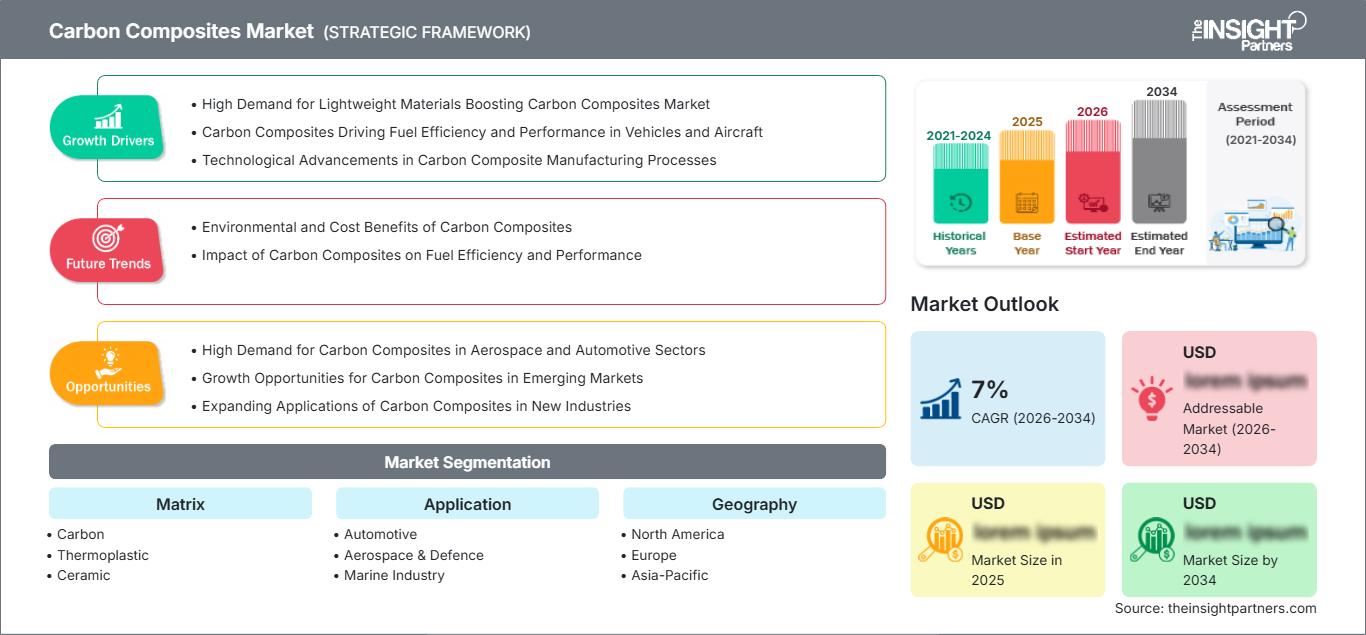
The Carbon Composites market is becoming increasingly indispensable across transportation, aerospace, renewable energy, and industrial engineering because of its exceptional strength-to-weight ratio, corrosion resistance, and fatigue performance. The Carbon Composites market was valued at US$ 25.46 Billion in 2025 and is projected to reach US$ 45.24 Billion by 2034, expanding at a CAGR of 6.60% during 2026–2034. Growing investments in lightweight structural materials, higher production of next-generation aircraft, electric vehicles, and offshore wind installations continue to strengthen long-term industry demand.
North America remains one of the most technologically advanced regional markets, supported by mature aerospace manufacturing, expanding defense modernization programs, and increasing adoption of lightweight automotive components. The Carbon Composites market size across North America is expected to expand at an estimated CAGR of 5.8–6.4% during 2026–2034, with sustained investments in advanced manufacturing, carbon fiber recycling technologies, and high-performance composite applications across commercial aviation, defense, and renewable energy sectors.
Carbon Composites Market Assessment and Insights
- North America: Accounted for a 34–37% share in 2025 and is projected to expand at a CAGR of 5.8–6.4% during 2026–2034, supported by aerospace production, defense procurement, wind energy installations, and increasing lightweight vehicle manufacturing.
- U.S.: Represented 82–86% of the North American market in 2025 and is anticipated to grow at a CAGR of 5.9–6.5% during 2026–2034, driven by aerospace OEMs, defense programs, and advanced automotive manufacturing.
- Europe: Held 27–30% share in 2025 and is forecast to register a CAGR of 6.0–6.7% during 2026–2034, led by Germany, France, the UK, Italy, and Spain through aerospace, automotive, and renewable energy investments.
- Asia Pacific: Captured 28–31% share in 2025 and is expected to witness the fastest regional expansion at a CAGR of 7.2–7.9% during 2026–2034, supported by China, Japan, South Korea, and India through industrial expansion and domestic aerospace programs.
- Largest Segment: Aerospace & Defense accounted for 34–38% market share in 2025 and is projected to grow at a CAGR of 6.4–7.0% during 2026–2034, reflecting continuous demand for lightweight structural materials and fuel-efficient aircraft.
- High Growth Segment: Wind Turbines represented 13–16% market share in 2025 and are anticipated to expand at a CAGR of 8.1–8.8% during 2026–2034, supported by larger rotor blades, offshore wind investments, and renewable energy capacity additions.
- Key companies analyzed in detail: Carbon Composites Inc., Epsilon Composite SA, Hexcel Corporation, Mitsubishi Chemical Carbon Fiber and Composites, Inc., Rock West Composites, Inc., SGL Carbon SE, Solvay SA, Teijin Carbon Europe GmbH, Toray Industries, Inc., Zhongfu Shenying Carbon Fiber Co., Ltd.
Source: The Insight Partners' analysis based on proprietary research, government publications, company annual reports, investor presentations, industry databases, and expert interviews.
The industry of Carbon Composites has grown from one providing advanced material solutions for aerospace-specific applications to that of advanced materials which cover transportation, renewable energy, marine engineering and industrial equipment. Improvements in automated fiber placement technology, resin transfer molding processes, thermoplastic composites processing and digital manufacturing have made the process more efficient and minimized waste in production. Increasing usage of recycled carbon fiber, bio-resin systems and closed loop processes makes the industry more sustainable without deteriorating the structural characteristics.
In the future, growth is set to come more from the manufacturing plants in Asia Pacific, the industrial diversification in the Middle East, and the investment in renewable energy projects around the world. Policies that encourage the development of electric vehicles, decarbonized aircraft, and offshore wind farms will fuel continuous demand for composite materials. On the other hand, the companies are making efforts toward localized manufacturing, automated manufacturing techniques, and recyclable materials.
Carbon Composites Market Report Scope
| Report Attribute | Details |
|---|---|
| Market size in 2025 | US$ 25.46 Billion |
| Market Size by 2034 | US$ 45.24 Billion |
| Global CAGR (2026 - 2034) | 6.60% |
| Historical Data | 2021-2024 |
| Forecast period | 2026-2034 |
Carbon Composites Market Analysis
Growing demand for lightweight structural materials remains the primary catalyst for industry expansion. Automotive manufacturers continue replacing conventional metals with advanced composites to improve fuel efficiency and extend electric vehicle driving range. Simultaneously, commercial aircraft manufacturers increasingly specify carbon composite structures to reduce aircraft weight and improve lifecycle operating economics. Consequently, the Carbon Composites market growth trajectory is supported by long-term structural changes across transportation, renewable energy, and industrial manufacturing.
The market ecosystem includes the production of precursors, carbon fiber production, development of resins, composite manufacturing, component assembly, and after-sales services. Increased investment in precursor manufacturing, lay-up automation systems, and large-scale composite manufacturing is leading to improved scalability of manufacturing processes. Increasing focus on localized supply chains and recycling technologies is aiding in reducing dependence on foreign raw materials by manufacturers.
Competitive intensity continues to increase as established manufacturers expand production capabilities while investing in advanced material technologies. The Carbon Composites market analysis indicates that companies, including Toray Industries, Inc., Hexcel Corporation, Mitsubishi Chemical Carbon Fiber and Composites, Inc., SGL Carbon SE, Solvay SA, and Teijin Carbon Europe GmbH, continue strengthening their positions through product innovation, strategic partnerships, manufacturing expansion, and sustainable material development. Regional specialists such as Epsilon Composite SA, Rock West Composites, Inc., Carbon Composites Inc., and Zhongfu Shenying Carbon Fiber Co., Ltd. are expanding application-specific portfolios to address growing industrial demand.
Investments are increasingly being made in thermoplastic composites, recycled carbon fiber technology, automation systems, and sustainable feedstocks. Programs such as aerospace certification, offshore wind energy, and defense modernization are all contributing to investments in advanced composite technology solutions. New product introductions have shown that the industry is shifting to greener manufacturing methods, as evidenced by the extension of Teijin Carbon’s Tenax Next™ line of sustainable carbon fiber products.
● REPORT CUSTOMIZATION
Tailor This Report To Align With Your Specific Business Requirements
This report can be customized to align precisely with your business objectives, scope, and target markets. Customization options include tailored segmentation, geography, competitive analysis, and strategic insights to support informed decision-making.
Customize This Report →WHAT YOU CAN ADJUST
- ● Segmentations
- ● Geography
- ● Competitive Analysis
- ● Language Preferences
Carbon Composites Market: Strategic Insights
Regional Insights
North America Carbon Composites Market
North America accounted for 34–37% of the Carbon Composites market share in 2025 and is expected to expand at a CAGR of 5.8–6.4% during 2026–2034. These include an existing aerospace manufacturing industry, advanced defense procurement initiatives, and increased production of lightweight electric vehicles. Continuous investments in composite manufacturing technology, automation, and carbon fiber recycling enhance competitiveness in the region even further. Excellent research and development capabilities provided by governments and industry collaboration have also been instrumental in bringing next-generation composite materials to market.
Investment in sustainable aviation, offshore wind energy generation, and high-performance vehicle manufacturing is happening extensively in both the US and Canada. Some of the major composite manufacturers with production, engineering, or technical support facilities in the region include Hexcel Corporation, Toray Industries, Inc., Solvay SA, and Mitsubishi Chemical Carbon Fiber and Composites, Inc. Demand is also expanding in pressure vessels, infrastructure rehabilitation, marine engineering, and industrial equipment, supporting diversified long-term consumption across multiple end-use sectors within the Carbon Composites Market.
U.S. Carbon Composites Market
The U.S. represented 82–86% of the North American market in 2025 and is projected to register a CAGR of 5.9–6.5% during 2026–2034. Strong aerospace manufacturing led by commercial aircraft production and defense modernization remains the principal demand driver. Increasing production of electric vehicles, advanced military platforms, space exploration systems, and hydrogen storage vessels is further supporting domestic composite consumption. Federal investments in infrastructure modernization and clean energy technologies also contribute to expanding application opportunities in the Carbon Composites Market.
The country hosts one of the world's most advanced composite manufacturing ecosystems, including raw material suppliers, component fabricators, research laboratories, and aerospace OEMs. Industry collaborations involving national laboratories and universities continue to improve manufacturing efficiency, thermoplastic processing, and recyclable composite technologies. These developments position the U.S. as the technological leader within North America while supporting export competitiveness across aerospace, industrial, and renewable energy applications.
Europe Carbon Composites Market
Europe held 27–30% of the global market in 2025 and is anticipated to grow at a CAGR of 6.0–6.7% during 2026–2034. Regional demand is supported by stringent carbon emission regulations, lightweight vehicle manufacturing, advanced aerospace production, and aggressive renewable energy deployment. Germany remains the leading market owing to its strong automotive engineering capabilities, industrial automation expertise, and extensive investments in advanced material technologies. Increasing offshore wind capacity further stimulates demand for high-performance composite structures, supporting growth in the Carbon Composites Market.
The UK is consistently innovating and adopting composites within aerospace, motorsports, defense, and marine applications via advanced manufacturing programs backed by the government. The French take advantage of their competitive aerospace sector and investment in hydrogen-based transportation. Italy and Spain are experiencing more requests for composites due to the automotive component and wind energy industries, as well as marine fabrication. The European Union-funded joint ventures are fast-tracking the development and implementation of recyclable thermoplastic composites and reduced emission manufacturing technologies.
APAC Carbon Composites Market
Asia Pacific accounted for 28–31% of the market in 2025 and is forecast to register the highest CAGR of 7.2–7.9% during 2026–2034. China leads regional production through large-scale carbon fiber capacity expansion, while Japan and South Korea continue advancing high-performance aerospace and industrial composite technologies. Growing investments in renewable energy, electric vehicles, advanced manufacturing, and infrastructure development are further strengthening regional demand, making Asia Pacific a key growth engine for the Carbon Composites Market.
India is witnessing rising demand from automotive manufacturing, renewable energy, defense, and infrastructure sectors, whereas Australia contributes through mining, marine engineering, and wind energy projects. Government support for advanced materials manufacturing, domestic aerospace programs, and industrial modernization is expected to sustain long-term regional expansion.
Middle East & Africa Carbon Composites Market
The Middle East & Africa market is projected to expand at a CAGR of 5.6–6.2% during 2026–2034. Saudi Arabia and the United Arab Emirates continue investing in aerospace manufacturing, renewable energy, and industrial diversification initiatives that increasingly utilize advanced composite materials. Growing investments in energy infrastructure, transportation projects, and next-generation manufacturing capabilities are creating additional opportunities for composite adoption, supporting the long-term growth of the Carbon Composites Market.
South Africa remains an important regional manufacturing and mining hub, while the Rest of MEA is gradually adopting composites across energy infrastructure, marine applications, and transportation. Continued investment in clean energy projects and industrial localization is expected to create new opportunities for composite manufacturers throughout the forecast period.
Segmentation Analysis
Matrix
The matrix segment is expected to grow at a CAGR of 6.4–7.0% during 2026–2034. The Carbon Composites market scope continues expanding as manufacturers develop application-specific matrix systems that improve mechanical performance, thermal resistance, and durability. Growing adoption of lightweight structural materials across aerospace, automotive, and renewable energy industries is accelerating demand for advanced matrix technologies, while innovations in recyclable thermoplastic systems are improving long-term sustainability.
- Carbon – Carbon matrix composites deliver excellent thermal stability, wear resistance, and mechanical strength, making them suitable for aerospace components, braking systems, and high-temperature industrial applications requiring exceptional structural integrity.
- Thermoplastic – Thermoplastic composites are increasingly preferred because of rapid processing, recyclability, impact resistance, and shorter manufacturing cycles, supporting large-scale automotive production and next-generation aerospace component manufacturing.
- Ceramic – Ceramic matrix composites provide outstanding oxidation resistance and high-temperature performance, enabling extensive use in aircraft engines, gas turbines, defense systems, and advanced industrial equipment operating under extreme conditions.
Application
The application segment is projected to record a CAGR of 6.8–7.4% during 2026–2034 as composite materials penetrate additional high-performance industries. Increasing focus on lightweight engineering, energy efficiency, structural durability, and emission reduction continues driving adoption across transportation, renewable energy, sports equipment, and marine manufacturing. Technological advancements in automated production further improve commercial viability.
- Automotive – Carbon composites improve fuel efficiency, battery range, crash performance, and structural rigidity while supporting lightweight electric vehicle platforms and premium performance vehicles.
- Aerospace & Defense – The largest application utilizes composite materials extensively in fuselage structures, wings, rotor blades, satellites, military aircraft, and defense equipment to reduce weight and improve operational efficiency.
- Marine Industry – Composite structures offer corrosion resistance, lower maintenance requirements, and improved vessel performance across commercial ships, naval platforms, luxury yachts, and offshore marine equipment.
- Wind Turbines – Longer rotor blades manufactured using carbon composites improve electricity generation efficiency while reducing structural weight, supporting large offshore and onshore wind energy installations.
- Sports – Sporting goods manufacturers increasingly utilize advanced composites in bicycles, golf clubs, tennis rackets, hockey sticks, and protective equipment to enhance durability, strength, and athlete performanc
Opportunity Snapshot
| Application | Revenue Contribution | Trend Tag | Adoption Stage |
| Automotive | High | EV Lightweighting | Scaling |
| Aerospace & Defense | High | Aircraft Efficiency | Mature |
| Marine Industry | Medium | Corrosion Control | Scaling |
| Wind Turbines | High | Offshore Wind | Scaling |
| Sports | Medium | Premium Equipment | Mature |
Carbon Composites Market Growth Drivers and Impact Analysis
Growing Demand for Lightweight Materials Across Aerospace and Transportation
Airplanes, electric vehicles, and military equipment manufacturers continue focusing on lightweight materials used in the construction of their products because of the need to be efficient, consume less fuel, and have low life cycle emissions. The use of carbon composites is very important due to their high strength-to-weight ratio and better fatigue properties than those of metal, thus rendering them fit for use in highly technical areas. Composites continue to be applied in commercial aviation projects in the construction of fuselages, wings, and interior structures in order to achieve the set goals of being sustainable and cost-effective to operate. Electric vehicle manufacturers also use lightweight composite parts in order to balance the extra weight of the batteries. This development will drive investments in advanced technologies, including fiber placement and local production capabilities.
Expansion of Renewable Energy Infrastructure and Wind Turbine Manufacturing
The growing adoption of renewables around the globe is opening new avenues for composite materials used in wind energy development. Today, the modern requirements for the fabrication of onshore and offshore wind power installations include long rotors that should be lightweight but still possess sufficient mechanical strength and fatigue durability. Through carbon composites, developers can design large rotor blades that will enhance the efficiency of energy production without putting additional stress on the structure. Growing investments in the development of offshore wind farms in Europe, North America, and the Asia Pacific region provide a stable demand for composite materials. Moreover, there are various supportive policy measures aimed at promoting renewable energy development.
Technological Advancements in Automated Composite Manufacturing
Automation is revolutionizing composite manufacturing through efficiency gains, cost reductions, and improved product quality. Through automation techniques like automated fiber placement, automated tape laying, resin transfer molding, robotic inspection, and digital quality control, manufacturers are able to boost manufacturing output while still adhering to strict quality standards. Constant advancements in thermoplastic composite manufacturing also ensure shorter manufacturing timeframes and support high-volume industrial applications. Digital manufacturing solutions combined with artificial intelligence and predictive maintenance help improve the performance of production plants. This will ease barriers for wider adoption of composites outside of the aerospace industry to other sectors, including automotive, marine, industrial machinery, infrastructure, and consumer goods, within the next ten years.
Carbon Composites Market Future Trends
Increasing Adoption of Sustainable and Recycled Composite Materials
Growing sustainability commitments across aerospace, automotive, and renewable energy industries are accelerating the development of recyclable carbon fiber materials and lower-carbon manufacturing processes. The Carbon Composites market trends increasingly emphasize circular material flows, bio-based resin systems, recycled fiber integration, and reduced manufacturing waste. Companies are investing in chemical recycling technologies, reclaimed carbon fiber production, and environmentally responsible processing methods to meet evolving environmental regulations and customer expectations. As sustainability becomes a key purchasing criterion, recycled composite solutions are expected to gain broader commercial acceptance while reducing lifecycle environmental impacts and supporting circular economy objectives across multiple industrial sectors.
Rapid Commercialization of Thermoplastic Composite Technologies
Thermoplastic composites will transform future manufacturing with their ability to produce more quickly, increased impact resistance, increased recyclability, and increased compatibility with automation. The use of thermoplastics will reduce assembly times as they allow the materials to be welded rather than bonded with adhesives. Thermoplastics will make cars easier to manufacture as the auto manufacturers will increase the use of thermoplastics for structural electric vehicles, while the aerospace manufacturers will keep on qualifying their use for primary structures of airplanes.
Carbon Composites Market Opportunities
Investment in Next-Generation Aerospace Manufacturing Capacity
The global expansion of commercial aviation, defense modernization programs, and emerging space technologies creates significant opportunities for composite manufacturers to expand production capabilities. The Carbon Composites market Forecasts indicate sustained long-term demand for lightweight aircraft structures, advanced propulsion systems, satellites, uncrewed aerial vehicles, and defense platforms utilizing high-performance composite materials. Investment in automated manufacturing facilities, digital production technologies, and certified aerospace-grade materials can strengthen competitive positioning while addressing rising global aircraft production requirements. Companies capable of delivering scalable, sustainable, and high-quality composite solutions are expected to secure long-term contracts with leading aerospace manufacturers and government defense organizations.
Expansion of Carbon Fiber Recycling and Circular Manufacturing Solutions
Growing regulatory attention toward resource efficiency and industrial sustainability presents attractive opportunities for companies developing carbon fiber recycling technologies. Recovering high-value fibers from manufacturing waste and end-of-life composite structures reduces raw material dependence while improving overall supply chain sustainability. Investment in recycling infrastructure, advanced separation technologies, and secondary material processing can create new revenue streams while supporting environmental compliance. Partnerships between composite manufacturers, automotive companies, aerospace suppliers, and recycling specialists are expected to accelerate the commercialization of circular manufacturing ecosystems capable of supplying cost-effective recycled carbon fiber materials to multiple industrial applications.
Recent Developments
- March 2026: Teijin Carbon Europe GmbH expanded its Tenax Next™ sustainable carbon fiber portfolio at JEC World 2026 by introducing additional industrial-grade materials for mobility, marine, infrastructure, and energy applications. The products utilize circular feedstocks that deliver an audited 36% reduction in CO₂ emissions while maintaining the mechanical performance required for high-volume industrial production.
- March 2026: Hexcel Corporation announced several next-generation composite solutions for aerospace, defense, and automotive markets at JEC World 2026. The company showcased rapid-cure prepregs, new HexTow® IM11 carbon fiber, advanced woven textiles, and multiple manufacturing collaborations aimed at improving lightweight structural performance while supporting composite recycling and circular economy initiatives.
- October 2025: Toray Industries, Inc. and Hyundai Motor Group strengthened their strategic partnership to jointly develop advanced materials for future mobility applications. The collaboration focuses on expanding the use of high-performance composite materials and lightweight technologies that improve vehicle efficiency, electrification, and next-generation automotive manufacturing capabilities.
Frequently Asked Questions

- Comprehensive Market Sizing and Forecast Analysis
- Detailed Segmentation Analysis
- In-Depth Market Dynamics Assessment
- Regional and Country-Level Insights
- Competitive Landscape and Company Benchmarking
- Strategic Business Intelligence
Recent Reports
Testimonials

The Insight Partners' SCADA System Market report is comprehensive, with valuable insights on current trends and future forecasts. The team was highly professional, responsive, and supportive throughout. We are very satisfied and highly recommend their services.
RAN KEDEM Partner, Reali Technologies LTDs
I requested a report on a very specific software market and the team produced the report in a few days. The information was very relevant and well presented. I then requested some changes and additions to the report. The team was again very responsive and I got the final report in less than a week.
JEAN-HERVE JENN Chairman, Future Analytica
We worked with The Insight Partners for an important market study and forecast. They gave us clear insights into opportunities and risks, which helped shape our plans. Their research was easy to use and based on solid data. It helped us make smart, confident decisions. We highly recommend them.
PIYUSH NAGPAL Sr. Vice President, High Beam Global
The Insight Partners delivered insightful, well-structured market research with strong domain expertise. Their team was professional and responsive throughout. The user-friendly website made accessing industry reports seamless. We highly recommend them for reliable, high-quality research services
YUKIHIKO ADACHI CEO, Deep Blue, LLC.
This is the first time I have purchased a market report from The Insight Partners.While I was unsure at first, I visited their web site and felt more comfortable to take the risk and purchase a market report.I am completely satisfied with the quality of the report and customer service. I had several questions and comments with the initial report, but after a couple of dialogs over email with their analyst I believe I have a report that I can use as input to our strategic planning process.Thank you so much for taking the extra time and making this a positive experience.I will definitely recommend your service to others and you will be my first call when we need further market data.
JOHN SUZUKI President and Chief Executive Officer, Board Director, BK Technologies
I wish to appreciate your support and the professionalism you displayed in the course of attending to my request for information regarding to infectious disease IVD market in Nigeria. I appreciate your patience, your guidance, and the fact that you were willing to offer a discount, which eventually made it possible for us to close a deal. I look forward to engaging The Insight Partners in the future, all thanks to the impression you have created in me as a result of this first encounter.
DR CHIJIOKE ONYIA MANAGING DIRECTOR, PineCrest Healthcare Ltd.Reason to Buy
- Informed Decision-Making
- Understanding Market Dynamics
- Competitive Analysis
- Identifying Emerging Markets
- Customer Insights
- Market Forecasts
- Risk Mitigation
- Boosting Operational Efficiency
- Strategic Planning
- Investment Justification
- Tracking Industry Innovations
- Aligning with Regulatory Trends





 Get Free Sample for