
Carbonyl Chloride Market Growth, Size & Forecast by 2034
Coverage: By Type (Gas, Solid); Application (Methylene diphenyldiisocyanate (MDI), Toluene diisocyanate (TDI), Others) , and Geography (North America, Europe, Asia Pacific, and South and Central America)
- Status : Data Released
- Report Code : TIPRE00019929
- Category : Chemicals and Materials
- No. of Pages : 150
- Available Report Formats :


- Last update date : August 11, 2026


2025 Market Size
US$ 1.28 Bn
Base year value
2034 Forecast
US$ 1.94 Bn
Projected by 2034
CAGR 2026-2034
4.76 %
Growth rate
Addressable Market
US$ 14.64 Bn
(2026-2034)
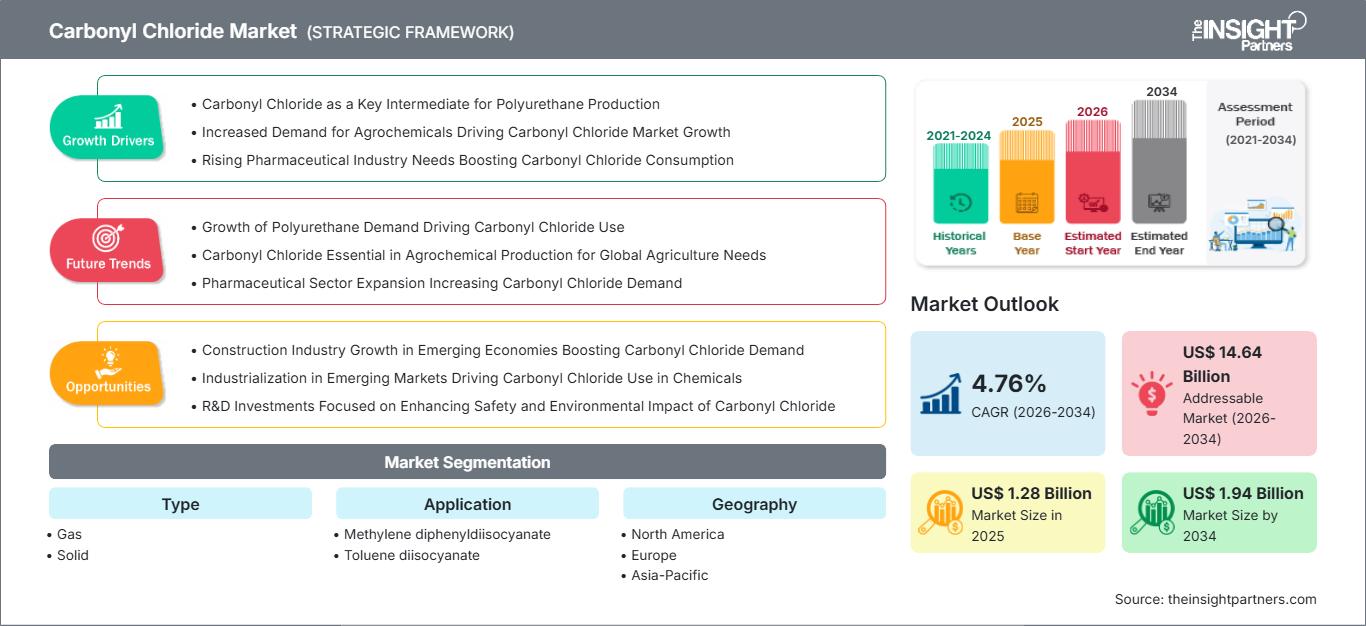
The Carbonyl Chloride market was valued at US$ 1.28 Billion in 2025 and is projected to reach US$ 1.94 Billion by 2034; it is expected to register a CAGR of 4.76% during 2026–2034. Demand remains closely linked to polyurethane intermediates, specialty chemicals, agrochemicals, and pharmaceutical manufacturing. Growth is supported by expanding production capacities for isocyanates, increasing investments in integrated chemical complexes, and the adoption of advanced process technologies that enhance operational safety and production efficiency.
Across North America, the Carbonyl Chloride market size continues to strengthen as regional producers invest in backward-integrated chemical manufacturing and secure domestic feedstock availability. The region is anticipated to expand at a CAGR of 4.2%–4.7% during 2026–2034, supported by rising demand for methylene diphenyl diisocyanate and specialty chemical intermediates. Strict process safety regulations, continuous modernization of production facilities, and sustained investments in high-value polyurethane applications further reinforce long-term market expansion.
Carbonyl Chloride Market Assessment and Insights
- North America: North America accounted for 27%–30% share in 2025 and is expected to register a CAGR of 4.2%–4.7% during 2026–2034. Strong polyurethane production, integrated chemical manufacturing facilities, and investments in process safety technologies continue to support regional demand for carbonyl chloride.
- U.S.: The U.S. represented 82%–86% of the North American market in 2025 and is projected to grow at a CAGR of 4.3%–4.8% through 2034. Domestic production of MDI and TDI, coupled with established specialty chemical manufacturers, sustains market expansion.
- Europe: Europe held 24%–27% share in 2025 and is anticipated to record a CAGR of 4.1%–4.5% during 2026–2034. Germany leads regional production, followed by France, Italy, and the UK, supported by advanced chemical manufacturing infrastructure and stringent industrial safety standards.
- Asia Pacific: Asia Pacific captured 38%–42% share in 2025 and is forecast to grow at a CAGR of 5.3%–5.8% during 2026–2034. China remains the largest producer and consumer, while India, Japan, and South Korea continue expanding downstream polyurethane, pharmaceutical, and specialty chemical manufacturing.
- Largest Segment: Application remained the largest segment with a market share of 68%–72% in 2025, advancing at a CAGR of 4.8%–5.2% during 2026–2034. Demand is primarily driven by methylene diphenyl diisocyanate production, followed by toluene diisocyanate manufacturing for polyurethane applications.
- High Growth Segment: Gas is projected to remain the high-growth segment, representing 62%–66% share in 2025 while expanding at a CAGR of 5.1%–5.6% during 2026–2034. Industrial preference for gaseous carbonyl chloride in continuous production systems and integrated chemical facilities supports sustained adoption.
- Key companies analyzed in detail: BASF SE, Covestro AG, Dalian Special Gases Co., Ltd., Hodogaya Chemical Co., Ltd., Huntsman International LLC, Paushak Limited, PMC Isochem, VanDeMark Chemical, Inc., Vertellus LLC, Wanhua Chemical Group Co., Ltd.
Source: The Insight Partners' analysis based on proprietary research, government publications, company annual reports, investor presentations, industry databases, and expert interviews.
The use of carbonyl chloride as an industrial intermediate has grown from merely being a commodity intermediate to a highly strategic intermediate in manufacturing processes. Through continuous developments in closed-loop manufacturing processes, process digitalization, and emission controls, there have been many efficiencies gained and risks minimized through these innovations. Vertical integration in the polyurethane manufacturing firms has enabled supply stability, providing manufacturers with opportunities to make efficient use of the raw materials in production. There are also technological innovations that favor purity and quality requirements in pharmaceutical and specialty chemicals.
The future development of Carbonyl Chloride Market will largely revolve around the enhancement of production capacities in the Asia Pacific, the updating of chemical facilities in North America, and the development of specialty chemicals manufacturing in Europe. The regulatory requirements for the improvement of workplace safety, compliance with environmental standards, and the development of innovative containment technologies will persistently promote investments in modern facilities. Developing countries will be increasing their manufacturing capabilities to decrease reliance on imports, while the leading manufacturers will continue optimizing the processes of production and signing supply agreements.
Carbonyl Chloride Market Report Scope
| Report Attribute | Details |
|---|---|
| Market size in 2025 | US$ 1.28 Billion |
| Market Size by 2034 | US$ 1.94 Billion |
| Global CAGR (2026 - 2034) | 4.76% |
| Historical Data | 2021-2024 |
| Forecast period | 2026-2034 |
Carbonyl Chloride Market Analysis
Carbonyl Chloride market growth is primarily supported by expanding demand from polyurethane manufacturing, where carbonyl chloride serves as a critical intermediate for methylene diphenyl diisocyanate (MDI) and toluene diisocyanate (TDI) production. The increasing consumption of polyurethane foams, insulation materials, automotive components, coatings, adhesives, elastomers, and construction products continues to strengthen downstream demand. Growth in pharmaceutical synthesis and specialty chemical manufacturing further enhances consumption, particularly for high-purity grades produced under tightly controlled industrial environments.
The value chain for the market is very much integrated, starting from sourcing the raw materials and having specific plants for phosgenation, then the manufacturing of intermediates and chemicals downstream. The use of automated process control technology and containment technology is increasingly being considered to increase efficiencies while complying with the strict regulatory environment regarding environmental protection and occupational safety. There are also long-term procurement agreements made between the producers of feedstocks and downstream users.
The Carbonyl Chloride market analysis indicates that competition is characterized by the presence of vertically integrated multinational chemical companies alongside specialized producers serving pharmaceutical and fine chemical applications. BASF SE, Covestro AG, Huntsman International LLC, Wanhua Chemical Group Co., Ltd., and Vertellus LLC continue investing in operational efficiency, process modernization, and integrated manufacturing assets to strengthen supply capabilities. Meanwhile, Paushak Limited, PMC Isochem, VanDeMark Chemical, Inc., Hodogaya Chemical Co., Ltd., and Dalian Special Gases Co., Ltd. focus on specialized product portfolios, high-purity grades, and customized customer requirements to maintain competitive differentiation.
Market Analysis of Carbonyl Chloride shows that the investments are made on capacity optimization and not expansion, since it involves many regulatory standards and the capital-intensive nature of the production process of carbonyl chloride. The companies continue making investments in digital manufacturing processes, predictive maintenance, advanced safety engineering, and emissions management technology. Strategic partnerships with polyurethane manufacturers and pharmaceutical companies make it possible to increase the resilience of the supply chain, while diversification geographically helps in dealing with the regional demand changes.
● REPORT CUSTOMIZATION
Tailor This Report To Align With Your Specific Business Requirements
This report can be customized to align precisely with your business objectives, scope, and target markets. Customization options include tailored segmentation, geography, competitive analysis, and strategic insights to support informed decision-making.
Customize This Report →WHAT YOU CAN ADJUST
- ● Segmentations
- ● Geography
- ● Competitive Analysis
- ● Language Preferences
Carbonyl Chloride Market: Strategic Insights
Regional Insights
North America Carbonyl Chloride Market
North America accounted for 27%–30% of the global Carbonyl Chloride market share in 2025 and is projected to expand at a CAGR of 4.2%–4.7% during 2026–2034. The regional market benefits from a well-established chemical manufacturing ecosystem, abundant feedstock availability, and advanced production technologies. Growing demand for polyurethane products in the construction, automotive, insulation, and industrial manufacturing sectors is set to maintain the demand for carbonyl chloride. Modernization and automation of facilities will further enhance production efficiency and guarantee compliance with tough environmental and safety standards.
The availability of integrated producers, logistics infrastructure, and steady demand from downstream industries enhances the competitive standing of the region. Digital process monitoring and predictive maintenance, along with closed-loop production, will assist producers in maximizing output without exposing themselves to excessive risks. Increased production of pharmaceuticals and specialty chemicals will open new vistas for the application of carbonyl chloride in North America, one of the largest centers of production and consumption.
U.S. Carbonyl Chloride Market
The U.S. represented 82%–86% of the North American Carbonyl Chloride Market in 2025 and is expected to register a CAGR of 4.3%–4.8% during 2026–2034. It possesses a very high manufacturing capability due to its chemical complexes that provide feedstock and investment in the production of polyurethane. The drivers of this demand are the production of methylene diphenyl diisocyanate and toluene diisocyanate, along with the increasing consumption from industries such as construction, transport, furniture, insulation, and industrial equipment.
Large firms are also making significant investments in their plants through the use of new technology, which not only makes the process more environmentally friendly but also increases efficiency and ensures safety. Manufacturing of pharmaceutical intermediates and specialty chemicals is also contributing to this demand, helping the United States become the primary supplier in North America throughout the forecast period.
Europe Carbonyl Chloride Market
Europe accounted for 24%–27% of the global Carbonyl Chloride Market in 2025 and is projected to expand at a CAGR of 4.1%–4.5% during 2026–2034. Germany remains the leading producer owing to its highly integrated chemical industry, extensive polyurethane manufacturing capacity, and strong research capabilities. The other advantage that the nation enjoys is that of having a strong industrial base, which involves the development of technologies that enhance the production process and at the same time, meet strict environmental requirements.
In the case of the United Kingdom, it maintains its demand in terms of specialty chemicals manufacturing and pharmaceutical production, along with research and development, whereas in the case of France, there is a strong support of chemical manufacturing and industrial use in the country. In Italy and Spain, there is continued development of downstream polyurethane processing and industrial chemical manufacturing.
APAC Carbonyl Chloride Market
Asia Pacific held 38%–42% of the global Carbonyl Chloride Market in 2025 and is anticipated to grow at a CAGR of 5.3%–5.8% during 2026–2034, making it the fastest-growing regional market. China leads regional production due to its extensive polyurethane manufacturing industry, while Japan and South Korea contribute through advanced specialty chemical and pharmaceutical production.
India continues expanding domestic chemical manufacturing capacity, supported by industrial investments and infrastructure development, while Australia provides demand from specialty chemicals and mining-related industrial applications. Favorable industrial policies, growing downstream manufacturing, and increasing investments in integrated chemical complexes continue to strengthen regional growth prospects.
Middle East & Africa Carbonyl Chloride Market
The Middle East & Africa market is projected to register a CAGR of 3.8%–4.3% during 2026–2034. Saudi Arabia leads regional demand through expanding petrochemical integration and investments in downstream chemical manufacturing. The UAE continues strengthening its specialty chemical sector, supported by industrial diversification initiatives and modern chemical processing facilities.
South Africa remains an important contributor through established industrial manufacturing and specialty chemical applications, while the Rest of the Middle East & Africa is witnessing gradual expansion supported by infrastructure development and increasing industrialization. Growing investments in energy, petrochemicals, and manufacturing diversification are expected to create long-term opportunities for carbonyl chloride consumption across the region.
Segmentation Analysis
Type
The Type segment is expected to grow at a CAGR of 4.5%–5.0% during 2026–2034. The Carbonyl Chloride market scope covers both gaseous and solid forms, each serving distinct industrial requirements. Selection depends on production scale, handling methods, transportation considerations, and downstream processing needs. Continuous investments in advanced containment systems, process automation, and safety technologies are supporting efficient utilization across chemical manufacturing facilities, while increasing demand for polyurethane intermediates and specialty chemicals continues to strengthen the overall segment outlook.
- Gas: Gas is the most widely utilized form because it enables continuous processing in integrated chemical plants. High production efficiency, consistent purity, and compatibility with large-scale MDI and TDI manufacturing make it the preferred industrial choice.
- Solid: Solid carbonyl chloride is primarily used for specialized laboratory applications, research activities, and selected fine chemical processes where controlled handling, transportation flexibility, and smaller production volumes are operationally advantageous.
Application
The Application segment is anticipated to expand at a CAGR of 4.8%–5.2% during 2026–2034. Demand is primarily influenced by the production of isocyanates used in polyurethane manufacturing, with additional opportunities emerging from specialty chemical synthesis. Expanding construction, automotive, insulation, electronics, and industrial manufacturing sectors continue to increase downstream consumption, encouraging manufacturers to optimize production efficiency, strengthen supply chain integration, and invest in advanced processing technologies.
- Methylene diphenyldiisocyanate: This application represents the largest share of market demand due to extensive utilization in rigid polyurethane foams, insulation materials, automotive components, construction products, adhesives, coatings, and industrial equipment manufacturing worldwide.
- Toluene diisocyanate: Toluene diisocyanate remains a strategically important application, supporting the production of flexible polyurethane foams widely used in furniture, bedding, automotive seating, packaging materials, and consumer goods requiring lightweight cushioning and durability.
Opportunity Snapshot
| Application | Revenue Contribution | Trend Tag | Adoption Stage |
| Methylene Diphenyldiisocyanate | High | Rigid Foams | Mature |
| Toluene Diisocyanate | Medium | Flexible Foams | Scaling |
Carbonyl Chloride Market Growth Drivers and Impact Analysis
Growing Demand for Polyurethane-Based Construction and Insulation Materials
The increasing usage of polyurethane products in the construction of homes, offices, and industrial facilities remains one of the key factors that drives the demand for carbonyl chloride. Carbonyl chloride is used as an important precursor in the manufacture of methylene diphenyl diisocyanate and toluene diisocyanate, which are commonly employed in the manufacture of rigid and flexible polyurethane foams. Investments in energy-efficient buildings, cold chain facilities, and modern insulation systems have been driving the demand for such products. Countries are imposing strict energy-efficient building codes and encouraging the use of modern insulating materials. With the expansion of construction activity in developed and developing countries, there is an increasing demand for carbonyl chloride in the production of polyurethane products.
Expansion of Automotive Manufacturing and Lightweight Material Adoption
The growth in world automotive production drives up the demand for polyurethane parts produced through the use of isocyanates produced from carbonyl chloride. Automotive manufacturers are utilizing polyurethane material in various parts, including seat assemblies, interior trims, insulation, dashboard parts, and other structures to enhance efficiency. The production of electric vehicles also drives high demand for insulation and acoustic materials, as well as lightweight structures. There are investments being made to provide the latest chemical process technology for the provision of high-quality intermediate materials in compliance with environmental and safety standards.
Increasing Consumption of Specialty Chemicals and Pharmaceutical Intermediates
Carbonyl Chloride continues to be a critical raw material used in many speciality chemicals and pharmaceutical manufacturing processes that require purity and precise reaction controls. The increase in the number of pharmaceutical manufacturing operations, increased agrochemicals manufacturing, and the rising research on the manufacture of novel chemicals contribute to market demand. Manufacturers are focusing on automation of their production process, digital controls and better containment methods in order to ensure safety during the operation. Focus on the development of premium specialty chemicals along with increased investment in fine chemicals manufacturing in the Asia Pacific and North America regions, is likely to drive demand in the future.
Carbonyl Chloride Market Future Trends
Expansion of Digitally Integrated and Safer Chemical Manufacturing Facilities
The Carbonyl Chloride Market trends indicate a growing transition toward digitally integrated manufacturing facilities equipped with advanced automation, real-time monitoring, artificial intelligence-enabled predictive maintenance, and enhanced process safety systems. Producers are increasingly modernizing phosgenation units with closed-loop operations, automated leak detection, and continuous process optimization to improve operational efficiency while minimizing environmental and workplace risks. The adoption of digital manufacturing platforms is also strengthening production consistency, reducing maintenance downtime, and improving regulatory compliance. As sustainability expectations increase, investments in energy-efficient production technologies and advanced emission-control systems are expected to become standard practice across major chemical manufacturing facilities, supporting long-term competitiveness and operational resilience.
Growing Shift Toward Regional Supply Chain Diversification
Manufacturers are increasingly diversifying production networks and establishing regional supply capabilities to reduce dependence on single manufacturing locations and improve supply chain resilience. Expanding chemical manufacturing investments across Asia Pacific, North America, and selected Middle Eastern countries are creating more balanced production ecosystems capable of supporting regional demand. Companies are strengthening strategic partnerships with downstream polyurethane and specialty chemical producers while increasing inventory optimization and logistics efficiency. The trend toward localized manufacturing is expected to reduce transportation risks, improve response times for industrial customers, and enhance supply reliability, particularly for highly regulated chemicals requiring specialized handling and controlled distribution networks.
Carbonyl Chloride Market Opportunities
Expansion of Integrated Chemical Manufacturing Capacity in Emerging Economies
The Carbonyl Chloride Market Forecasts indicate significant investment opportunities in emerging economies that continue expanding domestic chemical manufacturing infrastructure. Countries across the Asia Pacific and the Middle East are investing in integrated petrochemical complexes capable of producing polyurethane intermediates, specialty chemicals, and pharmaceutical ingredients. These developments create favorable conditions for new carbonyl chloride production facilities supported by improved feedstock availability and modern industrial infrastructure. Companies that establish regional manufacturing partnerships, adopt advanced safety technologies, and develop integrated value chains will be better positioned to benefit from increasing local demand while reducing logistics costs and strengthening long-term supply security.
Development of High-Purity Grades for Pharmaceutical and Specialty Chemical Applications
Increasing demand for high-value pharmaceutical intermediates and specialty chemicals presents attractive opportunities for manufacturers capable of producing ultra-high-purity carbonyl chloride under stringent quality standards. Pharmaceutical companies require consistent raw material quality, advanced contamination control, and reliable long-term supply relationships to support complex synthesis processes. Investments in purification technologies, automated quality control systems, digital manufacturing, and advanced containment solutions enable producers to address these specialized market requirements. Companies focusing on differentiated product portfolios and customized supply agreements can strengthen profitability while expanding their presence in premium industrial applications that demand superior product performance and regulatory compliance.
Recent Developments
- March 2026: BASF SE announced that its Intermediates division converted the entire portfolio of acid chlorides and chloroformates produced at Ludwigshafen to renewable electricity. The company also confirmed that its modernized production asset increased capacity by approximately 30% while reducing the average product carbon footprint by 19% in 2025, strengthening long-term supply security for downstream chemical manufacturers.
- March 2026: BASF SE announced that its Intermediates division transitioned the entire Ludwigshafen portfolio of acid chlorides and chloroformates to 100% renewable electricity, covering approximately 25 products and all upstream raw material processes. The company also completed the modernization of its Ludwigshafen production asset, increasing acid chloride and chloroformate production capacity by approximately 30% while reducing the average product carbon footprint by 19% in 2025. The initiative strengthens long-term supply security for carbonyl derivative value chains, including pharmaceutical and specialty chemical applications.
Frequently Asked Questions

- Comprehensive Market Sizing and Forecast Analysis
- Detailed Segmentation Analysis
- In-Depth Market Dynamics Assessment
- Regional and Country-Level Insights
- Competitive Landscape and Company Benchmarking
- Strategic Business Intelligence
Recent Reports
Testimonials

The Insight Partners' SCADA System Market report is comprehensive, with valuable insights on current trends and future forecasts. The team was highly professional, responsive, and supportive throughout. We are very satisfied and highly recommend their services.
RAN KEDEM Partner, Reali Technologies LTDs
I requested a report on a very specific software market and the team produced the report in a few days. The information was very relevant and well presented. I then requested some changes and additions to the report. The team was again very responsive and I got the final report in less than a week.
JEAN-HERVE JENN Chairman, Future Analytica
We worked with The Insight Partners for an important market study and forecast. They gave us clear insights into opportunities and risks, which helped shape our plans. Their research was easy to use and based on solid data. It helped us make smart, confident decisions. We highly recommend them.
PIYUSH NAGPAL Sr. Vice President, High Beam Global
The Insight Partners delivered insightful, well-structured market research with strong domain expertise. Their team was professional and responsive throughout. The user-friendly website made accessing industry reports seamless. We highly recommend them for reliable, high-quality research services
YUKIHIKO ADACHI CEO, Deep Blue, LLC.
This is the first time I have purchased a market report from The Insight Partners.While I was unsure at first, I visited their web site and felt more comfortable to take the risk and purchase a market report.I am completely satisfied with the quality of the report and customer service. I had several questions and comments with the initial report, but after a couple of dialogs over email with their analyst I believe I have a report that I can use as input to our strategic planning process.Thank you so much for taking the extra time and making this a positive experience.I will definitely recommend your service to others and you will be my first call when we need further market data.
JOHN SUZUKI President and Chief Executive Officer, Board Director, BK Technologies
I wish to appreciate your support and the professionalism you displayed in the course of attending to my request for information regarding to infectious disease IVD market in Nigeria. I appreciate your patience, your guidance, and the fact that you were willing to offer a discount, which eventually made it possible for us to close a deal. I look forward to engaging The Insight Partners in the future, all thanks to the impression you have created in me as a result of this first encounter.
DR CHIJIOKE ONYIA MANAGING DIRECTOR, PineCrest Healthcare Ltd.Reason to Buy
- Informed Decision-Making
- Understanding Market Dynamics
- Competitive Analysis
- Identifying Emerging Markets
- Customer Insights
- Market Forecasts
- Risk Mitigation
- Boosting Operational Efficiency
- Strategic Planning
- Investment Justification
- Tracking Industry Innovations
- Aligning with Regulatory Trends





 Get Free Sample for