
Emollient Esters Market Size, Share & Trends by 2034
Emollient Esters Market Size and Forecasts (2021–2034), Global and Regional Share, Trends, and Growth Opportunity Analysis Report Coverage : by Type (Alkyl Esters, Fatty Acid Esters, Tricetyl Citrate, Isoamyl Laurate, Stearyl Stearate, Isopropyl Myristate, Propylene Glycol Esters); Functionality (Moisturizing Agents, Skin Conditioning Agents, Solvents and Emulsifiers, Film Formers, Anti-aging Agents); Application (Personal Care and Cosmetics, Pharmaceuticals, Industrial Applications, Food & Beverages); and Geography (North America, Europe, Asia Pacific, and South and Central America)
- Status : Data Released
- Report Code : TIPRE00040569
- Category : Chemicals and Materials
- No. of Pages : 150
- Available Report Formats :


- Last update date : August 18, 2026


2025 Market Size
US$ 549.95 Mn
Base year value
2034 Forecast
US$ 793.5 Mn
Projected by 2034
CAGR 2026-2034
4.16 %
Growth rate
Addressable Market
US$ 6,102.01 Mn
(2026-2034)
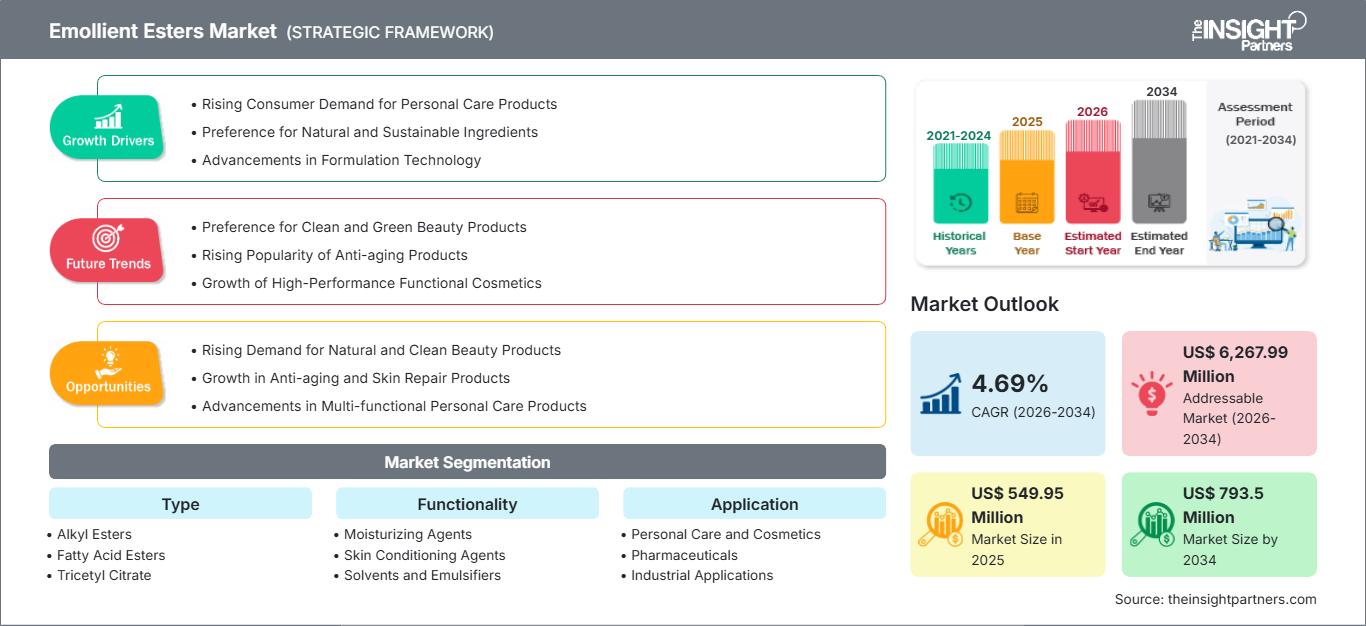
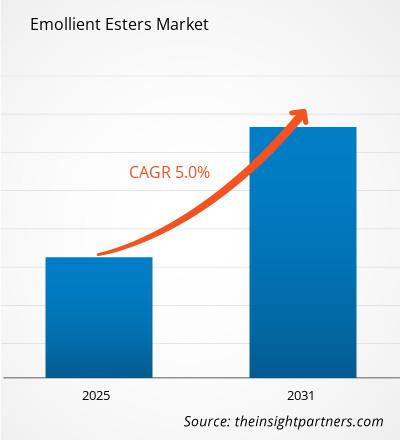
The Emollient Esters market was valued at US$ 549.95 million in 2025 and is expected to reach US$ 793.5 million by 2034; it is estimated to record a CAGR of 4.16% during 2026-2034.
Emollient Esters Market Assessment and Insights
- North America: Share in 2025 of 31–35% and CAGR between 4.2–5.0%. Demand is supported by premium skincare, OTC topical innovation, and mature specialty chemical distribution across the US and Canada.
- US: Share in 2025 of 79–83% of North America and CAGR between 4.1–4.9%. Strong cosmetic formulation activity and pharmaceutical topical development sustain national demand.
- Europe: Share in 2025 of 27–31% and CAGR between 3.8–4.6%. Germany, France, the UK, Italy, and Spain lead through regulated cosmetics production and sustainability-led ingredient substitution.
- Asia Pacific: Share in 2025 of 28–32% and CAGR between 5.2–6.0%. China, Japan, South Korea, India, and Australia drive demand through beauty manufacturing scale and rising skincare consumption.
- Largest Segment: Personal Care and Cosmetics held market share of 64–68% in 2025 and CAGR of 4.6–5.4% during 2026–2034, reflecting ester use in creams, lotions, sunscreens, makeup, and haircare.
- High Growth Segment: Anti-aging Agents held market share of 13–17% in 2025 and CAGR of 5.6–6.4% during 2026–2034, benefiting from active delivery and premium texture requirements.
- Key companies analyzed in detail: The Dow Chemical Company, BASF SE, Evonik Industries AG, The Lubrizol Corporation, Clariant AG, Croda International Plc, Stepan Company, Ashland Inc., Innospec Inc., Lonza Group AG, KLK OLEO, IOI Oleo GmbH, Nisshin OilliO Group, Ltd., Oleon NV, Wacker Chemie AG.
Source: The Insight Partners' analysis based on proprietary research, government publications, company annual reports, investor presentations, industry databases, and expert interviews.
Technological advances are changing the focus from simple emolliency to complex esters providing functionality that includes moisturizing, solubilizing, sensory enhancement, pigment dispersing, and actives delivering. Manufacturers are increasing the purity, fragrance notes, oxidative stability, biodegradability, and expanding vegetable-derived feedstock platforms. These developments coincide with cosmetics firms' interest in lighter feel, reduced dependence on silicones, and dependable performance in creams, sticks, serums, sun protection formulations, and topical pharmaceutical products.
In the forecast period, investments will be made in Asia Pacific capacities, bio-based ester chemistry, and increased technical support for indie and multinational brands. Focus on ingredient safety, transparent sourcing, and sustainability of palm-based ingredients in regulations will benefit suppliers with the oleochemical supply chain traceable. Increased consumption in India, China, ASEAN, and Gulf region beauty industry will support constant consumption in North America and Europe.
Supplier evaluation has also become increasingly sophisticated because brand owners demand that ingredient blends be easier to launch worldwide. That makes it essential for manufacturers to maintain records of their toxicology, allergens, natural origins, and compatibility in various emulsions, anhydrous products, sticks, and gels. Those that integrate oleochemicals with applications testing laboratories are less likely to make mistakes and increase their participation.
Emollient Esters Market Report Scope
| Report Attribute | Details |
|---|---|
| Market size in 2025 | US$ 549.95 Million |
| Market Size by 2034 | US$ 793.5 Million |
| Global CAGR (2026 - 2034) | 4.16% |
| Historical Data | 2021-2024 |
| Forecast period | 2026-2034 |
Emollient Esters Market Analysis
The route of development of the Emollient Esters market will be driven by increased usage of skincare products on a daily basis, increased penetration of sunscreens and demand for sensorial ingredients which aid in quick absorption with no oily residues. Esters will also contribute in balancing active compounds, fragrances, pigments and oils in stable emulsions. The supply will continue being dependent on fatty alcohols, fatty acids, palm, coconut derivatives and synthetics intermediates. Major manufacturers will increasingly develop oleochemical integration and quality control due to the rising demands for consistency in color, odor, traceability and biodegradability from the side of brand owners.
Price stability will differ by grade since commodity esters will experience more pressure on margins compared to the specialty grades related to the mildness properties, silicones replacement and active compounds' delivery. Buyers are thus segmenting their suppliers in terms of risks, feedstocks safety, documentation and formulating capabilities. Such an attitude is driving major companies to develop local inventories, technical services and unique ester families instead of depending on the advantages of large-scale manufacturing alone.
Current Emollient Esters Market analysis reveals a fairly consolidated competitive landscape characterized by presence of key global specialty chemicals companies having extensive personal care product range. These include BASF SE, Croda International Plc, Evonik Industries AG, The Lubrizol Corporation, Clariant AG, and Stepan Company who are competing based on sensory laboratories, application testing and being of natural origin apart from pricing.
Positioning strategy is also affected by manufacturing capability at regional level. Firms like KLK OLEO, IOI Oleo GmbH, Oleon NV, and Nisshin OilliO Group, Ltd are gaining an advantage with oleochemical feedstock knowledge, whereas Ashland Inc, Innospec Inc, Lonza Group AG, The Dow Chemical Company, and Wacker Chemie AG are reinforcing their position with formulation additives, distribution networks and technical services.
● REPORT CUSTOMIZATION
Tailor This Report To Align With Your Specific Business Requirements
This report can be customized to align precisely with your business objectives, scope, and target markets. Customization options include tailored segmentation, geography, competitive analysis, and strategic insights to support informed decision-making.
Customize This Report →WHAT YOU CAN ADJUST
- ● Segmentations
- ● Geography
- ● Competitive Analysis
- ● Language Preferences
Emollient Esters Market: Strategic Insights
Regional Insights
North America Emollient Esters Market
North America had 31-35% of the 2025 revenue and was expected to register a CAGR of 4.2-5.0%. The Emollient Esters Market share can be attributed to the high adoption rate of premium moisturizers, sunscreens, color cosmetics, and topical dermatology products.
There would be demand due to the specialized chemical distribution network, high claims testing, and product innovation based on sensory differentiation. American formulators were opting for esters that enhance spreading and lower tackiness, along with active delivery in multifunctional formulations.
U.S. Emollient Esters Market
United States constituted 79–83% of the North American market share in 2025 and is anticipated to grow at a CAGR of 4.1–4.9%. Internal demands include large personal care companies, contract manufacturers, and OTC dermatology companies that need dependable excipients.
Organizational presence is ensured via sales, technical facilities, and distribution networks offered by The Dow Chemical Company, BASF SE, The Lubrizol Corporation, Stepan Company, Ashland Inc., and Innospec Inc. Growth potential is high in moisturizer usage, sun care products, makeup and sensitive skin products.
Europe Emollient Esters Market
Europe represented 27–31% of 2025 revenue and should grow at a 3.8–4.6% CAGR. Germany leads regional demand because of specialty chemical production, cosmetics formulation capacity, and strong regulatory discipline under EU cosmetic safety rules.
The UK remains important for premium beauty innovation and fast-moving indie brands, while France benefits from prestige cosmetics and dermocosmetic exports. Italy and Spain add demand through sun care, color cosmetics, and contract manufacturing. Sustainability screening continues to favor biodegradable, renewable, and traceable ester chemistries.
APAC Emollient Esters Market
Asia Pacific accounted for 28–32% of 2025 revenue and is forecast to grow at a 5.2–6.0% CAGR. China is the leading national market, supported by cosmetics manufacturing scale, e-commerce beauty brands, and premium skincare adoption.
Japan and South Korea emphasize refined sensory performance and innovation in emulsions, serums, and sun care. India is expanding through rising disposable income and local beauty manufacturing, while Australia supports clean-label and sun-protection formulations. Policy support for safer ingredients and domestic manufacturing strengthens the regional outlook.
Middle East & Africa Emollient Esters Market
The region is expected to experience growth in the range of 4.5–5.3% CAGR. Saudi Arabia is set to dominate regional consumption due to increased retail and tourism as well as manufacturing activities for purposes of economic diversification.
United Arab Emirates is supportive of premium personal care and fragranced formulations, while South Africa drives consumption via existing cosmetic and pharmaceutical channels. Growth in the rest of MEA is tied to urbanization, skincare products for warm climate conditions, sun care and multinationals’ personal care brands.
Segmentation Analysis
Type
The Type segment is projected to grow at a 4.4–5.2% CAGR during 2026–2034. The Emollient Esters Market scope is widening as formulators select esters for targeted sensory profiles, polarity, solubility, and compatibility with active systems across skincare, makeup, pharmaceutical, and industrial formulations.
- Alkyl Esters: Alkyl esters support light skin feel, fast spreading, and good pigment wetting, making them strategically important in lotions, color cosmetics, sunscreens, and non-greasy daily care products.
- Fatty Acid Esters: Fatty acid esters remain versatile workhorse ingredients because they combine emolliency, lubrication, and formulation stability across creams, balms, ointments, and haircare products.
- Tricetyl Citrate: Tricetyl citrate serves niche applications where plasticizing, emollient, and film-modifying properties are required, particularly in specialized personal care and pharmaceutical formulations.
- Isoamyl Laurate: Isoamyl laurate is valued as a natural-origin, silicone-alternative ester offering dry touch, spreadability, and biodegradable positioning for clean beauty and lightweight skincare systems.
- Stearyl Stearate: Stearyl stearate provides structure, consistency, and conditioning effects in sticks, creams, and balms, supporting products requiring richer texture and stable solid or semi-solid formats.
- Isopropyl Myristate: Isopropyl myristate remains widely used for penetration enhancement, solvent functionality, and smooth skin feel in topical pharmaceuticals, cosmetics, and personal care formulations.
- Propylene Glycol Esters: Propylene glycol esters offer emulsification support, conditioning, and formulation flexibility, serving products that require balanced solubility, texture modification, and process stability.
Functionality
The Functionality segment is expected to grow at a 4.5–5.3% CAGR. Esters are increasingly selected not only for softness but also for improved delivery, sensory identity, film behavior, and compatibility with actives. Multifunctionality helps brands reduce ingredient complexity while supporting premium claims.
- Moisturizing Agents: Moisturizing applications remain central because esters reduce transepidermal water loss perception, improve softness, and enhance the finish of daily creams and body care products.
- Skin Conditioning Agents: Skin conditioning use is expanding as brands target smoothness, barrier comfort, and mildness in products for sensitive skin, facial care, and dermatology-adjacent formulations.
- Solvents and Emulsifiers: Solvent and emulsifier functions are strategically important where esters help dissolve actives, disperse oils, stabilize emulsions, and improve processing efficiency for formulators.
- Film Formers: Film-forming roles support sunscreens, makeup, and protective products by improving surface coverage, water resistance perception, and durability without compromising sensorial comfort.
- Anti-aging Agents: Anti-aging applications benefit from esters that support active delivery, premium texture, and consumer-preferred after-feel in serums, creams, eye products, and treatment-led skincare.
Application
The Application segment is forecast to record a 4.6–5.4% CAGR. Personal care dominates, but pharmaceutical, industrial, and food-related uses give suppliers diversified demand. Growth depends on ingredient safety documentation, sensory innovation, and ability to meet clean-label or pharmacopeial expectations.
- Personal Care and Cosmetics: Personal care and cosmetics form the largest application, driven by moisturizers, sunscreens, makeup, haircare, and multifunctional skincare formulations requiring lightweight texture and stability.
- Pharmaceuticals: Pharmaceutical use is supported by topical creams, ointments, gels, and transdermal systems where selected esters improve spreadability, solubilization, skin feel, and active compatibility.
- Industrial Applications: Industrial applications include lubricants, coatings, and specialty formulations where ester chemistry provides lubrication, solvency, plasticizing effects, and potential biodegradability benefits.
- Food & Beverages: Food and beverages remain limited but relevant where approved ester chemistries support processing aids, flavor systems, or functional ingredient applications under strict regulatory controls.
Opportunity Snapshot
| Segment Name | Revenue Contribution | Trend Tag | Adoption Stage |
| Personal Care and Cosmetics | High | Clean Beauty | Mature |
| Pharmaceuticals | Medium | Topical Delivery | Scaling |
| Industrial Applications | Low | Bio Lubricants | Emerging |
| Food & Beverages | Low | Approved Additives | Emerging |
Emollient Esters Market Growth Drivers and Impact Analysis
Shift Toward Lightweight Multifunctional Skincare
As consumers opt for hydrating makeup and moisturizer products that do not leave an oily residue, it is a good time for esters as the benefit in glide, absorption, distribution, and feel is very important for product differentiation. Market-wise, the need for esters increases when formulations are made to incorporate multiple features like barrier function, sun protection, coloration, and anti-aging benefits. Formulation with esters allows one to reduce the usage of thick oils or certain silicones as esters will provide a cleaner feel.
Expansion of Topical Pharmaceutical and Dermocosmetic Products
Topical pharmaceutical and dermocosmetic products increasingly require excipients that are skin compatible, stable, and suitable for active delivery. Esters such as isopropyl myristate are widely recognized for helping improve application properties and solubilization in creams, gels, and ointments. Population aging, increased dermatology awareness, and the tendency to opt for less invasive treatment options will boost the demand for topical formulations with good design. Those ingredient providers who offer high-quality ingredients as per pharmacopeia standards will gain access to better value propositions. The other important aspect of this trend is a reduced reliance on cosmetics alone.
Sustainable Feedstock and Silicone-Alternative Reformulation
Beauty brands are reformulating products to reduce environmental concerns, improve biodegradability claims, and increase renewable content. Bio-based ester options directly support this transition because they can deliver sensory performance similar to selected silicones while aligning with natural-origin positioning. The impact extends across mass, premium, and professional product lines as retailers and consumers scrutinize ingredient lists. Suppliers with RSPO-aligned palm sourcing, vegetable oil chemistry, and transparent life-cycle narratives are better positioned for preferred supplier status. Over time, sustainability expectations should shift ester selection from a cost-based decision toward a performance, compliance, and brand-trust decision.
Emollient Esters Market Future Trends
Bio-Based Sensory Engineering
Future Emollient Esters Market trends will increasingly focus on bio-based sensory engineering, where natural-origin esters are designed to match specific textures, absorption rates, and skin finishes. Rather than selling ingredients only by chemical identity, suppliers will offer application-ready sensory maps for serum, sunscreen, makeup, and body care formats. This approach can shorten formulation cycles for brands facing faster product launch pressure. It will also encourage closer collaboration between ingredient producers, contract manufacturers, and beauty laboratories, especially in Asia Pacific and Europe, where sustainability claims and premium textures are strongly linked to product differentiation.
Higher Documentation Standards for Ingredient Transparency
Ingredient selection is expected to become more documentation-intensive as brands respond to tighter safety scrutiny, consumer transparency expectations, and retailer compliance requirements. Ester suppliers will need to provide traceability, allergen data, biodegradability information, natural-origin indexes, and regulatory support across multiple regions. This trend will favor larger and technically capable producers that can support global launches without reformulation delays. Smaller suppliers may still compete in niche natural ingredients but will need stronger certification partnerships. As documentation becomes a commercial differentiator, technical service quality will influence purchasing decisions alongside price, sensory performance, and availability.
Emollient Esters Market Opportunities
Localized Supply for Asia Pacific Beauty Manufacturing
Asia Pacific offers investment opportunities for suppliers that can localize production, warehousing, and technical support near beauty manufacturing clusters. China, South Korea, Japan, India, and ASEAN markets require quick sample turnaround, consistent availability, and adaptation to local textures and climate preferences. Strategies aligned with Emollient Esters Market Forecasts should prioritize regional application labs, distributor training, and bio-based product lines that meet both global and domestic brand requirements. Companies able to combine cost competitiveness with documentation and formulation support can expand beyond commodity ester sales into higher-margin specialty ingredient partnerships.
Specialty Esters for Dermatology-Led Premium Care
Dermatology-led skincare, sensitive-skin products, and clinical-positioned beauty lines create room for specialty esters with clear safety, mildness, and delivery benefits. Investment should focus on grades suitable for barrier-repair creams, anti-aging serums, post-procedure care, and medicated topical systems. These applications often tolerate higher ingredient costs when performance, documentation, and consumer comfort are strong. Suppliers can differentiate through co-development with formulators, stability data, and claims support. The opportunity is attractive because it bridges cosmetics and pharmaceuticals, allowing companies to participate in premium product cycles while reducing exposure to low-margin commodity formulations.
Recent Developments
- October 2025: BRB showcases its Emfinity® Esters at in-cosmetics Asia, emphasizing a range of mostly plant-based, biodegradable, and natural multifunctional esters. These esters are designed for ease of use and cater to diverse application needs, supporting formulations that vary from light to rich textures while integrating patented innovation with proven industry standards.
- April 2025: Jojoba Desert has launched two new ingredient lines, JD Esteris Plus and JD Beads, expanding its product category JD Esters. These lines offer sustainable, high-performance solutions based on oil-free hydrogenated jojoba oil, focusing on sensory performance and texture functionality. JD Esteris Plus features jojoba wax esters enriched with Vitamin E, serving as body-formers to enhance texture and stability in diverse formulations, including creams, balms, and solid applications.
Frequently Asked Questions

- Comprehensive Market Sizing and Forecast Analysis
- Detailed Segmentation Analysis
- In-Depth Market Dynamics Assessment
- Regional and Country-Level Insights
- Competitive Landscape and Company Benchmarking
- Strategic Business Intelligence
Recent Reports
Testimonials

The Insight Partners' SCADA System Market report is comprehensive, with valuable insights on current trends and future forecasts. The team was highly professional, responsive, and supportive throughout. We are very satisfied and highly recommend their services.
RAN KEDEM Partner, Reali Technologies LTDs
I requested a report on a very specific software market and the team produced the report in a few days. The information was very relevant and well presented. I then requested some changes and additions to the report. The team was again very responsive and I got the final report in less than a week.
JEAN-HERVE JENN Chairman, Future Analytica
We worked with The Insight Partners for an important market study and forecast. They gave us clear insights into opportunities and risks, which helped shape our plans. Their research was easy to use and based on solid data. It helped us make smart, confident decisions. We highly recommend them.
PIYUSH NAGPAL Sr. Vice President, High Beam Global
The Insight Partners delivered insightful, well-structured market research with strong domain expertise. Their team was professional and responsive throughout. The user-friendly website made accessing industry reports seamless. We highly recommend them for reliable, high-quality research services
YUKIHIKO ADACHI CEO, Deep Blue, LLC.
This is the first time I have purchased a market report from The Insight Partners.While I was unsure at first, I visited their web site and felt more comfortable to take the risk and purchase a market report.I am completely satisfied with the quality of the report and customer service. I had several questions and comments with the initial report, but after a couple of dialogs over email with their analyst I believe I have a report that I can use as input to our strategic planning process.Thank you so much for taking the extra time and making this a positive experience.I will definitely recommend your service to others and you will be my first call when we need further market data.
JOHN SUZUKI President and Chief Executive Officer, Board Director, BK Technologies
I wish to appreciate your support and the professionalism you displayed in the course of attending to my request for information regarding to infectious disease IVD market in Nigeria. I appreciate your patience, your guidance, and the fact that you were willing to offer a discount, which eventually made it possible for us to close a deal. I look forward to engaging The Insight Partners in the future, all thanks to the impression you have created in me as a result of this first encounter.
DR CHIJIOKE ONYIA MANAGING DIRECTOR, PineCrest Healthcare Ltd.Reason to Buy
- Informed Decision-Making
- Understanding Market Dynamics
- Competitive Analysis
- Identifying Emerging Markets
- Customer Insights
- Market Forecasts
- Risk Mitigation
- Boosting Operational Efficiency
- Strategic Planning
- Investment Justification
- Tracking Industry Innovations
- Aligning with Regulatory Trends





 Get Free Sample for