
Cardiac Mapping Systems Market Growth, Demand & Size by 2034
Coverage: by Product (Contact Mapping Systems, Non-contact Mapping Systems); Indication (Atrial Fibrillation, Atrial Flutter, AVNRT), and Geography (North America, Europe, Asia Pacific, and South and Central America)
- Status : Data Released
- Report Code : TIPRE00011937
- Category : Life Sciences
- No. of Pages : 150
- Available Report Formats :


- Last update date : September 07, 2026


2025 Market Size
US$ 3.08 Bn
Base year value
2034 Forecast
US$ 4.41 Bn
Projected by 2034
CAGR 2026-2034
4.07 %
Growth rate
Addressable Market
US$ 34.02 Bn
(2026-2034)
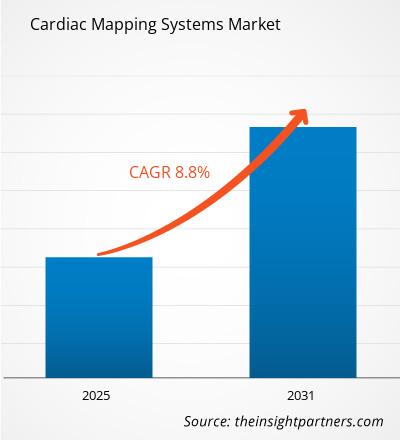
The global Cardiac Mapping Systems market was valued at US$ 3.08 billion in 2025 and is expected to reach US$ 4.41 billion by 2034; it is estimated to record a CAGR of 4.07% during 2026-2034.
Cardiac Mapping Systems Market Assessment and Insights
- North America: The region represented a 38–40% share in 2025 and is projected to record a CAGR between 4.2–4.8% during 2026–2034, supported by electrophysiology laboratory density, reimbursement access, and early adoption of integrated ablation platforms.
- US: The country accounted for 84–86% of North American revenue in 2025 and is expected to grow at a CAGR between 4.1–4.7% during 2026–2034.
- Europe: Europe held a 27–29% share in 2025 and is forecast to expand at a CAGR between 4.0–4.6% during 2026–2034. Germany, the UK, France, Italy, and Spain lead procedural adoption.
- Asia Pacific: Asia Pacific represented a 23–25% share in 2025 and is expected to register a CAGR between 5.2–5.8% during 2026–2034. China, Japan, South Korea, India, and Australia support regional expansion.
- Largest Segment: Contact mapping systems held a 74–78% market share in 2025 and are projected to grow at a CAGR between 4.3–4.9% during 2026–2034.
- High Growth Segment: Non-contact mapping systems represented a 22–26% market share in 2025 and are expected to register a CAGR between 5.2–5.8% during 2026–2034.
- Key companies analyzed in detail: Abbott Laboratories, Acutus Medical, Inc., Biosense Webster, Inc., BIOTRONIK SE & Co. KG, Boston Scientific Corporation, EP Solutions SA, Koninklijke Philips N.V., Lepu Medical Technology (Beijing) Co., Ltd., Medtronic plc, and MicroPort Scientific Corporation.
Source: The Insight Partners' analysis based on proprietary research, government publications, company annual reports, investor presentations, industry databases, and expert interviews.
Heart mapping has evolved from sequential point measurement and fluoroscopy-reliant catheter positioning to advanced three-dimensional technologies, which include electrograms, anatomical modeling, intracardiac imaging, and automated signal interpretation. The production process dynamics have become more oriented towards interoperable systems with consoles, catheters with sensors, software modules, and repeating sales of disposable products. Contact heart mapping technology has been clinically validated already, whereas non-contact heart mapping is gaining interest among developers due to its capability to maintain non-regular activations in full-chamber imaging.
In the forecast period, the investments will be made into the development of integrated heart mapping-ablation systems, artificial intelligence-powered anatomical modeling, and low-fluoroscopy procedures. Asia-Pacific is projected to attract incremental installations due to growing capacities for electrophysiology of specialist hospitals. European conformity assessment, FDA approval, and post-market data-gathering projects will probably drive upgrade cycles, yet financial planning and training will impact the adoption rate in community hospitals and developing healthcare systems.
Cardiac Mapping Systems Market Report Scope
| Report Attribute | Details |
|---|---|
| Market size in 2025 | US$ 3.08 Billion |
| Market Size by 2034 | US$ 4.41 Billion |
| Global CAGR (2026 - 2034) | 4.07% |
| Historical Data | 2021-2024 |
| Forecast period | 2026-2034 |
Cardiac Mapping Systems Market Analysis
The growing number of arrhythmias detected, aging demographics, and increased adoption of catheter ablation drive Cardiac Mapping Systems Market growth. Atrial fibrillation and atrial flutter were experienced by an estimated 52.55 million people across the globe in 2021, representing a 137% rise since 1990. The burden of such disease expands the base of patients that need electrophysiological investigation. The hospital is considered to be the primary purchaser, while mapping console suppliers, catheter vendors, imaging organizations, software developers, distributors, and clinicians education providers form the complementary ecosystem.
The supply dynamics become increasingly focused on portfolio approach and not standalone mapping consoles. Manufacturers provide capital equipment together with compatible mapping catheters, technical support, navigation patches, software updates, and ablation technology. Such approach brings regular revenue but creates switching barriers for the hospitals. Therefore, the considerations of mapping accuracy, compatibility of catheters, procedure duration, ability to serve the installed base, regulatory status, and reducing fluoroscopy exposure are important for purchase decisions.
According to the Cardiac Mapping Systems Market analysis, the market has a highly concentrated competitive landscape dominated by Abbott Laboratories, Biosense Webster, Inc., Boston Scientific Corporation, and Medtronic plc. In turn, all those companies position mapping as the element of electrophysiological workflow. Abbott specializes in omnipolar and high-density options, Biosense Webster incorporates CARTO mapping technology with intracardiac imaging and pulsed field ablation, Boston Scientific integrates OPAL HDx with navigation-enabled FARAPULSE catheter systems, and Medtronic couples Affera mapping with focal or single-shot ablation.
The specialists strive to differentiate themselves in terms of signal reconstruction, noncontact measurement, and software-defined mapping solutions. Acutus Medical, Inc. supplied the assets of AcQMap, which were later acquired by EnChannel Medical, while EP Solutions SA specializes in noninvasive cardiac mapping. BIOTRONIK SE & Co. KG, Koninklijke Philips N.V., Lepu Medical Technology (Beijing) Co., Ltd., and MicroPort Scientific Corporation engage through their electrophysiology, imaging, navigation, or interventional solutions.
● REPORT CUSTOMIZATION
Tailor This Report To Align With Your Specific Business Requirements
This report can be customized to align precisely with your business objectives, scope, and target markets. Customization options include tailored segmentation, geography, competitive analysis, and strategic insights to support informed decision-making.
Customize This Report →WHAT YOU CAN ADJUST
- ● Segmentations
- ● Geography
- ● Competitive Analysis
- ● Language Preferences
Cardiac Mapping Systems Market: Strategic Insights

Regional Insights
North America Cardiac Mapping Systems Market
North America held a 38–40% Cardiac Mapping Systems Market share in 2025 and is projected to register a 4.2–4.8% CAGR during 2026–2034. The market enjoys existing electrophysiology referral networks, significant presence of 3D mapping systems, and availability of leading-edge ablation systems. The FDA pathways further incentivize vendors to perform their pivotal trials and launch integrated mapping, imaging, and therapeutic platforms.
The growth will be driven by replacement cycles, software upgrades, and new applications outside the leading academic hospitals. Canada is contributing in terms of universal hospital systems and dedicated cardiac centers, whereas Mexico presents a smaller but growing market confined to private hospitals. In the region, there is an increasing interest in platforms that reduce the number of workflow stages, offer fluoroless or minimally fluoro procedures, and integrate mapping with pulsed field/radiofrequency ablation.
U.S. Cardiac Mapping Systems Market
The U.S. represented 84–86% of North American revenue in 2025 and is forecast to expand at a 4.1–4.7% CAGR during 2026–2034. Abbott Laboratories, Biosense Webster, Inc., Boston Scientific Corporation, and Medtronic plc maintain strong commercial and clinical footprints. Competitive activity is shaped by FDA approvals, post-market studies, physician training, and integration between mapping consoles, catheters, intracardiac imaging, and ablation generators.
Indications are expanding beyond classic atrial fibrillation mapping into persistent atrial fibrillation, repeat procedures, atrial flutter, and selected complex substrates. Hospitals are increasingly evaluating systems for their overall economic cost in terms of the entire procedure, not merely its console cost. Early discharge policies, decreased fluoroscopy, automatic anatomy generation, and reduced catheter changes may enhance lab efficiency and make workflow an important consideration in decision making.
Europe Cardiac Mapping Systems Market
Europe accounted for a 27–29% share in 2025 and is expected to register a 4.0–4.6% CAGR through 2034. Germany uses their advanced hospitals and electrophysiology facilities to drive the process. In the UK, there is the presence of specialist National Health Service facilities coupled with high levels of atrial fibrillation, while the limitations in capital will push them to procure based on workflow benefits and use.
The French make adoption easy using cardiac centers and reimbursement processes. In Italy and Spain, adoption will be helped by electrophysiology programs distributed nationally, though with regional differences in funding making equipment replacements difficult. In this case, having a CE mark may help speed up the adoption process before wider launch worldwide. It is estimated that the rise of Western European atrial fibrillation and flutter incidences from 600,735 in 2021 to 723,218 in 2044 will necessitate long-term mapping.
APAC Cardiac Mapping Systems Market
Asia Pacific held a 23–25% share in 2025 and is projected to grow at a 5.2–5.8% CAGR during 2026–2034. Japan leads regional value through advanced cardiac care, reimbursement structures, and specialist adoption, while China offers substantial hospital expansion potential. South Korea and Australia support premium technology uptake.
India’s opportunity is concentrated in tertiary private hospitals and expanding cardiac networks. Regional policy support for medical technology, local manufacturing, specialist training, and infrastructure investment should widen access, although affordability and uneven electrophysiologist availability remain adoption constraints.
Middle East & Africa Cardiac Mapping Systems Market
The Middle East and Africa region is expected to register a 3.8–4.4% CAGR during 2026–2034. Saudi Arabia leads through hospital modernization, specialist cardiac centers, and national healthcare investment. The UAE supports premium adoption through concentrated tertiary facilities and medical tourism, while South Africa remains the principal sub-Saharan market.
Across the rest of MEA, infrastructure availability, catheter affordability, and specialist scarcity constrain installations. Investment in digitally connected hospitals and cardiovascular referral pathways can improve access, but procurement will remain concentrated in metropolitan public hospitals and private networks.
Segmentation Analysis
Product
The Product segment is expected to grow at a 4.4–5.0% CAGR during 2026–2034. The Cardiac Mapping Systems Market scope by product reflects a balance between established contact-based platforms and emerging non-contact approaches. Contact systems benefit from procedural familiarity and substantial installed bases, whereas demand for non-contact reconstruction is supported by interest in capturing complex, irregular activation across an entire chamber.
- Contact Mapping Systems: These systems retain the leading position because direct electrode-tissue measurements, three-dimensional catheter localization, high-density acquisition, and compatibility with established ablation workflows support routine electrophysiology use.
- Non-contact Mapping Systems: Demand is developing around single-beat, full-chamber reconstruction for irregular rhythms, offering strategic value in persistent atrial fibrillation and other cases where sequential contact acquisition may be challenging.
Indication
The Indication segment is forecast to register a 4.5–5.1% CAGR during 2026–2034. Clinical demand is anchored by atrial fibrillation, although mapping remains important for atrial flutter and AVNRT procedures. Adoption varies according to arrhythmia complexity, ablation volume, referral pathways, and requirements for substrate characterization. Increasing detection through digital monitoring can expand the diagnosed population entering specialist evaluation.
- Atrial Fibrillation: This indication provides the largest demand base because pulmonary vein isolation, persistent disease, recurrent procedures, and substrate assessment require precise anatomical visualization and electrical signal interpretation.
- Atrial Flutter: Mapping supports identification of macro-reentrant circuits and confirmation of conduction block, making the indication strategically relevant for efficient cavotricuspid isthmus and atypical flutter procedures.
- AVNRT: Systems assist clinicians in defining atrioventricular nodal anatomy and electrical pathways, supporting targeted slow-pathway modification while helping reduce unintended injury to normal conduction tissue.
Opportunity Snapshot
| Indication | Revenue Contribution | Trend Tag | Adoption Stage |
| Atrial Fibrillation | High | PFA Integration | Scaling |
| Atrial Flutter | Medium | Circuit Mapping | Mature |
| AVNRT | Low | Precision Localization | Mature |
Cardiac Mapping Systems Market Growth Drivers and Impact Analysis
Expanding Atrial Fibrillation Treatment Pool
The Cardiac Mapping Systems Market forecast shows that an increasing frequency of diagnosis of atrial fibrillation leads to an expanding group of patients who need electrophysiology studies and catheter ablation. Prevalence of the disease globally grew from around 33.5 million people in 2010 to 59 million people in 2019, whereas lifetime risk of the disease starting at 45 years of age is estimated between one in three to one in five patients. The necessity for mapping systems increases along with patient progression from paroxysmal to persistent forms or repeated procedures. Economic benefit does not stop at console installations but expands to include mapping catheters usage, software updates, service contracts, and training for doctors.
Integration of Mapping, Imaging, and Ablation
Platforms help in minimizing the disruption in workflows by providing a connection between anatomical reconstruction, electro-anatomical mapping, catheter navigation, intracardiac imaging, and delivery of energy. The CARTO system from Biosense Webster, the Affera platform by Medtronic, and the OPAL HDx platform by Boston Scientific represent some of the platforms developed by vendors to build connected procedural architecture rather than devices that operate independently. The reduced number of exchanges can help in minimizing the process, and the real-time imaging can assist in determining the catheter positioning and lesioning. For vendors, integration can lead to recurring disposable attach and help in retaining the platform. For hospitals, there can be advantages in terms of procedural standardization and training efficiencies, but dependency on proprietary hardware can make it difficult to switch.
Growth of High-Density and Automated Mapping
High-density electrode configurations and automated signal-processing software enable electrophysiologists to collect larger datasets and identify clinically relevant activation patterns more efficiently. Machine learning-supported anatomy creation, automated point acquisition, far-field signal reduction, and improved substrate characterization can reduce manual interpretation burdens in complex procedures. These capabilities are particularly relevant for persistent atrial fibrillation and repeat ablation, where scar, fibrosis, and non-pulmonary-vein triggers complicate treatment planning. Vendors benefit through software-enabled upgrades and differentiated catheter portfolios, while hospitals gain opportunities to standardize workflows across operators. Adoption will depend on validation, usability, and interoperability because additional data alone do not guarantee better decisions. Platforms translating dense signals into reproducible clinical guidance should achieve stronger utilization.
Cardiac Mapping Systems Market Future Trends
Artificial Intelligence-Guided Anatomical Reconstruction
Cardiac Mapping Systems Market trends will increasingly center on artificial intelligence that converts intracardiac ultrasound and electrogram data into structured anatomical models. Emerging modules can automate chamber creation, label anatomical features, filter signals, and highlight regions requiring closer review. These functions should reduce operator-dependent variation and make complex mapping more accessible outside major academic centers. Future platforms are likely to combine procedural data with historical cases to recommend acquisition strategies rather than merely display points. Regulatory scrutiny will focus on algorithm transparency, clinical validation, cybersecurity, and performance across diverse anatomies. Vendors able to update software while maintaining validated hardware ecosystems will gain recurring revenue opportunities and stronger installed-base retention.
Convergence of Diagnostic and Therapeutic Catheters
Mapping and ablation functions are expected to converge within fewer catheters, reducing exchanges and creating more continuous workflows. Medtronic’s Sphere-9 and Sphere-360 technologies and Boston Scientific’s FARAWAVE NAV illustrate movement toward devices that locate, map, and treat cardiac tissue within an integrated platform. Future designs may combine high-density sensing, contact assessment, multiple energy modalities, and immediate lesion verification. This evolution could change revenue composition by shifting value from separate diagnostic catheters toward premium multifunctional devices and software. Clinical adoption will depend on evidence that combined tools preserve mapping quality while improving efficiency, safety, and procedural flexibility across paroxysmal, persistent, and recurrent arrhythmias.
Cardiac Mapping Systems Market Opportunities
Expansion into Asia Pacific Electrophysiology Networks
Manufacturers can pursue scalable growth by supporting electrophysiology capacity development in China, India, South Korea, and Southeast Asian healthcare networks. Investment should combine tiered platform configurations, local service capabilities, catheter supply reliability, and structured physician training rather than relying only on premium console sales. Partnerships with tertiary hospitals can establish reference centers that demonstrate complex-case workflows and train regional operators. Local manufacturing or assembly may improve tender competitiveness and supply resilience. Companies should also generate country-specific evidence addressing procedure time, fluoroscopy exposure, and resource utilization. This approach can convert rising arrhythmia diagnosis and hospital infrastructure investment into sustainable installations, while accommodating affordability differences across public and private systems.
Software and Service-Led Installed-Base Monetization
An expanding installed base creates opportunities for recurring software, analytics, maintenance, training, and workflow optimization revenue. Vendors can develop modular upgrades for automated anatomy generation, signal annotation, catheter visualization, remote technical support, and procedural benchmarking. Subscription or usage-linked models may lower initial acquisition barriers for medium-volume hospitals, provided data governance and cybersecurity controls are clear. Suppliers should prioritize backward-compatible enhancements that extend console life while encouraging adoption of advanced catheters. Commercial success will depend on proving operational value through reduced mapping time, consistent case preparation, and improved equipment availability. This service-led strategy can deepen customer relationships without depending solely on replacement cycles or greenfield laboratory construction.
Recent Developments
- April 2026: Johnson & Johnson launched the CARTOSOUND SONATA Module at Heart Rhythm 2026. The artificial intelligence-based module transforms intracardiac echocardiography images into detailed maps, supports automatic labeling of cardiac structures, and integrates with two-dimensional and four-dimensional ultrasound catheters within the CARTO platform.
- January 2026: Medtronic plc announced CE Mark approval for the Sphere-360 pulsed field ablation catheter and completion of initial U.S. Horizon 360 pivotal trial cases. The adjustable, rotation-free catheter integrates mapping and single-shot ablation with the Affera platform for paroxysmal atrial fibrillation procedures.
- July 2025: EnChannel Medical Ltd. signed an agreement to acquire Acutus Medical’s AcQMap high-resolution imaging and mapping assets, including intellectual property, regulatory documentation, clinical data, systems, and catheter devices. The transaction supports development of second- and third-generation non-contact technologies for full-chamber atrial fibrillation mapping.
Frequently Asked Questions

- Comprehensive Market Sizing and Forecast Analysis
- Detailed Segmentation Analysis
- In-Depth Market Dynamics Assessment
- Regional and Country-Level Insights
- Competitive Landscape and Company Benchmarking
- Strategic Business Intelligence
Recent Reports
Testimonials

The Insight Partners provided valuable market intelligence that supported our global go-to-market strategy. Their team was professional, responsive, and attentive to our feedback, providing thoughtful analysis and helpful methodological clarifications throughout the project.
Junmo Kim Chief Financial Officer (CFO), Enertech Co., Ltd.
The Insight Partners' SCADA System Market report is comprehensive, with valuable insights on current trends and future forecasts. The team was highly professional, responsive, and supportive throughout. We are very satisfied and highly recommend their services.
RAN KEDEM Partner, Reali Technologies LTDs
I requested a report on a very specific software market and the team produced the report in a few days. The information was very relevant and well presented. I then requested some changes and additions to the report. The team was again very responsive and I got the final report in less than a week.
JEAN-HERVE JENN Chairman, Future Analytica
We worked with The Insight Partners for an important market study and forecast. They gave us clear insights into opportunities and risks, which helped shape our plans. Their research was easy to use and based on solid data. It helped us make smart, confident decisions. We highly recommend them.
PIYUSH NAGPAL Sr. Vice President, High Beam Global
The Insight Partners delivered insightful, well-structured market research with strong domain expertise. Their team was professional and responsive throughout. The user-friendly website made accessing industry reports seamless. We highly recommend them for reliable, high-quality research services
YUKIHIKO ADACHI CEO, Deep Blue, LLC.
This is the first time I have purchased a market report from The Insight Partners.While I was unsure at first, I visited their web site and felt more comfortable to take the risk and purchase a market report.I am completely satisfied with the quality of the report and customer service. I had several questions and comments with the initial report, but after a couple of dialogs over email with their analyst I believe I have a report that I can use as input to our strategic planning process.Thank you so much for taking the extra time and making this a positive experience.I will definitely recommend your service to others and you will be my first call when we need further market data.
JOHN SUZUKI President and Chief Executive Officer, Board Director, BK Technologies
I wish to appreciate your support and the professionalism you displayed in the course of attending to my request for information regarding to infectious disease IVD market in Nigeria. I appreciate your patience, your guidance, and the fact that you were willing to offer a discount, which eventually made it possible for us to close a deal. I look forward to engaging The Insight Partners in the future, all thanks to the impression you have created in me as a result of this first encounter.
DR CHIJIOKE ONYIA MANAGING DIRECTOR, PineCrest Healthcare Ltd.Reason to Buy
- Informed Decision-Making
- Understanding Market Dynamics
- Competitive Analysis
- Identifying Emerging Markets
- Customer Insights
- Market Forecasts
- Risk Mitigation
- Boosting Operational Efficiency
- Strategic Planning
- Investment Justification
- Tracking Industry Innovations
- Aligning with Regulatory Trends





 Get Free Sample for