
Cardiac POC Testing Devices Market Trends, Size & Forecast by 2034
Cardiac POC Testing Devices Market Size and Forecasts (2021 - 2034), Global and Regional Share, Trends, and Growth Opportunity Analysis Report Coverage : by Product Type (Cardiac Markers Test, Analyzers); End User (Hospitals, Diagnostic Laboratories, Other End Users); and Geography (North America, Europe, Asia Pacific, and South and Central America)
- Status : Data Released
- Report Code : TIPRE00040780
- Category : Life Sciences
- No. of Pages : 150
- Available Report Formats :


- Last update date : September 08, 2026


2025 Market Size
US$ 2.79 Bn
Base year value
2034 Forecast
US$ 4.57 Bn
Projected by 2034
CAGR 2026-2034
5.64 %
Growth rate
Addressable Market
US$ 33.37 Bn
(2026-2034)
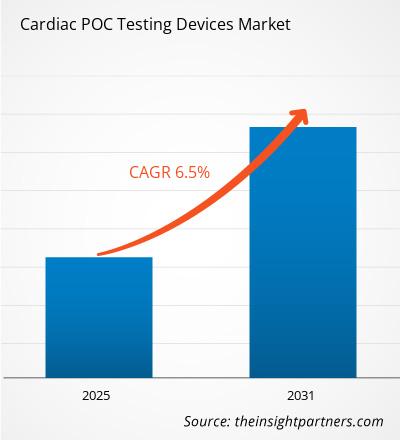
The Cardiac POC Testing Devices Market was valued at US$ 2.79 Billion in 2025 and is projected to reach US$ 4.57 Billion by 2034, registering a CAGR of 5.64% during 2026–2034. Expansion reflects sustained clinical demand for rapid cardiac biomarker measurement, shorter emergency department decision cycles, and decentralized diagnostic workflows that enable clinicians to assess suspected myocardial infarction and heart failure closer to the patient.
Within North America, the Cardiac POC Testing Devices Market size is expected to advance at a modeled CAGR of 5.2–5.7% during 2026–2034. Growth is supported by hospital adoption of high-sensitivity troponin testing and integrated point-of-care data management. The U.S. clearance of Abbott’s i-STAT high-sensitivity troponin I cartridge in January 2025 strengthened the clinical and regulatory foundation for bedside cardiac testing.
Cardiac POC Testing Devices Market Assessment and Insights
- North America: The region accounted for a modeled 39–42% share in 2025 and is expected to record a 5.2–5.7% CAGR between 2026–2034, supported by emergency care modernization, reimbursement coverage, and high-sensitivity troponin adoption.
- US: The country represented 86–89% of North American revenue in 2025 and is projected to expand at a 5.3–5.8% CAGR between 2026–2034 as hospitals transition toward bedside high-sensitivity assays.
- Europe: Europe held a modeled 28–31% share in 2025 and is forecast to grow at a 5.0–5.5% CAGR between 2026–2034, led by Germany, the UK, France, Italy, and Spain.
- Asia Pacific: Asia Pacific captured a modeled 21–24% share in 2025 and is expected to register a 6.4–7.0% CAGR between 2026–2034, with China, Japan, India, South Korea, and Australia driving adoption.
- Largest Segment: Hospitals held a modeled 64–68% market share in 2025 and are projected to grow at a 5.3–5.8% CAGR during 2026–2034 as emergency and critical care testing expands.
- High Growth Segment: Analyzers accounted for a modeled 31–35% market share in 2025 and are expected to register a 6.1–6.7% CAGR during 2026–2034 through connectivity and multiplexing upgrades.
- Key companies analyzed in detail: Abbott Laboratories, Siemens Healthineers AG, Roche Diagnostics, Medtronic plc, GE HealthCare Technologies Inc., Koninklijke Philips N.V., Becton, Dickinson and Company, ACON Laboratories, Inc., bioMérieux SA, and SCHILLER AG.
Source: The Insight Partners' analysis based on proprietary research, government publications, company annual reports, investor presentations, industry databases, and expert interviews.
Point-of-care cardiac diagnostic systems have advanced from being one-analyte readers to multi-functional systems that are able to facilitate tests for troponin, natriuretic peptide, coagulation and additional acute care applications. High sensitivity immunoassays, microfluidic cartridges, automated calibration, and two-way communication are altering the focus of manufacturers on producing precise components and scalable cartridges. In addition, manufacturers are increasingly coordinating the deployment of analyzers along with the periodic supply of cartridges while hospitals are assessing the total value proposition of the workflow, rather than just the cost of the device itself.
From 2023 until 2034, capital expenditure is expected to target hospitals of Asia Pacific, emergency departments of Europe and decentralized health facilities with restricted laboratory resources. As regulatory agencies approve high sensitivity testing, strict quality control measures and funding for acute care capacity is increased, systems that combine high sensitivity with easy use will be more successful in this market environment. Manufacturing organizations which are able to localize the production of cartridges, conduct operator training, and integrate results into the hospital IT system are likely to gain an advantage.
Cardiac POC Testing Devices Market Report Scope
| Report Attribute | Details |
|---|---|
| Market size in 2025 | US$ 2.79 Billion |
| Market Size by 2034 | US$ 4.57 Billion |
| Global CAGR (2026 - 2034) | 5.64% |
| Historical Data | 2021-2024 |
| Forecast period | 2026-2034 |
Cardiac POC Testing Devices Market Analysis
Increasing incidents of cardiovascular diseases, overcrowded emergency departments, and need for rapid detection and diagnosis drive Cardiac POC Testing Devices market growth. According to the World Health Organization, cardiovascular diseases were responsible for 19.8 million deaths in 2022, which is about 32% of all global deaths, but over three-fourths happen in developing countries. These diseases increase the addressable patient population for rapid troponin and heart-failure detection.
The value chain consists of biomarker providers, cartridge producers, analyzer makers, distributors, hospital laboratories, emergency physicians, and information systems vendors. Supply chain stability hinges on consistent antibodies, microfluidic manufacturing efficiency, cold storage needs, and lot-to-lot quality control. Ongoing reagent sales ensure steady income stream, but validation expenses, compliance paperwork, and user training create a high barrier to entry. Hence, device makers are focusing on local stockpiles, quality control automation, and connectivity.
Competitive analysis in the Cardiac POC Testing Devices Market suggests that the competition is moving away from turn-around time performance claims towards analytical sensitivity, menu capability, informatics and lifecycle economics. Abbott Laboratories and Siemens Healthineers AG have long-established point of care routes, whereas Roche Diagnostics offers a combination of cardiac biomarkers know-how and extensive laboratory presence. bioMérieux SA enhanced its near patient immunoassay capabilities by entering into an agreement to acquire SpinChip Diagnostics, whose bench top platform is intended to provide high-sensitivity performance on whole blood within ten minutes.
Strategic positioning also stems from core competence variations. Becton, Dickinson and Company and ACON Laboratories, Inc. bring their diagnostics and distribution expertise, while GE HealthCare Technologies Inc., Koninklijke Philips N.V., Medtronic plc and SCHILLER AG can leverage testing insights to acute care monitoring or cardiology workflows. Money is being invested in assay miniaturization, clinical validation, software integration and regional services capabilities. Differentiation will require reliable consumables delivery and workflow improvement proof rather than analyzer performance only.
● REPORT CUSTOMIZATION
Tailor This Report To Align With Your Specific Business Requirements
This report can be customized to align precisely with your business objectives, scope, and target markets. Customization options include tailored segmentation, geography, competitive analysis, and strategic insights to support informed decision-making.
Customize This Report →WHAT YOU CAN ADJUST
- ● Segmentations
- ● Geography
- ● Competitive Analysis
- ● Language Preferences
Cardiac POC Testing Devices Market: Strategic Insights

Regional Insights
North America Cardiac POC Testing Devices Market
North America held a modeled 39–42% Cardiac POC Testing Devices Market share in 2025 and is projected to register a 5.2–5.7% CAGR through 2034. It enjoys well-developed emergency medicine networks, high cardiac test volumes, established payment schemes, and substantial installed bases of connected point-of-care analyzers. Increasingly, hospital priorities include the rapid triage of chest pain, decreased laboratory turnaround, and standardization of results reporting.
Implementation is driven by troponin shift to high sensitivity and middleware connecting bedside analyzers to the laboratory and electronic medical records. Contributions by Canada are provided via hospital modernization within its provinces, whereas Mexico offers some select opportunities in the private hospital and urban diagnostic segments. Purchase considerations now increasingly take into account continuity of cartridges, cybersecurity, operator competency management, turnaround time, and compliance management. Suppliers with national service networks and clinically proven tests enjoy a competitive edge in multicenter hospital tenders and group purchase agreements.
U.S. Cardiac POC Testing Devices Market
The U.S. represented a modeled 86–89% of North American revenue in 2025 and is expected to post a 5.3–5.8% CAGR during 2026–2034. High patient volume in EDs, decentralized acute-care testing, and pressure by hospitals to speed up the flow all aid in creating demand. The FDA approval of Abbott’s i-STAT high sensitivity troponin I cartridge in January 3, 2025 created an important commercial path for laboratory-quality point-of-care cardiac analysis.
The major companies compete with each other through fleets of analyzers, service deals, connectivity, and repeat purchases of cartridges. The applications are increasingly moving beyond the traditional use for suspected heart attacks towards heart failure diagnosis, peri-operative monitoring, urgent care, and selected pre-hospital routes. Central lab oversight, proficiency testing, user qualifications, and clinical protocols are still needed from health systems, and adoption is greatest where there is an impact on decision-making or admission rate.
Europe Cardiac POC Testing Devices Market
Europe accounted for a modeled 28–31% share in 2025 and is forecast to expand at a 5.0–5.5% CAGR through 2034. The country generates regional revenue through its hospitals, diagnostic quality standards, and usage of sophisticated immunoassays. The UK creates opportunities through redesign of emergency pathways and the National Health Service programs dedicated to diagnostic productivity, though strict budget analysis increases the cycle of procurement.
France, Italy, and Spain make contributions through centralized hospital systems, cardiovascular disease management, and improvements of emergency departments. France is keen on creating a clinical evidence-based procurement process and connected infrastructure, while Italy and Spain demonstrate opportunities within regional hospital networks. EU IVDR regulations encourage suppliers with clinical evidence, surveillance systems, and reliable technical documentation. Assays certified by CE marking for high sensitivity and clinical trials conducted with a wide range of patients should help the acceptance of such tests.
APAC Cardiac POC Testing Devices Market
Asia Pacific held a modeled 21–24% share in 2025 and is expected to record a 6.4–7.0% CAGR through 2034. China leads regional revenue through hospital expansion and domestic diagnostic manufacturing, while Japan supports premium systems through established acute-care infrastructure.
India offers increasing demand from private hospital chains and tier-two cities. South Korea emphasizes connected diagnostics, and Australia supports evidence-led emergency testing. Policy investment in hospital capacity, local manufacturing, and digital health infrastructure will expand access, although pricing pressure and fragmented reimbursement encourage suppliers to develop flexible analyzer-placement and reagent-contract models.
Middle East & Africa Cardiac POC Testing Devices Market
The Middle East and Africa market is projected to grow at a modeled 5.8–6.4% CAGR through 2034. Saudi Arabia leads through hospital investment and health-system transformation, while the UAE sustains demand for premium connected diagnostics in public and private facilities.
South Africa anchors sub-Saharan adoption through laboratory networks and tertiary hospitals. Across the rest of MEA, infrastructure gaps, inconsistent electricity, and limited specialist access favor compact systems with durable consumables and simple maintenance. Healthcare construction, digital infrastructure investment, and localized distributor support will determine commercial scalability.
Segmentation Analysis
Product Type
Product Type is expected to register a modeled 5.5–6.0% CAGR during 2026–2034 as assay sensitivity, analyzer connectivity, and cartridge automation improve. The Cardiac POC Testing Devices Market scope covers Cardiac Markers Test and Analyzers exactly as defined, reflecting the relationship between recurring consumables and installed instruments. Clinical adoption depends on validated performance, rapid turnaround, manageable sample requirements, and integration with laboratory governance.
- Cardiac Markers Test: Cardiac marker tests form the recurring revenue core, with troponin, BNP, NT-proBNP, CK-MB, and related assays supporting myocardial injury assessment, heart-failure evaluation, and emergency clinical decisions.
- Analyzers: Analyzer demand is shaped by throughput, time to result, connectivity, footprint, and menu expansion. Multiplexing and automated quality controls increase strategic value across emergency, intensive-care, and outpatient settings.
End User
End User demand is projected to increase at a modeled 5.4–5.9% CAGR during 2026–2034. Adoption is concentrated in environments where rapid results can materially affect triage, treatment initiation, patient movement, or referral decisions. Procurement varies by testing volume, staffing, accreditation requirements, and information-system readiness, making workflow design and training central to successful deployment.
- Hospitals: Hospitals represent the largest end-user group because emergency departments, intensive-care units, cardiac wards, and perioperative facilities require rapid biomarker results and maintain governance structures for decentralized testing.
- Diagnostic Laboratories: Diagnostic laboratories use near-patient and satellite testing to extend acute services, manage turnaround commitments, and support hospital networks while retaining centralized oversight of calibration, quality control, and result interpretation.
Opportunity Snapshot
| End User | Revenue Contribution (High/Medium/Low) | Trend Tag | Adoption Stage (Emerging/Scaling/Mature) |
| Hospitals | High | Rapid Triage | Mature |
| Diagnostic Laboratories | Medium | Satellite Testing | Scaling |
| Other End Users | Low | Community Access | Emerging |
Cardiac POC Testing Devices Market Growth Drivers and Impact Analysis
Growing Cardiovascular Burden and Acute-Care Testing Volumes
Heart diseases continue to be the most prevalent cause of mortality worldwide, ensuring consistent test volumes in the emergency room, intensive care, and acute medicine departments. The World Health Organization reveals that there were 19.8 million deaths from cardiovascular diseases in 2022, with 85% caused by heart attack and stroke. Fast biomarker testing aids clinicians in the prioritization of possible acute coronary syndromes, diagnosis of myocardial damage, and determination of heart failure risks without relying on conventional specimen transport. Commercial success will be achieved primarily in hospitals with high volume of patients with chest pain, long distance or congestion of laboratory. The increase in testing frequency allows for regular income from cartridges, while increased instrument use makes the analyzer more economically viable.
High-Sensitivity Troponin Enters Bedside Clinical Workflows
High sensitivity troponins are playing an increasingly important role in driving purchase decisions at the point of care since physicians need quick turnaround times as well as performance matching those found at central labs. It is evident from Abbott's FDA approval for its U.S. i-STAT high sensitivity troponin I test and bioMérieux's investment in its SpinChip. This has implications for the industry that go beyond just replacement of cartridges. Hospitals will have to adapt their chest pain protocols, retrain staff, validate their reference limits, and integrate results with their decision-support systems. Vendors stand to gain from selling not only the instrument but also the assay, the middleware, and services associated with validation and maintenance.
Pressure to Improve Emergency Department Throughput
ED crowding makes turnaround time of tests more economically relevant. At the European Society of Cardiology Congress in September 2024, a study demonstrated that a test conducted within eight minutes reduced stay times in selected patients with chest pain with safety comparable to that of the recommended laboratory test despite limitations posed by staff shortages. Such cases demonstrate the fact that technology produces its value when supported by changes in patient management workflow. The hospitals can use fast results to detect low-risk patients, schedule cardiologist assessment, and avoid unnecessary observation. Manufacturers are thus advised to promote pathway adoption as opposed to selling only equipment. Workflow analytics, clinical training, connectivity, and quality management services can increase tender competitiveness and better utilization in hospitals where laboratory transportation or batching is responsible for delays.
Cardiac POC Testing Devices Market Future Trends
Multiplex Acute-Cardiac Panels with Digital Interpretation
Cardiac POC Testing Devices Market trends will increasingly center on multiplex platforms that combine high-sensitivity troponin with natriuretic peptides, D-dimer, inflammatory markers, and complementary acute-care tests. The change in strategy will decrease the dependency on individual instruments and allow clinicians to assess overlapping factors causing chest pain or dyspnea using just one sample. Algorithms incorporated in the software might help with setting age-specific cut-off values, sequential result comparisons, and patient risk stratifications, but final decisions will be left to clinicians. Vendors will require open software validation, cybersecurity measures, and standardized data formats. Instrumentation platforms that offer extensive menus with fast testing times and small sample volume requirements will likely become more relevant in emergency settings.
Expansion from Hospital Bedside to Prehospital Networks
The Cardiac POC Testing Devices Market forecasts show that portability high sensitivity tests will need to selectively target ambulances, community centers and rural referrals. Evidence on the performance of such tests under finger prick or whole blood samples is critical due to the presence of temperature changes, vibrations and lack of connectivity in pre-hospital settings. Deployment strategies could incorporate results of the tests by the paramedics and relate this to the receiving hospitals, thus facilitating activation of the cardiac pathway earlier and destination selection. The adoption process will have to be slow due to issues of quality control, payment and liability. Manufacturers with toughened analyzers, automation of testing and training of operators can create defensible positions.
Cardiac POC Testing Devices Market Opportunities
Localized Platforms for High-Growth Asian Hospital Networks
Manufacturers can pursue Asian expansion through localized consumable production, tiered analyzer configurations, and partnerships with hospital chains or regional distributors. Large tertiary hospitals require connected, high-throughput systems, while secondary facilities need compact instruments with simplified maintenance and stable cartridges. Investment should prioritize country-specific clinical validation, local-language interfaces, service engineer coverage, and integration with domestic laboratory information systems. Reagent-rental or analyzer-placement contracts can lower initial procurement barriers and align supplier returns with testing volume. Regional production may also reduce freight exposure and improve tender competitiveness. Companies that balance global quality standards with localized pricing and service models can address demand beyond capital-city hospitals and build recurring assay revenue.
Integrated Workflow and Quality-Management Services
Point-of-care programs require more than instruments, creating opportunities for suppliers to provide connectivity, operator certification, inventory monitoring, proficiency management, and utilization analytics. Hospitals often operate numerous devices across emergency, intensive-care, and satellite locations, increasing the risk of expired cartridges, undocumented users, and inconsistent quality checks. A service-led model can consolidate these activities through middleware and remote support. The Cardiac POC Testing Devices Market Report can help decision-makers identify vendors whose capabilities extend across assay performance, implementation, and governance. Investment in open interfaces and cybersecurity will be critical because buyers increasingly evaluate lifecycle operating risk. Recurring software and service revenue can also reduce dependence on analyzer replacement cycles.
Recent Developments
- September 2025: Roche Diagnostics announced primary results from the TSIX Study Program for its CE-marked Elecsys Troponin T hs Gen 6 assay. The program included more than 13,000 participants and evaluated the test’s ability to identify or rule out acute myocardial infarction with improved sensitivity and precision across a clinically diverse population.
- March 2025: Abbott Laboratories made its i-STAT high-sensitivity troponin I cartridge commercially available in the U.S. following FDA clearance on January 3, 2025. The bedside whole-blood assay was introduced as the first U.S. point-of-care high-sensitivity troponin test designed to provide laboratory-quality results for patients presenting with chest pain.
- January 2025: bioMérieux SA entered into an agreement to acquire SpinChip Diagnostics ASA, expanding its position in near-patient immunoassay testing. SpinChip’s compact platform is designed to return high-sensitivity results from whole-blood samples within ten minutes, with initial development focused on troponin I, NT-proBNP, and D-dimer assays.
Frequently Asked Questions

- Comprehensive Market Sizing and Forecast Analysis
- Detailed Segmentation Analysis
- In-Depth Market Dynamics Assessment
- Regional and Country-Level Insights
- Competitive Landscape and Company Benchmarking
- Strategic Business Intelligence
Recent Reports
Testimonials

The Insight Partners provided valuable market intelligence that supported our global go-to-market strategy. Their team was professional, responsive, and attentive to our feedback, providing thoughtful analysis and helpful methodological clarifications throughout the project.
Junmo Kim Chief Financial Officer (CFO), Enertech Co., Ltd.
The Insight Partners' SCADA System Market report is comprehensive, with valuable insights on current trends and future forecasts. The team was highly professional, responsive, and supportive throughout. We are very satisfied and highly recommend their services.
RAN KEDEM Partner, Reali Technologies LTDs
I requested a report on a very specific software market and the team produced the report in a few days. The information was very relevant and well presented. I then requested some changes and additions to the report. The team was again very responsive and I got the final report in less than a week.
JEAN-HERVE JENN Chairman, Future Analytica
We worked with The Insight Partners for an important market study and forecast. They gave us clear insights into opportunities and risks, which helped shape our plans. Their research was easy to use and based on solid data. It helped us make smart, confident decisions. We highly recommend them.
PIYUSH NAGPAL Sr. Vice President, High Beam Global
The Insight Partners delivered insightful, well-structured market research with strong domain expertise. Their team was professional and responsive throughout. The user-friendly website made accessing industry reports seamless. We highly recommend them for reliable, high-quality research services
YUKIHIKO ADACHI CEO, Deep Blue, LLC.
This is the first time I have purchased a market report from The Insight Partners.While I was unsure at first, I visited their web site and felt more comfortable to take the risk and purchase a market report.I am completely satisfied with the quality of the report and customer service. I had several questions and comments with the initial report, but after a couple of dialogs over email with their analyst I believe I have a report that I can use as input to our strategic planning process.Thank you so much for taking the extra time and making this a positive experience.I will definitely recommend your service to others and you will be my first call when we need further market data.
JOHN SUZUKI President and Chief Executive Officer, Board Director, BK Technologies
I wish to appreciate your support and the professionalism you displayed in the course of attending to my request for information regarding to infectious disease IVD market in Nigeria. I appreciate your patience, your guidance, and the fact that you were willing to offer a discount, which eventually made it possible for us to close a deal. I look forward to engaging The Insight Partners in the future, all thanks to the impression you have created in me as a result of this first encounter.
DR CHIJIOKE ONYIA MANAGING DIRECTOR, PineCrest Healthcare Ltd.Reason to Buy
- Informed Decision-Making
- Understanding Market Dynamics
- Competitive Analysis
- Identifying Emerging Markets
- Customer Insights
- Market Forecasts
- Risk Mitigation
- Boosting Operational Efficiency
- Strategic Planning
- Investment Justification
- Tracking Industry Innovations
- Aligning with Regulatory Trends





 Get Free Sample for