
Cardiopulmonary Resuscitation Devices Market Growth, Share & Trends by 2034
Cardiopulmonary Resuscitation Devices Market Size and Forecasts (2021–2034), Global and Regional Share, Trends, and Growth Opportunity Analysis Report Coverage : by Type (Manual CPR Devices, Automated CPR Devices); End-user (Hospitals, Pre-Hospital Care Settings, Ambulatory Surgical Centers); and Geography (North America, Europe, Asia Pacific, and South and Central America)
- Status : Data Released
- Report Code : TIPRE00040174
- Category : Life Sciences
- No. of Pages : 150
- Available Report Formats :


- Last update date : September 07, 2026


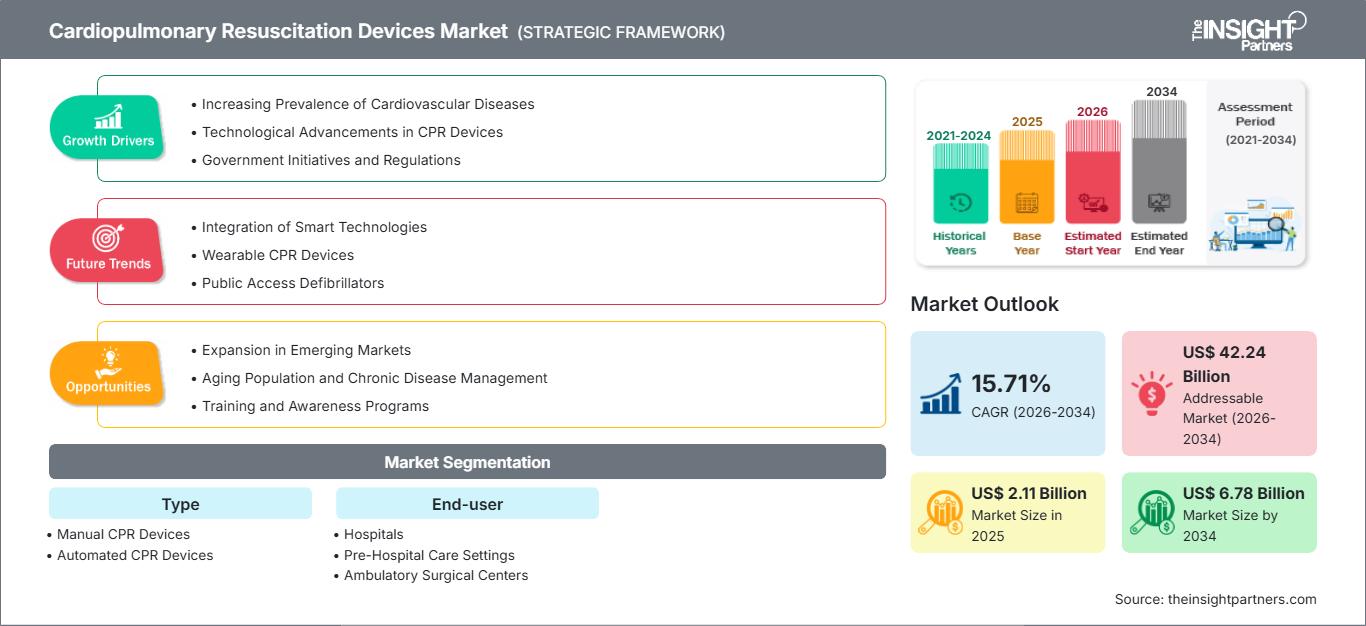
2025 Market Size
US$ 2.11 Bn
Base year value
2034 Forecast
US$ 6.78 Bn
Projected by 2034
CAGR 2026-2034
15.71 %
Growth rate
Addressable Market
US$ 42.24 Bn
(2026-2034)
The Cardiopulmonary Resuscitation Devices Market is projected to expand from US$ 2.11 Billion in 2025 to US$ 6.78 Billion by 2034, registering a CAGR of 15.71% during 2026–2034. Demand is strengthening as healthcare systems prioritize consistent chest compressions, faster emergency response, and safer patient transport. Automated technologies are increasingly supporting resuscitation teams during prolonged cardiac arrest, interfacility transfer, catheterization procedures, and extracorporeal cardiopulmonary resuscitation pathways.
Across North America, the Cardiopulmonary Resuscitation Devices Market size is expected to advance at a CAGR of 14.8–15.6% during 2026–2034. Established emergency medical service networks, cardiac catheterization capacity, and structured resuscitation quality programs support adoption. The American Heart Association’s 2025 guidelines contain 760 recommendations across adult, pediatric, neonatal, education, and systems-of-care domains, reinforcing institutional attention to protocol adherence, training, performance measurement, and coordinated post-arrest care.
Cardiopulmonary Resuscitation Devices Market Assessment and Insights
- North America: The region accounted for 36–39% share in 2025 and is projected to grow at a CAGR of 14.8–15.6% during 2026–2034, supported by organized EMS systems, replacement procurement, and advanced cardiac care networks.
- US: The country represented 82–85% of North American revenue in 2025 and is forecast to register a CAGR of 14.9–15.7% during 2026–2034.
- Europe: Europe held 27–30% share in 2025 and is expected to expand at a CAGR of 14.1–14.9% through 2034. Germany, the UK, France, Italy, and Spain remain important procurement markets.
- Asia Pacific: Asia Pacific captured 23–26% share in 2025 and is projected to record a CAGR of 17.0–18.0% during 2026–2034. China, Japan, India, South Korea, and Australia lead regional adoption.
- Largest Segment: Manual CPR Devices accounted for 56–60% market share in 2025 and are projected to grow at a CAGR of 12.4–13.2% during 2026–2034.
- High Growth Segment: Automated CPR Devices represented 40–44% market share in 2025 and are expected to register a CAGR of 18.5–19.5% during 2026–2034.
- Key companies analyzed in detail: Asahi Kasei Corporation, Stryker Corporation, Koninklijke Philips N.V., Physio-Control, Inc. (a Stryker company), Michigan Instruments, Inc., SCHILLER AG, CPR Medical Devices, Inc., Medtronic plc, GE HealthCare Technologies Inc., ZOLL Medical Corporation, and GS Elektromedizinische Geräte G. Stemple GmbH.
Source: The Insight Partners' analysis based on proprietary research, government publications, company annual reports, investor presentations, industry databases, and expert interviews.
The development of products has evolved from simple mechanical systems and patient feedback mannequins to piston system, load distributing band system, and connected systems. The improvement in product developments includes portability, fit range, battery life, radiopacity, active chest recoil, and data recording after each event. Production still depends upon high quality electronics, batteries, precise actuators, sensors, and molding. Supplier qualification and regulatory clearance make market entry challenging, while accessories and service agreements ensure ongoing income for established players.
During the forecast period, improvements in the EMS network at the city level in the Asia Pacific, Middle East, and some Latin American countries will expand the customer base. Government spending on ambulance fleet, trauma centers, air medical transport, and catheterization laboratory will drive sales of the devices. Focus on traceability, usability engineering, cybersecurity, and post-market surveillance will favor the companies with quality management system, evidence of performance, and local service offerings over price-driven competitors.
Cardiopulmonary Resuscitation Devices Market Report Scope
| Report Attribute | Details |
|---|---|
| Market size in 2025 | US$ 2.11 Billion |
| Market Size by 2034 | US$ 6.78 Billion |
| Global CAGR (2026 - 2034) | 15.71% |
| Historical Data | 2021-2024 |
| Forecast period | 2026-2034 |
Cardiopulmonary Resuscitation Devices Market Analysis
Market growth is influenced by the operational complexity in maintaining guidelines-compliant manual compressions during transportation, extended arrest, imaging, and invasive procedures. The main customer segments consist of hospitals, ambulance services, and air medical services, and market development involves distributors, training organizations, battery suppliers, software providers, and maintenance providers. Automated compressions are advantageous as they decrease rescuer fatigue and enable rescuers to handle airway management, vascular access, rhythm interpretation, administration of medications, and evaluation of reversible causes.
The supply of the products is driven by the need for reliable actuators, robust frames, compressions control software, and batteries that can function in emergency temperatures. Procurement considerations involve not only the initial costs but also deployment time, patient adaptability, consumable, warranties, training, maintenance, and fleet management. Manual resuscitation devices will remain competitive due to their low cost, ease of storage, and suitability for comprehensive training and preparedness programs, especially in places where budget constraints prevent automation.
The Cardiopulmonary Resuscitation Devices Market analysis shows that the automated device segment is highly concentrated, and the market for manual and training products is fragmented. Visibility of Stryker Corporation and Physio-Control, Inc. is ensured by the LUCAS product portfolio. Integration of automated compression, defibrillation, and case-review technologies benefits ZOLL Medical Corporation. Adaptive boards and radiolucent technology differentiate GS Elektromedizinische Geräte G. Stemple GmbH, while Michigan Instruments, Inc. and CPR Medical Devices, Inc. specialize in training and manual resuscitation products.
Innovative efforts are focused on connected fleets, event data analysis, light devices, improved battery efficiency, and more patient adaptability. Asahi Kasei Corporation is represented in the market through ZOLL Medical Corporation, and Koninklijke Philips N.V., SCHILLER AG, Medtronic plc, and GE HealthCare Technologies Inc. are involved in related emergency care ecosystems. Competitive advantage in the market depends more and more on integrated workflows, distribution channels, regulatory compliance, and fast technical support in particular in large-scale EMS tenders with long-term maintenance agreements.
● REPORT CUSTOMIZATION
Tailor This Report To Align With Your Specific Business Requirements
This report can be customized to align precisely with your business objectives, scope, and target markets. Customization options include tailored segmentation, geography, competitive analysis, and strategic insights to support informed decision-making.
Customize This Report →WHAT YOU CAN ADJUST
- ● Segmentations
- ● Geography
- ● Competitive Analysis
- ● Language Preferences
Cardiopulmonary Resuscitation Devices Market: Strategic Insights
Regional Insights
North America Cardiopulmonary Resuscitation Devices Market
North America held 36–39% of global revenue in 2025 and is expected to expand at a CAGR of 14.8–15.6% during 2026–2034. Cardiopulmonary Resuscitation Devices market share depends on organized emergency response networks, existing resuscitation committees within hospitals, extensive defibrillation, and replacements by ambulance organizations. Mechanical compressors become very important during transportations, hazardous rescue operations, catheterizations, and activation of extracorporeal resuscitation.
The Cardiopulmonary Resuscitation Devices Market forecast indicates that purchases within regions become focused on the need for interoperability with monitors, defibrillators, incident review software and electronic quality programs. The recent health technology assessment from Canada for 2025 has shown that there is insufficient clinical evidence and that the selective use of automated devices is more appropriate than routine one, thus promoting procurement based on protocols. This means that the vendors should show their training preparedness, disciplined deployment, servicing, and full value cycle. Air medical providers, metropolitan EMS services, and tertiary cardiac centers become the most promising buyers.
U.S. Cardiopulmonary Resuscitation Devices Market
The US accounted for 82–85% of North American revenue in 2025 and is forecast to progress at a CAGR of 14.9–15.7% through 2034. EMS systems in major municipalities, hospitals, fire departments, and air medical operations support buying. Distributors of Stryker Corporation, Physio-Control, Inc., ZOLL Medical Corporation, Michigan Instruments, Inc., and Defibtech products have visibility in the commercial and/or product space within professional resuscitation processes.
Uses are expanding beyond traditional ambulance usage to include cath lab, air medics, ECMO transports, and resuscitation quality management. Widespread use of AutoPulse NXT aboard Air Methods’ fleet highlights the increasing importance of ensuring continuity of compression delivery without clinicians being at risk of restraint. Adoption is contingent upon medical director protocol, training, device strategy, patient load, and post-event debrief. Procurement trends toward equipment that has predictable maintenance and consumable availability and readiness across sites.
Europe Cardiopulmonary Resuscitation Devices Market
Europe captured 27–30% share in 2025 and is projected to achieve a CAGR of 14.1–14.9% during 2026–2034. Strengths for Germany include advanced emergency medicine infrastructure, internal engineering capabilities, and high hospital purchasing standards. Domestic German suppliers will enjoy closer proximity to European distributors and familiarity with the Medical Device Regulation. In France, Italy, and Spain, emergency fleet modernization is increasing, albeit with varying procurement timelines between health systems of different countries and regions.
In the United Kingdom, structured ambulance trusts, resuscitation governance, and cardiac centers contribute to the possibility of selective placement along high-acuity pathways. The emphasis on physician-based emergency care and technologically-enabled ambulances in Germany supports the demand for premium devices. The strengths of France lie in its SAMU-oriented organization, and Italy and Spain can be reached via regional tenders and hospital modernization. However, regulatory transition costs may be limiting for smaller suppliers.
APAC Cardiopulmonary Resuscitation Devices Market
Asia Pacific represented 23–26% share in 2025 and is forecast to grow at a CAGR of 17.0–18.0% during 2026–2034. China leads regional revenue through hospital capacity, domestic device manufacturing, and emergency-system investment. Japan maintains advanced clinical standards, while South Korea and Australia support digitally enabled ambulance and hospital networks.
India offers substantial long-term potential as organized ambulance coverage, private hospital chains, and cardiac centers expand. Government emergency-response programs, local production incentives, and distributor-led training support adoption, although pricing remains decisive. Automated systems should gain fastest in metropolitan EMS, air rescue, tertiary hospitals, and long-distance transport.
Middle East & Africa Cardiopulmonary Resuscitation Devices Market
The Middle East and Africa region is expected to register a CAGR of 13.0–14.0% during 2026–2034. Saudi Arabia leads through hospital construction, ambulance modernization, and major-event medical preparedness. The UAE supports premium adoption through advanced hospitals, air ambulance capacity, and investments in digital emergency infrastructure.
South Africa represents the strongest sub-Saharan commercial base, supported by private hospital groups and professional emergency services. Across the rest of MEA, demand depends on donor programs, public tenders, distributor support, and equipment durability. Energy facilities, remote industrial sites, airports, and infrastructure projects create specialized requirements for portable resuscitation equipment.
Segmentation Analysis
Type
The Type segment is projected to grow at a CAGR of 15.2–16.0% during 2026–2034. The Cardiopulmonary Resuscitation Devices Market scope by type covers manual and automated technologies serving different budgets, care environments, and user capabilities. Manual devices provide broad accessibility and training utility, while automation addresses fatigue, transport safety, compression consistency, and complex resuscitation workflows. Procurement increasingly evaluates clinical protocol fit and lifetime operating cost.
- Manual CPR Devices: Manual products retain the largest installed base because of lower acquisition costs, straightforward storage, broad training applications, and suitability for facilities where automated compression systems cannot be economically justified.
- Automated CPR Devices: Automated systems occupy the highest-growth position by delivering repeatable compressions during transport and prolonged resuscitation while enabling clinical teams to perform defibrillation, airway management, medication administration, and diagnostic procedures.
End-user
The End-user segment is expected to expand at a CAGR of 15.0–15.8% during 2026–2034. Demand varies according to arrest volume, transfer distance, staffing models, capital availability, and clinical governance. Hospitals constitute the principal institutional buyers, while pre-hospital providers increasingly value continuous compression during movement. Ambulatory surgical centers require compact emergency equipment, staff training, and escalation protocols despite comparatively lower cardiac-arrest incidence.
- Hospitals: Hospitals prioritize dependable devices for emergency departments, intensive care units, catheterization laboratories, operating rooms, and resuscitation teams, with purchasing influenced by interoperability, training requirements, infection control, and service availability.
- Pre-Hospital Care Settings: Ambulance services, fire departments, air medical operators, and rescue teams require portable systems capable of maintaining compression quality in moving vehicles, confined environments, extended transports, and limited-personnel responses.
- Ambulatory Surgical Centers: These facilities favor readily deployable equipment that supports emergency preparedness, accreditation requirements, and rapid stabilization before transfer, with purchasing decisions shaped by procedure mix, staff competency, and available storage.
Opportunity Snapshot
| End-user | Revenue Contribution (High/Medium/Low) | Trend Tag | Adoption Stage (Emerging/Scaling/Mature) |
| Hospitals | High | Cath-Lab CPR | Mature |
| Pre-Hospital Care Settings | High | Transport Compression | Scaling |
| Ambulatory Surgical Centers | Medium | Emergency Readiness | Emerging |
Cardiopulmonary Resuscitation Devices Market Growth Drivers and Impact Analysis
Rising Burden of Sudden Cardiac Arrest
The persistent burden of out-of-hospital and in-hospital cardiac arrest sustains demand for equipment that supports immediate, standardized intervention. The aging population, cardiovascular diseases, diabetes, obesity, and delayed availability of definite care contribute to the growing number of people requiring resuscitation readiness. According to the World Health Organization, cardiovascular diseases are among the main causes of death in the world. Emergency cardiological services remain an issue that needs constant attention from the perspective of health system. Device sales benefit from the fact that hospitals and EMS agencies convert this issue into their replacement schedules, additional ambulances, and training for staff members. The best results for the market are achieved when these elements work as a chain.
Need for Consistent Compressions During Transport
Manual chest compressions are physically demanding and difficult to maintain in moving ambulances, aircraft, narrow stairways, and prolonged rescue situations. Automated technologies solve this problem of operation through ensuring consistent depth and rate of compression, enabling doctors to be restrained or to conduct additional treatments. This technology is even more useful in the process of transportation to hospitals with PCI capabilities, ECMO facilities, and specialized cardiac care units, in which compression of consistent quality needs to be maintained throughout many handovers. The use of Air Methods’ AutoPulse NXT system throughout the country by Air Methods shows how such organizations are utilizing mechanical CPR as part of their safety policy.
Expansion of Data-Driven Resuscitation Programs
Increasingly, hospitals and emergency services are analyzing parameters such as compression fraction, pauses, rate, depth, shocks, medication administration times, and post-resuscitation outcomes. CPR systems linked to each other allow achieving this trend by providing information on how CPR was carried out for subsequent debriefing, review of protocols, training, and quality control. Connecting to monitor-defibrillators and case-review systems makes such an approach economically feasible, especially for networks of hospitals or ambulances. Administrators may detect areas needing training, make comparisons between stations and demonstrate compliance without relying solely on documentation. This is the driver that will benefit companies selling secure information transfer, customizable protocols, fleet management, and good technical support.
Cardiopulmonary Resuscitation Devices Market Future Trends
Patient-Adaptive Mechanical Compression
Cardiopulmonary Resuscitation Devices Market trends will increasingly center on systems that adjust therapy using patient dimensions, chest resistance, piston position, recoil, and real-time compression feedback. Broader patient-fit ranges should reduce exclusions and simplify fleet standardization. Manufacturers are likely to combine adaptive algorithms with controls that minimize interruption during placement and repositioning. Development will remain constrained by the need for predictable performance, transparent logic, cybersecurity safeguards, and rigorous usability validation. Successful platforms will not merely automate motion. They will guide clinicians toward consistent deployment while recording information needed to verify protocol adherence, investigate device performance, and improve future resuscitation training.
Integration with Advanced Cardiac Rescue Pathways
Mechanical CPR will become more closely aligned with ECMO, coronary intervention, imaging, and interfacility transfer pathways. Radiolucent frames, lower profiles, secure patient fixation, and extended power options will enable compressions to continue during fluoroscopy or preparation for extracorporeal support. Hospitals may establish dedicated refractory-arrest protocols that specify device deployment before transport to specialized centers. This progression will favor suppliers capable of supporting hospital, ambulance, and air medical workflows through one platform. Evidence generation will remain essential because guidelines generally support mechanical devices selectively when delivering high-quality manual compressions is impractical or unsafe, rather than recommending routine use for every arrest.
Cardiopulmonary Resuscitation Devices Market Opportunities
Fleet Modernization in Emerging Emergency Systems
Rapidly urbanizing countries offer manufacturers an opportunity to align automated CPR placements with ambulance procurement, trauma-network development, and new tertiary hospitals. Investors should prioritize metropolitan regions where cardiac centers, trained paramedics, and dependable maintenance infrastructure already exist. Bundled proposals incorporating devices, spare batteries, simulation training, preventive service, and usage review can address public buyers’ concerns about readiness after installation. Local assembly or regional repair hubs may improve tender competitiveness and reduce downtime. Partnerships with medical universities, ambulance operators, and professional societies can establish training capacity before large deployments. This approach supports sustainable utilization instead of one-time equipment sales without adequate clinical integration.
Lifecycle Services and Subscription-Based Access
Capital constraints create an opportunity for leasing, subscription, managed-equipment, and pay-per-use models covering automated CPR systems. Providers can convert a high upfront purchase into predictable operating expenditure while receiving batteries, maintenance, software updates, training, and replacement coverage. Manufacturers and distributors gain recurring revenue and better visibility into fleet condition and utilization. The model is particularly relevant for smaller EMS agencies, ambulatory surgical centers, rural hospitals, and private ambulance operators with irregular arrest volumes. Investment should focus on remote diagnostics, standardized refurbishment, consumable logistics, and outcome-reporting tools. Contract structures must clearly allocate cybersecurity, servicing, device availability, training, and regulatory responsibilities throughout the subscription period.
Recent Developments
- August 2025: ZOLL Medical Corporation supported the nationwide deployment of the AutoPulse NXT Resuscitation System across Air Methods’ fleet. After three months, Air Methods reported a greater than 150% increase in its ability to transport patients safely while continuous CPR was required and an almost 10% rise in return of spontaneous circulation during transport compared with the prior-year period.
- July 2025: Defibtech, LLC transitioned the original Lifeline ARM automated chest compression platform toward end-of-life status in favor of the next-generation ARM XR. The transition concentrated future development and production on a lighter system featuring automated compression-depth adjustment, an integrated backboard, active chest recoil, data transfer capabilities, and an operating duration of up to 60 minutes.
- June 2025: Stryker Corporation addressed a US Class II recall involving specified demonstration units of LUCAS 2, LUCAS 3, and LUCAS 3.1 systems that could potentially have entered clinical use without appropriate labeling or maintenance. Customers were instructed to identify, stop using, return, and replace affected units, underscoring the importance of inventory controls and device traceability.
Frequently Asked Questions

- Comprehensive Market Sizing and Forecast Analysis
- Detailed Segmentation Analysis
- In-Depth Market Dynamics Assessment
- Regional and Country-Level Insights
- Competitive Landscape and Company Benchmarking
- Strategic Business Intelligence
Recent Reports
Testimonials

The Insight Partners' SCADA System Market report is comprehensive, with valuable insights on current trends and future forecasts. The team was highly professional, responsive, and supportive throughout. We are very satisfied and highly recommend their services.
RAN KEDEM Partner, Reali Technologies LTDs
I requested a report on a very specific software market and the team produced the report in a few days. The information was very relevant and well presented. I then requested some changes and additions to the report. The team was again very responsive and I got the final report in less than a week.
JEAN-HERVE JENN Chairman, Future Analytica
We worked with The Insight Partners for an important market study and forecast. They gave us clear insights into opportunities and risks, which helped shape our plans. Their research was easy to use and based on solid data. It helped us make smart, confident decisions. We highly recommend them.
PIYUSH NAGPAL Sr. Vice President, High Beam Global
The Insight Partners delivered insightful, well-structured market research with strong domain expertise. Their team was professional and responsive throughout. The user-friendly website made accessing industry reports seamless. We highly recommend them for reliable, high-quality research services
YUKIHIKO ADACHI CEO, Deep Blue, LLC.
This is the first time I have purchased a market report from The Insight Partners.While I was unsure at first, I visited their web site and felt more comfortable to take the risk and purchase a market report.I am completely satisfied with the quality of the report and customer service. I had several questions and comments with the initial report, but after a couple of dialogs over email with their analyst I believe I have a report that I can use as input to our strategic planning process.Thank you so much for taking the extra time and making this a positive experience.I will definitely recommend your service to others and you will be my first call when we need further market data.
JOHN SUZUKI President and Chief Executive Officer, Board Director, BK Technologies
I wish to appreciate your support and the professionalism you displayed in the course of attending to my request for information regarding to infectious disease IVD market in Nigeria. I appreciate your patience, your guidance, and the fact that you were willing to offer a discount, which eventually made it possible for us to close a deal. I look forward to engaging The Insight Partners in the future, all thanks to the impression you have created in me as a result of this first encounter.
DR CHIJIOKE ONYIA MANAGING DIRECTOR, PineCrest Healthcare Ltd.Reason to Buy
- Informed Decision-Making
- Understanding Market Dynamics
- Competitive Analysis
- Identifying Emerging Markets
- Customer Insights
- Market Forecasts
- Risk Mitigation
- Boosting Operational Efficiency
- Strategic Planning
- Investment Justification
- Tracking Industry Innovations
- Aligning with Regulatory Trends





 Get Free Sample for