
Cardiovascular And Soft Tissue Repair Patches Market Growth, Demand & Size by 2034
Cardiovascular And Soft Tissue Repair Patches Market Size and Forecasts (2021–2034), Global and Regional Share, Trends, and Growth Opportunity Analysis Report Coverage : by Raw Material (Biomaterial and tissue-engineered material, ePTFE); Application (Cardiac repair, Soft Tissue Repair, Vascular Repair & Reconstruction); and Geography (North America, Europe, Asia Pacific, and South and Central America)
- Status : Data Released
- Report Code : TIPRE00040098
- Category : Life Sciences
- No. of Pages : 150
- Available Report Formats :


- Last update date : September 07, 2026


2025 Market Size
US$ 5.92 Bn
Base year value
2034 Forecast
US$ 10.44 Bn
Projected by 2034
CAGR 2026-2034
6.51 %
Growth rate
Addressable Market
US$ 74.00 Bn
(2026-2034)
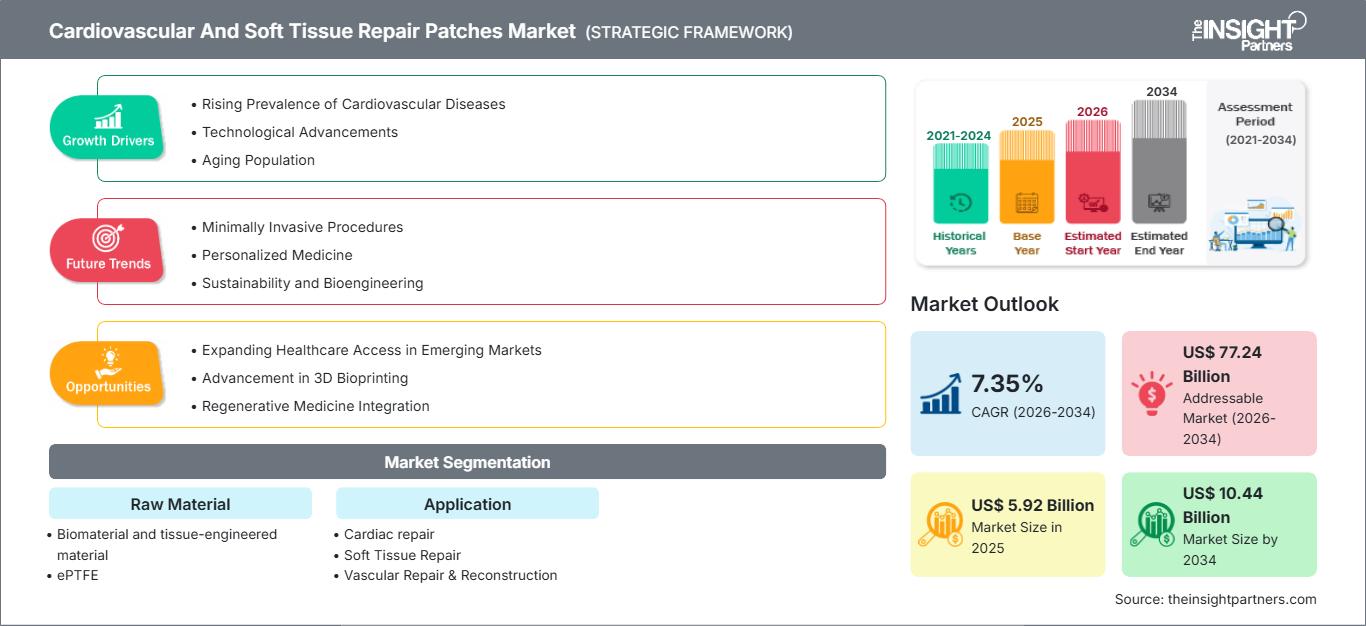
The Cardiovascular And Soft Tissue Repair Patches market was valued at US$ 5.92 billion in 2025 and is expected to reach US$ 10.44 billion by 2034; it is estimated to record a CAGR of 6.51% during 2026-2034.
Cardiovascular And Soft Tissue Repair Patches Market Assessment and Insights
- North America: The region accounted for an estimated 41–43% Cardiovascular And Soft Tissue Repair Patches Market share in 2025 and is projected to grow at a CAGR between 6.8–7.2% during 2026–2034, supported by advanced surgical capacity, reimbursement coverage, and established cardiovascular device suppliers.
- US: The country represented 86–88% of North American revenue in 2025 and is expected to expand at a CAGR between 6.9–7.3% during 2026–2034, led by procedure volumes and product clearances.
- Europe: Europe held an estimated 27–29% share in 2025 and is forecast to register a CAGR between 6.6–7.0% during 2026–2034. Germany, the UK, France, Italy, and Spain remain leading contributors.
- Asia Pacific: Asia Pacific accounted for approximately 21–23% in 2025 and is projected to grow at a CAGR between 8.4–8.8% during 2026–2034, with China, Japan, India, South Korea, and Australia supporting expansion.
- Largest Segment: Biomaterial and tissue-engineered material held an estimated 66–69% market share in 2025 and is expected to record a CAGR between 7.7–8.1% during 2026–2034.
- High Growth Segment: Cardiac repair represented approximately 35–38% market share in 2025 and is projected to register a CAGR between 7.8–8.2% during 2026–2034 as congenital and structural procedures increase.
- Key companies analyzed in detail: Medtronic plc, Johnson & Johnson through Ethicon, Inc., Boston Scientific Corporation, Abbott Laboratories, Smith & Nephew plc, Cook Medical LLC, Artivion, Inc., Integra LifeSciences Holdings Corporation, W. L. Gore & Associates, Inc., and Zimmer Biomet Holdings, Inc.
Source: The Insight Partners' analysis based on proprietary research, government publications, company annual reports, investor presentations, industry databases, and expert interviews.
Evolution of product range has moved from durable weave constructions to decellularized biological matrices, multidirectionally structured ePTFE, resorbable polymers, and tissue engineering products that strike a balance between mechanical properties and tissue compatibility. Product design differentiators include manufacturer-controlled collagen modification, porosity, crosslinking, sterilization, and packaging. Current commercially available ePTFE patch products retain their value due to their dimensional stability, variable thickness, and long clinical experience; on the other hand, biological products resolve issues related to calcification, remodeling, and infection management. Gore sells more than 755,000 cardiovascular patches annually worldwide.
During the forecast period, research and development will be focused on electrospun scaffolds, materials suitable for patients, and patches applicable for minimally invasive interventions. Emerging hospital systems in Asia Pacific and the Middle East are increasing potential demand by developing cardiac centers and training surgeons. Improved regulatory classification and post-market evidence generation requirements will benefit suppliers of sterile, biocompatible, suturable, dimensionally stable and clinically proven patches across a number of indications.
Cardiovascular And Soft Tissue Repair Patches Market Report Scope
| Report Attribute | Details |
|---|---|
| Market size in 2025 | US$ 5.92 Billion |
| Market Size by 2034 | US$ 10.44 Billion |
| Global CAGR (2026 - 2034) | 6.51% |
| Historical Data | 2021-2024 |
| Forecast period | 2026-2034 |
Cardiovascular And Soft Tissue Repair Patches Market Analysis
Increased volume of cardiovascular procedures, growing awareness of complex hernias, and increased capabilities in reconstructive surgeries drive market growth. Hospital is the key player in the supply chain eco-system, linking material suppliers, device manufacturers, sterilization vendors, distributors, surgeons, and payment agencies. Procedure types differentiate the demand – cardiac surgeons need biocompatible and conformable patches; vascular surgeons prefer good suture retention and anti-dilation capabilities, while soft tissue surgeons assess the risk of infection, resorption characteristics, and reinforcing capabilities.
Supply factors include availability of animal-derived tissue, controlled polymer manufacturing, sterilization process and regulatory compliance. Biological patches need traceability and manufacturing control process, while ePTFE provides standard process of manufacturing and storing. Procurement committees become increasingly more interested in comparing total costs of episodes, rather than unit costs, considering time, probability of revisions, handling, and managing inventory. FDA classifications clearly state that synthetic cardiovascular patches may strengthen weakened cardiac and peripheral vascular tissues in repair and reconstruction procedures.
Analysis of the Cardiovascular And Soft Tissue Repair Patches Market shows competitive differentiation based on material science, clinical evidence, surgeon preference and product portfolio. W. L. Gore & Associates, Inc. continues to maintain its reputation of ePTFE products, and Artivion, Inc. provides decellularized bovine pericardium for cardiac and vascular reconstruction. Smith & Nephew plc and Johnson & Johnson (Ethicon, Inc.) have access to wide network of surgical customers and related tissue repair technologies.
Medtronic plc, Abbott Laboratories, Boston Scientific Corporation, Cook Medical LLC, Integra LifeSciences Holdings Corporation, and Zimmer Biomet Holdings, Inc. compete via cardiovascular, reconstructive, neurosurgical, and orthopedic relationships. Investment strategies are evolving towards unique resorption, regenerative signals and better fixation. Portfolio companies may offer implants together with procedural devices and education. Specialists may defend their positions using proprietary scaffold technology and focused evidence. Therefore capital investments should be directed towards regulatory and multicenter evidence rather than undifferentiated capacity additions.
● REPORT CUSTOMIZATION
Tailor This Report To Align With Your Specific Business Requirements
This report can be customized to align precisely with your business objectives, scope, and target markets. Customization options include tailored segmentation, geography, competitive analysis, and strategic insights to support informed decision-making.
Customize This Report →WHAT YOU CAN ADJUST
- ● Segmentations
- ● Geography
- ● Competitive Analysis
- ● Language Preferences
Cardiovascular And Soft Tissue Repair Patches Market: Strategic Insights
Regional Insights
North America Cardiovascular And Soft Tissue Repair Patches Market
The market share of North America was expected to be between 41–43% for the year 2025 with further growth expected at a rate of 6.8–7.2% for the period 2026–2034. The region has high cardiovascular surgery capability and hospital purchase processes, availability of biological implants, and experts in reconstructive surgery. The pathway for FDA approvals of patches for intracardiac, vascular, hernia, and soft tissue reinforcement is clear in the commercialization of the product.
The demand is boosted by congenital heart surgeries, vascular repairs, abdominal repairs, tendon repairs, and difficult wound closures. Manufacturers are able to cater for different specialty areas using the flexible dimensions of the patches and the available materials; however, there is need for data on infection, recurrence, calcification, patency, and revision. The contribution from Canada will come from public cardiac facilities and centralized procurement process while that of Mexico comes from the private hospital and medical centers.
U.S. Cardiovascular And Soft Tissue Repair Patches Market
The US represented an estimated 86–88% of North American revenue in 2025 and is forecast to grow at a 6.9–7.3% CAGR during 2026–2034. The location is based on a cluster of tertiary hospitals, congenital heart programs, vascular centers, outpatient surgical centers, and orthopedics. The commercialization process involves 510(k) and premarket approval by FDA, though the requirements differ depending on materials and application.
Market presence is widespread. W. L. Gore & Associates, Inc. has ePTFE patches for cardiovascular applications, while Artivion, Inc. provides bovine pericardial products. There are other diversified suppliers for other related repair applications. The market application is transitioning from the conventional open repair to minimally invasive implantation, patch reinforcement for high risk closure, and absorbable products for specific types of hernia repairs. Competition involves procedure training, contracting, clinical data, supply chain, and availability of products in multiple sizes.
Europe Cardiovascular And Soft Tissue Repair Patches Market
Europe accounted for an estimated 27–29% share in 2025 and is expected to register a 6.6–7.0% CAGR through 2034. Germany is the leading market owing to its cardiovascular hospital base, reimbursement system, and usage of sophisticated surgical materials. The United Kingdom makes its contribution through cardiac specialist centers and clinical assessment that are influenced by evidence quality and cost-effectiveness. France uses the combination of structured hospital procurement and cardiovascular and reconstructive expertise. Italy and Spain provide growth opportunities through hospital modernization in regions, expansion of vascular surgery, and growing availability of high-tech meshes and biological matrices. European MDR regulations raise documentation and surveillance expenses, but may be an opportunity for proven suppliers with robust quality systems. European region demand characteristics include clinically documented products that ensure consistent handling, reinforcement, and compatibility with congenital, carotid, peripheral vascular, abdominal wall, and reconstructive surgeries. In Europe, Gore indicates indications including carotid stenosis and several congenital heart conditions.
APAC Cardiovascular And Soft Tissue Repair Patches Market
Asia Pacific held an estimated 21–23% share in 2025 and is forecast to achieve an 8.4–8.8% CAGR during 2026–2034. China leads regional revenue through hospital scale and expanding cardiovascular capacity, while Japan supports adoption of premium, clinically established materials.
India offers volume-led potential as tertiary care networks expand. South Korea contributes advanced biomaterials capabilities, and Australia provides a mature regulatory and specialist environment. Public investment in cardiac centers, insurance expansion, local manufacturing, and surgeon education should improve access. Affordability and imported-device dependence remain constraints, encouraging suppliers to develop region-specific pricing and distribution models.
Middle East & Africa Cardiovascular And Soft Tissue Repair Patches Market
The region is projected to grow at a 5.7–6.1% CAGR during 2026–2034. Saudi Arabia is the leading country, supported by hospital infrastructure programs and specialist cardiovascular investment. The UAE serves as a premium medical hub with demand for complex reconstruction and imported devices.
South Africa anchors sub-Saharan access through established private and academic hospitals, while the Rest of MEA remains constrained by specialist availability. Energy-funded healthcare investment in Gulf countries supports advanced operating rooms and cardiac centers. Wider growth depends on distributor coverage, clinical training, dependable cold-chain management for selected biologic products, and public infrastructure resilience.
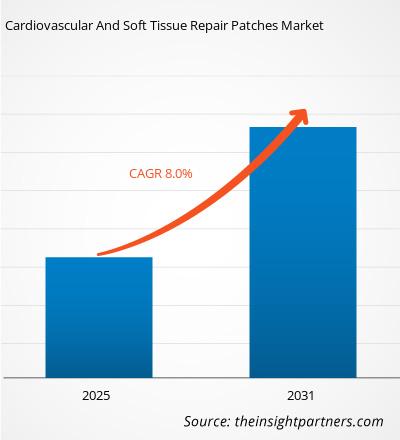
Segmentation Analysis
Raw Material
Raw Material is projected to record a 7.2–7.6% CAGR during 2026–2034. The Cardiovascular And Soft Tissue Repair Patches Market scope encompasses biologic and tissue-engineered products alongside ePTFE patches. Selection depends on anatomy, infection risk, required durability, surgeon preference, and remodeling objectives. Biologic solutions benefit from tissue integration potential, while ePTFE maintains strategic importance where dimensional consistency, handling predictability, and resistance to dilation are priorities.
- Biomaterial and tissue-engineered material: These patches lead demand because decellularized tissue, collagen matrices, and regenerative scaffolds can support remodeling and conformability in cardiac, vascular, and complex soft tissue reconstruction.
- ePTFE: ePTFE remains strategically important for cardiovascular reconstruction because multidirectional strength, configurable thickness, storage convenience, and established surgical familiarity support dependable use across cardiac and peripheral vascular procedures.
Application
Application is expected to expand at a 7.3–7.7% CAGR during 2026–2034. Growth is distributed across defect closure, reinforcement, and anatomical reconstruction, with purchasing criteria changing by surgical specialty. Cardiovascular applications require durable hemostatic repair and secure suturing, while soft tissue procedures increasingly consider resorption, infection response, recovery, and recurrence. Suppliers serving several applications can improve manufacturing utilization and hospital contracting leverage.
- Cardiac repair: Demand centers on congenital defect closure, epicardial reinforcement, chamber reconstruction, and great-vessel procedures where conformability, biocompatibility, secure suturing, and long-term dimensional performance are clinically important.
- Soft Tissue Repair: Adoption spans abdominal wall, tendon, reconstructive, and high-risk closure procedures, creating demand for permanent, biologic, and absorbable patches selected according to contamination and healing requirements.
- Vascular Repair & Reconstruction: Patches support carotid, peripheral, and large-vessel reconstruction by widening repaired vessels, reinforcing suture lines, and providing handling characteristics suited to blood-contacting surgical environments.
Opportunity Snapshot
| Application | Revenue Contribution (High/Medium/Low) | Trend Tag | Adoption Stage (Emerging/Scaling/Mature) |
| Cardiac repair | High | Regenerative Scaffolds | Scaling |
| Soft Tissue Repair | High | Resorbable Reinforcement | Scaling |
| Vascular Repair & Reconstruction | Medium | Patency Support | Mature |
Cardiovascular And Soft Tissue Repair Patches Market Growth Drivers and Impact Analysis
Rising Surgical Need Across Cardiovascular and Reconstructive Care
The trends of population aging and increased diagnostic capabilities are driving the evaluation of patients with structural heart diseases, vascular obstructions, hernias, tendon damage, and complicated tissue malformations. It expands the procedural basis of patches to repair, reinforce, or reconstruct damaged tissues. Resilient demand exists in tertiary care hospitals since many procedures are medically necessary, not elective. The business impact goes beyond the volume of units: heterogeneous patient anatomy drives hospitals to carry a range of patch sizes, thicknesses, and materials. Suppliers providing cardiac, vascular, and soft tissue variants of patches have an opportunity to simplify tendering process and streamline procurement. But the development of the patch business is tied to surgeons' training and OR capabilities.
Transition Toward Biologic and Resorbable Material Platforms
Surgeons increasingly assess how an implant behaves after placement rather than relying only on immediate mechanical reinforcement. Decellularized tissue and resorbable polymers are therefore gaining attention where remodeling, contamination management, or avoidance of permanent foreign material is clinically desirable. Decellularized bovine pericardium from Artivion and novel synthetic electrospun matrices are examples of how material options have been broadened. The effect is an increasing segmentation in terms of cost, with more sophisticated materials demanding a higher degree of clinical proof. Providers will need to prove that their material is biocompatible, degrades predictably, sutures well, and is reproducible in its manufacture. There may be a willingness to pay a premium price where the evidence suggests better handling, reduced revision risk, or appropriate use in challenging patients.
Expansion of Specialist Hospitals and Procedural Infrastructure
Increased investments in cardiovascular centers, ambulatory surgeries, and reconstructive surgery programs increase the number of locations that are able to use advanced patches. This is especially true of Asia Pacific and Gulf states, where new tertiary hospitals can employ modern surgical equipment without having to replace large amounts of old equipment. However, infrastructure is not enough on its own; sustainable use also requires trained surgeons, cardiac procedure perfusion, infection control processes, imaging technology, post-op monitoring, and dependable distributors. Manufacturers can increase the adoption rates through the combination of product delivery and teaching of procedures, anatomic choices, and inventory management. As hospitals develop standardized treatment approaches, patches that offer a wide range of sizes and proven efficacy will be preferred in the hospital formulary. Regional suppliers can compete through lower prices, but multinationals still have several advantages.
Cardiovascular And Soft Tissue Repair Patches Market Future Trends
Patient-Compatible and Tissue-Engineered Patch Architectures
Cardiovascular And Soft Tissue Repair Patches Market trends will increasingly center on scaffolds engineered to approximate native tissue mechanics while enabling cellular infiltration and controlled remodeling. These development efforts should include the use of decellularized matrices, electrospinning technologies, biodegradable polymers, and surface modifications that address inflammation or calcification. The pediatric cardiac repair area is one such promising avenue of research because traditional permanent materials are unable to grow with the patient. Success in this area will be determined by proof of consistent manufacturing and results, not just innovation. Those who can link materials with imaging, histology, performance outcomes, and registries stand to gain more surgeon acceptance and support for their pricing.
Procedure-Specific Designs and Simplified Fixation
The Cardiovascular And Soft Tissue Repair Patches Market Forecasts show that future product development will shift from general-purpose sheets toward anatomically and procedurally optimized designs. Pre-shaped patches, controlled thicknesses, integrated barriers, and fixation-assistance features can shorten preparation time and improve placement consistency. ZuriMED’s cleared tendon reinforcement system demonstrates how patch and delivery instrument integration can create a differentiated workflow, while absorbable umbilical hernia products show the value of indication-specific geometry. Adoption will be determined by whether simplified deployment reduces operative steps without compromising fixation or tissue response. Manufacturers are likely to build modular platforms that preserve common material technology while adapting shape, porosity, and instrumentation for cardiac, vascular, orthopedic, and abdominal applications.
Cardiovascular And Soft Tissue Repair Patches Market Opportunities
Clinical Evidence Programs for Premium Biomaterials
Investors and manufacturers can create value by funding prospective registries and comparative studies that connect material properties with patient outcomes. Evidence gaps remain around calcification, recurrence, infection, patency, reoperation, and performance in pediatric or contaminated settings. A structured program combining post-market surveillance, surgeon-reported handling, imaging, and long-term follow-up can support reimbursement discussions and differentiate premium products. Companies should prioritize indications where revision costs are high and material selection materially affects clinical decisions. Partnerships with specialist hospitals can accelerate enrollment and generate credible real-world evidence. The resulting datasets can also guide product refinement, strengthen regulatory submissions, and support geographic expansion without relying primarily on price-based competition.
Localized Commercial Models in High-Growth Asian Markets
Asia Pacific offers an opportunity for suppliers to pair advanced products with localized manufacturing, distributor development, and tiered pricing. Companies should identify cardiac and reconstructive centers capable of generating reference cases, then expand through surgeon education and hospital-level evidence. Local packaging or manufacturing can improve lead times, reduce import exposure, and help satisfy domestic procurement preferences. Strategic partnerships may also provide regulatory expertise and access to public tenders. The most attractive portfolios will balance premium biologic or tissue-engineered patches with dependable synthetic options, allowing hospitals to select products according to case complexity and budget. Success requires disciplined market segmentation rather than a uniform regional commercialization strategy.
Recent Developments
- November 2025: Nurami Medical Ltd. completed Phase 1 milestones for its Artifix synthetic biomimetic dural repair adhesive patch, including preclinical testing and European technical-file submission. The company also reported preliminary US sales of its FDA-cleared ArtiFascia graft, demonstrating commercial progress for nanofiber-based soft tissue repair platforms.
- June 2025: Acera Surgical, Inc. received an additional FDA 510(k) clearance for Restrata Sheet and Restrata Meshed products covering soft tissue reinforcement. The fully synthetic, electrospun matrix provides temporary structural support and is designed to resorb within three to four weeks after implantation.
- April 2025: Becton, Dickinson and Company obtained FDA 510(k) clearance and commercially launched the Phasix ST Umbilical Hernia Patch. The procedure-specific product combines biologically derived poly-4-hydroxybutyrate with a hydrogel barrier and provides a fully absorbable alternative for umbilical soft tissue defect repair.
Frequently Asked Questions

- Comprehensive Market Sizing and Forecast Analysis
- Detailed Segmentation Analysis
- In-Depth Market Dynamics Assessment
- Regional and Country-Level Insights
- Competitive Landscape and Company Benchmarking
- Strategic Business Intelligence
Recent Reports
Testimonials

The Insight Partners provided valuable market intelligence that supported our global go-to-market strategy. Their team was professional, responsive, and attentive to our feedback, providing thoughtful analysis and helpful methodological clarifications throughout the project.
Junmo Kim Chief Financial Officer (CFO), Enertech Co., Ltd.
The Insight Partners' SCADA System Market report is comprehensive, with valuable insights on current trends and future forecasts. The team was highly professional, responsive, and supportive throughout. We are very satisfied and highly recommend their services.
RAN KEDEM Partner, Reali Technologies LTDs
I requested a report on a very specific software market and the team produced the report in a few days. The information was very relevant and well presented. I then requested some changes and additions to the report. The team was again very responsive and I got the final report in less than a week.
JEAN-HERVE JENN Chairman, Future Analytica
We worked with The Insight Partners for an important market study and forecast. They gave us clear insights into opportunities and risks, which helped shape our plans. Their research was easy to use and based on solid data. It helped us make smart, confident decisions. We highly recommend them.
PIYUSH NAGPAL Sr. Vice President, High Beam Global
The Insight Partners delivered insightful, well-structured market research with strong domain expertise. Their team was professional and responsive throughout. The user-friendly website made accessing industry reports seamless. We highly recommend them for reliable, high-quality research services
YUKIHIKO ADACHI CEO, Deep Blue, LLC.
This is the first time I have purchased a market report from The Insight Partners.While I was unsure at first, I visited their web site and felt more comfortable to take the risk and purchase a market report.I am completely satisfied with the quality of the report and customer service. I had several questions and comments with the initial report, but after a couple of dialogs over email with their analyst I believe I have a report that I can use as input to our strategic planning process.Thank you so much for taking the extra time and making this a positive experience.I will definitely recommend your service to others and you will be my first call when we need further market data.
JOHN SUZUKI President and Chief Executive Officer, Board Director, BK Technologies
I wish to appreciate your support and the professionalism you displayed in the course of attending to my request for information regarding to infectious disease IVD market in Nigeria. I appreciate your patience, your guidance, and the fact that you were willing to offer a discount, which eventually made it possible for us to close a deal. I look forward to engaging The Insight Partners in the future, all thanks to the impression you have created in me as a result of this first encounter.
DR CHIJIOKE ONYIA MANAGING DIRECTOR, PineCrest Healthcare Ltd.Reason to Buy
- Informed Decision-Making
- Understanding Market Dynamics
- Competitive Analysis
- Identifying Emerging Markets
- Customer Insights
- Market Forecasts
- Risk Mitigation
- Boosting Operational Efficiency
- Strategic Planning
- Investment Justification
- Tracking Industry Innovations
- Aligning with Regulatory Trends





 Get Free Sample for