
Case Packers Market Share, Growth & Forecast by 2034
Coverage: By Automation Mode (Automatic, Semi-Automatic); Machine Type (Horizontal, Vertical, Overwrapping, Robotics, Others); End-user (Food and Beverages , Pharmaceuticals, Consumer Goods, Others) , and Geography (North America, Europe, Asia Pacific, and South and Central America)
- Status : Data Released
- Report Code : TIPRE00007866
- Category : Manufacturing and Construction
- No. of Pages : 150
- Available Report Formats :


- Last update date : July 17, 2026


2025 Market Size
US$ 6.78 Bn
Base year value
2034 Forecast
US$ 10.53 Bn
Projected by 2034
CAGR 2026-2034
5.01 %
Growth rate
Addressable Market
US$ 78.54 Bn
(2026-2034)
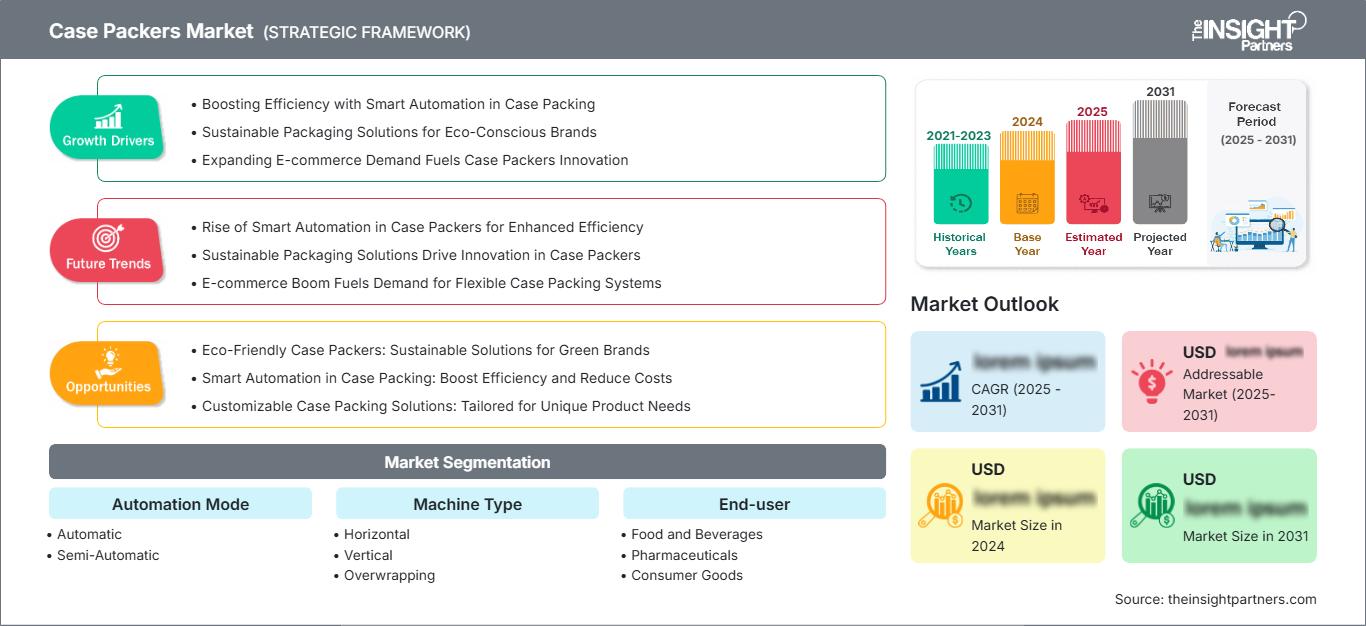
The case packers market was valued at US$ 6.78 Billion in 2025 and is projected to reach US$ 10.53 Billion by 2034, registering a CAGR of 5.01% during 2026–2034. Demand is shaped by end-of-line automation, high-throughput secondary packaging, and rising requirements for carton integrity across food and beverages, pharmaceuticals, and consumer goods manufacturing.
North America remains a high-value adoption base, with regional case packers market size supported by an estimated 4.6–5.2% CAGR through 2034. Growth is linked to labor scarcity, reshoring of packaged goods production, and investment in automated secondary packaging lines that improve uptime, inspection consistency, and SKU changeover speed.
Case Packers Market Assessment and Insights
- North America accounted for 27–30% share in 2025 and is expected to grow at a CAGR of 4.6–5.2% between 2026–2034, supported by automated fulfillment, food processing upgrades, and pharmaceutical packaging validation.
- US represented 78–82% of North America in 2025 and is projected to grow at a CAGR of 4.7–5.3% between 2026–2034, led by co-packing and packaged foods.
- Europe held 25–28% share in 2025 and is forecast to grow at a CAGR of 4.3–4.9% between 2026–2034, with Germany, Italy, France, and the UK leading equipment replacement cycles.
- Asia Pacific captured 31–34% share in 2025 and is set to grow at a CAGR of 5.6–6.3% between 2026–2034, led by China, India, Japan, and South Korea.
- Largest Segment Food and Beverages held 42–46% market share in 2025 and is projected to grow at a CAGR of 4.8–5.4% between 2026–2034.
- High Growth Segment Robotics held 18–22% market share in 2025 and is expected to grow at a CAGR of 6.4–7.1% between 2026–2034.
- Key companies analyzed in detail: ADCO Manufacturing, Hangzhou Youngsun Intelligent Equipment Co., Ltd., Illinois Tool Works Inc., Marchesini Group S.p.A., Massman LLC, MOLINS, ProMach Inc., Syntegon Technology GmbH, U-PACK ENGINEERING CO., LTD., Douglas Machine Inc.
Source: The Insight Partners' analysis based on proprietary research, government publications, company annual reports, investor presentations, industry databases, and expert interviews.
Packaging lines are evolving from mechanically indexed machinery to servo driven, robotic, and digital controlled machines capable of accommodating mixed cartons, trays, wrappers, and ready for retail packaging lines. Such changes have minimized manual labor and optimized balancing of the primary packaging lines and palletizing operations. Food manufacturers focus on wash down construction and quick changeover, whereas pharmaceutical customers stress validation capability, serial interface capability, and product repeatability.
Future growth will increasingly be driven by Asian Pacific capacity growth, North American reshoring, and European sustainability compliance requirements. Manufacturers are equipping themselves with machines which facilitate lightweight corrugated boxes, recyclable material use, and greater number of SKU configurations. The regulatory requirements from food safety and pharmaceutical quality systems are also in favor of automatic case handling due to its low contamination rate.
Case Packers Market Report Scope
| Report Attribute | Details |
|---|---|
| Market size in 2025 | US$ 6.78 Billion |
| Market Size by 2034 | US$ 10.53 Billion |
| Global CAGR (2026 - 2034) | 5.01% |
| Historical Data | 2021-2024 |
| Forecast period | 2026-2034 |
Case Packers Market Analysis
Requirements for case packers are being driven by growth in packaged food products, compliance in the pharmaceutical industry, robustness in e-commerce shipping, and filling gaps in skilled labor. Automation in loading, box forming, sealing, and inspecting allows plants to manage their output rate as the product mix increases. In the decision to purchase equipment, total cost of ownership is becoming more important than outright cost, particularly where down time is important in terms of high volume economics.
Value chain members include the original equipment manufacturer (OEM), robot manufacturers, controls firms, corrugated packing materials makers, system integrators, and after market services firms. Supply dynamics will continue to be affected by servomotors, sensors, programmable logic controllers, stainless steel manufacture, and engineering labor. Users prefer systems that are modular and can evolve as formats change.
Moderate fragmentation of competition exists due to ADCO Manufacturing, Marchesini Group S.p.A., Syntegon Technology GmbH, ProMach Inc., and Douglas Machine Inc. fighting for speed, size, format versatility, and life cycle service. As per the case packers market analysis, specialists with solid application engineering skills can earn projects in case such parameters as product fragility, carton design, and validation impose high customization requirements.
Capital investments tend to be directed at robotic loading, vision-based inspection systems, remote diagnostics capabilities, and automatic changeover. Specialists in Illinois Tool Works Inc., Massman LLC, MOLINS, Hangzhou Youngsun Intelligent Equipment Co., Ltd., and U-PACK ENGINEERING CO., LTD. are positioned according to diversified machinery offerings, whereas demand for local service capability and spare parts availability grows among clients.
● REPORT CUSTOMIZATION
Tailor This Report To Align With Your Specific Business Requirements
This report can be customized to align precisely with your business objectives, scope, and target markets. Customization options include tailored segmentation, geography, competitive analysis, and strategic insights to support informed decision-making.
Customize This Report →WHAT YOU CAN ADJUST
- ● Segmentations
- ● Geography
- ● Competitive Analysis
- ● Language Preferences
Case Packers Market: Strategic Insights
Regional Insights
North America Case Packers Market
North America represented 27–30% of global demand in 2025 and is forecast to expand at a CAGR of 4.6–5.2% during 2026–2034. The regional case packers market share reflects high automation penetration in packaged foods, beverages, personal care, and pharmaceuticals. Rising warehouse wages and shorter retail replenishment cycles are encouraging investment in compact, flexible end-of-line systems.
Regulatory compliance also shapes purchasing decisions. FDA-aligned food safety programs, pharmaceutical good manufacturing practices, and customer audit requirements favor repeatable carton loading with reduced product contact. Many buyers are replacing legacy semi-automatic equipment with robotic or fully automatic systems that support data capture, remote troubleshooting, and faster changeovers for multipack formats.
U.S. Case Packers Market
In 2025, the share of the United States in North America demand was around 78–82%, and the compound annual growth rate during 2026-2034 would be 4.7–5.3%. The food processing plants, contract packers, and pharmaceutical industry players are leading applications, driven by significant installed base and regular budget allocation for upgrading secondary packaging facilities.
The presence in the area is quite significant, ranging from companies such as ProMach Inc., Douglas Machine Inc., Massman LLC, ADCO Manufacturing, and Illinois Tool Works Inc. to ensure local engineering, maintenance, and product application. The application of packaging in the frozen food industry, snack packaging industry, beverage packaging industry, personal care products, and health care packaging industry is significant.
Europe Case Packers Market
In 2025, Europe held 25-28% share and it is expected to experience a CAGR of 4.3-4.9% during 2026-2034. Germany dominates due to expertise in machinery engineering, pharmaceutical manufacturing, and premium food exports. Italy continues to be an important player due to packaging machinery concentrations and excellent OEM capabilities.
The UK market is boosted by food retail automation and copacker needs. On the other hand, France focuses on dairy, bakery, cosmetics, and healthcare applications. Flexible machinery is being deployed in Spain and Italy for export-driven food and beverages lines. Sustainable goals set by the EU are driving machines which can handle lightweight corrugated boxes.
APAC Case Packers Market
The APAC region held 31–34% share in 2025 and is projected to register a CAGR of 5.6–6.3% through 2026–2034. China is the leading regional market, followed by Japan, South Korea, India, and Australia, wherein the investment is linked to manufacturing of packaged foods, beverages, personal care, and health-care.
The policies promoting localization of manufacturing operations, increased organized retailing, and production for exports are boosting demand for automation solutions. The food processing subsidies in India and factory modernization policies in China are particularly relevant for case packers, whereas Japan and South Korea emphasize compact robots and labor efficiency.
Middle East & Africa Case Packers Market
Middle East & Africa is expected to have a CAGR of 4.9-5.5% for the period between 2026-2034. Saudi Arabia is the frontrunner in the adoption, followed by UAE and South Africa due to food security, beverages capacity, and pharmaceutical localization.
Automated secondary packaging is being facilitated by energy-based investments into industry and logistics infrastructure. The case format should be robust for the food and consumer goods segment in South Africa because of its export needs.
Segmentation Analysis
Automation Mode
Automation Mode is projected to grow at a CAGR of 5.0–5.6% during 2026–2034. The segment is defined by the shift from manual loading toward integrated case forming, robotic placement, sealing, and verification. Adoption is strongest where producers need repeatable throughput, lower ergonomic risk, and simplified operator training.
- Automatic systems dominate high-volume plants because they reduce labor exposure, stabilize case quality, and support continuous operation across beverages, snacks, pharmaceuticals, and personal care products.
- Semi-Automatic systems remain relevant for small manufacturers, contract packagers, and mixed-SKU facilities that require lower capital intensity, operator oversight, and flexible batch-based production.
Machine Type
Machine Type is expected to grow at a CAGR of 5.2–5.9% during 2026–2034. Horizontal and vertical machines serve established carton handling needs, while overwrapping and robotics support newer formats and shelf-ready packaging. Buyers increasingly evaluate footprint, changeover time, product fragility, and integration with upstream cartoners or flow wrappers.
- Horizontal machines are widely used for cartons, pouches, and rigid packs where side loading supports consistent product orientation, stable case filling, and efficient downstream sealing.
- Vertical machines fit products that can be dropped or stacked into cases, including bags and flexible packs, making them useful in snacks, powders, and frozen foods.
- Overwrapping equipment supports bundled secondary packs and retail-ready formats, helping brands improve display efficiency, transit protection, and material optimization in consumer goods channels.
- Robotics is gaining strategic importance because articulated and delta systems handle mixed SKUs, fragile products, and rapid format changes with greater placement precision.
End-user
End-user demand is projected to grow at a CAGR of 4.9–5.5% during 2026–2034. Food and beverages lead because of high case volumes, while pharmaceuticals require controlled handling and documentation. Consumer goods manufacturers invest in flexible platforms that manage packaging variety, seasonal promotions, and retailer-specific case specifications.
- Food and Beverages remains the largest end-user group, driven by high-volume packaged foods, beverages, dairy, bakery, frozen foods, and snacks requiring fast, hygienic secondary packaging.
- Pharmaceuticals requires validated handling, traceability integration, and consistent carton placement, making automated systems important for compliance, batch security, and reduced manual intervention.
- Consumer Goods adoption is shaped by SKU proliferation, retail-ready packaging, promotional packs, and e-commerce fulfillment needs that require flexible case handling and faster changeovers.
Opportunity Snapshot
| Segment Name | Revenue Contribution | Trend Tag | Adoption Stage |
| Food and Beverages | High | Hygienic Lines | Mature |
| Pharmaceuticals | Medium | Validated Packing | Scaling |
| Consumer Goods | Medium | SKU Flexibility | Scaling |
Case Packers Market Growth Drivers and Impact Analysis
Automation economics in high-volume packaging
Case packing machines are being employed by manufacturers in order to cut down reliance on repetitive loading processes, especially due to factors such as wage inflation, absenteeism, and safety considerations impacting productivity levels. Through automation of the process, efficiencies are achieved through synchronized input of products into the packaging line and also opening, filling, and sealing of cases. The most significant economic benefit accrues to multi-shift manufacturing facilities since even small improvements in uptime can make investment worthwhile.
Regulated industries require repeatable case handling
Pharmaceutical, nutraceutical, and food producers need secondary packaging systems that support audit readiness, reduced human contact, and consistent product orientation. Case packers with inspection, rejection, and serialization interfaces help protect batch integrity while improving documentation. In food applications, hygienic designs and cleanable surfaces reduce contamination exposure. In healthcare applications, validated motion control improves repeatability. This creates a measurable shift from basic mechanical equipment toward intelligent systems with traceability and controlled changeover functions.
Retail and e-commerce pressure on secondary packaging
Retailers and online channels increasingly require cases that protect products through automated warehouses, mixed pallets, and longer distribution routes. Poorly packed cases create damage, returns, and brand quality issues, making secondary packaging a strategic control point. Flexible case packers enable producers to shift between club-store formats, retail-ready cases, and e-commerce configurations. The impact is higher demand for machines that combine gentle handling, carton strength optimization, and data-driven performance monitoring across distribution-focused packaging operations.
Case Packers Market Future Trends
Robotic cells with adaptive vision
Future case packers market trends will center on robotic cells that use machine vision to identify product orientation, carton position, and pack defects in real time. This will reduce mechanical change parts and make equipment more suitable for high-mix production. Adaptive gripping will help handle fragile baked goods, pouches, bottles, and cartons on the same platform. Suppliers that combine robotics, vision algorithms, and service analytics will gain advantage as plants seek lower changeover time and higher asset utilization.
Service-led digital lifecycle models
OEMs are expected to expand from equipment sales into lifecycle performance models supported by sensors, remote diagnostics, spare parts forecasting, and preventive maintenance contracts. This shift will help customers reduce unplanned downtime and extend machine life. Digital dashboards will become important for multi-site manufacturers comparing OEE, changeover losses, and material waste. As capital buyers demand measurable outcomes, service capability may become as important as mechanical design in supplier selection.
Case Packers Market Opportunities
Mid-market automation upgrades
Small and mid-sized manufacturers represent a strong opportunity because many still rely on manual or semi-automatic case loading. Modular machines, leasing models, and retrofit-friendly designs can lower adoption barriers. The case packers market forecasts indicate that vendors able to offer scalable automation, simple controls, and local service will capture demand from regional food, personal care, and contract packaging companies. Financing partnerships and standardized machine platforms can shorten sales cycles while preserving customization options.
Sustainable corrugated and retail-ready formats
Packaging sustainability is creating demand for equipment that can run thinner corrugated board, recyclable cases, and shelf-ready formats without increasing product damage. OEMs can differentiate through gentle handling, precise case forming, and material-saving changeovers. Retailers are also pushing suppliers toward packaging that reduces waste and improves shelf replenishment efficiency. Equipment makers that validate performance with alternative materials will be better positioned as brands redesign secondary packaging to meet cost and environmental targets.
Recent Developments
- September 2025: ProMach Inc. — Wexxar Bel announced a next-generation automation suite for PACK EXPO Las Vegas, including the BEL300 Random Case Sealer, BEL615 Fully Automatic Case Erector, and BEL625 Robotic Case Erector. The launch targeted high-mix operations, e-commerce, fulfillment, and facilities needing reduced operator intervention.
- August 2025: Bradman Lake announced the launch of its latest innovation in Case Packing: the WR6X Robotic Wraparound Case Packer. Engineered to meet the demands of modern manufacturing, the WR6X offers a compact, high-speed solution for businesses seeking to increase packaging capacity without the need for additional factory space.
Frequently Asked Questions

- Comprehensive Market Sizing and Forecast Analysis
- Detailed Segmentation Analysis
- In-Depth Market Dynamics Assessment
- Regional and Country-Level Insights
- Competitive Landscape and Company Benchmarking
- Strategic Business Intelligence
Recent Reports
Testimonials

The Insight Partners' SCADA System Market report is comprehensive, with valuable insights on current trends and future forecasts. The team was highly professional, responsive, and supportive throughout. We are very satisfied and highly recommend their services.
RAN KEDEM Partner, Reali Technologies LTDs
I requested a report on a very specific software market and the team produced the report in a few days. The information was very relevant and well presented. I then requested some changes and additions to the report. The team was again very responsive and I got the final report in less than a week.
JEAN-HERVE JENN Chairman, Future Analytica
We worked with The Insight Partners for an important market study and forecast. They gave us clear insights into opportunities and risks, which helped shape our plans. Their research was easy to use and based on solid data. It helped us make smart, confident decisions. We highly recommend them.
PIYUSH NAGPAL Sr. Vice President, High Beam Global
The Insight Partners delivered insightful, well-structured market research with strong domain expertise. Their team was professional and responsive throughout. The user-friendly website made accessing industry reports seamless. We highly recommend them for reliable, high-quality research services
YUKIHIKO ADACHI CEO, Deep Blue, LLC.
This is the first time I have purchased a market report from The Insight Partners.While I was unsure at first, I visited their web site and felt more comfortable to take the risk and purchase a market report.I am completely satisfied with the quality of the report and customer service. I had several questions and comments with the initial report, but after a couple of dialogs over email with their analyst I believe I have a report that I can use as input to our strategic planning process.Thank you so much for taking the extra time and making this a positive experience.I will definitely recommend your service to others and you will be my first call when we need further market data.
JOHN SUZUKI President and Chief Executive Officer, Board Director, BK Technologies
I wish to appreciate your support and the professionalism you displayed in the course of attending to my request for information regarding to infectious disease IVD market in Nigeria. I appreciate your patience, your guidance, and the fact that you were willing to offer a discount, which eventually made it possible for us to close a deal. I look forward to engaging The Insight Partners in the future, all thanks to the impression you have created in me as a result of this first encounter.
DR CHIJIOKE ONYIA MANAGING DIRECTOR, PineCrest Healthcare Ltd.Reason to Buy
- Informed Decision-Making
- Understanding Market Dynamics
- Competitive Analysis
- Identifying Emerging Markets
- Customer Insights
- Market Forecasts
- Risk Mitigation
- Boosting Operational Efficiency
- Strategic Planning
- Investment Justification
- Tracking Industry Innovations
- Aligning with Regulatory Trends





 Get Free Sample for