
Cell Banking Outsourcing Market Size, Trends & Demand by 2034
Coverage: By Product Type (Cord Cell Banking, Adult Stem Cell Banking, Embryonic Stem Cells, IPS Stem Cell Banking); Bank Type (Master Cell Banking, Viral Cell Banking, Working Cell Banking); Phase (Cell Bank Storage, Cell Bank Characterization and Testing, Gene Expression Testing, Gene Sequencing Testing, Cell Bank Preparation, Others) , and Geography (North America, Europe, Asia Pacific, and South and Central America)
- Status : Data Released
- Report Code : TIPRE00006956
- Category : Life Sciences
- No. of Pages : 150
- Available Report Formats :


- Last update date : September 09, 2026


2025 Market Size
US$ 17.13 Bn
Base year value
2034 Forecast
US$ 60.05 Bn
Projected by 2034
CAGR 2026-2034
14.95 %
Growth rate
Addressable Market
US$ 329.82 Bn
(2026-2034)
The Cell Banking Outsourcing Market was valued at US$ 17.13 Billion in 2025 and is expected to reach US$ 60.05 Billion by 2034. It is projected to register a CAGR of 14.95% during 2026–2034. Expansion can be attributed to growing externalization of regulated processes involved in cell bank preparation, characterization, sequencing, storage, and biosafety in the production of biologicals, vaccines, regenerative medicines, and advanced therapies.
North America will be at the core of Cell Banking Outsourcing Market size, where it is expected to exhibit a CAGR of 13.5-14.5% in the years 2026-2034. The market’s growth will be backed up by its dense clinical stage biotech environment, well-established infrastructure of GMPs, and need for independent biosafety testing.
Cell Banking Outsourcing Market Assessment and Insights
- North America: Representing a 37–40% share in 2025, North America is projected to grow at a 13.5–14.5% CAGR between 2026–2034 as advanced therapy pipelines and stringent biologics testing requirements sustain outsourcing.
- US: Accounting for 80–84% of North American revenue in 2025, the US is expected to record a 13.7–14.7% CAGR between 2026–2034, supported by biotechnology clusters and specialized laboratories.
- Europe: Europe held a 27–30% share in 2025 and is projected to expand at a 13.0–14.0% CAGR between 2026–2034. Germany, the UK, and France lead through established biomanufacturing and regulatory-testing capabilities.
- Asia Pacific: Asia Pacific represented a 23–26% share in 2025 and is expected to register a 16.5–17.5% CAGR between 2026–2034. China, Japan, South Korea, and India are expanding cell-therapy infrastructure and domestic biologics production.
- Largest Segment: Adult stem cell banking accounted for a 35–39% market share in 2025 and is projected to grow at a 14.0–15.0% CAGR during 2026–2034.
- High Growth Segment: IPS stem cell banking represented a 17–20% market share in 2025 and is expected to register a 17.0–18.0% CAGR during 2026–2034.
- Key companies analyzed in detail: Merck KGaA, Eurofins Scientific SE, Clean Cells SAS, Charles River Laboratories International, Inc., Sartorius AG, Texcell SA, SGS SA, Goodwin Biotechnology, Inc., LifeCell International Private Limited, Cordlife Group Limited, and Cryo-Cell International, Inc.
Source: The Insight Partners' analysis based on proprietary research, government publications, company annual reports, investor presentations, industry databases, and expert interviews.
Technological advancements have progressed outsourced banking from mere cryopreservation to an inclusive approach involving GMP-controlled processes of preparation, identity verification, stability analysis, and adventitious agent testing. Next-generation sequencing techniques are gradually replacing traditional in vivo and culture-based testing approaches; meanwhile, automation in the freezing process, chain of custody records electronically, and constant tank monitoring enhance reproducibility. Production dynamics are also shifting to a state where sponsor companies are demanding services from companies that can create their master, working, and viral banks through an integrated approach.
Capacity expansions in outsourced banking will expand beyond the traditionally concentrated areas of the US and Western Europe in the forecasted period. There is growth in the biologics and advanced therapies ecosystems in places like Singapore, South Korea, China, India, and some selected markets in the Gulf. The regulatory push for integrity of data, traceability of source material, viral safety, and storage will advantage providers with multinational quality systems.
Cell Banking Outsourcing Market Report Scope
| Report Attribute | Details |
|---|---|
| Market size in 2025 | US$ 17.13 Billion |
| Market Size by 2034 | US$ 60.05 Billion |
| Global CAGR (2026 - 2034) | 14.95% |
| Historical Data | 2021-2024 |
| Forecast period | 2026-2034 |
Cell Banking Outsourcing Market Analysis
Factors affecting the development of the Cell Banking Outsourcing Market include increased technical complexities in the area of biologics and advanced therapies. There is a need for verified starting materials, stable production cell lines and storage capabilities prior to any clinical or commercial manufacturing. The value chain involves developers of cell-lines, sponsors in biotechnology, contract manufacturers, testing facilities, logistics services and cryopreservation facilities.
The supply side is limited to laboratories that have access to proper clean rooms, control rate freezers, molecular testing and knowledge of regulatory documentation. The capacity of supply cannot be increased through storage equipment only since there is a need for proper personnel and assays among others. Thus, integrated companies can handle projects from cell banking to release testing and storage while specialist labs compete in terms of time, expertise in specific modalities and project scheduling.
The Cell Banking Outsourcing Market report reflects a competitive landscape that comprises a combination of international testing networks along with biosafety and cell engineering expertise. The companies like Merck KGaA, Eurofins Scientific SE, Charles River Laboratories International, Inc., SGS SA, and Sartorius AG have an advantage because of their worldwide presence and experience working with the pharmaceutical industry. Clean Cells SAS, Texcell SA, and Goodwin Biotechnology, Inc. distinguish themselves through their specialized development and testing capabilities.
Strategic investment areas encompass next generation sequencing, quick mycoplasma testing, digital archiving and storage geography. LifeCell International Private Limited, Cordlife Group Limited and Cryo-Cell International, Inc. add more market presence in terms of clinical and family stem cell banking. Competitive advantage is now based on inspection history, assay transfer success rate, platform diversification, timing and business continuity at multiple qualified locations.
● REPORT CUSTOMIZATION
Tailor This Report To Align With Your Specific Business Requirements
This report can be customized to align precisely with your business objectives, scope, and target markets. Customization options include tailored segmentation, geography, competitive analysis, and strategic insights to support informed decision-making.
Customize This Report →WHAT YOU CAN ADJUST
- ● Segmentations
- ● Geography
- ● Competitive Analysis
- ● Language Preferences
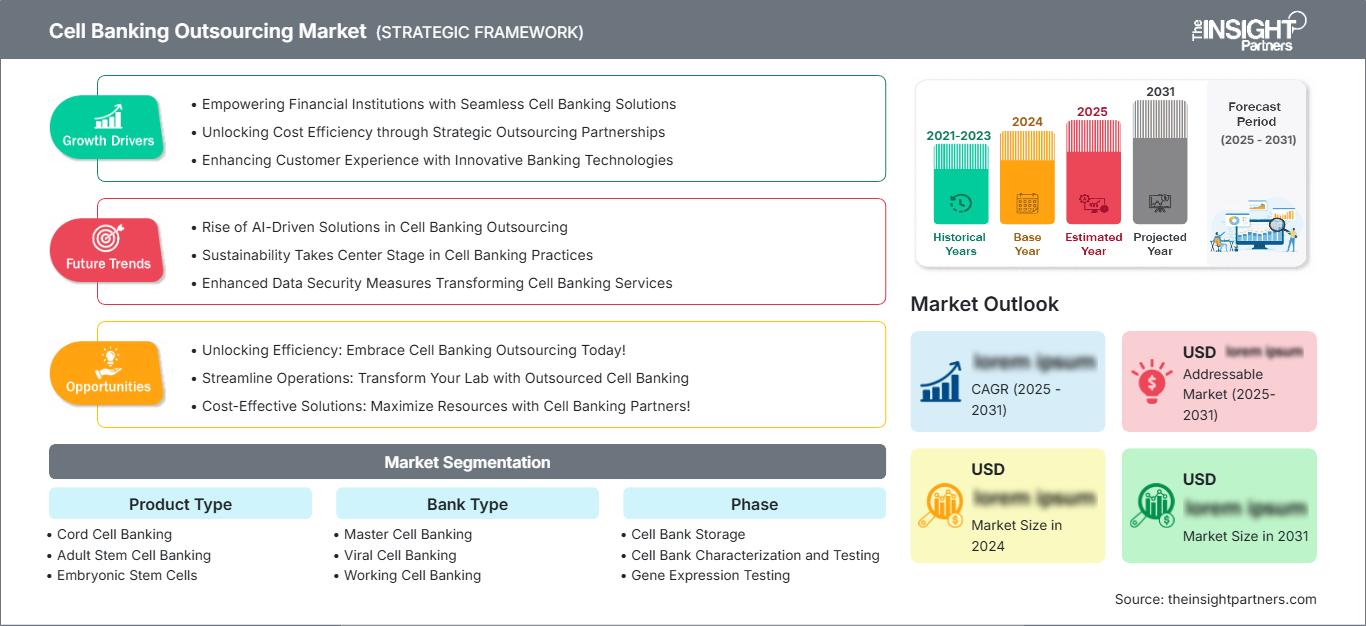
Cell Banking Outsourcing Market: Strategic Insights
Regional Insights
North America Cell Banking Outsourcing Market
The North American region had a 37-40% of the Cell Banking Outsourcing Market share of the Cell Banking Outsourcing in 2025, and is expected to grow at a 13.5-14.5% CAGR during 2026-2034. The demand within this region depends on the extent of biological R&D activities, commercial manufacturing of monoclonal antibodies, vaccines, and the cell and gene therapies that take place there. It is common for sponsors to outsource the process due to costly and highly skilled cleanrooms and biosafety labs.
In Canada, demand is supplemented by academic research institutions, companies involved in regenerative medicines, repositories, and upcoming biomanufacturing infrastructure. Suppliers are looking into sequencing, rapid virus identification, duplicate liquid nitrogen storage, and comprehensive analytical release capabilities. Regulatory requirements within the region help in fostering testing procedures, chain-of-custody record keeping, stability studies, and secure retention of production cells.
U.S. Cell Banking Outsourcing Market
The US accounted for 80–84% of North American revenue in 2025 and is projected to grow at a 13.7–14.7% CAGR between 2026 and 2034. The demand is driven by biotech hubs in Massachusetts, California, Maryland, Pennsylvania, North Carolina, and New Jersey, where researchers can find collaboration opportunities with contract manufacturing facilities, testing labs, academia, and cold chain logistics.
Merck KGaA, Eurofins Scientific SE, Charles River Laboratories International, Inc., and SGS SA have capacities for supporting development programs in the US. The application demand covers master banks and working banks of recombinant proteins, producer cell banks for viruses, vaccine substrates, assay control banks, and therapeutic stem cells. The outsourcing trend is especially applicable to smaller biotech companies that require GMP compliance without the need for cleanroom, cryopreservation, and molecular testing facilities.
Europe Cell Banking Outsourcing Market
In 2025, Europe held 27–30% market share and will be projected to grow at a CAGR of 13.0–14.0% between 2026 and 2034. Germany is the dominant country on account of pharmaceutical manufacturing, advanced analytical services, and regional presence of Merck KGaA and Sartorius AG. Demand is shifting towards bank production together with genetic stability and viral safety packages.
The UK has cell and gene therapy research, translational centers and biosafety laboratories. The sponsors of the UK demand need qualified repositories and testing services appropriate for manufacturing. France benefits from biologics manufacturing and specialty providers such as Clean Cells SAS and Texcell SA, while domestic research programs generate demand for characterized master and working banks.
Italy and Spain represent growth opportunities driven by increasing hospital research, cell-therapy programs in academia and contract manufacturing. End-users in Europe place importance on regulatory documentation, donor material traceability, shipping validation and storage redundancy. Service providers who are able to provide test package compatible with both European and US submissions can serve developers requiring multinational commercialization.
APAC Cell Banking Outsourcing Market
Asia-Pacific represents 23%-26% of the market in 2025 and is predicted to grow at a CAGR of 16.5%-17.5% during 2026-2034. China leads the market due to its biologics manufacturing capabilities, cell therapy, and improved testing facilities. Japan and South Korea have contributed because of their regenerative medicine strategies. India has also contributed due to its clinical abilities and efficient laboratories.
Australia assists in translational research and regulated clinical development. In the region, policies for internal biomanufacturing, increased hospital involvement, and cryogenic logistics are increasing the demand for outsourcing services.
Middle East & Africa Cell Banking Outsourcing Market
Middle East & Africa is projected to demonstrate a CAGR between 12.0% and 13.0% during 2026-2034. Saudi Arabia dominates investments through healthcare localization initiatives, infrastructure development, and biotech development. UAE focuses on developing specialized laboratories and medical logistics capabilities, whereas South Africa provides clinical research and laboratory services for sub-Saharan Africa.
For the other countries in the region, consistent power supply, back-up cooling, liquid nitrogen supplies, and logistics infrastructure affect the economics of repositories. Collaboration with laboratories outside the country could overcome shortages in skills, whereas local laboratories could develop quality systems and robust storage facilities.

Segmentation Analysis
Product Type
Product type is projected to register a 14.4–15.4% CAGR during 2026–2034. The Cell Banking Outsourcing Market scope encompasses established cord and adult stem-cell repositories alongside embryonic and induced pluripotent platforms. Demand varies by ethical framework, therapeutic maturity, donor availability, and characterization burden. Adult cells retain scale advantages, while IPS platforms create faster-growing requirements for genomic integrity, clonality assessment, and specialized cryopreservation.
- Cord Cell Banking: Cord-derived materials maintain strategic relevance for hematopoietic transplantation, immunology research, and therapy development, with outsourcing demand centered on collection processing, contamination control, compatibility testing, secure storage, and documented sample retrieval.
- Adult Stem Cell Banking: Adult stem cells hold the leading position because of established collection pathways, broader clinical familiarity, and demand across regenerative medicine, hematology, immunotherapy, research, and personalized treatment development.
- Embryonic Stem Cells: Embryonic stem-cell banking serves pluripotency research and selected therapeutic programs, although adoption depends on national ethical rules, consent requirements, genetic stability controls, and highly standardized culture and preservation methods.
- IPS Stem Cell Banking: IPS stem-cell platforms are gaining strategic importance in disease modeling, drug screening, and personalized therapies because reprogrammed cells offer pluripotency without relying on embryonic sources, although characterization remains technically intensive.
Bank Type
Bank type is forecast to expand at a 14.3–15.3% CAGR during 2026–2034. Tiered banking structures protect manufacturers against contamination, genetic drift, and inconsistent production. Master banks provide the controlled foundation, working banks support routine manufacturing, and viral banks enable vector-related workflows. Outsourcing reduces the need to maintain separate suites and allows standardized testing, documentation, inventory control, and disaster-recovery practices.
- Master Cell Banking: Master banks form the primary controlled source for subsequent manufacturing, making identity, purity, viability, stability, and freedom from adventitious agents critical to regulatory submissions and long-term product consistency.
- Viral Cell Banking: Viral banks are strategically important for vaccines, gene therapies, and vector manufacturing, requiring enhanced biosafety controls, validated containment, infectivity assessment, sequencing, and carefully documented handling procedures.
- Working Cell Banking: Working banks support repeated manufacturing campaigns by providing qualified material derived from the master bank, thereby reducing passage variability and enabling predictable production scheduling, inventory planning, and batch consistency.
Phase
Phase-based services are expected to record a 14.6–15.6% CAGR during 2026–2034. Characterization and testing represent high-value activities because bank release depends on identity, purity, genetic stability, and microbial and viral safety evidence. Storage produces recurring revenue, while preparation anchors longer client relationships. Gene expression and sequencing services are becoming more important as advanced therapies require deeper molecular understanding and faster contamination detection.
- Cell Bank Storage: Storage demand is supported by long product lifecycles, mandatory retention strategies, and business-continuity requirements, encouraging sponsors to divide inventories across monitored cryogenic systems and geographically separated qualified repositories.
- Cell Bank Characterization and Testing: Characterization and testing combine identity, viability, sterility, mycoplasma, adventitious-virus, and genetic stability assessments, making this phase essential for bank release, regulatory evidence, and manufacturing-risk reduction.
- Gene Expression Testing: Gene expression testing helps confirm phenotype, productivity, potency-related attributes, and process consistency, particularly when engineered cell lines or complex therapeutic cells must retain defined biological functions after expansion.
- Gene Sequencing Testing: Sequencing supports cell-line authentication, genetic stability assessment, construct confirmation, and broad viral detection, providing more comprehensive molecular evidence than narrowly targeted assays for technically complex development programs.
- Cell Bank Preparation: Preparation includes controlled expansion, harvesting, filling, freezing, labeling, and initial quality controls, directly influencing vial uniformity, recovered viability, future manufacturing performance, and the reliability of subsequent characterization.
Opportunity Snapshot
| Phase | Revenue Contribution (High/Medium/Low) | Trend Tag | Adoption Stage (Emerging/Scaling/Mature) |
| Cell Bank Storage | High | Redundant Storage | Mature |
| Cell Bank Characterization and Testing | High | Rapid Biosafety | Scaling |
| Gene Expression Testing | Medium | Potency Profiling | Scaling |
| Gene Sequencing Testing | High | Viral Sequencing | Scaling |
| Cell Bank Preparation | High | Modular GMP | Mature |
Cell Banking Outsourcing Market Growth Drivers and Impact Analysis
Expansion of biologics and advanced therapy pipelines
Growth in monoclonal antibodies, recombinant proteins, vaccines, gene therapies, and cell-based medicines creates recurring requirements for qualified source materials. Each program may require research, master, working, producer, or viral banks before manufacturing can scale. Outsourcing enables developers to obtain these assets without constructing cleanrooms or recruiting dedicated banking and biosafety teams. The impact extends beyond initial preparation because banks require characterization, release testing, secure retention, inventory monitoring, and controlled shipment. As therapies progress from discovery into multicenter clinical trials, demand shifts toward larger vial inventories, stronger documentation, and geographically resilient storage. Providers that integrate banking with analytical development and manufacturing support can reduce handoffs and improve program continuity.
Rising regulatory emphasis on identity and viral safety
Regulators expect manufacturers to demonstrate cell-line identity, genetic stability, microbial purity, and absence of relevant adventitious agents. These expectations increase the number and technical depth of assays needed before a bank can support regulated production. External laboratories offer validated methods, controlled quality systems, and specialists familiar with different cell substrates and product classes. Outsourcing is especially valuable where sponsors require sequencing, retrovirus testing, mycoplasma detection, sterility testing, or species-specific viral panels that would be uneconomical to establish internally. The commercial impact is a shift from individual tests toward integrated characterization packages, supported by auditable data, retained samples, investigation procedures, and documentation suitable for regulatory submissions across multiple jurisdictions.
Asset-light operating models among biotechnology companies
Emerging biotechnology companies frequently prioritize capital for clinical development, process optimization, and patient recruitment rather than permanent laboratory infrastructure. Cell-bank suites, cryogenic repositories, monitoring platforms, and molecular-testing laboratories involve fixed investment and continuing qualification costs, even when internal utilization is variable. Outsourcing converts part of that burden into project-based expenditure and provides access to specialists as programs advance. It also allows sponsors to add capacity without delaying development for facility construction and commissioning. This dynamic strengthens demand for flexible contracts covering pilot expansion, GMP preparation, characterization, storage, and retrieval. Providers benefit when early-stage assignments convert into multiyear relationships spanning clinical and commercial manufacturing.
Cell Banking Outsourcing Market Future Trends
Sequencing-led biosafety and identity workflows
Cell Banking Outsourcing Market trends are moving toward sequencing-led workflows that complement or replace selected conventional assays. Broad sequencing can identify unexpected viral signals, verify engineered constructs, authenticate cell lines, and evaluate genetic stability from a consolidated molecular dataset. During the forecast period, adoption should increase as validated bioinformatics pipelines, curated databases, reference standards, and regulatory experience mature. Providers will need controlled data environments and clear investigation procedures for ambiguous findings. Commercial differentiation will depend on turnaround time, sample requirements, analytical sensitivity, and integration with orthogonal tests. Sequencing will therefore evolve from a specialist option into a central element of advanced bank-characterization strategies.
Digitally connected and distributed cryogenic repositories
Cryogenic storage will become more digitally connected and geographically distributed as sponsors strengthen continuity planning. Continuous sensor networks, automated alarm escalation, electronic chain-of-custody records, barcode-based retrieval, and remote inventory visibility will replace fragmented monitoring practices. Storage providers are also expected to divide critical banks between independently qualified locations to reduce exposure to equipment failure, natural disasters, transport interruption, or regional utility instability. These systems will generate extensive operational data that can support audits, deviation investigations, capacity forecasting, and preventive maintenance. Providers combining secure physical infrastructure with validated digital platforms should be better positioned to win long-duration contracts from commercial biologics and advanced-therapy manufacturers.
Cell Banking Outsourcing Market Opportunities
Regional banking hubs for Asia Pacific therapy developers
Asia Pacific Cell Banking Outsourcing Market Forecast presents an investment opportunity for providers that establish local GMP banking, molecular testing, and redundant storage near emerging therapy clusters. Regional developers may otherwise ship irreplaceable materials across borders, creating customs, temperature-control, permitting, and data-governance complications. New facilities should prioritize modular cleanrooms, vapor-phase liquid-nitrogen systems, next-generation sequencing, rapid microbiology, and bilingual regulatory support. Partnerships with hospitals, biotechnology parks, universities, and domestic manufacturers can accelerate client acquisition and workforce development. A hub-and-spoke model could serve China, Japan, South Korea, India, Australia, and Southeast Asia while preserving country-specific controls over samples and data. Early investment can secure recurring storage and lifecycle-testing relationships.
Integrated packages for emerging biotechnology sponsors
Small and midsized biotechnology companies need coordinated services but often manage multiple vendors for bank development, preparation, testing, storage, and logistics. Providers can address this fragmentation through modular packages linked to defined development milestones. A sponsor could begin with feasibility work, move into GMP master-bank preparation, add characterization and sequencing, and reserve working-bank and storage capacity as clinical progress becomes clearer. Transparent pricing, standardized timelines, regulatory gap assessments, and digital project visibility would reduce procurement complexity. Commercial opportunities also exist in rescue programs involving poorly documented legacy banks, method transfer, recharacterization, and inventory relocation. Integrated delivery can increase retention while helping sponsors avoid repeated qualification of separate suppliers.
Recent Developments
- July 2026: Charles River Laboratories International, Inc. entered a collaboration with Arovella Therapeutics Limited to provide GMP next-generation sequencing for cell-bank characterization. The work supports viral safety evaluation for banks producing reagents used in the ALA-101 manufacturing process, with Charles River also performing viral safety release testing for clinical batches.
- May 2026: Merck KGaA entered a five-year agreement with Genetix Biotherapeutics to provide analytical and biosafety release testing for three commercial gene therapies. The engagement includes analytical assays, viral clearance, biosafety testing, and cell-banking support intended to strengthen consistent commercial supply and lifecycle quality oversight.
- October 2025: Charles River Laboratories International, Inc. announced support for Singapore General Hospital’s cord blood-derived allogeneic CAR-T program. The collaboration includes master cell banking and next-generation sequencing testing intended to strengthen the safety and quality evidence required to advance the investigational platform toward clinical evaluation.
Frequently Asked Questions

- Comprehensive Market Sizing and Forecast Analysis
- Detailed Segmentation Analysis
- In-Depth Market Dynamics Assessment
- Regional and Country-Level Insights
- Competitive Landscape and Company Benchmarking
- Strategic Business Intelligence
Recent Reports
Testimonials

The Insight Partners provided valuable market intelligence that supported our global go-to-market strategy. Their team was professional, responsive, and attentive to our feedback, providing thoughtful analysis and helpful methodological clarifications throughout the project.
Junmo Kim Chief Financial Officer (CFO), Enertech Co., Ltd.
The Insight Partners' SCADA System Market report is comprehensive, with valuable insights on current trends and future forecasts. The team was highly professional, responsive, and supportive throughout. We are very satisfied and highly recommend their services.
RAN KEDEM Partner, Reali Technologies LTDs
I requested a report on a very specific software market and the team produced the report in a few days. The information was very relevant and well presented. I then requested some changes and additions to the report. The team was again very responsive and I got the final report in less than a week.
JEAN-HERVE JENN Chairman, Future Analytica
We worked with The Insight Partners for an important market study and forecast. They gave us clear insights into opportunities and risks, which helped shape our plans. Their research was easy to use and based on solid data. It helped us make smart, confident decisions. We highly recommend them.
PIYUSH NAGPAL Sr. Vice President, High Beam Global
The Insight Partners delivered insightful, well-structured market research with strong domain expertise. Their team was professional and responsive throughout. The user-friendly website made accessing industry reports seamless. We highly recommend them for reliable, high-quality research services
YUKIHIKO ADACHI CEO, Deep Blue, LLC.
This is the first time I have purchased a market report from The Insight Partners.While I was unsure at first, I visited their web site and felt more comfortable to take the risk and purchase a market report.I am completely satisfied with the quality of the report and customer service. I had several questions and comments with the initial report, but after a couple of dialogs over email with their analyst I believe I have a report that I can use as input to our strategic planning process.Thank you so much for taking the extra time and making this a positive experience.I will definitely recommend your service to others and you will be my first call when we need further market data.
JOHN SUZUKI President and Chief Executive Officer, Board Director, BK Technologies
I wish to appreciate your support and the professionalism you displayed in the course of attending to my request for information regarding to infectious disease IVD market in Nigeria. I appreciate your patience, your guidance, and the fact that you were willing to offer a discount, which eventually made it possible for us to close a deal. I look forward to engaging The Insight Partners in the future, all thanks to the impression you have created in me as a result of this first encounter.
DR CHIJIOKE ONYIA MANAGING DIRECTOR, PineCrest Healthcare Ltd.Reason to Buy
- Informed Decision-Making
- Understanding Market Dynamics
- Competitive Analysis
- Identifying Emerging Markets
- Customer Insights
- Market Forecasts
- Risk Mitigation
- Boosting Operational Efficiency
- Strategic Planning
- Investment Justification
- Tracking Industry Innovations
- Aligning with Regulatory Trends





 Get Free Sample for