
Cell Dissociation Market Size, Trends & Demand by 2034
Coverage: By Product (Enzymatic Dissociation Products, Instruments and Accessories, Non-Enzymatic Dissociation Products); Type (Non-Enzymatic Dissociation Products, Tissue Dissociation); Tissue Type (Epithelial Tissue, Connective Tissue, Other Tissues); End User (Research and Academic Institutes, Pharmaceutical and Biotechnology Companies, Other End Users), and Geography\n, and Geography (North America, Europe, Asia Pacific, and South and Central America)
- Status : Data Released
- Report Code : TIPBT00002178
- Category : Life Sciences
- No. of Pages : 150
- Available Report Formats :


- Last update date : September 09, 2026


2025 Market Size
US$ 3.90 Bn
Base year value
2034 Forecast
US$ 6.72 Bn
Projected by 2034
CAGR 2026-2034
6.22 %
Growth rate
Addressable Market
US$ 48.04 Bn
(2026-2034)
The Cell Dissociation Market was valued at US$ 3.90 Billion in 2025 and is projected to reach US$ 6.72 Billion by 2034, registering a CAGR of 6.22% during 2026–2034. The demand is driven by the increasing applications for cell-based research, biopharmaceuticals, regenerative medicine, and single-cell analysis. Reproducible dissociation processes have become increasingly necessary in laboratories that ensure the viability of cells, surface markers, morphology, and functionality.
North America continues to be the leading market in the industry, with a CAGR forecasted at 5.8–6.4% up to 2034. The Cell Dissociation Market Size in North America is aided by intensive biotechnological research, existing cell and gene therapy infrastructure, and continued financial support from governments. Growth in the area is facilitated by the use of tissue processing systems, standardized enzymes, and incorporation of dissociation techniques into flow cytometry, single-cell sequencing, organoids, and translational oncology workflows.
Cell Dissociation Market Assessment and Insights
- North America: Represented 36–40% share in 2025 and is expected to record a CAGR between 5.8–6.4% during 2026–2034, supported by advanced biomedical research infrastructure, biotechnology clusters, and early adoption of automated sample preparation.
- US: Accounted for 80–84% of North American revenue in 2025 and is projected to grow at a CAGR between 5.9–6.5% during 2026–2034.
- Europe: Captured 25–29% share in 2025 and is anticipated to expand at a CAGR between 5.5–6.1% during 2026–2034, led by Germany, the UK, and France.
- Asia Pacific: Held 23–27% share in 2025 and is forecast to register a CAGR between 7.0–7.8% during 2026–2034, with China, Japan, India, and South Korea leading adoption.
- Largest Segment: Enzymatic Dissociation Products accounted for 46–50% market share in 2025 and are projected to register a CAGR between 5.9–6.5% during 2026–2034.
- High Growth Segment: Instruments and Accessories represented 20–24% market share in 2025 and are expected to record a CAGR between 7.0–7.8% during 2026–2034.
- Key companies analyzed in detail: VitaCyte, LLC; Becton, Dickinson and Company; Thermo Fisher Scientific Inc.; PAN-Biotech GmbH; Merck KGaA; HiMedia Laboratories Private Limited; Miltenyi Biotec B.V. & Co. KG; STEMCELL Technologies Inc.; GE HealthCare Technologies Inc.; ATCC; Corning Incorporated; AcceGen; CellSystems GmbH; and Innovative Cell Technologies, Inc.
Source: The Insight Partners' analysis based on proprietary research, government publications, company annual reports, investor presentations, industry databases, and expert interviews.
The Cell Dissociation Market has advanced from primarily manual trypsinization to a customized combination of reagents, closed system process, and automated mechanical technology. Manufacturers are now combining collagenases, neutral proteases, recombinant enzymes, buffers, tubes, and validated methods to enhance standardization. The manufacturing trends are leaning towards animal free components, traceable raw materials, stable enzyme activity, and scalability of packaging. Such trends help to solve the problems of inconsistent cell harvesting, epitope damage, variability in batch production and operator dependence which may affect sequencing and flow cytometry procedures.
During the forecast period, investments will increasingly be channeled to biotechnology clusters in the Asia Pacific region, translational research centers and contract development organizations. The increasing need for raw material traceability and consistency in manufacture will lead to increased demand for recombinant and GMP products. Growth will not only happen in major research centers due to smaller instruments, distributor trainings and technical support in localities.
Cell Dissociation Market Report Scope
| Report Attribute | Details |
|---|---|
| Market size in 2025 | US$ 3.90 Billion |
| Market Size by 2034 | US$ 6.72 Billion |
| Global CAGR (2026 - 2034) | 6.22% |
| Historical Data | 2021-2024 |
| Forecast period | 2026-2034 |
Cell Dissociation Market Analysis
The Cell Dissociation Market is experiencing growth due to the rising number and sophistication of cell-based assays. Viable single-cell suspensions have to be obtained prior to flow cytometry, cell sorting, primary cell culture, and single-cell sequencing. In terms of the value chain, suppliers include enzyme providers, buffer formulation specialists, instrument manufacturers, tissue banks, distributors, academic labs, biotech companies, and contract research organizations.
The availability factors include enzyme quality, cold chain reliability, lot uniformity, and protocol compatibility. Use of recombinant versions decreases the risk of animal contamination, while pre-formulations minimize work in the lab. Vendors of instruments are increasingly relying on programmable mechanical disassociation with proprietary consumables, which leads to recurring revenues. Decisions about purchasing products are made based on reproducibility, yield, epitope integrity, documentation, and technical assistance.
The Cell Dissociation Market Report shows that the competitive structure is split between diversified life science providers and specialized sample preparation service providers. The key players in the market such as Thermo Fisher Scientific Inc., Merck KGaA, Corning Incorporated, and Becton, Dickinson and Company offer their competitive edge through cell culture product lines, international presence, and cross selling into downstream analytical processes. Miltenyi Biotec B.V. & Co. KG and STEMCELL Technologies Inc. stand out with their tissue specific dissociation systems and protocols.
Firms specialized in the area include VitaCyte, LLC, AcceGen, CellSystems GmbH, and Innovative Cell Technologies, Inc. Firms dealing in reagents, biologicals, laboratory facilities, and regional distributors include PAN-Biotech GmbH, HiMedia Laboratories Private Limited, ATCC, and GE HealthCare Technologies Inc. This will increase availability in the areas under consideration. The areas of interest will be automation, recombinants, quality documentation, and difficult tissue protocols.
● REPORT CUSTOMIZATION
Tailor This Report To Align With Your Specific Business Requirements
This report can be customized to align precisely with your business objectives, scope, and target markets. Customization options include tailored segmentation, geography, competitive analysis, and strategic insights to support informed decision-making.
Customize This Report →WHAT YOU CAN ADJUST
- ● Segmentations
- ● Geography
- ● Competitive Analysis
- ● Language Preferences
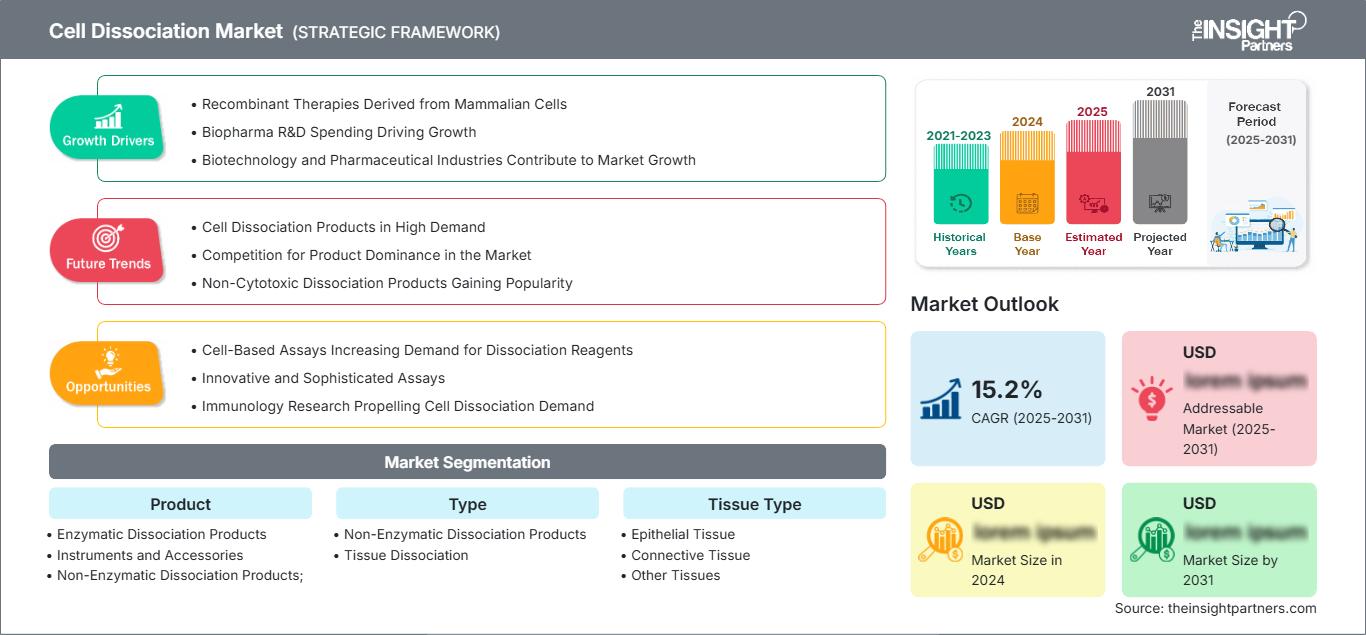
Cell Dissociation Market: Strategic Insights
Regional Insights
North America Cell Dissociation Market
North America represented 36–40% of the Cell Dissociation Market Share in 2025 and is expected to record a 5.8–6.4% CAGR during 2026–2034. The region benefits from established research universities, cancer centers, biotechnology clusters, biobanks, and contract laboratories. High utilization of flow cytometry, organoids, cell therapy development, and single-cell sequencing supports recurring purchases of enzymes, buffers, tubes, filters, and tissue-processing instruments.
Adoption is moving toward standardization and reducing variation, thanks to Canadian regenerative medicine projects, US biotech investments, apart from pharmaceutical manufacturing and education in Mexico. Suppliers who have established protocols and efficient cold chain logistics continue to have an upper hand. However, due to the lack of funds in the university setup and long capital equipment approvals, it might be preferable to go for modular instruments and rent reagents.
U.S. Cell Dissociation Market
The US held 80–84% of North America’s share of revenue in 2025 and is projected to report a 5.9–6.5% CAGR until 2034. Highly concentrated biotech ecosystems in Massachusetts, California, Maryland, North Carolina, and Pennsylvania ensure stable demand. Dissociation products are used by pharmaceutical labs in drug discovery, immuno-oncology, cell line culture, organoids, and advanced therapy development.
Some of the key vendors operating here include Thermo Fisher Scientific Inc., Becton, Dickinson and Company, Corning Incorporated, ATCC, VitaCyte, LLC, AcceGen, and Innovative Cell Technologies, Inc. University-based institutions and cancer centers are looking for standardization prior to cytometry and genomics analysis, whereas vendors prefer animal-free enzymes and traceability of their components. Biomedical funding at federal level, together with clinical research facilities, promote adoption, but research grants cycle affects buying decisions. Vendors that can offer application specialists, protocol optimization, and prompt reagents availability are likely to get a repeat purchase from laboratories dealing with heterogeneous patient samples.
Europe Cell Dissociation Market
Europe contributed 25-29% to the world’s market in 2025 and is expected to record a 5.5-6.1% CAGR during the period 2026-2034. Germany emerges dominant due to biotechnological manufacturing, research institutions, and existence of companies like Merck KGaA, Miltenyi Biotec B.V. & Co. KG, PAN-Biotech GmbH, and CellSystems GmbH. Demand in the region stresses reproducibility, documentation, and low dependence on animal derived products.
The UK offers university research, genomics platforms, and development of cell therapies that provide for automated tissue processing and specialized reagents. Germany enjoys the benefit of laboratory engineering and translational medicine centers. France excels in the research areas of oncology and immunology. Italy and Spain participate through hospital-based research, biobanks, and regenerative medicine programs. Multi-center European research generates increased demand for standardized protocols since multi-center research demands standardized cell recovery and viability. Procurement is decentralized among national healthcare and academic institutions.
APAC Cell Dissociation Market
In 2025, Asia Pacific accounted for 23-27% of total revenue in the world and is anticipated to register 7.0-7.8% CAGR from 2026 to 2034. Biotech parks, drug manufacturing capability, and increasing genome research in China drive the market, regenerative medicine expertise in Japan, and biopharmaceutical manufacturing in South Korea.
India is building up its academic laboratories and reagent production, and Australia profits from biomedical facilities and clinical research organizations. Programs related to biotechnology, localization incentives, and increase in distributors contribute to the adoption. Price sensitivity encourages instrument versatility, small reagents, and multi-tissue compatibility protocols.
Middle East & Africa Cell Dissociation Market
The forecasted CAGR of the Middle East and Africa segment is 5.0% - 5.8% for 2026-2034. Leading players here include Saudi Arabia due to healthcare facilities, research institutions, and development of biotech sector. The UAE focuses on genomics and personalized medicine solutions, and South Africa possesses academic and pathology capabilities.
Other regions will continue facing the issue of limited cold chain, import expenses on reagents, and instrument servicing challenges. Additional lab facilities, biobanking and research collaboration might increase implementation rates. Suppliers that provide stable product formulations, educate distributors, provide remote services and compact processing systems have a good position here.
Segmentation Analysis
Product
The Product segment is projected to grow at a CAGR of 6.0–6.6% during 2026–2034. The Cell Dissociation Market scope across products covers recurring reagents, automated instruments, disposable accessories, and gentle non-enzymatic alternatives. Laboratories balance cell yield, viability, antigen preservation, throughput, and cost. Integrated systems gain importance where standardized processing is required, while enzymes remain essential for dense extracellular matrices.
- Enzymatic Dissociation Products: These products maintain the leading position because trypsin, collagenase, dispase, papain, and recombinant enzymes efficiently release adherent cells and process complex tissues for culture and analytical workflows.
- Instruments and Accessories: Automated dissociators, specialized tubes, strainers, blades, and disposable processing components reduce manual variability, improve throughput, and support reproducible sample preparation across multicenter and high-volume laboratories.
- Non-Enzymatic Dissociation Products: Chelating and enzyme-free formulations serve sensitive primary cells, stem cells, and surface-marker studies where proteolytic activity could alter receptors, compromise phenotype, or reduce downstream analytical reliability.
Type
The Type segment is anticipated to register a CAGR of 6.1–6.7% during 2026–2034. Selection depends on starting material, extracellular-matrix density, cell sensitivity, required yield, and downstream assay. Non-enzymatic procedures are valued for phenotype preservation, whereas tissue dissociation combines mechanical and biochemical action to process complex specimens. Protocol optimization remains critical because excessive treatment can reduce viability or alter transcriptional profiles.
- Non-Enzymatic Dissociation Products: Demand centers on routine passaging and sensitive cell populations that require gentle detachment, intact membrane proteins, predictable recovery, and compatibility with serum-free or chemically defined culture conditions.
- Tissue Dissociation: This category is strategically important for oncology, immunology, neuroscience, organoid, and regenerative medicine studies requiring viable single-cell suspensions from heterogeneous or fibrotic solid-tissue specimens.
Tissue Type
The Tissue Type segment is expected to expand at a CAGR of 6.2–6.8% during 2026–2034. Tissue architecture determines enzyme selection, incubation time, temperature, and mechanical force. Epithelial specimens require careful junction disruption, while connective tissues need stronger collagen-degrading activity. Vendors offering tissue-specific protocols can reduce optimization time and improve recovery from clinical samples with variable size, composition, and storage history.
- Epithelial Tissue: Utilization is supported by cancer research, skin biology, gastrointestinal studies, airway models, and organoids, where preservation of cell-surface markers and viable epithelial subpopulations is analytically important.
- Connective Tissue: Dense extracellular matrices create demand for collagenase-rich formulations and controlled mechanical processing in adipose, cartilage, tendon, cardiac, and fibrotic tissue research applications.
End User
The End User segment is forecast to register a CAGR of 6.0–6.6% during 2026–2034. Research institutes generate broad protocol demand, while pharmaceutical and biotechnology companies prioritize traceability, scalability, and process consistency. Purchasing criteria vary by throughput and regulatory exposure. Academic users favor flexible platforms, whereas commercial laboratories increasingly prefer documented, animal-origin-free reagents and closed or semi-automated processing workflows.
- Research and Academic Institutes: Universities, medical schools, and public laboratories represent recurring users across basic biology, neuroscience, cancer, stem-cell, and immunology research, with purchasing influenced by grants and shared-instrument facilities.
- Pharmaceutical and Biotechnology Companies: Commercial users require reproducible, scalable materials for drug discovery, toxicity testing, biologics development, cellular therapies, analytical characterization, and transfer of validated protocols between research and manufacturing sites.
Opportunity Snapshot
| End User | Revenue Contribution (High/Medium/Low) | Trend Tag | Adoption Stage (Emerging/Scaling/Mature) |
| Research and Academic Institutes | High | Single-Cell Prep | Mature |
| Pharmaceutical and Biotechnology Companies | High | Therapy Processing | Scaling |
| Other End Users | Medium | Clinical Biobanking | Emerging |
Cell Dissociation Market Growth Drivers and Impact Analysis
Expansion of Single-Cell and Spatial Biology Workflows
Single-cell sequencing and spatial biology are increasing the strategic importance of sample preparation because analytical quality begins with effective cell or nuclei recovery. Poor dissociation can selectively lose fragile populations, trigger stress-response genes, damage membrane proteins, or increase debris. Laboratories therefore invest in optimized enzymes, temperature-controlled processing, filtration, and automated mechanical systems. The commercial impact extends beyond one-time instrument sales because each experiment consumes tubes, kits, strainers, and buffers. Suppliers that validate workflows for tumors, brain, lung, liver, skin, and archived material can reduce method-development time. Integration with cytometry and sequencing preparation also creates opportunities for bundled protocols, training, and technical services that improve laboratory reproducibility.
Rising Cell Therapy and Regenerative Medicine Activity
Cell therapy development requires repeatable harvesting, passaging, tissue processing, and cell recovery without compromising potency or identity. These requirements increase demand for recombinant, animal-origin-free, and GMP-compatible dissociation materials with defined composition and batch documentation. As programs progress from discovery toward clinical manufacturing, developers reassess research-grade reagents, supply continuity, residual enzyme removal, and closed-system compatibility. This transition raises the value of quality agreements, change notifications, traceability, and scalable pack sizes. Regenerative medicine research also broadens demand across stem cells, induced pluripotent stem cells, organoids, and engineered tissues. Vendors able to support early protocol development and later manufacturing transfer can establish longer customer relationships and reduce supplier-switching risk.
Automation of Variable Tissue Processing Procedures
Manual mincing, pipetting, incubation, and filtration create operator-dependent variation that can affect yield and experimental comparability. Automated dissociation platforms address this problem through programmable motion, controlled temperature, standardized vessels, and tissue-specific protocols. Their impact is strongest in core laboratories, biobanks, contract research organizations, and multicenter collaborations processing repeated sample types. Automation also reduces hands-on time and occupational exposure to clinical specimens. Instrument adoption stimulates recurring consumable demand and encourages workflow standardization around proprietary accessories. Wider deployment will depend on flexible protocols, throughput options, service coverage, and evidence that automated processing preserves target-cell populations. Compact benchtop designs can extend adoption to laboratories unable to justify high-capacity systems.
Cell Dissociation Market Future Trends
Shift Toward Recombinant and Chemically Defined Reagents
Cell Dissociation Market trends will increasingly favor recombinant enzymes and chemically defined formulations that reduce biological variability and animal-origin concerns. Developers of advanced therapies require stronger raw-material traceability, while research laboratories seek consistent activity across experiments. Suppliers will differentiate through sequence-defined enzymes, controlled impurity profiles, activity testing, and compatibility with serum-free media. Ready-to-use liquids, ambient-shipping options, and concentrated formats will improve logistics. Product development will also focus on selective cleavage, shorter exposure, and rapid neutralization to preserve surface proteins and cellular function. Adoption should accelerate as standardized documentation makes these products easier to incorporate into regulated workflows.
Protocol Intelligence and Connected Sample Preparation
Future instruments will combine programmable tissue processing with digital protocol libraries, experiment tracking, and remote technical support. Rather than operating as isolated devices, dissociators will increasingly capture sample type, processing duration, temperature, speed, reagent lot, and operator information. Such traceability can improve transfer between laboratories and help identify causes of low viability or biased recovery. Vendors may use aggregated performance data to refine tissue-specific settings while preserving customer confidentiality. Connectivity will also support preventive maintenance and consumable management. The strongest platforms will remain sufficiently open for customized research while providing locked, documented methods for routine or regulated applications.
Cell Dissociation Market Opportunities
Localized Manufacturing and Distribution in Asia Pacific
Asia Pacific offers an investment opportunity in the Cell Dissociation Market Forecast for suppliers that combine local reagent manufacturing, application laboratories, and trained distribution. Cell therapy research, biopharmaceutical production, and single-cell genomics are expanding, but imported products can face high freight costs, long lead times, and cold-chain exposure. Regional filling, packaging, quality testing, and inventory hubs can improve responsiveness without altering core formulations. Partnerships with universities, biotechnology parks, distributors, and contract laboratories can accelerate protocol validation for locally prevalent research models. Commercial strategies should include smaller pack sizes, instrument leasing, multilingual technical resources, and hands-on training. These measures can convert laboratories from manual preparation to standardized, consumable-based workflows.
Integrated Solutions for Difficult and Archived Tissues
Complex tumors, fibrotic organs, adipose tissue, neural samples, and formalin-fixed material remain difficult to process consistently. This creates an opportunity for suppliers to develop combined enzyme, instrument, filtration, and protocol packages for defined specimen classes. Investment should prioritize recovery of rare populations, preservation of nucleic acids, reduced debris, and compatibility with downstream sequencing or imaging. Products validated across storage conditions and sample sizes can support biobanks and retrospective studies. A platform approach also enables premium technical services, custom protocol development, and recurring consumables. Differentiation will depend on comparative performance data and access to representative human specimens for validation.
Recent Developments
- October 2025: c-LEcta GmbH introduced CellTrypase, a recombinant trypsin-like enzyme developed for biopharmaceutical manufacturing and GMP-compatible cell processing. The animal-origin-free product offers at least 95% purity and is supplied as a sterile-filtered liquid for viral-vector production, vaccine manufacturing, stem-cell processing, tissue engineering, and cell banking. It can replace established trypsin solutions without extensive process reoptimization.
- July 2025: STEMCELL Technologies Inc. commercially launched the STEMprep Tissue Dissociator System, a benchtop instrument designed to automate and standardize conversion of solid tissues into single-cell suspensions. The system supports validated and customizable protocols while preserving cellular integrity and functionality for cancer, immunology, regenerative medicine, flow cytometry, and gene-expression research.
- August 2025: Corning Incorporated signed a letter of intention with Revital Healthcare to establish a life-sciences manufacturing footprint in Africa. The initiative is relevant to regional laboratory supply availability and supports Corning’s broader life-science presence in markets where imported cell-culture products, consumables, and sample-processing materials are affected by long lead times and distribution constraints.
Frequently Asked Questions

- Comprehensive Market Sizing and Forecast Analysis
- Detailed Segmentation Analysis
- In-Depth Market Dynamics Assessment
- Regional and Country-Level Insights
- Competitive Landscape and Company Benchmarking
- Strategic Business Intelligence
Recent Reports
Testimonials

The Insight Partners provided valuable market intelligence that supported our global go-to-market strategy. Their team was professional, responsive, and attentive to our feedback, providing thoughtful analysis and helpful methodological clarifications throughout the project.
Junmo Kim Chief Financial Officer (CFO), Enertech Co., Ltd.
The Insight Partners' SCADA System Market report is comprehensive, with valuable insights on current trends and future forecasts. The team was highly professional, responsive, and supportive throughout. We are very satisfied and highly recommend their services.
RAN KEDEM Partner, Reali Technologies LTDs
I requested a report on a very specific software market and the team produced the report in a few days. The information was very relevant and well presented. I then requested some changes and additions to the report. The team was again very responsive and I got the final report in less than a week.
JEAN-HERVE JENN Chairman, Future Analytica
We worked with The Insight Partners for an important market study and forecast. They gave us clear insights into opportunities and risks, which helped shape our plans. Their research was easy to use and based on solid data. It helped us make smart, confident decisions. We highly recommend them.
PIYUSH NAGPAL Sr. Vice President, High Beam Global
The Insight Partners delivered insightful, well-structured market research with strong domain expertise. Their team was professional and responsive throughout. The user-friendly website made accessing industry reports seamless. We highly recommend them for reliable, high-quality research services
YUKIHIKO ADACHI CEO, Deep Blue, LLC.
This is the first time I have purchased a market report from The Insight Partners.While I was unsure at first, I visited their web site and felt more comfortable to take the risk and purchase a market report.I am completely satisfied with the quality of the report and customer service. I had several questions and comments with the initial report, but after a couple of dialogs over email with their analyst I believe I have a report that I can use as input to our strategic planning process.Thank you so much for taking the extra time and making this a positive experience.I will definitely recommend your service to others and you will be my first call when we need further market data.
JOHN SUZUKI President and Chief Executive Officer, Board Director, BK Technologies
I wish to appreciate your support and the professionalism you displayed in the course of attending to my request for information regarding to infectious disease IVD market in Nigeria. I appreciate your patience, your guidance, and the fact that you were willing to offer a discount, which eventually made it possible for us to close a deal. I look forward to engaging The Insight Partners in the future, all thanks to the impression you have created in me as a result of this first encounter.
DR CHIJIOKE ONYIA MANAGING DIRECTOR, PineCrest Healthcare Ltd.Reason to Buy
- Informed Decision-Making
- Understanding Market Dynamics
- Competitive Analysis
- Identifying Emerging Markets
- Customer Insights
- Market Forecasts
- Risk Mitigation
- Boosting Operational Efficiency
- Strategic Planning
- Investment Justification
- Tracking Industry Innovations
- Aligning with Regulatory Trends





 Get Free Sample for