
Chlorhexidine Gluconate (CHG) Wipe Market Trends, Size & Forecast by 2034
Coverage: By Type (2% Chlorhexidine Gluconate Cloths, 4% Chlorhexidine Gluconate Cloths); Application (Personal Care, Surgical Care); Distribution Channel (Online Pharmacies, Retail Pharmacies, Others), and Geography (North America, Europe, Asia Pacific, and South and Central America)
- Status : Data Released
- Report Code : TIPRE00016864
- Category : Life Sciences
- No. of Pages : 150
- Available Report Formats :


- Last update date : November 02, 2026


2025 Market Size
US$ 863.98 Mn
Base year value
2034 Forecast
US$ 1,640.28 Mn
Projected by 2034
CAGR 2026-2034
7.38 %
Growth rate
Addressable Market
US$ 11,289.57 Mn
(2026-2034)
The Chlorhexidine Gluconate Wipe Market was valued at US$ 863.98 Million in 2025 and is expected to reach US$ 1,640.28 Million by 2034, registering a CAGR of 7.38% during 2026–2034. Expansion is supported by hospital infection-prevention protocols, increasing surgical volumes, wider use of rinse-free preoperative preparation, and demand for standardized patient bathing. Product convenience, residual antimicrobial activity, and compatibility with procedure-specific care bundles are strengthening adoption across acute-care and outpatient settings.
Across North America, the Chlorhexidine Gluconate Wipe Market size is projected to expand at approximately ~7% CAGR through 2034. The region benefits from established infection-control programs, centralized hospital purchasing, and routine use of chlorhexidine cloths in intensive care and surgical preparation. Clinical demand is also reinforced by efforts to reduce care variation through premeasured, ready-to-use wipes that simplify application, support protocol compliance, and reduce dependence on water, basins, and manually diluted antiseptic solutions.
Chlorhexidine Gluconate (CHG) Wipe Market Assessment and Insights
Regional Outlook
- North America: ~42% of the global market in 2025 | ~7% CAGR through 2034. Market position: North America leads through mature hospital infection-prevention programs, high surgical activity, established group purchasing structures, and broad clinical familiarity with preoperative and daily chlorhexidine bathing protocols.
- US: ~84% of North American market revenue in 2025 | ~7% CAGR through 2034. Market position: The US anchors regional demand through extensive acute-care utilization, strong supplier coverage, protocol-driven purchasing, and continued implementation of standardized skin preparation across surgical, critical-care, and long-term-care settings.
- Europe: ~28% of the global market in 2025 | ~6% CAGR through 2034. Market position: Europe represents a mature, regulated market led by the UK and Germany, with France, Italy, and Spain contributing through hospital hygiene procurement and surgical-care modernization.
- Asia Pacific: ~22% of the global market in 2025 | ~9% CAGR through 2034. Market position: Asia Pacific is the fastest-growing region, supported by expanding hospital capacity, rising surgical access, private healthcare investment, and increasing adoption in China, Japan, India, South Korea, and Australia.
Segment Outlook
- Surgical Care: ~68% Share in 2025 | ~7% CAGR through 2034. Market position: Surgical care leads because preoperative skin preparation is protocol-sensitive, repeatable, and suited to packaged wipes that provide controlled dosing and convenient patient application.
- Online Pharmacies: ~34% Share in 2025 | ~10% CAGR through 2034. Market position: Online pharmacies show the strongest growth as home preparation, repeat purchasing, product comparison, and geographically broader access shift selected transactions toward digital healthcare channels.
Competitive Coverage
3M Company, Cardinal Health, Inc., Stryker Corporation (Sage Products), Convatec Group Plc, GAMA Healthcare Ltd, Becton, Dickinson and Company, Medline Industries, LP, Mölnlycke Health Care AB, Coloplast A/S, Clinicept Healthcare Ltd
Methodology
The Insight Partners follows Data Collection & Secondary Research, Primary Research, Data Analysis, and Data Triangulation & Final Review to validate market estimates and insights.
Source: The Insight Partners' analysis based on proprietary research, government publications, company annual reports, investor presentations, industry databases, and expert interviews.
Product developments have taken the industry away from antiseptic toweling towards pre-saturated and specific to procedure cloth products. The differentiation among various wipes is being done based on the fabric softness, fluid retaining capabilities, pack designs, skin conditioning ingredients, chlorhexidine delivery mechanism, and alcohol free varieties. Manufacturing of the product requires access to non-woven substrate, filling, microbial quality controls, packaging integrity, and shelf life validation. All the above factors require integrated quality systems and converting capabilities in the manufacturer, while the healthcare buyers look into the productivity in addition to unit price.
From 2009 to 2034, Chlorhexidine Gluconate Wipes market dynamics will be determined by construction of hospitals in the Asia-Pacific region and Middle East, growth of ambulatory surgeries, and investment in healthcare associated infections. Regulatory requirements of labeling, biocompatibility, manufacturing control, and intended use will determine the product portfolio. Suppliers who offer reliable regional distribution along with clinical education can help overcome adoption barriers in the emerging systems where antiseptic techniques differ from one facility to another.
Chlorhexidine Gluconate (CHG) Wipe Market Report Scope
| Report Attribute | Details |
|---|---|
| Market size in 2025 | US$ 863.98 Million |
| Market Size by 2034 | US$ 1,640.28 Million |
| Global CAGR (2026 - 2034) | 7.38% |
| Historical Data | 2021-2024 |
| Forecast period | 2026-2034 |
Chlorhexidine Gluconate (CHG) Wipe Market Analysis
Chlorhexidine Gluconate Wipes Demand-Side Growth is related to the requirement for reproducible skin antisepsis without complicated pre-preparation procedure. Healthcare facilities like wipes because defined loading of the solution in wipes allows eliminating variations in comparison with prepared manually cloths. Departments of surgery, intensive care unit, and long-term care are key areas of demand, while selective personal care applications help boost retail demand.
The value chain starts from chlorhexidine formulation ingredients and nonwoven substrate supply, followed by impregnation, conversion, sealing, sterilization or controlled production if needed, testing and distribution. Dependability of supply is dependent upon the performance of packaging barrier and proper solution saturation. Manufacturers have to take care about skin tolerance issues, instructions and compatibility with procedures used in hospitals, so quality assurance is a competitive necessity.
Chlorhexidine Gluconate Wipe Market Report suggests that the competition is centered around clinical familiarity, product portfolio, contracting capability, packaging ease, and implementation support. While Stryker Corporation through its Sage Products subsidiary has a clear presence in the pre-operative cloth wipe market, GAMA Healthcare Ltd and Clinicept Healthcare Ltd have competing products in chlorhexidine bathing formats. Cardinal Health, Inc. and Medline Industries, LP are benefited by wide institutional distribution networks.
Positioning is becoming more and more aligned with the use of consumables and education, infection prevention methodologies, and procurement process standardization. Becton Dickinson and Company, 3M Company, Convatec Group Plc, Mölnlycke Health Care AB, and Coloplast A/S realize synergies because of their complementary capabilities in the fields of skin preparation, wound management, and consumables. The areas of investments are specialized substrates, packaging design, regional regulatory data, manufacturing efficiencies, and formulary choices.
● REPORT CUSTOMIZATION
Tailor This Report To Align With Your Specific Business Requirements
This report can be customized to align precisely with your business objectives, scope, and target markets. Customization options include tailored segmentation, geography, competitive analysis, and strategic insights to support informed decision-making.
Customize This Report →WHAT YOU CAN ADJUST
- ● Segmentations
- ● Geography
- ● Competitive Analysis
- ● Language Preferences
Chlorhexidine Gluconate (CHG) Wipe Market: Strategic Insights
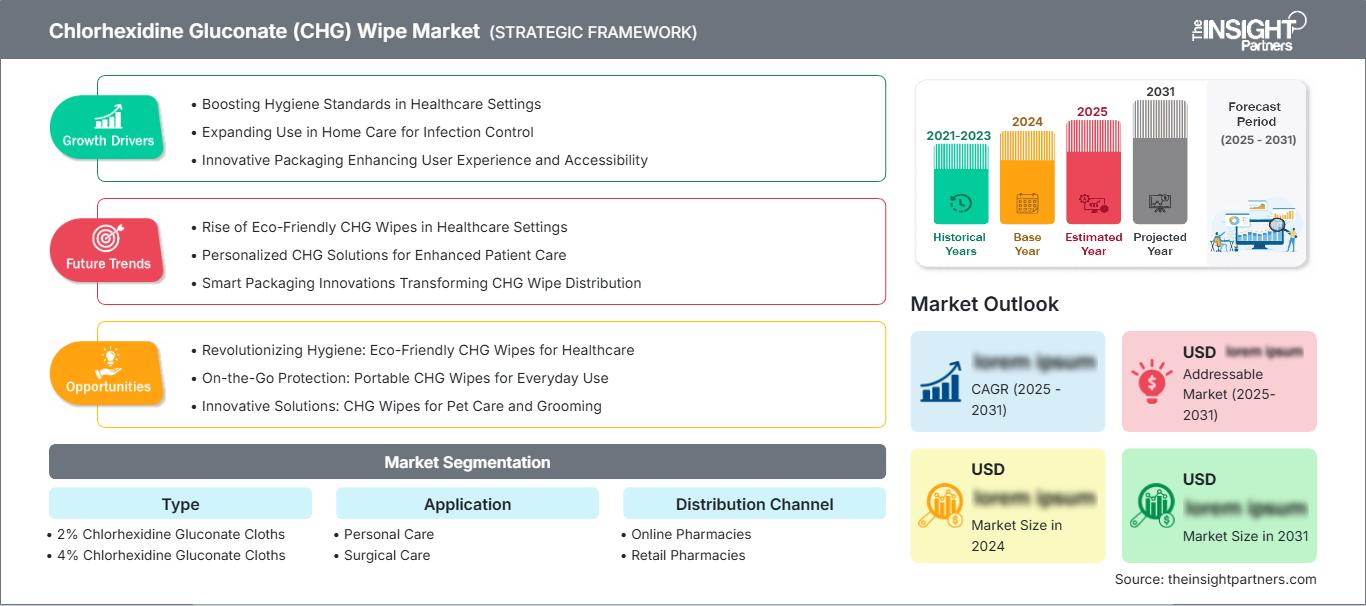
Regional Insights
North America Chlorhexidine Gluconate Wipe Market
North America is forecast to progress at approximately 7% CAGR to 2034. The region has advanced infection prevention facilities and high usage of disposables in the clinical setting. Hospitals have protocols for bathing and pre-operative preparation to ensure standardization in nursing shifts, reduction in preparation process, and enable documentation for compliance purposes. These factors maintain steady demand despite price pressure from purchasing committees.
The Chlorhexidine Gluconate Wipe Market Share in North America is driven by existing supplier relationships, consolidated purchasing processes, and expertise on skin preparation using chlorhexidine-based products. Canada provides the factor of public hospitals and infection control programs, while Mexico provides opportunities for growth from private hospitals and greater access to surgery. There is a need to balance the value proposition, pricing, accessibility, and patient selection training by suppliers.
U.S. Chlorhexidine Gluconate Wipe Market
The US has 84% share of North American revenue and is expected to witness growth of ~7% CAGR until 2034. High volume hospital groups, ambulatory surgery centers and long-term-care facilities will drive adoption of the ready-to-use wipes. Preparation procedures remain crucial but routine bathing of the selected high-risk patients can also be considered a key institutional application. Formulary assessment often focuses on workflow, skin compatibility, packaging and overall cost of the process.
Stryker Corporation, Medline Industries, LP, Cardinal Health, Inc. and Becton, Dickinson and Company have strong market presence in the healthcare networks of the United States. The competitive edge depends on access to the infection prevention committee, clinician training, supply chain management and purchase contract participation. However, retail and Internet markets are growing for the physician-directed home preparation procedure, which has been traditionally driven by hospitals.
Europe Chlorhexidine Gluconate Wipe Market
The European region accounted for approximately ~28% of the world’s revenue in 2025 and is forecasted to grow by ~6% CAGR between 2025-2034. Growth is calculated since hospital hygiene systems have attained maturity but continue to be buoyed by surgeries performed, aging demographics, and the need for patient preparation standardization. Classification, purpose, language, biocompatibility, and claim substantiation affect the market access in national healthcare systems.
The United Kingdom (UK) is the largest country in Europe due to institutional understanding of rinse-free patient bathing and participation of suppliers in healthcare procurement process of the public sector. GAMA Healthcare Ltd and Clinicept Healthcare Ltd provide their infection control products while multinational medical products companies offer broad distribution network. Germany is noted for regulated hospital purchases and quality product documentation. France offers a combination of public hospital market and increasing ambulatory surgery.
There is further adoption potential for Italy and Spain, as hospitals within these regions continue to improve infection prevention procedures and surgery pathways. There are separate procurement processes in each country, which demand localized bidding and specific language requirements, among other factors. The development of the market in Europe will thus be less about product awareness and more about differentiation, packaging, availability, and purchasing procedures.
APAC Chlorhexidine Gluconate Wipe Market
The Asia Pacific region accounted for ~22% of total global revenue in 2025 and is expected to have the highest regional CAGR at ~9% until 2034. China leads this region on account of its hospital presence, manufacturing capacity, and procedural growth. On the other hand, Japan and Australia can be classified as mature regions that prioritize quality. South Korea represents a country with advanced healthcare infrastructure and good acceptance of disposable medical products.
India represents a large untapped market owing to the growth in investments in private hospitals, increased access to surgery, and standardization of infection control practices. In the Asia Pacific region, procurement is quite diversified and this drives manufacturers to ensure local registration, training of distributors, and pricing packs. Efforts toward improving quality in hospitals and availability of domestic medical products can encourage adoption, but protocol execution might hinder penetration.
Middle East & Africa Chlorhexidine Gluconate Wipe Market
The Middle East & Africa market is projected to grow at approximately ~8% CAGR through 2034. Saudi Arabia is positioned as the leading country in the Middle East & Africa due to hospital investment, healthcare transformation programs, and rising procedural capacity. The UAE supports premium medical-product adoption through internationally accredited facilities and medical tourism, while South Africa provides the region’s most developed sub-Saharan distribution base.
Furthermore, growth is contingent on expenditure on healthcare infrastructure related to economic diversification and urbanization. Rest of MEA is varied with regards to procurement difficulties, dependency on imports, and lack of consistency in protocols that hinder adoption. Distributors that offer consistent stock, education and package sizes will facilitate adoption in high-acuity institutions before moving towards retail adoption.
Segmentation Analysis
Type
Type segment in the Chlorhexidine Gluconate Wipe Market reflects differences in concentration, intended use, protocol familiarity, skin-tolerance considerations, and institutional purchasing specifications. Hospitals generally select products according to approved care pathways rather than concentration alone, making labeling clarity and application guidance essential. Within this category, 2% formulations are projected to expand at approximately ~8% CAGR during 2026–2034, supported by established use in rinse-free bathing and preoperative cloth formats. The Chlorhexidine Gluconate Wipe Market scope includes both supplied concentration categories without extending to unrelated antiseptic liquids or surface-disinfection wipes.
- 2% Chlorhexidine Gluconate Cloths: These cloths are widely associated with rinse-free patient bathing and preoperative cleansing. Their positioning benefits from convenient whole-body application, premeasured delivery, and compatibility with nursing workflows that prioritize standardized preparation.
- 4% Chlorhexidine Gluconate Cloths: Products in this concentration category address protocols requiring higher-strength chlorhexidine exposure. Adoption depends on local instructions, clinical preferences, skin suitability, and clear differentiation from conventional liquid washes used with reusable or disposable materials.
Application
Application segment in the Chlorhexidine Gluconate Wipe Market determines purchasing authority, frequency of use, pack configuration, and required clinical documentation. Institutional demand is shaped by infection-prevention committees, surgical teams, and nursing leadership, whereas consumer-facing demand depends more heavily on professional recommendation and retail accessibility. Surgical care is expected to register approximately ~7% CAGR during 2026–2034 as hospitals and outpatient centers seek reproducible preparation methods. Category expansion will depend on appropriate-use education, patient compliance, and evidence connecting correct application with reduced skin bioburden.
- Personal Care: Personal-care use includes selected hygiene routines and clinician-directed preparation outside inpatient facilities. Growth is supported by convenient application and portability, but product instructions and sensitivity precautions remain important for responsible consumer adoption.
- Surgical Care: Surgical care forms the principal clinical demand base because wipes can support pre-admission and facility-based preparation. Pack sequencing, body-area guidance, solution consistency, and ease of patient instruction strengthen their relevance to standardized perioperative pathways.
Distribution Channel
Distribution channels segment in the Chlorhexidine Gluconate Wipe Market influence availability, price transparency, order frequency, and customer education. Institutional products may pass through pharmaceutical or medical-supply networks even when transactions are digitally initiated. Buyers increasingly expect accurate product specifications, inventory visibility, traceability, and dependable fulfillment. Online pharmacies are forecast to grow at approximately ~10% CAGR during 2026–2034 as home preparation and repeat ordering expand. Nevertheless, channel success requires safeguards against inappropriate substitution and clear presentation of concentration, pack size, intended use, and application instructions.
- Online Pharmacies: Digital pharmacies improve geographic reach and product comparison for home-use buyers and smaller care providers. Search visibility, verified product information, delivery reliability, and access to repeat purchases are central competitive factors.
- Retail Pharmacies: Retail pharmacies support immediate access, pharmacist interaction, and local availability. The channel is particularly relevant when patients receive short-notice preoperative instructions or prefer in-person clarification regarding application, concentration, and package selection.
Opportunity Snapshot
| Application | Revenue Contribution | Trend Tag | Adoption Stage |
| Personal Care | Medium | Home Preparation | Scaling |
| Surgical Care | High | Perioperative Protocols | Mature |
Chlorhexidine Gluconate (CHG) Wipe Market Growth Drivers and Impact Analysis
Expansion of Standardized Infection-Prevention Protocols
Healthcare systems are moving toward care bundles that reduce variation in skin preparation, patient bathing, and device-related infection prevention. Pre-saturated wipes support this objective by replacing multiple preparation steps with a packaged format containing a defined antiseptic load. The operational impact extends beyond antimicrobial performance because nurses can follow body-area instructions, document completion, and avoid basin-related workflow complexity. Adoption is strongest where infection-prevention teams collaborate with nursing, surgery, procurement, and quality departments. Suppliers that provide protocol materials, staff education, and pack designs aligned with clinical sequences can achieve deeper institutional utilization. However, demand remains dependent on appropriate patient assessment, correct application, and adherence to facility-specific policies.
Rising Surgical Volumes and Ambulatory Procedure Capacity
Growth in elective surgery, orthopedic procedures, cardiovascular interventions, and ambulatory care increases the number of patients requiring preoperative skin preparation. Wipes offer a practical option for preparation performed at home before admission or within the facility, especially when providers seek a simple process that patients can follow consistently. Ambulatory surgery centers also favor consumables that reduce setup time and support rapid patient turnover. Market impact is visible through demand for procedure-oriented packs, multilingual instructions, and formats that can be distributed during pre-admission consultations. Manufacturers must demonstrate packaging integrity and uncomplicated application because incorrect use can weaken the intended workflow benefit.
Clinical Preference for Rinse-Free, Ready-to-Use Formats
Rinse-free wipes reduce dependence on water, reusable basins, separate cloths, and manually prepared antiseptic solutions. This is particularly relevant for immobile patients, intensive-care populations, and facilities seeking to simplify bedside hygiene. Ready-to-use products also help purchasing teams estimate per-patient consumption and compare protocol costs more consistently. The market impact includes recurring demand, predictable inventory cycles, and opportunities for pack differentiation by cloth count or patient pathway. Nevertheless, manufacturers must address skin comfort, cloth durability, solution distribution, and compatibility with sensitive populations. Products that combine reliable saturation with clear contraindications and use instructions are better positioned for formulary review.
Chlorhexidine Gluconate (CHG) Wipe Market Future Trends
Connected Compliance and Protocol Documentation
Chlorhexidine Gluconate Wipe Market trends will increasingly reflect the integration of consumable use with digital care documentation. Hospitals may link bathing or preoperative preparation tasks to electronic checklists, barcode-supported workflows, and quality dashboards. The wipe itself will remain a physical consumable, but purchasing decisions may consider whether the supplier supports implementation materials, digital training, and auditable protocol completion. This development could favor vendors able to combine products with workflow guidance rather than competing solely on pack price. Data-supported implementation may also help facilities identify missed preparation steps, compare compliance across units, and refine patient instructions without changing the core antiseptic formulation.
Lower-Waste Packaging and Material Optimization
Environmental considerations are expected to influence nonwoven selection, secondary packaging, carton efficiency, and disposal discussions through 2034. Healthcare providers cannot compromise barrier integrity or solution stability, so progress will likely involve material reduction and manufacturing efficiency rather than rapid elimination of single-use formats. Suppliers may redesign pack dimensions, reduce unnecessary components, improve shipping density, or assess alternative substrate construction while preserving clinical performance. Tender evaluations in mature markets may increasingly request environmental information alongside efficacy and quality documentation. Companies that substantiate packaging improvements without overstating recyclability or compromising shelf life can build differentiation in procurement processes.
Chlorhexidine Gluconate (CHG) Wipe Market Opportunities
Localized Supply for High-Growth Healthcare Systems
Demand growth in Asia Pacific and parts of the Middle East creates opportunities for regional converting, packaging partnerships, and distributor-led market development. Chlorhexidine Gluconate Wipe Market Forecasts indicate that commercial success will depend on more than exporting a standard global product. Companies should evaluate local registration requirements, hospital price thresholds, language-specific instructions, preferred cloth counts, and distribution lead times. Contract manufacturing can reduce freight exposure and improve responsiveness, provided formulation controls and microbial quality standards remain consistent. Investment should initially target urban hospital networks and private surgical providers where protocol adoption, training access, and payment capacity are stronger.
Procedure-Specific Packs for Outpatient and Home Preparation
Outpatient surgery creates an investment opportunity for preparation packs designed around patient comprehension and scheduled use. Suppliers can develop clear body-area sequences, compact packaging, educational inserts, and pharmacy-ready formats that complement pre-admission counseling. Commercial execution requires cooperation with surgical centers, pharmacy networks, and digital health platforms rather than reliance on general consumer marketing. Product differentiation may come from better instructions, accessible pack design, skin-conditioning features, and fulfillment models that deliver the correct product before the procedure. Companies should preserve strict intended-use communication because convenience cannot replace clinical screening for allergies, age-related precautions, or facility-specific preparation requirements.
Recent Developments
- October 2025: Becton, Dickinson and Company - BD introduced the Incada Connected Care Platform and next-generation Pyxis Pro dispensing solution. Although focused on medication-management connectivity, the launch illustrates BD’s broader investment in integrated hospital workflows and enterprise data visibility, capabilities relevant to infection-prevention procurement and protocol standardization across connected care environments
- October 2025: Stryker Corporation - Stryker’s Sage business released a data-driven infection-prevention resource addressing surgical-site infection, hospital-acquired pneumonia, catheter-associated urinary tract infection, and patient hygiene workflows. The initiative supports Sage’s consultative positioning around standardized care processes and complements its established portfolio of preoperative skin-preparation cloths
- September 2025: Convatec Group Plc - Convatec received UK and European regulatory approval for ConvaMatrix, a single-use wound dressing intended to support healing in hard-to-heal wounds. The company planned a European launch from 2026, extending its regulated skin and wound-care portfolio and reinforcing its capacity to commercialize clinically differentiated consumables across institutional channels
Frequently Asked Questions

- Comprehensive Market Sizing and Forecast Analysis
- Detailed Segmentation Analysis
- In-Depth Market Dynamics Assessment
- Regional and Country-Level Insights
- Competitive Landscape and Company Benchmarking
- Strategic Business Intelligence
Recent Reports
Testimonials

The Insight Partners provided valuable market intelligence that supported our global go-to-market strategy. Their team was professional, responsive, and attentive to our feedback, providing thoughtful analysis and helpful methodological clarifications throughout the project.
Junmo Kim Chief Financial Officer (CFO), Enertech Co., Ltd.
The Insight Partners' SCADA System Market report is comprehensive, with valuable insights on current trends and future forecasts. The team was highly professional, responsive, and supportive throughout. We are very satisfied and highly recommend their services.
RAN KEDEM Partner, Reali Technologies LTDs
I requested a report on a very specific software market and the team produced the report in a few days. The information was very relevant and well presented. I then requested some changes and additions to the report. The team was again very responsive and I got the final report in less than a week.
JEAN-HERVE JENN Chairman, Future Analytica
We worked with The Insight Partners for an important market study and forecast. They gave us clear insights into opportunities and risks, which helped shape our plans. Their research was easy to use and based on solid data. It helped us make smart, confident decisions. We highly recommend them.
PIYUSH NAGPAL Sr. Vice President, High Beam Global
The Insight Partners delivered insightful, well-structured market research with strong domain expertise. Their team was professional and responsive throughout. The user-friendly website made accessing industry reports seamless. We highly recommend them for reliable, high-quality research services
YUKIHIKO ADACHI CEO, Deep Blue, LLC.
This is the first time I have purchased a market report from The Insight Partners.While I was unsure at first, I visited their web site and felt more comfortable to take the risk and purchase a market report.I am completely satisfied with the quality of the report and customer service. I had several questions and comments with the initial report, but after a couple of dialogs over email with their analyst I believe I have a report that I can use as input to our strategic planning process.Thank you so much for taking the extra time and making this a positive experience.I will definitely recommend your service to others and you will be my first call when we need further market data.
JOHN SUZUKI President and Chief Executive Officer, Board Director, BK Technologies
I wish to appreciate your support and the professionalism you displayed in the course of attending to my request for information regarding to infectious disease IVD market in Nigeria. I appreciate your patience, your guidance, and the fact that you were willing to offer a discount, which eventually made it possible for us to close a deal. I look forward to engaging The Insight Partners in the future, all thanks to the impression you have created in me as a result of this first encounter.
DR CHIJIOKE ONYIA MANAGING DIRECTOR, PineCrest Healthcare Ltd.Reason to Buy
- Informed Decision-Making
- Understanding Market Dynamics
- Competitive Analysis
- Identifying Emerging Markets
- Customer Insights
- Market Forecasts
- Risk Mitigation
- Boosting Operational Efficiency
- Strategic Planning
- Investment Justification
- Tracking Industry Innovations
- Aligning with Regulatory Trends





 Get Free Sample for