Cholesterol Screening/ Cholesterol Lab Testing Market Size & Overview
The Cholesterol Screening/ Cholesterol Lab Testing Market was valued at US$ 24.55 Billion in 2025 and is projected to reach US$ 47.53 Billion by 2034, registering a CAGR of 7.62% during 2026–2034. Market expansion is supported by rising cardiovascular disease prevention, routine lipid-profile utilization, growing cardiometabolic risk assessment, expanding preventive health programs, and wider laboratory access. Increasing integration of cholesterol measurements into primary care and chronic disease monitoring is reinforcing recurring test demand.
Across North America, the Cholesterol Screening/ Cholesterol Lab Testing Market size is expected to expand at approximately ~7% CAGR through 2034. Extensive clinical laboratory infrastructure, established preventive-care pathways, and a large population requiring cardiovascular risk assessment support regional demand. Growing connections between lipid testing and the management of diabetes, hypertension, obesity, and cardiovascular conditions are sustaining repeat testing across physician, hospital, payer, employer, and patient-directed channels.
Cholesterol Screening/ Cholesterol Lab Testing Market is driven by the continuous need of clinicians and not based on the use of symptom-based diagnosis. Abnormalities related to lipids may be asymptomatic; thus, the use of laboratory tests becomes crucial in determining risk and finding the appropriate course of action, whether it is lifestyle changes, medications, or monitoring. The sources of demand include physicians, hospitals, patients, employers, payers, managed care providers, and government schemes. Value chain involves testing requests, sample collection, transportation, analysis, quality control, interpretation, and monitoring. Efficiency of supply will depend on automated chemistry systems, standardized reagents, logistics, expertise, and reporting. Centralized laboratories may collect samples using the collection networks, whereas hospital laboratories conduct tests using the care pathways.
According to the Cholesterol Screening/ Cholesterol Lab Testing Market Report, competition includes network coverage, turnaround efficiency, payer relationships, connectivity, test menu breadth, and integration into health systems. Labcorp Holdings Inc. and Quest Diagnostics Incorporated have major lab testing infrastructure in the USA. Unilabs and SYNLAB International GmbH have presence in European diagnostic markets. Eurofins Scientific SE brings in their expertise in the clinical diagnostics space. The investment flow is towards automation of laboratory processes, patient portals, direct access testing, hospital affiliations, and consolidation of labs. The companies offering different models include BioReference Health, LLC; Clinical Reference Laboratory, Inc.; ACM Global Laboratories; Adicon Holdings Limited; and Spectra Laboratories. Strategic differentiation lies more in linking cholesterol tests to additional cardiometabolic data, sample access, and interoperability of the results.
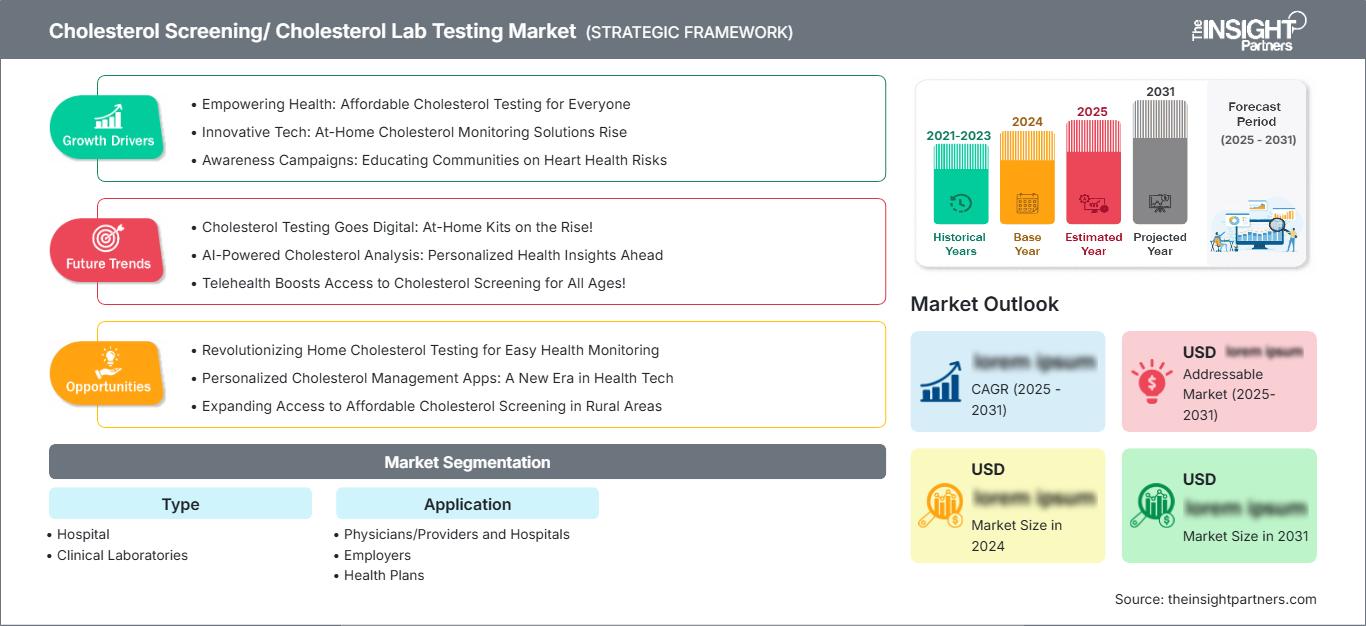
Cholesterol Screening/ Cholesterol Lab Testing Market Assessment and Insights
Regional Outlook
- North America: ~42% of the global market in 2025 | ~7% CAGR through 2034. Market position: North America leads through extensive laboratory networks, established reimbursement pathways, strong preventive-testing penetration, and routine inclusion of lipid profiles in primary-care and cardiometabolic disease management.
- US: ~88% of North American market revenue in 2025 | ~7% CAGR through 2034. Market position: The US dominates North America through nationwide reference laboratories, physician-directed screening, employer wellness programs, health-plan participation, consumer testing services, and repeated monitoring of higher-risk patients.
- Europe: ~27% of the global market in 2025 | ~7% CAGR through 2034. Market position: Europe is a mature diagnostic market supported by organized preventive care and community laboratory access. Germany leads the region, while the UK, France, Italy, and Spain generate substantial testing volumes.
- Asia Pacific: ~23% of the global market in 2025 | ~9% CAGR through 2034. Market position: Asia Pacific is the fastest-growing region as laboratory access, urban diagnostic capacity, and chronic disease prevention expand. China leads the region, followed by strong testing activity in Japan, India, South Korea, and Australia.
Segment Outlook
- Hospital: ~55% Share in 2025 | ~7% CAGR through 2034. Market position: Hospital-based testing leads because integrated diagnostic workflows, inpatient and outpatient encounters, specialist referrals, and treatment monitoring create sustained lipid-testing volumes across coordinated care environments.
- Patients: ~12% Share in 2025 | ~9% CAGR through 2034. Market position: Patient-directed testing has a high-growth profile as digital ordering, direct laboratory access, convenient specimen collection, preventive-health awareness, and longitudinal result tracking increase consumer participation.
Competitive Coverage
Unilabs, SYNLAB International GmbH, BioReference Health, LLC, Clinical Reference Laboratory, Inc., ACM Global Laboratories, Adicon Holdings Limited, Labcorp Holdings Inc., Quest Diagnostics Incorporated, Eurofins Scientific SE, Spectra Laboratories
Methodology
The Insight Partners follows Data Collection & Secondary Research, Primary Research, Data Analysis, and Data Triangulation & Final Review to validate market estimates and insights.
Source: The Insight Partners' analysis based on proprietary research, government publications, company annual reports, investor presentations, industry databases, and expert interviews.
Cholesterol Screening/ Cholesterol Lab Testing Market Trends
Advanced Cardiometabolic Profiles Beyond Conventional Lipids
Cholesterol Screening/ Cholesterol Lab Testing Market trends increasingly favor richer cardiovascular-risk characterization rather than reliance on conventional measurements alone. Advanced assessments involving apolipoproteins, lipoprotein(a), particle-related indicators, and complementary cardiometabolic markers can support selected patients whose clinical history or residual risk requires additional information. Through 2034, laboratories are expected to develop tiered pathways in which conventional lipid profiles remain the accessible first step and specialized assays are used when clinically appropriate. This transition gives large providers opportunities to combine routine testing scale with specialty capabilities. Competitive differentiation can consequently shift from stand-alone cholesterol measurement toward integrated cardiovascular diagnostic portfolios that support more individualized interpretation and treatment decisions.
Connected Results and Longitudinal Patient Monitoring
Digital laboratory platforms are expected to convert individual cholesterol results into longitudinal information that supports continuing risk management. Patient portals, mobile applications, interoperable health records, result visualization, and clinician notifications can make repeated measurements easier to compare over time. For laboratories, effective digital engagement can strengthen relationships with providers, payers, health systems, employers, and consumers without changing the core analytical process. As patient-accessible services mature, providers combining convenient collection with secure historical results may differentiate through continuity and usability. This development can also help integrated-care organizations identify testing gaps, connect abnormal results with interventions, and evaluate whether patients complete recommended follow-up.
Cholesterol Screening/ Cholesterol Lab Testing Market Growth Factors
Rising Need for Cardiometabolic Risk Assessment
Cholesterol testing occupies a foundational position in cardiovascular risk evaluation because lipid abnormalities frequently develop without immediately visible symptoms. Laboratory measurement provides clinicians with objective information for assessing whether lifestyle changes, pharmacologic management, further evaluation, or periodic monitoring may be appropriate. Growing clinical attention to the relationship among obesity, diabetes, hypertension, abnormal lipid levels, and cardiovascular disease is increasing opportunities to include lipid profiles in broader metabolic assessments. The resulting commercial impact extends beyond an initial screening event because higher-risk patients and individuals receiving treatment often require repeat measurements. This recurring pattern favors laboratories capable of maintaining analytical quality, convenient specimen access, consistent turnaround, and effective result delivery across primary-care and specialist settings.
Expansion of Preventive and Routine Screening
Preventive screening creates durable laboratory volumes because cholesterol assessment is relevant to broad adult populations rather than only individuals experiencing acute symptoms. Screening frequency can differ according to cardiovascular history, diabetes status, age, treatment, family history, and other clinical risk factors, creating multiple demand pathways. For laboratories, routine lipid testing produces predictable clinical chemistry workloads suitable for automated platforms and consolidated processing. Physicians and hospitals remain major ordering channels, while health plans, employers, public programs, and patient-access services broaden opportunities for risk identification. As healthcare systems place greater emphasis on earlier intervention, lipid testing can serve as an accessible entry point into lifestyle counseling, medication decisions, additional cardiovascular assessment, and longitudinal monitoring.
Improved Access Through Distributed Collection Networks
The expansion of collection centers, digital ordering, electronic reporting, and patient-accessible services reduces practical barriers surrounding laboratory testing. Routine lipid profiles are compatible with distributed collection because established analytical methods can be centralized while specimen collection occurs closer to patients. National and regional providers can therefore gain operating leverage by connecting neighborhood access points with automated core laboratories. Consumer pathways create an additional route for individuals seeking preventive information outside traditional appointments, although medical interpretation remains important when results are abnormal or risk factors are present. Greater convenience can increase screening participation, support adherence to follow-up schedules, and improve laboratory utilization without requiring equivalent analytical capacity at every collection location.
Cholesterol Screening/ Cholesterol Lab Testing Market Opportunities
Scale Consumer-Accessible Preventive Testing Networks
Consumer-accessible services allow laboratories to complement physician-directed testing with convenient preventive pathways. Investment priorities include simplified ordering, geographically distributed collection, clear preparation instructions, mobile result delivery, transparent pricing, and mechanisms for clinical follow-up. Cholesterol Screening/ Cholesterol Lab Testing Market Forecasts suggest that commercial value will increasingly depend on reducing access friction while preserving standardized laboratory quality. Providers can combine lipid testing with broader metabolic assessments to increase clinical relevance without relying exclusively on stand-alone cholesterol tests. The opportunity is strongest where consumer services complement established care and enable results to remain usable across primary care, cardiology, endocrinology, wellness, and chronic disease management.
Build Scalable Capacity in Asian Healthcare Systems
Asia Pacific offers an investment opportunity around automated clinical chemistry, localized collection networks, standardized quality processes, and digital reporting. China provides substantial volume potential, while India’s uneven laboratory access creates room for organized networks to expand beyond major urban centers. Partnerships with physicians, hospitals, and local collection operators can accelerate specimen flows without requiring every location to replicate full analytical capabilities. Investors and laboratory operators can prioritize hub-and-spoke systems that combine centralized processing with distributed access. Success will depend on affordable pricing, local reimbursement, quality requirements, physician relationships, turnaround performance, and patient convenience rather than population scale alone.
Segmentation Analysis
Type
Type defines the operational setting in which cholesterol analysis is produced and remains central to the Cholesterol Screening/ Cholesterol Lab Testing Market scope. Purchasing priorities include throughput, automation, turnaround time, quality assurance, connectivity, and specimen logistics. Adoption favors technologies that integrate with existing clinical chemistry workflows and process routine volumes efficiently. Within this category, Hospital is projected to expand at approximately ~7% CAGR during 2026–2034 as lipid testing remains embedded in coordinated inpatient, outpatient, specialist, and chronic-care pathways.
- Hospital: Hospital testing supports cholesterol assessment alongside cardiovascular, endocrine, renal, and metabolic evaluations, enabling clinicians to relate lipid results to broader diagnostic findings during treatment planning and follow-up.
- Clinical Laboratories: Independent and reference laboratories aggregate physician-referred specimens across collection networks, benefiting from centralized automation, efficient routine chemistry workflows, standardized processing, and broad geographic coverage.
Application
Application segmentation reflects the organizations or individuals that initiate, finance, coordinate, or consume cholesterol-testing services. Demand is extending beyond episodic clinical care as cardiovascular prevention becomes a longitudinal population-health priority. Buyer requirements vary in ordering integration, reporting, accessibility, scale, and follow-up support. Patient-directed participation is expected to register approximately ~9% CAGR during 2026–2034, supported by direct-access pathways, digital engagement, and convenient collection without replacing the need for appropriate clinical interpretation.
- Physicians/Providers and Hospitals: Clinical providers generate recurring orders through cardiovascular risk assessment, annual evaluations, treatment monitoring, and management of patients with lipid abnormalities or associated metabolic conditions.
- Employers: Workplace wellness initiatives can incorporate cholesterol testing into preventive assessments, particularly when employers connect measurable cardiometabolic indicators with education, coaching, and employee health-management resources.
- Health Plans: Payers use screening within preventive-care and chronic disease frameworks, where identifying elevated risk and supporting continued monitoring can facilitate structured interventions for covered members.
- Managed Care Organizations: Integrated managed-care models connect laboratory ordering with population analytics, coordinated care pathways, and follow-up programs, improving continuity between screening outcomes and risk-management decisions.
- Government Agencies: Public programs can extend testing through preventive-health initiatives and community services, particularly among populations facing financial, geographic, or primary-care access barriers.
- Patients: Consumer-directed services respond to interest in convenient ordering, accessible collection, transparent results, digital records, and greater participation in monitoring personal cardiovascular and metabolic indicators.
Opportunity Snapshot
| Application | Revenue Contribution | Trend Tag | Adoption Stage |
| Physicians/Providers and Hospitals | High | Integrated Screening | Mature |
| Employers | Medium | Workplace Prevention | Scaling |
| Health Plans | High | Risk Stratification | Mature |
| Managed Care Organizations | Medium | Population Analytics | Scaling |
| Government Agencies | Medium | Community Screening | Scaling |
| Patients | Medium | Direct Access | Scaling |
Regional Insights
North America Cholesterol Screening/ Cholesterol Lab Testing Market
North America is set to represent ~42% of the total revenue pool in 2025 and is forecasted to witness ~7% CAGR up to 2034. The Cholesterol Screening/Cholesterol Laboratory Test Market is influenced by the presence of existing preventive-care protocols, comprehensive lab facilities, clinical information system technology, and routine use of lipid panels in cardiovascular disease prevention.
Regional operations include hospitals' laboratories, national reference laboratories, collection centers, physician ordering process, employers’ initiatives, and consumer access programs. Existing infrastructure limits the percentage CAGR growth when compared to the less-developed regions, but regular treatment monitoring ensures sustainable volume. Canada will contribute via primary care, public healthcare, and US will contribute more towards commercial revenue due to higher testing population and private laboratories infrastructure.
U.S. Cholesterol Screening/ Cholesterol Lab Testing Market
The United States constituted about ~88% of North American revenues in 2025 and is expected to grow at a CAGR of ~7% through 2034. The US market is characterized by extensive cardiovascular risk assessment, robust laboratory capacity, established payor relationships, and large numbers of individuals who need either an initial or repeat cholesterol test. Cholesterol screening frequency depends on age, cardiovascular condition, presence of diabetes, family history, drug exposure, and many more clinical risk factors.
Quest Diagnostics Incorporated and Labcorp Holdings Inc. offer wide-ranging laboratory and patient access capabilities in conjunction with hospitals, regional providers, and specialty laboratories. Applications are diverse and include both doctors, hospitals, health plans, employers, government-sponsored programs, and individuals. Online orders, mobile interactions, convenient sample collection, and longitudinal reporting can help increase repeat testing compliance. Complementary use of metabolic panel tests will ensure cholesterol results can be assessed along with glucose levels and other clinical biomarkers.
Europe Cholesterol Screening/ Cholesterol Lab Testing Market
Europe generated approximately ~27% of global revenue in 2025 and is expected to expand at around ~7% CAGR through 2034. The region benefits from established public and private laboratory infrastructure, cardiovascular prevention programs, primary-care screening, and broad access to clinical chemistry services. Germany is assessed as the leading country in Europe because of its large healthcare system, mature outpatient laboratory market, and substantial diagnostic utilization.
The UK provides healthcare routes with diagnostic procedures being offered privately for the purpose of cholesterol detection during cardiovascular risk assessment and chronic disease management. In France, there exists an extensive network of medical laboratories, and Germany has a distributed health care system that allows performing numerous out-patient tests. In Italy and Spain, there is contribution from hospitals, laboratories, specialized care, and prevention programs.
Cholesterol Screening/ Cholesterol Lab Testing Market Share conditions vary from country to country due to different reimbursement and laboratory ownership, procurement, and referral processes of physicians. The companies participating in the diagnostics market in Europe include SYNLAB International GmbH, Unilabs, and Eurofins Scientific SE. Consolidation within laboratories may increase the efficiency of operations and investments, and digital reporting helps to enhance the cooperation between laboratories, doctors, and patients. The development of the market has already reached the level of basic screening; therefore, future expansion will depend on regular monitoring and cardiometabolic evaluation.
APAC Cholesterol Screening/ Cholesterol Lab Testing Market
Asia Pacific represented approximately ~23% of global revenue in 2025 and is projected to register around ~9% CAGR through 2034, making it the fastest-growing regional market. China is assessed as the leading country in Asia Pacific, supported by population scale, expanding urban laboratory capacity, and rising focus on managing cardiometabolic risk.
Japan combines mature diagnostic infrastructure with an aging population, while South Korea and Australia have sophisticated preventive-care systems. India presents substantial expansion potential as organized laboratories and collection networks extend beyond major metropolitan areas. Regional growth is supported by laboratory automation, healthcare investment, digital-health adoption, chronic disease programs, and greater public awareness of cardiovascular prevention.
Middle East & Africa Cholesterol Screening/ Cholesterol Lab Testing Market
Middle East & Africa will see a growth rate of about ~8% CAGR till 2034 due to improvement in healthcare infrastructure, which will result in an increased need for routine clinical chemistry and cardiovascular risk assessment services. Saudi Arabia and the United Arab Emirates are among the most notable countries in the Gulf region, where investment in hospitals and preventive care helps laboratory use. South Africa represents a large part of sub-Saharan private laboratory testing.
Saudi Arabia is considered one of the leaders of Middle East & Africa due to the presence of strong healthcare investments and laboratory modernization. In the Rest of MEA, there are access issues that present good opportunities for the centralization of laboratories and sample collection, automation, and effective sample logistics. Financial capability from the energy sector may help with Gulf healthcare investment, and infrastructure is critical everywhere else.
Cholesterol Screening/ Cholesterol Lab Testing Market Report Scope
| Report Attribute | Details |
|---|---|
| Market size in 2025 | US$ 24.55 Billion |
| Market Size by 2034 | US$ 47.53 Billion |
| Global CAGR (2026 - 2034) | 7.62% |
| Historical Data | 2021-2024 |
| Forecast period | 2026-2034 |
| Segments Covered | Type, Application |
| Region scope | North America, Europe, Asia-Pacific, South and Central America, Middle East and Africa |
Recent Developments
- September 2026: Labcorp Holdings Inc. outlined its long-term growth strategy during its 2026 Investor Day, emphasizing specialty testing, hospital laboratory partnerships, direct-to-consumer testing, digital capabilities, and acquisition-led expansion. These priorities are relevant to routine and advanced cardiometabolic services because they expand laboratory access, consumer engagement, health-system integration, and the infrastructure used to process recurring blood tests.
- January 2026: Quest Diagnostics Incorporated and Corewell Health completed Diagnostic Lab of Michigan, LLC, a laboratory joint venture owned 51% by Quest Diagnostics and 49% by Corewell Health. The collaboration includes laboratory management services across Corewell Health hospitals and plans for a new centralized laboratory facility, demonstrating deeper integration between reference-laboratory capabilities and health-system testing operations.
- February 2025: Eurofins Scientific SE continued expanding its clinical diagnostics and laboratory network through acquisition-led development and investment in laboratory capabilities. The company’s broader strategy of strengthening local testing operations, specialized diagnostics, technical capacity, and geographic reach supports the infrastructure required for routine clinical chemistry, including lipid assessment, although cholesterol testing was not presented as a stand-alone transaction category.
Frequently Asked Questions

Recent Reports






