
Chronic Heart Failure Devices Market Growth, Trends & Forecast by 2034
Coverage: By Product Type (Ventricular Assist Devices (VADs), Implantable Cardioverter Defibrillators (ICD), Pacemakers, Cardiac Resynchronization Therapy, Counter Pulsation Devices); End User (Hospitals, Specialized Cardiovascular Disease Treatment Centers, Ambulatory Surgical Centers), and geography, and Geography (North America, Europe, Asia Pacific, and South and Central America)
- Status : Data Released
- Report Code : TIPRE00018030
- Category : Life Sciences
- No. of Pages : 150
- Available Report Formats :


- Last update date : November 02, 2026


2025 Market Size
US$ 3.03 Bn
Base year value
2034 Forecast
US$ 7.56 Bn
Projected by 2034
CAGR 2026-2034
10.69 %
Growth rate
Addressable Market
US$ 46.89 Bn
(2026-2034)
The Chronic Heart Failure Devices Market was valued at US$ 3.03 Billion in 2025 and is projected to reach US$ 7.56 Billion by 2034, recording a CAGR of 10.69% during 2026–2034. Expansion is supported by the rising clinical burden of chronic heart failure, broader use of rhythm-management therapies, improved survival among advanced cardiac patients, and continued development of smaller, more durable implantable systems. Remote monitoring capabilities and evidence-based device selection are also strengthening adoption across cardiovascular care pathways.
Across North America, the Chronic Heart Failure Devices Market size is expected to expand at a modeled CAGR of ~9% through 2034. The region benefits from established electrophysiology and advanced heart-failure programs, favorable access to implantable technologies, and coordinated post-implantation monitoring. Replacement procedures provide a recurring demand base, while growing use of conduction-system pacing, temporary mechanical circulatory support, and integrated diagnostic algorithms extends device utilization beyond conventional rhythm correction.
Chronic Heart Failure Devices Market Assessment and Insights
Regional Outlook
- North America: ~43% of the global market in 2025 | ~9% CAGR through 2034. Market position: North America leads through high implant volumes, extensive specialist infrastructure, structured reimbursement, early adoption of connected cardiac devices, and a sizable population requiring rhythm management or circulatory support.
- US: ~86% of North American market revenue in 2025 | ~9% CAGR through 2034. Market position: The US anchors regional demand through concentrated electrophysiology expertise, advanced heart-failure centers, clinical-trial participation, replacement procedures, and strong use of implantable defibrillation, pacing, and mechanical-support technologies.
- Europe: ~28% of the global market in 2025 | ~10% CAGR through 2034. Market position: Europe represents a mature but expanding market, supported by structured cardiac-care networks. Germany leads within Europe, while the UK, France, Italy, and Spain maintain substantial procedural demand.
- Asia Pacific: ~21% of the global market in 2025 | ~13% CAGR through 2034. Market position: Asia Pacific is the fastest-growing region as cardiac infrastructure, insurance coverage, specialist training, and device availability expand. China leads within Asia Pacific, followed by Japan as a technologically mature market.
Segment Outlook
- Implantable Cardioverter Defibrillators: ~34% Share in 2025 | ~9% CAGR through 2034. Market position: The segment leads because defibrillators provide established protection against life-threatening ventricular arrhythmias, generate recurring replacement demand, and are integrated into advanced chronic heart-failure management pathways.
- Ventricular Assist Devices: ~24% Share in 2025 | ~13% CAGR through 2034. Market position: Growth is driven by transplant shortages, improving pump durability, expanded destination-therapy consideration, and increased use of temporary or durable support for stabilization, recovery, and long-term management.
Competitive Coverage
Boston Scientific Corporation, Medtronic plc, Abiomed, Inc., Jarvik Heart, Inc., LivaNova PLC, ReliantHeart, Inc., BIOTRONIK SE & Co. KG, Berlin Heart GmbH, Abbott Laboratories, Getinge AB
Methodology
The Insight Partners follows Data Collection & Secondary Research, Primary Research, Data Analysis, and Data Triangulation & Final Review to validate market estimates and insights.
Source: The Insight Partners' analysis based on proprietary research, government publications, company annual reports, investor presentations, industry databases, and expert interviews.
Heart-failure treatment based on device therapy has evolved from simple electrical correction to more complex rhythms, hemodynamics, physiology, and remote monitoring. The makers are shrinking the leads, increasing the battery life, adding multi-parameter diagnostics, and improving the control of pumps. The manufacturing of such products requires advanced technology as the implantable devices require certain components, software, biocompatible materials, and a controlled production environment. More and more hospitals are evaluating the devices on the total care basis, which includes procedure difficulty, follow-up load, device replacement cycles, compatibility, and the availability of implanting teams.
During the forecast period up until 2034, investments will shift to connected implants, physiologic pacing, less invasive circulatory support, and stratification using device therapy. Some possibilities for market growth can be seen in the Asia Pacific and certain Middle Eastern markets, as the tertiary cardiac centers will expand their procedural capabilities. Regulatory approaches recognizing significant innovation in clinical outcomes will speed up the commercialization process, though manufacturers should still produce evidence on the long-term safety and effectiveness.
Chronic Heart Failure Devices Market Report Scope
| Report Attribute | Details |
|---|---|
| Market size in 2025 | US$ 3.03 Billion |
| Market Size by 2034 | US$ 7.56 Billion |
| Global CAGR (2026 - 2034) | 10.69% |
| Historical Data | 2021-2024 |
| Forecast period | 2026-2034 |
Chronic Heart Failure Devices Market Analysis
The Growth of Chronic Heart Failure Devices Market is driven by the synergy between rising demand, better identification of the target population and availability of specialized cardiac procedures. The demand comes from patients with chronic heart failure who need protection against sudden death, ventricular resynchronization, bradycardia treatment or mechanical circulatory support. Ageing population and long-term survival after myocardial infarction expand the addressable market, and repeated hospitalization drives early risk stratification and increased treatment intensity.
The value chain includes components makers, contract manufacturers, device makers, regulatory agencies, distributors, implanting facilities and remote monitoring organizations. Supply risks relate to the availability of semiconductors, batteries, precise leads, biocompatible materials and certified software. Implantable platforms need lots of proof and post-launch surveillance, therefore established players enjoy inherent advantages, but specialists can still play roles in ventricular assist devices and pediatrics.
From the Chronic Heart Failure Devices Market Report, it can be seen that the competition trends have changed from being hardware focused to becoming clinical ecosystems. Boston Scientific Corporation, Medtronic plc, Abbott Laboratories, and BIOTRONIK SE & Co. KG compete based on rhythm management, diagnostics, monitoring capabilities, and relationships with physicians. Circulatory support devices are highlighted by companies like Abiomed, Inc., Jarvik Heart, Inc., ReliantHeart, Inc., and Berlin Heart GmbH, while Getinge AB has its contribution through counterpulsation technology.
Development areas encompass miniaturization, leads design, hemocompatibility, power source capability, predictive capabilities, and indication validation. The development skills related to device development also apply to LivaNova PLC. Clinical success, training programs, service, regulatory activities, and demonstrating reduction in complications/efficient management of longitudinal nature are some of the factors of strategic positioning.
● REPORT CUSTOMIZATION
Tailor This Report To Align With Your Specific Business Requirements
This report can be customized to align precisely with your business objectives, scope, and target markets. Customization options include tailored segmentation, geography, competitive analysis, and strategic insights to support informed decision-making.
Customize This Report →WHAT YOU CAN ADJUST
- ● Segmentations
- ● Geography
- ● Competitive Analysis
- ● Language Preferences
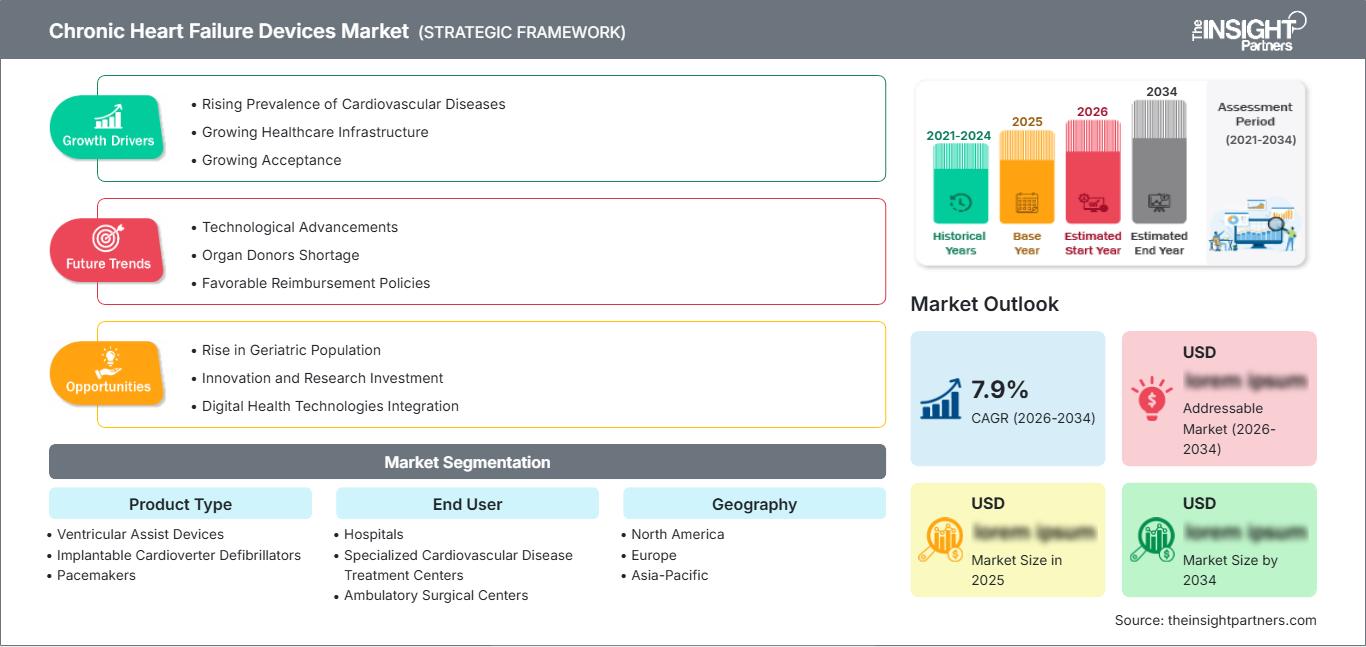
Chronic Heart Failure Devices Market: Strategic Insights
Regional Insights
North America Chronic Heart Failure Devices Market
The region captured around 43% of the Chronic Heart Failure Devices Market Share worldwide in 2025 and is anticipated to post a CAGR of ~9% during 2026–2034. The region's share in the market is driven by mature electrophysiology platforms, advanced mechanical support programs, high intensity of diagnostics, and well-developed procedures of implant replacements. The hospitals are able to assess the patients via interdisciplinary teams including heart failure specialists, electrophysiologists, surgeons, imaging professionals, and remote monitoring professionals.
The factors driving the region include use of physiologic pacing, extracardiac defibrillation, next-generation leads, predictive diagnostics, and temporary heart pumps. Canada is a part of this region with its universal hospital systems and cardiovascular centers, whereas Mexico represents select opportunities for private tertiary hospitals.
U.S. Chronic Heart Failure Devices Market
The US represented ~86% of North American revenue in 2025 and is expected to grow at ~9% through 2034. It is the leading country in North America because of its large treated population, concentration of advanced heart-failure programs, broad clinical-trial activity, and access to high-value implantable technologies. Specialized centers also support ventricular assist device implantation, bridge-to-transplant care, and complex device revisions.
Boston Scientific Corporation, Medtronic plc, Abbott Laboratories, Abiomed, Inc., and Getinge AB have an extensive business or clinical footprint in all these areas. The direction that adoption is taking includes connected monitoring, conduction system pacing, small defibrillation leads, and risk stratification. Procurement now takes into account the lifespan of the device, its ability to interface with remote systems, efficiency in procedures, and hospital avoidance.
Europe Chronic Heart Failure Devices Market
Europe accounts for ~28% of worldwide revenue in 2025, expected to grow at ~10% CAGR until 2034. Nationally implemented health systems enable systematic diagnostics and specialist referral; however, procurement procedures vary across countries. The demand for replacement continues to be significant since Europe has a well-established implanted device population; however, new demand arises from improvements in referral processes and application of more advanced pacing and circulatory assist devices.
Germany is the largest country in Europe due to its developed cardiac infrastructure, high-level of procedure implementation, and medical device sector development. The UK provides dedicated heart failure services and centralized assessment of expensive technologies. In France, hospital-based care along with reimbursement for specialists is present, but in Italy there is acknowledged electrophysiology expertise, although access varies regionally.
The trend in the European market is moving towards products that have comparative outcomes, life cycle information, cybersecurity measures, and workflow advantages. Companies like BIOTRONIK SE & Co. KG, Berlin Heart GmbH, LivaNova PLC, Medtronic plc, Abbott Laboratories, and Boston Scientific Corporation are active in this particular regional value chain. The adoption between 2024 and 2034 will be influenced by evidence-based purchasing and equal access beyond the metro hospitals.
APAC Chronic Heart Failure Devices Market
In 2025, Asia Pacific constituted about 21% of the global market and is expected to witness the highest regional CAGR of about 13% between 2026-2034. In Asia Pacific, China leads owing to increasing capacity of hospitals, larger addressable population, localization policies, and availability of specialist procedures.
Japan is one of the most developed markets with stringent adoption rates and replacement demand. South Korea represents high technology adoption and highly advanced hospitals, whereas India provides scalability owing to increased insurance penetration and private cardiac networks. Australia is equipped with advanced implantation and follow-up facilities.
Middle East & Africa Chronic Heart Failure Devices Market
The Middle East & Africa market is projected to grow at ~9% CAGR through 2034. Saudi Arabia is the leading country in the Middle East & Africa, supported by investment in tertiary hospitals, cardiovascular centers, and national health-system modernization. The UAE emphasizes high-acuity specialist care, imported technology, and digitally connected hospital infrastructure.
With South Africa representing the most advanced sub-Saharan base for heart care within the region, however, limited affordability and access to health facilities have limited patient volume, whereas the Rest of MEA continues to be underserved, thus presenting selective demand for pacemakers, defibrillators, and counterpulsation systems. Growth will depend more on human resources and sustainable funding rather than hardware.
Segmentation Analysis
Product Type
Product Type defines the Chronic Heart Failure Devices Market scope across implantable electrical therapies and mechanical systems that correct rhythm, coordinate contraction, or support circulation. Hospitals select technologies according to ventricular function, arrhythmic risk, disease severity, procedural suitability, and anticipated care duration. Adoption is strongest where specialist assessment and longitudinal monitoring are available. Within this category, implantable cardioverter defibrillators are projected to expand at ~9% CAGR through 2034 as replacement demand and sudden-death prevention sustain utilization.
- Ventricular Assist Devices: These pumps serve patients with advanced ventricular dysfunction as bridge-to-transplant, bridge-to-decision, recovery support, or destination therapy. Demand depends on multidisciplinary programs, surgical capability, anticoagulation management, pump durability, and limited donor-heart availability.
- Implantable Cardioverter Defibrillators: ICDs continuously detect dangerous ventricular rhythms and deliver corrective therapy. Their established evidence base, broad electrophysiology availability, replacement cycle, and integration with diagnostic monitoring support a leading commercial position.
- Pacemakers: Pacemakers address clinically significant bradycardia and conduction abnormalities that can complicate heart-failure management. Miniaturized generators, leadless configurations, and physiologic pacing approaches strengthen relevance for carefully selected patients.
- Cardiac Resynchronization Therapy: CRT devices coordinate ventricular activation in eligible patients with electrical dyssynchrony. Uptake is influenced by patient selection, lead-placement expertise, response optimization, and the ability to combine resynchronization with defibrillation.
- Counter Pulsation Devices: Counterpulsation systems provide temporary hemodynamic assistance by improving coronary perfusion and reducing ventricular workload. They remain relevant in selected acute-care scenarios where rapid deployment, clinician familiarity, and temporary stabilization are priorities.
End User
End User segmentation reflects differences in clinical complexity, procurement authority, procedural infrastructure, and post-implantation responsibility. The Chronic Heart Failure Devices Market is concentrated in facilities capable of imaging, electrophysiology, intensive monitoring, surgery, and emergency management. Referral coordination increases utilization by moving eligible patients from general cardiology toward device specialists. Specialized cardiovascular disease treatment centers are expected to record a CAGR of ~12% through 2034 as complex case concentration and dedicated heart-failure pathways support adoption.
- Hospitals: Hospitals account for broad procedural demand because they combine emergency services, catheterization laboratories, operating rooms, intensive care, and multidisciplinary support. They are central to complex implantation, complication management, and inpatient circulatory assistance.
- Specialized Cardiovascular Disease Treatment Centers: These centers concentrate electrophysiology and advanced heart-failure expertise, enabling refined patient selection and higher procedural efficiency. Their dedicated teams support complex programming, optimization, rehabilitation, and longitudinal device surveillance.
- Ambulatory Surgical Centers: Ambulatory facilities participate mainly in suitable lower-complexity procedures and follow-up services. Expansion depends on regulatory permissions, reimbursement, appropriate patient selection, emergency-transfer arrangements, and compact technologies that reduce recovery requirements.
Opportunity Snapshot
| End Users | Revenue Contribution | Trend Tag | Adoption Stage |
| Hospitals | High | Integrated Care | Mature |
| Specialized Cardiovascular Disease Treatment Centers | High | Complex Referrals | Scaling |
| Ambulatory Surgical Centers | Low | Outpatient Migration | Emerging |
Chronic Heart Failure Devices Market Growth Drivers and Impact Analysis
Rising Burden of Chronic and Advanced Heart Failure
Population aging, cardiometabolic disease, improved survival after acute cardiac events, and persistent hypertension are enlarging the pool of patients requiring long-term heart-failure management. Device demand does not rise uniformly with prevalence because candidacy depends on rhythm status, ejection fraction, symptoms, anatomy, and response to medical therapy. However, a larger monitored population increases identification of patients who may benefit from defibrillation, resynchronization, pacing, or circulatory support. The commercial impact is strongest in health systems that maintain referral pathways between primary cardiology, electrophysiology, advanced heart-failure services, and cardiac surgery. Manufacturers benefit when therapy-selection tools and clinical education reduce delayed referral.
Expanding Remote Monitoring and Predictive Diagnostics
Connected cardiac devices are changing follow-up from scheduled interrogation toward continuous or event-driven surveillance. Multiparameter information can assist clinicians in identifying rhythm disturbances, changes in activity, fluid-related deterioration, and device-performance issues before an emergency presentation. This improves the strategic value of implanted platforms beyond their primary therapeutic function. Market impact includes greater demand for interoperable software, cybersecurity, alert-management protocols, and service infrastructure. Vendors that reduce false alerts and integrate information into clinical workflows can improve adoption, while hospitals must assign staff and define escalation processes. The driver therefore supports both hardware replacement and recurring digital-service engagement.
Limited Donor Hearts and Broader Mechanical Support Pathways
The persistent imbalance between transplant demand and available donor hearts strengthens the clinical role of ventricular assist and temporary support devices. Mechanical systems can maintain perfusion while clinicians assess recovery, transplantation, durable support, or further intervention. Improved pump controls, smaller insertion profiles, and more structured shock teams broaden the settings in which support may be considered. The market impact extends beyond unit sales because adoption requires consoles, disposables, implantation training, intensive-care protocols, and long-term patient management. Growth remains concentrated in qualified centers because bleeding, infection, thrombosis, vascular injury, and device-management requirements demand experienced multidisciplinary teams.
Chronic Heart Failure Devices Market Future Trends
Physiologic Pacing and More Personalized Electrical Therapy
Chronic Heart Failure Devices Market trends increasingly point toward stimulation strategies that more closely reproduce the heart’s natural conduction pattern. Conduction-system pacing, improved lead delivery, adaptive programming, and better characterization of electrical dyssynchrony could expand personalization beyond conventional pacing configurations. Future platforms may combine pacing, defibrillation, resynchronization, and diagnostic intelligence within more flexible treatment pathways. The principal implication is a shift from device-category selection toward individualized electrical-therapy design. Adoption will depend on procedural reproducibility, training, long-term lead evidence, battery implications, and demonstration that physiological improvements translate into fewer symptoms, admissions, or revisions.
Data-Enabled Implants Within Coordinated Care Networks
By 2034, implanted devices are expected to function as connected nodes within broader heart-failure management networks. Algorithms may combine device signals with clinical history, imaging, medication changes, and patient-reported information to prioritize intervention. This transition could improve surveillance efficiency, but it also introduces governance requirements involving data quality, explainability, cybersecurity, and clinical accountability. Manufacturers will need to design platforms that deliver actionable information rather than undifferentiated alerts. Hospitals that establish centralized monitoring teams and standardized escalation pathways may capture greater value from predictive systems. The trend favors vendors with integrated hardware, software, evidence-generation, and clinical-support capabilities.
Chronic Heart Failure Devices Market Opportunities
Scaling Advanced Device Programs in Underserved Urban Markets
Emerging metropolitan areas in Asia Pacific, the Middle East, Latin America, and parts of Africa present opportunities where tertiary hospitals are expanding but advanced heart-failure services remain concentrated. Chronic Heart Failure Devices Market Forecasts support investment in physician training, referral development, inventory planning, remote technical assistance, and regional service hubs. A commercially sustainable approach requires more than premium product distribution. Suppliers should align device configurations with local reimbursement, build complication-management capability, and support patient follow-up. Partnerships with hospital networks can reduce geographic fragmentation and create sufficient procedure volumes for specialized teams, particularly in pacing, defibrillation, and temporary circulatory support.
Developing Lower-Burden and Modular Care Platforms
Manufacturers can address adoption barriers by designing devices and delivery systems that lower procedural complexity, simplify programming, improve longevity, and reduce follow-up burden. Modular platforms that share programmers, monitoring environments, accessories, or training resources may improve hospital economics and strengthen customer retention. Opportunity also exists in smaller leads, leadless pacing, compact pumps, biocompatible blood-contacting surfaces, and software that supports patient selection. Investment should prioritize measurable clinical and operational outcomes, including fewer revisions, shorter procedures, efficient surveillance, or improved utilization of specialist staff. Evidence demonstrating total-care value will be essential for reimbursement and procurement decisions.
Recent Developments
- May 2026: Abiomed, Inc. - Johnson & Johnson reported results from the IMPACT US pilot study evaluating planned Impella 5.5 support in high-risk cardiac surgery patients with severe left ventricular dysfunction. The single-arm study assessed safety and feasibility in a non-shock population, extending clinical investigation of pump-supported recovery strategies. The evaluated use remains investigational and is not currently cleared or approved by the FDA.
- April 2026: Abbott Laboratories - Abbott presented late-breaking evidence across its pacing and electrophysiology pipeline, including initial results involving the investigational UltiSynq conduction-system pacing ICD lead and an early feasibility evaluation of the investigational AVEIR conduction-system pacing leadless pacemaker. The programs illustrate continuing investment in physiological pacing and less-invasive rhythm-management platforms.
- September 2025: Medtronic plc - Medtronic initiated the global ELEVATE-HFpEF pivotal study to evaluate personalized elevated pacing rates and conduction-system pacing in patients with heart failure with preserved ejection fraction. The company stated that study results may support pursuit of a new pacing indication for a patient population with limited device-based treatment options.
Frequently Asked Questions

- Comprehensive Market Sizing and Forecast Analysis
- Detailed Segmentation Analysis
- In-Depth Market Dynamics Assessment
- Regional and Country-Level Insights
- Competitive Landscape and Company Benchmarking
- Strategic Business Intelligence
Recent Reports
Testimonials

The Insight Partners provided valuable market intelligence that supported our global go-to-market strategy. Their team was professional, responsive, and attentive to our feedback, providing thoughtful analysis and helpful methodological clarifications throughout the project.
Junmo Kim Chief Financial Officer (CFO), Enertech Co., Ltd.
The Insight Partners' SCADA System Market report is comprehensive, with valuable insights on current trends and future forecasts. The team was highly professional, responsive, and supportive throughout. We are very satisfied and highly recommend their services.
RAN KEDEM Partner, Reali Technologies LTDs
I requested a report on a very specific software market and the team produced the report in a few days. The information was very relevant and well presented. I then requested some changes and additions to the report. The team was again very responsive and I got the final report in less than a week.
JEAN-HERVE JENN Chairman, Future Analytica
We worked with The Insight Partners for an important market study and forecast. They gave us clear insights into opportunities and risks, which helped shape our plans. Their research was easy to use and based on solid data. It helped us make smart, confident decisions. We highly recommend them.
PIYUSH NAGPAL Sr. Vice President, High Beam Global
The Insight Partners delivered insightful, well-structured market research with strong domain expertise. Their team was professional and responsive throughout. The user-friendly website made accessing industry reports seamless. We highly recommend them for reliable, high-quality research services
YUKIHIKO ADACHI CEO, Deep Blue, LLC.
This is the first time I have purchased a market report from The Insight Partners.While I was unsure at first, I visited their web site and felt more comfortable to take the risk and purchase a market report.I am completely satisfied with the quality of the report and customer service. I had several questions and comments with the initial report, but after a couple of dialogs over email with their analyst I believe I have a report that I can use as input to our strategic planning process.Thank you so much for taking the extra time and making this a positive experience.I will definitely recommend your service to others and you will be my first call when we need further market data.
JOHN SUZUKI President and Chief Executive Officer, Board Director, BK Technologies
I wish to appreciate your support and the professionalism you displayed in the course of attending to my request for information regarding to infectious disease IVD market in Nigeria. I appreciate your patience, your guidance, and the fact that you were willing to offer a discount, which eventually made it possible for us to close a deal. I look forward to engaging The Insight Partners in the future, all thanks to the impression you have created in me as a result of this first encounter.
DR CHIJIOKE ONYIA MANAGING DIRECTOR, PineCrest Healthcare Ltd.Reason to Buy
- Informed Decision-Making
- Understanding Market Dynamics
- Competitive Analysis
- Identifying Emerging Markets
- Customer Insights
- Market Forecasts
- Risk Mitigation
- Boosting Operational Efficiency
- Strategic Planning
- Investment Justification
- Tracking Industry Innovations
- Aligning with Regulatory Trends





 Get Free Sample for