Clinical Laboratory Automation Systems Market Size & Overview
The Clinical Laboratory Automation Systems Market was valued at US$ 3.81 Billion in 2025 and is projected to reach US$ 7.38 Billion by 2034, registering a CAGR of 7.63% during 2026–2034. Expansion is supported by rising diagnostic workloads, shortages of trained laboratory personnel, demand for standardized specimen handling, and pressure to reduce turnaround times. Integrated automation also improves traceability, limits manual intervention, and enables laboratories to process expanding test volumes without proportionate staffing increases.
North America remains central to the Clinical Laboratory Automation Systems Market size, with the regional market expected to record a ~7% CAGR through 2034. Consolidated reference-laboratory networks, capital availability, and early adoption of connected pre-analytical and post-analytical workflows support demand. Laboratory staffing constraints provide an additional structural catalyst. Survey findings presented by Siemens Healthineers indicate that 39% of laboratory professionals consider limited staffing their greatest challenge and 89% believe automation is needed to manage testing demand.
Growth in Clinical Laboratory Automation Systems Market is due to the increasing gap between the need for testing and available labor in the laboratory. End-users have started using the automation technology to overcome bottlenecks or any kind of errors in the accessioning, centrifugation, decapping, aliquoting, sorting, and archiving. The industry comprises manufacturers of the automation platforms, analyzers, middleware, laboratory information systems, tracks, distributors, service providers, and workflow consultants. The supply side of the industry now relies on interoperability and not performance of the individual piece of equipment. The laboratories are looking for bidirectional routing, priority handling, quality of specimen checking, and compatibility with various analyzers. According to F. Hoffmann-La Roche Ltd, their products comprise pre-analytics, post-analytics, transport, and digital solutions.
According to the Clinical Laboratory Automation Systems Market analysis, competitive positioning has moved away from instrument attributes and towards workflow results. The rivalry between Beckman Coulter, Inc., Siemens Healthineers AG, Abbott Laboratories, and F. Hoffmann-La Roche Ltd exists via integrated core-laboratory ecosystems, while Copan Italia S.p.A. offers specialized value proposition in microbiology automation and artificial intelligence-based workflows. The areas for investment are small size design, interoperability, specimen quality assessment automation, remote monitoring, cybersecurity, and data orchestration. Companies such as Thermo Fisher Scientific Inc., Hitachi High-Tech Corporation, Sysmex Corporation, Becton, Dickinson and Company, and CLA Clinical Laboratory Automation SA have room to stand out by specializing in certain applications or integrating into customers' existing systems or through localized service.
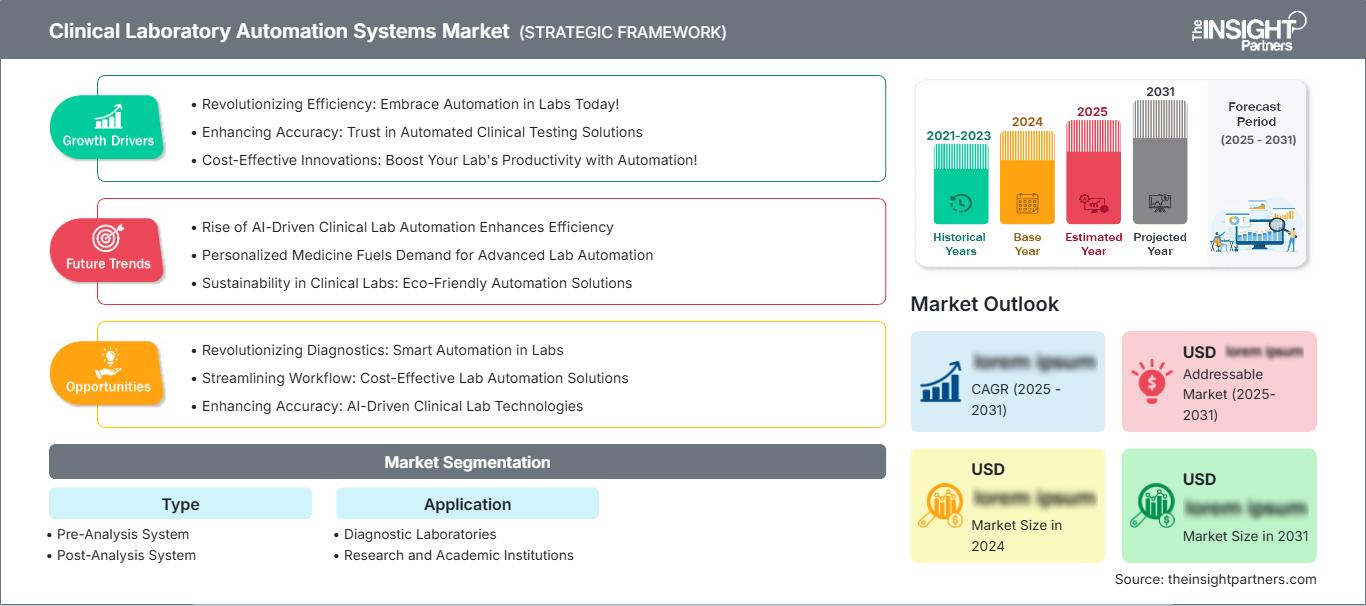
Clinical Laboratory Automation Systems Market Assessment and Insights
Regional Outlook
- North America: ~39% of the global Clinical Laboratory Automation Systems Market share in 2025 | ~7% CAGR through 2034. Market position: North America leads through its concentration of high-throughput laboratories, established diagnostic networks, skilled labor shortages, and capacity to finance integrated automation, middleware, maintenance, and workflow-consulting projects.
- US: ~85% of North American market revenue in 2025 | ~7% CAGR through 2034. Market position: The US anchors regional revenue because large hospital systems and reference laboratories prioritize specimen traceability, rapid turnaround, analyzer connectivity, and automation of repetitive tasks across centralized operations.
- Europe: ~30% of the global market in 2025 | ~7% CAGR through 2034. Market position: Europe represents a mature installed base supported by laboratory consolidation and quality standardization. Germany is the leading country in Europe, followed by the UK and France, while Italy and Spain offer replacement-led opportunities.
- Asia Pacific: ~24% of the global market in 2025 | ~10% CAGR through 2034. Market position: Asia Pacific is the fastest-growing region as diagnostic networks expand capacity and automate centralized facilities. China leads the region, while Japan, South Korea, India, and Australia sustain differentiated modernization programs.
Segment Outlook
- Pre-Analysis System: ~61% Share in 2025 | ~8% CAGR through 2034. Market position: The segment leads because specimen receipt, identification, sorting, centrifugation, decapping, aliquoting, and routing contain multiple repetitive steps where automation produces measurable operational and safety benefits.
- Research and Academic Institutions: ~27% Share in 2025 | ~9% CAGR through 2034. Market position: Growth is supported by translational research, biobanking, multicenter studies, and demand for repeatable sample workflows that can accommodate variable protocols and increasingly data-intensive projects.
Competitive Coverage
Thermo Fisher Scientific Inc., Beckman Coulter, Inc., Hitachi High-Tech Corporation, Siemens Healthineers AG, CLA Clinical Laboratory Automation SA, Sysmex Corporation, Becton, Dickinson and Company, Abbott Laboratories, F. Hoffmann-La Roche Ltd, Copan Italia S.p.A.
Methodology
The Insight Partners follows Data Collection & Secondary Research, Primary Research, Data Analysis, and Data Triangulation & Final Review to validate market estimates and insights.
Source: The Insight Partners' analysis based on proprietary research, government publications, company annual reports, investor presentations, industry databases, and expert interviews.
Clinical Laboratory Automation Systems Market Trends
Artificial Intelligence Will Shift Automation Toward Predictive Workflows
Clinical Laboratory Automation Systems Market trends will increasingly involve artificial intelligence that anticipates workload, identifies specimen anomalies, adjusts routing, and supports preventive maintenance. Current systems already apply rules-based prioritization, but future platforms are expected to use historical volumes, analyzer status, staffing patterns, and quality indicators to predict congestion before it affects turnaround. Adoption will depend on transparent decision logic, cybersecurity, validated performance, and continued human oversight. AI will not remove the need for laboratory professionals; it will redirect attention toward exceptions and clinically significant decisions. Microbiology provides an early pathway, with Copan Italia S.p.A. integrating automation and AI to assist laboratory workflows and accelerate actionable results.
Modular Automation Will Expand Beyond High-Volume Laboratories
Future development will prioritize configurable systems that can be installed incrementally within constrained laboratory footprints. Instead of committing immediately to a full track, midsized laboratories will adopt targeted modules and add routing, storage, or analyzer connections as volumes rise. This approach lowers initial capital exposure and reduces implementation disruption. Standardized interfaces and vendor-neutral middleware will become more important because buyers want to preserve analyzer choice throughout the automation lifecycle. Compact systems will also expand the addressable market beyond flagship hospitals and mega-laboratories. Suppliers must support phased validation, adaptable service contracts, and credible expansion paths to convert this structural shift into sustainable recurring revenue.
Clinical Laboratory Automation Systems Market Growth Factors
Laboratory Workforce Constraints Accelerate Automation Investment
Diagnostic laboratories face sustained pressure to handle growing workloads with limited technical staffing. Automation directly addresses this constraint by transferring repetitive tube handling, specimen preparation, sorting, routing, and archiving from personnel to standardized systems. The operational impact extends beyond headcount savings because automated workflows reduce interruptions and allow qualified staff to focus on exception management, quality assurance, and technically complex testing. Survey evidence reported by Siemens Healthineers shows that 83% of laboratory professionals expect testing demand to increase, while 89% believe automation is required to keep pace. Consequently, laboratory directors increasingly evaluate automation as capacity infrastructure rather than discretionary equipment.
Demand for Faster and More Predictable Turnaround Times
Turnaround consistency is becoming as important as maximum throughput, particularly for emergency, inpatient, and high-priority testing. Manual specimen transfers create variable queues, whereas automated routing can direct tubes according to urgency, analyzer availability, test requirements, and sample condition. This capability allows laboratories to manage routine and STAT work on connected workflows without relying on repeated manual intervention. Improved predictability benefits clinical decision-making, hospital bed management, and service-level compliance. It also provides laboratories with traceable process data that can expose bottlenecks and support continuous improvement. Vendors that demonstrate reliable cycle-time improvements under real operating conditions can strengthen the investment case and reduce buyer concern about implementation disruption.
Laboratory Consolidation Increases Throughput and Standardization Needs
Healthcare systems and independent diagnostic groups are consolidating testing into centralized facilities to improve asset utilization and harmonize quality. Consolidation raises the number and diversity of specimens entering individual laboratories, making manual sorting and decentralized workcells increasingly difficult to coordinate. Automation supports common processes, standardized specimen identification, and connection of multiple analytical disciplines to shared transport and data layers. It can also help laboratory networks replicate validated workflow rules across facilities. As procurement becomes more centralized, suppliers benefit from larger projects but face more demanding requirements for interoperability, uptime, project management, and multiyear service support. This favors vendors capable of delivering an integrated workflow rather than an isolated instrument.
Clinical Laboratory Automation Systems Market Opportunities
Scalable Platforms for Emerging Diagnostic Networks
Clinical Laboratory Automation Systems Market Forecasts indicate attractive opportunity in Asia Pacific and selected Middle Eastern markets, where diagnostic networks are adding centralized capacity while seeking consistent quality across expanding operations. Vendors can capture this demand through modular configurations, local application support, financing partnerships, and service models aligned with laboratory volumes. Products must tolerate varied floor plans and connect with existing analyzer fleets rather than requiring complete replacement. India is particularly relevant because automation is already being deployed across multiple metropolitan laboratories. Abbott Laboratories reports that its Indian GLP systems Track installations remove at least 80% of manual steps, demonstrating a value proposition centered on scalable capacity and workflow efficiency.
Retrofit, Middleware, and Lifecycle Optimization Services
Mature markets offer opportunity beyond greenfield equipment sales. Laboratories with established analyzer fleets require connectivity upgrades, workflow redesign, automated storage, remote monitoring, cybersecurity support, and middleware capable of coordinating heterogeneous instruments. Suppliers can develop recurring revenue through performance assessments, preventive maintenance, software subscriptions, staff training, and phased modernization. The strongest propositions will quantify utilization, turnaround, manual touchpoints, and downtime before and after implementation. Open connectivity can be commercially important because laboratories often wish to retain functional instruments while modernizing specimen movement. Partnerships among automation manufacturers, informatics providers, and local integrators can reduce installation risk and address capability gaps without forcing buyers into a single-vendor analytical environment.
Segmentation Analysis
Type
Type defines where automation is applied before or after analytical testing and shapes throughput, labor reduction, safety, and integration requirements. The Clinical Laboratory Automation Systems Market scope covers systems used to control specimen preparation and disposition rather than standalone analytical instruments. Pre-analysis systems are projected to expand at a ~8% CAGR during 2026–2034, supported by their ability to address labor-intensive workflow stages and improve consistency before specimens reach connected analyzers.
- Pre-Analysis System: These systems automate specimen receipt, barcode identification, sorting, centrifugation, decapping, aliquoting, and routing. Their strategic value arises from reducing handling variation and creating standardized inputs for downstream analytical platforms.
- Post-Analysis System: Post-analysis solutions support recapping, classification, refrigerated storage, retrieval, and disposal. Adoption is influenced by add-on testing volumes, retention protocols, biobanking requirements, and the operational cost of locating archived specimens manually.
Application
Application segmentation reflects differences in sample volumes, protocol variability, purchasing authority, and return-on-investment expectations. Diagnostic Laboratories represent the established demand center, with a modeled ~7% CAGR through 2034, while research settings are expected to advance more rapidly. Buyers increasingly prioritize scalable installations, data integrity, reproducibility, technical support, and compatibility with existing informatics environments.
- Diagnostic Laboratories: High routine-test volumes make diagnostic laboratories the principal deployment environment. Automation supports predictable turnaround, workload balancing, specimen traceability, and standardized operation across hospital laboratories, independent chains, and centralized reference facilities.
- Research and Academic Institutions: These institutions require flexible workflows for translational studies, biobanking, clinical research, and protocol-driven sample processing. Modular hardware and configurable software are favored because research volumes and assay pathways can change between projects.
Opportunity Snapshot
| Application | Revenue Contribution | Trend Tag | Adoption Stage |
| Diagnostic Laboratories | High | Workflow Integration | Mature |
| Research and Academic Institutions | Medium | Translational Automation | Scaling |
Regional Insights
North America Clinical Laboratory Automation Systems Market
North America accounted for an estimated ~39% of worldwide revenue in 2025 and is projected to expand at a ~7% CAGR through 2034. The Clinical Laboratory Automation Systems Market share indicates an industry that has a large number of hospitals, standalone labs, developed information technology capabilities, and defined purchase processes in place for capital equipment in diagnostics. Lack of staffing and complex tests contribute to the need to automate repetitive manual operations.
The demand is shifting from large central labs to smaller labs with the help of automation systems due to their cost advantages. Decision makers are not only focused on the speed but also on system uptime, maintenance services, middleware compatibility, and ability to sort out urgent samples. Canada makes its contribution in terms of upgrading hospitals and provincial lab networks, Mexico offers selective opportunities.
U.S. Clinical Laboratory Automation Systems Market
The US generated approximately ~85% of North American revenue in 2025 and is forecast to register a ~7% CAGR through 2034. Its rationale is underpinned by extensive testing networks, consolidation of hospitals, costly labor resources, and the need for standardizing processes in different locations. The automation process also helps in ensuring specimen tracking and reliable turnaround times for emergency, in-patient, and out-patient testing.
The main vendors have extensive presence through commercial and service activities within the region. The applications include chemistry, immunoassay, hematology, microbiology, and specimen management. Increasingly, laboratories require intelligent routing of specimens rather than basic conveyance processes. According to Beckman Coulter, Inc., its DxA 5000 system not only assesses but also routes the specimen based on its urgency and analyzer requirement.
Europe Clinical Laboratory Automation Systems Market
Europe represented an estimated ~30% of global revenue in 2025 and is expected to grow at a ~7% CAGR through 2034. Germany is the leading European country, due to its large number of hospitals, production of equipment for diagnostics, and laboratory standardization. The UK is the second country in terms of opportunities associated with centralized pathology laboratories and the need to increase productivity in conditions of limited staffing and capital.
France features public hospital modernization and private laboratory groups with capability to introduce standardized systems. Italy is known for regional hospital purchases and private diagnostic networks; hence, there is demand for flexible installations and service over the lifecycle. In Spain, there are opportunities for replacements and optimizations with the consolidation of laboratory routine workflows.
There was an experiment in Spanish hospitals involving the DxA 5000 system which reduced manual sample preparation by 77%. Hence, it is clear why performance metrics are important in investments in laboratories.
Throughout Europe, purchasing focuses on regulatory compliance, patient data protection, energy efficiency, and compatibility with existing analyzer systems. There are not many greenfield projects because of mature installed base, however, there is potential in replacement cycles for compact tracks, automated storage, remote monitoring, and software for coordination of instruments over the network.
APAC Clinical Laboratory Automation Systems Market
Asia Pacific accounted for approximately ~24% of global revenue in 2025 and is forecast to expand at a ~10% CAGR, making it the fastest-growing region through 2034. China emerges as the most dominant market in the Asia Pacific due to its robust hospital base, high number of diagnostics, and ongoing lab automation process. In Japan and South Korea, the need for automation comes from their readiness for automation along with advanced diagnostics infrastructure.
India has immense scope of capacity building in terms of automation; while Australia focuses on network optimization. The deployment of Abbott's GLP systems Track in India at Chennai, Bangalore, Ahmedabad, and Srinagar is an example of localization of automation technology in high volume.
Middle East & Africa Clinical Laboratory Automation Systems Market
The Middle East & Africa market is projected to record a ~6% CAGR through 2034. Saudi Arabia is the front-running nation within the MEA region, thanks to investment in hospitals, central diagnostics, and wider healthcare transformation initiatives. The United Arab Emirates stimulates demand due to its modern private hospitals and medical centers, while South Africa underpins adoption in sub-Saharan Africa.
The growth trajectory is patchy as there are huge disparities in terms of financial resources, lab infrastructure, technical services, and number of tests being performed. As a result, projects are mainly focused on tertiary hospitals, reference laboratories, and major cities. The Rest of MEA represents long-term opportunities due to improvement in electrification, cold chain, and ICT.
Clinical Laboratory Automation Systems Market Report Scope
| Report Attribute | Details |
|---|---|
| Market size in 2025 | US$ 3.81 Billion |
| Market Size by 2034 | US$ 7.38 Billion |
| Global CAGR (2026 - 2034) | 7.63% |
| Historical Data | 2021-2024 |
| Forecast period | 2026-2034 |
| Segments Covered | Type, Application |
| Region scope | North America, Europe, Asia-Pacific, South and Central America, Middle East and Africa |
Recent Developments
- May 2024: Abbott Laboratories – The company introduced GLP systems Track in India to support high-volume laboratory automation. Installations were reported in Chennai, Bengaluru, Ahmedabad, and Srinagar. Abbott stated that the solution can remove at least 80% of manual steps and reduce operational costs by more than 50% compared with conventional systems, depending on the operating setting.
- 2024: Beckman Coulter, Inc. – Beckman Coulter expanded the commercial positioning of its DxA 5000 Fit Workflow Automation System for small and midsized laboratories. The compact platform can automate up to 22 pre-analytical and post-analytical workflow steps, extending integrated automation capabilities beyond traditional high-volume facilities with larger floorspace and capital resources.
- 2024: Copan Italia S.p.A. – Copan advanced its laboratory automation portfolio across microbiology, molecular diagnostics, pharmaceutical testing, and food-safety applications, combining pre-analytical automation with artificial intelligence-enabled workflow support. Its portfolio includes full laboratory automation, digital microbiology, automated molecular sample preparation, and configurable specimen-aliquoting platforms.
Frequently Asked Questions

Recent Reports






