
Colloidal Metal Particles Market Trends, Share & Demand by 2034
Coverage: by Type (Aluminum Oxide, Silver, Gold, Zinc, Others); Application (Catalysis and Photocatalysis, Adsorbents, Drug Delivery, Dietary Supplements) , and Geography (North America, Europe, Asia Pacific, and South and Central America)
- Status : Data Released
- Report Code : TIPRE00011731
- Category : Chemicals and Materials
- No. of Pages : 150
- Available Report Formats :


- Last update date : August 13, 2026


2025 Market Size
US$ 3.97 Bn
Base year value
2034 Forecast
US$ 5.74 Bn
Projected by 2034
CAGR 2026-2034
4.71 %
Growth rate
Addressable Market
US$ 45.29 Bn
(2026-2034)
The Colloidal Metal Particles Market was valued at US$ 3.97 Billion in 2025 and is projected to reach US$ 5.74 Billion by 2034, expanding at a CAGR of 4.71% during 2026–2034. Demand is supported by the growing use of nanoscale metallic dispersions across catalysis, pharmaceutical formulations, advanced coatings, and specialty chemicals. Continuous advancements in colloidal synthesis technologies, stringent quality standards for high-purity particles, and increasing commercialization of nanotechnology-based products are strengthening adoption across industrial and healthcare applications.
Across North America, sustained investments in nanotechnology research, pharmaceutical innovation, and advanced materials manufacturing continue to reinforce regional demand. The Colloidal Metal Particles Market size in the region benefits from extensive collaboration among research institutions, specialty chemical manufacturers, and biotechnology companies. Strong regulatory oversight for pharmaceutical materials, expanding catalyst development programs, and increasing funding for nanomaterial commercialization are expected to support regional expansion at a CAGR ranging between 4.2% and 4.8% through 2034.
Colloidal Metal Particles Market Assessment and Insights
- North America: North America accounted for 33–36% share in 2025 and is projected to expand at a CAGR of 4.2–4.8% during 2026–2034. Strong pharmaceutical manufacturing, catalyst innovation, and investments in nanotechnology research continue to support stable regional demand.
- US: The US represented 74–78% of the North American market in 2025 and is anticipated to grow at a CAGR of 4.3–4.9% during 2026–2034, supported by extensive R&D activities and advanced healthcare applications.
- Europe: Europe held 26–29% share in 2025 and is expected to register a CAGR of 4.0–4.6% during 2026–2034. Germany, the UK, and France remain the principal markets owing to established specialty chemicals and pharmaceutical industries.
- Asia Pacific: Asia Pacific captured 29–32% share in 2025 and is forecast to grow at a CAGR of 5.2–5.8% during 2026–2034. China, Japan, South Korea, and India continue to benefit from expanding nanotechnology manufacturing capacity and increasing industrial investments.
- Largest Segment: Silver dominated the market with a market share of 38–42% in 2025 and is anticipated to expand at a CAGR of 4.6–5.1% during 2026–2034, supported by widespread utilization in healthcare, antimicrobial products, and catalytic processes.
- High Growth Segment: Drug Delivery accounted for 23–27% market share in 2025 and is projected to witness the fastest expansion at a CAGR of 5.8–6.4% during 2026–2034, driven by precision medicine research and nanoparticle-enabled therapeutic systems.
- Key companies analyzed in detail: Akzo Nobel N.V., BBI Solutions, Evonik Industries AG, IMRA America, Inc., Nouryon BV, Purest Colloids, Inc., SunForce Health & Organics Inc., TANAKA Holdings Co., Ltd., W. R. Grace & Co., American Elements.
Source: The Insight Partners' analysis based on proprietary research, government publications, company annual reports, investor presentations, industry databases, and expert interviews.
Manufacturing of metal nanoparticles has progressed from lab-based fabrication to very controlled commercial production owing to continuous flow, improved colloidal stability and particle size control techniques. More attention is paid to high-purity dispersions having narrow particle size distribution to meet pharmaceutical, catalyst and electronics industry needs. There has been more importance given to reproducibility, environmentally sustainable synthesis processes and scalable technology, resulting in enhanced commercial feasibility and wider adoption within various value-added industries.
In the future, research and development efforts in pharmaceutical nanomedicine, sustainable catalysts and functional materials will drive changes in demand for nanoparticle products. Asia Pacific will continue to receive investments into manufacturing due to increasing research capabilities and national-level nanotechnology programs, whereas North America and Europe will benefit from innovation and supportive regulatory and intellectual property frameworks.
Colloidal Metal Particles Market Report Scope
| Report Attribute | Details |
|---|---|
| Market size in 2025 | US$ 3.97 Billion |
| Market Size by 2034 | US$ 5.74 Billion |
| Global CAGR (2026 - 2034) | 4.71% |
| Historical Data | 2021-2024 |
| Forecast period | 2026-2034 |
Colloidal Metal Particles Market Analysis
The rising capital in nanotech-driven manufacturing, medicine and industrial processing is driving the Colloidal Metal Particles market in various end-user sectors. The rising preference for highly dispersed metallic nanoparticles in catalysts, medicine and advanced coatings is bolstering the supply chain starting from raw material providers to specialty chemicals manufacturers. Better particle stability, nucleation control and large-scale synthesis techniques are improving product uniformity and allowing for larger commercial application in pharmaceuticals, electronics and environment.
There are some shifts occurring in supply conditions in terms of diversified sources of precursors, automation of production and implementation of quality control systems that allow manufacturers to create homogeneous nanoparticles. Some precious metals like silver and gold are subject to commodity price volatility and thus firms strive to increase their efficiency in material recovery and recycling. On the other hand, there is rising usage of aluminum oxide and zinc colloids owing to their cost-effectiveness in catalyst supports, adsorbents and specialty chemicals.
Competition intensity in the Colloidal Metal Particles Market analysis is demonstrated by the existence of existing specialty chemical providers together with nanomaterial suppliers that develop application-specific innovations. Firms like Evonik Industries AG, Nouryon BV, TANAKA Holdings Co., Ltd., Akzo Nobel N.V., W. R. Grace & Co., American Elements, BBI Solutions, and Purest Colloids, Inc. keep developing and diversifying their range of products via collaboration, application-specific nanoparticle formulas and technological innovations in the production process. Product differentiation is becoming more dependent on particle morphology, purity, surface functionalization and dispersion stability instead of production volume.
The areas of investment activity include pharmaceutical nanocarriers, heterogeneous catalysts and environmentally-friendly production process development for solvent saving. Collaboration of nanotechnology firms, universities and healthcare companies allows reducing the time of commercialization and creating an additional base of intellectual property. Firms have increased their production capabilities in Asia Pacific to satisfy demands of industrial clients, at the same time maintaining research and product development activities in North America and Europe.
● REPORT CUSTOMIZATION
Tailor This Report To Align With Your Specific Business Requirements
This report can be customized to align precisely with your business objectives, scope, and target markets. Customization options include tailored segmentation, geography, competitive analysis, and strategic insights to support informed decision-making.
Customize This Report →WHAT YOU CAN ADJUST
- ● Segmentations
- ● Geography
- ● Competitive Analysis
- ● Language Preferences
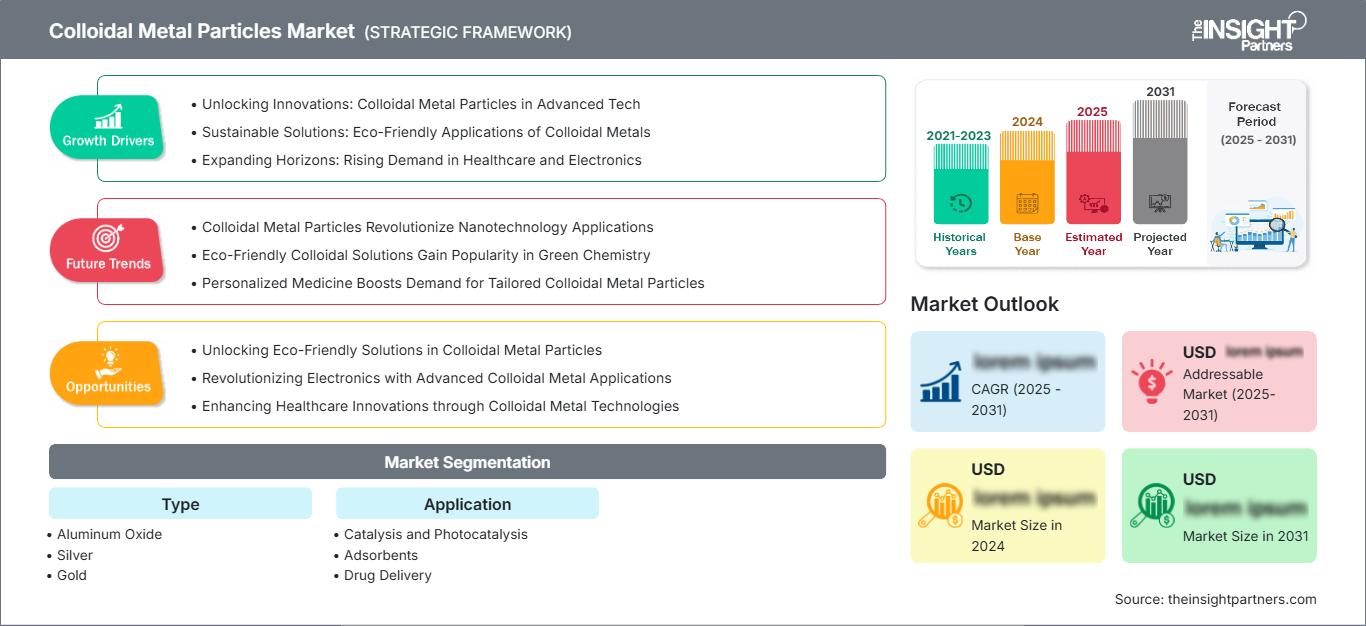
Colloidal Metal Particles Market: Strategic Insights
Regional Insights
North America Colloidal Metal Particles Market
North America accounted for 33–36% of the Colloidal Metal Particles Market share in 2025 and is projected to expand at a CAGR of 4.2–4.8% during 2026–2034. This area will see an advantage due to its well-developed nanotechnology sector fueled by considerable investments into pharmaceutical studies, advanced materials, and catalysts. Collaborations between academic institutions, government research facilities, and specialized chemical producers keep boosting the production of high-quality colloidal metal nanoparticles for various applications.
The United States and Canada are the main players in the Colloidal Metal Particles Market because of their strong healthcare industry, electronics industry, and specialty chemical industry. Regulatory bodies urge for high quality of the manufacturing process of nanomaterials employed in medical and pharmaceutical applications, while ongoing financial support of nanotechnology studies ensures innovation. Expansion of nanotechnology-based drug delivery systems, catalysts, and coatings is likely to maintain stable regional demand through the forecast period.
U.S. Colloidal Metal Particles Market
The US represented 74–78% of the North American Colloidal Metal Particles market in 2025 and is anticipated to register a CAGR of 4.3–4.9% during 2026–2034. The nation houses many of the leading nanotechnology developers, pharmaceutical companies, and specialty chemicals producers who are constantly investing in new technologies related to colloidal particles. The continuous investments in the form of R&D support coming from federal organizations and private bodies promote innovations in health care, electronics, and environmental sectors.
With increased demand for pharmaceutical applications, more of the pharmaceutical firms are using nanoparticles for designing drug delivery systems, diagnostic systems, and vaccine developments. With the rising usage of colloidal metal particles for catalysts, coating applications, and advanced material productions, the involvement of firms like Evonik Industries AG, BBI Solutions, American Elements, and W. R. Grace & Co. further helps in product development.
Europe Colloidal Metal Particles Market
Europe held 26–29% of the market in 2025 and is projected to expand at a CAGR of 4.0–4.6% during 2026–2034. Germany remains the primary market due to its robust manufacturing of chemical products, catalytic agents, and research in advanced materials. European Union programs that promote sustainable technologies and nanotechnology innovations keep encouraging industrial applications.
The United Kingdom has been driving demand due to pharmaceutical research, innovations in biotechnology, and academic research in nanomaterials. The commercialization of nanoparticles used for therapy and diagnostics is ensuring continuous investment, and the partnership between universities and industries is accelerating technology transfer into healthcare and specialty chemicals.
Germany retains regional leadership due to the specialty chemicals sector and advanced manufacturing of chemical products. Continuous investments in industrial catalysis, automotive materials, and precision engineering increase the demand for colloidal metal nanoparticles. Advanced research in environmentally friendly technologies further promotes market expansion.
France, Italy, and Spain together provide significant contribution due to increased pharmaceutical production, cosmetics production, and R&D. The innovations in biotechnology help France drive demand, the specialty chemicals and industrial coatings help Italy drive demand, whereas the research programs related to healthcare and environment continue in Spain.
APAC Colloidal Metal Particles Market
Asia Pacific captured 29–32% of the market in 2025 and is forecast to record the fastest regional expansion at a CAGR of 5.2–5.8% during 2026–2034. China is the leader of regional production because of mass nanomaterial production, but Japan and South Korea focus on the high-end applications of nanotechnology in electronics, healthcare, and precision materials.
On the other hand, India develops its pharmaceuticals and nanotechnology research while Australia invests in innovations via university research and advanced materials. Encouragement of the government on high-technology manufacturing and innovation drives the rapid growth of the region.
Middle East & Africa Colloidal Metal Particles Market
The Middle East & Africa is expected to witness a CAGR of 4.1–4.7% during 2026–2034, supported by expanding industrial diversification initiatives and increasing investments in advanced materials research. Saudi Arabia leads regional demand through industrial modernization programs, while the UAE continues to strengthen nanotechnology-related research and specialty manufacturing capabilities.
South Africa remains an important market because of its mining, chemical processing, and research infrastructure supporting advanced material development. The rest of the Middle East & Africa is gradually adopting colloidal metal particles across environmental treatment, catalyst production, and specialty industrial applications as governments continue investing in innovation-led economic diversification strategies.
Segmentation Analysis
Type
The Type segment is projected to expand at a CAGR of 4.5–5.0% during 2026–2034. The Colloidal Metal Particles Market scope continues to broaden as manufacturers develop application-specific colloidal materials with enhanced purity, particle size uniformity, and surface stability. Demand varies according to functional requirements across catalysis, healthcare, environmental remediation, and specialty industrial applications. Continuous advances in synthesis technologies and surface modification techniques are enabling higher-performance products while improving scalability and production efficiency.
- Aluminum Oxide: Aluminum oxide colloidal particles are extensively utilized in catalyst supports, polishing applications, and ceramic processing. Their excellent thermal stability, chemical resistance, and mechanical durability make them valuable across industrial manufacturing and advanced materials production.
- Silver: Silver colloidal particles represent the largest product category owing to their superior antimicrobial characteristics, catalytic performance, and broad acceptance in healthcare, diagnostics, coatings, and specialty chemical formulations requiring high biological activity.
- Gold: Gold colloidal particles are widely adopted in biomedical imaging, diagnostics, targeted therapeutics, and analytical research because of their excellent optical properties, chemical stability, and ease of surface functionalization for precision healthcare applications.
- Zinc: Zinc colloidal particles are increasingly incorporated into environmental remediation, photocatalytic systems, functional coatings, and specialty chemical formulations where oxidation resistance, ultraviolet protection, and catalytic efficiency are critical performance requirements.
Application
The Application segment is anticipated to register a CAGR of 5.0–5.6% during 2026–2034, supported by expanding commercialization of nanotechnology across healthcare, environmental engineering, and industrial manufacturing. Continuous innovation in nanoparticle functionality, regulatory acceptance of advanced nanomaterials, and increasing investment in sustainable industrial technologies are expected to diversify commercial opportunities throughout the forecast period.
- Catalysis and Photocatalysis: Colloidal metal particles improve reaction efficiency, selectivity, and catalyst stability across petrochemicals, environmental treatment, and specialty chemical production, making this application a significant contributor to industrial demand.
- Adsorbents: Nanostructured colloidal particles are increasingly utilized in water purification, wastewater treatment, and industrial separation processes because of their large surface area, high adsorption capacity, and enhanced contaminant removal efficiency.
- Drug Delivery: Drug delivery represents the fastest-growing application, supported by rising investment in precision medicine, controlled-release therapeutics, targeted cancer treatment, and nanoparticle-enabled pharmaceutical formulations that improve treatment efficacy and patient outcomes.
- Dietary Supplements: Colloidal metal particles are incorporated into selected dietary supplement formulations where manufacturers emphasize bioavailability, product differentiation, and specialized health applications while complying with evolving safety and quality standards.
Opportunity Snapshot
| Application | Revenue Contribution | Trend Tag | Adoption Stage |
|---|---|---|---|
| Catalysis and Photocatalysis | High | Green Catalysis | Mature |
| Adsorbents | Medium | Water Purification | Scaling |
| Drug Delivery | High | Precision Medicine | Scaling |
| Dietary Supplements | Low | Functional Nutrition | Emerging |
Colloidal Metal Particles Market Growth Drivers and Impact Analysis
Expanding adoption of nanotechnology in pharmaceutical drug development
There is still more investment by pharmaceutical companies in therapeutic products based on nanoparticles which help enhance drug solubility, controlled release, and drug delivery. The use of colloidal metal particles in diagnostic tools, anticancer drugs, vaccines, and other precision medicines due to their surface chemistry and functional characteristics is rising. There is support from regulatory and healthcare institutions for innovation in advanced nanomedicine through evaluation tools. At the same time, there is more financing globally in research. There is increased cooperation between biotechnology companies, universities, and specialized material suppliers in advancing nanoparticle-based medicines. With more pipeline products in development, there will be greater demand for highly consistent and pure colloidal metal particles during the forecast period.
Increasing utilization of advanced catalysts across industrial manufacturing
The industry is actively looking for catalyst materials that can boost the efficiency of the reactions, reduce energy use, decrease emission levels without affecting the quality of the end-product. The colloidal metal particles feature extremely high ratios of surface area to volume and contribute to improved catalytic performance in petrochemical industries, hydrogen production processes, specialty chemical products, and environmental treatment facilities. The governments are providing incentives to develop cleaner industrial technologies via increasingly strict environmental policies and decarbonization programs and encourage companies to use new types of catalysts. At the same time, chemical producers still work on optimizing their processes to increase productivity and decrease waste output.
Growing investments in environmental remediation and water treatment technologies
Water scarcity, pollution caused by industries, and increased environmental laws are some of the factors increasing the demand for treatment materials with higher adsorbing and catalytic capabilities. Colloids are increasingly being employed in the removal of contaminants, degradation of organics through photocatalytic methods, and water treatment processes owing to their higher reaction capability and surface properties. The need for advanced treatment facilities in public infrastructure development, sustainability goals set by companies, and increased effluent discharge regulations are also prompting utilities and industries to use new treatment technologies. Research in nanomaterials that can be employed in the removal of heavy metals, pathogens, and organic substances will continue to boost the commercial potential of such products.
Colloidal Metal Particles Market Future Trends
Surface-engineered nanoparticles enabling application-specific performance
Surface engineering is becoming a defining trend as manufacturers tailor colloidal metal particles for highly specialized applications in medicine, catalysis, sensing, and advanced coatings. Functional surface ligands, biocompatible polymers, and hybrid inorganic-organic interfaces improve particle stability, targeting capability, and dispersion characteristics. The Colloidal Metal Particles Market trends increasingly reflect customer demand for customized nanomaterials that deliver reproducible performance under application-specific operating conditions. Companies are investing in precision synthesis, advanced characterization technologies, and scalable functionalization processes to differentiate product portfolios. These developments are expected to expand commercial opportunities in regulated industries while supporting higher-value formulations with improved lifecycle performance and manufacturing consistency.
Commercial expansion of sustainable and continuous-flow nanoparticle production
Manufacturers are progressively replacing conventional batch synthesis with continuous-flow production technologies that improve process control, reduce waste generation, and enhance product consistency. Green chemistry approaches using environmentally benign solvents, recyclable reagents, and energy-efficient manufacturing systems are gaining wider acceptance across specialty chemicals and pharmaceutical production. Automation, artificial intelligence-driven process monitoring, and digital quality management systems are further improving reproducibility while reducing manufacturing costs. As sustainability objectives become central to industrial investment decisions, commercial producers are expected to prioritize scalable production platforms capable of delivering high-purity colloidal particles with lower environmental impact and greater operational efficiency.
Colloidal Metal Particles Market Opportunities
Expansion into precision medicine and advanced therapeutic platforms
The continued evolution of personalized healthcare creates significant opportunities for manufacturers capable of supplying highly engineered colloidal metal particles for targeted therapeutics, molecular diagnostics, and controlled drug delivery systems. Colloidal Metal Particles Market Forecasts indicate that investments in precision medicine, cell therapies, and nanomedicine research will continue supporting long-term demand for application-specific nanoparticle formulations. Companies that establish partnerships with pharmaceutical developers, contract research organizations, and biotechnology firms can accelerate commercialization while strengthening intellectual property portfolios. Investment in regulatory compliance, scalable manufacturing technologies, and customized surface functionalization capabilities will position suppliers to capture emerging opportunities across high-value healthcare applications.
Increasing commercialization across clean energy and environmental technologies
The transition toward sustainable industrial systems is creating new commercial opportunities for colloidal metal particles in hydrogen production, carbon capture, environmental catalysis, and advanced water treatment technologies. Growing investments in renewable energy infrastructure and low-carbon manufacturing require high-performance nanomaterials capable of improving reaction efficiency and operational durability. Manufacturers developing specialized colloidal formulations for photocatalytic hydrogen generation, pollutant degradation, and industrial emissions control are well positioned to benefit from expanding public and private investment. Strategic collaboration with energy technology developers, research institutions, and environmental engineering companies will further accelerate product innovation and open new high-growth revenue streams across global industrial markets.
Recent Developments
- June 2026: Velo3D, Inc. (NASDAQ: VELO) ("Velo3D" or the "Company"), a leader in additive manufacturing ("AM") technology known for transforming aerospace and defense supply chains through world-class metal additive manufacturing, and Aurelia Technologies, a developer of highly efficient and fuel‑flexible small‑scale gas turbines, announced a strategic partnership focused on advancing the use of additive manufacturing in next‑generation gas turbine systems.
- February 2026: Brenntag, the global leader in chemicals and ingredients distribution, announced a new partnership with Nanum, a Brazilian company specializing in industrial-scale nanomaterials.
Frequently Asked Questions

- Comprehensive Market Sizing and Forecast Analysis
- Detailed Segmentation Analysis
- In-Depth Market Dynamics Assessment
- Regional and Country-Level Insights
- Competitive Landscape and Company Benchmarking
- Strategic Business Intelligence
Recent Reports
Testimonials

The Insight Partners' SCADA System Market report is comprehensive, with valuable insights on current trends and future forecasts. The team was highly professional, responsive, and supportive throughout. We are very satisfied and highly recommend their services.
RAN KEDEM Partner, Reali Technologies LTDs
I requested a report on a very specific software market and the team produced the report in a few days. The information was very relevant and well presented. I then requested some changes and additions to the report. The team was again very responsive and I got the final report in less than a week.
JEAN-HERVE JENN Chairman, Future Analytica
We worked with The Insight Partners for an important market study and forecast. They gave us clear insights into opportunities and risks, which helped shape our plans. Their research was easy to use and based on solid data. It helped us make smart, confident decisions. We highly recommend them.
PIYUSH NAGPAL Sr. Vice President, High Beam Global
The Insight Partners delivered insightful, well-structured market research with strong domain expertise. Their team was professional and responsive throughout. The user-friendly website made accessing industry reports seamless. We highly recommend them for reliable, high-quality research services
YUKIHIKO ADACHI CEO, Deep Blue, LLC.
This is the first time I have purchased a market report from The Insight Partners.While I was unsure at first, I visited their web site and felt more comfortable to take the risk and purchase a market report.I am completely satisfied with the quality of the report and customer service. I had several questions and comments with the initial report, but after a couple of dialogs over email with their analyst I believe I have a report that I can use as input to our strategic planning process.Thank you so much for taking the extra time and making this a positive experience.I will definitely recommend your service to others and you will be my first call when we need further market data.
JOHN SUZUKI President and Chief Executive Officer, Board Director, BK Technologies
I wish to appreciate your support and the professionalism you displayed in the course of attending to my request for information regarding to infectious disease IVD market in Nigeria. I appreciate your patience, your guidance, and the fact that you were willing to offer a discount, which eventually made it possible for us to close a deal. I look forward to engaging The Insight Partners in the future, all thanks to the impression you have created in me as a result of this first encounter.
DR CHIJIOKE ONYIA MANAGING DIRECTOR, PineCrest Healthcare Ltd.Reason to Buy
- Informed Decision-Making
- Understanding Market Dynamics
- Competitive Analysis
- Identifying Emerging Markets
- Customer Insights
- Market Forecasts
- Risk Mitigation
- Boosting Operational Efficiency
- Strategic Planning
- Investment Justification
- Tracking Industry Innovations
- Aligning with Regulatory Trends





 Get Free Sample for