
Commercial Video Surveillance Market Growth, Trends & Forecast by 2034
Coverage: By Component (Hardware, Software); Service (Hosted Service, Managed Service, Hybrid Service) , and Geography (North America, Europe, Asia Pacific, and South and Central America)
- Status : Data Released
- Report Code : TIPRE00020748
- Category : Electronics and Semiconductor
- No. of Pages : 150
- Available Report Formats :


- Last update date : July 21, 2026


2025 Market Size
US$ 83.67 Bn
Base year value
2034 Forecast
US$ 239.01 Bn
Projected by 2034
CAGR 2026-2034
12.37 %
Growth rate
Addressable Market
US$ 1,411.16 Bn
(2026-2034)
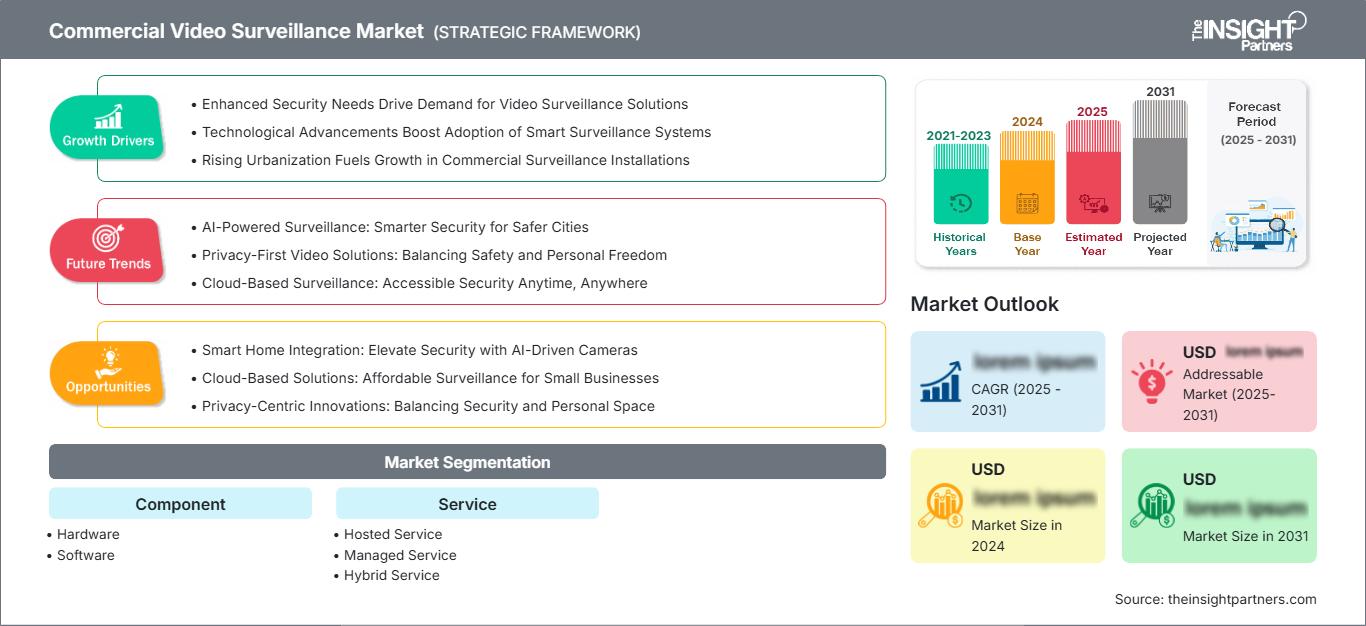
Commercial Video Surveillance market was valued at US$ 83.67 Billion in 2025 and is projected to reach US$ 239.01 Billion by 2034, registering a CAGR of 12.37% during 2026–2034. This is indicative of an increase in the need for connected cameras, video management systems, video analytics, cloud-based surveillance, managed security services, and hybrid deployment in various verticals including retail, logistics, corporate offices, banks, transportation, health care, education, and commercial infrastructure.
North America Commercial Video Surveillance Market is anticipated to register a growth rate of 10.9%-12.1% between 2026 and 2034, owing to the need for modernization of enterprise security systems, adoption of cloud technology, and the need for AI-based forensic studies. There is modernization of disparate camera networks in large commercial estates with edge video analytics, monitoring and cybersecurity capabilities.
Commercial Video Surveillance Market Assessment and Insights
- North America held 29–33% share in 2025 and is growing at a CAGR of 10.9–12.1% during 2026–2034, driven by cloud VMS, retail loss prevention, and enterprise security consolidation.
- US represented 78–82% of North American revenue in 2025 and is growing at a CAGR of 11.0–12.3% during 2026–2034, supported by large multi-site deployments.
- Europe accounted for 21–25% share in 2025 and is growing at a CAGR of 9.8–11.0% during 2026–2034, with the UK, Germany, France, Italy, and Spain leading privacy-compliant adoption.
- Asia Pacific held 34–38% share in 2025 and is growing at a CAGR of 13.2–14.6% during 2026–2034, led by China, India, Japan, South Korea, and Australia.
- Largest Segment Hardware held 62–66% market share in 2025 and is growing at a CAGR of 10.8–12.0% during 2026–2034 as cameras, storage, and edge devices remain essential.
- High Growth Segment Hosted Service represented 18–22% market share in 2025 and is growing at a CAGR of 14.5–16.0% during 2026–2034, supported by cloud migration.
- Key companies analyzed in detail: Huawei Technologies Co., Ltd.; NICE Ltd.; Hangzhou Hikvision Digital Technology Co., Ltd.; Hanwha Vision Co., Ltd.; Axis Communications AB; Teledyne FLIR LLC; Bosch Sicherheitssysteme GmbH; Honeywell International Inc.; i-PRO Co., Ltd.; Avigilon Corporation.
Source: The Insight Partners' analysis based on proprietary research, government publications, company annual reports, investor presentations, industry databases, and expert interviews.
Whereas commercial security surveillance used to be standalone systems recording images from cameras, the current trend is towards networked systems offering deterrence, detection, investigation, and operational intelligence capabilities. The adoption of Commercial Video Surveillance Market is going to be influenced by IP cameras, edge AI processing, cloud video management systems, cybersecurity strengthening, and metadata searchability. Device production dynamics will be influenced by increasing emphasis on resolution, thermal imaging, low light, privacy masking, and openness.
The forward-looking investments will focus on urban development, transport-based business opportunities, intelligent retailing, logistics centers, banking infrastructure, health institutions, and educational institutions. The regulatory headwinds will revolve around the safety at work laws, privacy laws, and critical infrastructure security laws. The Commercial Video Surveillance system will be pertinent to all those areas that need a proof of events, rapid reviews of incidents, remote monitoring, and integration with other systems like access control, alarm systems, visitor systems, and building management systems.
Commercial Video Surveillance Market Report Scope
| Report Attribute | Details |
|---|---|
| Market size in 2025 | US$ 83.67 Billion |
| Market Size by 2034 | US$ 239.01 Billion |
| Global CAGR (2026 - 2034) | 12.37% |
| Historical Data | 2021-2024 |
| Forecast period | 2026-2034 |
Commercial Video Surveillance Market Analysis
Commercial Video Surveillance Market adoption is stimulated by asset security, employee protection, loss prevention, insurance, and quick response. There is the greatest demand where visibility is required for large-scale operations such as retailers, warehouses, airports, office buildings, hotels, medical institutions, and bank branches. AI analytics add to value by detecting people, cars, queues, intrusion, and abnormal events before human operators watch hours of video.
The value chain consists of camera producers, chipset makers, VMS producers, storage providers, cloud hosting providers, managed service providers, integrators, alarm monitoring centers, and end-users' security departments. Supply is impacted by chip shortages, cybersecurity standards, NDAA-compliant procurement practices, cloud hosting fees, and interoperability standards such as ONVIF enabling multi-vendor deployment.
The Commercial Video Surveillance market report shows an evenly balanced market environment with the competition being divided into hardware-oriented vendors, enterprise software vendors, and monitoring via service. Hangzhou Hikvision Digital Technology Co., Ltd., Hanwha Vision Co., Ltd., Axis Communications AB, i-PRO Co., Ltd., Teledyne FLIR LLC, and Bosch Sicherheitssysteme GmbH offer their products based on the capabilities of cameras, analytics, and channels.
NICE Ltd., Honeywell International Inc., Huawei Technologies Co., Ltd., and Avigilon Corporation enhance their position by means of the development of software for command centers, enterprise security solutions, video search with the use of artificial intelligence, and access control. The funding is now shifting to cloud-native VMS, edge inference, generative search, cybersecurity by design, and subscriptions.
● REPORT CUSTOMIZATION
Tailor This Report To Align With Your Specific Business Requirements
This report can be customized to align precisely with your business objectives, scope, and target markets. Customization options include tailored segmentation, geography, competitive analysis, and strategic insights to support informed decision-making.
Customize This Report →WHAT YOU CAN ADJUST
- ● Segmentations
- ● Geography
- ● Competitive Analysis
- ● Language Preferences
Commercial Video Surveillance Market: Strategic Insights
Regional Insights
North America Commercial Video Surveillance Market
North America had a share of 29-33% of Commercial Video Surveillance Market in 2025 and it is expected to grow at a CAGR of 10.9-12.1% between 2026 and 2034. The drivers in North America include reducing retail shrink, logistics visibility, safety in the workplace, smart building upgrades, and upgrading existing analog cameras to IP cameras and managed services via cloud-based software.
Enterprises in the region have a preference for hybrid deployments which will enable them to store video data on-premise and transmit alerts and metadata via cloud dashboards. Security measures such as cybersecurity, privacy and data protection, as well as integration with access control systems are key considerations in procurement.
U.S. Commercial Video Surveillance Market
The U.S. represented 78–82% of North American revenue in 2025 and is forecast to grow at a CAGR of 11.0–12.3% during 2026–2034. These applications comprise: retail video analytics, warehouse perimeter security, healthcare incident reviews, school security, office access control, and banking branches.
Those firms providing the required products to enhance the U.S. ecosystem include Axis Communications AB, Honeywell International Inc., Avigilon Corporation, Teledyne FLIR LLC, and NICE Ltd. Those who wish to buy these systems want their capabilities for audit trail logging, firmware encryption, flexible storage, and linking of videos with alarms and emergencies.
Europe Commercial Video Surveillance Market
Europe held 21–25% share in 2025 and is projected to grow at a CAGR of 9.8–11.0% during 2026–2034. Commercial use in the UK is made possible through retail outlets, transport infrastructure, banks, and city center security programs; however, GDPR compliance requires privacy-by-design attributes like anonymization, data retention, and role-based access.
Germany is critical because of the manufacturing facilities, logistics centers, and infrastructure that are important, as well as integrator capabilities. The demand from France, Italy, and Spain is related to tourism, upgraded retail, transportation security, and city initiatives. The Europeans prefer secure cameras, certification, interface openness, and safety-privacy systems.
APAC Commercial Video Surveillance Market
Asia Pacific accounted for 34–38% share in 2025 and is expected to grow at a CAGR of 13.2–14.6% during 2026–2034. China excels due to massive camera production, business building projects, and deployment of AIoT technology. India, Japan, South Korea, and Australia promote growth via smart city initiatives, logistics, retail centers, universities, and security systems related to transport.
Industrial policies, increasing urbanization, and growing cloud infrastructure facilities are promoting application not only for public safety but also for malls, factories, logistics centers, hospitals, and other complex mixed-use developments. The buyers from regions now use their local camera technology together with global video management systems, analytics, and cloud-based storage.
Middle East & Africa Commercial Video Surveillance Market
The Middle East & Africa market is projected to grow at a CAGR of 11.4–12.8% during 2026–2034. Integration in surveillance systems is critical in sectors such as hospitality, retail, airports, energy infrastructure, and mega-projects. The UAE drives demand through smart buildings, tourism infrastructure, logistics zones, and city surveillance upgrades.
South Africa drives demand through mining, commercial real estate, retail security, and infrastructure security, while the Rest of MEA relies on project financing and integrator availability, among others. Infrastructure for energy projects and transport corridors continue to be critical demand drivers due to the need for constant visibility and evidence management.
Segmentation Analysis
Component
Component is projected to grow at a CAGR of 11.5–12.9% during 2026–2034. The Commercial Video Surveillance market scope spans cameras, encoders, storage, VMS, analytics, cybersecurity tools, and integration software. Hardware remains the revenue anchor, while software gains strategic weight as users demand searchable video, event classification, remote management, and policy-based retention across distributed sites.
- Hardware leads adoption through IP cameras, thermal cameras, NVRs, storage systems, network switches, and edge devices that determine image quality, coverage, retention capacity, and analytics readiness.
- Software is increasingly strategic as VMS, video analytics, cybersecurity management, and cloud dashboards help organizations search footage faster, standardize workflows, and manage distributed camera fleets.
Service
Service is forecast to grow at a CAGR of 13.0–14.4% during 2026–2034. Service models are expanding as commercial buyers seek lower upfront costs, remote administration, managed monitoring, and predictable upgrades. Hosted, managed, and hybrid approaches help organizations align retention, access, cybersecurity, and response protocols without building large internal video infrastructure teams.
- Hosted Service supports cloud-based video access, centralized updates, and scalable retention for multi-site users that want faster deployment and reduced dependence on local server maintenance.
- Managed Service provides monitoring, health checks, firmware updates, analytics tuning, and incident escalation for organizations that require specialist oversight and predictable operating expenditure.
- Hybrid Service combines edge storage with cloud dashboards, preserving local video control while enabling remote alerts, metadata search, compliance reporting, and cross-site administration.
Opportunity Snapshot
| Service | Revenue Contribution | Trend Tag | Adoption Stage |
| Hosted Service | Medium | Cloud VMS | Scaling |
| Managed Service | Medium | Remote Monitoring | Scaling |
| Hybrid Service | High | Edge Cloud | Mature |
Commercial Video Surveillance Market Growth Drivers and Impact Analysis
AI analytics reduce investigation time and false alarms
Commercial sites generate more video than security teams can review manually, making analytics central to procurement decisions. Person, vehicle, object, queue, intrusion, and loitering detection help operators prioritize events rather than monitor passive screens. The impact is strongest in retail, logistics, transport, and campuses where incidents unfold across many cameras. Edge AI also reduces bandwidth pressure by sending alerts and metadata instead of constant full-stream video. As models improve, surveillance systems are becoming decision-support tools that accelerate investigations, reduce nuisance alarms, and help managers document compliance, safety, and service-level performance.
Cloud and hybrid architectures simplify multi-site operations
Commercial chains often operate hundreds of premises with inconsistent camera brands, storage devices, and local maintenance practices. Cloud and hybrid VMS models allow central teams to manage users, firmware, retention, alerts, and evidence sharing from a common interface. This improves governance while reducing travel, truck rolls, and server replacement cycles. Hybrid designs are especially important because many enterprises still need local recording for resilience, bandwidth control, or regulatory reasons. The commercial impact is a clearer migration path from fragmented CCTV estates to scalable platforms that support security, operations, and compliance teams.
Cybersecurity and compliance requirements reshape purchasing
Network cameras are now part of enterprise IT environments, so buyers evaluate security hardening alongside image quality. Secure boot, signed firmware, encryption, role-based access, vulnerability management, and audit trails are moving from optional features to minimum requirements. Privacy regulations also influence camera placement, retention periods, masking, and access permissions. For vendors, this shifts differentiation toward trusted lifecycle management and documented compliance. For buyers, it reduces operational risk by ensuring video evidence can be used responsibly, protected against intrusion, and retained according to corporate, insurance, and legal requirements.
Commercial Video Surveillance Market Future Trends
Generative search changes video investigation workflows
Commercial Video Surveillance Market trends point toward natural language search that lets operators locate events by description rather than timestamp review. Future systems will interpret queries such as vehicle color, object type, direction of movement, or unusual behavior across many cameras. This will reduce investigation time in retail theft, warehouse incidents, workplace safety reviews, and access violations. The trend also raises governance needs because search accuracy, bias control, and auditability will affect how evidence is trusted. Vendors that combine explainable AI with secure data handling will gain stronger enterprise acceptance.
Video becomes an operational intelligence layer
Commercial users will increasingly apply camera data beyond security departments. Retailers can measure queue formation, planogram compliance, and customer movement; warehouses can monitor dock congestion and safety zones; hospitals can improve restricted-area oversight; offices can validate occupancy patterns. This does not eliminate privacy obligations, but it expands the business case for connected video. Systems will need configurable analytics, anonymization options, and integrations with operations dashboards. As video metadata becomes reusable, procurement will shift from camera replacement cycles toward platform value, workflow automation, and measurable operational outcomes.
Commercial Video Surveillance Market Opportunities
Subscription platforms for distributed commercial estates
Commercial Video Surveillance Market Forecasts support investment in subscription platforms that help retailers, banks, restaurants, warehouses, and healthcare networks manage many sites without rebuilding every camera system. Vendors can package cloud VMS, device health monitoring, analytics, retention, and evidence sharing into tiered offers. This opportunity is attractive because customers want predictable costs, faster deployment, and continuous updates. Channel partners can add value through migration planning, cybersecurity reviews, and managed services. The strongest propositions will preserve existing hardware where possible while standardizing operations across locations.
Vertical analytics for retail, logistics, and healthcare
Specialized analytics create an opportunity to move beyond generic motion alerts. Retail users need shrink analysis, queue visibility, and after-hours intrusion detection; logistics operators need dock monitoring, vehicle verification, and safety zone alerts; healthcare facilities need restricted-area oversight, incident documentation, and visitor flow control. Vendors that design analytics around vertical workflows can improve adoption because buyers see direct operational relevance. Successful offerings will include privacy controls, easy tuning, clear reporting, and integrations with point-of-sale, warehouse, access control, and incident management systems.
Recent Developments
- March 2026: Semtech Corporation (Nasdaq: SMTC), a leading provider of high-performance semiconductor, Internet of Things (IoT) systems and cloud connectivity service solutions, announced a partnership with Digital Barriers to deliver a fully integrated device-to-cloud cellular video solution, Semtech Video Compression, purpose-built for critical video surveillance and analytics.
- August 2025: March Networks, a global leader in intelligent video solutions, has announced its latest Release, introducing new products and features across its video surveillance and intelligence platforms. Focused on delivering actionable insights, operational efficiency, and system scalability, this milestone furthers March Networks’ mission to help organizations make smarter, faster decisions at scale.
- March 2025: Johnson Controls (NYSE: JCI), the global leader for smart, healthy and sustainable buildings, announced a series of upgrades to their access control and video surveillance (ACVS) solutions. These product enhancements will integrate with existing security architectures to improve management of mission critical security and protection for people, buildings and assets. They will transform customers’ security posture, unlocking new levels of operational agility and cost-effectiveness.
Frequently Asked Questions

- Comprehensive Market Sizing and Forecast Analysis
- Detailed Segmentation Analysis
- In-Depth Market Dynamics Assessment
- Regional and Country-Level Insights
- Competitive Landscape and Company Benchmarking
- Strategic Business Intelligence
Recent Reports
Testimonials

The Insight Partners' SCADA System Market report is comprehensive, with valuable insights on current trends and future forecasts. The team was highly professional, responsive, and supportive throughout. We are very satisfied and highly recommend their services.
RAN KEDEM Partner, Reali Technologies LTDs
I requested a report on a very specific software market and the team produced the report in a few days. The information was very relevant and well presented. I then requested some changes and additions to the report. The team was again very responsive and I got the final report in less than a week.
JEAN-HERVE JENN Chairman, Future Analytica
We worked with The Insight Partners for an important market study and forecast. They gave us clear insights into opportunities and risks, which helped shape our plans. Their research was easy to use and based on solid data. It helped us make smart, confident decisions. We highly recommend them.
PIYUSH NAGPAL Sr. Vice President, High Beam Global
The Insight Partners delivered insightful, well-structured market research with strong domain expertise. Their team was professional and responsive throughout. The user-friendly website made accessing industry reports seamless. We highly recommend them for reliable, high-quality research services
YUKIHIKO ADACHI CEO, Deep Blue, LLC.
This is the first time I have purchased a market report from The Insight Partners.While I was unsure at first, I visited their web site and felt more comfortable to take the risk and purchase a market report.I am completely satisfied with the quality of the report and customer service. I had several questions and comments with the initial report, but after a couple of dialogs over email with their analyst I believe I have a report that I can use as input to our strategic planning process.Thank you so much for taking the extra time and making this a positive experience.I will definitely recommend your service to others and you will be my first call when we need further market data.
JOHN SUZUKI President and Chief Executive Officer, Board Director, BK Technologies
I wish to appreciate your support and the professionalism you displayed in the course of attending to my request for information regarding to infectious disease IVD market in Nigeria. I appreciate your patience, your guidance, and the fact that you were willing to offer a discount, which eventually made it possible for us to close a deal. I look forward to engaging The Insight Partners in the future, all thanks to the impression you have created in me as a result of this first encounter.
DR CHIJIOKE ONYIA MANAGING DIRECTOR, PineCrest Healthcare Ltd.Reason to Buy
- Informed Decision-Making
- Understanding Market Dynamics
- Competitive Analysis
- Identifying Emerging Markets
- Customer Insights
- Market Forecasts
- Risk Mitigation
- Boosting Operational Efficiency
- Strategic Planning
- Investment Justification
- Tracking Industry Innovations
- Aligning with Regulatory Trends





 Get Free Sample for