
Commercializing Biomarkers In Therapeutic And Diagnostic Applications Market Size, Demand & Growth by 2034
Coverage: By Type (Consumables, Services, Software); Application (Oncology, Cardiology, Neurology, Other) , and Geography (North America, Europe, Asia Pacific, and South and Central America)
- Status : Data Released
- Report Code : TIPRE00018281
- Category : Life Sciences
- No. of Pages : 150
- Available Report Formats :


- Last update date : November 12, 2026


2025 Market Size
US$ 24.17 Bn
Base year value
2034 Forecast
US$ 35.42 Bn
Projected by 2034
CAGR 2026-2034
4.34 %
Growth rate
Addressable Market
US$ 270.63 Bn
(2026-2034)
The Commercializing Biomarkers in Therapeutic and Diagnostic Applications Market was valued at US$ 24.17 Billion in 2025 and is projected to reach US$ 35.42 Billion by 2034, registering a CAGR of 4.34% during 2026–2034. Expansion is supported by precision medicine adoption, biomarker-guided drug development, companion diagnostic programs, and rising demand for earlier disease detection. Wider clinical use of genomic, proteomic, and digital biomarkers is strengthening commercialization pathways across therapeutic development and routine diagnostic decision-making.
North America remains central to the Commercializing Biomarkers in Therapeutic and Diagnostic Applications Market size, with the regional industry projected to register a ~4% CAGR through 2034. Its position is reinforced by mature molecular diagnostic infrastructure, extensive biopharmaceutical research activity, and established regulatory pathways for companion diagnostics. Pharmaceutical companies increasingly integrate biomarker strategies into clinical development, while laboratories expand sequencing, immunoassay, and computational interpretation capabilities to support treatment selection and longitudinal patient monitoring.
Commercializing Biomarkers In Therapeutic And Diagnostic Applications Market Assessment and Insights
Regional Outlook
- North America: ~41% of the global Commercializing Biomarkers in Therapeutic and Diagnostic Applications market share in 2025 | ~4% CAGR through 2034. Market position: North America leads through extensive precision medicine programs, high-value biopharmaceutical pipelines, advanced diagnostic laboratories, and established reimbursement and regulatory frameworks supporting biomarker validation and clinical deployment.
- US: ~84% of North American market revenue in 2025 | ~4% CAGR through 2034. Market position: The US anchors regional commercialization through concentrated pharmaceutical research, FDA-linked companion diagnostic development, large clinical testing networks, and strong oncology, cardiology, and neurology biomarker adoption.
- Europe: ~30% of the global market in 2025 | ~4% CAGR through 2034. Market position: Europe represents a mature research and diagnostic environment led by Germany and supported by the UK, France, Italy, and Spain through coordinated genomic medicine and laboratory modernization initiatives.
- Asia Pacific: ~22% of the global market in 2025 | ~6% CAGR through 2034. Market position: Asia Pacific is the fastest-growing region, supported by expanding molecular laboratories, localized assay production, precision medicine investment, and widening clinical research activity in China, Japan, South Korea, India, and Australia.
Segment Outlook
- Consumables: ~57% Share in 2025 | ~4% CAGR through 2034. Market position: Consumables lead because biomarker testing generates recurring demand for assay kits, antibodies, reagents, calibrators, controls, and sample preparation products across research, clinical trials, and diagnostic workflows.
- Software: ~18% Share in 2025 | ~7% CAGR through 2034. Market position: Software records the strongest growth as laboratories and drug developers require scalable interpretation, multimodal data integration, workflow automation, and clinical decision support for increasingly complex biomarker datasets.
Competitive Coverage
F. Hoffmann-La Roche Ltd, Agilent Technologies, Inc., Merck KGaA, QIAGEN N.V., Abbott Laboratories, Revvity, Inc., Thermo Fisher Scientific Inc., Bio-Rad Laboratories, Inc., Almac Group Limited, Charles River Laboratories International, Inc.
Methodology
The Insight Partners follows Data Collection & Secondary Research, Primary Research, Data Analysis, and Data Triangulation & Final Review to validate market estimates and insights.
Source: The Insight Partners' analysis based on proprietary research, government publications, company annual reports, investor presentations, industry databases, and expert interviews.
Biomarker commercialization has shifted from independent research assays to interconnected platforms bridging discovery, validation, clinical data, regulatory acceptance, and commercialization of products. Advances in high-throughput sequencing, multiplex immunoassays, mass spectrometry, and digital pathology have increased the types of biological information that can be obtained while decreasing reliance on individual biomarker assays. Production considerations have moved from focus on reagent standardization, quality reference material, lab automation, and reliable software processes. Vendors are increasingly providing solutions combining instruments, consumable, bioinformatics, and services to minimize handoffs during biomarker discovery and clinical translation.
During the period ending in 2034, commercial expansion will increasingly include healthcare systems in Asia Pacific, decentralized testing networks, and centers for biopharma development outside the conventional centers in the US and Western Europe. It is anticipated that investments will be made in areas such as liquid biopsies, markers for neurodegenerative diseases, real-world data, and inter-platform assay standardization. Acceptance of biomarker enriched trial designs and companion diagnostics approaches by regulators should increase development efficiencies but not necessarily adoption rate.
Commercializing Biomarkers In Therapeutic And Diagnostic Applications Market Report Scope
| Report Attribute | Details |
|---|---|
| Market size in 2025 | US$ 24.17 Billion |
| Market Size by 2034 | US$ 35.42 Billion |
| Global CAGR (2026 - 2034) | 4.34% |
| Historical Data | 2021-2024 |
| Forecast period | 2026-2034 |
Commercializing Biomarkers In Therapeutic And Diagnostic Applications Market Analysis
Market growth is driven by the requirement to screen out responsive patients, track treatment efficacy, and minimize risk during drug development. The need starts from biomarker discovery to development of assays, validation, trials, regulatory filing, and testing of biomarkers. Hence, pharmaceutical companies, diagnostic companies, contract research organizations, reference labs, hospitals, and software suppliers are involved in the inter-dependent value chain.
Suppliers have their own set of qualities based on the product that they supply. Consumables need high volumes of testing but should maintain uniform quality in every lot and across platforms. For services, the key qualities include science expertise, accredited lab capability, specimen handling, and regulation capabilities. Software suppliers depend on the selection of data, interoperability, security, and analytics.
Biomarkers Commercialization within Therapeutic and Diagnostic Application The market analysis reveals competition that is based on the range of portfolio, regulation expertise, laboratory equipment installation, and cooperation with pharmaceutical companies. F. Hoffmann-La Roche Ltd and Abbott Laboratories use biomarker assays together with a wide diagnostic network, whereas QIAGEN N.V., Thermo Fisher Scientific Inc., Agilent Technologies, Inc., and Bio-Rad Laboratories, Inc. focus on molecular diagnostics, development of assays, and related workflow analysis.
Merck KGaA and Revvity, Inc. provide research tools and translation services, while Almac Group Limited and Charles River Laboratories International, Inc. offer outsourcing and clinical studies services. More investment is going now to the business models that incorporate both biomarker strategy, production of assays, regulation assistance, and global trial execution. The difference between the companies lies in their ability to create validated assays out of experimental findings.
● REPORT CUSTOMIZATION
Tailor This Report To Align With Your Specific Business Requirements
This report can be customized to align precisely with your business objectives, scope, and target markets. Customization options include tailored segmentation, geography, competitive analysis, and strategic insights to support informed decision-making.
Customize This Report →WHAT YOU CAN ADJUST
- ● Segmentations
- ● Geography
- ● Competitive Analysis
- ● Language Preferences
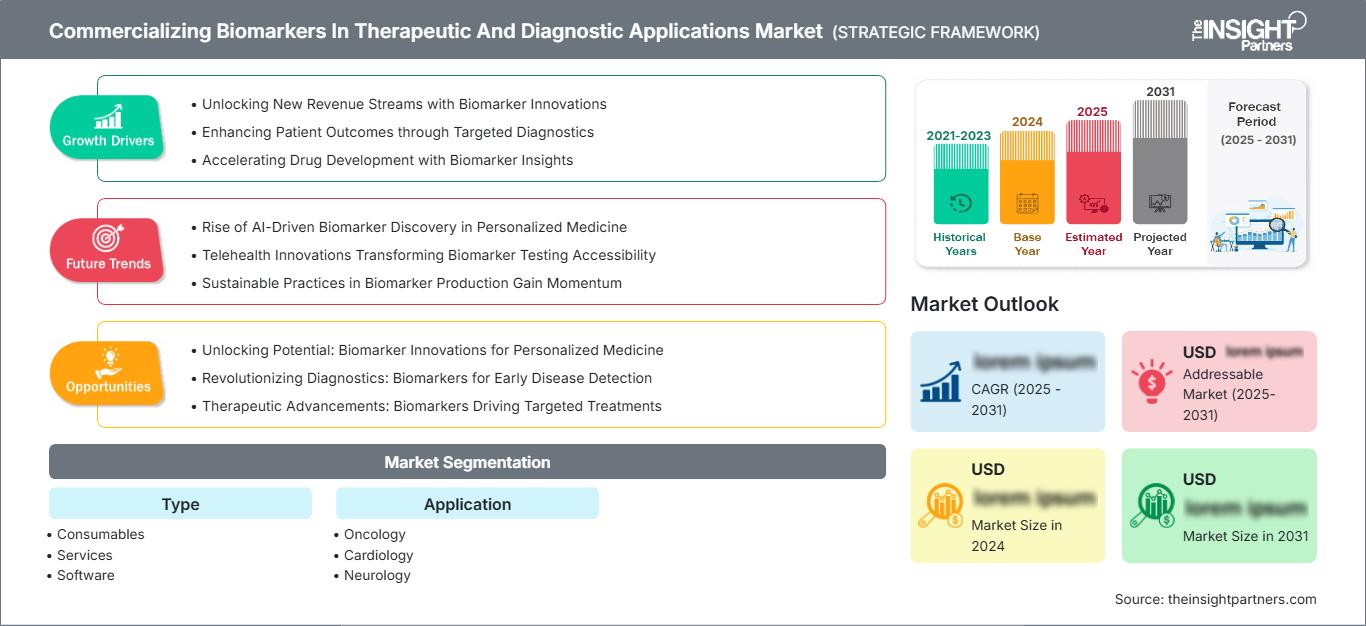
Commercializing Biomarkers In Therapeutic And Diagnostic Applications Market: Strategic Insights
Regional Insights
North America Commercializing Biomarkers in Therapeutic and Diagnostic Applications Market
North America accounted for ~41% of global revenue in 2025 and is expected to expand at a ~4% CAGR through 2034. The Commercializing Biomarkers for Therapeutic and Diagnostic Applications market has this share due to highly concentrated research in biopharmaceuticals, advanced molecular labs, clinical studies, and proven ways to connect therapeutics approval with diagnostics. The oncology space is the primary commercial environment due to the usage of biomarkers by drug developers for patient selection and response analysis.
The demand for this product in various locations is increasing because of risk assessment of cardiovascular disease and liquid biopsy of the nervous system. Automated solutions, sequencing, immunoassays, digital pathology, and informatics are being created by the laboratories to deal with more sophisticated information. Genomics research centers have influence on this product in Canada. Most of the commercial scale, venture capital, regulation, and pharmaceutical partnerships are from the USA.
U.S. Commercializing Biomarkers in Therapeutic and Diagnostic Applications Market
The US represented ~84% of North American revenue in 2025 and is forecast to record a ~4% CAGR through 2034. This is justified with regard to its presence of numerous pharmaceutical pipelines, clinical laboratories, academic medical centers, and a thriving network of diagnostics companies. The programs involving biomarkers are often part of oncology studies, but cardiology and neurology are on the rise owing to their minimally invasive approaches and use in treatment monitoring.
The key players such as F. Hoffmann-La Roche Ltd, QIAGEN N.V., Abbott Laboratories, Thermo Fisher Scientific Inc., Agilent Technologies, Inc., and Bio-Rad Laboratories, Inc. have notable commercial, developmental, and laboratory ties within the country. The market demands solid proof of analytical, clinical validity, and clinical utility. Those developers who can align the development of their assays with the schedule of therapies can speed up commercialization.
Europe Commercializing Biomarkers in Therapeutic and Diagnostic Applications Market
Europe held approximately ~30% of global revenue in 2025 and is projected to expand at a ~4% CAGR through 2034. Germany is the leading country in Europe, supported by its pharmaceutical industry, molecular diagnostic capabilities, research hospitals, and translational medicine infrastructure. The region combines advanced testing demand with demanding regulatory, quality, data governance, and health technology assessment requirements.
The UK makes its contribution via genomics initiatives, academic research, biobanks, and biomarker-focused clinical trials. For France, there is the coordinated cancer care and biomedical research network. In Italy, the demand comes from hospital-based oncology and molecular pathology laboratories. Spain further develops precision medicine and genomic testing capabilities, especially in large urban medical facilities. Such differences at the level of countries show the importance of local evidence and laboratory solutions for deployment.
Commercialization in Europe becomes more dependent on conformity with in vitro diagnostic needs, validated testing workflow, and evidence of how testing alters the management of the patients. F. Hoffmann-La Roche Ltd, Merck KGaA, QIAGEN N.V., Revvity, Inc., and Almac Group Limited participate via diagnostic tools, research tools, development services, and pharmaceutical industry. The areas where there are growth opportunities include biomarker testing that could be integrated into clinical pathways without additional interpretation and laboratory workload.
APAC Commercializing Biomarkers in Therapeutic and Diagnostic Applications Market
Asia Pacific represented ~22% of global Commercializing Biomarkers in Therapeutic and Diagnostic Applications Market in 2025 and is expected to register the fastest regional CAGR of ~6% through 2034. China leads as the largest market in the Asia Pacific region because of large patient pools, growth in the development of biopharmaceuticals, laboratory investments, and local production of diagnostic tests. Japan offers experience in diagnostics, whereas South Korea offers experience in genomics and biotechnology investments.
India is growing in its clinical research and reference laboratory services, whereas Australia offers facilities for academic and genomic research and oncology. Policy that promotes precision medicine, sequencing access, and assay production in the region can reduce commercialization hurdles. Access to markets will be country-specific since there are significant differences in regulation, reimbursement, and laboratory/clinical practice.
Middle East & Africa Commercializing Biomarkers in Therapeutic and Diagnostic Applications Market
The Middle East & Africa Commercializing Biomarkers in Therapeutic and Diagnostic Applications Market is forecast to expand at a ~5% CAGR through 2034. Saudi Arabia is positioned as the leading country in the Middle East & Africa, supported by healthcare transformation, genomic initiatives, hospital investment, and growing interest in localized life sciences capabilities. The UAE is developing specialized diagnostic and research infrastructure connected to precision health programs.
South Africa provides the region’s most established laboratory and academic research base, although affordability and uneven access constrain wider commercialization. Across the Rest of MEA, opportunities depend on reference laboratory expansion, sample transport networks, workforce development, and partnerships with global manufacturers. Unlike energy-intensive industrial markets, biomarker development relies primarily on reliable healthcare infrastructure, cold-chain logistics, digital connectivity, and sustained laboratory funding.
Segmentation Analysis
Type
Type defines how biomarker capabilities are procured, deployed, and monetized across discovery, development, and clinical testing. The Commercializing Biomarkers in Therapeutic and Diagnostic Applications Market scope includes recurring laboratory inputs, outsourced scientific capabilities, and digital interpretation infrastructure. Buyers increasingly favor interoperable offerings that lower assay transfer risk and support regulatory documentation. Within this category, Software is projected to register a ~7% CAGR during 2026–2034 as multimodal datasets and automated interpretation requirements increase.
- Consumables: Consumables support routine experimental and clinical testing through standardized reagents, assay kits, antibodies, controls, calibrators, cartridges, and sample preparation materials. Their recurring use creates stable demand tied to testing volume and platform utilization.
- Services: Services cover biomarker discovery support, assay development, analytical validation, clinical trial testing, regulatory preparation, and laboratory deployment. Adoption is strongest when sponsors lack specialized infrastructure or require coordinated multicountry execution.
- Software: Software enables data processing, variant interpretation, image analysis, workflow management, and clinical reporting. Its strategic importance is rising as laboratories combine genomic, proteomic, imaging, and patient-level information within traceable decision pathways.
Application
Application determines the clinical utility, evidence threshold, testing frequency, and commercial pathway of biomarker products. Oncology maintains the broadest established role because biomarkers directly influence patient stratification and targeted therapy eligibility. Cardiology benefits from high testing volumes and established protein markers, while neurology is moving toward blood-based assessment and treatment-monitoring models. Oncology is expected to expand at a ~5% CAGR through 2034, supported by companion diagnostic development and longitudinal disease monitoring.
- Oncology: Oncology uses biomarkers for screening, molecular classification, prognosis, therapy selection, response assessment, and recurrence monitoring. Commercial demand is strengthened by targeted drug pipelines and the transition from single-gene assays toward broader molecular profiles.
- Cardiology: Cardiology biomarkers support acute event assessment, heart failure management, inflammation evaluation, and risk stratification. Adoption benefits from established hospital workflows, clinically familiar markers, and demand for rapid, reproducible results.
- Neurology: Neurology represents an emerging commercialization focus for blood-based proteins, genetic indicators, imaging markers, and digital measures. Growth depends on demonstrating clinical utility within complex diagnostic pathways and specialist referral systems.
Opportunity Snapshot
| Application | Revenue Contribution | Trend Tag | Adoption Stage |
| Oncology | High | Therapy Matching | Mature |
| Cardiology | Medium | Risk Stratification | Mature |
| Neurology | Medium | Blood Biomarkers | Scaling |
Commercializing Biomarkers In Therapeutic And Diagnostic Applications Market Growth Drivers and Impact Analysis
Precision Medicine Is Integrating Biomarkers into Drug Development
Pharmaceutical developers increasingly use biomarkers to select trial participants, explain differential treatment response, and support benefit-risk evaluation. This integration creates demand for analytically validated assays that can move from early research into multicenter studies and, where required, become regulated companion diagnostics. The impact extends beyond test sales because commercialization programs require reference materials, sample logistics, laboratory training, data management, regulatory documentation, and post-launch support. Biomarker-defined development can improve trial efficiency by concentrating enrollment on patients most likely to respond, although narrow populations may complicate recruitment. Suppliers with coordinated therapeutic and diagnostic development capabilities are consequently positioned to capture value across multiple stages of a medicine’s lifecycle.
Earlier Detection Is Expanding the Addressable Testing Population
Healthcare systems are placing greater emphasis on detecting disease before irreversible progression or costly complications. Biomarkers measured in blood, tissue, or other samples can support earlier assessment, risk classification, and referral decisions when their clinical performance is validated. Oncology benefits through residual disease and recurrence monitoring, cardiology through rapid evaluation and risk management, and neurology through less-invasive assessment of pathological changes. The commercial impact is a potential shift from episodic specialist testing toward repeated or distributed testing across broader care settings. Adoption still depends on clear testing algorithms, clinician education, reimbursement, and confirmation that earlier information leads to better decisions rather than unnecessary downstream procedures.
Laboratory Automation Is Improving Reproducibility and Scale
Commercial biomarker deployment requires consistent performance across operators, instruments, sites, and patient populations. Automated sample preparation, standardized assay kits, integrated analyzers, laboratory information systems, and quality-control software reduce manual variability and increase throughput. This is particularly important for multicenter clinical trials and diagnostics that must reproduce development-stage results in routine laboratories. Automation also changes supplier economics by encouraging platform-linked consumable demand and long-term customer relationships. Smaller laboratories can access advanced biomarker workflows when manufacturers simplify protocols and interpretation, although capital requirements and workflow integration remain barriers. Vendors that combine automation with service support and interoperable reporting can shorten implementation timelines and strengthen customer retention.
Commercializing Biomarkers In Therapeutic And Diagnostic Applications Market Future Trends
Multimodal Biomarker Models Will Replace Isolated Measurements
Commercializing Biomarkers in Therapeutic and Diagnostic Applications Market trends will increasingly involve models that combine genomic, proteomic, imaging, clinical, and digital information. A single marker may not adequately represent heterogeneous diseases or changing therapeutic response, whereas integrated signatures can provide more contextual decision support. Through 2034, software will become more central to data harmonization, feature selection, interpretation, and reporting. Commercial models may shift from selling individual assays toward delivering validated decision systems connected to laboratory platforms. Developers will need transparent algorithms, representative datasets, version control, and evidence that combined models improve decisions beyond established standards. Regulatory scrutiny of software changes and dataset bias will shape deployment speed.
Liquid Biopsy Will Move toward Longitudinal Patient Management
Liquid biopsy is expected to advance from selected mutation detection toward repeated assessment of treatment response, residual disease, resistance, and recurrence. Serial sampling offers an operational advantage over repeated tissue procedures and may reveal molecular changes during therapy. Future commercialization will depend on sensitivity at low analyte concentrations, standardized pre-analytical handling, reproducible thresholds, and prospective evidence of clinical benefit. Oncology will remain the primary adoption environment, but circulating proteins, nucleic acids, and extracellular vesicles may support neurological and cardiovascular applications. Companies that align assay design, sample logistics, interpretation software, and clinician reporting can create more defensible offerings than developers focused only on analytical performance.
Commercializing Biomarkers In Therapeutic And Diagnostic Applications Market Opportunities
Decentralized Biomarker Testing in Asia Pacific
Commercializing Biomarkers in Therapeutic and Diagnostic Applications Market Forecasts indicate that Asia Pacific offers an actionable expansion pathway for assay manufacturers, software providers, and laboratory service companies. Investment can target compact workflows, locally validated panels, regional manufacturing, and partnerships with hospital networks or reference laboratories. China, Japan, South Korea, India, and Australia require distinct regulatory and reimbursement strategies, making a uniform regional launch inefficient. Companies can prioritize applications with clear clinical pathways and build evidence using representative local populations. Localization of reagents, technical support, data interpretation, and regulatory capabilities can reduce dependence on imported workflows while improving service continuity and commercial scalability.
Neurology Biomarkers beyond Specialist Centers
Neurology offers an investment opportunity as blood-based biomarkers create routes for assessment outside highly specialized imaging and cerebrospinal fluid pathways. The Commercializing Biomarkers in Therapeutic and Diagnostic Applications Market can benefit from partnerships connecting assay manufacturers, pharmaceutical developers, primary care networks, neurologists, and laboratory operators. Commercial programs should focus on clearly defined use cases such as referral support, pathological assessment, treatment eligibility, or response monitoring rather than broad diagnostic claims. Scalable access will require clinician education, confirmatory pathways, standardized interpretation, and evidence across diverse populations. Companies positioned around existing laboratory infrastructure may achieve faster deployment than those requiring dedicated instruments or complex sample handling.
Recent Developments
- August 2026: F. Hoffmann-La Roche Ltd – The US FDA cleared Roche’s Elecsys pTau217 blood test to support rule-in and rule-out assessment of amyloid pathology associated with Alzheimer’s disease. The assay is intended for adults aged 55 years and older with cognitive decline and is designed for deployment across Roche’s installed US laboratory instrument base, expanding the commercial pathway for neurology biomarkers.
- June 2025: QIAGEN N.V. – QIAGEN and Incyte announced a global precision medicine collaboration to develop a multimodal next-generation sequencing panel for detecting clinically relevant alterations in myeloproliferative neoplasms. The program initially focuses on mutant CALR and includes support for regulatory submissions and market access across the US, European Union, and Asia Pacific.
- June 2025: QIAGEN N.V. – QIAGEN expanded its minimal residual disease capabilities through separate collaborations with Tracer Biotechnologies and Foresight Diagnostics. The initiatives cover blood-based testing for solid tumors using digital PCR and development of a kit version of an NGS assay for lymphoma, strengthening QIAGEN’s ability to support pharmaceutical clinical trials and companion diagnostic co-development.
Frequently Asked Questions

- Comprehensive Market Sizing and Forecast Analysis
- Detailed Segmentation Analysis
- In-Depth Market Dynamics Assessment
- Regional and Country-Level Insights
- Competitive Landscape and Company Benchmarking
- Strategic Business Intelligence
Recent Reports
Testimonials

The Insight Partners provided valuable market intelligence that supported our global go-to-market strategy. Their team was professional, responsive, and attentive to our feedback, providing thoughtful analysis and helpful methodological clarifications throughout the project.
Junmo Kim Chief Financial Officer (CFO), Enertech Co., Ltd.
The Insight Partners' SCADA System Market report is comprehensive, with valuable insights on current trends and future forecasts. The team was highly professional, responsive, and supportive throughout. We are very satisfied and highly recommend their services.
RAN KEDEM Partner, Reali Technologies LTDs
I requested a report on a very specific software market and the team produced the report in a few days. The information was very relevant and well presented. I then requested some changes and additions to the report. The team was again very responsive and I got the final report in less than a week.
JEAN-HERVE JENN Chairman, Future Analytica
We worked with The Insight Partners for an important market study and forecast. They gave us clear insights into opportunities and risks, which helped shape our plans. Their research was easy to use and based on solid data. It helped us make smart, confident decisions. We highly recommend them.
PIYUSH NAGPAL Sr. Vice President, High Beam Global
The Insight Partners delivered insightful, well-structured market research with strong domain expertise. Their team was professional and responsive throughout. The user-friendly website made accessing industry reports seamless. We highly recommend them for reliable, high-quality research services
YUKIHIKO ADACHI CEO, Deep Blue, LLC.
This is the first time I have purchased a market report from The Insight Partners.While I was unsure at first, I visited their web site and felt more comfortable to take the risk and purchase a market report.I am completely satisfied with the quality of the report and customer service. I had several questions and comments with the initial report, but after a couple of dialogs over email with their analyst I believe I have a report that I can use as input to our strategic planning process.Thank you so much for taking the extra time and making this a positive experience.I will definitely recommend your service to others and you will be my first call when we need further market data.
JOHN SUZUKI President and Chief Executive Officer, Board Director, BK Technologies
I wish to appreciate your support and the professionalism you displayed in the course of attending to my request for information regarding to infectious disease IVD market in Nigeria. I appreciate your patience, your guidance, and the fact that you were willing to offer a discount, which eventually made it possible for us to close a deal. I look forward to engaging The Insight Partners in the future, all thanks to the impression you have created in me as a result of this first encounter.
DR CHIJIOKE ONYIA MANAGING DIRECTOR, PineCrest Healthcare Ltd.Reason to Buy
- Informed Decision-Making
- Understanding Market Dynamics
- Competitive Analysis
- Identifying Emerging Markets
- Customer Insights
- Market Forecasts
- Risk Mitigation
- Boosting Operational Efficiency
- Strategic Planning
- Investment Justification
- Tracking Industry Innovations
- Aligning with Regulatory Trends





 Get Free Sample for