
Communication Platform as a Service Market Size, Share & Trends by 2034
Communication Platform as a Service Market Size and Forecasts (2021–2034), Global and Regional Share, Trends, and Growth Opportunity Analysis Report Coverage : By Component (Solutions, Services), Organization Size (Large Enterprises, Small and Medium-sized Enterprises (SMEs)), Vertical (BFSI, Retail & eCommerce, IT & Telecom, Government, Healthcare, Education, Manufacturing, Other Verticals)
- Status : Data Released
- Report Code : TIPRE00039791
- Category : Technology, Media and Telecommunications
- No. of Pages : 150
- Available Report Formats :


- Last update date : August 03, 2026


2025 Market Size
US$ 24.93 Bn
Base year value
2034 Forecast
US$ 186.98 Bn
Projected by 2034
CAGR 2026-2034
25.09 %
Growth rate
Addressable Market
US$ 807.78 Bn
(2026-2034)
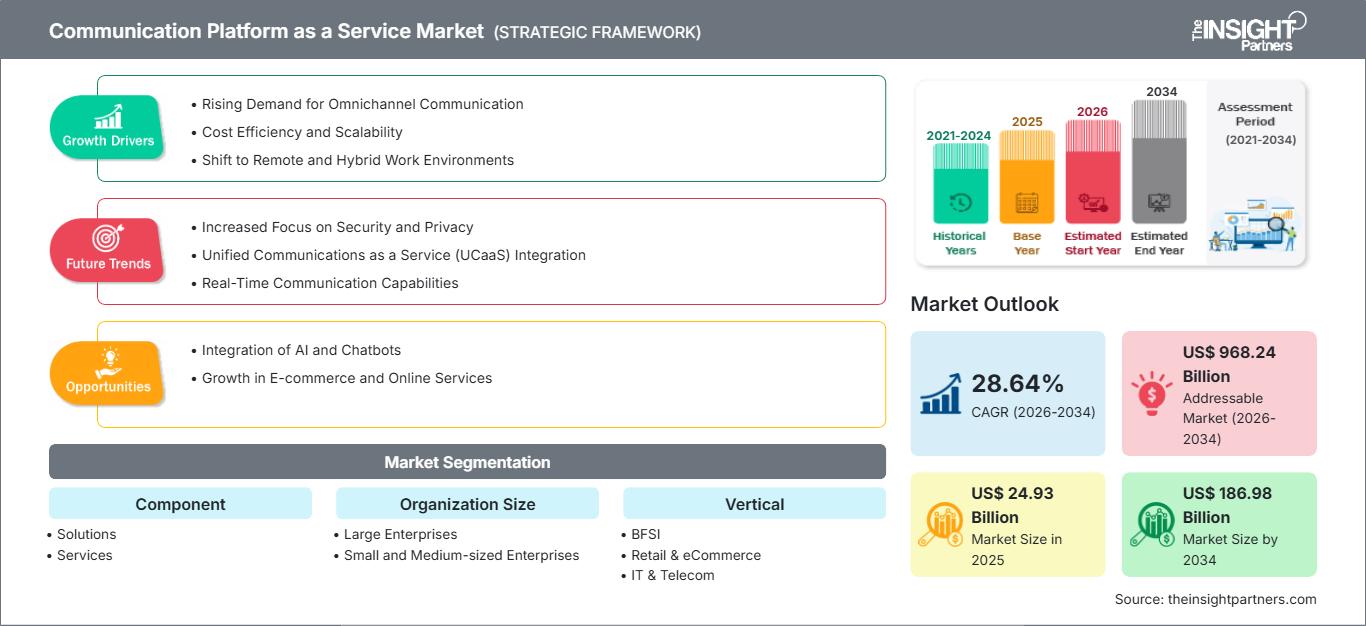
The Communication Platform as a Service market was valued at US$ 24.93 billion in 2025 and is expected to reach US$ 186.98 billion by 2034; it is estimated to record a CAGR of 25.09% during 2026-2034.
Communication Platform as a Service Market Assessment and Insights
- North America: High enterprise spend and early cloud migration give North America a meaningful lead, with a 2025 share range of 35–41% and growth at a CAGR range of 24–30% between 2026–2034
- US: The US captures the bulk of North American demand with a 2025 share range of 72–78% of the region and a 2026–2034 CAGR range of 24–30%, supported by hyperscaler partnerships and developer ecosystems.
- Europe: Strong uptake across the UK, Germany, France, Italy, and Spain supports a 2025 share range of 20–26% and a 2026–2034 CAGR range of 22–28%, with the UK and Germany leading adoption.
- Asia Pacific: Fastest enterprise digitization drives APAC to a 2025 share range of 18–24% and a 2026–2034 CAGR range of 30–36%, with China, Japan, South Korea, India, and Australia as major contributors.
- Largest Segment: The Solutions component is the largest segment, holding a 2025 market share range of 65–72% and growing at a CAGR range of 26–32% between 2026–2034.
- High Growth Segment: The Small and Medium-sized Enterprises organization-size segment is the high growth segment, with a 2025 market share range of 14–20% and a 2026–2034 CAGR range of 32–38% due to lower entry costs and packaged CPaaS offerings.
- Key companies analyzed in detail: Twilio, Sinch AB, Avaya Holdings Corp., Vonage Holdings Corp., Bandwidth Inc., RingCentral Inc., TeleSign Corporation, Infobip d.o.o., CM.com BV, 8x8 Inc.twilio+1
Source: The Insight Partners' analysis based on proprietary research, government publications, company annual reports, investor presentations, industry databases, and expert interviews.
The communication platform as a service market has evolved from simple programmable SMS and voice APIs to fully integrated omnichannel orchestration stacks that embed messaging, voice, video, and identity into application workflows. Platform vendors have layered analytics, developer tooling, and AI-driven routing to create higher-value offerings that suppliers can monetize via usage, subscription, and outcome-based pricing. Enterprise procurement has shifted from bespoke integration projects to platform-led consumption with standardized APIs, driving faster deployment cycles and predictable operational costs. These dynamics have compressed time-to-market for new engagement products and shifted vendor focus to developer experience, global carrier reach, and regulatory compliance.
Looking forward, expansion into the Asia Pacific and selected MEA markets will attract incremental investment, supporting gains in the Communication Platform As A Service Market share. Regulatory clarity for messaging and identity in Europe and North America will unlock larger enterprise contracts, while venture and strategic funding is expected to favor platform capabilities in conversational AI, identity verification, and secure cross-border messaging. Public procurement modernization in government verticals and rising digital health compliance requirements will create measurable demand for privacy-preserving, auditable communications solutions in regulated industries.
Communication Platform as a Service Market Report Scope
| Report Attribute | Details |
|---|---|
| Market size in 2025 | US$ 24.93 Billion |
| Market Size by 2034 | US$ 186.98 Billion |
| Global CAGR (2026 - 2034) | 25.09% |
| Historical Data | 2021-2024 |
| Forecast period | 2026-2034 |
Communication Platform as a Service Market Analysis
Demand for programmable communications is driven by enterprise requirements for richer, personalized customer engagement across the lifecycle. Customer expectations for real-time, contextual interactions have pushed brands to integrate messaging, voice, and digital channels into product flows, while compliance and verification use cases have driven uptake in regulated verticals such as BFSI and healthcare, as highlighted in the Communication Platform As A Service Market report.
The CPaaS value chain now includes carriers, platform providers, system integrators, and specialist application developers; carriers supply reach and delivery quality while platform vendors provide orchestration, SDKs, and analytics. Suppliers that can deliver low-latency global routing, resilient fallbacks, and measurable delivery SLA capture larger enterprise contracts, and strategic partnerships between CPaaS vendors and hyperscalers have become common.
The competitive landscape of the Communication Platform As A Service Market is marked by a mix of large public vendors and niche regional specialists competing on global reach, pricing, and verticalized offerings. Market leaders spend extensively on development tools, AI orchestration, and direct carrier relationships to guarantee deliverability and compliance. Mergers, strategic acquisitions, and bundling are still the most prominent methods of gaining wider channel access and building expertise in areas such as identity verification or conversational AI.
Venture capitalists are pouring money into platform differentiation through low-code orchestration, data residency solutions, and embedded payments. The most successful players are those who provide a combination of robust developer experience, enterprise SLA, and compliance controls.
● REPORT CUSTOMIZATION
Tailor This Report To Align With Your Specific Business Requirements
This report can be customized to align precisely with your business objectives, scope, and target markets. Customization options include tailored segmentation, geography, competitive analysis, and strategic insights to support informed decision-making.
Customize This Report →WHAT YOU CAN ADJUST
- ● Segmentations
- ● Geography
- ● Competitive Analysis
- ● Language Preferences
Communication Platform as a Service Market: Strategic Insights
Regional Insights
North America Communication Platform As A Service Market
North America accounted for a 2025 share range of 35–41% of the global market and is forecast to expand at a CAGR range of 24–30% from 2026–2034, reflecting broad enterprise modernization and cloud-native adoption. Regional drivers include large-scale digital transformation programs, regulatory compliance investments in customer data handling, and mature developer ecosystems that speed integration and innovation, reinforcing the positive Communication Platform As A Service Market forecast.
US enterprise demand, strong hyperscaler partnerships, and advanced contact center modernization are primary growth engines for the region, with finance, retail, and healthcare leading consumption. The concentration of large global customers and strong venture funding for SaaS and cloud-native communications startups underpin continued expansion and vendor consolidation.
U.S. Communication Platform As A Service Market
The U.S. contributed 72–78% of North America’s 2025 market and is expected to grow at a CAGR range of 24–30% for 2026–2034, driven by large-scale rollouts of omnichannel engagement platforms across retail, BFSI, and technology sectors. Enterprise cloud migration, developer adoption of programmable APIs, and aggressive product roadmaps from major platform providers accelerate enterprise consumption and cross-border deployments, shaping key Communication Platform As A Service Market trends.
Application usage leans towards AI-driven customer service, verification of identity in digital transactions, and marketing automation integration that enhances conversion and retention rates. Vendors’ penetration is high as there are major players at the global level and niche vendors in certain regions.
Europe Communication Platform As A Service Market
Europe held a 2025 share range of 20–26% of the market and is forecast to expand at a CAGR range of 22–28% between 2026–2034, as businesses modernize legacy telephony and incorporate programmable messaging and voice into customer journeys. The UK and Germany are leading country markets, with the UK exhibiting rapid adoption in fintech and e-commerce, while Germany shows strong uptake in enterprise-grade communication services and manufacturing applications, contributing significantly to the growth of the Communication Platform As A Service Market.
The UK market is a good example of the quick adoption of API-first communication technologies, which is due to the need of fintech and e-commerce companies to onboard clients quickly and reduce fraud. The issues of vendor integration with local telecom operators and data residency become critical.
In Germany, there is a focus on security and compliance, where large manufacturers and insurance companies prefer on-premise or hybrid solutions from vendors.
APAC Communication Platform As A Service Market
APAC represented a 2025 share range of 18–24% and is projected to grow at a CAGR range of 30–36% for 2026–2034, making it one of the fastest-expanding regions due to rapid digitalization and mobile-first commerce. Leading countries include China, Japan, South Korea, India, and Australia, where high smartphone penetration and eCommerce growth produce heavy demand for programmable messaging and verification services, supporting the expansion of the Communication Platform As A Service Market.
Industrial modernization, supportive digital policies, and increased investment in cloud infrastructure are key policy and industrial drivers. Vendors that secure local carrier agreements and provide multilingual, low-latency routing are best positioned to capture APAC growth opportunities.
Middle East & Africa Communication Platform As A Service Market
MEA accounted for a smaller share in 2025 but shows strong upside, with a 2026–2034 CAGR range of 28–34%, led by infrastructure investment and digitization efforts in Saudi Arabia and the UAE. The region’s growth is supported by national digital initiatives, expansion of mobile payment systems, and increased enterprise outsourcing to cloud providers, strengthening the outlook for the Communication Platform As A Service Market.
Saudi Arabia and the UAE are early adopters with targeted investments in digital government services, while South Africa leads southern Africa on enterprise use cases. Energy-sector modernization and telecommunications infrastructure upgrades are structural tailwinds for CPaaS adoption across the region.
Segmentation Analysis
Component
The Component segment comprises Solutions and Services and is forecast to expand at a CAGR range of 25–31% between 2026–2034, reflecting strong demand for integrated solution sets and managed services that help enterprises accelerate deployments. Within the Communication Platform As A Service Market, solutions account for most revenues as enterprises buy packaged orchestration, APIs, and developer tooling, while services, including implementation, integration, and managed operations, remain critical for complex, regulated deployments.
- Solutions: Solutions dominate revenue with broad applicability across customer engagement, identity, and verification use cases; vendors differentiate on APIs, analytics, and carrier reach.
- Services: Services provide deployment, integration, and managed-support capabilities for complex enterprise implementations, helping reduce time-to-value and ensure compliance.
Organization Size
The Organization Size segment includes Large Enterprises and Small and Medium-sized Enterprises and carries a 2026–2034 CAGR range of 26–34% as packaging and pricing models broaden to reach SMEs while large enterprises pursue deep integrations and SLAs. Large enterprises drive revenue via multi-year contracts and customization requirements; SMEs adopt packaged CPaaS offerings for rapid deployment and lower operational overhead.
- Large Enterprises: Large enterprises favor customizable, SLA-backed platforms with strong security, global reach, and integration services for mission-critical operations.
- Small and Medium-sized Enterprises: SMEs prefer turnkey, self-serve CPaaS with transparent pricing and prebuilt templates to reduce implementation friction and cost.
Vertical
The Vertical segment covers BFSI, Retail & eCommerce, IT & Telecom, Government, Healthcare, Education, and Manufacturing and is forecast at a CAGR range of 27–33% between 2026–2034 as verticalized use cases proliferate. BFSI and retail remain prominent demand drivers due to identity, fraud prevention, and customer engagement needs, while healthcare and government require compliance and auditability, elevating demand for secure communications platforms.
- BFSI: BFSI uses CPaaS for identity verification, transaction notifications, and secure customer communications to reduce fraud and improve onboarding.
- Retail & eCommerce: Retail leverages omnichannel notifications, cart recovery messaging, and post-purchase support to increase conversions and retention.
- IT & Telecom: IT and Telecom adopt CPaaS for network-integrated messaging and operator-grade routing to support large-scale communications.
- Government: Government agencies employ CPaaS for citizen notifications, emergency messaging, and digital service delivery with audit trails.
- Healthcare: Healthcare uses secure messaging for appointment reminders, telemedicine coordination, and compliance-sensitive communications.
- Education: Education institutions adopt CPaaS for student engagement, alerts, and remote learning support scenarios.
- Manufacturing: Manufacturing applies CPaaS for supply-chain alerts, field service coordination, and safety communications.
Opportunity Snapshot
| Industry Vertical | Revenue Contribution | Trend Tag | Adoption Stage |
|---|---|---|---|
| BFSI | High | Identity Verification | Scaling |
| Retail & eCommerce | High | Order Notifications | Scaling |
| IT & Telecom | Medium | Operator Routing | Mature |
| Government | Medium | Citizen Alerts | Scaling |
| Healthcare | Medium | Telemedicine Messaging | Emerging |
| Education | Low | Remote Learning Alerts | Scaling |
| Manufacturing | Low | Field Service Alerts | Scaling |
Communication Platform as a Service Market Growth Drivers and Impact Analysis
Enterprise digital transformation and omnichannel demand
Enterprise buyers are shifting budgets from legacy telephony to cloud-native, API-first engagement platforms that enable integrated omnichannel experiences and measurable ROI. This transformation is a key driver of the Communication Platform As A Service Market growth, increasing demand for programmable messaging and voice APIs, unified orchestration, and analytics that tie communications to customer outcomes. Adoption is strongest where business cases show measurable reductions in handling time, improved verification success, or higher conversion rates in digital sales funnels. The shift also forces legacy vendors and integrators to partner or replatform, accelerating consolidation and promoting standards around security, data residency, and interoperability. Enterprises increasingly prioritize platforms that combine developer experience, global carrier reach, and robust compliance features.
Regulatory compliance and identity verification requirements
Growing regulations in payment solutions, health privacy, and digital identity compel businesses to move towards platforms that offer auditable messaging, consent management, and advanced identity verification processes. The need to be compliant is going to generate a demand for capabilities like message archiving, secure delivery, and geographic data hosting, which platforms would have to support in order to be able to sell their services to enterprises. With governments moving towards standardizing digital identity standards and KYC compliance requirements, CPaaS providers who can integrate identity verification and secure credentialing through APIs are sure to carve out a market share.
Conversational AI and automation embedding
The integration of conversational AI into communications workflows offers an opportunity for organizations to engage in automated and contextual conversations, which lowers the burden on agents and improves the quality of their responses. By offering capabilities such as agent assistance, intent detection, and orchestration within multiple channels, CPaaS providers create new possibilities, such as automated dispute resolution, proactive alerts, and intelligent routing. The capability to execute AI within the CPaaS platform becomes a point of differentiation as well as the basis for upselling more expensive plans.
Communication Platform as a Service Market Future Trends
Shift to outcome-based pricing models
Providers will start offering price models based on outcomes related to the delivery of SLA or KPIs of the business, not just based on consumption. This is because outcome models ensure that provider interests are aligned with customer success, hence more integration and contracts from providers for large enterprises with stable financial models. Outcome models will facilitate faster adoption in price-sensitive vertical markets.
Regionalization through data residency and local carrier partnerships
Regionalization tactics will be used by platforms to address their need to adhere to regulations as well as latency requirements through localized infrastructure and direct carrier connectivity. In-region routing and local data centers will be unique selling propositions for those businesses that have residency or latency requirements. Regionalization allows customization of compliance functionality and language capabilities, making adoption feasible in highly regulated regions with cross-border messaging requirements.
Communication Platform as a Service Market Opportunities
Embedded communications in vertical SaaS
Integration of communication capabilities right within the vertical SaaS workflows generates sticky and high-value-added use cases for vertical applications like onboarding for banking, telemedicine workflows, and checkout flows in retail. CPaaS vendors may form strategic partnerships with vertical SaaS vendors to create integrated bundles, white-labeled flows, and revenue-sharing mechanisms that drive fast penetration. Such partnerships help minimize the go-to-market effort for CPaaS vendors and provide vertical SaaS vendors with more differentiated capabilities that result in better customer retention and monetization.
SME-focused packaged offerings
The packaged CPaaS offerings with templates, predictable pricing, and simple onboarding processes offer a huge potential market by removing the technical and procurement barriers for vendors to grow in volume and build partner ecosystems. There is a huge market potential for CPaaS offerings targeted at SMEs looking to achieve fast value for their customer engagement efforts. Retail and services sector SMEs would be prime candidates for such opportunities.
Frequently Asked Questions

- Comprehensive Market Sizing and Forecast Analysis
- Detailed Segmentation Analysis
- In-Depth Market Dynamics Assessment
- Regional and Country-Level Insights
- Competitive Landscape and Company Benchmarking
- Strategic Business Intelligence
Recent Reports
Testimonials

The Insight Partners' SCADA System Market report is comprehensive, with valuable insights on current trends and future forecasts. The team was highly professional, responsive, and supportive throughout. We are very satisfied and highly recommend their services.
RAN KEDEM Partner, Reali Technologies LTDs
I requested a report on a very specific software market and the team produced the report in a few days. The information was very relevant and well presented. I then requested some changes and additions to the report. The team was again very responsive and I got the final report in less than a week.
JEAN-HERVE JENN Chairman, Future Analytica
We worked with The Insight Partners for an important market study and forecast. They gave us clear insights into opportunities and risks, which helped shape our plans. Their research was easy to use and based on solid data. It helped us make smart, confident decisions. We highly recommend them.
PIYUSH NAGPAL Sr. Vice President, High Beam Global
The Insight Partners delivered insightful, well-structured market research with strong domain expertise. Their team was professional and responsive throughout. The user-friendly website made accessing industry reports seamless. We highly recommend them for reliable, high-quality research services
YUKIHIKO ADACHI CEO, Deep Blue, LLC.
This is the first time I have purchased a market report from The Insight Partners.While I was unsure at first, I visited their web site and felt more comfortable to take the risk and purchase a market report.I am completely satisfied with the quality of the report and customer service. I had several questions and comments with the initial report, but after a couple of dialogs over email with their analyst I believe I have a report that I can use as input to our strategic planning process.Thank you so much for taking the extra time and making this a positive experience.I will definitely recommend your service to others and you will be my first call when we need further market data.
JOHN SUZUKI President and Chief Executive Officer, Board Director, BK Technologies
I wish to appreciate your support and the professionalism you displayed in the course of attending to my request for information regarding to infectious disease IVD market in Nigeria. I appreciate your patience, your guidance, and the fact that you were willing to offer a discount, which eventually made it possible for us to close a deal. I look forward to engaging The Insight Partners in the future, all thanks to the impression you have created in me as a result of this first encounter.
DR CHIJIOKE ONYIA MANAGING DIRECTOR, PineCrest Healthcare Ltd.Reason to Buy
- Informed Decision-Making
- Understanding Market Dynamics
- Competitive Analysis
- Identifying Emerging Markets
- Customer Insights
- Market Forecasts
- Risk Mitigation
- Boosting Operational Efficiency
- Strategic Planning
- Investment Justification
- Tracking Industry Innovations
- Aligning with Regulatory Trends





 Get Free Sample for