
Composite Bearings Market Growth, Trends & Demand by 2034
Coverage: by Product Type (Fiber Matrix, Metal Matrix); Application (Construction and Mining, Agriculture, Automotive, Aerospace, Marine, Others) , and Geography (North America, Europe, Asia Pacific, and South and Central America)
- Status : Data Released
- Report Code : TIPRE00009939
- Category : Chemicals and Materials
- No. of Pages : 150
- Available Report Formats :


- Last update date : November 03, 2026


2025 Market Size
US$ 6.77 Bn
Base year value
2034 Forecast
US$ 12.59 Bn
Projected by 2034
CAGR 2026-2034
7.13 %
Growth rate
Addressable Market
US$ 87.34 Bn
(2026-2034)
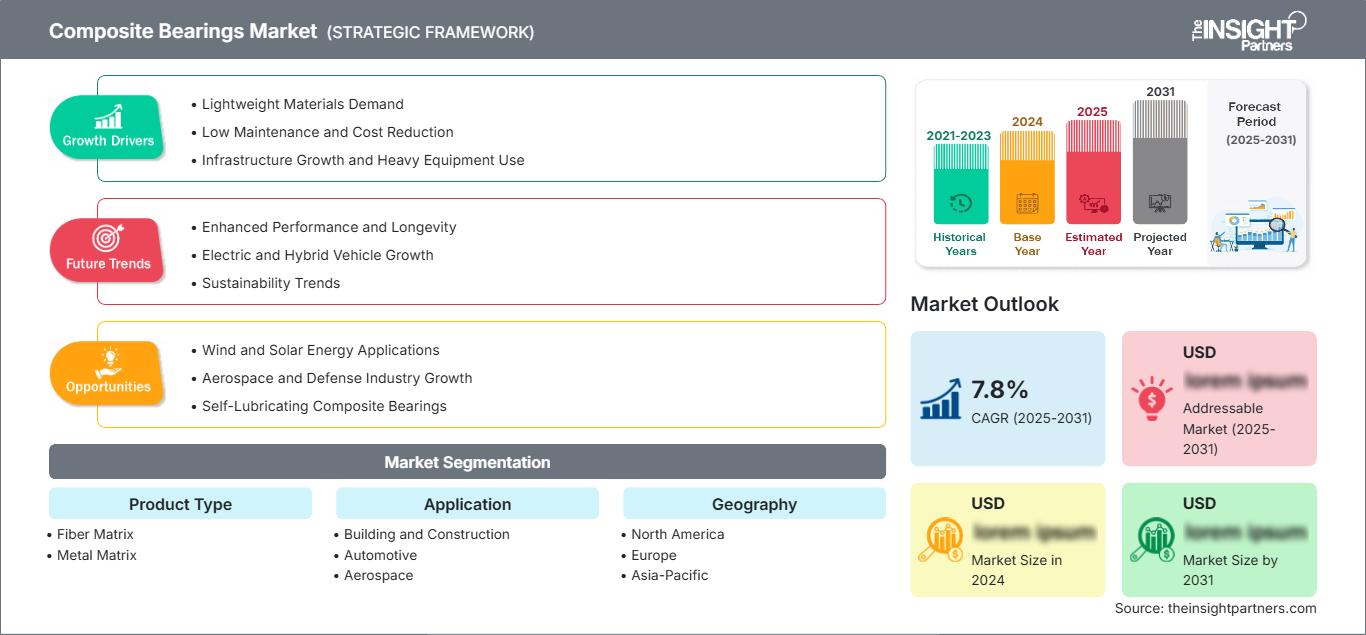
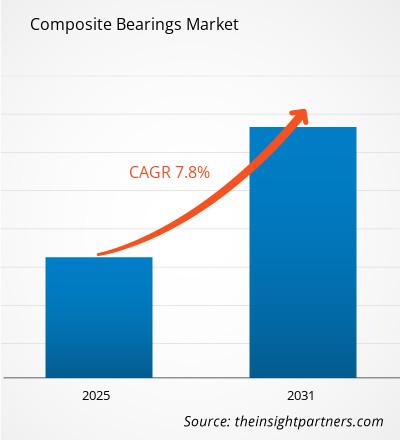
The Composite Bearings Market is valued at US$ 6.77 Billion in 2025 and is expected to reach US$ 12.59 Billion by 2034, registering a CAGR of 7.13% from 2026 to 2034. Expansion is supported by demand for lightweight, corrosion-resistant, low-friction, and maintenance-reduced bearing systems across automotive, aerospace, marine, construction, and mining equipment. Increasing equipment automation, harsher operating environments, and the replacement of conventional metal bearings with engineered composite solutions are strengthening adoption.
North America represents a substantial demand center for the Composite Bearings Market size because of its established aerospace, automotive, construction, mining, and industrial equipment base. The region is expected to register a ~7% CAGR through 2034, supported by the replacement of conventional bearing materials, demand for maintenance-free components, and continued use of composite systems in high-load and low-speed applications. The presence of established suppliers and specialized manufacturers also supports shorter qualification cycles and application-specific engineering.
Composite Bearings Market Assessment and Insights
Regional Outlook
- North America: ~30% of the global market in 2025 | ~7% CAGR through 2034. Market position: North America ranks among the largest regional markets, supported by aerospace manufacturing, industrial equipment, construction machinery, mining operations, and an established demand for engineered bearings capable of operating with limited lubrication and maintenance.
- US: ~70% of North American market revenue in 2025 | ~7% CAGR through 2034. Market position: The US holds the largest country position within North America because of its aerospace and defense manufacturing base, industrial machinery demand, mining activity, and strong supplier ecosystem spanning engineered plastics, composites, and precision bearing systems.
- Europe: ~34% of the global market in 2025 | ~6% CAGR through 2034. Market position: Europe is the largest regional market, reflecting mature industrial manufacturing and aerospace capabilities. Germany leads Europe, followed by established demand centers in the UK, France, Italy, and Spain, supported by machinery modernization and automotive engineering.
- Asia Pacific: ~27% of the global market in 2025 | ~8% CAGR through 2034. Market position: Asia Pacific is the fastest-growing region as industrial production, automotive manufacturing, infrastructure investment, mining, marine equipment, and automation expand. China leads Asia Pacific, while Japan, South Korea, India, and Australia broaden demand.
Segment Outlook
- Fiber Matrix: ~62% Share in 2025 | ~7% CAGR through 2034. Market position: Fiber Matrix leads because reinforced composite constructions provide a favorable combination of strength, low friction, dimensional stability, and weight reduction. Their suitability for demanding equipment makes them attractive where conventional metal bearing systems create maintenance or corrosion limitations.
- Automotive: ~31% Share in 2025 | ~8% CAGR through 2034. Market position: Automotive represents the highest-growth application as manufacturers prioritize lightweight components, friction reduction, durability, and compact designs. Electrification and increased use of engineered materials are expanding the specification opportunities for composite bearing technologies.
Competitive Coverage
Saint-Gobain S.A., Trelleborg AB, Schaeffler AG, Polygon Company, Inc., RBC Bearings Incorporated, Regal Rexnord Corporation, CIP Composites Corp., Tristar Plastic Corp., Spaulding Composites, Inc., HyComp, LLC
Methodology
The Insight Partners follows Data Collection & Secondary Research, Primary Research, Data Analysis, and Data Triangulation & Final Review to validate market estimates and insights.
Source: The Insight Partners' analysis based on proprietary research, government publications, company annual reports, investor presentations, industry databases, and expert interviews.
Composite Bearings Market share has evolved alongside composite bearing technology from relatively specialized applications toward broader use in equipment requiring controlled friction, reduced maintenance, corrosion resistance, and weight efficiency. Modern manufacturing combines reinforced fibers, engineered resins, lubricating additives, and precision machining to create bearing structures suited to dry, wet, oscillating, and high-load conditions. Trelleborg, for example, offers composite and thermoplastic bearing systems across industrial applications, while CIP Composites positions its products for high-load, high-impact, and slow-rotating applications.
The forward outlook for the Composite Bearings Market forecast is increasingly shaped by industrial automation, aerospace production, vehicle electrification, infrastructure investment, and demand for equipment capable of operating in corrosive or difficult environments. Asia Pacific is gaining strategic importance as automotive and industrial manufacturing capacity expands, while Europe retains a strong installed base and engineering capability. Investments in advanced materials and application-specific designs should allow suppliers to address higher load requirements without returning to heavier metallic constructions.
Composite Bearings Market Report Scope
| Report Attribute | Details |
|---|---|
| Market size in 2025 | US$ 6.77 Billion |
| Market Size by 2034 | US$ 12.59 Billion |
| Global CAGR (2026 - 2034) | 7.13% |
| Historical Data | 2021-2024 |
| Forecast period | 2026-2034 |
Composite Bearings Market Analysis
Demand aligned with Composite Bearings Market trends is closely connected to equipment operating conditions rather than bearing replacement alone. The selection of bearing materials is increasingly based on friction, maintenance cycles, corrosive exposure, weight, dimensional stability, and overall life cycle performance. The supply chain consists of resin, fiber, lubrication, and backing material suppliers, as well as composite materials formulating, consolidating, molding, machining, and finishing. There is thus a role to play for companies that combine material technology with component design rather than focusing solely on standard bearing sizes.
The supply situation is affected by the availability of specialty resins, reinforcing fibers, precision machining, and certified manufacturing processes. Composite bearings are an alternative to bronze, Babbitt metal, and certain plastics or metals in appropriate uses. As an example, CIP Composites produces composite bearing material in tube and sheet forms, which are machinable into bearings, bushings, wear pads, thrust washers, and wear rings.
Competitive forces include a blend of diversified engineering firms along with specialty composite materials firms. Trelleborg has both composite and thermoplastic bearing lines, whereas Schaeffler has large industrial, automotive, aerospace, and linear motion bearing businesses. RBC Bearings has composite journal bearings via the Lubron line. Firms compete based on materials, engineering applications, qualifications, manufacturing capabilities, and partnerships with equipment manufacturers, not just on the price of the bearings.
Investments are becoming increasingly focused on specialty materials, local manufacturing, and high-end applications. Schaeffler formed the Aerospace Bearings group in 2025 in recognition of the significance of aerospace bearings, and Schaeffler's 2025 performance was particularly good in aerospace bearings. Trelleborg's product line is also comprised of engineered polymer and composite materials.
● REPORT CUSTOMIZATION
Tailor This Report To Align With Your Specific Business Requirements
This report can be customized to align precisely with your business objectives, scope, and target markets. Customization options include tailored segmentation, geography, competitive analysis, and strategic insights to support informed decision-making.
Customize This Report →WHAT YOU CAN ADJUST
- ● Segmentations
- ● Geography
- ● Competitive Analysis
- ● Language Preferences
Composite Bearings Market: Strategic Insights
Regional Insights
North America Composite Bearings Market
North America accounted for approximately ~30% of the global Composite Bearings Market demand in 2025 and is projected to grow at a ~7% CAGR through 2034. The US is the primary market, which is bolstered by the presence of the aerospace engineering industry, heavy construction equipment, mining machinery, industrial automation, and specialty hydraulic/pneumatic equipment. Composite bearings are useful in cases when equipment has the requirement of minimal maintenance and protection against moisture, chemicals, impact, or irregular lubrication.
The geographical area enjoys the advantage of an existing supply chain infrastructure and application engineering. RBC Bearings offers the Lubron line with coiled and solid composite journal bearings, and CIP Composites provides composite bearing material for various industrial applications, including marine, hydro, oil & gas, mining, and hydraulic applications. This enables North American end-users to design composite bearing systems in applications where regular metallic bearings would impose constraints in terms of lubrication, corrosion, or weight.
U.S. Composite Bearings Market
The US represented approximately ~70% of North American Composite Bearings Market revenue in 2025 and is expected to expand at a ~7% CAGR through 2034. Its placement is indicative of the wide range of industries in the areas of aerospace and defense, industrial machines, construction, mining, and transportation equipment production. Another advantage for demand is the development of an aftermarket where component replacement would make sense due to less maintenance needs and longer intervals of operation.
The country boasts of diverse domestic supply chains. RBC Bearings provides bearings to aerospace and industrial clients across different bearing types, while CIP Composites offers custom bearing materials and machining of components made of composite materials. There is a growing tendency toward weight reduction and maintenance elimination, especially within the aerospace industry and special industrial machinery.
Europe Composite Bearings Market
Europe held approximately ~34% of the global Composite Bearings Market demand in 2025 and is expected to register a ~6% CAGR through 2034. Germany is the top nation in Europe, driven by its automotive manufacturing, industrial machinery, automation, and precision engineering industries. On the other hand, the UK provides contributions via aerospace, marine, industrial, and defense applications, while France gets the advantage of aerospace and transportation equipment manufacturing. Demand from Italy and Spain comes from machinery, automotive components, construction machinery, marine equipment, and industrial manufacturing.
European demand is marked by advanced engineering and emphasis on efficiency and cost of equipment. Schaeffler's Bearings & Industrial Solutions division focuses on industrial, automotive, aerospace, and linear motion products, where aerospace bearings run as a separate business division from 2025. The results of Schaeffler in 2025 have shown that there was good growth in European and American aerospace bearings.
Trelleborg further enhances the European expertise in composites with its Orkot, Turcite, and HiMod bearing family. Trelleborg composite bearings cover the requirements of the applications where there is a necessity for dry operation, boundary lubrication, contact with water, high loads, and a marine environment.
APAC Composite Bearings Market
Asia Pacific represented approximately ~27% of the global Composite Bearings Market in 2025 and is projected to grow at a ~8% CAGR through 2034, making it the fastest-growing region. China is the leading country in Asia Pacific, supported by automotive production, industrial equipment manufacturing, mining, infrastructure construction, and expanding automation. Japan and South Korea provide advanced automotive, robotics, electronics, and precision-machinery demand.
India and Australia add opportunities through infrastructure, construction, mining, and industrial equipment. Increasing localization of manufacturing and expansion of domestic supply chains should improve access to engineered composite components. Trelleborg has also expanded its Asian footprint, including a manufacturing facility in Vietnam, reinforcing the importance of localized production and regional customer support.
Middle East & Africa Composite Bearings Market
Middle East & Africa Composite Bearings Market is projected to record a ~6% CAGR through 2034. Saudi Arabia represents a leading country in the Middle East & Africa region because of large infrastructure, energy, water, mining, and industrial-development programs. The UAE contributes through ports, marine equipment, infrastructure, logistics, and industrial modernization, while South Africa provides a strong mining and heavy-equipment demand base.
The regional opportunity is closely connected with harsh operating conditions. High temperatures, dust, water exposure, corrosion, and limited access to maintenance infrastructure can favor bearing designs that reduce lubrication requirements. Composite solutions are therefore relevant to pumps, marine systems, mining equipment, hydraulic machinery, and infrastructure assets where component reliability can reduce operational disruption.
Segmentation Analysis
Product Type
Fiber-based composite construction represents the principal product category because reinforcement enables manufacturers to balance structural strength, dimensional stability, friction characteristics, and weight. The category benefits from increasing use in applications where traditional metal bearings impose excessive weight or maintenance requirements. Fiber Matrix is estimated to register a ~7% CAGR from 2026 to 2034, supported by broader adoption of engineered composite materials and application-specific bearing designs.
- Fiber Matrix: Fiber Matrix bearings use reinforced composite structures to achieve favorable strength-to-weight characteristics and controlled friction. They are particularly relevant where corrosion resistance, low maintenance, and dimensional stability are important to equipment performance.
- Metal Matrix: Metal Matrix bearings combine metallic structural characteristics with reinforcing phases to address higher mechanical loads and demanding operating conditions. Their value proposition is strongest where designers require greater rigidity and load tolerance while retaining composite material advantages.
Application
Application demand is expanding as equipment manufacturers evaluate bearings on total operating performance rather than initial component cost. Automotive is estimated to register an ~8% CAGR from 2026 to 2034, reflecting lightweighting, electrification, compact packaging, and greater attention to friction and durability. Composite systems also gain specification opportunities where equipment operates in wet, corrosive, high-load, or maintenance-constrained environments.
- Building and Construction: Construction equipment uses composite bearing solutions where large machinery experiences dust, vibration, oscillating movement, and intermittent maintenance. Durable low-friction components can support equipment reliability in demanding operating environments.
- Automotive: Automotive applications prioritize lightweight construction, compact component design, controlled friction, and durability. Electrification further encourages materials that can reduce mechanical losses and accommodate changing drivetrain and chassis architectures.
- Aerospace: Aerospace applications emphasize weight efficiency, reliability, dimensional stability, and performance under demanding temperature and load conditions. Qualification requirements are stringent, favoring suppliers with established engineering, testing, and production capabilities.
- Marine: Marine equipment benefits from composite bearings that resist seawater exposure and corrosion while operating with reduced lubrication. Water-lubricated designs are relevant to propulsion, steering, pumps, and other equipment exposed continuously to wet environments.
- Mining: Mining equipment requires bearing materials capable of handling impact, contamination, oscillatory motion, and heavy loads. Composite solutions can reduce maintenance requirements in locations where equipment downtime and servicing access carry high operating costs.
Opportunity Snapshot
| Application | Revenue Contribution | Trend Tag | Adoption Stage |
|---|---|---|---|
| Building and Construction | Medium | Heavy Equipment | Scaling |
| Automotive | High | Vehicle Lightweighting | Scaling |
| Aerospace | High | Airframe Weight | Mature |
| Marine | Medium | Water Lubrication | Scaling |
| Mining | Medium | Harsh-Duty Equipment | Scaling |
Composite Bearings Market Growth Drivers and Impact Analysis
Lightweighting and Lower Friction Requirements
Weight reduction is becoming a more important design criterion across transportation and industrial equipment. Composite bearings can reduce component weight while maintaining suitable load and wear performance, particularly when engineered fiber reinforcement and low-friction layers are matched to the operating environment. In automotive applications, lower component mass complements broader vehicle efficiency objectives, while aerospace designers place an even higher value on weight savings because reductions can influence payload and operating efficiency. Composite systems can also lower friction and reduce wear when correctly specified, supporting longer service intervals. Trelleborg's HiMod Advanced Composite Bearing Plus, for example, uses a low-friction layer and continuous-fiber composite manufacturing technology for demanding applications.
Demand for Maintenance-Free Bearing Systems
Equipment operators increasingly seek bearing technologies that reduce scheduled lubrication, inspection requirements, and unplanned maintenance. This requirement is particularly important in mining, marine, construction, hydraulic, and industrial machinery applications where component access may be difficult or downtime may interrupt high-value operations. Composite materials can incorporate solid lubricants or operate with water lubrication, allowing designers to reduce reliance on external grease systems in suitable applications. CIP Composites specifically identifies self-lubrication, low wear, and wet or dry operation among the performance advantages of its composite materials. This expands the economic rationale for conversion from conventional bronze or other metallic bearing systems.
Expansion of Harsh-Environment Industrial Applications
Industrial equipment increasingly operates in environments involving water, chemicals, dust, temperature variation, impact, or limited maintenance access. Such conditions create opportunities for materials that resist corrosion and maintain predictable friction and wear characteristics. Marine propulsion, hydropower, mining machinery, oil and gas equipment, pumps, and hydraulic systems can therefore represent important specification areas. Trelleborg's Orkot composite bearings are positioned for marine and hydropower applications because of their low friction, wear resistance, and minimal swelling in seawater. CIP similarly serves marine, hydro, mining, oil and gas, and hydraulic industries.
Composite Bearings Market Future Trends
Integration of Advanced Fiber and Thermoplastic Technologies
Future bearing development is likely to emphasize engineered combinations of reinforcement architecture, thermoplastics, thermoset matrices, solid lubricants, and precision manufacturing. Continuous-fiber placement and other controlled manufacturing processes allow designers to orient reinforcement according to load paths rather than relying on uniform material structures. This can improve the relationship between weight, stiffness, wear, and load capacity. Trelleborg's advanced composite bearing technology demonstrates the direction of development toward lightweight structures with engineered low-friction surfaces. As material formulation and manufacturing become more application-specific, suppliers should increasingly compete through design optimization and qualification capability rather than standardized component availability.
Broader Adoption Across Electrified and Automated Equipment
Electrification and automation will alter bearing requirements across vehicles, robotics, production equipment, and infrastructure machinery. Electric platforms place greater emphasis on efficiency, compact packaging, thermal behavior, and weight, while automated machinery can increase operating cycles and therefore magnify friction and wear costs. Composite bearings can address selected requirements where conventional metallic systems create unnecessary weight or lubrication needs. The trend is also relevant to industrial automation because maintenance interruptions can reduce the utilization of highly automated assets. As equipment designers gain more application data, composite bearing specifications are likely to expand from specialized assemblies into broader classes of engineered motion components.
Composite Bearings Market Opportunities
Localized Manufacturing in High-Growth Asian Markets
Asia Pacific provides an opportunity for composite-bearing manufacturers to localize production, engineering support, and distribution close to automotive, industrial, construction, mining, and machinery customers. China already has a large manufacturing base, while India and Southeast Asia are expanding industrial capacity and infrastructure investment. Local manufacturing can shorten delivery cycles, reduce logistics exposure, and improve customization for region-specific equipment. Trelleborg's recent expansion of its regional footprint, including its Vietnam facility, illustrates the broader strategic importance of strengthening Asian manufacturing and customer proximity. Suppliers that combine localized machining with centralized material expertise can potentially serve both multinational OEMs and regional equipment manufacturers.
High-Performance Bearing Solutions for Aerospace and Marine Equipment
Aerospace and marine applications offer opportunities for higher-value composite bearing systems because performance requirements can justify specialized materials and engineering. Aerospace manufacturers prioritize weight, reliability, and qualification, while marine operators require corrosion resistance and dependable performance in wet environments. Schaeffler's decision to establish Aerospace Bearings as a separate business division in 2025 demonstrates the strategic importance of specialized bearing technologies, while Trelleborg maintains composite solutions for marine and hydropower applications. Suppliers with strong testing, certification, and application-engineering capabilities can target these markets through customized bearing designs rather than standardized products.
Recent Developments
- July 2026: National Engineering Industries Ltd. (NEI), India’s leading bearings manufacturer under the NBC brand, and iMRail Technology GmbH, a pioneer in next-generation railborne mobility solutions, announced a strategic partnership. This partnership lays the foundation for a comprehensive ‘Make in India’ ecosystem for advanced transit systems, including low-to-medium speed Maglev, next-generation Monorail and Ropeways as well as sub-systems for such mobility solutions.
- June 2026: Indutrade signed an agreement to acquire all shares in the German company Createc GmbH & Co. KG, with annual sales of approximately EUR 23 million (SEK 250 million). Createc designs, manufactures and sells high-performance composite components for medical instruments, sealing solutions, and pump bearing applications. Based on its proprietary composite material platforms, the company addresses mission-critical applications with high regulatory and technical requirements.
Frequently Asked Questions

- Comprehensive Market Sizing and Forecast Analysis
- Detailed Segmentation Analysis
- In-Depth Market Dynamics Assessment
- Regional and Country-Level Insights
- Competitive Landscape and Company Benchmarking
- Strategic Business Intelligence
Recent Reports
Testimonials

The Insight Partners provided valuable market intelligence that supported our global go-to-market strategy. Their team was professional, responsive, and attentive to our feedback, providing thoughtful analysis and helpful methodological clarifications throughout the project.
Junmo Kim Chief Financial Officer (CFO), Enertech Co., Ltd.
The Insight Partners' SCADA System Market report is comprehensive, with valuable insights on current trends and future forecasts. The team was highly professional, responsive, and supportive throughout. We are very satisfied and highly recommend their services.
RAN KEDEM Partner, Reali Technologies LTDs
I requested a report on a very specific software market and the team produced the report in a few days. The information was very relevant and well presented. I then requested some changes and additions to the report. The team was again very responsive and I got the final report in less than a week.
JEAN-HERVE JENN Chairman, Future Analytica
We worked with The Insight Partners for an important market study and forecast. They gave us clear insights into opportunities and risks, which helped shape our plans. Their research was easy to use and based on solid data. It helped us make smart, confident decisions. We highly recommend them.
PIYUSH NAGPAL Sr. Vice President, High Beam Global
The Insight Partners delivered insightful, well-structured market research with strong domain expertise. Their team was professional and responsive throughout. The user-friendly website made accessing industry reports seamless. We highly recommend them for reliable, high-quality research services
YUKIHIKO ADACHI CEO, Deep Blue, LLC.
This is the first time I have purchased a market report from The Insight Partners.While I was unsure at first, I visited their web site and felt more comfortable to take the risk and purchase a market report.I am completely satisfied with the quality of the report and customer service. I had several questions and comments with the initial report, but after a couple of dialogs over email with their analyst I believe I have a report that I can use as input to our strategic planning process.Thank you so much for taking the extra time and making this a positive experience.I will definitely recommend your service to others and you will be my first call when we need further market data.
JOHN SUZUKI President and Chief Executive Officer, Board Director, BK Technologies
I wish to appreciate your support and the professionalism you displayed in the course of attending to my request for information regarding to infectious disease IVD market in Nigeria. I appreciate your patience, your guidance, and the fact that you were willing to offer a discount, which eventually made it possible for us to close a deal. I look forward to engaging The Insight Partners in the future, all thanks to the impression you have created in me as a result of this first encounter.
DR CHIJIOKE ONYIA MANAGING DIRECTOR, PineCrest Healthcare Ltd.Reason to Buy
- Informed Decision-Making
- Understanding Market Dynamics
- Competitive Analysis
- Identifying Emerging Markets
- Customer Insights
- Market Forecasts
- Risk Mitigation
- Boosting Operational Efficiency
- Strategic Planning
- Investment Justification
- Tracking Industry Innovations
- Aligning with Regulatory Trends





 Get Free Sample for