
Composite Decking and Railing Market Share, Size & Demand by 2034
Coverage: by Type (Capped, Uncapped); Resin Type (Polyethylene, Polypropylene, Polyvinylchloride, Others); Application (Residential, Non-Residential) , and Geography (North America, Europe, Asia Pacific, and South and Central America)
- Status : Data Released
- Report Code : TIPRE00010205
- Category : Chemicals and Materials
- No. of Pages : 150
- Available Report Formats :


- Last update date : August 19, 2026


2025 Market Size
US$ 4.92 Bn
Base year value
2034 Forecast
US$ 14.03 Bn
Projected by 2034
CAGR 2026-2034
12.35 %
Growth rate
Addressable Market
US$ 82.89 Bn
(2026-2034)
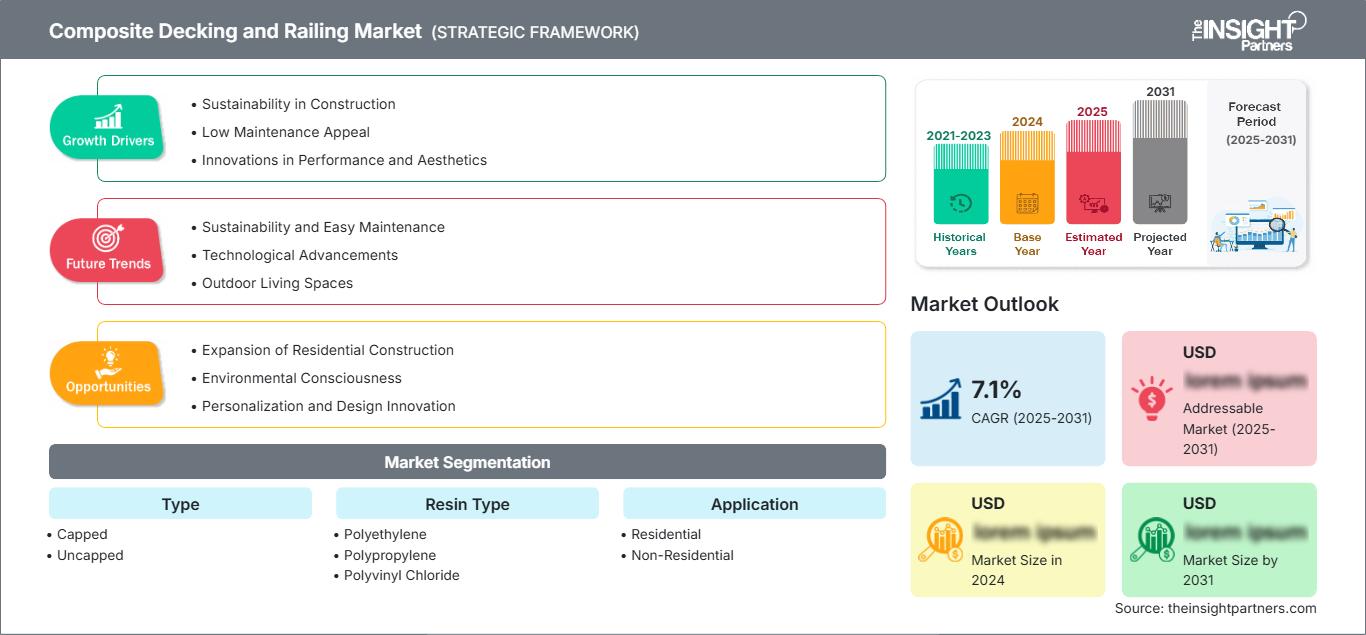
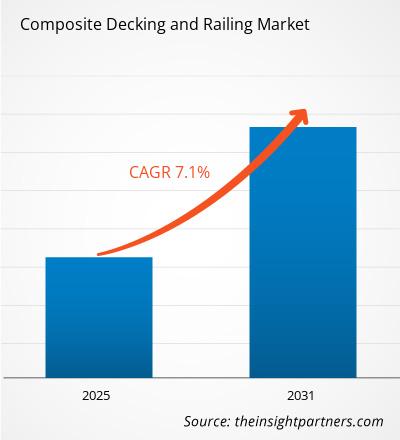
The Composite Decking and Railing Market size stood at US$ 4.92 billion in 2025 and is estimated to grow to US$ 14.03 billion by 2034, posting a CAGR of 12.35% over the forecast period of 2026 to 2034. Driving factors include the rising inclination towards easy to maintain outdoor products, technological advancements in capsulated products, and increased use of WPCs.
North America continues to lead the market as the dominant demand base due to high remodeling work being done in the region, presence of experienced contractors, and consumer awareness about the composite outdoor living products. CAGR for the size of the Composite Decking and Railing Market in North America is forecasted to be 11.8-12.6% over 2026-2034, backed by the replacement of old wood decks and expenditure on high-end outdoor renovations.
Composite Decking and Railing Market Assessment and Insights
- North America: North America is estimated to account for 58–62% Composite Decking and Railing Market share in 2025, supported by established composite decking adoption, remodeling activity, and strong distribution infrastructure, while expanding at a CAGR of 11.8–12.6% between 2026 and 2034.
- US: The US represents 88–91% of North America's 2025 share, benefiting from large remodeling expenditure and extensive contractor networks, with growth projected at a CAGR of 11.7–12.5% between 2026 and 2034.
- Europe: Europe is estimated at 17–20% share in 2025, with Germany, the UK, France, Italy, and Spain leading demand. Sustainability requirements, outdoor renovation, and preference for durable alternatives support a CAGR of 11.3–12.1% between 2026 and 2034.
- Asia Pacific: Asia Pacific holds an estimated 13–16% share in 2025, led by China, Japan, Australia, India, and South Korea. Urban development, hospitality construction, and increasing acceptance of engineered outdoor materials support a CAGR of 13.0–14.2% between 2026 and 2034.
- Largest Segment: Capped products represent an estimated 70–74% market share in 2025, reflecting stronger weather, stain, fade, and scratch resistance, with a CAGR of 12.8–13.6% between 2026 and 2034.
- High Growth Segment: Non-Residential applications account for approximately 24–28% market share in 2025 and are expected to register a CAGR of 13.2–14.1% between 2026 and 2034, driven by hospitality and commercial outdoor projects.
- Key companies analyzed in detail: Trex Company, Inc.; UPM-Kymmene Corporation through UPM Biocomposites; Advanced Environmental Recycling Technologies, Inc. (AERT); TAMKO Building Products, Inc.; James Hardie Industries plc through TimberTech; UFP Industries, Inc.; CRH plc through Oldcastle APG; Fortune Brands Innovations, Inc. through Fiberon; Eva-Last; and Fortress Building Products.
Source: The Insight Partners' analysis based on proprietary research, government publications, company annual reports, investor presentations, industry databases, and expert interviews.
As a result, composite decking has transformed from an alternative to wood to a high-performance outdoor construction product. Innovations include co-extruded caps, mineral-filled formulation, advanced polymers, wood grain replication technology, and heat-reduction solutions. There is also consolidation in the industry, as players are increasing production, using recycled materials and distributing products in a wider range. This trend allows suppliers to differentiate their offerings while meeting the needs for longevity, appearance, fire resistance, easy installation and maintenance of the boards.
In the next few years, expansion is predicted to continue beyond the mature US and European markets towards the Asia Pacific and certain Middle Eastern markets. The investment will focus on localized manufacturing, climate-based formulations, fire-resistant materials and lower carbon footprints. The requirements from the building codes, material recycling policies, and customers who demand high-quality outdoor materials will push suppliers to produce high-performance boards.
Composite Decking and Railing Market Report Scope
| Report Attribute | Details |
|---|---|
| Market size in 2025 | US$ 4.92 Billion |
| Market Size by 2034 | US$ 14.03 Billion |
| Global CAGR (2026 - 2034) | 12.35% |
| Historical Data | 2021-2024 |
| Forecast period | 2026-2034 |
Composite Decking and Railing Market Analysis
The production process starts from resin polymers, recycled plastic, wood fiber, dyes, fillers, and reinforcing agents and ends with compounding, extrusion, surface treatment, cutting, finishing, and distribution. The development of the Composite Decking and Railing Market is directly linked to spending on remodeling, housing construction, hotels, and outdoor living spaces. Many producers control more than one step of the process in order to increase consistency and stability.
Consumption is also driven by economic factors. Composite boards usually cost more initially compared to pressure-treated wood, however, due to the lack of need for staining, sealing, painting, and replacing, the life-cycle costs are economically beneficial. Retailers, specialty distributors, contractors, architects, and professional installers continue to play an important role in the industry. Supply chains are getting more adaptive to regional climatic needs, with products differing in heat, moisture, fire, slip, and UV resistance.
Positioning has shifted towards product diversification beyond mere board sales. The Composite Decking and Railing Market assessment takes into consideration complete solutions comprising deck, railing, framing, lighting, fastening, and design support. Trex Company, Inc. provides a diverse range of outdoor living products, whereas James Hardie Industries plc reinforces their positioning in the decking and railing market with the TimberTech brand. UFP Industries, Inc. has grown Deckorators through product development and capacity enhancements.
Other companies adopt differentiated strategies. The strategy for UPM-Kymmene Corporation is recycling and recyclable material technology via UPM Biocomposites, CRH plc offers complementary outdoor products through Oldcastle APG, Fortune Brands Innovations, Inc. through Fiberon, and Eva-Last with bamboo-based composite technologies. Priority areas of investment have become production capacity, product engineering, fire performance, heat management, contractors, and distribution.
● REPORT CUSTOMIZATION
Tailor This Report To Align With Your Specific Business Requirements
This report can be customized to align precisely with your business objectives, scope, and target markets. Customization options include tailored segmentation, geography, competitive analysis, and strategic insights to support informed decision-making.
Customize This Report →WHAT YOU CAN ADJUST
- ● Segmentations
- ● Geography
- ● Competitive Analysis
- ● Language Preferences
Composite Decking and Railing Market: Strategic Insights
Regional Insights
North America Composite Decking and Railing Market
North America has been accounted for an approximate 58–62% share in 2025 and is considered as the largest regional market. The US leads the regional consumption due to the composite decking gaining extensive recognition among homeowners, contractors, retailers, and remodelers. Canada provides contribution in the form of residential renovations and high-end outdoor living projects. The regional demand is backed by the aging housing stock, built up home equity, and outdoor improvements being made by homeowners.
The region is expected to grow at a CAGR of 11.8–12.6% from 2026 to 2034. US remodeling spending is a key demand driver with NAHB pointing out aging housing stock and homeowners’ decision to stay in existing homes as factors for structural remodeling. The companies are also responding to the risk of wildfire exposure, extreme heat, and moisture through fire-rated, heat mitigated, and enhanced-cap products.
U.S. Composite Decking and Railing Market
The US accounts for approximately 88–91% of North America's 2025 market share, making it the principal national market. The country is expected to grow at a CAGR of 11.7–12.5% between 2026 and 2034. Trex Company, Inc., James Hardie Industries plc through TimberTech, UFP Industries, Inc. through Deckorators, Fortune Brands Innovations, Inc. through Fiberon, and CRH plc through Oldcastle APG maintain significant market-facing positions.
The residential remodels market is still the biggest driver of demand, but multifamily units, hotels, restaurants, resorts, and institutions' outdoor areas present further possibilities. The census construction statistics are still an important signal for new housing demand, while the NAHB remodeling statistics show the role of replacements and renovations expenditures. Product demand becomes more differentiated according to pricing, performance in different climates, aesthetics, installation ease, and warranties instead of just material type.
Europe Composite Decking and Railing Market
Europe possesses around 17-20% market share in 2025 and is anticipated to exhibit a CAGR of 11.3-12.1% during 2034. The country is dominated by the market of Germany due to the presence of well-developed standards and sustainable use of construction materials. In addition to Germany, the UK, France, Italy, and Spain offer demand owing to renovation of residential areas, hospitality projects, construction of terraces, balconies, and commercial outdoor areas.
The UK shows high demand due to the renovation of areas since composite decking is more durable and needs less maintenance than timber flooring. Germany puts more emphasis on the quality of materials, lifecycle, and environmental aspects; thus, it provides better conditions for recycled or recyclable materials. France, Italy, and Spain show potential owing to hospitality, residential terraces, tourism facilities, and weathered outdoor environments.
APAC Composite Decking and Railing Market
It is forecasted that APAC would be contributing 13-16% share in 2025 and is projected to expand with a CAGR of 13.0-14.2% till 2034. The leading countries in this region are China, Japan, South Korea, India, and Australia. Australia holds relatively advanced adoption of outdoor living, whereas China and India have long-term growth prospects due to urbanization, hospitality, and upscale residential building.
Demand in this region can be attributed to industrialization, tourism, housing, and construction which is climate resilient. Weather resistance and durability are priorities in the Australian and Japanese markets, whereas China and India provide prospects for localized production and distribution. Nevertheless, the decline of China’s real estate investment in 2025 would mean that further market expansion will have to come from renovations and commercial construction.
Middle East & Africa Composite Decking and Railing Market
Middle East and Africa represents a smaller portion of global demand but offers specialized opportunities in hospitality, resorts, luxury residential development, and infrastructure-linked outdoor spaces. Saudi Arabia and the UAE lead regional potential, while South Africa provides the strongest established market base. The region is expected to expand at a CAGR of 10.4–11.6% between 2026 and 2034.
Saudi Arabia's large-scale tourism and urban development projects create opportunities for durable outdoor materials, while UAE demand is supported by hospitality, residential, and leisure construction. South Africa provides demand through residential renovations and commercial developments. High temperatures, ultraviolet exposure, moisture variation, and maintenance costs make heat-resistant and low-maintenance composite products particularly relevant across the region.
Segmentation Analysis
Type
Type segmentation distinguishes capped and uncapped products according to surface construction and performance characteristics. Capped boards command stronger adoption because their protective layer improves resistance to fading, staining, scratching, and moisture. The segment's CAGR of 12.8–13.6% between 2026 and 2034 is supported by premium residential remodeling and commercial specifications. The Composite Decking and Railing Market scope is consequently expanding toward higher-performance products rather than basic wood-substitute boards.
- Capped: Capped boards provide a protective polymer surface over the composite core, improving weatherability and visual retention. Their stronger lifecycle proposition supports premium positioning across residential remodeling, hospitality, and commercial outdoor applications.
- Uncapped: Uncapped boards remain relevant where upfront cost and material efficiency are priorities. They provide an accessible composite alternative for price-sensitive projects and selected residential applications where extreme surface protection is less critical.
Resin Type
Resin Type encompasses polyethylene, polypropylene, and polyvinyl chloride formulations. Material selection influences processing characteristics, moisture resistance, thermal behavior, cost, and surface performance. Polyethylene remains important because recycled polyethylene integrates effectively with wood fiber, while polypropylene supports selected premium formulations. The segment is expected to record a CAGR of 12.0–12.8% between 2026 and 2034 as manufacturers optimize resin blends and recycled content.
- Polyethylene: Polyethylene-based composites remain widely adopted because recycled polyethylene can be combined efficiently with wood fibers. The formulation supports cost-effective manufacturing and broad residential use, particularly where balanced durability and price are required.
- Polypropylene: Polypropylene composites occupy a differentiated position where improved moisture resistance, dimensional stability, and surface performance are priorities. Their strategic importance is increasing in premium outdoor products and specialized applications exposed to demanding weather conditions.
- Polyvinyl Chloride: Polyvinyl chloride formulations compete through moisture resistance, dimensional stability, and low-maintenance characteristics. Their adoption is particularly relevant in applications where manufacturers and specifiers prioritize long service life and consistent appearance.
Application
Application divides demand between residential and non-residential construction. Residential projects continue to represent the largest volume base because decks and outdoor living areas are common renovation targets. Non-residential demand is expanding faster as hotels, restaurants, resorts, multifamily properties, and institutional developments specify durable outdoor surfaces. Residential applications are expected to record a CAGR of 12.1–12.8%, while non-residential applications should grow at 13.2–14.1% between 2026 and 2034.
- Residential: Residential demand is supported by deck replacement, backyard renovation, outdoor kitchens, pool areas, and premium landscaping. Homeowners increasingly value low maintenance, realistic wood aesthetics, extended warranties, and climate-specific performance.
- Non-Residential: Non-residential projects prioritize durability, installation efficiency, safety, and predictable maintenance expenditure. Hotels, restaurants, multifamily developments, resorts, and institutional facilities create opportunities for higher-volume specifications and integrated railing systems.
Opportunity Snapshot
| Application | Revenue Contribution | Trend Tag | Adoption Stage |
|---|---|---|---|
| Residential | High | Outdoor Living | Mature |
| Non-Residential | Medium | Hospitality Decking | Scaling |
Composite Decking and Railing Market Growth Drivers and Impact Analysis
Aging Housing Stock and Remodeling Demand
Aging housing stock creates a replacement-oriented demand base for outdoor structures, particularly in mature North American markets. NAHB identifies aging homes, accumulated homeowner equity, and owners choosing to remain in existing properties as important remodeling tailwinds. For composite decking manufacturers, this changes the demand profile from purely new construction toward recurring replacement cycles. Composite products can capture these projects because homeowners often compare lifecycle maintenance requirements rather than initial purchase price alone. The impact extends across retailers, installers, distributors, and manufacturers, creating demand for standardized board dimensions, fastening systems, railing components, and design tools. Companies with strong contractor networks can benefit because replacement projects frequently require professional installation. This driver also supports premium capped products where consumers prioritize longer appearance retention and reduced maintenance.
Shift Toward Low-Maintenance Outdoor Materials
Consumer expectations are moving toward outdoor materials that combine appearance with reduced maintenance requirements. Traditional wood decking commonly requires periodic staining, sealing, painting, or replacement, whereas composite products are positioned around reduced routine upkeep. This difference is particularly relevant for homeowners with limited time and for commercial property owners seeking predictable maintenance expenditure. The impact is strengthening investment in surface technologies that improve resistance to stains, scratches, fading, moisture, and heat. Manufacturers are therefore competing on performance attributes rather than simply material substitution. Product warranties, hidden fastening systems, realistic wood-grain finishes, and coordinated railing solutions increasingly influence purchasing decisions. Over time, these features can raise average selling prices while also widening the addressable customer base beyond environmentally motivated buyers to consumers primarily seeking convenience, durability, and long-term value.
Expansion of Climate-Resilient Outdoor Construction
Extreme heat, wildfire exposure, intense rainfall, and ultraviolet radiation are increasing the importance of climate-specific outdoor building materials. Manufacturers are responding by developing fire-resistant cores, heat-mitigating surfaces, enhanced slip resistance, and improved moisture protection. This creates opportunities for composite products in locations where traditional timber performance can become more difficult to manage. The market impact is particularly relevant in western US states, Australia, coastal regions, and hot Middle Eastern markets. Building professionals are also placing greater emphasis on tested performance characteristics when selecting exterior products. Consequently, suppliers that can document fire behavior, slip resistance, thermal performance, and durability may gain specification advantages. This driver encourages higher-value product development and could gradually shift demand away from undifferentiated boards toward engineered systems designed for specific environmental conditions.
Composite Decking and Railing Market Future Trends
Fire and Heat Performance Become Core Product Attributes
The Composite Decking and Railing Market trends are moving toward climate-specific performance as manufacturers respond to hotter summers and greater wildfire exposure. Future product development is likely to combine fire-resistant cores with heat-mitigating surfaces, improved slip resistance, and enhanced dimensional stability. Instead of treating these characteristics as premium add-ons, manufacturers are expected to integrate them across broader product tiers. Western US markets may remain an important testing ground because wildfire requirements and extreme summer temperatures encourage demand for verified performance. Similar requirements can emerge in Australia, southern Europe, and selected Middle Eastern markets. The result should be stronger differentiation between commodity and engineered boards, with certification, testing, and documented performance becoming more important during contractor and architect selection.
Digitally Enabled Design and Customization
Digital planning tools are expected to become more closely integrated with decking sales, allowing homeowners and contractors to visualize board colors, layouts, railing systems, lighting, stairs, and accessories before purchase. Manufacturers can use these platforms to connect design selection with product availability, installation guidance, contractor referrals, and quotations. The development of increasingly realistic digital material visualization should reduce uncertainty around color and texture choices, particularly for premium products. Manufacturers may also use customer interaction data to identify regional preferences for board colors, patterns, railing styles, and outdoor configurations. This trend can strengthen direct engagement without eliminating traditional dealer channels. Instead, digital tools are likely to support the physical showroom and contractor experience by shortening decision cycles and reducing errors between product selection, project measurement, and installation.
Composite Decking and Railing Market Opportunities
Localized Production in High-Growth Regions
Manufacturers can pursue localized production or regional partnerships in Asia Pacific, the Middle East, and selected European markets where logistics costs can constrain composite product competitiveness. Local manufacturing can reduce freight distances, shorten delivery times, and enable product formulations tailored to regional climates. The Composite Decking and Railing Market Forecasts indicate that faster-growing regions will increasingly require distribution structures capable of supporting contractors and large commercial projects rather than relying entirely on imported products. Companies entering these markets can prioritize recycled polyethylene or polypropylene feedstocks available locally, while establishing quality controls consistent with established international standards. Partnerships with distributors, architects, hospitality developers, and outdoor-living specialists can further reduce market-entry risk. A regional approach also allows manufacturers to adjust product portfolios according to local demand for heat resistance, fire performance, aesthetics, and price tiers.
Integrated Outdoor-Living Systems
The expansion from individual deck boards toward integrated outdoor-living systems offers another investment opportunity. Suppliers can combine decking with railing, framing, stairs, lighting, fasteners, privacy screens, drainage solutions, and design services. This strategy increases revenue potential per project while improving installation compatibility and reducing the need for contractors to coordinate multiple suppliers. The opportunity is particularly attractive in residential renovation, multifamily developments, hotels, restaurants, and resort projects where customers increasingly seek coordinated outdoor environments. Manufacturers can also use integrated systems to strengthen brand loyalty because replacement components, accessories, and future expansions remain within the same ecosystem. Strategic investment should focus on modular compatibility, simplified installation, digital project planning, and dealer training. Such systems can also support higher-margin premium positioning while improving the predictability of project execution.
Recent Developments
- June 2026: Decks & Docks Co., a specialty distributor of composite decking and outdoor living building products, acquired J&W Lumber, a provider of outdoor building materials serving southern California. The transaction marks a significant step in Decks & Docks’ geographic expansion strategy and establishes its first major presence on the West Coast.
- April 2026: Deckorators, a leading brand in the outdoor living industry and a division of UFP Industries, acquired the remaining operating assets for MoistureShield decking, a respected brand in the decking and outdoor living market. The acquisition represents a strategic step forward for Deckorators as it continues to expand its wood plastic composite manufacturing capabilities, strengthen its product portfolio, and accelerate innovation in the rapidly growing outdoor living category.
Frequently Asked Questions

- Comprehensive Market Sizing and Forecast Analysis
- Detailed Segmentation Analysis
- In-Depth Market Dynamics Assessment
- Regional and Country-Level Insights
- Competitive Landscape and Company Benchmarking
- Strategic Business Intelligence
Recent Reports
Testimonials

The Insight Partners' SCADA System Market report is comprehensive, with valuable insights on current trends and future forecasts. The team was highly professional, responsive, and supportive throughout. We are very satisfied and highly recommend their services.
RAN KEDEM Partner, Reali Technologies LTDs
I requested a report on a very specific software market and the team produced the report in a few days. The information was very relevant and well presented. I then requested some changes and additions to the report. The team was again very responsive and I got the final report in less than a week.
JEAN-HERVE JENN Chairman, Future Analytica
We worked with The Insight Partners for an important market study and forecast. They gave us clear insights into opportunities and risks, which helped shape our plans. Their research was easy to use and based on solid data. It helped us make smart, confident decisions. We highly recommend them.
PIYUSH NAGPAL Sr. Vice President, High Beam Global
The Insight Partners delivered insightful, well-structured market research with strong domain expertise. Their team was professional and responsive throughout. The user-friendly website made accessing industry reports seamless. We highly recommend them for reliable, high-quality research services
YUKIHIKO ADACHI CEO, Deep Blue, LLC.
This is the first time I have purchased a market report from The Insight Partners.While I was unsure at first, I visited their web site and felt more comfortable to take the risk and purchase a market report.I am completely satisfied with the quality of the report and customer service. I had several questions and comments with the initial report, but after a couple of dialogs over email with their analyst I believe I have a report that I can use as input to our strategic planning process.Thank you so much for taking the extra time and making this a positive experience.I will definitely recommend your service to others and you will be my first call when we need further market data.
JOHN SUZUKI President and Chief Executive Officer, Board Director, BK Technologies
I wish to appreciate your support and the professionalism you displayed in the course of attending to my request for information regarding to infectious disease IVD market in Nigeria. I appreciate your patience, your guidance, and the fact that you were willing to offer a discount, which eventually made it possible for us to close a deal. I look forward to engaging The Insight Partners in the future, all thanks to the impression you have created in me as a result of this first encounter.
DR CHIJIOKE ONYIA MANAGING DIRECTOR, PineCrest Healthcare Ltd.Reason to Buy
- Informed Decision-Making
- Understanding Market Dynamics
- Competitive Analysis
- Identifying Emerging Markets
- Customer Insights
- Market Forecasts
- Risk Mitigation
- Boosting Operational Efficiency
- Strategic Planning
- Investment Justification
- Tracking Industry Innovations
- Aligning with Regulatory Trends





 Get Free Sample for