
Composite Floor Market Size, Share & Growth by 2034
Coverage: by Type (High Pressure Laminated Flooring, Solid Wood Composite Floor, PVC Composite Floor); Application (Residential, Commercial, Others) , and Geography (North America, Europe, Asia Pacific, and South and Central America)
- Status : Data Released
- Report Code : TIPRE00009487
- Category : Chemicals and Materials
- No. of Pages : 150
- Available Report Formats :


- Last update date : November 13, 2026


2025 Market Size
US$ 2.54 Bn
Base year value
2034 Forecast
US$ 4.15 Bn
Projected by 2034
CAGR 2026-2034
5.61 %
Growth rate
Addressable Market
US$ 30.33 Bn
(2026-2034)
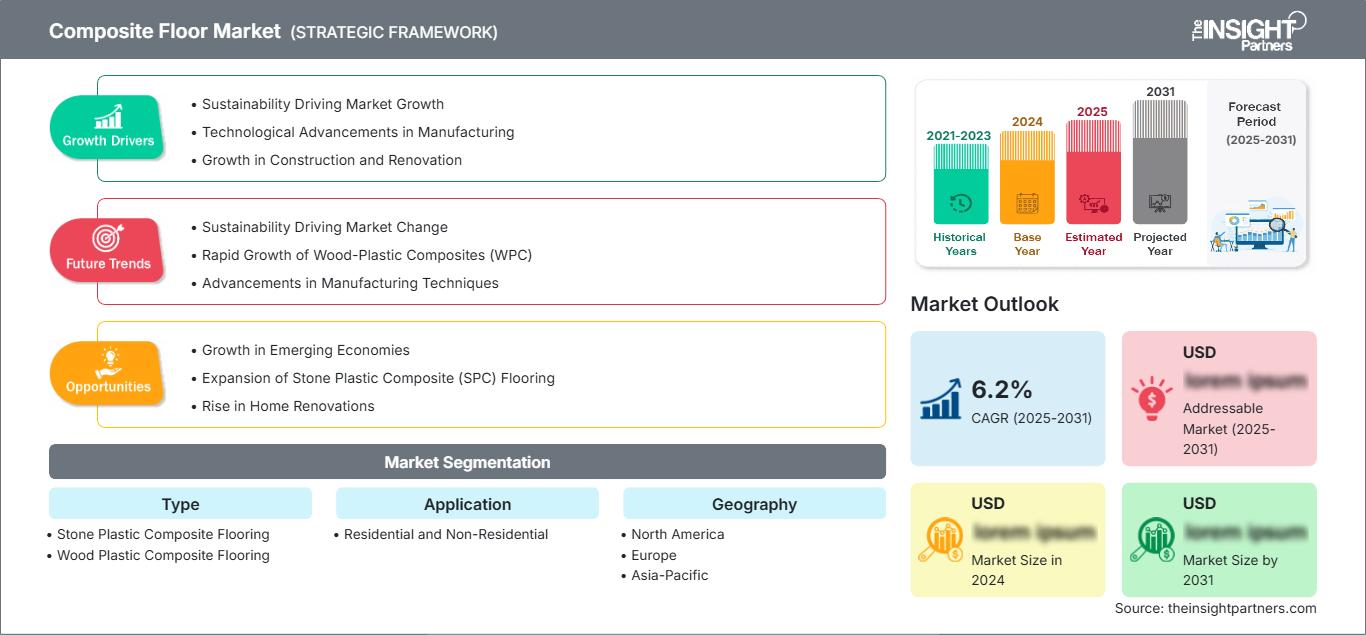
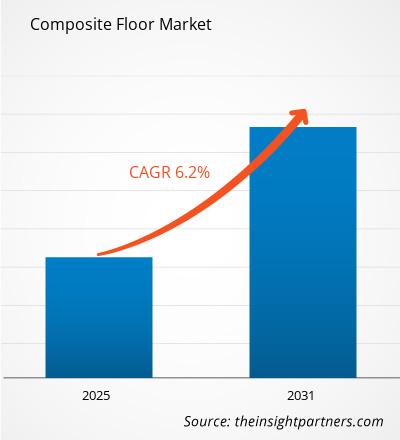
The composite floor market size was US$ 2.54 Billion in 2025 and will achieve US$ 4.15 Billion by 2034, growing at a rate of 5.61% CAGR from 2026–2034. Growth is driven by rigid flooring that can easily be installed without being sensitive to moisture, and more development is going into dimensionally stable, acoustically sound, and low emissions materials.
The North American composite floor market is expected to grow consistently due to residential renovations, multifamily building, and commercial renovations driving specifications. This market is forecasted to grow at a CAGR of 5.8–6.4%, driven by preferences for resilient flooring, faster installation methods, moisture resistance, and distribution through home improvement and specialty flooring channels.
Composite Floor Market Assessment and Insights
- North America: North America represented an estimated 28–32% composite floor market share in 2025, supported by renovation and commercial replacement activity, and is expected to grow at a CAGR of 5.8–6.4% during 2026–2034.
- US: The US accounted for 72–78% of North American demand in 2025 and is projected to expand at a CAGR of 5.7–6.3% through 2034, led by remodeling and resilient flooring adoption.
- Europe: Europe held an estimated 24–28% share in 2025 and is expected to grow at a CAGR of 4.8–5.4%, with Germany, the UK, France, Italy, and Spain supporting renovation-led demand.
- Asia Pacific: Asia Pacific represented 30–34% of 2025 demand and is forecast to grow at a CAGR of 6.2–6.9%, with China, Japan, South Korea, India, and Australia driving production, renovation, and project activity.
- Largest Segment: Stone Plastic Composite Flooring held an estimated 70–74% market share in 2025 and is projected to grow at a CAGR of 5.5–6.0%, reflecting rigid-core performance and installation efficiency.
- High Growth Segment: Non-Residential applications represented 36–40% in 2025 and are expected to grow at a CAGR of 6.1–6.8%, supported by retail, hospitality, offices, and institutional refurbishment.
- Key companies analyzed in detail: CLASSEN Group, Pergo, Kronoflooring, Alsafloor SA, Abet Laminati S.p.A., Balterio, Milwaukee Composites, Comflor, MP Global Products, NewTechWood
Source: The Insight Partners' analysis based on proprietary research, government publications, company annual reports, investor presentations, industry databases, and expert interviews.
The market has progressed from traditional laminate and flexible resilient materials to engineered rigid-core products featuring the combination of mineral or wood reinforcement, polymers, and decorative coverings. The production process has also undergone changes involving digital printing technology, synchronized embossing, click system, underlayment integration, and increased dimensional accuracy.
In the coming years, new construction markets in South and Southeast Asia, the Middle East, and certain Latin American countries will expand the addressable demand through developing retail and installation channels. The investments have to be made in localized finishing, recycling, certification, and digital distribution systems.
Composite Floor Market Report Scope
| Report Attribute | Details |
|---|---|
| Market size in 2025 | US$ 2.54 Billion |
| Market Size by 2034 | US$ 4.15 Billion |
| Global CAGR (2026 - 2034) | 5.61% |
| Historical Data | 2021-2024 |
| Forecast period | 2026-2034 |
Composite Floor Market Analysis
The growth drivers of the composite floors sector include renovation cycles, residential floor replacement, and products that offer both aesthetics and performance. The value chain includes raw materials of polymers and minerals/wood fibers; stabilizers and additives; core board manufacturers; decorative film producers; flooring producers; underlays; distributors; installers; retailers; and specifier customers. Supply-side considerations include resin and mineral prices, electricity, transportation, press capacity, and access to high-quality recycled feedstocks.
Demand-side considerations include the potential of the rigid product format to simplify installation and resist moisture, making these products suitable for kitchens, bathrooms, rentals, hospitality and commercial interiors. In addition, producers are improving click systems, surface finishes, acoustic features, and wear resistance. This produces an ecosystem wherein material uniformity and ease of installation can be as important as aesthetics.
The market for composite floors indicates that the competition within the industry remains fragmented among multinational flooring firms, specialized rigid-floor producers, laminate manufacturers, and composite-panel producers. CLASSEN Group promotes its PVC-free polypropylene technology, while Pergo and Balterio take advantage of the wide platform of Unilin. Kronoflooring specializes in rigid vinyl flooring, and Alsafloor SA competes through flooring ranges and channels. Abet Laminati S.p.A. provides expertise in engineered laminates and exterior floor coverings, and MP Global Products combines composite floors with underlayments.
Positioning relies more than ever on the sustainability record, automation in the production process, the unique lock system, and special aesthetics of the product. Milwaukee Composites offers its services in the field of specialized composite floors, while Comflor offers composite steel floor deckings and thus operates in another project ecosystem. NewTechWood specializes in wood-plastic composites, and investments within the industry go into production efficiency, product certification, recycling, and distribution.
● REPORT CUSTOMIZATION
Tailor This Report To Align With Your Specific Business Requirements
This report can be customized to align precisely with your business objectives, scope, and target markets. Customization options include tailored segmentation, geography, competitive analysis, and strategic insights to support informed decision-making.
Customize This Report →WHAT YOU CAN ADJUST
- ● Segmentations
- ● Geography
- ● Competitive Analysis
- ● Language Preferences
Composite Floor Market: Strategic Insights
Regional Insights
North America Composite Floor Market
North America captured 28-32% of total global demand in 2025 and will grow at a CAGR of 5.8-6.4% till 2034. The composite floor share in the region is highly concentrated through existing renovation channels. Renovations, turnover rates of apartments, commercial renovations, and need for waterproof or moisture-proof floorings help in achieving high replacement rate. The region has the advantage of existing specialty floor distributor and installer network.
United States constitutes 72-78% of total regional demand, whereas Canada makes for a smaller but steady demand through renovation and institutional projects. Customers in the region prefer to compare composite floors with luxury vinyl, laminate, engineered wood, and ceramic tiles on basis of their price and maintenance costs.
U.S. Composite Floor Market
The US accounted for 72–78% of North American composite floor demand in 2025, with a CAGR estimated at 5.7–6.3%. Drivers include home remodeling, property renovation, new constructions of multi-family housing units, renovation of hotels, and replacement of moisture-sensitive flooring. Retailers and flooring specialists sell rigid floors together with luxury vinyl and laminates, enabling consumers to choose among different installation systems, thickness, acoustic backing, wear layers, and warranties.
Usage includes interior applications, kitchen and bathroom floors, as well as corridors and heavy traffic areas; there is also growing use in commercial facilities in such segments as retail, hospitality, office, and selected institutional sectors. Participants include Pergo, CLASSEN Group, MP Global Products, Milwaukee Composites, NewTechWood, and others, through specific products or components. Opportunities lie in contractor education, regional stock, quick delivery, recycled content, and floors made for renovation projects.
Europe Composite Floor Market
The share of Europe in the total world demand was 24-28% in 2025 and is forecast to grow by a CAGR of 4.8-5.4%. Germany stands out as an important market due to a well-developed production of floors, renovation activities and sustainable product development. The UK, France, Italy and Spain contribute significantly through their needs for renovation of residential and hospitality facilities, and retail and commercial premises. European purchases are becoming more conscious about such aspects as product certification, indoor air quality, circularity, recyclability, and lifecycle.
In the UK replacement of flooring and renovation generate demand for products that are easy to install and resistant to moisture. Germany is fortunate with well-developed local production and attention to resource efficiency and product certification and durability. In France, Italy and Spain there is an opportunity to sell products for residential renovations, hospitality premises, retail spaces and commercial buildings. In Europe, key players have adapted their product specifications and documentation to growing environmental demands.
APAC Composite Floor Market
The APAC region accounted for 30-34% of global consumption in 2025 and is expected to increase at a CAGR of 6.2-6.9%. China leads in the region due to the scale of manufacture and exports, while Japan and South Korea focus more on the quality, dimensional stability, and design of the product.
There is an increase in industrialization, urbanization, and retail modernization that will promote the use. Manufacturers are adopting local design and packaging along with improvements in click system, acoustics, and moisture resistance. Policies focused on energy efficiency and quality buildings will support certified and low emission products.
Middle East & Africa Composite Floor Market
Demand growth in Middle East and Africa is anticipated to grow at CAGR of 5.4% to 6.0%, thanks to hospitality construction, residential developments, retail upgrades, and infrastructure investments. Demand in Middle East will be led by Saudi Arabia and UAE, while that in Africa by South Africa. Buyers of the project seek products which are durable, easy-to-maintain, quick-to-install, and resist temperature and moisture conditions.
The advantage of Saudi Arabia lies in the development programs of huge size, whereas in case of UAE, it lies in the importance of hotels, offices, and residential interior projects. South Africa is contributing by means of renovations and commercial projects, and MEA as a whole represents an opportunity for the longer term, owing to improvements in distribution channels.
Segmentation Analysis
Type
The type segment represents a key area of product differentiation in the Composite Floor Market, reflecting variations in durability, aesthetics, moisture resistance, installation characteristics, and lifecycle performance. Demand is being driven by increasing residential and commercial construction activities, renovation projects, and consumer preference for cost-effective flooring solutions that combine functionality with visual appeal. Manufacturers continue to introduce advanced composite flooring products with improved wear resistance, sustainability attributes, and ease of maintenance. Among product types, PVC Composite Floor is expected to register a CAGR of ~8% during 2026–2034, supported by rising demand for waterproof, durable, and low-maintenance flooring across residential and commercial environments.
- High Pressure Laminated Flooring: High pressure laminated flooring is widely used due to its scratch resistance, aesthetic versatility, and cost-effectiveness. The product is popular in residential and commercial settings where durability, ease of installation, and the appearance of natural materials are key purchasing considerations.
- Solid Wood Composite Floor: Solid wood composite flooring combines the visual appeal of natural wood with improved dimensional stability and durability. Demand is supported by consumers seeking premium flooring solutions that offer enhanced resistance to temperature fluctuations and moisture compared to traditional hardwood flooring.
- PVC Composite Floor: PVC composite flooring is increasingly adopted because of its excellent moisture resistance, durability, and design flexibility. Its suitability for high-traffic environments, ease of maintenance, and compatibility with modern interior designs continue to drive strong demand across multiple end-use sectors.
Application
The application segment highlights the broad utilization of composite flooring products across residential, commercial, and specialized environments. Growth is influenced by rapid urbanization, increasing infrastructure investments, rising consumer spending on interior improvements, and the need for long-lasting flooring solutions. Composite flooring products offer advantages such as durability, design flexibility, moisture resistance, and reduced maintenance requirements, making them attractive across diverse applications. Among applications, the Commercial segment is projected to record a CAGR of ~7% during 2026–2034, driven by increasing investments in office spaces, retail developments, hospitality facilities, healthcare institutions, and educational infrastructure.
- Residential: Residential applications account for significant demand for composite flooring products due to ongoing housing construction, remodeling activities, and growing consumer preference for aesthetically appealing and easy-to-maintain flooring materials. Enhanced durability and design options further support adoption in homes and apartments.
- Commercial: Commercial facilities such as offices, hotels, retail centers, healthcare establishments, and educational institutions increasingly utilize composite flooring because of its ability to withstand heavy foot traffic while maintaining visual appeal. Cost efficiency and reduced maintenance requirements also contribute to strong adoption.
Opportunity Snapshot
| Application | Revenue Contribution | Trend Tag | Adoption Stage |
| Residential | High | Home Renovation | Mature |
| Commercial | High | Smart Interiors | Scaling |
Composite Floor Market Growth Drivers and Impact Analysis
Renovation and replacement activity
Renovation is another driver of structural demand due to the fact that the replacement of floors is frequently done regardless of any building reconstruction projects. Composite floors can cater to homeowners, landlords, retailers, and hospitality establishments wishing to update their interiors without the difficulties of installation that some traditional floor materials bring. The click system can make installation times shorter, and moisture protection can increase its range of application in places like kitchens, bathrooms, utility rooms, and other highly utilized spaces. For construction professionals, standard plank sizes and the built-in underlayment can make the process of installation more convenient.
Material performance and installation efficiency
Performance attributes play an increasing role in determining flooring specifications aside from just pricing and aesthetics. For instance, rigid composite cores can be relied on for dimensional stability, while the wear layers and protective finishes contribute to resistance to scratching, staining, and cleaning. The click lock mechanism can also help reduce dependency on wet adhesives and improve the installation sequence. These attributes are important to commercial users since down time has a cost implication, but even home buyers are interested in these attributes because installation disruption is one of their concerns when buying products. Hence manufacturers compete using core density, lock geometry, acoustic backing, surface embossing, and moisture management attributes. Improved engineering can also result in fewer complaints associated with joint movement, surface damage, and improper installation.
Sustainability and material transparency requirements
Environmental requirements are becoming a commercial differentiator as architects, developers, retailers, and consumers request clearer information on recycled content, emissions, recyclability, and product composition. Flooring producers are responding by redesigning polymer systems, reducing hazardous substances, increasing recycled inputs, and pursuing third-party certifications. These changes can influence product qualification in commercial projects where environmental documentation is part of procurement. Material transparency also affects long-term brand positioning because buyers increasingly compare products on lifecycle considerations rather than upfront price alone. Companies capable of demonstrating responsible sourcing, controlled emissions, and credible end-of-life pathways can improve specification acceptance. The impact is likely to be strongest in Europe and premium commercial projects, but requirements can gradually spread through multinational retailers, property developers, and standardized procurement systems.
Composite Floor Market Future Trends
Recyclable rigid-core platforms
composite floor market trends are likely to include recyclable rigid-core platforms. Future product development is likely to move toward rigid-core flooring platforms designed with simpler material combinations and improved recyclability. Manufacturers will increasingly evaluate whether core, backing, decorative layer, and wear layer can be separated, recovered, or incorporated into controlled recycling streams. Polypropylene-based systems, mineral-filled formulations, and recycled-content compounds can gain attention where they provide comparable performance with clearer end-of-life pathways. Product certification will become more important because sustainability claims need measurable support. This trend may also encourage manufacturers to redesign adhesives, inks, coatings, and underlayments so that the complete floor assembly has a more coherent environmental profile. Over time, procurement teams could place greater emphasis on documented material composition and recycled content.
Digitally engineered natural aesthetics
The next generation of composite flooring is likely to combine digital decoration with increasingly precise surface synchronization. High-resolution printing can reproduce complex wood grain, stone variation, knots, mineral effects, and tonal transitions without relying on a narrow library of conventional decorative papers. Embossed-in-register techniques can reinforce the relationship between visual and tactile patterns, improving perceived authenticity. Manufacturers can also use digital design systems to shorten development cycles and introduce region-specific collections more quickly. This matters commercially because consumers often evaluate flooring first through appearance, while professional buyers require repeatable quality across large projects. As design personalization expands, suppliers with flexible printing and finishing capacity may respond more efficiently to smaller batches and faster style turnover.
Composite Floor Market Opportunities
Localized manufacturing and regional supply hubs
Investment in regional manufacturing and distribution hubs can reduce freight exposure, shorten lead times, and improve responsiveness to local design preferences. This opportunity is particularly relevant in large consumption regions where imported products face long replenishment cycles or changing logistics costs. Local finishing, cutting, packaging, and warehousing can provide a practical intermediate step before full-scale manufacturing investment. Companies can also use regional facilities to adapt plank formats, color collections, labeling, and technical documentation to local requirements. The opportunity is strongest where renovation markets are fragmented but retail and professional installation channels are becoming more organized. Strategic investors should evaluate proximity to polymer, mineral, and recycled-material suppliers, electricity costs, port or inland logistics, and installer density.
Recycled-content product platforms
composite floor market Forecasts indicate that a second opportunity lies in developing composite flooring platforms around verified recycled content and measurable environmental performance. Producers can differentiate through recycled polymers, reclaimed mineral fillers, recycled wood fibers, or production scrap recovery, provided that quality and emissions remain controlled. The commercial opportunity extends beyond environmentally motivated consumers because recycled-content specifications can become procurement criteria for offices, hotels, retailers, and public projects. Manufacturers can build stronger propositions by publishing product declarations, traceability information, and clear recycling guidance. Partnerships with recyclers and compounders can improve feedstock consistency and reduce dependence on virgin materials. Investors should prioritize technologies that maintain dimensional stability, surface quality, and locking performance while increasing recovered content.
Recent Developments
- July 2026: Brazilian manufacturer of structural composite panels Diprofiber – which also supplies raw materials for composite processing –launched CoreFloor, the country’s first thermoplastic composite flooring system intended for industrialised construction, i.e. the manufacture of all or part of a building’s components in an industrial setting, followed by their assembly on site.
- February 2025: SPAN FLOORS, a provider of premium wooden flooring and exterior wood solutions, introduced Tenacity Eco Composite Flooring to the Indian market. The product is positioned as a PVC-free alternative to conventional flooring, combining sustainability-focused material composition with durability and installation flexibility for residential and commercial applications. Tenacity Eco Composite Flooring contains up to 80% natural materials and up to 50% post-consumer recycled content. Its renewable composite core is PVC-free, supporting the product's positioning as an alternative for buyers seeking flooring solutions with reduced reliance on conventional PVC-based materials. The product received the Domotex Green Collection Award 2024 for its eco-focused design.
Frequently Asked Questions

- Comprehensive Market Sizing and Forecast Analysis
- Detailed Segmentation Analysis
- In-Depth Market Dynamics Assessment
- Regional and Country-Level Insights
- Competitive Landscape and Company Benchmarking
- Strategic Business Intelligence
Recent Reports
Testimonials

The Insight Partners provided valuable market intelligence that supported our global go-to-market strategy. Their team was professional, responsive, and attentive to our feedback, providing thoughtful analysis and helpful methodological clarifications throughout the project.
Junmo Kim Chief Financial Officer (CFO), Enertech Co., Ltd.
The Insight Partners' SCADA System Market report is comprehensive, with valuable insights on current trends and future forecasts. The team was highly professional, responsive, and supportive throughout. We are very satisfied and highly recommend their services.
RAN KEDEM Partner, Reali Technologies LTDs
I requested a report on a very specific software market and the team produced the report in a few days. The information was very relevant and well presented. I then requested some changes and additions to the report. The team was again very responsive and I got the final report in less than a week.
JEAN-HERVE JENN Chairman, Future Analytica
We worked with The Insight Partners for an important market study and forecast. They gave us clear insights into opportunities and risks, which helped shape our plans. Their research was easy to use and based on solid data. It helped us make smart, confident decisions. We highly recommend them.
PIYUSH NAGPAL Sr. Vice President, High Beam Global
The Insight Partners delivered insightful, well-structured market research with strong domain expertise. Their team was professional and responsive throughout. The user-friendly website made accessing industry reports seamless. We highly recommend them for reliable, high-quality research services
YUKIHIKO ADACHI CEO, Deep Blue, LLC.
This is the first time I have purchased a market report from The Insight Partners.While I was unsure at first, I visited their web site and felt more comfortable to take the risk and purchase a market report.I am completely satisfied with the quality of the report and customer service. I had several questions and comments with the initial report, but after a couple of dialogs over email with their analyst I believe I have a report that I can use as input to our strategic planning process.Thank you so much for taking the extra time and making this a positive experience.I will definitely recommend your service to others and you will be my first call when we need further market data.
JOHN SUZUKI President and Chief Executive Officer, Board Director, BK Technologies
I wish to appreciate your support and the professionalism you displayed in the course of attending to my request for information regarding to infectious disease IVD market in Nigeria. I appreciate your patience, your guidance, and the fact that you were willing to offer a discount, which eventually made it possible for us to close a deal. I look forward to engaging The Insight Partners in the future, all thanks to the impression you have created in me as a result of this first encounter.
DR CHIJIOKE ONYIA MANAGING DIRECTOR, PineCrest Healthcare Ltd.Reason to Buy
- Informed Decision-Making
- Understanding Market Dynamics
- Competitive Analysis
- Identifying Emerging Markets
- Customer Insights
- Market Forecasts
- Risk Mitigation
- Boosting Operational Efficiency
- Strategic Planning
- Investment Justification
- Tracking Industry Innovations
- Aligning with Regulatory Trends





 Get Free Sample for