
Composite Resin Market Growth, Trends & Forecast by 2034
Composite Resin Market Size and Forecasts (2021 - 2034), Global and Regional Share, Trends, and Growth Opportunity Analysis Report Coverage : by Type (Epoxy, Phenolic, Polyimide, Cyanate Ester, Bismaleimide); Process (Filament Winding, Injection Molding, Compression Molding); End-Use Industry (Automotive, Aerospace and Defense, Electrical and Electronics, Wind Energy); and Geography (North America, Europe, Asia Pacific, and South and Central America)
- Status : Data Released
- Report Code : TIPRE00040295
- Category : Chemicals and Materials
- No. of Pages : 150
- Available Report Formats :


- Last update date : August 19, 2026


2025 Market Size
US$ 37.46 Bn
Base year value
2034 Forecast
US$ 63.46 Bn
Projected by 2034
CAGR 2026-2034
6.03 %
Growth rate
Addressable Market
US$ 456.99 Bn
(2026-2034)
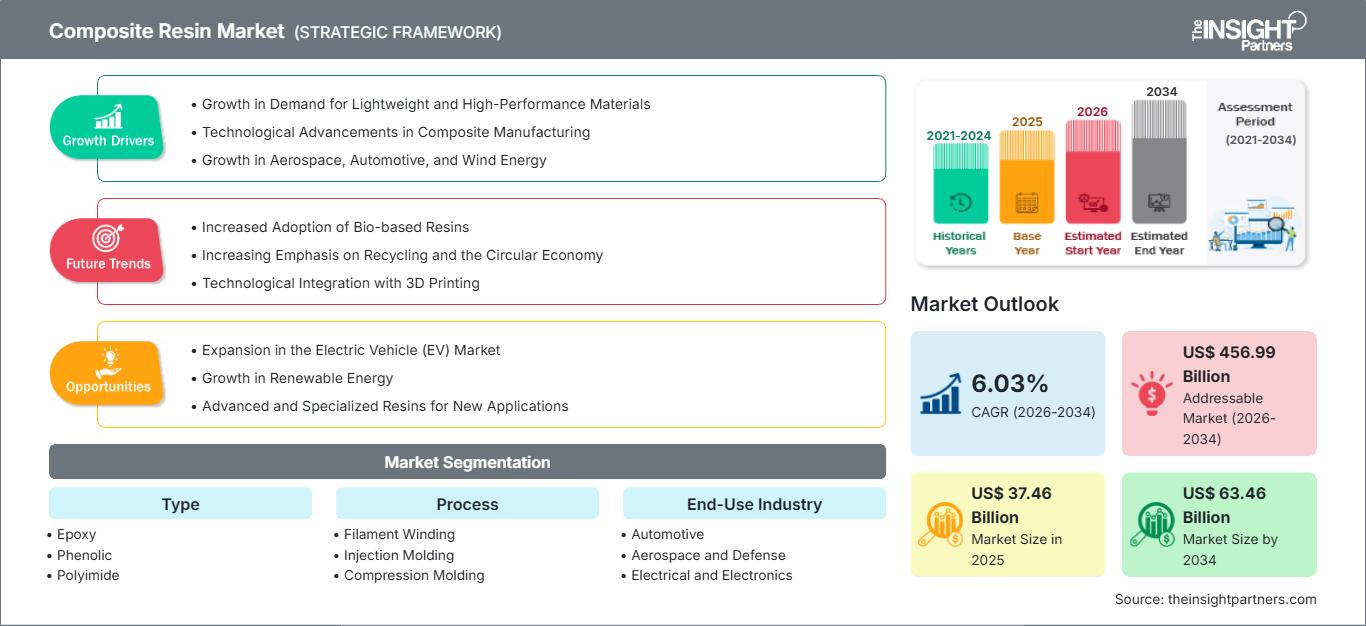
The Composite Resin Market size was estimated at US$ 37.46 Billion in 2025 and is expected to achieve US$ 63.46 Billion by 2034, growing with a CAGR of 6.03% during the forecast period. Growth drivers include reduced weight, good thermal behavior, corrosion resistance, electrical insulation, and composite fabrication flexibility. Epoxy resins play key roles in aerospace, automotive, electrical, and wind energy markets; and high temperature resin systems handle extreme conditions.
Regionally, North America continues to be an important base, as its market enjoys strong aerospace manufacturing, automotive lightweighting, wind energy installations, and electrical equipment manufacturing facilities. The Composite Resin Market will continue to grow with a CAGR of 5.8–6.8% by 2034.
Composite Resin Market Assessment and Insights
- North America: North America is estimated to hold a 29–33% Composite Resin Market share in 2025 and expand at a 5.8–6.8% CAGR between 2026–2034, supported by aerospace production, automotive lightweighting, electrical equipment, wind energy, and established composite manufacturing capabilities.
- US: The US is estimated to represent 25–29% share in 2025 and grow at a 5.8–6.8% CAGR between 2026–2034, driven by aerospace, defense, automotive, electronics, and industrial composite applications.
- Europe: Europe is estimated to account for 24–28% share in 2025 and expand at a 5.5–6.5% CAGR between 2026–2034, led by Germany, France, Italy, the UK, and Spain through automotive, aerospace, wind, and electrical applications.
- Asia Pacific: Asia Pacific is estimated at 30–34% share in 2025 and projected to register a 6.5–7.5% CAGR between 2026–2034, led by China, Japan, South Korea, India, and expanding electronics and renewable-energy manufacturing.
- Largest Segment: Epoxy is estimated to hold a 58–62% market share in 2025 and grow at a 5.8–6.8% CAGR between 2026–2034, supported by broad structural and electrical applications.
- High Growth Segment: Wind Energy is estimated to hold a 12–16% market share in 2025 and expand at a 7.0–8.0% CAGR between 2026–2034, supported by blade manufacturing and renewable capacity expansion.
- Key companies analyzed in detail: TORAY INDUSTRIES, INC., DIC CORPORATION, Arkema, Hexcel Corporation, Nexam Chemical AB, Epic Resins, Final Advanced Materials, Molded Fiber Glass Companies, SUMITOMO BAKELITE CO., LTD., and RTP Company.
Source: The Insight Partners' analysis based on proprietary research, government publications, company annual reports, investor presentations, industry databases, and expert interviews.
Resin manufacturing has evolved from traditional thermosetting processes to faster curing, increased thermal stability, improved toughness, reduced viscosity, and better processability. Resin epoxy remains the most dominant choice for widespread composites applications, whereas resins phenolic still play an important role when flame and smoke performances are required. Increasing polyimide, cyanate ester, and bismaleimide resins find applications in aerospace, electronics, and high-temperature fields.
According to the Composite Resin Market report, future developments will be driven by localized manufacturing, electrified mobility, aircraft manufacturing, renewable energy applications, and the increased complexity of electronics. Asia Pacific will become even more significant due to growing composite manufacturing capabilities in China, India, Japan, and South Korea. Moreover, efforts on recycling of thermoplastics, bio-based sources, low energy curing, and automation in the manufacturing process can affect resin choice.
Composite Resin Market Report Scope
| Report Attribute | Details |
|---|---|
| Market size in 2025 | US$ 37.46 Billion |
| Market Size by 2034 | US$ 63.46 Billion |
| Global CAGR (2026 - 2034) | 6.03% |
| Historical Data | 2021-2024 |
| Forecast period | 2026-2034 |
Composite Resin Market Analysis
Composite Resin Market demand is linked to the increasing use of light-weight materials and electrically insulating parts in transportation, aerospace, electronic devices and energy sector. Suppliers of resins are located upstream of reinforcement fabricators, prepreg producers, molders, component producers, and end-users. Fiber architecture, curing needs, component design, production rate affect the choice of resin formulations; and increasingly often clients assess resin systems according to their processability, mechanical properties, temperature tolerance and life cycle costs.
Supply is affected by petrochemicals, special additives, curing agents, compatibility of resins with different types of reinforcements, and production capacities in certain regions. High volume need for epoxies is favored by mature manufacturing technologies, and special-purpose resins for aerospace have to be qualified through testing. Producers have to find the balance between scale economies and special formulations. Variability in feedstock may affect price; and localization strategy makes producers set up technical centers, laboratories and production in proximity to composites production sites.
The Composite Resin Market trends indicate that competitive environment involves diversified chemical companies, specialized resin providers, composite material suppliers, and formulators who specialize in applications. TORAY INDUSTRIES, INC. and Hexcel Corporation have a firm hold over advanced composites and aerospace materials, whereas DIC CORPORATION and SUMITOMO BAKELITE CO., LTD. come with extensive capabilities in terms of polymers and specialty materials. Arkema specializes in advanced thermoplastics and resins for mobility and aerospace applications.
Nexam Chemical AB, Epic Resins, and Final Advanced Materials specialize in providing highly formulated materials and applications expertise. Molded Fiber Glass Companies and RTP Company are more generalized in terms of composite and engineered materials. Increasing focus of investments is seen in faster processing, low energy consumption, toughness, recycling resins, and automated process compatible formulations. Suppliers who offer high qualification and technical support capabilities can make the best out of high-value applications where the performance of formulations will enhance the productivity and reliability of the components.
● REPORT CUSTOMIZATION
Tailor This Report To Align With Your Specific Business Requirements
This report can be customized to align precisely with your business objectives, scope, and target markets. Customization options include tailored segmentation, geography, competitive analysis, and strategic insights to support informed decision-making.
Customize This Report →WHAT YOU CAN ADJUST
- ● Segmentations
- ● Geography
- ● Competitive Analysis
- ● Language Preferences
Composite Resin Market: Strategic Insights
Regional Insights
North America Composite Resin Market
North America is expected to account for 29-33% market share in 2025 and grow at a CAGR of 5.8-6.8% through 2034. Leading regional consumer, the United States is driven by the aerospace & defense industry, automotive industry, electrical & electronics industry, wind energy segment, and industrial composites industry. Canada adds value through transport applications, energy applications, infrastructure applications, and renewable energy applications.
The growth of regional demand is driven by stringent regulations on aircraft materials and lightweight materials in transport applications. Car makers are researching composite parts to decrease the weight of vehicles. Electrical and electronics makers need thermally stable and electrically insulating materials. Wind energy applications offer additional demand opportunity. The United States is also driven by investments made in its own manufacturing facilities, thus requiring local specialty resin systems and technical services.
U.S. Composite Resin Market
The US is expected to account for 86–90% of the market in North America until 2025, accounting for 25–29% of the world demand, and is forecasted to grow at a CAGR of 5.8–6.8% up to 2034. Aerospace and defense form premium application areas, whereas automotive, electronics, wind power, and industrial machinery offer larger volume opportunities.
TORAY INDUSTRIES, INC., Hexcel Corporation, Epic Resins, and RTP Company are among the firms engaged in the US composite material industry through their innovative materials and resin systems. Increasing demand has been associated with aircraft manufacture, electric vehicles and lightweight automobiles, electronics products, wind blades, and industrial applications. Procurement of specialized resins takes into consideration processing stability, certification, heat resistance, curing process, and technical service.
Europe Composite Resin Market
It is expected that the Europe region will represent 24% to 28% market share in 2025 and grow at a CAGR of 5.5% to 6.5% till 2034. The top national market is Germany, which is backed by its automotive production, industrial equipment, electrical systems and wind power generation capabilities. France and UK make contributions from their aerospace and defense segment while Italy and Spain benefit from their automotive, industrial, marine and renewable energy uses.
Germany has diversified composite manufacturing industries and also demands from its automotive and industrial customers. While France gains from its aerospace production and engineering capability, UK has its aerospace, wind energy and industrial application contribution. The composite application in transport and machinery is supported by Italy and wind energy manufacturing and aerospace activities of Spain. Weight reduction, process efficiency, durability, emissions considerations and composite recycling are the important considerations for European resin choice.
APAC Composite Resin Market
APAC is forecasted to have 30–34% market share in 2025 and grow at 6.5–7.5% CAGR, with China dominating the demand for region. Japan and South Korea bring their strengths in electronics, automotive, aerospace, and industrial applications, and India and Australia offer potential in transportation, infrastructure, energy, and renewable applications.
China has a favorable environment for mass production of electronics, automotive, wind power, and industrial applications. Japan places its focus on high-performance electronics, automotive, and aerospace materials, while South Korea leverages electronics, automotive, shipbuilding, and energy applications. India is developing in aerospace, automotive, electrical, and renewable manufacturing, and Australia offers wind power, infrastructure, mining, and energy applications.
Middle East & Africa Composite Resin Market
The Middle East & Africa region is forecast to grow with a CAGR of 5.0-6.0% until 2034. It is worth noting that the market in Saudi Arabia is among those leading markets. The needs for UAE are related to aviation, construction, transport, and infrastructure segments; South Africa contributes to this market via automotive, renewable energy, industrial equipment, and infrastructure sectors.
Energy infrastructure, industrial diversification, and renewable-energy investments drive growth in this region. The programs on industrial development in Saudi Arabia will provide opportunities for composite parts, electric components, and transportation applications; the UAE will benefit from aviation and infrastructure segment activity. South Africa provides opportunities related to wind energy, automotive production, and industrial applications. The rest of MEA has less demand and provides opportunities in water infrastructure, construction, energy, and corrosion resistant composite systems.
Segmentation Analysis
Type
Type is projected to expand at a 5.8–6.8% CAGR during 2026–2034, with epoxy maintaining the largest position because of its broad compatibility with glass and carbon fibers, established processing technologies, and balance of mechanical and electrical properties. The Composite Resin Market scope across resin types increasingly reflects differentiated requirements for temperature resistance, flame performance, toughness, curing speed, and long-term durability.
- Epoxy: Epoxy remains the principal resin family for structural composites because of strong adhesion, mechanical performance, dimensional stability, and processing flexibility. Demand spans aerospace, automotive, wind, electrical, and industrial applications requiring reliable fiber-matrix bonding.
- Phenolic: Phenolic resins remain important where flame, smoke, and toxicity performance are critical. Aerospace interiors, transportation components, and electrical applications benefit from their inherent fire-performance characteristics and established processing experience.
- Polyimide: Polyimide resins serve demanding high-temperature applications where conventional thermosets cannot maintain required performance. Aerospace propulsion, electrical systems, and specialized industrial components provide important opportunities for these higher-value formulations.
- Cyanate Ester: Cyanate ester systems provide low moisture absorption, low dielectric loss, and strong dimensional stability. They are particularly relevant to aerospace structures, radomes, antennas, and high-frequency electronic applications requiring controlled electrical performance.
- Bismaleimide: Bismaleimide resins address high-temperature structural applications where thermal stability and mechanical retention are critical. Aerospace engine-adjacent structures and other demanding applications support their specialized position despite higher processing requirements.
Process
Process is expected to grow at a 5.5–6.5% CAGR during 2026–2034, reflecting different resin viscosity, curing, tooling, reinforcement, and production-volume requirements. Filament winding supports continuous tubular structures, injection molding serves repeatable high-volume components, and compression molding provides efficient production of shaped composite parts. Resin formulation increasingly evolves alongside process automation and cycle-time requirements.
- Filament Winding: Filament winding is strategically important for cylindrical and pressure-bearing structures. Resin systems must provide controlled impregnation, curing behavior, and fiber wet-out for pipes, tanks, pressure vessels, and selected energy components.
- Injection Molding: Injection molding supports high-volume production of complex composite components with repeatable dimensions and relatively short cycle times. Resin systems compatible with automated processing are increasingly important for automotive and electrical applications.
- Compression Molding: Compression molding enables efficient production of shaped composite components under controlled pressure and temperature. Automotive, electrical, and industrial manufacturers use the process where productivity, dimensional consistency, and material utilization are important.
End-Use Industry
End-Use Industry is projected to expand at a 6.0–7.0% CAGR during 2026–2034, supported by lightweighting, electrification, renewable-energy deployment, and demand for high-performance structural materials. Automotive and electrical applications provide broad volume opportunities, while aerospace and wind energy support specialized resin demand. The Composite Resin Market Forecasts increasingly depend on production rates, component complexity, and resin qualification requirements.
- Automotive: Automotive manufacturers use composite materials to reduce vehicle mass and integrate functional components. Demand is supported by lightweighting, electrification, thermal management, and opportunities to consolidate components through advanced molding technologies.
- Aerospace and Defense: Aerospace and defense require high-performance resin systems capable of meeting stringent mechanical, thermal, fire, and environmental requirements. Specialized epoxy, cyanate ester, polyimide, and bismaleimide systems serve higher-value applications.
- Electrical and Electronics: Electrical and electronics applications require insulation, dimensional stability, thermal performance, and controlled dielectric characteristics. Resin demand benefits from increasingly complex components, power systems, electronic assemblies, and equipment requiring lightweight insulation.
- Wind Energy: Wind energy uses resin systems extensively in composite blades and related structures. Larger turbines and continued renewable deployment increase requirements for durable formulations offering suitable toughness, fatigue resistance, processing efficiency, and environmental performance.
Opportunity Snapshot
| End-Use Industry | Revenue Contribution | Trend Tag | Adoption Stage |
| Automotive | High | Vehicle Lightweighting | Scaling |
| Aerospace and Defense | High | Aircraft Composites | Mature |
| Electrical and Electronics | High | Electrical Insulation | Mature |
| Wind Energy | Medium | Blade Scaling | Scaling |
Composite Resin Market Growth Drivers and Impact Analysis
Rising Demand for Lightweight Transportation Components
Weight reduction continues to be an important material choice criterion in automotive and aerospace industry as it leads to increased energy efficiency and payload capacity and enhanced performance of vehicles. Composite materials need resin systems that will ensure proper fiber wetting, adhesion, toughness, dimensional stability, and curing. The potential in the automotive industry lies in the area of electric vehicles where reduced structural weight can compensate for the heavy batteries. In the aerospace industry, the same applies, but there is a need for lightweight structures that will satisfy high safety and durability criteria. The market implications affect resin producers, fiber manufacturers, prepreg companies, molders and parts suppliers. Increased volumes of production lead to a need for fast curing and automation, which leads to the development of formulations for cycle time and processability.
Expansion of Renewable Energy and Wind Blade Manufacturing
The blades used in wind turbines need to be constructed from composites since they need to be lightweight, stiff, fatigue-resistant, and durable given the environment they operate in. As the size of turbines grows, there will be an increasing need for resins that can support bigger components without losing manufacturing efficiencies. Larger blades may use up more resin per component, creating volume effects even in situations where unit growth is not significant. It is important for manufacturers to have formulations that will enable them to work effectively with infusion process among others. With growing wind installation capacity, the need for resin emerges out of new blade construction as well as blade replacements. The significance of the market is especially pronounced in countries that are growing their wind manufacturing capacity.
Growth of Advanced Electrical and Electronic Applications
Electrification is increasing the requirement for materials that combine electrical insulation with thermal stability, dimensional consistency, and mechanical strength. Resin systems are used in electrical components, encapsulation, insulation structures, and composite housings where conventional materials may not provide the necessary combination of properties. Demand is also influenced by increasing power density and the expansion of electronic systems in transportation, industrial equipment, renewable-energy infrastructure, and communication technologies. Specialty formulations such as epoxy, cyanate ester, and polyimide can address different combinations of dielectric, thermal, and mechanical requirements. This creates opportunities for suppliers to develop application-specific formulations rather than relying only on standard grades. The impact is strongest where higher operating temperatures, tighter dimensional tolerances, or demanding dielectric performance justify premium resin systems and technical qualification.
Composite Resin Market Future Trends
Shift Toward Lower-Carbon and Recyclable Resin Systems
Sustainability is expected to become a more significant factor in resin selection as composite manufacturers face increasing pressure to reduce embodied emissions and improve end-of-life management. Development activity is moving toward bio-based feedstocks, recycled content, recyclable thermoplastics, and resin systems that enable more efficient recovery of composite components. Arkema, for example, has highlighted recyclable Elium resins and recycled-content formulations for composite applications. Future adoption will depend on whether lower-impact formulations can maintain mechanical performance, processing compatibility, durability, and cost competitiveness. Automotive, wind, marine, and consumer applications may adopt these systems earlier because their qualification pathways can differ from highly regulated aerospace applications. Over time, sustainability credentials could become a procurement requirement alongside mechanical and processing specifications.
Higher-Rate Processing and Resin Formulation Optimization
Composite manufacturers are expected to prioritize resin formulations that support shorter cycle times, automated processing, lower curing temperatures, and more consistent production. Aerospace manufacturers are particularly focused on increasing production rates while maintaining structural performance, encouraging investigation of thermoplastics, rapid-curing systems, and infusion-based manufacturing. Automotive producers similarly require formulations compatible with high-volume molding and component consolidation. Resin suppliers can respond by improving viscosity control, cure kinetics, storage stability, and fiber compatibility. Digital process monitoring can further connect resin behavior with production parameters, enabling manufacturers to reduce defects and improve repeatability. The trend should gradually shift competition from resin chemistry alone toward integrated material-process solutions that deliver measurable productivity improvements while meeting performance and qualification requirements.
Composite Resin Market Opportunities
Expansion of Specialty Resin Production in Asia Pacific
Asia Pacific provides an attractive investment environment for specialty resin production because automotive, electronics, aerospace, wind, and industrial manufacturing capacity continues to expand across the region. Localized production can reduce transportation exposure, improve customer response times, and support formulation customization for regional processing conditions. China provides significant scale, while Japan and South Korea offer sophisticated electronics and advanced manufacturing ecosystems. India represents an emerging opportunity as aerospace, automotive, electrical, and renewable manufacturing capabilities develop. Producers can target applications requiring higher-performance epoxy, cyanate ester, polyimide, and bismaleimide systems rather than competing solely in commodity grades. Establishing technical centers alongside production facilities can further strengthen customer relationships by supporting formulation qualification, process optimization, testing, and troubleshooting.
Integrated Resin and Composite Manufacturing Solutions
Suppliers have an opportunity to move beyond resin sales by combining formulations with reinforcement compatibility, processing guidance, technical testing, and application engineering. Customers increasingly require material suppliers to help optimize cure schedules, cycle times, fiber wet-out, component performance, and production consistency. Integrated support is particularly valuable in aerospace, wind, automotive, and electrical applications where changing resin chemistry can affect tooling, process parameters, qualification, and component performance. Companies with formulation expertise can build differentiation through application-specific grades and technical services. Partnerships with molding companies and component manufacturers can accelerate qualification and provide direct feedback for product development. This model can also support higher-value customer relationships because resin suppliers become involved in production optimization rather than remaining interchangeable raw-material vendors.
Recent Developments
- April 2026: The Irish-based Tricel Group officially completed the acquisition of Matrix Composite Materials Company Ltd, a UK distributor specialising in advanced composites. The transaction forms part of a broader strategy to consolidate its distribution activities across the UK and Ireland, while expanding its portfolio towards higher value-added materials.
- April 2026: PRO-SET Formulated Resin Systems (PFRS) announced a series of strategic leadership appointments that position the company for its next phase of growth as a scaled, global platform in specialty coatings, adhesives, sealants, and composite resins. Together, these appointments reflect PFRS's commitment to building a high-performing leadership team across its growing portfolio of brands, including WEST SYSTEM, PRO-SET Epoxy, Entropy Resins, WRA, and UNICHEM.
Frequently Asked Questions

- Comprehensive Market Sizing and Forecast Analysis
- Detailed Segmentation Analysis
- In-Depth Market Dynamics Assessment
- Regional and Country-Level Insights
- Competitive Landscape and Company Benchmarking
- Strategic Business Intelligence
Recent Reports
Testimonials

The Insight Partners' SCADA System Market report is comprehensive, with valuable insights on current trends and future forecasts. The team was highly professional, responsive, and supportive throughout. We are very satisfied and highly recommend their services.
RAN KEDEM Partner, Reali Technologies LTDs
I requested a report on a very specific software market and the team produced the report in a few days. The information was very relevant and well presented. I then requested some changes and additions to the report. The team was again very responsive and I got the final report in less than a week.
JEAN-HERVE JENN Chairman, Future Analytica
We worked with The Insight Partners for an important market study and forecast. They gave us clear insights into opportunities and risks, which helped shape our plans. Their research was easy to use and based on solid data. It helped us make smart, confident decisions. We highly recommend them.
PIYUSH NAGPAL Sr. Vice President, High Beam Global
The Insight Partners delivered insightful, well-structured market research with strong domain expertise. Their team was professional and responsive throughout. The user-friendly website made accessing industry reports seamless. We highly recommend them for reliable, high-quality research services
YUKIHIKO ADACHI CEO, Deep Blue, LLC.
This is the first time I have purchased a market report from The Insight Partners.While I was unsure at first, I visited their web site and felt more comfortable to take the risk and purchase a market report.I am completely satisfied with the quality of the report and customer service. I had several questions and comments with the initial report, but after a couple of dialogs over email with their analyst I believe I have a report that I can use as input to our strategic planning process.Thank you so much for taking the extra time and making this a positive experience.I will definitely recommend your service to others and you will be my first call when we need further market data.
JOHN SUZUKI President and Chief Executive Officer, Board Director, BK Technologies
I wish to appreciate your support and the professionalism you displayed in the course of attending to my request for information regarding to infectious disease IVD market in Nigeria. I appreciate your patience, your guidance, and the fact that you were willing to offer a discount, which eventually made it possible for us to close a deal. I look forward to engaging The Insight Partners in the future, all thanks to the impression you have created in me as a result of this first encounter.
DR CHIJIOKE ONYIA MANAGING DIRECTOR, PineCrest Healthcare Ltd.Reason to Buy
- Informed Decision-Making
- Understanding Market Dynamics
- Competitive Analysis
- Identifying Emerging Markets
- Customer Insights
- Market Forecasts
- Risk Mitigation
- Boosting Operational Efficiency
- Strategic Planning
- Investment Justification
- Tracking Industry Innovations
- Aligning with Regulatory Trends





 Get Free Sample for