
Composites in Oil and Gas Industry Market Share, Demand & Growth by 2034
Coverage: by Fiber Type (Glass Fiber Composites, Carbon Fiber Composites); Resin Type (Epoxy Resin, Polyester Resin, Phenolic Resins, Others); Application (Pipes, Tanks, Top Side Applications, Others) , and Geography (North America, Europe, Asia Pacific, and South and Central America)
- Status : Data Released
- Report Code : TIPRE00010420
- Category : Chemicals and Materials
- No. of Pages : 150
- Available Report Formats :


- Last update date : August 21, 2026


2025 Market Size
US$ 4.05 Bn
Base year value
2034 Forecast
US$ 7.24 Bn
Projected by 2034
CAGR 2026-2034
6.67 %
Growth rate
Addressable Market
US$ 51.04 Bn
(2026-2034)
The Composites in Oil and Gas Industry Market size stood at US$ 4.05 Billion in 2025 and will reach a value of US$ 7.24 Billion by 2034, growing at a CAGR of 6.67% during the forecast period of 2026-2034. Growth is driven by rising demands for corrosion-resistant products, lightweight structures, and improved service life for all three upstream, midstream, and offshore applications, especially where metallic products have limitations in terms of maintenance, transportability, and installations.
North America is expected to remain a strategically significant market due to high shale production, developed pipelines, offshore projects, and replacements of aging facilities. The regional market is expected to grow at a CAGR of 6.4-7.1% over the next decade. The growth will be facilitated by composite piping systems, storage systems, and corrosion-resistant products.
Composites in Oil and Gas Industry Market Assessment and Insights
- North America: North America is estimated to account for a 31–35% Composites in Oil and Gas Industry Market share in 2025 and expand at a 6.4–7.1% CAGR between 2026–2034, supported by shale operations, infrastructure replacement, offshore production, and corrosion-management requirements.
- US: The US is estimated to represent 26–30% of the regional market in 2025 and grow at a 6.3–7.0% CAGR between 2026–2034, led by unconventional production and pipeline modernization.
- Europe: Europe is estimated to hold a 18–22% share in 2025 and grow at a 5.8–6.5% CAGR between 2026–2034, with Norway, the UK, and Italy supporting demand through offshore assets and energy infrastructure investment.
- Asia Pacific: Asia Pacific is estimated to represent a 22–26% share in 2025 and expand at a 7.0–7.8% CAGR between 2026–2034, with China, Australia, India, and Southeast Asian producers supporting infrastructure deployment.
- Largest Segment: Pipes represent the largest application segment, with an estimated 48–53% market share in 2025 and a 6.8–7.5% CAGR during 2026–2034, reflecting corrosion and weight advantages.
- High Growth Segment: Carbon Fiber Composites represent the high-growth fiber segment, with an estimated 15–19% share in 2025 and a 7.4–8.2% CAGR during 2026–2034.
- Key companies analyzed in detail: Strohm B.V. (formerly Airborne Oil & Gas), CIP Composites, Enduro Composites, Inc., Baker Hughes Company (formerly GE Oil & Gas), NOV Inc. (formerly National Oilwell Varco), Pipex Ltd., SLB (formerly Schlumberger), Strongwell Corporation, Vello Nordic AS, and ZCL Composites Inc.
Source: The Insight Partners' analysis based on proprietary research, government publications, company annual reports, investor presentations, industry databases, and expert interviews.
The industry has evolved from fiberglass parts mainly employed for secondary structures into engineered composite piping, tankage, risers, and highly efficient flow systems. Developments in fiber design, resin technology, automated wrapping, and thermoplastic composite fabrication have resulted in increased pressure resistance and installation versatility. Composite producers are looking at composites versus steel on the basis of lifecycle costs rather than material cost alone.
Future growth is anticipated to be more global in scope as operators in new offshore and onshore formations look to corrosion resistant equipment. Focus by regulatory bodies on pipeline integrity, containment, emission control, and reliability will help advance composite solutions. The investment trend will be in spoolable pipe, deep-water systems, carbon fiber reinforced pipe, and systems minimizing installation ships, field manpower, and intervention.
Composites in Oil and Gas Industry Market Report Scope
| Report Attribute | Details |
|---|---|
| Market size in 2025 | US$ 4.05 Billion |
| Market Size by 2034 | US$ 7.24 Billion |
| Global CAGR (2026 - 2034) | 6.67% |
| Historical Data | 2021-2024 |
| Forecast period | 2026-2034 |
Composites in Oil and Gas Industry Market Analysis
The demand is primarily driven by the requirement to manage corrosion, especially in equipment that is subjected to produced water, sour fluids, carbon dioxide, chemicals, and marine conditions. The market for Composites in Oil and Gas Industry is boosted by the potential of reinforced plastics since they are able to combine the property of corrosion resistance with their lightness compared to steel. The value chain includes providers of fibers and resins, fabricators of composites, producers of piping and tanks, engineering firms, certifying organizations, and oil and gas producers.
Supply is increasingly driven by application-oriented qualification. While glass fibers are relevant for economically viable applications, carbon fibers have been becoming popular in cases where the advantages of stiffer materials and better pressure characteristics outweigh higher costs. Firms capable of offering automatic winding process and long-term production, as well as reliable testing procedures, will be able to cater to bigger contracts and minimize variations.
Competitive positioning is increasingly relying on engineering skills rather than material supply alone. The composites used in oil and gas industry analysis demonstrate that companies which have qualified pipes, fittings, tanks, and installation services are likely to have stronger positioning. Strohm B.V. manufactures thermoplastic composite pipes, and NOV Inc. has a diversified range that includes fiberglass pipes, spoolable pipes, tanks, and offshore solutions.
Baker Hughes Company, SLB, Strongwell Corporation, Enduro Composites, Pipex Ltd., ZCL Composites Inc., Vello Nordic AS, and CIP Composites operate in various parts of the value chain. Investment focuses on qualification processes, manufacturing automation, large-diameter systems, and applications where composite materials could result in lower total costs of ownership. Partnerships with operators, EPC contractors, and certification authorities are important due to qualification cycles impacting commercialization process.
● REPORT CUSTOMIZATION
Tailor This Report To Align With Your Specific Business Requirements
This report can be customized to align precisely with your business objectives, scope, and target markets. Customization options include tailored segmentation, geography, competitive analysis, and strategic insights to support informed decision-making.
Customize This Report →WHAT YOU CAN ADJUST
- ● Segmentations
- ● Geography
- ● Competitive Analysis
- ● Language Preferences
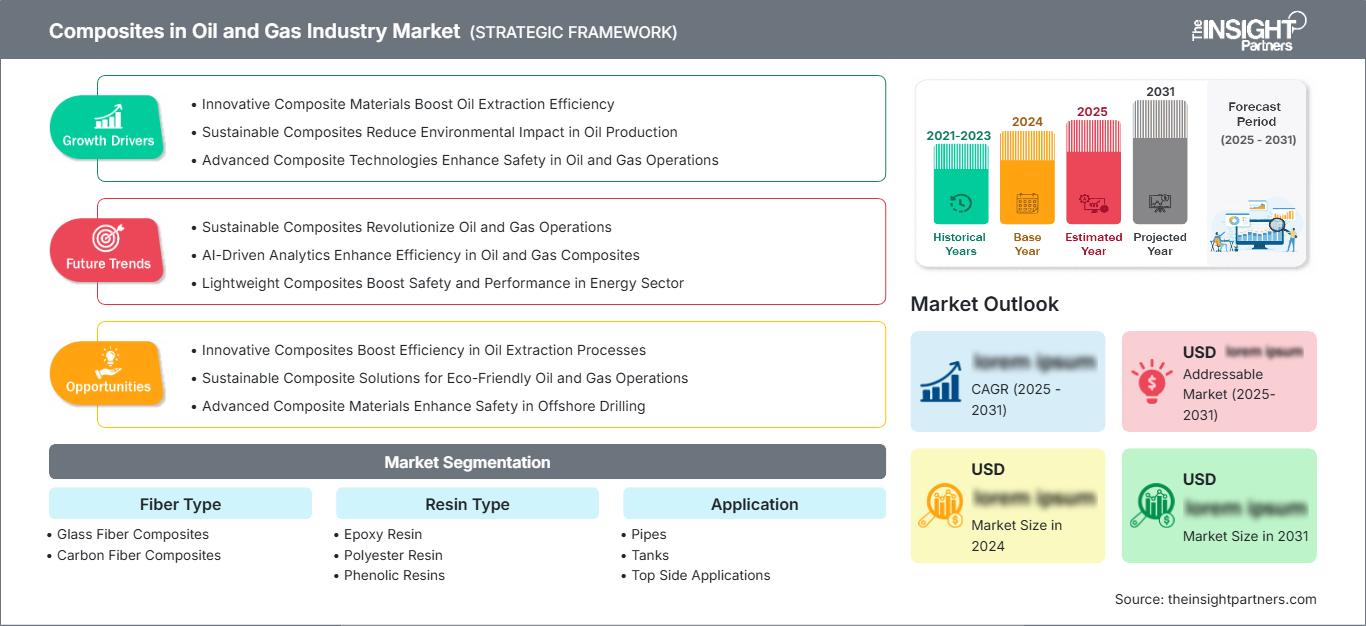
Composites in Oil and Gas Industry Market: Strategic Insights
Regional Insights
North America Composites in Oil and Gas Industry Market
The share of North America in 2025 is projected at 31-35%, with a 6.4-7.1% CAGR till 2034. The US continues to be the main source of demand, owing to the need for extensive infrastructure associated with shale extraction. The application of composites is especially pertinent in regions where the presence of produced water and corrosive liquids results in increased degradation of steel pipelines. Additional demand is generated by Canada due to oil sands development, midstream applications, and industrial storage.
The advantages of the region are represented by its well-developed composite manufacturing industry and relatively developed engineering system. Operators can use fiberglass and spoolable composite solutions in gathering, injection, and facility applications, thus reducing lifting and installation needs. Mexico will present a growing market as offshore and onshore infrastructures are being developed there.
U.S. Composites in Oil and Gas Industry Market
The US is estimated to represent 84–88% of North America's market in 2025 and expand at a 6.3–7.0% CAGR. The Permian, Eagle Ford, Bakken, and Gulf Coast infrastructure base creates demand for corrosion-resistant flowlines, gathering systems, tanks, and produced-water applications. Composite suppliers benefit from established domestic manufacturing and service networks.
NOV Inc., Strongwell Corporation, Enduro Composites, Baker Hughes Company, and ZCL Composites Inc. have exposure to relevant composite applications. Demand is increasingly linked to field development economics, replacement of corrosion-prone piping, and installation efficiency. Offshore Gulf of Mexico activity also creates opportunities for lightweight structures and composite piping. Adoption remains application-specific because pressure, temperature, fluid chemistry, fire performance, and qualification requirements differ across upstream and midstream assets.
Europe Composites in Oil and Gas Industry Market
Europe is projected to have a 18-22% share in 2025 and grow at a 5.8-6.5% CAGR. Norway drives the demand in the region through its offshore operations and subsea engineering, while the UK has an important installed assets portfolio. Italy adds through its capabilities in industrial engineering and composite manufacture.
Offshore conditions in Norway drive the need for corrosion-proof and lightweight equipment, especially with subsea installations and the weight of the platforms being factors in the economy of the projects. The UK is driven by maintenance in the North Sea, brownfield retrofits, decommissioning work, and integrity needs. Industrial activities from Italy, Spain, and France contribute, as do composite materials from European operators for pipelines, tanks, offshore facilities, and rehabilitation works.
APAC Composites in Oil and Gas Industry Market
The APAC region is expected to account for a 22%–26% market share in 2025 and will exhibit a 7.0%–7.8% CAGR. The major countries driving the regional demand include China, Australia, India, Japan, and South Korea. Growth in refining facilities, petrochemicals, LNG, offshore operations, and pipelines will facilitate the adoption of composites, especially those that resist corrosion in pipes and storage systems.
Industrial localization along with infrastructure modernization will ensure an enhanced manufacturing capacity in the region. Australia presents prospects in LNG and remote resource extraction projects. India will invest in developing its energy infrastructure. China will have the advantage of large domestic manufacturing capacity along with demand from downstream sectors. Japan and South Korea will play a role by providing advanced engineering and offshore equipment.
Middle East & Africa Composites in Oil and Gas Industry Market
Demand in Middle East and Africa is expected to grow at a CAGR of 6.2%-7.0%, spearheaded by Saudi Arabia and UAE. Significant oil and gas production facilities, offshore drilling operations, the need to manage water, and petrochemical plants make use of corrosion resistant pipes and structures.
Saudi Arabia retains its position as the top market in the region, whereas the UAE capitalizes on offshore operations and diversification of the industrial sector. South Africa constitutes a small but technologically significant market due to mining, chemicals and energy infrastructure. The rest of the MEA region represents an opportunity for products that have a long-term value in difficult climates and locations.
Segmentation Analysis
Fiber Type
The fiber type segment is expected to expand at a 6.5–7.3% CAGR during 2026–2034. Glass fiber remains the principal material because of its cost-performance balance, while carbon fiber is increasingly selected for high-performance applications where weight, stiffness, and pressure requirements justify premium material economics. The Composites in Oil and Gas Industry Market scope therefore extends from conventional fiberglass systems to advanced reinforced structures.
- Glass Fiber Composites: Glass fiber composites maintain broad adoption across pipes, tanks, and structural applications because they provide corrosion resistance and mechanical performance at comparatively moderate material cost. Their established fabrication ecosystem supports replacement and new-build projects.
- Carbon Fiber Composites: Carbon fiber composites are strategically important for weight-sensitive, high-pressure, and high-stiffness applications. Their higher cost limits mass adoption, but performance advantages support specialized offshore, subsea, and advanced pipe applications.
Resin Type
The resin type segment is projected to grow at a 6.0–6.8% CAGR during 2026–2034. Resin selection depends on temperature, pressure, chemical compatibility, curing requirements, and service environment. Epoxy systems remain important for demanding structural applications, while polyester and phenolic formulations serve applications where processing economics, fire performance, or chemical resistance influence material selection.
- Epoxy Resin: Epoxy resin supports high-performance composite structures because of strong adhesion, mechanical properties, and resistance to demanding operating conditions. It is particularly relevant where pressure retention and structural integrity are critical.
- Polyester Resin: Polyester resin remains widely used in cost-sensitive fiberglass pipes and tanks. Its established processing methods and favorable economics make it suitable for infrastructure where operating conditions do not require premium resin performance.
- Phenolic Resins: Phenolic resins are strategically relevant where fire, smoke, and thermal performance are important. Their adoption is more specialized, particularly in facilities where safety requirements influence material selection and composite construction.
Application
The application segment is expected to register a 6.8–7.5% CAGR during 2026–2034. Pipes constitute the principal demand area because corrosion, fluid compatibility, and installation economics directly influence operating expenditure. Tanks remain important for storage and containment, while top side applications increasingly use composites to reduce platform weight and maintenance.
- Pipes: Pipes represent the core application because composite systems can address corrosion, weight, and installation challenges across gathering, injection, flowline, and facility applications. Spoolable and jointed formats provide different deployment strategies.
- Tanks: Composite tanks provide corrosion-resistant containment for chemicals, produced water, fuels, and process fluids. Their lower weight and resistance to many aggressive environments can reduce maintenance requirements and support installation in constrained locations.
- Top Side Applications: Top side applications include structural and process components where reduced weight, corrosion resistance, and lower maintenance requirements can improve offshore asset economics. Adoption is linked closely to engineering qualification and fire-performance requirements.
Opportunity Snapshot
| Application | Revenue Contribution | Trend Tag | Adoption Stage |
| Pipes | High | Spoolable Pipe | Scaling |
| Tanks | Medium | Corrosion Storage | Scaling |
| Top Side Applications | Medium | Platform Weight | Emerging |
Composites in Oil and Gas Industry Market Growth Drivers and Impact Analysis
Corrosion control across demanding production environments
Corrosion remains a major lifecycle consideration for oil and gas infrastructure exposed to produced water, hydrogen sulfide, carbon dioxide, chlorides, and process chemicals. Composite materials can reduce exposure to corrosion mechanisms that require coatings, chemical treatment, inspection, or periodic replacement in metallic systems. The commercial impact is strongest in remote fields and offshore facilities, where maintenance activities involve expensive equipment and restricted access. Composite piping and tanks can therefore create value through reduced intervention frequency as well as material durability. Operators increasingly compare alternatives using total cost of ownership rather than purchase price alone. This approach favors composite solutions when installation, downtime, corrosion mitigation, and transportation costs are material components of project economics.
Lower installation requirements for remote and offshore assets
Composite components weigh substantially less than comparable metallic systems in many applications, reducing requirements for heavy lifting, transportation capacity, and installation equipment. This advantage is particularly relevant offshore, where vessel availability and crane capacity can affect project schedules. Onshore operators can also benefit when remote gathering systems require long transportation routes or limited access roads. The resulting reduction in handling complexity can improve installation productivity and lower field labor requirements. Lightweight spoolable pipe is especially relevant because long continuous lengths can reduce the number of field joints. As operators seek to improve project execution while controlling capital expenditure, composite systems with simpler deployment characteristics can become more competitive against conventional steel. The impact is strongest where installation logistics represent a significant portion of total project cost.
Expansion of unconventional and offshore production infrastructure
Continued investment in unconventional production, offshore developments, LNG infrastructure, and associated gathering systems expands the addressable base for composite components. New projects require flowlines, water-handling systems, storage, and process infrastructure that must withstand increasingly complex operating environments. Composite manufacturers can capture this demand by developing products compatible with specific pressure, temperature, fluid chemistry, and installation requirements. The impact extends beyond greenfield projects because existing assets also require replacement of corrosion-prone components. Composite systems can be attractive during brownfield modifications when installation space, lifting access, and shutdown duration are constrained. Increasing use of produced-water management and injection infrastructure further broadens applications. Qualification and operator acceptance remain critical because performance requirements vary substantially across upstream, midstream, and offshore environments.
Composites in Oil and Gas Industry Market Future Trends
Thermoplastic composite systems for deeper and longer-distance deployment
According to the Composites in Oil and Gas Industry Market report, trends are moving toward thermoplastic composite pipe systems that combine corrosion resistance with flexibility, spoolability, and improved installation efficiency. Future designs are likely to use higher-performance fiber architectures, improved polymer matrices, and optimized end fittings to expand operating pressure and temperature windows. Automated manufacturing can reduce variability while supporting longer continuous lengths. Qualification programs will increasingly focus on fatigue, collapse, connection reliability, permeation, and long-term fluid compatibility. These developments could expand composites beyond conventional gathering applications toward deeper offshore flowlines, risers, and challenging subsea environments. Integration with monitoring systems may further improve asset management by providing operators with condition data alongside material performance records.
Greater integration of composite qualification and digital asset management
Future adoption will increasingly depend on the ability to demonstrate predictable performance over complete asset lifecycles. Manufacturers are likely to combine laboratory qualification, field data, digital design tools, and predictive maintenance models to improve confidence among operators and engineering contractors. The Composites in Oil and Gas Industry Market trends should therefore extend beyond material innovation toward integrated engineering services. Digital twins can help evaluate stress, temperature, pressure, and fatigue conditions before installation, while inspection data can support maintenance planning. Standardization will also become increasingly important as operators seek consistent qualification pathways across geographies. Suppliers capable of connecting material selection, component design, testing, installation guidance, and lifecycle monitoring may achieve stronger differentiation than companies focused only on composite fabrication.
Composites in Oil and Gas Industry Market Opportunities
Expansion of composite solutions in brownfield asset replacement
The Composites in Oil and Gas Industry Market forecast indicates that brownfield replacement provides a significant commercial opportunity because operators must maintain aging pipelines, tanks, platforms, and process equipment while minimizing shutdown periods. Suppliers can target assets where corrosion, difficult access, or high maintenance frequency reduces the economic attractiveness of conventional materials. The opportunity is particularly relevant for produced-water systems, chemical lines, storage infrastructure, and offshore components. Vendors can strengthen their positions by offering engineering surveys, material selection, installation planning, and replacement packages rather than standalone products. The composites in oil and gas industry Forecasts should therefore account for replacement demand alongside greenfield project activity. Companies that demonstrate shorter installation windows, predictable service life, and compatibility with existing connections can improve adoption rates in mature producing regions.
Development of composite infrastructure for carbon management
Carbon capture, utilization, storage, hydrogen, and related low-carbon infrastructure can create adjacent demand for corrosion-resistant composite pipes, tanks, and structural systems. These applications may involve carbon dioxide, water, chemicals, or mixed streams that require careful material compatibility assessment. Suppliers with experience in oil and gas qualification can leverage existing engineering capabilities to address emerging energy infrastructure. The opportunity is strongest where lightweight construction and corrosion resistance provide clear lifecycle benefits. Manufacturers can also explore applications around CO2 transport and storage facilities, particularly where conventional materials require specialized corrosion control. Developing products against recognized design and qualification frameworks can improve acceptance among EPC contractors and operators. This adjacent market can diversify revenue while retaining strong overlap with existing manufacturing and engineering capabilities.
Recent Developments
- July 2026: A University of Queensland (UQ, Australia) project, supported by the Australian Composites Manufacturing CRC (ACM CRC, Sydney), announced the development of more durable, high-temperature sucker rod guides (SRGs) for Oilfield Piping Systems (OPS, Brisbane City, Australia).
- July 2026: AIS completed the acquisition of Matrix Composites & Engineering, a leading Australian provider of advanced composite materials and subsea engineering solutions. The completion marks a significant milestone for AIS, accelerating its strategy to expand its global footprint in the offshore energy, marine, and defence markets. The acquisition brings together two highly complementary businesses, combining AIS’ engineering, manufacturing, and project delivery expertise with Matrix’s globally recognised syntactic foam and subsea buoyancy systems.
Frequently Asked Questions

- Comprehensive Market Sizing and Forecast Analysis
- Detailed Segmentation Analysis
- In-Depth Market Dynamics Assessment
- Regional and Country-Level Insights
- Competitive Landscape and Company Benchmarking
- Strategic Business Intelligence
Recent Reports
Testimonials

The Insight Partners provided valuable market intelligence that supported our global go-to-market strategy. Their team was professional, responsive, and attentive to our feedback, providing thoughtful analysis and helpful methodological clarifications throughout the project.
Junmo Kim Chief Financial Officer (CFO), Enertech Co., Ltd.
The Insight Partners' SCADA System Market report is comprehensive, with valuable insights on current trends and future forecasts. The team was highly professional, responsive, and supportive throughout. We are very satisfied and highly recommend their services.
RAN KEDEM Partner, Reali Technologies LTDs
I requested a report on a very specific software market and the team produced the report in a few days. The information was very relevant and well presented. I then requested some changes and additions to the report. The team was again very responsive and I got the final report in less than a week.
JEAN-HERVE JENN Chairman, Future Analytica
We worked with The Insight Partners for an important market study and forecast. They gave us clear insights into opportunities and risks, which helped shape our plans. Their research was easy to use and based on solid data. It helped us make smart, confident decisions. We highly recommend them.
PIYUSH NAGPAL Sr. Vice President, High Beam Global
The Insight Partners delivered insightful, well-structured market research with strong domain expertise. Their team was professional and responsive throughout. The user-friendly website made accessing industry reports seamless. We highly recommend them for reliable, high-quality research services
YUKIHIKO ADACHI CEO, Deep Blue, LLC.
This is the first time I have purchased a market report from The Insight Partners.While I was unsure at first, I visited their web site and felt more comfortable to take the risk and purchase a market report.I am completely satisfied with the quality of the report and customer service. I had several questions and comments with the initial report, but after a couple of dialogs over email with their analyst I believe I have a report that I can use as input to our strategic planning process.Thank you so much for taking the extra time and making this a positive experience.I will definitely recommend your service to others and you will be my first call when we need further market data.
JOHN SUZUKI President and Chief Executive Officer, Board Director, BK Technologies
I wish to appreciate your support and the professionalism you displayed in the course of attending to my request for information regarding to infectious disease IVD market in Nigeria. I appreciate your patience, your guidance, and the fact that you were willing to offer a discount, which eventually made it possible for us to close a deal. I look forward to engaging The Insight Partners in the future, all thanks to the impression you have created in me as a result of this first encounter.
DR CHIJIOKE ONYIA MANAGING DIRECTOR, PineCrest Healthcare Ltd.Reason to Buy
- Informed Decision-Making
- Understanding Market Dynamics
- Competitive Analysis
- Identifying Emerging Markets
- Customer Insights
- Market Forecasts
- Risk Mitigation
- Boosting Operational Efficiency
- Strategic Planning
- Investment Justification
- Tracking Industry Innovations
- Aligning with Regulatory Trends





 Get Free Sample for