
Composites Testing Market Size, Demand & Growth by 2034
Coverage: by Testing Method (Non-Destructive Testing, Destructive Testing); Product Type (Continuous Fiber Composites, Discontinuous Fiber Composites, Polymer Matrix Composites, Ceramic Matrix Composites, Others); Application (Aerospace and Defense, Transportation, Wind Energy, Building and Construction, Sporting Goods, Electricals and Electronics, Others) , and Geography (North America, Europe, Asia Pacific, and South and Central America)
- Status : Data Released
- Report Code : TIPRE00010009
- Category : Chemicals and Materials
- No. of Pages : 150
- Available Report Formats :


- Last update date : August 21, 2026


2025 Market Size
US$ 2.14 Bn
Base year value
2034 Forecast
US$ 3.44 Bn
Projected by 2034
CAGR 2026-2034
5.44 %
Growth rate
Addressable Market
US$ 25.34 Bn
(2026-2034)
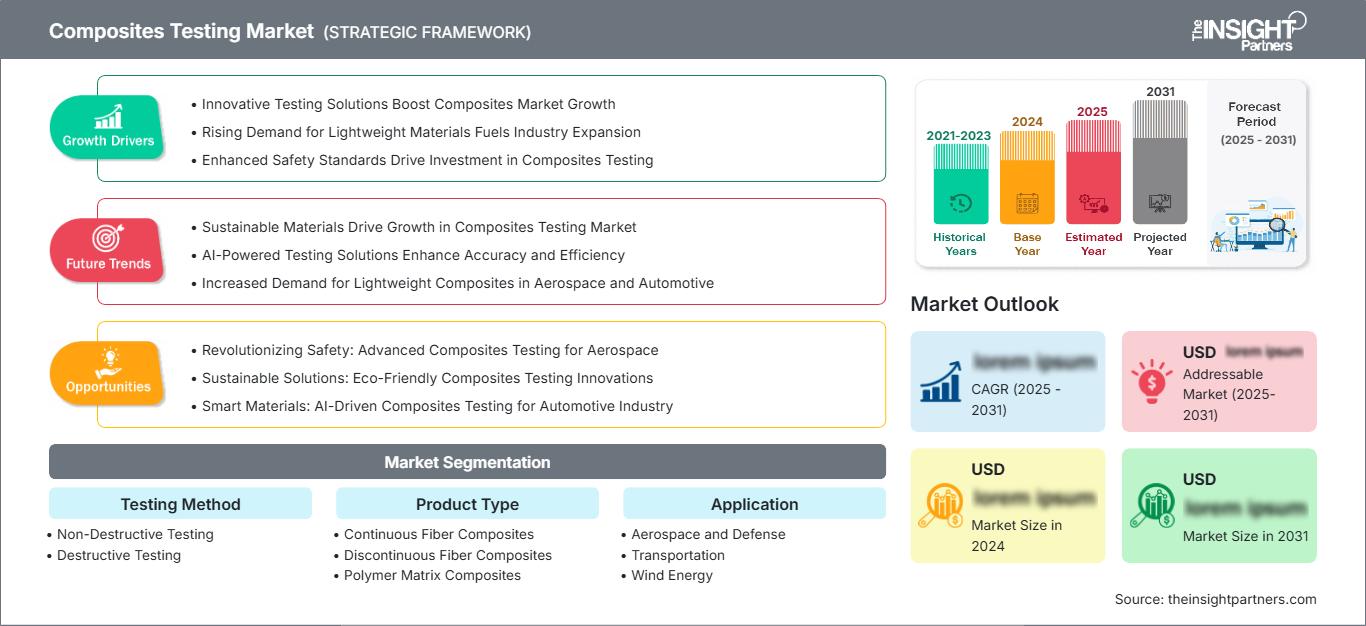
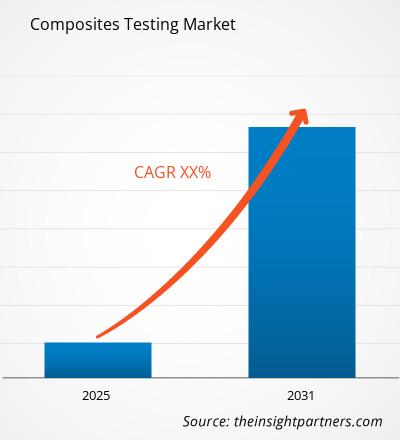
The Composites Testing Market size is estimated at US$ 2.14 Billion in 2025 and projected to reach US$ 3.44 Billion by 2034, growing at a CAGR of 5.44% during the period of 2026-2034. The market consists of test services and expertise used for characterization of composites, performance validation of components, detection of manufacturing issues, and durability verification in demanding end-use environments. Higher applications of lightweight materials in safety-critical applications are driving needs for repeatable tests of mechanics, environment, fatigue, and non-destructive testing.
North America is a structurally important test market, backed by the existing aerospace manufacturing, defense procurement, automotive engineering, wind energy facilities, and laboratory infrastructure. Market demand is set to grow at around 5.1-5.7% CAGR until 2034, driven by higher need for qualification testing, life cycle assessments, process validation, and inspections among manufacturers. North America is also benefiting from established ASTM standards, accredited laboratories, and close cooperation between material producers, component manufacturers, engineering organizations, and testing service providers.
Composites Testing Market Assessment and Insights
- North America: The region is estimated to account for 30–34% Composites Testing Market share in 2025, with demand growing at a 5.1–5.7% CAGR between 2026–2034, supported by aerospace, defense, transportation, and established composite qualification infrastructure.
- US: The US is estimated to represent 78–82% of North America in 2025, expanding at a 5.0–5.5% CAGR between 2026–2034, led by aerospace qualification, defense applications, and advanced manufacturing.
- Europe: Europe is estimated at 24–28% share in 2025, advancing at a 4.7–5.2% CAGR between 2026–2034. Germany, France, the UK, Italy, and Spain provide significant aerospace, automotive, wind, and industrial demand.
- Asia Pacific: Asia Pacific is estimated at 27–31% share in 2025, with the strongest regional expansion of 6.3–7.0% CAGR between 2026–2034, driven by China, Japan, South Korea, and India.
- Largest Segment: Non-Destructive Testing is estimated at 58–62% market share in 2025, expanding at 5.7–6.2% CAGR between 2026–2034, reflecting lifecycle inspection and defect-detection requirements.
- High Growth Segment: Wind Energy is estimated at 7–10% market share in 2025, expanding at 8.0–8.7% CAGR between 2026–2034, supported by larger blades and increasingly demanding structural validation.
- Key companies analyzed in detail: Composites Testing Laboratory Ltd., Element Materials Technology, ETIM Composites, Exova Group PLC., Henkel AG & Co. KGaA, Instron Corporation, Intertek Group PLC., Matrix Composites, Inc., Mistras Group, Inc., Westmoreland Mechanical Testing and Research, Inc.
Source: The Insight Partners' analysis based on proprietary research, government publications, company annual reports, investor presentations, industry databases, and expert interviews.
The composites testing market has moved beyond traditional coupon mechanical testing and now involves an integrated validation process involving materials, processes, parts, and entire lifecycle performance. Increasing use of carbon-fiber and glass-fiber construction materials has necessitated the need for fatigue, impact, fracture, thermal, environmental, and microstructural testing. Laboratory facilities have started combining destructive testing with non-destructive ultrasonic, radiographic, thermographic, acoustic, and other NDT methods. Standards of ASTM, aerospace specifications, laboratory accreditation requirements, and customer qualifications procedures dictate the choice of equipment and testing programs by laboratories. Public laboratory testing capacity reveals the diversity of the new direction, involving tensile, compression, shear, fatigue, fracture, environmental testing, and defect inspection.
In future, the scope of testing will expand into newly developed centers of composite manufacturing in the Asian-Pacific region and some selected Middle-Eastern economies. Investments into aerospace manufacturing, renewable energy infrastructure, electric transportation, and military systems will drive the need for material qualifications and in-service inspection. Automated inspection, digital image processing, advanced ultrasonic testing and data-driven interpretation will increase throughput and reduce the need for visual assessment. Accredited laboratories will be encouraged by regulatory and customer requirements to deliver reproducible results in various material systems and testing conditions.
Composites Testing Market Report Scope
| Report Attribute | Details |
|---|---|
| Market size in 2025 | US$ 2.14 Billion |
| Market Size by 2034 | US$ 3.44 Billion |
| Global CAGR (2026 - 2034) | 5.44% |
| Historical Data | 2021-2024 |
| Forecast period | 2026-2034 |
Composites Testing Market Analysis
The Composites Testing Market report indicates that demand is related directly to the production of composites, their qualification, certification, maintenance and failures investigation. The value chain starts with fibers, resins, prepregs, cores, adhesives and intermediate materials, followed by composite processing and component manufacturing. Testing laboratories bridge manufacturers and customers transforming material properties into evidences of design approval and quality assurance. Composite qualification typically involves mechanical, thermal, chemical, environmental, fatigue, impact and dimensional testing. This means that supply-side demand for composite materials testing services depends on not only volume of composite production but also material complexity, qualification rigor, production ramp up and inspection frequency.
According to the Composites Testing Market forecast, the competitive environment is driven by accreditation of laboratories, technical specialization, geographical coverage, equipment capability, response time and experience with particular standards of applications. Element Materials Technology provides composite materials testing along with other aerospace materials testing. Intertek Group PLC. is competing by having an extensive testing and assurance infrastructure. Instron Corporation operates within mechanical testing systems. Mistras Group, Inc. focuses on inspection and structural integrity. Composites Testing Laboratory Ltd., ETIM Composites, Matrix Composites, Inc. and Westmoreland Mechanical Testing and Research, Inc. are specialists in their niche. Henkel AG & Co. KGaA brings relevant composite materials testing experience and expertise to the market.
● REPORT CUSTOMIZATION
Tailor This Report To Align With Your Specific Business Requirements
This report can be customized to align precisely with your business objectives, scope, and target markets. Customization options include tailored segmentation, geography, competitive analysis, and strategic insights to support informed decision-making.
Customize This Report →WHAT YOU CAN ADJUST
- ● Segmentations
- ● Geography
- ● Competitive Analysis
- ● Language Preferences
Composites Testing Market: Strategic Insights
Regional Insights
North America composites testing market
North America is estimated to hold 30–34% share in 2025 and expand at a 5.1–5.7% CAGR through 2034. The US dominates regional demand because of its extensive aerospace and defense manufacturing base, large transportation engineering ecosystem, established wind installations, and concentration of accredited materials laboratories. Composite qualification remains important for structural safety, certification, production quality, and maintenance.
Canada contributes through aerospace manufacturing, transportation, energy infrastructure, and research activities. Regional demand is also supported by increasingly complex carbon-fiber structures, repair validation, and lifecycle inspection. Testing providers benefit from established ASTM procedures and customer-specific qualification frameworks. Greater use of automated NDT, digital inspection, and advanced fatigue characterization should expand laboratory requirements as manufacturers pursue higher production rates and longer component service lives.
U.S. Composites Testing Market
The US accounts for approximately 78–82% of the North America market in 2025 and has a projected growth rate of 5.0–5.5% CAGR. The key applications are aerospace & defense, further complemented by automotive, wind energy, sporting goods, and electronics. There are numerous facilities that help in material development, qualification, certification, failure analysis, and troubleshooting of materials.
There is a presence of a host of companies, universities, defense contracts, composite manufacturers, and testing laboratories in the country. Element Materials Technology, Intertek Group PLC., Instron Corporation, Mistras Group, Inc., and others possess such facilities. Increasingly, there is emphasis on testing of lightweight structures, critical fatigue assemblies, bonded assemblies, and complex laminates, and NDT helps in inspection without disassembly.
Europe Composites Testing Market
Europe accounts for an estimated 24–28% share in 2025 and is projected to grow at a 4.7–5.2% CAGR. Germany is a leading country because of automotive engineering, industrial machinery, aerospace, and renewable-energy manufacturing. France and the UK add substantial aerospace and defense testing demand, while Italy and Spain contribute through automotive, aerospace, wind, and industrial composite applications.
The German economy enjoys high-end automotive and industrial value chains, wherein composite qualifications come hand-in-hand with lightweighting and electrification programs. There is a lot of aerospace test infrastructure in France and the UK, which includes laboratories as well as material testing and development. In addition to the automotive industry, aerospace industry, sports, and wind energy generation equipment, the Italian and Spanish economies add demand.
APAC Composites Testing Market
The Asia-Pacific region contributes to around 27-31% market share in 2025 and is forecasted to witness 6.3-7.0% CAGR growth rate. China dominates the regional demand followed by Japan, South Korea, India, and Australia. The sectors such as aerospace production, automotive weight reduction, renewable energy, electronics and defense localization are witnessing growing requirements for testing.
China's large-scale manufacturing activities have high qualification requirements, whereas Japan and South Korea provide advanced technologies in aerospace, automotive, electronics, and industrial sectors. The Indian economy is developing in the areas of aerospace, defense, infrastructure and renewable energy composites, whereas Australia is adding demand from aerospace, defense, marine and energy applications.
Middle East & Africa Composites Testing Market
The Middle East & Africa region is estimated to grow at a 4.5 – 5.2% CAGR up to 2034. Saudi Arabia and the UAE are leading regions with the help of diversified infrastructure programs, aerospace development, energy, and industrialization. South Africa participates via transportation, defense, mining, and engineering applications.
Saudi Arabia enjoys the benefit of infrastructure and industrial development programs whereas the UAE's aerospace and advanced manufacturing ecosystem helps the region meet more valuable testing requirements. South Africa remains a significant technical hub for engineering and composite applications. In the rest of MEA region, wind, construction, energy, and transportation applications are estimated to add incremental demand for composites testing due to increasing use of composites structures.
Segmentation Analysis
Testing Method
Testing Method is divided between Non-Destructive Testing and Destructive Testing. The segment is expected to expand as manufacturers require complementary methods for qualification and lifecycle assurance. Non-destructive methods are particularly important for identifying delamination, voids, cracks, impact damage, and manufacturing inconsistencies without sacrificing usable components. Destructive methods remain essential for generating fundamental material-property data, establishing design allowables, and validating new materials.
- Non-Destructive Testing: Non-destructive evaluation occupies the largest position because composite structures require defect detection without component destruction. Ultrasonic, radiographic, thermographic, acoustic, and optical techniques support manufacturing inspection and lifecycle monitoring.
- Destructive Testing: Destructive testing remains strategically essential for tensile, compression, shear, fatigue, fracture, impact, and environmental characterization. It supplies baseline performance data required for material qualification, design validation, and certification.
Product Type
Product Type comprises Continuous Fiber Composites, Discontinuous Fiber Composites, Polymer Matrix Composites, and Ceramic Matrix Composites. The segment is supported by increasing material differentiation, requiring testing protocols tailored to reinforcement architecture, matrix behavior, temperature resistance, processing route, and intended application.
- Continuous Fiber Composites: Continuous reinforcement requires detailed testing of anisotropic strength, interlaminar behavior, fatigue, impact resistance, and delamination. Aerospace and high-performance transportation applications create consistent qualification requirements.
- Discontinuous Fiber Composites: Discontinuous systems support cost-sensitive manufacturing and complex geometries. Testing focuses on strength consistency, molding quality, fiber distribution, dimensional stability, and repeatability across production batches.
- Polymer Matrix Composites: Polymer matrix systems represent a broad testing base because of extensive use in aerospace, automotive, wind, construction, and sporting goods. Testing addresses mechanical, thermal, chemical, and environmental performance.
- Ceramic Matrix Composites: Ceramic matrix composites require specialized high-temperature testing because conventional polymer-composite procedures are insufficient. Demand is linked to aerospace propulsion, thermal protection, and other extreme-environment applications.
Application
Application includes Aerospace and Defense, Transportation, Wind Energy, Building and Construction, Sporting Goods, and Electricals and Electronics. Application requirements vary substantially according to safety criticality, operating environment, production scale, and certification intensity. Aerospace and defense remain major users, while wind energy is positioned for faster expansion as turbine dimensions increase.
- Aerospace and Defense: Safety-critical structures require extensive qualification, fatigue, damage-tolerance, environmental, and NDT programs. Certification and traceability requirements create recurring laboratory demand throughout product development and service.
- Transportation: Automotive, rail, marine, and emerging mobility platforms use testing to validate lightweight structures, crash performance, fatigue resistance, and manufacturing consistency.
- Wind Energy: Larger blades and increasingly demanding operating conditions require structural, fatigue, damage, and material testing. Inspection capabilities are also important for maintaining turbine availability.
- Building and Construction: Composite reinforcement, panels, bridges, and specialized structures require durability, load, fire, environmental, and bonding evaluation to demonstrate long-term performance.
- Sporting Goods: Bicycles, racquets, protective equipment, and performance products use testing to optimize stiffness, impact resistance, weight, and durability while maintaining consistent production quality.
- Electricals and Electronics: Composite housings, insulation structures, and electronic components require testing of mechanical strength, thermal behavior, dimensional stability, and environmental resistance.
Opportunity Snapshot
| Application | Revenue Contribution (High/Medium/Low) | Trend Tag | Adoption Stage |
|---|---|---|---|
| Aerospace and Defense | High | Damage Tolerance | Mature |
| Transportation | High | Lightweighting | Scaling |
| Wind Energy | Medium | Blade Inspection | Scaling |
| Building and Construction | Medium | Structural Composites | Scaling |
| Sporting Goods | Low | Performance Design | Mature |
| Electricals and Electronics | Medium | Thermal Protection | Scaling |
Composites Testing Market Growth Drivers and Impact Analysis
Increasing use of composites in safety-critical structures
The Composites Testing Market trends indicate that increased use of composite materials in aircraft, defense products, transportation systems, wind turbine parts, and industrial machinery raises validation requirements. Whereas traditional materials have homogeneity, composites may display directionality, delamination, matrix cracking, fiber fracturing, presence of voids, and complicated environmental degradation. As such, manufacturers will be compelled to perform more extensive tests on various loading conditions. The business implications go further than material qualification since production changes, changes in suppliers, repairs, and field failures could necessitate further testing. Increased use of composite materials means that labs with dedicated fixtures, environmental control, fatigue, microscopy, and non-destructive testing become more significant.
Expansion of qualification and lifecycle inspection requirements
Qualification through composites is now being considered not only at the time of product qualification but also for ongoing production control and in-service testing. The manufacturer requires evidence that the batches of materials, process parameters, bonds, and end products are within the prescribed performance parameters. The lifecycle needs generate repeat testing requirements since the product might have to be inspected, repaired, evaluated for failure, and tested for its residual life. In this case, independent labs would be able to offer specific test facilities and accreditation procedures without obligating the manufacturer to retain all such facilities. This approach facilitates outsourcing especially for advanced tests such as fatigue and fracture testing, thermal and environmental testing.
Advancement of automated and data-assisted inspection technologies
Automation is changing the economics of composite inspection by improving repeatability, coverage, and data interpretation. Conventional inspection can require significant operator expertise, particularly when evaluating large components or complex laminate geometries. Automated ultrasonic scanning, machine vision, thermography, digital image correlation, and advanced signal-processing approaches can reduce inspection variability while generating larger datasets. For laboratories, automation can increase throughput and support standardized inspection across production programs. For manufacturers, improved defect mapping can reduce unnecessary component rejection and identify process problems earlier. The market impact is particularly relevant to aerospace, wind, and transportation applications where component size and inspection frequency are increasing. Providers combining equipment expertise with engineering interpretation are positioned to capture higher-value testing assignments as customers seek actionable information rather than isolated test results.
Composites Testing Market Future Trends
Integration of digital inspection with predictive maintenance
Future testing programs are expected to connect inspection results with digital engineering, asset histories, and predictive-maintenance systems. Rather than treating an inspection as an isolated pass-or-fail event, operators can increasingly compare defect dimensions, material properties, loading history, environmental exposure, and previous inspection results. This approach can support earlier identification of degradation and improve decisions regarding repair, replacement, or continued operation. For large composite assets such as aircraft structures and wind-turbine blades, the ability to establish a traceable condition history could become increasingly valuable. Testing laboratories may therefore expand from measurement services toward engineering interpretation, digital data management, and condition-assessment support. Such integration should favor providers that can connect laboratory results with field inspection, simulation, and lifecycle engineering workflows.
Growth of testing for recycled and next-generation composites
The development of recycled fibers, thermoplastic composites, bio-based matrices, and hybrid material systems is expected to introduce new testing requirements. Established qualification databases are often less extensive for emerging materials, creating a need to characterize mechanical consistency, thermal behavior, durability, processing variability, and end-of-life performance. Thermoplastic systems may require testing protocols adapted to processing history and reheating, while recycled reinforcement can introduce variability in fiber length and properties. Testing providers that develop repeatable procedures for these materials can become important partners during commercialization. The trend should also increase demand for comparative testing, enabling manufacturers to demonstrate that lower-impact material alternatives can meet application-specific performance requirements without compromising safety, reliability, or production consistency.
Composites Testing Market Opportunities
Developing specialized testing capacity in emerging manufacturing hubs
Investment opportunities exist in regions where composite manufacturing is expanding faster than local laboratory infrastructure. Asia Pacific provides the clearest opportunity because aerospace, automotive, renewable-energy, electronics, and defense manufacturing are developing simultaneously. Local laboratories can reduce testing turnaround times, transportation costs, and qualification delays for domestic manufacturers. Similar opportunities exist in the Middle East as industrial diversification programs encourage aerospace, energy, infrastructure, and advanced-manufacturing activity. A differentiated laboratory strategy should prioritize accreditation, application-specific equipment, qualified personnel, and internationally recognized test procedures rather than generic capacity alone. Partnerships with universities, composite manufacturers, equipment suppliers, and certification organizations can accelerate capability development. Providers that establish regional expertise while maintaining internationally accepted reporting practices can improve their ability to serve multinational customers.
Building integrated testing packages for composite manufacturers
A second opportunity lies in bundling material characterization, process validation, component testing, NDT, failure analysis, and lifecycle inspection into integrated service programs. Composite manufacturers often engage multiple technical providers because different laboratories specialize in individual tests or materials. A coordinated model can reduce project-management complexity and improve consistency between test stages. Providers can further differentiate through specimen preparation, environmental conditioning, statistical analysis, engineering interpretation, and digital reporting. Such packages are particularly relevant for manufacturers introducing new materials, scaling production, or qualifying suppliers. Commercially, integrated programs can create longer customer relationships because testing requirements extend from initial development through production and field support. Investment in cross-disciplinary engineering teams can therefore be as important as investment in individual testing machines.
Recent Developments
- August 2026: Forza Composites (São José dos Campos), a Brazilian deep-tech company advancing its proprietary composite pressure vessel technology, successfully developed and experimentally validated a Type 4 pressure vessel for hydrogen, biomethane and compressed natural gas (CNG) storage applications, marking the first time this complete engineering and manufacturing capability has been established domestically in Brazil. The validated 5-liter vessel integrates a polymer liner, metallic bosses and a carbon fiber composite overwrap produced via filament winding. The full development cycle — from structural design and manufacturing through hydrostatic burst testing — was completed in-house, with experimental results confirming the accuracy of Forza’s computational structural predictions.
- March 2026: VisionWave Holdings announced that C.M. Composite Materials, an Israeli aerospace and defence composites manufacturer, has signed a memorandum of understanding with a major Indian industrial manufacturing group to explore forming a joint venture in India. The proposed partnership would combine C.M.'s advanced composite engineering capabilities with the Indian partner's manufacturing infrastructure and supply-chain network.
Frequently Asked Questions

- Comprehensive Market Sizing and Forecast Analysis
- Detailed Segmentation Analysis
- In-Depth Market Dynamics Assessment
- Regional and Country-Level Insights
- Competitive Landscape and Company Benchmarking
- Strategic Business Intelligence
Recent Reports
Testimonials

The Insight Partners provided valuable market intelligence that supported our global go-to-market strategy. Their team was professional, responsive, and attentive to our feedback, providing thoughtful analysis and helpful methodological clarifications throughout the project.
Junmo Kim Chief Financial Officer (CFO), Enertech Co., Ltd.
The Insight Partners' SCADA System Market report is comprehensive, with valuable insights on current trends and future forecasts. The team was highly professional, responsive, and supportive throughout. We are very satisfied and highly recommend their services.
RAN KEDEM Partner, Reali Technologies LTDs
I requested a report on a very specific software market and the team produced the report in a few days. The information was very relevant and well presented. I then requested some changes and additions to the report. The team was again very responsive and I got the final report in less than a week.
JEAN-HERVE JENN Chairman, Future Analytica
We worked with The Insight Partners for an important market study and forecast. They gave us clear insights into opportunities and risks, which helped shape our plans. Their research was easy to use and based on solid data. It helped us make smart, confident decisions. We highly recommend them.
PIYUSH NAGPAL Sr. Vice President, High Beam Global
The Insight Partners delivered insightful, well-structured market research with strong domain expertise. Their team was professional and responsive throughout. The user-friendly website made accessing industry reports seamless. We highly recommend them for reliable, high-quality research services
YUKIHIKO ADACHI CEO, Deep Blue, LLC.
This is the first time I have purchased a market report from The Insight Partners.While I was unsure at first, I visited their web site and felt more comfortable to take the risk and purchase a market report.I am completely satisfied with the quality of the report and customer service. I had several questions and comments with the initial report, but after a couple of dialogs over email with their analyst I believe I have a report that I can use as input to our strategic planning process.Thank you so much for taking the extra time and making this a positive experience.I will definitely recommend your service to others and you will be my first call when we need further market data.
JOHN SUZUKI President and Chief Executive Officer, Board Director, BK Technologies
I wish to appreciate your support and the professionalism you displayed in the course of attending to my request for information regarding to infectious disease IVD market in Nigeria. I appreciate your patience, your guidance, and the fact that you were willing to offer a discount, which eventually made it possible for us to close a deal. I look forward to engaging The Insight Partners in the future, all thanks to the impression you have created in me as a result of this first encounter.
DR CHIJIOKE ONYIA MANAGING DIRECTOR, PineCrest Healthcare Ltd.Reason to Buy
- Informed Decision-Making
- Understanding Market Dynamics
- Competitive Analysis
- Identifying Emerging Markets
- Customer Insights
- Market Forecasts
- Risk Mitigation
- Boosting Operational Efficiency
- Strategic Planning
- Investment Justification
- Tracking Industry Innovations
- Aligning with Regulatory Trends





 Get Free Sample for