
Concrete Superplasticizer Market Share, Size & Demand by 2034
Coverage: by Type (Sulfonated Naphthalene Formaldehydes (SNF), Sulfonated Melamine Formaldehydes (SMF), Modified Lignosulfonates (MLS), Polycarboxylate Derivatives (PC), Others); Form (Liquid, Powder); Application (Ready Mix Concrete, Precast Concrete, High-Performance Concrete, Shotcrete, Self-Compacting Concrete, Fly Ash Concrete, Others) , and Geography (North America, Europe, Asia Pacific, and South and Central America)
- Status : Data Released
- Report Code : TIPRE00007646
- Category : Chemicals and Materials
- No. of Pages : 150
- Available Report Formats :


- Last update date : August 27, 2026


2025 Market Size
US$ 4.74 Bn
Base year value
2034 Forecast
US$ 9.45 Bn
Projected by 2034
CAGR 2026-2034
7.96 %
Growth rate
Addressable Market
US$ 63.80 Bn
(2026-2034)
The concrete superplasticizer market was valued at US$ 4.74 Billion in 2025 and is projected to reach US$ 9.45 Billion by 2034, expanding at a CAGR of 7.96% during 2026–2034. Growth is supported by rising demand for flowable, high-strength concrete, increasing use of advanced admixture technologies, and greater emphasis on durability and material efficiency across building and infrastructure projects.
In North America, the concrete superplasticizer market size is expected to expand at an estimated CAGR of 6.8–7.4% through 2034. Growth is underpinned by infrastructure rehabilitation, commercial construction, and increasing specifications for durable concrete with lower water-to-cement ratios. Ready-mix producers are also adopting higher-performance admixtures to accommodate blended cements and demanding placement conditions.
Concrete Superplasticizer Market Assessment and Insights
- North America: The region represented an estimated 23–27% share in 2025, supported by infrastructure renewal and sophisticated ready-mix operations, with the market projected to grow at a 6.8–7.4% CAGR between 2026–2034.
- US: The US accounted for an estimated 82–86% of North American demand in 2025 and is expected to expand at a 6.7–7.3% CAGR through 2034, led by infrastructure and commercial construction.
- Europe: Europe held an estimated 24–28% share in 2025 and is projected to grow at a 7.2–7.8% CAGR, with Germany, France, Italy, the UK, and Spain supported by renovation and low-carbon concrete requirements.
- Asia Pacific: Asia Pacific captured an estimated 31–35% share in 2025 and is expected to register an 8.6–9.2% CAGR, with China, India, Japan, South Korea, and Australia driving infrastructure and urban development.
- Largest Segment: Ready Mix Concrete represented an estimated 38–42% share in 2025 and is expected to expand at a 7.4–8.0% CAGR as producers prioritize flow retention and placement efficiency.
- High Growth Segment: Polycarboxylate Derivatives held an estimated 43–47% share in 2025 and is projected to grow at a 9.2–9.8% CAGR because of superior water reduction and rheology control.
- Key companies analyzed in detail: Arkema SA, BASF SE, Concrete Additives and Chemicals Pvt. Ltd., Enaspol AS, HA-BE Betonchemie GmbH and Co. KG, Lion Specialty Chemicals Co., Ltd., Mapei S.p.A., Muhu (China) Construction Materials Co., Ltd., Sika AG, Sure Chemical Co., Ltd.
Source: The Insight Partners' analysis based on proprietary research, government publications, company annual reports, investor presentations, industry databases, and expert interviews.
The concrete superplasticizer market has evolved from conventional sulfonated chemistries toward polymers offering stronger dispersion, higher water reduction, and longer slump retention. Increasingly, polycarboxylate technology assists complex concrete mixes where the tradeoffs between workability, strength, durability, and economy have to be optimized. Production logistics are also moving towards regional formulation support owing to the dependence of admixtures on cement composition, aggregates, weather, and transportation conditions.
As far as future development is concerned, investment would probably go towards those regions where new construction markets demand steady performance of concrete mixes. Suppliers are creating solutions that are compatible with supplementary cementitious materials, low-clinker binders, and tough environmental constraints. Regionally produced products make more sense for the same reason, as shorter logistics chains allow formulators to optimize admixture performance according to locally available cementitious raw materials and project needs.
Concrete Superplasticizer Market Report Scope
| Report Attribute | Details |
|---|---|
| Market size in 2025 | US$ 4.74 Billion |
| Market Size by 2034 | US$ 9.45 Billion |
| Global CAGR (2026 - 2034) | 7.96% |
| Historical Data | 2021-2024 |
| Forecast period | 2026-2034 |
Concrete Superplasticizer Market Analysis
Demand is closely connected with ready-mix concrete output, precast production, infrastructure construction, and increasingly complex structural designs. Superplasticizers improve cement-particle dispersion and enable lower water demand while maintaining required flow. This creates value across the ecosystem, from polymer and chemical suppliers to admixture formulators, concrete producers, contractors, and engineering consultants. The supply chain therefore, depends on both chemical availability and technical formulation expertise. The Concrete Superplasticizer Market share is influenced by the expansion of ready-mix concrete applications, large-scale infrastructure developments, and growing adoption of high-performance concrete solutions, with leading manufacturers competing through advanced formulations, product quality, and strong regional distribution networks.
Dynamics of supply are influenced by regional production, integration of raw materials, and formulation according to applications. Derivatives of polycarboxylate have higher formulation needs than traditional chemistries, as performance depends on the structure of the polymer as well as its compatibility with the cementitious system. Manufacturers with labs, application engineers, and regional technical teams thus have an edge in terms of prices. Quality, stability, dosage, and field trials continue to be important factors in purchases.
Competitive structure comprises multinational producers of construction chemicals along with regional manufacturers specializing in certain types of products. Sika AG, BASF SE, Mapei S.p.A., and Arkema SA have comprehensive technologies, while companies like Enaspol AS, HA-BE Betonchemie GmbH and Co. KG, Lion Specialty Chemicals Co., Ltd., and other regional manufacturers compete through formulation abilities and closeness to the customers. Concrete Additives and Chemicals Pvt. Ltd., Muhu (China) Construction Materials Co., Ltd., and Sure Chemical Co., Ltd. are among others. The Concrete Superplasticizer Market report analyzes this competitive environment and key participant strategies.
The investments being made are in capacities to manufacture, applications labs, sustainable formulations, and local supplies. Positioning is therefore shifting from the supply of commodity mixtures to performance solutions for low-carbon concrete, long hauls, varied aggregates, and difficult placements. The supplier relationships with ready-mixed and precast concrete producers are being fortified since formulation tests and technical support may influence the choice of products across many projects.
● REPORT CUSTOMIZATION
Tailor This Report To Align With Your Specific Business Requirements
This report can be customized to align precisely with your business objectives, scope, and target markets. Customization options include tailored segmentation, geography, competitive analysis, and strategic insights to support informed decision-making.
Customize This Report →WHAT YOU CAN ADJUST
- ● Segmentations
- ● Geography
- ● Competitive Analysis
- ● Language Preferences
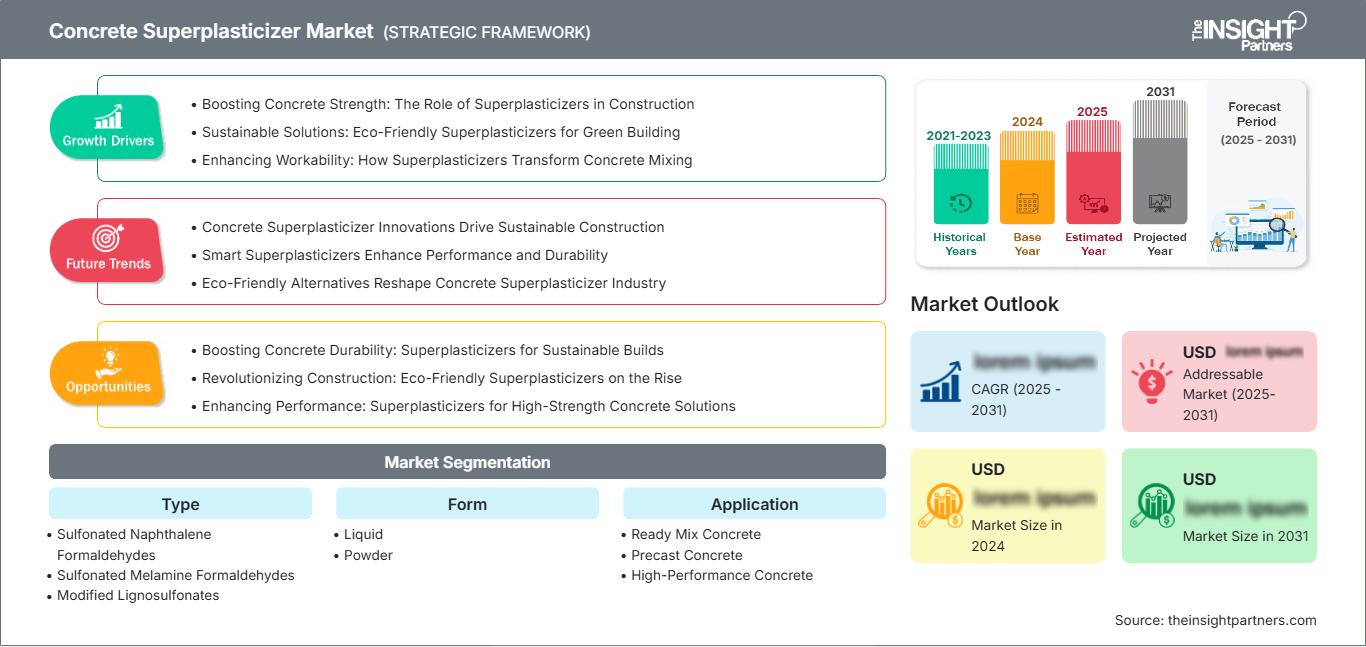
Concrete Superplasticizer Market: Strategic Insights
Regional Insights
North America Concrete Superplasticizer Market
North America accounted for an estimated 23–27% share of the global market in 2025 and is projected to grow at a 6.8–7.4% CAGR through 2034. The US dominates regional consumption, while Canada contributes through infrastructure renewal, commercial development, and residential construction. Demand increasingly reflects specifications for durable, high-strength, and lower-permeability concrete. The Concrete Superplasticizer Market forecast indicates sustained growth supported by ongoing construction activity and evolving performance requirements.
Structural needs in infrastructure rehabilitation are still a key factor, as roads, bridges, transport, utilities, and facilities need concrete that can withstand harsh demands for longevity. Also, ready-mix producers need to adapt to cement blends and changes in aggregates. The importance of supplier proximity, laboratories, and distribution is increasing as admixtures need to be tested with local cement chemistries and requirements for particular projects.
U.S. Concrete Superplasticizer Market
The U.S. represented an estimated 82–86% of North American demand in 2025 and is projected to grow at a 6.7–7.3% CAGR through 2034. Major suppliers maintain established production and technical-service networks, supporting ready-mix, precast, infrastructure, commercial, and high-performance concrete applications across major construction corridors. Concrete Superplasticizer Market trends in the U.S. increasingly emphasize high-performance admixture technologies, enhanced concrete durability, and solutions that support evolving construction and infrastructure requirements.
The demand for admixtures is becoming more dependent on formulations that increase their durability, decrease permeability, preserve workability, and conserve cementitious materials. High-performance admixtures have a special application in large structural components, highly reinforced structures, and pumpable concrete. The competition among suppliers is becoming more focused on technical assistance and formulation compatibility with supplementary cementitious materials than on pricing alone.
Europe Concrete Superplasticizer Market
Europe represented an estimated 24–28% share in 2025 and is forecast to grow at a 7.2–7.8% CAGR through 2034. Germany is the leading country, followed by France, Italy, the UK, and Spain. Regulatory pressure around embodied carbon and energy-efficient construction supports advanced admixture adoption. The Concrete Superplasticizer Market in Europe benefits from stringent sustainability standards and increasing demand for high-performance concrete in infrastructure and building projects.
The UK market is affected by infrastructure modernization, commercial redevelopment, and sustainability-based specifications. Germany is helped by the need for renovations and engineering-intensive constructions. France and Italy keep up the demand through infrastructure and special constructions, whereas Spain is helped by transport, renewable energy, and urban development projects. In all of these countries, admixtures with high performance in low-clinker and blended cement are becoming increasingly important.
APAC Concrete Superplasticizer Market
APAC held an estimated 31–35% share in 2025 and is expected to register an 8.6–9.2% CAGR through 2034. China remains the leading market, while India, Japan, South Korea, and Australia provide additional demand through infrastructure, urbanization, industrial construction, and increasingly sophisticated concrete specifications. The Concrete Superplasticizer Market in APAC is driven by large-scale construction investments, expanding ready-mix concrete production, and rising adoption of advanced admixture technologies for high-performance concrete applications.
Opportunities in terms of volume are provided by China and India through infrastructure and urban development, whereas the focus of Japan and South Korea is durability and performance in construction. Lower-carbon concrete and supplementary cementitious materials are becoming more and more important in Australia. Policy support in the region for infrastructure, transportation, housing, and energy initiatives will continue to drive the demand for admixtures.
Middle East & Africa Concrete Superplasticizer Market
The Middle East & Africa is expected to expand at an 8.1–8.7% CAGR through 2034. Saudi Arabia is the leading country, supported by large infrastructure and urban-development programs, while the UAE contributes through commercial, residential, tourism, and transport projects. South Africa remains an important market for infrastructure and industrial construction. The Concrete Superplasticizer Market in the region is supported by ongoing construction modernization, large-scale development initiatives, and increasing use of high-performance concrete solutions.
The regional opportunity extends across the rest of MEA as energy, water, logistics, and urban infrastructure projects require durable concrete under challenging climatic conditions. High temperatures and long transportation times increase the importance of slump retention and controlled setting. Local production and technical service can reduce logistics risks and support mix optimization for regionally available cement and aggregates.
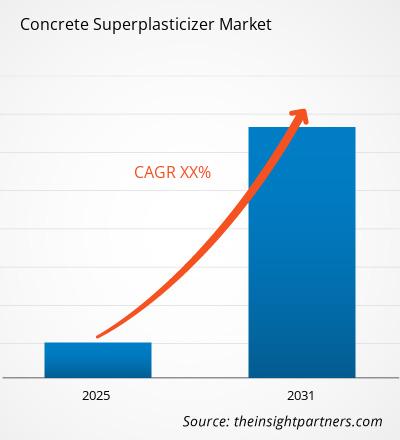
Segmentation Analysis
Type
The Type segment is led by Polycarboxylate Derivatives and is projected to grow at a 9.2–9.8% CAGR during 2026–2034. Adoption is supported by superior water reduction, slump retention, and compatibility with high-performance concrete. Conventional sulfonated products remain relevant where cost, established formulations, and simpler performance requirements influence purchasing decisions. The Concrete Superplasticizer Market continues to benefit from the shift toward advanced admixture technologies and performance-driven concrete specifications.
- Sulfonated Naphthalene Formaldehydes: Established water-reducing chemistry remains important in conventional concrete, where proven formulations, predictable performance, and competitive economics are prioritized by producers serving cost-sensitive construction projects.
- Sulfonated Melamine Formaldehydes: This chemistry serves applications requiring strong early performance and water reduction, particularly where concrete producers need controlled flow characteristics and established admixture technology.
- Modified Lignosulfonates: Modified lignosulfonates retain relevance in conventional concrete because of established processing familiarity and cost advantages, although increasingly demanding specifications favor higher-efficiency polymer technologies.
- Polycarboxylate Derivatives: Polycarboxylate derivatives occupy the strategic high-performance position because molecular design enables strong dispersion, water reduction, slump retention, and formulation flexibility across advanced concrete applications.
Form
The Form segment is expected to grow at a 7.5–8.1% CAGR through 2034. Liquid products maintain a strong position because they integrate readily into batching systems and enable precise dosage control. Powder products remain relevant for dry-mix formulations, transportation-sensitive applications, and locations where storage or handling considerations favor concentrated materials. The Concrete Superplasticizer Market benefits from demand across both form types, with selection largely influenced by application requirements, logistics, and operational preferences.
- Liquid: Liquid formulations dominate practical concrete production because automated dosing systems support accurate addition, rapid dispersion, and convenient integration into ready-mix and precast batching operations.
- Powder: Powder formulations remain strategically useful where concentrated transportation, longer storage flexibility, dry blending, or specialized concrete and mortar formulations influence procurement decisions.
Application
The Application segment is projected to expand at a 7.4–8.0% CAGR, with Ready Mix Concrete representing the largest application at an estimated 38–42% share in 2025. Demand is driven by transportation requirements, pumping distances, placement conditions, and increasing performance specifications. The Concrete Superplasticizer Market is supported by the growing use of ready-mix concrete in infrastructure, commercial, and residential construction projects.
- Ready Mix Concrete: Ready-mix is the leading application because transport, pumping, and variable site conditions require controlled workability, slump retention, water reduction, and consistent concrete performance.
- Precast Concrete: Precast producers prioritize admixtures that accelerate productivity, improve surface quality, and achieve high early strength while maintaining dimensional consistency across repetitive manufacturing cycles.
- High-Performance Concrete: High-performance concrete requires advanced dispersion and water reduction to achieve strength, durability, permeability, and rheological targets in demanding structural applications.
- Shotcrete: Shotcrete applications depend on rapid placement, controlled rheology, and reliable adhesion, making admixture selection important for tunnels, mining, repair works, and complex underground structures.
- Self-Compacting Concrete: Self-compacting concrete requires exceptionally controlled flow and stability so that mixes can pass congested reinforcement without conventional vibration while avoiding segregation and excessive bleeding.
- Fly Ash Concrete: Fly ash concrete relies on admixture compatibility to compensate for slower early strength and variable workability, supporting cement reduction and efficient utilization of supplementary cementitious materials.
Opportunity Snapshot
| Application | Revenue Contribution (High/Medium/Low) | Trend Tag | Adoption Stage |
| Ready Mix Concrete | High | Slump Retention | Mature |
| Precast Concrete | High | Fast Demolding | Mature |
| High-Performance Concrete | Medium | Low Permeability | Scaling |
| Shotcrete | Medium | Rapid Placement | Scaling |
| Self-Compacting Concrete | Medium | Vibration Elimination | Scaling |
| Fly Ash Concrete | Medium | SCM Utilization | Scaling |
Concrete Superplasticizer Market Growth Drivers and Impact Analysis
Expansion of infrastructure and urban construction
Infrastructure investment directly increases demand for concrete admixtures because transportation systems, bridges, water facilities, industrial plants, housing, and commercial buildings require large volumes of concrete with consistent performance. Superplasticizers become especially valuable when projects involve dense reinforcement, long pumping distances, difficult access, or strict durability specifications. Their ability to improve flow without proportionally increasing mixing water can help contractors maintain placement efficiency while protecting strength and permeability targets. The resulting market impact extends beyond concrete volume because larger and more technically demanding projects generally require higher-value admixture formulations and technical support. Suppliers with local laboratories and application teams can capture this demand by developing mixes around regional cement, aggregate, temperature, and transportation conditions, thereby improving customer retention and reducing formulation risk during major projects. These factors collectively support the Concrete Superplasticizer Market growth across both developed and emerging construction markets.
Increasing emphasis on lower-carbon concrete formulations
The trend towards decarbonization will affect the mix design of concrete through promoting increased use of supplementary cementitious materials and low-clinker cements. Such materials have the ability to influence the setting, workability, early strengths, and rheological behavior of the concrete and hence increase the demand for admixtures that can help restore or improve the fresh and hardened concrete properties. The market effect is considerable since the superplasticizers will aid the concrete manufacturer in achieving the desired strength and workability without using high clinker cement. The product will thus create room for suppliers to differentiate their products on the basis of mix optimization rather than the traditional role of water reduction. Technical cooperation with cement manufacturers, ready-mix companies, and engineering companies will be very vital.
Greater use of automated and high-efficiency concrete production
There is increased control over concrete production as there is automation in batching plants using dosing, monitoring, laboratory tests, and quality control. The change makes it essential to have consistent admixtures when it comes to performance, dosing at a precise level and stability regardless of the changes in raw materials used. For producers, good dosing control helps in reducing waste of raw materials, improving consistency among batches, and making workability specifications easier. The change requires admixtures with predictable response curves and technical support. It further calls for integration between the formulation of the chemical and the concrete production program. With time, this will enable suppliers of admixtures who offer application engineering and mix design services to have an advantage over other competing suppliers who rely mainly on prices.
Concrete Superplasticizer Market Future Trends
Greater integration with low-clinker concrete systems
Future developments will see an increasing number of superplasticizer formulations that will be used in combination with cement systems containing larger amounts of supplementary cementitious materials and alternative binders. In this regard, there will be a transition from developing admixtures that can be added to any cementitious systems regardless of the type of binder used to compatibility engineering, where the structure of polymers will be selected in accordance with the binder’s chemistry. Suppliers will need to offer a wider range of formulating options that will allow dealing with limestone, slag, fly ash, calcined clay, and recycled mineral constituents of binders. In this case, there will be a rise in the technical importance of admixture suppliers since customers will have to validate their products before mass production.
Application-specific polymer design and performance optimization
The future development of products will most probably be geared toward polymers customized for application-specific transportation, weather, site conditions, and strength needs. Ready-mix formulations will focus on high slump retention, while precast products can aim at early strength and quick form turnaround. Different rheological characteristics are required for shotcrete and self-compacting concretes, and there are possibilities of developing application-specific formulations. With the improvement in polymer structures, the suppliers will be able to control better adsorption, dispersion, workability retention, and interaction with various cementitious materials. It will minimize the usage of excessive amounts of admixtures, which often result from the variation in material qualities. Given that the concrete manufacturers seek more predictable behavior, the supplier with an excellent laboratory for formulations and field testing capabilities is expected to have an edge.
Concrete Superplasticizer Market Opportunities
Localized production in high-growth construction economies
There is a significant opportunity in emerging construction markets for locally produced admixtures due to the fact that the cost of transportation, climate and variations in cement and aggregate composition can affect product efficacy. Creating regionalized manufacturing and testing facilities will allow suppliers to reduce their lead times and customize their formulas for regional concrete production. Opportunities for investment are especially prevalent in the case of Asia, the Middle East and certain African countries due to the fact that infrastructure, residential, power generation and industrial construction are increasing the demand for reliable concrete. Regional manufacturing of admixtures could prove beneficial if imported chemical products are experiencing issues of freight or exchange rate instability. Investors must consider opportunities near existing ready mix clusters, infrastructure development corridors and regions producing cement rather than considering just market size.
Low-carbon admixture platforms for next-generation concrete
A second opportunity lies in developing integrated admixture platforms specifically designed for low-carbon concrete. Producers increasingly need solutions that maintain performance when clinker content declines and supplementary cementitious materials increase. This creates room for products positioned around total mix optimization, including water reduction, strength development, workability retention, and compatibility with alternative binders. Companies can strengthen commercial positioning by validating these solutions through large infrastructure and commercial projects where environmental specifications are increasingly explicit. Development programs should prioritize measurable performance across multiple cement systems rather than single-product claims. Collaboration with cement manufacturers and engineering consultants can also accelerate acceptance because mix-design changes often require technical validation before being incorporated into project specifications. Suppliers capable of linking admixture chemistry with carbon-reduction outcomes can therefore access higher-value applications while strengthening long-term customer relationships.
Recent Developments
- June 2026: Holcim completed the acquisition of Xella, a leader in the highly attractive European walling market with projected 2026 net sales of EUR 1 billion. The acquisition expands Holcim’s building solutions portfolio with the addition of brands for both new build and the energy-efficient repair and refurbishment market. These include prefabricated Ytong and Hebel autoclaved aerated concrete (AAC) modular systems, Silka calcium silicate elements, and, Multipor mineral insulation.
- August 2025: Saint-Gobain strengthened its construction chemicals business with the acquisition of three companies: Interstar Materials in North America, Isoltech in Italy, and Soquimic in Peru. Collectively, these acquisitions generated around €25 million in additional annual revenue and benefitted from Chryso’s expertise in innovation, R&D, and low-carbon solutions.
Frequently Asked Questions

- Comprehensive Market Sizing and Forecast Analysis
- Detailed Segmentation Analysis
- In-Depth Market Dynamics Assessment
- Regional and Country-Level Insights
- Competitive Landscape and Company Benchmarking
- Strategic Business Intelligence
Recent Reports
Testimonials

The Insight Partners' SCADA System Market report is comprehensive, with valuable insights on current trends and future forecasts. The team was highly professional, responsive, and supportive throughout. We are very satisfied and highly recommend their services.
RAN KEDEM Partner, Reali Technologies LTDs
I requested a report on a very specific software market and the team produced the report in a few days. The information was very relevant and well presented. I then requested some changes and additions to the report. The team was again very responsive and I got the final report in less than a week.
JEAN-HERVE JENN Chairman, Future Analytica
We worked with The Insight Partners for an important market study and forecast. They gave us clear insights into opportunities and risks, which helped shape our plans. Their research was easy to use and based on solid data. It helped us make smart, confident decisions. We highly recommend them.
PIYUSH NAGPAL Sr. Vice President, High Beam Global
The Insight Partners delivered insightful, well-structured market research with strong domain expertise. Their team was professional and responsive throughout. The user-friendly website made accessing industry reports seamless. We highly recommend them for reliable, high-quality research services
YUKIHIKO ADACHI CEO, Deep Blue, LLC.
This is the first time I have purchased a market report from The Insight Partners.While I was unsure at first, I visited their web site and felt more comfortable to take the risk and purchase a market report.I am completely satisfied with the quality of the report and customer service. I had several questions and comments with the initial report, but after a couple of dialogs over email with their analyst I believe I have a report that I can use as input to our strategic planning process.Thank you so much for taking the extra time and making this a positive experience.I will definitely recommend your service to others and you will be my first call when we need further market data.
JOHN SUZUKI President and Chief Executive Officer, Board Director, BK Technologies
I wish to appreciate your support and the professionalism you displayed in the course of attending to my request for information regarding to infectious disease IVD market in Nigeria. I appreciate your patience, your guidance, and the fact that you were willing to offer a discount, which eventually made it possible for us to close a deal. I look forward to engaging The Insight Partners in the future, all thanks to the impression you have created in me as a result of this first encounter.
DR CHIJIOKE ONYIA MANAGING DIRECTOR, PineCrest Healthcare Ltd.Reason to Buy
- Informed Decision-Making
- Understanding Market Dynamics
- Competitive Analysis
- Identifying Emerging Markets
- Customer Insights
- Market Forecasts
- Risk Mitigation
- Boosting Operational Efficiency
- Strategic Planning
- Investment Justification
- Tracking Industry Innovations
- Aligning with Regulatory Trends





 Get Free Sample for