
Conductive Rubber Market Size, Demand & Growth by 2034
Coverage: By Type (Thermal Conductive Rubber, Electrical Conductive Rubber); End User (Automotive and Transportation, Electrical and Electronics, Industrial Machines, Others) , and Geography (North America, Europe, Asia Pacific, and South and Central America)
- Status : Data Released
- Report Code : TIPRE00005977
- Category : Chemicals and Materials
- No. of Pages : 150
- Available Report Formats :


- Last update date : August 28, 2026


2025 Market Size
US$ 1.37 Bn
Base year value
2034 Forecast
US$ 2.20 Bn
Projected by 2034
CAGR 2026-2034
5.40 %
Growth rate
Addressable Market
US$ 16.19 Bn
(2026-2034)
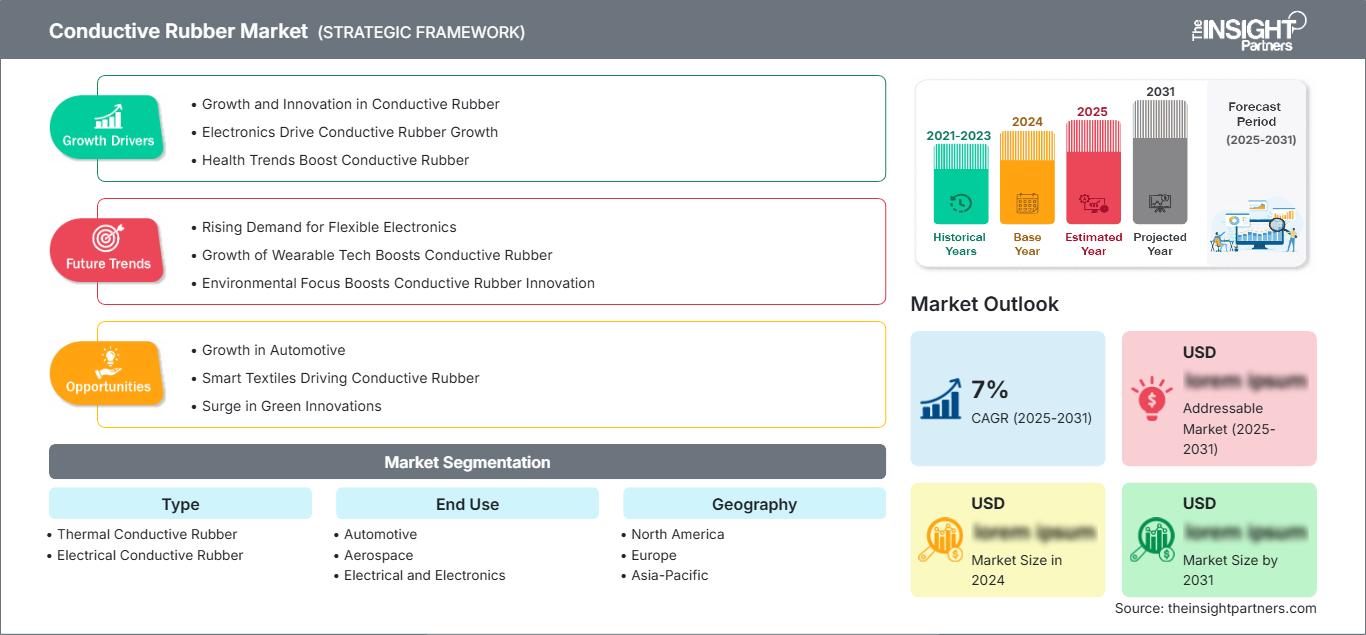
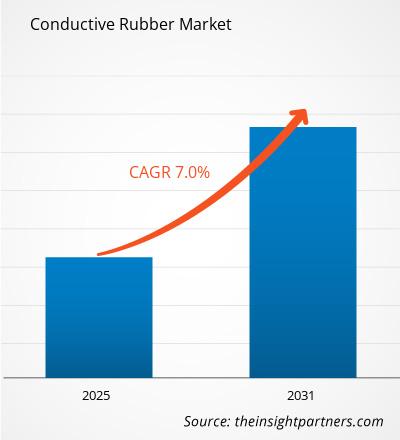
The Conductive Rubber Market was valued at US$ 1.37 Billion in 2025 and is projected to reach US$ 2.20 Billion by 2034, expanding at a CAGR of 5.40% during 2026–2034. These segments drive the market through rising demands for electrical conductivity, electromagnetic shielding, thermal control, and flexible seals, where rubber offers both functionality and mechanical strength.
The North American region will continue to be a major consumer market, with its conductive rubber market size driven by automobile electrification, aerospace electronics, data infrastructure, and rising electromagnetic compatibility demands. This region will grow at a CAGR of 5.0%-6.0% from 2026 to 2034. Growth is further driven by the presence of specialty elastomers production facilities and stringent specifications for mission-critical electrical and electronic devices.
Conductive Rubber Market Assessment and Insights
- North America: North America is estimated to hold a 35–39% share in 2025 and grow at a 5.0–6.0% CAGR between 2026–2034, supported by aerospace electronics, automotive systems, industrial equipment, and EMI shielding requirements.
- US: The US represents 82–86% of North America's 2025 demand and is projected to grow at a 5.0–6.0% CAGR during 2026–2034, driven by aerospace, automotive, electronics, and defense applications.
- Europe: Europe accounts for a 25–29% share in 2025 and is expected to grow at a 4.5–5.5% CAGR during 2026–2034, led by Germany, France, the UK, Italy, and Spain across automotive and industrial applications.
- Asia Pacific: Asia Pacific represents a 24–28% share in 2025 and is forecast to expand at a 6.0–7.0% CAGR during 2026–2034, with China, Japan, South Korea, India, and Taiwan supporting electronics and automotive production.
- Largest Segment: Electrical Conductive Rubber is estimated to hold a 64–68% market share in 2025 and grow at a 5.5–6.5% CAGR during 2026–2034, reflecting extensive EMI and grounding applications.
- High Growth Segment: Thermal Conductive Rubber is estimated to account for a 32–36% market share in 2025 and expand at a 5.0–6.0% CAGR during 2026–2034, supported by thermal management requirements.
- Key companies analyzed in detail: Dow Inc., General Electric Company, Holland Shielding Systems BV, K.D. Joshi Rubber Industries Pvt. Ltd., Momentive Performance Materials Inc., Reiss Manufacturing, Inc., Saint-Gobain, Shin-Etsu Chemical Co., Ltd., Specialty Silicone Products, Inc., Wacker Chemie AG
Source: The Insight Partners' analysis based on proprietary research, government publications, company annual reports, investor presentations, industry databases, and expert interviews.
In terms of function, the market has progressed from its initial use for more specific purposes such as sealing and grounding applications to multifunctional elastomers that can combine all electrical, thermal, mechanical and environmental properties in one material. The conductive fillers that may be based on carbon-based and metal particles are increasingly used in elastomers such as silicone rubber.
As regards the future, the demand will rise due to increased use of electric cars, electronic devices, aerospace systems, and automation processes. The Asia-Pacific region will continue to attract manufacturers, while North America and Europe will remain key regions for higher specification products. Environmental regulations, material conservation and qualification standards will drive suppliers to create new low filler content products.
Conductive Rubber Market Report Scope
| Report Attribute | Details |
|---|---|
| Market size in 2025 | US$ 1.37 Billion |
| Market Size by 2034 | US$ 2.20 Billion |
| Global CAGR (2026 - 2034) | 5.40% |
| Historical Data | 2021-2024 |
| Forecast period | 2026-2034 |
Conductive Rubber Market Analysis
Growth in Conductive Rubber Market is directly related to increasing electronic contents in vehicles, airplanes, industrial equipment and electrical equipment. The conductive elastomers are useful in providing sealability and conductivity; thus, they can be used where traditional metals and other conductive parts cannot be used in order to reduce complexity of assembling. Increasing need for EMI shielding and grounding in automobile electronics, battery packs, connectors, sensors and control modules are some applications in which conductive rubber is increasingly being used.
Some of the participants mentioned in the Conductive Rubber Market Report are silicone & elastomers makers, conductive filler makers, compounds makers, molded component makers, gasket makers and OEMs. Conductivity, thermal properties, compression set, hardness and environmental resistance depend upon the formulations. Conductive fillers made of metal have greater conductivity but higher cost and weight while carbon based fillers have low costs. So, suppliers differentiate on the basis of formulations and geometry of products.
Competitive positioning is heavily influenced by the material technology, qualifications capabilities, manufacturing capability, and custom engineering for the customer. Dow Inc. and Momentive Performance Materials Inc. offer extensive silicone and specialty materials technology, while Shin-Etsu Chemical Co., Ltd. offers electrically conductive silicone material. Wacker Chemie AG also has electrically conductive silicone material along with the thermal management materials. All of these make it possible for the large suppliers to cater to various performance needs of the customer.
Holland Shielding Systems BV, Reiss Manufacturing, Inc. and Specialty Silicone Products, Inc. offer competitiveness through customized shielding profiles, conductive elastomers, and sealant materials. Saint-Gobain offers engineering materials and K.D. Joshi Rubber Industries Pvt. Ltd. offers specialized rubber technology. More investment is being done in compounds, high-performance fillers, automated molding, and electric mobility/compact electronics components.
● REPORT CUSTOMIZATION
Tailor This Report To Align With Your Specific Business Requirements
This report can be customized to align precisely with your business objectives, scope, and target markets. Customization options include tailored segmentation, geography, competitive analysis, and strategic insights to support informed decision-making.
Customize This Report →WHAT YOU CAN ADJUST
- ● Segmentations
- ● Geography
- ● Competitive Analysis
- ● Language Preferences
Conductive Rubber Market: Strategic Insights
Regional Insights
North America Conductive Rubber Market
North America is projected to account for 35–39% of worldwide demand in 2025 and will experience 5.0–6.0% CAGR until 2034. The United States is the driving force behind the region’s consumption, owing to applications in aerospace and defense industries, automotive electronics, industrial machines, telecommunications, and advanced electrical equipment. In Canada, automotive, industrial, energy, and engineering applications that require conductive sealing and thermal protection make contributions.
Demand in North America will benefit from the development of advanced aerospace and electronics manufacturing infrastructure and stringent engineering requirements regarding EMI shielding and protection, environmental sealing, and electrical conductivity. Growth in the electric mobility market is leading to new possibilities in thermally conductive and electrically conductive elastomer applications related to batteries, power electronics, sensors, and connectors. There are established manufacturers and customized profile fabricators in North America.
U.S. Conductive Rubber Market
The United States is responsible for 82-86% of North America's demand in 2025 and is expected to grow at a CAGR of 5.0-6.0% through 2034. The applications that make up the major part of the market are aerospace & defense, automotive electronics, industrial machinery, and telecommunications.
Dow Inc., General Electric Company, Momentive Performance Materials Inc., Reiss Manufacturing, Inc., and Specialty Silicone Products, Inc. operate in the material and component ecosystem. The uses of silicone rubbers in EMI gaskets, conductive sealing, thermal interface, electrical connector, and molded component are some of the applications in the market. As the use of data infrastructure, advanced electronics, and electric vehicles increases, more electrical interfaces become available for shielding and heat dissipation purposes.
Europe Conductive Rubber Market
Europe possesses an estimated 25-29% Conductive Rubber Market share in 2025 and is forecasted to expand at a CAGR of 4.5-5.5% until 2034. Germany dominates the region owing to its expertise in automotive manufacturing, industrial automation, electrical equipment, and specialty chemicals. The UK continues to be significant in terms of aerospace and defense, while France provides contributions from transportation, aerospace, energy, and industrial equipment segments.
The automotive manufacturing and engineering capabilities of Germany help boost the demand for conductive gaskets and thermal-management components as vehicles become more electronic in nature. Additional demand comes from France and the UK on account of their involvement in the aerospace and defense industries and advanced electronics where environmental protection and shielding are vital. Demand from the region is provided by Italy and Spain through automotive components, industrial machinery, electrical equipment, and renewable energy technologies.
APAC Conductive Rubber Market
APAC accounts for 24% to 28% of the world's demand in 2025 and is estimated to grow at a rate of 6.0% to 7.0% CAGR till 2034. China dominates APAC, with Japan and South Korea following suit, whereas India's demand would be driven by its localization strategies in automotive and electronics production.
The sheer scale of China's electronics and automotive production means that there will be high demand for EMI shielding, conductive seals, and thermal-management products. The requirements in Japan and South Korea would be driven by high-end applications in semiconductors, displays, batteries, and automotive electronics. Demand in India would increase on account of localization policies, whereas Australia would drive the region's demand from industrial and energy-related applications.
Middle East & Africa Conductive Rubber Market
Middle East and Africa demand remains comparatively specialized but is supported by energy infrastructure, industrial machinery, telecommunications, transportation, and electrical equipment. The region is estimated to grow at a 4.5–5.5% CAGR through 2034, with Saudi Arabia and the UAE representing leading Gulf markets and South Africa serving as an important industrial base.
Saudi Arabia and the UAE continue to develop industries that need robust electrical and sealing parts, while South Africa focuses on mining, automotive, power, and industrial uses. Demand in Rest-of-MEA is centered on energy, telecommunications, transport, and industrial maintenance. Modernization of infrastructure and energy diversification will slowly boost the need for functional elastomers, but availability of imported specialty material and formulation capability of the region have to be considered.
Segmentation Analysis
Type
The Type segment in the Conductive Rubber Market is expected to expand at a 5.0–6.0% CAGR during 2026–2034. Electrical conductive rubber currently represents the larger product category because EMI shielding, grounding, and static-control applications are established across electronics, aerospace, automotive, and industrial equipment. Thermal conductive rubber is gaining importance as electronic components become smaller and heat loads increase, creating demand for elastomers that transfer heat while retaining electrical isolation where required.
- Thermal Conductive Rubber: Thermal conductive grades support heat-transfer applications in electronics and electrical systems, particularly where flexible interfaces, dimensional conformity, and reliable thermal contact are needed within compact assemblies.
- Electrical Conductive Rubber: Electrical conductive grades provide conductivity, grounding, and EMI shielding while retaining elastomeric sealing characteristics, making them strategically important for connectors, enclosures, gaskets, aerospace equipment, and automotive electronics.
End Use
The End Use segment in the Conductive Rubber Market is projected to grow at a 5.5–6.5% CAGR during 2026–2034. Automotive and electrical and electronics applications provide substantial demand because electrification and component miniaturization increase requirements for EMI control, thermal management, and reliable sealing. Aerospace applications emphasize high reliability, while industrial machinery benefits from durable conductive components operating under demanding conditions.
- Automotive: Increasing electronic content, electrification, sensors, power electronics, and battery systems are creating demand for conductive elastomers that provide sealing, shielding, thermal management, and vibration resistance.
- Aerospace: Aerospace users prioritize lightweight, durable, chemically resistant, and electrically functional sealing materials for avionics, communication equipment, engines, and mission-critical electronic systems.
- Electrical and Electronics: Dense circuitry and electromagnetic compatibility requirements support demand for conductive gaskets, O-rings, connectors, shielding components, and thermal interfaces used in electronic assemblies and enclosures.
- Industrial Machinery: Industrial machinery applications require conductive elastomers for equipment sealing, grounding, sensors, electrical enclosures, and components exposed to vibration, temperature variation, chemicals, and continuous operation.
Opportunity Snapshot
| End Use | Revenue Contribution (High/Medium/Low) | Trend Tag | Adoption Stage |
| Automotive | High | E-Mobility | Scaling |
| Aerospace | Medium | Avionics Shielding | Mature |
| Electrical and Electronics | High | EMI Shielding | Mature |
| Industrial Machinery | Medium | Smart Machinery | Scaling |
Conductive Rubber Market Growth Drivers and Impact Analysis
Rising Electronic Content and Electromagnetic Compatibility Requirements
Modern vehicles, aircraft, industrial systems, and electronic equipment contain increasing numbers of sensors, processors, power modules, and communication interfaces. Greater electronic density raises the risk of electromagnetic interference and creates stronger requirements for shielding and grounding at component and enclosure interfaces. Conductive rubber provides a practical solution because the same component can maintain environmental sealing while establishing electrical continuity. This combination reduces the need for separate metallic shielding elements in selected designs and can simplify assembly. The effect is particularly important in compact equipment where space constraints make rigid metal components less attractive. As electronics become more densely integrated, demand should shift toward elastomers offering controlled conductivity, stable compression, reliable shielding performance, and long service life under thermal and mechanical stress.
Electrification of Automotive and Industrial Equipment
Electrification is increasing the number of high-current and high-voltage interfaces within vehicles and industrial equipment. Batteries, inverters, motors, charging systems, sensors, and electronic control units create new requirements for thermal management, shielding, sealing, and electrical isolation. Conductive and thermally conductive elastomers can address selected interface requirements while accommodating vibration, dimensional variation, and complex geometries. Automotive qualification also favors materials that maintain performance across wide temperature ranges and exposure to fluids, salt, and mechanical stress. Industrial equipment is experiencing a similar transition as automation and connected machinery increase electrical content. Consequently, suppliers that can tailor conductivity, thermal transfer, compression behavior, and chemical resistance for electrified systems are positioned to capture higher-value applications and longer qualification programs.
Miniaturization of Electronics and Increasing Thermal Loads
Electronic miniaturization is creating tighter component spacing and increasing the importance of effective thermal pathways. Smaller devices often concentrate heat within limited areas, requiring interface materials that can conform to irregular surfaces while transferring heat reliably. Thermally conductive rubber offers flexibility and sealing capabilities that can complement rigid thermal-management components. At the same time, smaller electronic enclosures require improved EMI shielding because components operate in closer proximity. This creates a dual opportunity for conductive elastomer suppliers to develop materials optimized for either electrical or thermal performance, depending on the design requirement. Improvements in filler dispersion and polymer processing can help manufacturers achieve functional performance without excessive filler loading. Such developments can preserve flexibility and processability while supporting increasingly compact electronic architectures.
Conductive Rubber Market Future Trends
Development of Multifunctional Conductive Elastomer Systems
Future material platforms are likely to combine electrical conductivity, thermal transfer, sealing, adhesion, and environmental resistance within fewer components. This direction can reduce assembly steps and improve reliability in compact electronic systems. Manufacturers are expected to optimize conductive filler networks more precisely so that conductivity can be achieved without excessive deterioration of flexibility or compression behavior. Hybrid filler systems combining carbonaceous and metallic materials may receive greater attention where cost and performance must be balanced. Application-specific formulations will increasingly be developed for automotive electronics, aerospace equipment, sensors, and industrial controls. The Conductive Rubber Market trends will therefore increasingly center on multifunctionality, customized performance windows, and compatibility with automated manufacturing rather than conductivity as an isolated material characteristic.
Expansion of Thermal Management in Electrified Systems
Thermal-management requirements are expected to become increasingly important as electric vehicles, power electronics, data equipment, and industrial automation operate at higher power densities. Future conductive rubber formulations will likely focus on improved thermal pathways, lower thermal resistance, controlled mechanical compliance, and long-term stability under repeated temperature cycling. Material developers may also integrate thermal performance with electrical insulation where system architecture requires heat transfer without unintended current flow. Greater use of thin interface layers and customized geometries should support efficient packaging within space-constrained assemblies. Suppliers capable of maintaining consistent thermal properties across production batches will gain importance because interface variability can directly affect system reliability. This trend should gradually expand the role of functional elastomers in advanced thermal-management architectures.
Conductive Rubber Market Opportunities
Regionalized Production for Electric Mobility Supply Chains
Automotive and battery manufacturing is becoming increasingly localized across North America, Europe, China, India, and Southeast Asia. This creates opportunities for conductive elastomer suppliers to establish regional compounding, molding, technical support, and qualification capabilities close to vehicle and component manufacturers. Localized supply can shorten lead times, simplify engineering changes, and improve responsiveness to platform-specific requirements. Companies can target battery housings, connectors, power electronics, sensors, charging systems, and electronic control modules with customized grades. Partnerships with Tier 1 suppliers and component manufacturers can provide an efficient route into qualification programs. The Conductive Rubber Market Forecasts indicate that suppliers with geographically distributed production and application engineering capabilities can improve resilience while capturing demand associated with expanding electric mobility manufacturing footprints.
Advanced Shielding Solutions for Aerospace and Defense Electronics
Aerospace and defense electronics offer an attractive opportunity for high-performance conductive elastomers because equipment must combine shielding, sealing, flexibility, and environmental resistance. Suppliers can target specialized EMI gaskets, O-rings, profiles, and molded components for avionics, communication systems, radar equipment, and protected electronic enclosures. Products using fluorosilicone or specialized conductive fillers can address applications exposed to fuels, chemicals, temperature cycling, and demanding operating environments. Qualification requirements create meaningful entry barriers, but successful material approvals can support long product lifecycles and recurring demand. Companies can strengthen positioning by investing in traceability, application testing, custom geometry, and certification support. Such capabilities can differentiate suppliers from commodity compounders and improve access to mission-critical programs.
Recent Developments
- April 2026: The Rubber Group (TRG) acquired precision plastics manufacturer, Diversified Plastics Inc (DPI). By joining the high-performance rubber solutions leader, the pair can work together to expand a complementary manufacturing platform. Additionally, the new partnership strengthened the offerings of both companies, with rubber, plastics, and urethane capabilities accessible from an integrated, trusted source.
- October 2025: Elkem ASA (ticker: ELK), a global leader in advanced silicon-based materials, unveiled SILBIONE LSR Select EC 70, a next-generation medical-grade liquid silicone rubber. Designed for wearable and diagnostic devices, the material combines high electrical conductivity, certified biocompatibility, and enhanced process control, setting a new standard for precision healthcare applications.
Frequently Asked Questions

- Comprehensive Market Sizing and Forecast Analysis
- Detailed Segmentation Analysis
- In-Depth Market Dynamics Assessment
- Regional and Country-Level Insights
- Competitive Landscape and Company Benchmarking
- Strategic Business Intelligence
Recent Reports
Testimonials

The Insight Partners' SCADA System Market report is comprehensive, with valuable insights on current trends and future forecasts. The team was highly professional, responsive, and supportive throughout. We are very satisfied and highly recommend their services.
RAN KEDEM Partner, Reali Technologies LTDs
I requested a report on a very specific software market and the team produced the report in a few days. The information was very relevant and well presented. I then requested some changes and additions to the report. The team was again very responsive and I got the final report in less than a week.
JEAN-HERVE JENN Chairman, Future Analytica
We worked with The Insight Partners for an important market study and forecast. They gave us clear insights into opportunities and risks, which helped shape our plans. Their research was easy to use and based on solid data. It helped us make smart, confident decisions. We highly recommend them.
PIYUSH NAGPAL Sr. Vice President, High Beam Global
The Insight Partners delivered insightful, well-structured market research with strong domain expertise. Their team was professional and responsive throughout. The user-friendly website made accessing industry reports seamless. We highly recommend them for reliable, high-quality research services
YUKIHIKO ADACHI CEO, Deep Blue, LLC.
This is the first time I have purchased a market report from The Insight Partners.While I was unsure at first, I visited their web site and felt more comfortable to take the risk and purchase a market report.I am completely satisfied with the quality of the report and customer service. I had several questions and comments with the initial report, but after a couple of dialogs over email with their analyst I believe I have a report that I can use as input to our strategic planning process.Thank you so much for taking the extra time and making this a positive experience.I will definitely recommend your service to others and you will be my first call when we need further market data.
JOHN SUZUKI President and Chief Executive Officer, Board Director, BK Technologies
I wish to appreciate your support and the professionalism you displayed in the course of attending to my request for information regarding to infectious disease IVD market in Nigeria. I appreciate your patience, your guidance, and the fact that you were willing to offer a discount, which eventually made it possible for us to close a deal. I look forward to engaging The Insight Partners in the future, all thanks to the impression you have created in me as a result of this first encounter.
DR CHIJIOKE ONYIA MANAGING DIRECTOR, PineCrest Healthcare Ltd.Reason to Buy
- Informed Decision-Making
- Understanding Market Dynamics
- Competitive Analysis
- Identifying Emerging Markets
- Customer Insights
- Market Forecasts
- Risk Mitigation
- Boosting Operational Efficiency
- Strategic Planning
- Investment Justification
- Tracking Industry Innovations
- Aligning with Regulatory Trends





 Get Free Sample for