
Construction Adhesives Market Growth, Trends, and Analysis by 2034
Coverage: by Type (PVA, PU, Epoxy, Acrylic, and Others); Technology (Reactive, Solventborne, Waterborne, and Others); and Application (Residential, Non-residential, and Infrastructure), and Geography (North America, Europe, Asia Pacific, and South and Central America)
- Status : Data Released
- Report Code : TIPRE00002795
- Category : Chemicals and Materials
- No. of Pages : 150
- Available Report Formats :


- Last update date : August 27, 2026


2025 Market Size
US$ 11.86 Bn
Base year value
2034 Forecast
US$ 18.87 Bn
Projected by 2034
CAGR 2026-2034
5.3 %
Growth rate
Addressable Market
US$ 139.42 Bn
(2026-2034)
The construction adhesives market was valued at US$ 11.86 Billion in 2025 and is projected to reach US$ 18.87 Billion by 2034, expanding at a 5.3% CAGR from 2026 to 2034. Construction adhesives are becoming increasingly important across modern building systems as contractors and manufacturers prioritize durable bonding, faster installation, and compatibility with diverse substrates. Growth reflects broader adoption of engineered bonding solutions across residential, commercial, and industrial construction.
North America is expected to maintain a substantial position as renovation activity, commercial refurbishment, energy-efficient buildings, and prefabricated construction support adhesive consumption. The construction adhesives market size in the region is supported by demand for low-emission formulations, durable flooring and insulation installation, and high-performance bonding systems. Regional expansion is estimated at a 4.5–4.9% CAGR during 2026–2034, with the US remaining the principal demand center.
Construction Adhesives Market Assessment and Insights
- North America: The region is estimated to account for 25–29% share in 2025, supported by renovation, commercial construction, and advanced building systems, while growing at a 4.5–4.9% CAGR between 2026–2034.
- US: The US represents approximately 78–82% of North American revenue in 2025, with demand expanding at a 4.5–4.9% CAGR between 2026–2034.
- Europe: Europe is estimated at 20–24% share in 2025, led by Germany, the UK, France, Italy, and Spain, with renovation, energy efficiency, and low-emission materials supporting a 4.4–4.8% CAGR between 2026–2034.
- Asia Pacific: Asia Pacific is estimated to hold 38–42% share in 2025, led by China, Japan, India, and South Korea, and is projected to grow at a 5.7–6.1% CAGR between 2026–2034.
- Largest Segment: Acrylic is estimated at 43–46% market share in 2025, benefiting from broad substrate compatibility, with a 4.8–5.2% CAGR during 2026–2034.
- High Growth Segment: Polyvinyl Acetate is estimated at 13–16% market share in 2025 and is projected to expand at a 5.2–5.6% CAGR during 2026–2034.
- Key companies analyzed in detail: 3M Company, BASF SE, Henkel AG & Co. KGaA, Bostik SA, Sika AG, DAP Products Inc., Dow Inc., H.B. Fuller Company, Illinois Tool Works Inc., Avery Dennison Corporation.
Source: The Insight Partners' analysis based on proprietary research, government publications, company annual reports, investor presentations, industry databases, and expert interviews.
The construction adhesives market has evolved from conventional mechanical fastening toward engineered bonding systems capable of joining dissimilar substrates while distributing stress more evenly. The development of acrylic, polyurethane and epoxy formulations is providing more opportunities for the use of such adhesives in floors, insulation, panels, facades and prefab units. Formulation approaches are also becoming more geared towards water-based, low odor and low emissions versions in response to the increasing concern about indoor air quality, ease of installation and product longevity by building owners and contractors.
Going forward, manufacturers can be expected to focus on localized production, specialized formulations and customized application systems within the newer construction markets. Investment in infrastructure in the Asia Pacific and selected Middle Eastern economies will provide new opportunities for bonding products in light of the need for more durable bonding systems.
Construction Adhesives Market Report Scope
| Report Attribute | Details |
|---|---|
| Market size in 2025 | US$ 11.86 Billion |
| Market Size by 2034 | US$ 18.87 Billion |
| Global CAGR (2026 - 2034) | 5.3% |
| Historical Data | 2021-2024 |
| Forecast period | 2026-2034 |
Construction Adhesives Market Analysis
The construction adhesives market growth is closely linked to building activity, renovation expenditure, and the replacement of mechanical fastening in selected applications. The demand passes through polymer and chemical suppliers, adhesive manufacturers, distributors, contractors, installers, and building material manufacturers. Acrylic systems take advantage of the system's versatility, whereas polyurethane and epoxy formulations are designed for applications that need more moisture, heat, or mechanical resistance. The supply environment continues to be impacted by polymer, monomer, solvent, additive, and energy prices.
Adhesive manufacturers are increasingly differentiating their products on parameters such as curing time, substrate compatibility, moisture resistance, open time, and emissions instead of the basic functionality of the products. Manufacturing of products regionally is gaining importance due to varying logistics costs, formulation issues and contractor preferences. Regional manufacturing may help reduce lead time and compliance with regional building codes. This is helping suppliers to combine global technology platforms with regional products.
The construction adhesives market analysis indicates a moderately concentrated competitive environment in which multinational chemical and adhesive companies compete through technology breadth, distribution reach, application support, and formulation specialization. Sika AG, Henkel AG & Co. KGaA, Bostik SA, 3M Company, H.B. Fuller Company, and BASF SE possess diverse technology portfolios, while DAP Products Inc., Dow Inc., Illinois Tool Works Inc., and Avery Dennison Corporation contribute by means of customized bonding technologies and materials.
Competition for investments is growing in terms of localized manufacturing facilities, formulations, and related adhesives technologies. Sika AG has focused on manufacturing capacity growth and localization, while Henkel AG & Co. KGaA has continued expanding its bonding technologies via mergers and acquisitions. Another example of innovative formulations is the joint effort between BASF SE and Sika AG in creating low-emission epoxies.
● REPORT CUSTOMIZATION
Tailor This Report To Align With Your Specific Business Requirements
This report can be customized to align precisely with your business objectives, scope, and target markets. Customization options include tailored segmentation, geography, competitive analysis, and strategic insights to support informed decision-making.
Customize This Report →WHAT YOU CAN ADJUST
- ● Segmentations
- ● Geography
- ● Competitive Analysis
- ● Language Preferences
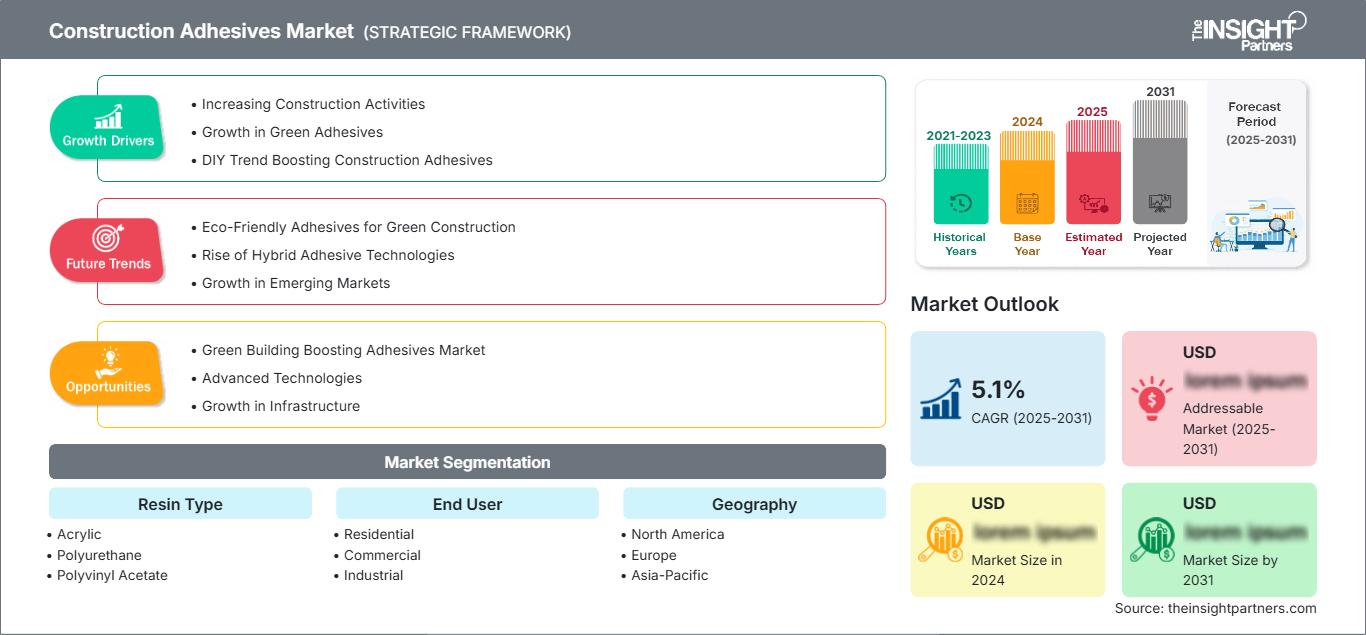
Construction Adhesives Market: Strategic Insights
Regional Insights
North America Construction Adhesives Market
North America is estimated to represent 25–29% of global construction adhesives market share in 2025 and is projected to expand at a 4.5–4.9% CAGR through 2034. The region is served by well-established supply chains for construction products, high levels of renovation, commercial renovations, and demand for energy-efficient building skins. The use of adhesives in floors, insulations, panels, roofing systems, and other interior assemblies where efficiency in installation and substrate compatibility are key considerations is becoming more common.
The United States represents 78–82% of North America’s revenues, which makes it the leading source of demand in the region. Canada drives demand via residential construction, infrastructure renovation, and commercial construction. The emphasis of suppliers in the region is placed on low-emission, moisture-resistant, and fast-curing products to boost installer productivity. The development of modernized construction, warehouses, health care facilities, and multi-residential buildings presents continuing opportunities.
U.S. Construction Adhesives Market
The Construction Adhesives Market Report highlights that the US represents approximately 78–82% of North American revenue in 2025 and is expected to grow at a 4.5–4.9% CAGR from 2026 to 2034. The demand exists in residential remodeling, commercial interiors, flooring, insulation, roofing, and industrial construction sectors. The importance of renovation continues to be felt in this context since the use of adhesives will make it easy to install them despite different substrates and the time frame of the projects.
Recent trends in applications have seen more people preferring products that have low odor, good moisture resistance, fast curing and easier cleaning. Some of the leading players, such as 3M Company, Henkel AG & Co. KGaA, Sika AG, DAP Products Inc. and H.B. Fuller Company have existing commercial channels and technical expertise in the region.
Europe Construction Adhesives Market
Europe is estimated to account for 20–24% share of the Construction Adhesives Market in 2025 and is expected to expand at a 4.4–4.8% CAGR through 2034. Germany is the leading national market, supported by industrial construction and renovation. The UK remains important for refurbishment and commercial interiors, while France, Italy, and Spain contribute through residential upgrades, flooring, infrastructure, and renovation projects. Low-emission formulations and energy-efficient construction are increasingly important selection criteria.
The country enjoys the advantages of an advanced production facility in construction materials and a high demand for bonding solutions in industrial and commercial construction. The market in the UK is driven by renovation, flooring, insulation, and maintenance construction needs. In France, Italy, and Spain, there is additional demand due to renovation projects, upgrading of homes, and tourism-related construction. Regulations in Europe focus on emissions, indoor air quality, and resource efficiency, encouraging water-based adhesive solutions.
APAC Construction Adhesives Market
APAC is estimated to hold 38–42% share of the Construction Adhesives Market in 2025, making it the leading regional market, and is projected to grow at a 5.7–6.1% CAGR through 2034. The major consumers in the region are China, followed by Japan, South Korea, India, and Australia. Urban construction, industries, infrastructure, and housing are important drivers of demand.
China relies on infrastructural developments as well as manufacturing operations, India on urbanization along with infrastructural and housing constructions, Japan on renovation, quality construction, and efficient installations, and South Korea on advanced industrial and commercial buildings. Australia plays a role due to residential constructions and renovations. There is an increased focus on localized manufacturing investments in the region.
Middle East & Africa Construction Adhesives Market
The Middle East & Africa Construction Adhesives Market is expected to grow at approximately 5.0–5.4% CAGR through 2034, with Saudi Arabia leading regional demand. Construction, hospitality, and infrastructure development in the UAE, along with the South African market, add extra demand to adhesives. There are large development plans and rising construction activity in the region.
The demand for adhesives is driven by energy infrastructure development, transportation projects, urbanization, and commercial construction. Adhesive usage for floors, façades, insulation, and panels is driven by Saudi Arabia's development pipeline, and in the UAE, it is driven by commercial and hospitality construction. However, there is diversified demand in South Africa and other MEA countries through maintenance, housing, and industrial projects.
Segmentation Analysis
Resin Type
The resin type segment of the Construction Adhesives Market is expected to expand at a 4.8–5.2% CAGR from 2026–2034, with acrylic maintaining the leading position. Product selection depends on substrate compatibility, curing behavior, moisture resistance, flexibility, durability, and application economics. Polyvinyl acetate should benefit from continued use in wood-based construction and interior applications.
- Acrylic: Acrylic adhesives hold the largest position because of their broad compatibility with concrete, metal, glass, plastics, and composite surfaces. Their durability and resistance characteristics support flooring, panels, insulation, and interior applications.
- Polyurethane: Polyurethane formulations are strategically important where flexibility, moisture resistance, and durable bonding are required. They are used across flooring, insulation, façades, panels, and assemblies exposed to movement or variable environmental conditions.
- Polyvinyl Acetate: Polyvinyl acetate benefits from cost-effective bonding of wood, plywood, laminates, and interior materials. Its ease of application and suitability for water-based formulations support demand in residential and commercial finishing activities.
- Epoxy: Epoxy adhesives serve demanding applications requiring high bond strength, chemical resistance, and dimensional stability. Their use is concentrated in industrial construction, structural assemblies, flooring systems, and applications requiring durable performance.
End User
The end user segment of the Construction Adhesives Market is projected to grow at a 5.1–5.6% CAGR from 2026–2034 as construction activity expands across residential, commercial, and industrial projects. Demand varies by project scale and performance requirements, with commercial construction generating significant adhesive consumption through flooring, interiors, panels, and building-system installation.
- Residential: Residential demand is supported by new housing, remodeling, flooring, cabinetry, wall panels, insulation, and decorative installation. Adhesives offer installers practical alternatives where speed, appearance, and compatibility with multiple substrates are important.
- Commercial: Commercial construction represents a major demand pool because offices, retail facilities, hotels, healthcare buildings, and educational projects require extensive flooring, wall-covering, panel, and interior installation solutions.
- Industrial: Industrial users prioritize durable bonding for factories, warehouses, production facilities, insulation systems, flooring, and specialized assemblies. Performance requirements are generally higher because products may face mechanical loads, chemicals, temperature changes, or moisture.
Opportunity Snapshot
| End User | Revenue Contribution | Trend Tag | Adoption Stage |
|---|---|---|---|
| Residential | Medium | Renovation Bonding | Mature |
| Commercial | High | Interior Fitout | Mature |
| Industrial | Medium | Durable Assembly | Scaling |
Construction Adhesives Market Growth Drivers and Impact Analysis
Expansion of Renovation and Building Modernization
The need for adhesives arises from the activity of renovating, whereby old buildings require floor renovations, insulation improvements, installation of wall coverings, panels, and interior renovations. The use of adhesives helps in hiding fastening and provides bonding even on different surfaces. In developed countries, renovating provides a more stable demand compared to construction. Today, contractors are looking for materials that make installations easy while limiting the number of mechanical fixations. This trend favors the firms that produce various types of adhesives and have a well-established network of installers. It not only affects residential but also non-residential buildings such as offices, hospitals, hotels, retailers, and schools. Building owners have the need to improve energy efficiency and interiors, which will lead to increased usage of adhesives.
Demand for Efficient Lightweight and Prefabricated Construction
The use of prefabricated components and lightweight structures means that there is an increasing need for adhesives when joining wood, metals, plastics, composite materials, insulating materials, and fabricated sheets together. Adhesive bonding is capable of spreading the load over large areas while reducing drilling and other assembly activities. This is especially true when manufacturers are interested in developing standardized manufacturing methods and contractors are faced with labor shortages. Adhesive technology can allow for better architectural finishes due to a reduction in visible screws and bolts. Market opportunities are especially strong in modular buildings, insulating panels, building façades, flooring assemblies, and manufactured interior components. Suppliers able to produce quick-setting adhesives with good bonding properties on different substrates will enjoy opportunities in high-value-added applications. With greater industrialization in construction, the decision-making process will be determined not only by adhesive cost but also by time of application and productivity of workers.
Stricter Sustainability and Indoor-Environment Requirements
Environmental and indoor-air-quality considerations are reshaping adhesive formulation priorities. Building owners, architects, contractors, and certification systems increasingly consider volatile organic compound emissions, odor, worker exposure, and material sustainability when selecting products. This creates opportunities for waterborne, solvent-reduced, and lower-emission formulations that retain required bond performance. The shift also encourages manufacturers to optimize raw-material selection, packaging, curing behavior, and product lifecycle characteristics. In Europe and North America, sustainability requirements are particularly influential in commercial and institutional projects, while emerging markets are progressively adopting comparable specifications. Product innovation can therefore become a differentiator rather than simply a compliance exercise. BASF SE and Sika AG, for example, introduced an epoxy hardener in 2025 designed to reduce VOC emissions by up to 90% versus selected conventional hardeners, illustrating the commercial relevance of lower-emission chemistry.
Construction Adhesives Market Future Trends
Greater Adoption of Low-Emission and Bio-Attributed Formulations
The construction adhesives market trends are expected to increasingly center on formulations that combine lower emissions with durable performance. Manufacturers are likely to expand waterborne systems, solvent-reduced technologies, and products incorporating renewable or bio-attributed feedstocks. However, sustainability claims will increasingly be evaluated alongside bond strength, curing reliability, moisture resistance, service life, and compatibility with established construction substrates. This will favor suppliers capable of reformulating without compromising installer productivity. Building certification programs and procurement standards should accelerate the specification of products with documented environmental attributes, particularly in commercial and institutional projects. Over time, product development may also focus on lower embodied carbon, improved packaging efficiency, and easier removal or recycling where construction assemblies permit. These changes should gradually shift competition from conventional resin performance toward a broader combination of environmental, technical, and lifecycle metrics.
Digital Specification and Application-Specific Adhesive Systems
Digital specification tools are likely to influence how contractors, architects, and distributors select adhesive products. Manufacturers can increasingly provide digital technical documentation, substrate compatibility databases, application calculators, installation guidance, and project-specific recommendations. Such systems reduce uncertainty when multiple materials are bonded within a single assembly. Product portfolios are also likely to become more application-specific, with optimized solutions for flooring, insulation, façades, panels, modular construction, and industrial building components. Faster curing, controlled open times, and simplified surface preparation will remain important because labor productivity is becoming a central purchasing consideration. Suppliers that combine adhesive chemistry with technical service can strengthen customer retention by becoming part of the installation process rather than merely a material vendor. The resulting competitive advantage should favor companies with strong application engineering, digital support capabilities, and extensive distribution networks.
Construction Adhesives Market Opportunities
Localized Manufacturing in High-Growth Construction Economies
The Construction Adhesives Market Forecasts indicate meaningful opportunities for manufacturers to establish or expand localized production in Asia Pacific, the Middle East, and selected emerging economies. Local manufacturing can reduce logistics exposure, improve delivery reliability, and enable formulations tailored to regional climate and construction practices. India, China, Southeast Asia, and Gulf markets offer particularly attractive conditions where urbanization, infrastructure investment, and industrial development create diversified adhesive demand. Companies can combine regional manufacturing with technical centers that support contractors and distributors, improving product specification and application reliability. Localization also enables faster response to regulatory changes and customer preferences. Strategic partnerships with building-material producers, flooring manufacturers, insulation suppliers, and large distributors can further accelerate market penetration. Investment decisions should therefore consider not only market size, but also raw-material availability, import dependence, distribution density, and the technical sophistication of local customers.
High-Performance Bonding for Modular and Energy-Efficient Buildings
Modular construction and energy-efficient building systems create an opportunity for specialized adhesive products designed around complete assemblies rather than individual substrates. Insulated panels, façade components, flooring systems, engineered wood, and lightweight structures require reliable bonding while accommodating thermal movement, moisture, and dimensional variation. Suppliers can develop application packages combining primers, adhesives, surface treatments, and technical guidance to address these requirements. Such solutions can generate stronger customer relationships than standalone adhesive sales because contractors receive an integrated installation system. The opportunity is especially relevant in markets where labor shortages encourage off-site manufacturing and faster installation. Manufacturers can also target energy-efficiency retrofits, where insulation and façade upgrades require durable bonding without extensive structural modification. Companies with established construction-chemical portfolios are positioned to extend into these higher-value applications through product development, partnerships, and targeted acquisitions.
Recent Developments
- February 2026: Sika AG — Sika agreed to acquire Akkim, a Turkey-based adhesives and sealants manufacturer with approximately CHF 220 million in 2025 sales. The transaction is intended to expand Sika's geographic reach, distribution access, production capacity, and construction adhesive and sealant portfolio across Eastern Europe, Central Asia, the Middle East, and North Africa.
- January 2026: Henkel AG & Co. KGaA — Henkel signed an agreement to acquire ATP Adhesive Systems, expanding its Adhesive Technologies portfolio into high-performance water-based specialty tapes. ATP serves building and construction alongside automotive, electronics, medical, and graphics markets, while the transaction adds expertise in water-based, hot-melt, and solvent-based polymer tape technologies.
Frequently Asked Questions

- Comprehensive Market Sizing and Forecast Analysis
- Detailed Segmentation Analysis
- In-Depth Market Dynamics Assessment
- Regional and Country-Level Insights
- Competitive Landscape and Company Benchmarking
- Strategic Business Intelligence
Recent Reports
Testimonials

The Insight Partners provided valuable market intelligence that supported our global go-to-market strategy. Their team was professional, responsive, and attentive to our feedback, providing thoughtful analysis and helpful methodological clarifications throughout the project.
Junmo Kim Chief Financial Officer (CFO), Enertech Co., Ltd.
The Insight Partners' SCADA System Market report is comprehensive, with valuable insights on current trends and future forecasts. The team was highly professional, responsive, and supportive throughout. We are very satisfied and highly recommend their services.
RAN KEDEM Partner, Reali Technologies LTDs
I requested a report on a very specific software market and the team produced the report in a few days. The information was very relevant and well presented. I then requested some changes and additions to the report. The team was again very responsive and I got the final report in less than a week.
JEAN-HERVE JENN Chairman, Future Analytica
We worked with The Insight Partners for an important market study and forecast. They gave us clear insights into opportunities and risks, which helped shape our plans. Their research was easy to use and based on solid data. It helped us make smart, confident decisions. We highly recommend them.
PIYUSH NAGPAL Sr. Vice President, High Beam Global
The Insight Partners delivered insightful, well-structured market research with strong domain expertise. Their team was professional and responsive throughout. The user-friendly website made accessing industry reports seamless. We highly recommend them for reliable, high-quality research services
YUKIHIKO ADACHI CEO, Deep Blue, LLC.
This is the first time I have purchased a market report from The Insight Partners.While I was unsure at first, I visited their web site and felt more comfortable to take the risk and purchase a market report.I am completely satisfied with the quality of the report and customer service. I had several questions and comments with the initial report, but after a couple of dialogs over email with their analyst I believe I have a report that I can use as input to our strategic planning process.Thank you so much for taking the extra time and making this a positive experience.I will definitely recommend your service to others and you will be my first call when we need further market data.
JOHN SUZUKI President and Chief Executive Officer, Board Director, BK Technologies
I wish to appreciate your support and the professionalism you displayed in the course of attending to my request for information regarding to infectious disease IVD market in Nigeria. I appreciate your patience, your guidance, and the fact that you were willing to offer a discount, which eventually made it possible for us to close a deal. I look forward to engaging The Insight Partners in the future, all thanks to the impression you have created in me as a result of this first encounter.
DR CHIJIOKE ONYIA MANAGING DIRECTOR, PineCrest Healthcare Ltd.Reason to Buy
- Informed Decision-Making
- Understanding Market Dynamics
- Competitive Analysis
- Identifying Emerging Markets
- Customer Insights
- Market Forecasts
- Risk Mitigation
- Boosting Operational Efficiency
- Strategic Planning
- Investment Justification
- Tracking Industry Innovations
- Aligning with Regulatory Trends





 Get Free Sample for