
Construction Paints and Coatings Market Growth, Size & Forecast by 2034
Coverage: By Type (Water-based, Solvent-based, Others); Application (Residential, Commercial, Industrial) , and Geography (North America, Europe, Asia Pacific, and South and Central America)
- Status : Data Released
- Report Code : TIPRE00023814
- Category : Chemicals and Materials
- No. of Pages : 150
- Available Report Formats :


- Last update date : August 27, 2026


2025 Market Size
US$ 20.01 Bn
Base year value
2034 Forecast
US$ 31.79 Bn
Projected by 2034
CAGR 2026-2034
5.28 %
Growth rate
Addressable Market
US$ 234.99 Bn
(2026-2034)
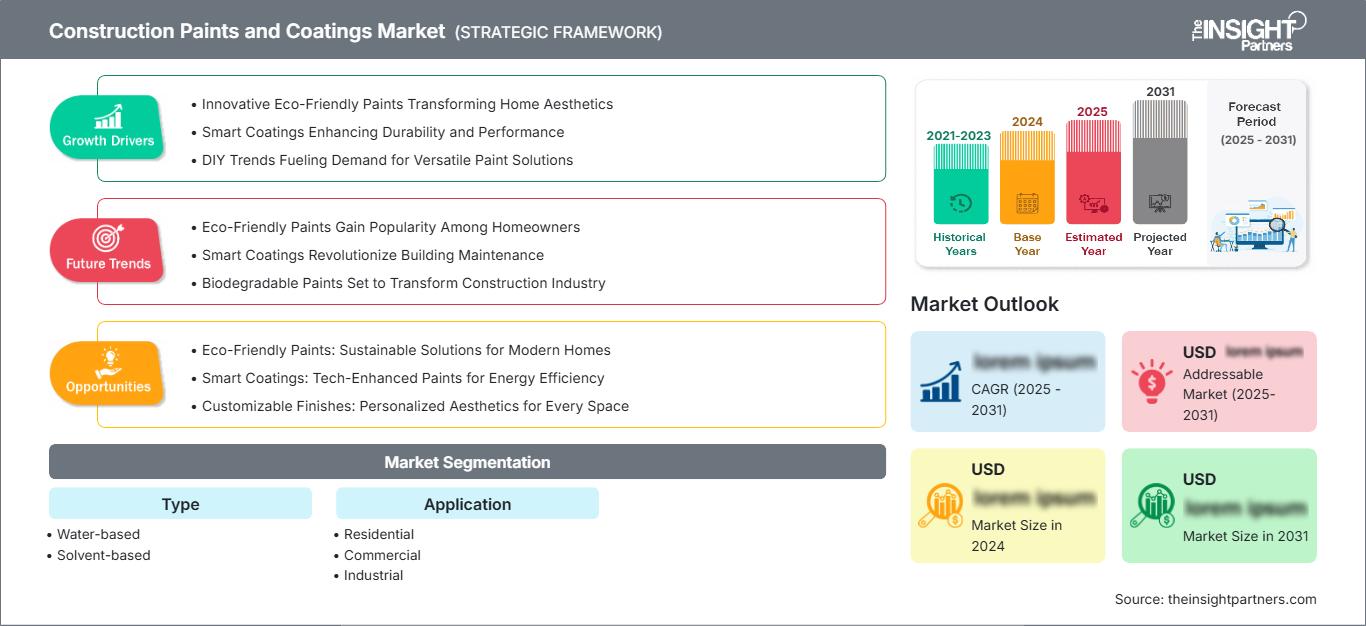
The Construction Paints and Coatings market was valued at US$ 20.01 billion in 2025 and is expected to reach US$ 31.79 billion by 2034; it is estimated to record a CAGR of 5.28% during 2026-2034.
Construction Paints and Coatings Market Assessment and Insights
- North America: Renovation activity, commercial maintenance, and environmental compliance support a 27–31% share in 2025, with the region growing at a 4.7–5.2% CAGR between 2026–2034 as low-VOC formulations gain adoption.
- US: The US represents 68–72% of North American demand in 2025 and is expected to expand at a 4.5–5.0% CAGR between 2026–2034, led by remodeling and commercial refurbishment.
- Europe: Europe accounts for 22–26% share in 2025 and is projected to grow at a 4.2–4.8% CAGR, with Germany, the UK, France, Italy, and Spain supported by renovation, energy-efficiency requirements, and sustainable coating adoption.
- Asia Pacific: Asia Pacific holds a 35–39% share in 2025 and is projected to register a 5.6–6.2% CAGR, led by China, India, Japan, South Korea, and Australia through urban development and industrial construction.
- Largest Segment: Water-based coatings represent a 68–72% market share in 2025 and are projected to grow at a 6.2–6.7% CAGR between 2026–2034, supported by lower emissions and application versatility.
- High Growth Segment: Industrial applications account for a 28–32% market share in 2025 and are expected to expand at a 6.3–6.8% CAGR, driven by protective requirements and new industrial facilities.
- Key companies analyzed in detail: Akzo Nobel N.V.; Ashland Inc.; Asian Paints Limited; Axalta Coating Systems Ltd.; BASF SE; Beckers Group; DyStar Singapore Pte Ltd.; Nippon Paint (India) Private Limited; PPG Industries, Inc.; The Sherwin-Williams Company.
Source: The Insight Partners' analysis based on proprietary research, government publications, company annual reports, investor presentations, industry databases, and expert interviews.
Paints and coatings for construction have moved from the initial use of only decorative paint formulations to more complex solutions that combine decoration, protection, durability, and application effectiveness. The use of waterborne technology is becoming more significant as formulators work towards reducing VOCs through advances in polymer dispersions, pigments, additives, and rheological additives that can offer good film coverage and weather resistance. Manufacturing methods are focusing on regional production and formulation in response to fluctuations in raw material prices, high logistics costs, and changing building specifications.
For the forecast period, investments will be made in low-emissions products, superior-quality exterior paints, and coatings for difficult industrial environments. Opportunities arising from new construction activities in South and Southeast Asia, the Middle East, and selected Latin American countries will provide alternative avenues of demand. Pressure for lower VOC emissions, along with green building needs and consumer interest in durable finishes, will further support the drive for formula innovations and commercialization of improved water-based formulations.
Construction Paints and Coatings Market Report Scope
| Report Attribute | Details |
|---|---|
| Market size in 2025 | US$ 20.01 Billion |
| Market Size by 2034 | US$ 31.79 Billion |
| Global CAGR (2026 - 2034) | 5.28% |
| Historical Data | 2021-2024 |
| Forecast period | 2026-2034 |
Construction Paints and Coatings Market Analysis
Demand is closely linked to building completions, renovation cycles, maintenance expenditure, and industrial asset construction. The Construction Paints and Coatings Market growth is therefore influenced by both new-build activity and the recurring repainting requirements of existing structures. Producers depend on resin and binder suppliers, pigment manufacturers, additive providers, packaging companies, distributors, contractors, and organized retail channels to deliver finished products to end users.
The dynamics of supply are influenced by titanium dioxide, acrylic and vinyl resins, solvents, additives, and specialty pigments. Manufacturers seek to refine their products by minimizing the reliance on unstable ingredients while preserving hiding qualities and durability. Regionally based manufacturers enjoy certain benefits related to transport and formulation adjustments necessary for regions with special climate conditions, requiring moisture resistance, UV resistance, salt resistance, or resistance to temperature fluctuations.
The key competitors comprise diversified coatings companies and regional paint producers, competing in terms of formulation technology, geographic coverage, brand strength, relationships with contractors, and technical assistance. Akzo Nobel N.V., BASF SE, PPG Industries, Inc., and The Sherwin-Williams Company have international capabilities, whereas Asian Paints Limited and Nippon Paint (India) Private Limited have regional strengths. Axalta Coating Systems Ltd. represents another coatings specialist.
The Construction Paints and Coatings Market Share is increasingly influenced by strategic positioning connected to portfolio optimization and sustainable product development. Akzo Nobel N.V. and Axalta Coating Systems Ltd. are pursuing major corporate integration, while PPG Industries, Inc. continues emphasizing architectural coatings in selected international markets. BASF SE is strengthening local dispersion production in India. Investment priorities increasingly include regional capacity, formulation laboratories, digital color systems, and technologies that lower environmental impacts without sacrificing performance.
● REPORT CUSTOMIZATION
Tailor This Report To Align With Your Specific Business Requirements
This report can be customized to align precisely with your business objectives, scope, and target markets. Customization options include tailored segmentation, geography, competitive analysis, and strategic insights to support informed decision-making.
Customize This Report →WHAT YOU CAN ADJUST
- ● Segmentations
- ● Geography
- ● Competitive Analysis
- ● Language Preferences
Construction Paints and Coatings Market: Strategic Insights
Regional Insights
North America Construction Paints and Coatings Market
North America represented 27–31% of the global Construction Paints and Coatings Market demand in 2025 and is projected to expand at a 4.7–5.2% CAGR through 2034. Consumption is led by the US due to residential remodeling, maintenance, refurbishment and industrial building. Canadian contributions are made through renovation work and related infrastructure construction. Mexican involvement will help to enhance the regional environment of supply and demand.
Increasing consumer preferences are geared towards water-based coatings with higher washability and durability, along with low VOC content. US environmental standards will push manufacturers to develop better formulas and efficient applications, while drying rate and even coverage become essential for contractors. Local manufacturers will also benefit from dealer networks and distribution. Exterior high-end coatings, elastomeric materials and industrial coatings should be key areas for value generation.
U.S. Construction Paints and Coatings Market
The US contributes approximately 68–72% of the North American Construction Paints and Coatings Market demand in 2025 and is expected to grow at a 4.5–5.0% CAGR through 2034. Remodeling, repainting, commercial maintenance, and institutional construction create recurrent usage for both indoor and outdoor finishes. Resilience is expected where the paint acts as a protective layer for the building against weathering and provides long maintenance periods.
Leading manufacturers sell through contractors, company-owned outlets, distributors, and retail outlets. Sherwin-Williams Company enjoys significant exposure to architectural coatings, while PPG Industries, Inc. has an international presence following the sale of its business for architectural coatings in the US and Canada. Waterborne indoor and outdoor paints have been essential in homes, whereas industries seek corrosion-resistant, chemical-resistant, and long-lasting finishes.
Europe Construction Paints and Coatings Market
Europe accounted for 22–26% of the global Construction Paints and Coatings Market demand in 2025 and is projected to grow at a 4.2–4.8% CAGR. Germany is the leading national market, supported by renovation, industrial facilities, and stringent environmental requirements. The UK continues to be important due to maintenance needs for both domestic and commercial structures. France uses new construction alongside renovations, whereas Italy and Spain take advantage of residential renovations, tourist constructions, and commercial renovations. In the whole region, water-based paints are becoming popular due to environmental considerations in laws and green building specifications that require low-emission formulas. The advanced industry in Germany helps to cater to specialty coating products.
APAC Construction Paints and Coatings Market
Asia Pacific held 35–39% of the global Construction Paints and Coatings Market demand in 2025 and should grow at a 5.6–6.2% CAGR. China remains the leading market, while India, Japan, South Korea, and Australia provide diversified demand. Urbanization, industrial investment, housing development, and infrastructure spending underpin consumption.
Policy emphasis on energy-efficient buildings and cleaner production is encouraging water-based formulations and advanced coating technologies. India offers particularly strong potential through residential construction and infrastructure investment, while China remains central to regional manufacturing. Japan and South Korea emphasize high-performance formulations, whereas Australia supports demand through renovation and weather-resistant exterior coatings.
Middle East & Africa Construction Paints and Coatings Market
The Middle East and Africa Construction Paints and Coatings Market demand is expected to expand at a 5.3–5.9% CAGR through 2034. Saudi Arabia is the leading growth market, supported by large-scale construction and diversification programs, while the UAE benefits from commercial, hospitality, and infrastructure projects. South Africa represents a mature regional base.
Energy infrastructure, urban development, tourism projects, and public investment create opportunities for protective and decorative coatings. The Rest of MEA remains fragmented, with demand concentrated around urban centers and major infrastructure projects. High temperatures, ultraviolet exposure, and dust increase requirements for durable exterior systems, supporting premium formulations.
Segmentation Analysis
Type
Type-based demand is shifting toward formulations that combine environmental compliance with application performance. The water-based segment is the largest category and is expected to register a 6.2–6.7% CAGR during 2026–2034. Solvent-based systems remain relevant where superior penetration, curing, chemical resistance, or substrate performance is required.
- Water-based: Water-based paints dominate architectural applications because of lower VOC characteristics, easier cleanup, reduced odor, and improved durability. Their strategic importance is increasing as contractors and building owners prioritize environmental performance without compromising finish quality.
- Solvent-based: Solvent-based coatings retain demand in demanding environments where penetration, adhesion, curing behavior, and resistance to chemicals or moisture are critical. Their position remains strongest in selected industrial and specialty construction applications.
Application
The Construction Paints and Coatings Market Forecast indicates that application demand reflects different construction cycles and performance requirements. Industrial applications are expected to record a 6.3–6.8% CAGR during 2026–2034, making them the fastest-growing major application. Residential demand remains the largest consumption base because repainting creates recurring requirements.
- Residential: Residential construction and refurbishment generate consistent demand for interior and exterior finishes. Consumers increasingly consider washability, color retention, low odor, and durability when selecting products, supporting premiumization and broader adoption of advanced water-based formulations.
- Commercial: Commercial buildings require coatings that balance appearance, maintenance intervals, traffic resistance, and application speed. Offices, retail properties, hotels, and mixed-use developments support demand for durable decorative systems and specialized finishes.
- Industrial: Industrial facilities require coatings capable of protecting substrates from corrosion, chemicals, abrasion, heat, and moisture. New factories, warehouses, utilities, and manufacturing expansions therefore support higher-value specialty products and technical service requirements.
Opportunity Snapshot
| Application | Revenue Contribution | Trend Tag | Adoption Stage |
| Residential | High | Repainting | Mature |
| Commercial | Medium | Premium Finishes | Scaling |
| Industrial | Medium | Protective Systems | Scaling |
Construction Paints and Coatings Market Growth Drivers and Impact Analysis
Urban housing expansion and residential refurbishment
The need for architectural coatings is likely to recur due to population expansion, family creation, urbanization, and the aging of buildings. Construction activities will ensure an initial need for coatings, but repainting creates another cycle of demand that does not rely much on the level of new construction. Growing income levels of households in emerging markets are likely to favor high-quality coatings, including colors, texture, stain and washable finishes. The need to renew older buildings in mature markets ensures a steady demand for architectural coatings, irrespective of construction activities. The driver favors manufacturers with extensive distribution channels and partnerships with contractors, as well as tinting systems. It also allows segmentation of coatings based on substrates and climates, creating the need for specialized exterior coatings.
Expansion of industrial and commercial building assets
Facilities such as industrial parks, warehouses, logistics facilities, data centers, factories, commercial real estate properties, and hospitality developments need to be coated for appearance as well as protection. Often, these facilities will present more rigorous criteria compared to ordinary residential projects when it comes to wear, chemicals, moisture, UV resistance, and temperature resistance. Growing spending on localized manufacturing and logistics development opens up new opportunities in terms of expanding the addressable market for protective coating systems. Additionally, commercial property developers are looking for coating systems that have a longer life between maintenance needs to avoid service interruptions. This makes it possible for coating system providers to extract more value from each development through specification, application advice, and formulation.
VOC reduction and environmental performance requirements
Increasing environmental regulation will drive formulation innovation in architectural coatings. Volatile organic compound regulations will spur manufacturers to formulate less solvent-based products, enhance water-based technology, and develop binders that retain their strength at low emission rates. In the United States, there are national architectural coating regulations that set the VOC emission levels, while in Canada, VOC levels are also regulated. Building owners and developers have started including sustainability as part of their purchasing criteria; hence, environmental concerns will go beyond mere regulation. This trend will give a competitive edge to those companies that are technologically advanced in dispersion, resins, additives, and application. This trend will increase the complexity of formulations because low-emission-rate products must still fulfill the requirements of coverage, drying, adhesion, washability, and weatherability.
Construction Paints and Coatings Market Future Trends
Bio-based and low-carbon formulation platforms
Product development in the future will rely on the use of renewable materials, carbon-light binders, recycled packaging, and production methods with a smaller energy input. The formulation process will involve the substitution of specific petroleum-based ingredients without compromising adhesion, color retention, weather resistance, or shelf life stability. Life-cycle assessment may prove to be another important factor influencing purchasing decisions, especially when dealing with big commercial and institutional projects. Digital product documentation will provide manufacturers with an opportunity to prove the environmental benefits of their products and make specifications easier for architects and contractors. The other promising trend will be low-VOC chemistry combined with higher durability, providing an opportunity for longer maintenance intervals and possible reduction in total material utilization during its life cycle.
Digital color management and intelligent application
Digital technologies are expected to influence product selection, color matching, inventory planning, and application quality. Connected tinting equipment can reduce color variation and improve retailer inventory efficiency, while digital visualization allows customers to evaluate finishes before purchasing. Professional contractors may increasingly use digital tools to estimate coverage, schedule applications, and document project specifications. Manufacturers can combine these capabilities with customer data to identify regional color preferences and optimize product portfolios. Intelligent application technologies may also support more consistent coating thickness and reduce material waste on larger projects. Over time, digitalization should shift competition beyond formulation alone, particularly in organized distribution channels. Companies with strong retail networks, technical databases, and integrated customer platforms can use these tools to improve conversion, reduce returns, and strengthen relationships with professional applicators.
Construction Paints and Coatings Market Opportunities
Localized production for high-growth emerging markets
Manufacturers can expand through localized production of dispersions, resins, and finished coatings in high-growth markets where transportation costs, supply reliability, and formulation requirements favor regional manufacturing. India, Southeast Asia, the Middle East, and selected African economies offer opportunities linked to construction investment and urban development. Local facilities can also support faster product customization for climate-specific requirements, including humidity, ultraviolet exposure, and high-temperature conditions. Strategic investment should prioritize modular production capacity, technical laboratories, contractor training, and reliable raw-material sourcing rather than capacity expansion alone. Partnerships with local distributors and construction companies can accelerate market entry while reducing channel risk. Companies able to combine global formulation expertise with local manufacturing and application knowledge can improve responsiveness and capture demand generated by infrastructure and residential development.
Premium protective coatings for infrastructure assets
The Construction Paints and Coatings Market Trends highlight that infrastructure modernization creates an opportunity to expand premium coatings designed for bridges, transport facilities, utilities, industrial structures, and public buildings. Asset owners increasingly evaluate maintenance cost over the full service life rather than selecting products solely on initial purchase price. This supports coatings that extend repainting intervals, improve corrosion resistance, withstand ultraviolet exposure, and tolerate harsh operating environments. Suppliers can target this opportunity through specification partnerships with engineering firms, infrastructure contractors, and government agencies. Product development should emphasize measurable performance characteristics and application reliability because project specifications often require documented technical compliance. Digital inspection and maintenance records could further support premium positioning by demonstrating lifecycle benefits. The opportunity is particularly relevant in emerging markets where new infrastructure investment is occurring alongside efforts to improve durability and reduce long-term maintenance expenditure.
Recent Developments
- June 2026: Nippon Paint unveiled a major expansion initiative for its Indian operations, aiming to nearly double its revenue from the current EUR 313 million to EUR 672 million by 2029. The company plans to add eight manufacturing plants to its existing network of seven facilities, bringing the total to 15 by the end of the decade. This ambitious move involves a planned investment of EUR 56 million over the next 18 months, allocated to both brownfield and greenfield projects, with a particular focus on eastern India.
- May 2026: Nippon Paint Group and Sherwin-Williams carefully considered AkzoNobel's all-stock merger with Axalta announced on 18 November 2025, which set out an alternative path to AkzoNobel's standalone strategy. Nippon Paint Group and Sherwin-Williams thoroughly assessed options for engaging with AkzoNobel at this pivotal moment, in accordance with the terms of AkzoNobel's existing merger agreement with Axalta, and jointly submitted the comprehensive Joint Proposal to the Boards of AkzoNobel for a recommended public offer for AkzoNobel, taking the interests of all stakeholders of AkzoNobel into account. The Joint Proposal envisages the acquisition of AkzoNobel's Decorative Paints and Industrial Coatings business ("Deco") by Nippon Paint Group and the acquisition of AkzoNobel's Marine & Protective Coatings, Automotive & Specialty Coatings and Powder Coatings businesses ("Coatings") by Sherwin-Williams.
Frequently Asked Questions

- Comprehensive Market Sizing and Forecast Analysis
- Detailed Segmentation Analysis
- In-Depth Market Dynamics Assessment
- Regional and Country-Level Insights
- Competitive Landscape and Company Benchmarking
- Strategic Business Intelligence
Recent Reports
Testimonials

The Insight Partners provided valuable market intelligence that supported our global go-to-market strategy. Their team was professional, responsive, and attentive to our feedback, providing thoughtful analysis and helpful methodological clarifications throughout the project.
Junmo Kim Chief Financial Officer (CFO), Enertech Co., Ltd.
The Insight Partners' SCADA System Market report is comprehensive, with valuable insights on current trends and future forecasts. The team was highly professional, responsive, and supportive throughout. We are very satisfied and highly recommend their services.
RAN KEDEM Partner, Reali Technologies LTDs
I requested a report on a very specific software market and the team produced the report in a few days. The information was very relevant and well presented. I then requested some changes and additions to the report. The team was again very responsive and I got the final report in less than a week.
JEAN-HERVE JENN Chairman, Future Analytica
We worked with The Insight Partners for an important market study and forecast. They gave us clear insights into opportunities and risks, which helped shape our plans. Their research was easy to use and based on solid data. It helped us make smart, confident decisions. We highly recommend them.
PIYUSH NAGPAL Sr. Vice President, High Beam Global
The Insight Partners delivered insightful, well-structured market research with strong domain expertise. Their team was professional and responsive throughout. The user-friendly website made accessing industry reports seamless. We highly recommend them for reliable, high-quality research services
YUKIHIKO ADACHI CEO, Deep Blue, LLC.
This is the first time I have purchased a market report from The Insight Partners.While I was unsure at first, I visited their web site and felt more comfortable to take the risk and purchase a market report.I am completely satisfied with the quality of the report and customer service. I had several questions and comments with the initial report, but after a couple of dialogs over email with their analyst I believe I have a report that I can use as input to our strategic planning process.Thank you so much for taking the extra time and making this a positive experience.I will definitely recommend your service to others and you will be my first call when we need further market data.
JOHN SUZUKI President and Chief Executive Officer, Board Director, BK Technologies
I wish to appreciate your support and the professionalism you displayed in the course of attending to my request for information regarding to infectious disease IVD market in Nigeria. I appreciate your patience, your guidance, and the fact that you were willing to offer a discount, which eventually made it possible for us to close a deal. I look forward to engaging The Insight Partners in the future, all thanks to the impression you have created in me as a result of this first encounter.
DR CHIJIOKE ONYIA MANAGING DIRECTOR, PineCrest Healthcare Ltd.Reason to Buy
- Informed Decision-Making
- Understanding Market Dynamics
- Competitive Analysis
- Identifying Emerging Markets
- Customer Insights
- Market Forecasts
- Risk Mitigation
- Boosting Operational Efficiency
- Strategic Planning
- Investment Justification
- Tracking Industry Innovations
- Aligning with Regulatory Trends





 Get Free Sample for