
Construction Repair Composites Market Size, Growth & Trends by 2034
Construction Repair Composites Market Size and Forecasts (2021 - 2034), Global and Regional Share, Trends, and Growth Opportunity Analysis Report Coverage : by Fiber Type (Glass Fiber, Carbon Fiber); Product Type (Textile/ Fabric, Plate, Rebar, Adhesive); Application (Residential, Commercial, Bridge, Oil and Natural Gas Pipeline); and Geography (North America, Europe, Asia Pacific, and South and Central America)
- Status : Data Released
- Report Code : TIPRE00040298
- Category : Chemicals and Materials
- No. of Pages : 150
- Available Report Formats :


- Last update date : September 01, 2026


2025 Market Size
US$ 450.15 Mn
Base year value
2034 Forecast
US$ 976.86 Mn
Projected by 2034
CAGR 2026-2034
8.99 %
Growth rate
Addressable Market
US$ 6,385.68 Mn
(2026-2034)
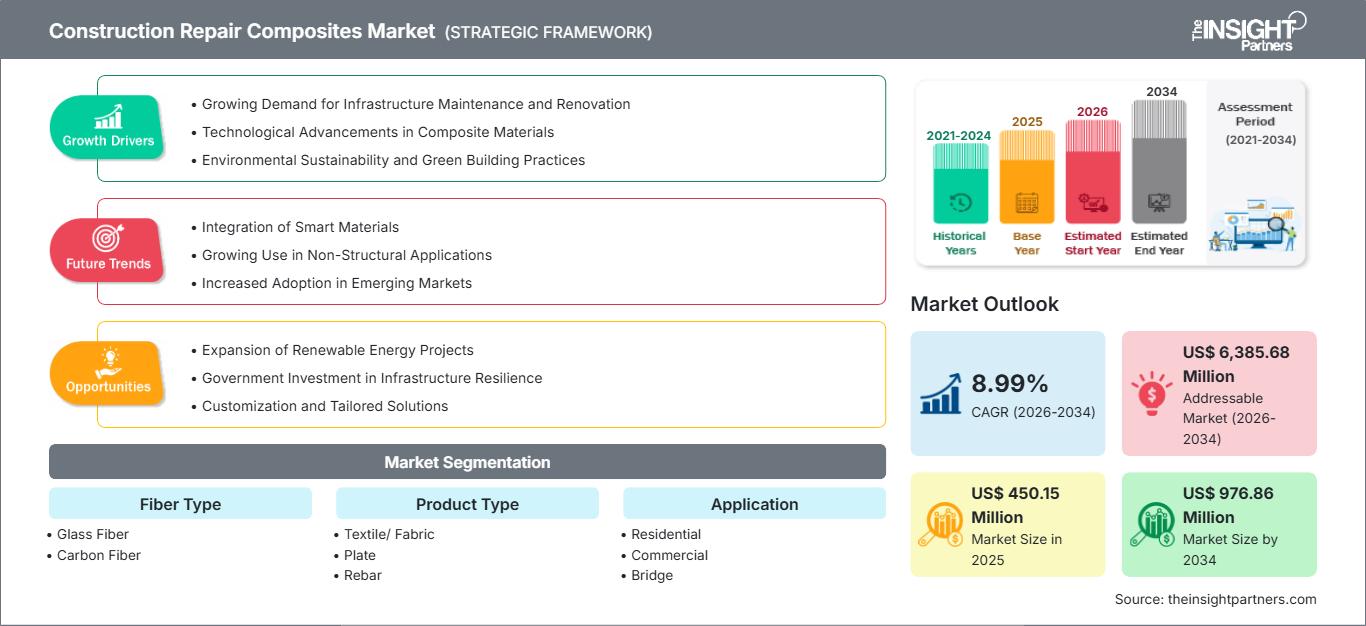
The construction repair composites market is valued at US$ 450.15 Million in 2025 and is projected to reach US$ 976.86 Million by 2034, registering a CAGR of 8.99% during 2026–2034. The market encompasses fiber-reinforced materials used to strengthen, repair, and extend the service life of structures, with demand spanning glass and carbon fiber systems, textile/fabric, plates, rebars, adhesives, and applications across residential, commercial, bridge, and pipeline assets.
North America is expected to remain a major demand center, with the construction repair composites market size supported by aging bridge inventories, rehabilitation spending, and requirements for minimizing traffic and operational disruption. The regional market is estimated to expand at a 9.1–9.6% CAGR from 2026–2034, supported by federal infrastructure programs, seismic strengthening requirements, corrosion mitigation, and growing specification of lightweight reinforcement systems.
Construction Repair Composites Market Assessment and Insights
- North America: North America is estimated to hold a 32–36% Construction Repair Composites Market share in 2025 and grow at a 9.1–9.6% CAGR between 2026–2034, supported by bridge rehabilitation, structural retrofits, and infrastructure renewal.
- US: The US represents approximately 72–76% of North America's 2025 market, expanding at a 9.2–9.7% CAGR between 2026–2034, supported by bridge investment and repair backlogs.
- Europe: Europe accounts for approximately 25–29% share in 2025 and is expected to grow at a 8.3–8.9% CAGR between 2026–2034, led by Germany, the UK, France, Italy, and Spain, where aging transport infrastructure supports rehabilitation.
- Asia Pacific: Asia Pacific represents approximately 27–31% share in 2025 and is projected to grow at a 10.0–10.6% CAGR between 2026–2034, led by China, Japan, India, South Korea, and Australia through infrastructure modernization.
- Largest Segment: Glass Fiber is estimated to command a 62–67% market share in 2025, with a 8.5–9.0% CAGR during 2026–2034, reflecting its cost-performance balance.
- High Growth Segment: Bridge applications represent approximately 33–38% share in 2025, with a 9.8–10.4% CAGR during 2026–2034, supported by aging transport structures and rehabilitation programs.
- Key companies analyzed in detail: Sika AG, MAPEI S.p.A., Saint-Gobain, Simpson Manufacturing Co., Inc., Aegion Corporation, DowAksa İleri Kompozit Malzemeler Sanayi A.Ş., AB-SCHOMBURG GmbH & Co. KG, Chomarat Group, SIREG GEOTECH S.r.l., and Owens Corning.
Source: The Insight Partners' analysis based on proprietary research, government publications, company annual reports, investor presentations, industry databases, and expert interviews.
Composite materials used in construction repairs are now moving away from materials used just for reinforcement towards a more comprehensive system that integrates fibers, resins, adhesives, and installation techniques. The glass fiber composite is still relevant for economically-sensitive situations, while the carbon fiber composite is gaining popularity in cases where tensile strength, minimal weight gain, and minor structural changes are critical.
As we move forward, the application of the material is anticipated to increase further in the Asia-Pacific region and in other countries that are developing their infrastructures. Factors that will have an effect on the application rate of the composite include regulations, structural designs, sustainability considerations, and contractor training. Investors are becoming more interested in buying complete systems, which means that companies who have everything can benefit.
Construction Repair Composites Market Report Scope
| Report Attribute | Details |
|---|---|
| Market size in 2025 | US$ 450.15 Million |
| Market Size by 2034 | US$ 976.86 Million |
| Global CAGR (2026 - 2034) | 8.99% |
| Historical Data | 2021-2024 |
| Forecast period | 2026-2034 |
Construction Repair Composites Market Analysis
The growth drivers for construction repair composites market in construction are directly related to the condition of infrastructure assets and the economics of increasing their lifetime. Bridges, commercial buildings, pipelines, and residential buildings face the challenge of reinforcement without adding to the dead load. The supply chain consists of fiber manufacturers, resin manufacturers, composite manufacturers, system formulators, consulting engineers, contractors, and owners, where technical requirements are a significant factor in the choice of materials prior to purchase.
Dynamics of supply differ among fibers. Glass fiber has the advantage of large production capacity and reinforcement production, while carbon fiber production is still driven by performance and economics of precursors and energy. Textile and laminate systems need downstream processing and quality control, while adhesives should be compatible with concrete, masonry, steel, and composite substrates. Hence, local installation capabilities remain one of the key factors of success.
The Construction Repair Composites Market report states that competitive positioning is becoming more and more oriented towards full systems of strengthening rather than single elements. Sika AG offers a combination of repair chemistry and strengthening materials, MAPEI S.p.A. has a complete structural strengthening range, whereas Simpson Manufacturing Co., Inc. focuses on engineered reinforcement solutions. Aegion Corporation is very relevant to infrastructure and pipeline restoration, whereas DowAksa İleri Kompozit Malzemeler Sanayi A.Ş. has carbon-fiber technology.
Investment is another way of growing a product portfolio and establishing local production facilities. The merger of Saint-Gobain and Fosroc enhances the construction chemicals portfolio, while Owens Corning has glass-fiber technology for strengthening infrastructure. Chomarat Group, SIREG GEOTECH S.r.l., and AB-SCHOMBURG GmbH & Co. KG compete by offering composite reinforcement and strengthening systems.
● REPORT CUSTOMIZATION
Tailor This Report To Align With Your Specific Business Requirements
This report can be customized to align precisely with your business objectives, scope, and target markets. Customization options include tailored segmentation, geography, competitive analysis, and strategic insights to support informed decision-making.
Customize This Report →WHAT YOU CAN ADJUST
- ● Segmentations
- ● Geography
- ● Competitive Analysis
- ● Language Preferences
Construction Repair Composites Market: Strategic Insights
Regional Insights
North America Construction Repair Composites Market
Market share of North America in 2025 is predicted at 32–36%, CAGR 9.1–9.6% during 2026–2034. United States leads in consumption within the region due to need for bridges repair, seismic upgrading, commercial building renovation, and corrosion protection for reinforcement. Canada boosts demand by means of transportation and public infrastructure maintenance.
Positive factors for the regional construction repair composites market include existing engineering standards, specialist applicators' network, and developed ecosystem with structural engineers, construction companies, and materials providers. Carbon fibers have special importance in case of high-load and seismic reinforcement, whereas glass fibers are applicable to rehabilitation in cost-effective manner. Pipeline rehabilitation creates another demand channel, especially if there is no economic reason for replacing pipes.
U.S. Construction Repair Composites Market
The United States is estimated to account for about 72-76% of the North American market share in 2025 and is anticipated to grow at a CAGR of 9.2-9.7% till 2034. Infrastructure investment by federal and state governments, requirements for rehabilitation of bridges and commercial building refurbishment present a wide variety of projects. Composite strengthening is more and more preferred in cases when traditional demolition or use of steel would make operations more lengthy, heavy or complex.
According to the construction repair composites market forecast, the largest application is found in bridges and commercial buildings, while pipeline rehabilitation forms an important industrial application segment. Among companies operating in this area there are such firms as Sika AG, Simpson Manufacturing Co., Inc., Aegion Corporation, Owens Corning. Installer qualification and engineering approval are important selection factors, as performance largely depends on surface treatment, fiber orientation, choice of resins, curing conditions.
Europe Construction Repair Composites Market
Europe is estimated to represent 25–29% share in 2025 and grow at a 8.3–8.9% CAGR during 2026–2034, with Germany serving as a leading national market. The area enjoys high infrastructure maintenance, sustainability requirements, and existing structural rehabilitation practices.
The UK and Germany are vital sources of demand. The UK is driven by the maintenance of bridge and transportation infrastructure, while Germany is benefited by the rehabilitation of aging road and rail bridges and strong engineering practices. Carbon and glass fiber materials are used where lower weight and faster reinforcement are desired.
The French, Italians, and Spanish are other sources of demand in terms of transportation infrastructure, rehabilitation of commercial buildings and infrastructure, and rehabilitation of aging structures. France is helped by big infrastructure projects, Italy by bridge and building rehabilitation, and Spain by transport and seismic-strengthening requirements.
APAC Construction Repair Composites Market
APAC is estimated to hold 27–31% share in 2025 and expand at a 10.0–10.6% CAGR during 2026–2034, making it the fastest-growing major region. China leads regional demand, followed by Japan, India, South Korea, and Australia.
Infrastructure modernization, bridge maintenance, urban expansion, and exposure to seismic and coastal conditions support composite adoption. Japan's aging bridge stock, India's infrastructure investment, China's extensive transport network, and Australia's corrosion exposure create distinct use cases for glass and carbon fiber systems.
Middle East & Africa Construction Repair Composites Market
Middle East & Africa is expected to expand at an 8.0–8.6% CAGR during 2026–2034, with Saudi Arabia representing a leading market. Commercial and transportation infrastructure is responsible for the needs of the UAE, whereas South Africa requires rehabilitation of old infrastructure, whether it be public infrastructure or industrial infrastructure.
The oil and gas industry provides a specific niche since pipeline and structural repairs help in minimizing shutdowns. The countries of Saudi Arabia and UAE require huge infrastructure development, whereas South Africa and other countries of MEA provide opportunities in bridges, industrial infrastructures, and utilities with regard to corrosion and installation weight.
Segmentation Analysis
Fiber Type
The fiber type segment is shaped by the trade-off between reinforcement cost, tensile performance, stiffness, installation requirements, and exposure conditions. Glass fiber remains the broader-volume solution, while carbon fiber is increasingly specified for demanding structural strengthening. The segment is expected to expand at a 8.5–9.0% CAGR during 2026–2034.
- Glass Fiber: Glass fiber provides a cost-efficient reinforcement option for columns, beams, walls, pipelines, and general rehabilitation. Its corrosion resistance and established processing routes support broad contractor adoption across routine strengthening projects.
- Carbon Fiber: Carbon fiber targets applications requiring high strength-to-weight performance and dimensional efficiency. Its relevance is particularly strong in bridge strengthening, seismic retrofit, and structures where added reinforcement weight must remain minimal.
Product Type
The product type segment covers engineered reinforcement formats and bonding materials required to transfer structural loads. Demand is influenced by project geometry, installation access, load requirements, and contractor expertise. The segment is projected to grow at a 8.7–9.3% CAGR during 2026–2034.
- Textile/ Fabric: Textile and fabric systems provide flexible reinforcement for irregular surfaces, beams, columns, walls, slabs, and bridge components. Their adaptability supports field installation where rigid reinforcement formats are difficult to position.
- Plate: Composite plates provide concentrated strengthening for beams, slabs, and other structural members requiring defined reinforcement paths. Their dimensional stability and controlled mechanical properties suit engineered rehabilitation specifications.
- Rebar: Composite rebars are used where corrosion resistance and long service life are priorities. Their application is strategically relevant to rehabilitation projects exposed to moisture, chlorides, chemicals, and other aggressive environments.
- Adhesive: Adhesives transfer stresses between composite reinforcement and the substrate. Their compatibility with concrete, steel, masonry, and composite surfaces makes formulation performance and installation conditions central to system reliability.
Application
Application demand is determined by structural condition, rehabilitation budgets, asset criticality, exposure environment, and acceptable downtime. Bridge projects represent the largest application, while commercial and pipeline projects provide additional expansion channels. The segment is forecast to grow at a 9.1–9.7% CAGR during 2026–2034.
- Residential: Residential applications include strengthening of beams, columns, walls, and other structural components. Adoption is concentrated in renovation, seismic reinforcement, and situations where strengthening must avoid extensive demolition.
- Commercial: Commercial buildings use composite systems for structural upgrades, changes in occupancy loads, seismic reinforcement, and localized rehabilitation. Reduced installation disruption can improve suitability for occupied properties.
- Bridge: Bridge rehabilitation is strategically important because strengthening can extend service life while minimizing traffic disruption. Lightweight reinforcement, corrosion resistance, and rapid installation make composite systems attractive for aging transport assets.
- Oil and Natural Gas Pipeline: Pipeline applications focus on localized reinforcement and corrosion-related repair. Composite systems can support continued operation where replacement would involve major excavation, shutdowns, environmental controls, or complex logistics.
Opportunity Snapshot
| Application | Revenue Contribution | Trend Tag | Adoption Stage |
| Residential | Low | Seismic Retrofit | Scaling |
| Commercial | Medium | Load Upgrade | Scaling |
| Bridge | High | Bridge Renewal | Mature |
| Oil and Natural Gas Pipeline | Medium | Corrosion Repair | Scaling |
Construction Repair Composites Market Growth Drivers and Impact Analysis
Aging infrastructure and rising rehabilitation requirements
Aging infrastructure will increasingly lead to structural evaluation, reinforcement, and life extension rather than replacement. In the US, federal transportation initiatives will continue to allocate significant funds to bridge rehabilitation, while Japan mandates regular inspection of road bridges as well as other infrastructures. The same trend prevails in Europe and Asia. Composite repairs will benefit from this scenario because reinforcement may be applied without the weight and inconvenience that comes along with using traditional steel materials. On the supplier side, the implication is an increased number of retrofit opportunities and a higher need for engineering systems. Repairing infrastructures is being considered based on criteria such as life extension, traffic interruptions, corrosion, and total lifetime costs.
Demand for corrosion-resistant and lightweight strengthening systems
Corrosion continues to pose an important challenge throughout the lifecycle of reinforced concrete, bridge members, coasting structures, and industrial infrastructure. Composite reinforcement provides protection against corrosion processes that typically affect traditional steel as well as low weight, which minimizes the burden on handling and loading of the structure. This property makes composite reinforcement particularly advantageous in the situation when reinforcement takes place in difficult circumstances or when additional strengthening does not change the dimensions of a structure. Thus, the market expands from bridges to office buildings, utilities, and pipelines. Manufacturers react by producing systems of reinforcement fabrics, plates, rebars, and corresponding adhesives. The business opportunity does not stop at the sales of fibers but includes the complete packages of repair, special equipment, engineering, inspection, and specifications.
Expansion of engineered rehabilitation and specialized installer networks
Composite repair requires more than material availability because structural performance depends on design calculations, substrate preparation, fiber placement, resin impregnation, curing, and quality assurance. Consequently, the expansion of certified or technically trained applicator networks is supporting market penetration. Engineering consultants and contractors increasingly influence material selection during the design stage, creating opportunities for suppliers with technical documentation and project support. This ecosystem effect also reduces adoption barriers in markets where composites remain less familiar than concrete repair mortars or steel reinforcement. Suppliers able to standardize installation procedures, provide training, and document performance can strengthen specification positions. Over time, greater contractor familiarity should shorten project evaluation cycles and increase repeat procurement, particularly for bridge, commercial, and pipeline rehabilitation where asset owners prioritize predictable execution.
Construction Repair Composites Market Future Trends
Digitalized structural assessment and performance-based repair design
Digital inspection technologies are expected to increasingly influence composite repair specifications. Asset owners can combine inspection imagery, structural monitoring, digital models, and maintenance histories to identify deterioration before severe capacity loss occurs. This creates a more targeted role for composite strengthening, with reinforcement designed around measured load paths rather than broad conventional repair assumptions. Over the forecast period, engineering workflows are likely to integrate condition assessment with lifecycle modeling, enabling asset owners to compare strengthening against replacement using service-life and disruption criteria. Suppliers may respond with digital design libraries, standardized calculation tools, installation monitoring, and documentation platforms. The trend could also improve material utilization by allowing reinforcement to be concentrated only where structural analysis identifies deficiencies, supporting more efficient designs while increasing confidence among engineers and infrastructure operators.
Lower-impact materials and circular composite systems
construction repair composites market trends indicate that environmental performance is expected to become more important as construction owners seek to reduce embodied impacts and waste generated by replacement projects. Repair composites can contribute indirectly by extending asset life and avoiding demolition, but material-level sustainability will increasingly receive attention. Manufacturers are likely to develop lower-emission resin formulations, recycled-content reinforcement options, improved packaging, and production processes with reduced energy intensity. The broader trend may also encourage environmental product declarations and project-level lifecycle assessments as procurement tools. Composite suppliers with documented environmental performance could gain an advantage in infrastructure tenders where sustainability criteria accompany technical specifications. Recycling remains technically challenging for many thermoset composite systems, so future innovation is likely to focus simultaneously on longer service life, material efficiency, recoverable reinforcement, and manufacturing waste reduction.
Construction Repair Composites Market Opportunities
Localized manufacturing and regional application centers
Regional production and application centers in the construction repair composites market represent an attractive opportunity because transportation, installer availability, and technical support can materially affect project economics. Growth in India, Southeast Asia, the Middle East, and selected Latin American markets creates scope for local fabrication of textile systems, plates, rebars, and compatible adhesives. Establishing application centers can shorten lead times while improving engineering support and installer training. Suppliers can also adapt product systems to local exposure conditions, construction practices, and regulatory requirements. Partnerships with engineering firms and specialist contractors may accelerate specification acceptance more effectively than conventional distribution alone. Investment should therefore prioritize markets where infrastructure rehabilitation pipelines are expanding and where imported composite systems face long lead times. Local technical capability can create a durable competitive position by combining product availability with application expertise.
Integrated bridge and pipeline rehabilitation packages
Integrated rehabilitation packages offer another opportunity in the construction repair composites market because asset owners increasingly prefer solutions that reduce coordination across multiple material suppliers. Bridge packages can combine surface preparation, structural repair, fiber reinforcement, plates, adhesives, protective coatings, and installation guidance. Pipeline packages can integrate composite reinforcement with inspection, corrosion assessment, surface preparation, and repair verification. Such bundled offerings allow suppliers to participate earlier in project planning and capture a greater portion of project value. The opportunity is particularly relevant for infrastructure operators seeking predictable shutdown periods and documented performance. Companies with complementary repair chemistry, composite reinforcement, and engineering capabilities can use these packages to differentiate beyond material pricing. Strategic alliances with inspection companies, engineering consultants, and specialist contractors can further broaden project access without requiring complete vertical integration.
Recent Developments
- August 2026: Pilatus (Stans, Switzerland) officially opened its center of advanced composite competence in the canton of Nidwalden, Switzerland. Effective immediately, the development and production of the company’s composite components will be united under one roof for the first time. The new building provides a state-of-the-art workplace for ≈300 employees and has been designed to meet the highest sustainability standards.
- August 2026: Denso announced its Composite Pipe Repair Systems, by launching Protal 3200CF and Protal 2800CF, two advanced, non-metallic solutions engineered to reinforce pipelines affected by corrosion, wall loss and mechanical damage while avoiding hot-welding and minimizing operational disruption.
Frequently Asked Questions

- Comprehensive Market Sizing and Forecast Analysis
- Detailed Segmentation Analysis
- In-Depth Market Dynamics Assessment
- Regional and Country-Level Insights
- Competitive Landscape and Company Benchmarking
- Strategic Business Intelligence
Recent Reports
Testimonials

The Insight Partners' SCADA System Market report is comprehensive, with valuable insights on current trends and future forecasts. The team was highly professional, responsive, and supportive throughout. We are very satisfied and highly recommend their services.
RAN KEDEM Partner, Reali Technologies LTDs
I requested a report on a very specific software market and the team produced the report in a few days. The information was very relevant and well presented. I then requested some changes and additions to the report. The team was again very responsive and I got the final report in less than a week.
JEAN-HERVE JENN Chairman, Future Analytica
We worked with The Insight Partners for an important market study and forecast. They gave us clear insights into opportunities and risks, which helped shape our plans. Their research was easy to use and based on solid data. It helped us make smart, confident decisions. We highly recommend them.
PIYUSH NAGPAL Sr. Vice President, High Beam Global
The Insight Partners delivered insightful, well-structured market research with strong domain expertise. Their team was professional and responsive throughout. The user-friendly website made accessing industry reports seamless. We highly recommend them for reliable, high-quality research services
YUKIHIKO ADACHI CEO, Deep Blue, LLC.
This is the first time I have purchased a market report from The Insight Partners.While I was unsure at first, I visited their web site and felt more comfortable to take the risk and purchase a market report.I am completely satisfied with the quality of the report and customer service. I had several questions and comments with the initial report, but after a couple of dialogs over email with their analyst I believe I have a report that I can use as input to our strategic planning process.Thank you so much for taking the extra time and making this a positive experience.I will definitely recommend your service to others and you will be my first call when we need further market data.
JOHN SUZUKI President and Chief Executive Officer, Board Director, BK Technologies
I wish to appreciate your support and the professionalism you displayed in the course of attending to my request for information regarding to infectious disease IVD market in Nigeria. I appreciate your patience, your guidance, and the fact that you were willing to offer a discount, which eventually made it possible for us to close a deal. I look forward to engaging The Insight Partners in the future, all thanks to the impression you have created in me as a result of this first encounter.
DR CHIJIOKE ONYIA MANAGING DIRECTOR, PineCrest Healthcare Ltd.Reason to Buy
- Informed Decision-Making
- Understanding Market Dynamics
- Competitive Analysis
- Identifying Emerging Markets
- Customer Insights
- Market Forecasts
- Risk Mitigation
- Boosting Operational Efficiency
- Strategic Planning
- Investment Justification
- Tracking Industry Innovations
- Aligning with Regulatory Trends





 Get Free Sample for