
Consumer Electronics Market Size, Share & Growth by 2034
Coverage: By Product Type {Electronic Devices (Smartphones, Television, Computer & Laptops, Digital Camera & Camcorders, Video Games, and Others), Home Appliance (Refrigerator, Washing Machine, Air Conditioner, Microwave Ovens, Vacuum Cleaners, and Others) Personal Care & Grooming (Smart Wearables, Beauty Electronics, and Others)}; By End-use (Residential and Commercial); By Distribution Channel (Online and Offline), and Geography
- Status : Data Released
- Report Code : TIPRE00006497
- Category : Electronics and Semiconductor
- No. of Pages : 150
- Available Report Formats :


- Last update date : August 04, 2026


2025 Market Size
US$ 872.38 Bn
Base year value
2034 Forecast
US$ 1,456.63 Bn
Projected by 2034
CAGR 2026-2034
5.86 %
Growth rate
Addressable Market
US$ 10,550.96 Bn
(2026-2034)
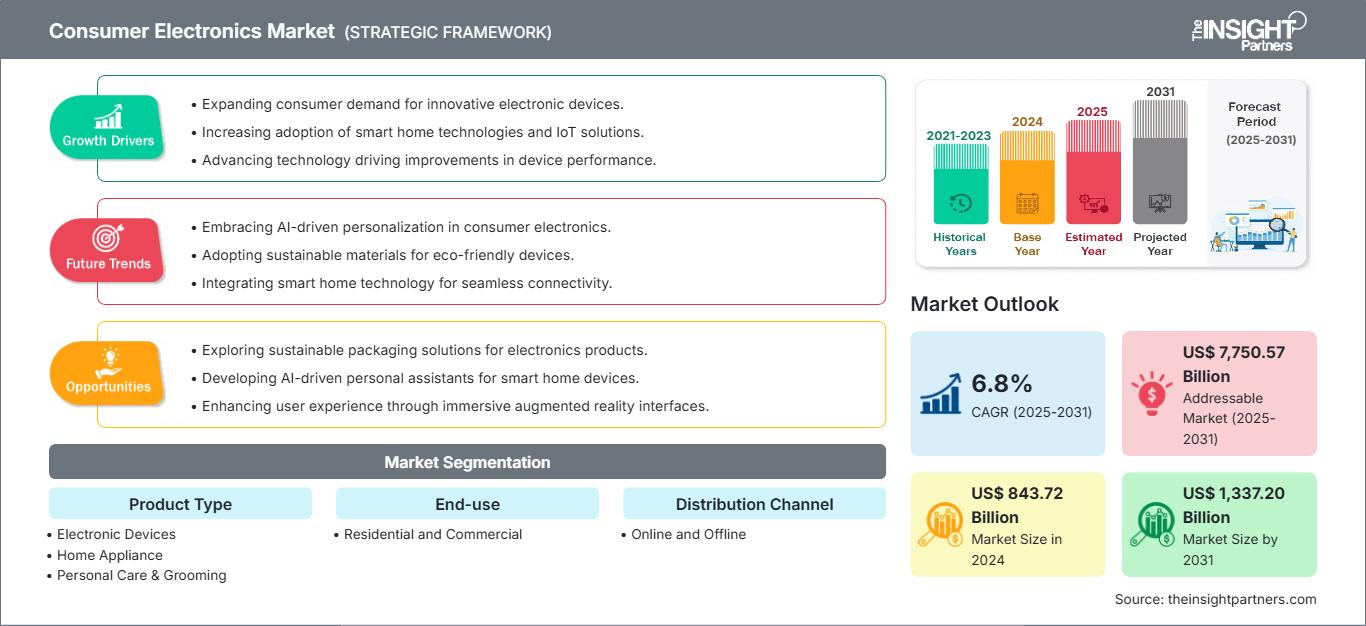
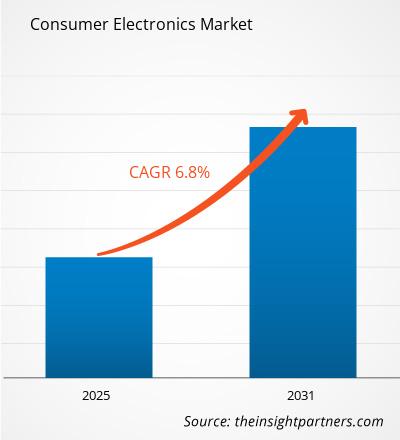
Consumer Electronics Market size stood at US$ 872.38 Bn in 2025 and is estimated to grow to US$ 1,456.63 Bn in 2034 registering a CAGR of 5.86% during 2026 to 2034. Key drivers are replacement needs of the devices, increasing uptake of the connected homes, adoption of artificial intelligence enabled interfaces, premiumization of phones, home appliances, grooming products and digital entertainment goods.
In North America, demand arising due to the replacement, high broadband availability and ecosystem of the connected devices will be driving the Consumer Electronics Market size during 2026–2034, where the market is anticipated to witness a CAGR of 4.8-5.4%. Growth will come from smart homes, AI computers, premium wearables and robust online sales channels.
Consumer Electronics Market Assessment and Insights
- North America held a 27–30% Consumer Electronics Market share in 2025 and is projected to grow at a 4.8–5.4% CAGR between 2026–2034, supported by premium devices, AI-enabled computing, connected homes, and mature omnichannel retail.
- US represented 78–82% of North America in 2025 and is expected to record a 4.7–5.3% CAGR between 2026–2034, led by smartphones, PCs, and smart-home upgrades.
- Europe accounted for 20–23% share in 2025 and may grow at a 4.1–4.8% CAGR between 2026–2034, with Germany, the UK, France, Italy, and Spain driving replacement-led demand.
- Asia Pacific captured 38–41% share in 2025 and is forecast to advance at a 6.5–7.2% CAGR between 2026–2034, led by China, India, Japan, South Korea, and Australia.
- Largest Segment Electronic Devices segment holds 52–56% market share in 2025 and is projected to grow at a CAGR of 5.2–5.9% during 2026–2034, driven by smartphones, laptops, and gaming devices.
- High Growth Segment Personal Care & Grooming segment accounts for 10–14% share in 2025 and is expected to grow at a CAGR of 7.2–8.0% during 2026–2034, driven by smart wearables and beauty electronics adoption.
- Key companies analyzed in detail: Samsung Electronics Co., Ltd., LG Electronics Inc., Sony Group Corporation, Panasonic Holdings Corporation, Koninklijke Philips N.V., Whirlpool Corporation, AB Electrolux, Apple Inc., HP Inc., Huawei Technologies Co., Ltd., Dell Technologies Inc., Toshiba Corporation, Haier Smart Home Co., Ltd., Xiaomi Corporation, Liebherr-International AG, Google LLC.
Source: The Insight Partners' analysis based on proprietary research, government publications, company annual reports, investor presentations, industry databases, and expert interviews.
The product evolution is shifting from individual hardware towards software-defined eco-systems, which enhance repeated purchases through devices, services, and accessories. The market growth is fueled by AI chips, OLED screens, edge connections, appliance automation and, in terms of production dynamics, semiconductor availability, battery availability, localization of components and flexible manufacturing footprints in East Asia, North America, and Europe.
The future market growth is bound to be driven by the rise of the emerging middle class, energy efficiency requirements, circular economy regulations and government spending on broadband infrastructure. The manufacturers are likely to realign their product mixes towards appliances for repairs, AI-based personal devices and accessory-bound hardware, whereas retailers leverage financing schemes, trade-ins, and online personalization.
Consumer Electronics Market Report Scope
| Report Attribute | Details |
|---|---|
| Market size in 2025 | US$ 872.38 Billion |
| Market Size by 2034 | US$ 1,456.63 Billion |
| Global CAGR (2026 - 2034) | 5.86% |
| Historical Data | 2021-2024 |
| Forecast period | 2026-2034 |
Consumer Electronics Market Analysis
The demand cycle is being driven by the replacement cycle of phones, laptops, TVs, and appliances, as consumers emphasize factors like battery life, screen quality, connectivity, and service integration. The value chain consists of chipset suppliers, display companies, contract manufacturers, brand owners, distributors, marketplaces, and aftermarket providers, resulting in margin pressure, as innovation cycles accelerate and warranty periods increase.
Supply chain dynamics remain vulnerable to prices for memory chips, logistics, rare earth materials, and trade policies, although top brands are moving toward diversity in their manufacturing and suppliers. The Consumer Electronics Market report shows that companies with platforms, manufacturing flexibility, and retail effectiveness are better positioned to deal with demand volatility and margin management.
The competitive landscape is dominated by Samsung Electronics Co., Ltd., Apple Inc., LG Electronics Inc., Sony Group Corporation, Xiaomi Corporation, and Huawei Technologies Co., Ltd., while HP Inc. and Dell Technologies Inc. continue to be crucial in computing. Portfolio development is becoming more about hardware releases coupled with software developments, financing, cloud solutions, warranties, and subscriptions.
Capital is flowing into AI-powered devices, energy-efficient products, health-related solutions, and local distribution. Whirlpool Corporation, AB Electrolux, Haier Smart Home Co., Ltd., and Liebherr-International AG focus on efficiency and premium kitchens, while Google LLC and Koninklijke Philips N.V. expand their connected ecosystems and personal care adjacencies.
● REPORT CUSTOMIZATION
Tailor This Report To Align With Your Specific Business Requirements
This report can be customized to align precisely with your business objectives, scope, and target markets. Customization options include tailored segmentation, geography, competitive analysis, and strategic insights to support informed decision-making.
Customize This Report →WHAT YOU CAN ADJUST
- ● Segmentations
- ● Geography
- ● Competitive Analysis
- ● Language Preferences
Consumer Electronics Market: Strategic Insights
Regional Insights
North America Consumer Electronics Market
North America accounted for a 27-30% share in 2025 and is estimated to record a 4.8-5.4% CAGR growth between 2026 and 2034. The segment is driven by the availability of devices, premium device replacements, and increased adoption of AI computers, wearables, Smart TVs, and appliances.
The retail execution in this region is organized with online platforms, carrier financing, and membership-driven marketplaces facilitating upgrades. Market Share of Consumer Electronics in North America is aided by the ecosystem of brands, enterprise refreshes, and smart home applications; however, trade war threats and longer appliance replacement cycles can limit revenue momentum.
U.S. Consumer Electronics Market
U.S. constitutes 78-82% share of North America in 2025, with growth forecasted at 4.7-5.3% CAGR until 2034. High demand in the region comes from smartphones, laptops, tablets, gaming systems, luxury home appliances, and smart homes, driven by subsidies and DTC sales.
Key players include Apple Inc., Samsung Electronics Co., Ltd., Google LLC, HP Inc., and Dell Technologies Inc. with their strong presence in the form of product ecosystems, physical stores, cloud computing, and business solutions. Commercial spending is encouraged by hybrid work environments, educational refreshes, and hospitality renovations, while residential customers opt for entertainment and energy-efficient devices.
Europe Consumer Electronics Market
The market share of Europe in 2025 was between 20 and 23 percent and expected to grow at a 4.1 to 4.8 percent CAGR from 2026 to 2034. In the region, Germany is expected to dominate due to its premium appliances, PCs, and entertainment devices, whereas the United Kingdom continues to show strength in electronic devices sold via the internet, subscriptions, and early adoption of smart homes.
France, Italy, and Spain drive replacement demand based on energy labels, repairable products, and inflation-driven buying. The Consumer Electronics Market in Europe is driven by sustainability regulation, extended producer responsibility, and durable appliances demand.
APAC Consumer Electronics Market
APAC region held a 38-41% market share in 2025 and will continue to grow at a CAGR of 6.5-7.2% from 2025 to 2034. China is the dominant nation in the region, owing to manufacturing, brands, 5G, and e-commerce.
Japan and South Korea help drive innovation in display, appliances, and mobile technologies, while India and Australia drive growth with online retail, increasing incomes, and adoption of smart homes. There is favorable policy towards electronics manufacturing, semiconductors, and energy-efficient appliances.
Middle East & Africa Consumer Electronics Market
Middle East and Africa is expected to grow at a 5.2–5.9% CAGR during 2026–2034. Saudi Arabia leads the region as infrastructure investment, premium retail, tourism projects, and connected living initiatives support demand for smartphones, displays, appliances, and smart-building electronics.
The UAE benefits from high expatriate purchasing power and omnichannel retail, while South Africa and Rest of MEA remain value-oriented but digitally expanding. Energy efficiency, cooling demand, and housing projects are important drivers for appliances and entertainment devices across urban centers.
Segmentation Analysis
Product Type
The Product Type segment in the Consumer Electronics Market is projected to grow at a CAGR of 5.6–6.2% during 2026–2034. The Consumer Electronics Market scope within this segment reflects diverse demand across electronic devices, home appliances, and personal care products. Continuous innovation in device functionality and increasing consumer preference for smart and connected products are driving segment expansion across both developed and emerging markets.
- Electronic Devices include smartphones, televisions, laptops, and gaming systems, which dominate demand due to high replacement cycles and continuous innovation, making them central to digital lifestyles and connectivity-driven consumer behavior.
- Home Appliance products such as refrigerators, washing machines, and air conditioners are witnessing steady demand driven by urbanization, rising incomes, and increasing adoption of energy-efficient appliances across residential sectors globally.
- Personal Care & Grooming devices, including smart wearables and beauty electronics, are gaining traction due to rising health awareness, lifestyle changes, and growing interest in personal wellness technologies among consumers.
End-use
The End-use segment is expected to grow at a CAGR of 5.4–6.0% during 2026–2034. Demand is primarily driven by residential consumers, although commercial applications are expanding steadily due to increasing adoption of digital solutions in offices, hospitality, and retail environments.
- Residential segment dominates due to widespread adoption of consumer electronics products, driven by increasing disposable income, urbanization, and the growing importance of connected living environments across global households.
- Commercial segment is expanding with increasing demand for digital displays, security systems, and connected appliances across sectors such as hospitality, retail, and corporate offices, supporting steady growth.
Distribution Channel
The Distribution Channel segment is projected to grow at a CAGR of 5.8–6.5% during 2026–2034. The shift toward digital retail platforms is transforming purchasing behavior, while offline channels continue to play a crucial role in product experience and after-sales services.
- Online channels are gaining significant traction due to convenience, competitive pricing, and availability of a wide range of products, supported by rapid growth in e-commerce platforms and digital payment systems globally.
- Offline channels remain relevant due to physical product experience, personalized services, and immediate product availability, especially in emerging markets where traditional retail continues to dominate consumer purchasing behavior.
Opportunity Snapshot
| End-use | Revenue Contribution | Trend Tag | Adoption Stage |
|---|---|---|---|
| Residential | High | Smart Living | Mature |
| Commercial | Medium | Digital Displays | Scaling |
Consumer Electronics Market Growth Drivers and Impact Analysis
AI-Enabled Device Replacement Cycles
AI-powered capabilities are starting to serve as a viable trigger for replacement instead of an expensive luxury. In fact, consumers are considering such things as camera capabilities, assistants, battery life, voice control, health information, and recommendations while making purchases of smartphones, laptops, wearable gadgets, and even home appliances. It helps to drive up ASPs where such benefits could be demonstrated every day, but forces mid-range players to integrate AI functionalities into their products. However, electronic gadgets still are the most affected products, although some appliances and cosmetics already started to apply sensor technologies.
Omnichannel Retail and Financing Models
The new retail models have made it easier to remove barriers to buying via trade-ins, financing options, accessory packs, instant deliveries, and extended warranties. Online search is now increasingly coupled with offline demonstrations and installations, particularly for appliances, TVs, and high-end computing equipment. This has led to a more predictable process from product introduction to conversion, enabling businesses to tweak their marketing programs on a regional, channel, and stock basis. The end result is a faster refresh cycle of gadgets and improved conversion rates for larger ticket items that had longer deliberation times before.
Energy Efficiency and Connected Living
Increasing energy efficiency affects the purchase of appliances, displays, and computing products as consumers and companies evaluate total operating costs. The concept of connected living means that devices like air conditioners, refrigerators, TVs, lights, speakers, and even personal items are being connected through home technology and voice interfaces. Rules for energy labeling and repairability mean that there is pressure for redesigning products, and the increased cost of electricity makes it more sensible to purchase energy-efficient products.
Consumer Electronics Market Future Trends
Device Ecosystems Become Service-Led Platforms
Consumer Electronics Market trends indicate towards an ecosystem for hardware where revenues can be achieved not only from hardware sales. It is expected that the brands will integrate smartphones, PCs, home appliances, TV sets, wearables, cloud computing, and repair services using common accounts and software updates. Such strategy would help retain customers, generate cross-selling, and maintain long-term relations with customers. This will be more beneficial for those companies which have their own operating systems, app ecosystems, and service infrastructure.
Repairability and Circular Design Gain Strategic Weight
Repair-friendliness, modularity, recycled material, and certified refurbishment will gain greater significance as the scrutiny on e-waste increases among regulatory agencies and consumers. Companies offering extended software lifecycle, available spare parts, and repair-friendly policies can mitigate compliance risks while creating consumer confidence at the same time. There is a business opportunity that arises as a result of this trend, which is additional income generation through certified used products, refurbished equipment, and maintenance contracts.
Consumer Electronics Market Opportunities
Localized Manufacturing and Supply Resilience
Consumer Electronics Market Forecasts indicate that regionalized production can become a strategic opportunity as companies seek shorter lead times, tariff flexibility, and supply continuity. Investment in assembly, component qualification, and after-sales logistics near demand centers can reduce exposure to disruptions and improve responsiveness to local product preferences. Governments supporting semiconductor packaging, electronics manufacturing, and energy-efficient appliance production may attract supplier ecosystems. Companies that align manufacturing footprints with channel demand can improve availability, protect margins, and strengthen retailer relationships. Increasing adoption of digital manufacturing, automation, and predictive supply chain analytics will further strengthen localized production strategies. Companies investing in flexible manufacturing capacity, diversified supplier networks, and regional distribution hubs can respond more effectively to demand fluctuations, minimize transportation risks, and improve operational resilience while meeting evolving regulatory and sustainability requirements across global markets.
Commercial Modernization Across Workplaces and Hospitality
Commercial modernization offers an actionable opportunity for vendors selling PCs, displays, collaboration devices, appliances, audio systems, and connected controls. Offices need hybrid meeting rooms, schools require durable learning devices, retailers deploy digital signage, and hotels upgrade guest-room entertainment and efficient appliances. The opportunity depends on bundled solutions, installation support, cybersecurity readiness, and lifecycle service contracts. Vendors that combine hardware with financing, fleet management, and maintenance can convert fragmented replacement spending into structured, repeatable enterprise relationships. Demand for integrated technology ecosystems is expected to increase as organizations prioritize operational efficiency, user experience, and long-term cost optimization. Suppliers offering cloud-enabled management platforms, energy-efficient equipment, remote monitoring, and scalable service packages will be better positioned to secure multi-site deployments, strengthen customer retention, and generate recurring revenue through long-term commercial partnerships.
Recent Developments
- July 2026: Apple launched Apple Upgrade in the United States, a new leasing program that lets customers lease iPhones, iPads, Macs, and Apple Watches with flexible monthly payments through Klarna. Users can upgrade, purchase, or return their devices at the end of the lease term, replacing Apple’s previous iPhone Upgrade Program and expanding financing options across more products.
- July 2026: Reports indicate that Google is expected to unveil the Pixel 11 series, Pixel Watch 5, and other AI-focused devices at its Made by Google event in August 2026. The launch is anticipated to introduce upgraded Tensor-powered AI features, camera enhancements, and tighter ecosystem integration across Google's hardware lineup.
- July 2026: Samsung introduced the Galaxy Z Fold7, Galaxy Z Flip7, and the new Galaxy Z Flip7 FE, expanding its foldable smartphone portfolio. The new devices feature slimmer designs, enhanced Galaxy AI capabilities, improved performance, and upgraded cameras, reinforcing Samsung’s leadership in the premium foldable smartphone market.
Frequently Asked Questions

- Comprehensive Market Sizing and Forecast Analysis
- Detailed Segmentation Analysis
- In-Depth Market Dynamics Assessment
- Regional and Country-Level Insights
- Competitive Landscape and Company Benchmarking
- Strategic Business Intelligence
Recent Reports
Testimonials

The Insight Partners' SCADA System Market report is comprehensive, with valuable insights on current trends and future forecasts. The team was highly professional, responsive, and supportive throughout. We are very satisfied and highly recommend their services.
RAN KEDEM Partner, Reali Technologies LTDs
I requested a report on a very specific software market and the team produced the report in a few days. The information was very relevant and well presented. I then requested some changes and additions to the report. The team was again very responsive and I got the final report in less than a week.
JEAN-HERVE JENN Chairman, Future Analytica
We worked with The Insight Partners for an important market study and forecast. They gave us clear insights into opportunities and risks, which helped shape our plans. Their research was easy to use and based on solid data. It helped us make smart, confident decisions. We highly recommend them.
PIYUSH NAGPAL Sr. Vice President, High Beam Global
The Insight Partners delivered insightful, well-structured market research with strong domain expertise. Their team was professional and responsive throughout. The user-friendly website made accessing industry reports seamless. We highly recommend them for reliable, high-quality research services
YUKIHIKO ADACHI CEO, Deep Blue, LLC.
This is the first time I have purchased a market report from The Insight Partners.While I was unsure at first, I visited their web site and felt more comfortable to take the risk and purchase a market report.I am completely satisfied with the quality of the report and customer service. I had several questions and comments with the initial report, but after a couple of dialogs over email with their analyst I believe I have a report that I can use as input to our strategic planning process.Thank you so much for taking the extra time and making this a positive experience.I will definitely recommend your service to others and you will be my first call when we need further market data.
JOHN SUZUKI President and Chief Executive Officer, Board Director, BK Technologies
I wish to appreciate your support and the professionalism you displayed in the course of attending to my request for information regarding to infectious disease IVD market in Nigeria. I appreciate your patience, your guidance, and the fact that you were willing to offer a discount, which eventually made it possible for us to close a deal. I look forward to engaging The Insight Partners in the future, all thanks to the impression you have created in me as a result of this first encounter.
DR CHIJIOKE ONYIA MANAGING DIRECTOR, PineCrest Healthcare Ltd.Reason to Buy
- Informed Decision-Making
- Understanding Market Dynamics
- Competitive Analysis
- Identifying Emerging Markets
- Customer Insights
- Market Forecasts
- Risk Mitigation
- Boosting Operational Efficiency
- Strategic Planning
- Investment Justification
- Tracking Industry Innovations
- Aligning with Regulatory Trends





 Get Free Sample for