
Controlled Release Fertilizer Market Size, Share & Demand by 2034
Coverage: By Type (Slow Release, Coated and Encapsulated, Nitrogen Stabilizer); Mode of Application (Foliar, Fertigation, Soil); Application (Agriculture, Non-Agriculture) , and Geography (North America, Europe, Asia Pacific, and South and Central America)
- Status : Data Released
- Report Code : TIPRE00005625
- Category : Chemicals and Materials
- No. of Pages : 150
- Available Report Formats :


- Last update date : September 01, 2026


2025 Market Size
US$ 3.26 Bn
Base year value
2034 Forecast
US$ 4.92 Bn
Projected by 2034
CAGR 2026-2034
5.27 %
Growth rate
Addressable Market
US$ 38.26 Bn
(2026-2034)
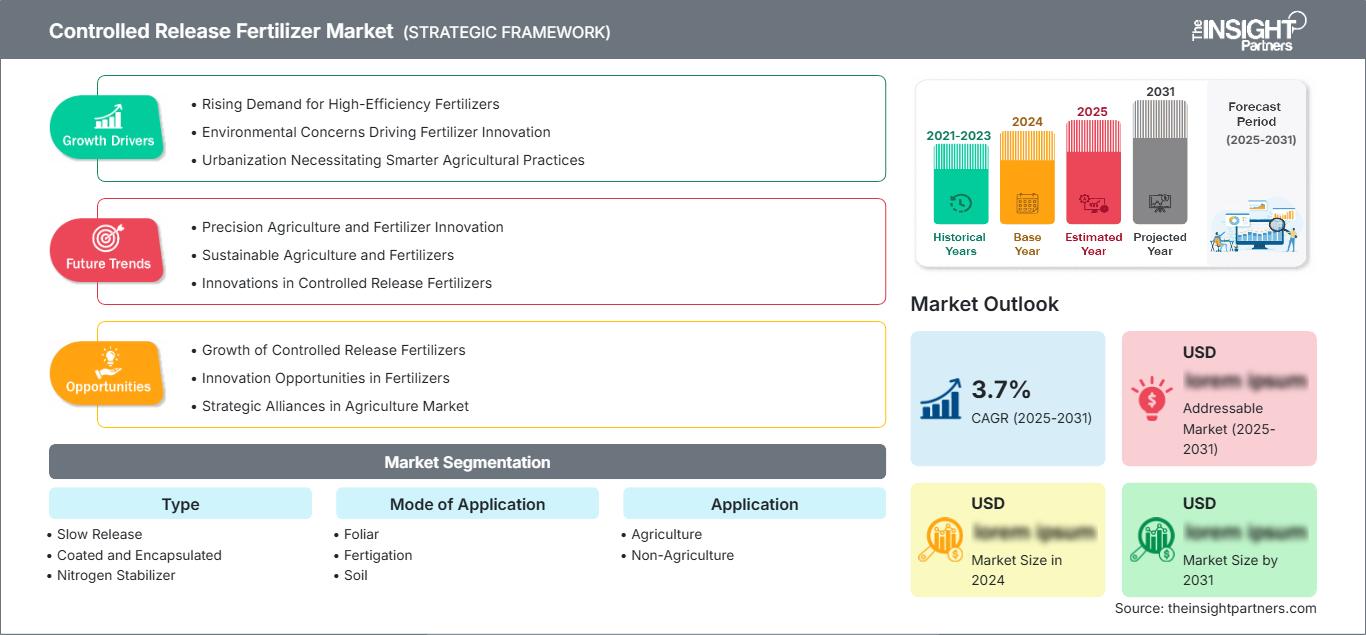
The Controlled Release Fertilizer Market size is valued at US$ 3.26 Billion in 2025 and is projected to reach US$ 4.92 Billion by 2034, expanding at a 5.27% CAGR from 2026 to 2034. Growth is supported by increasing emphasis on nutrient-use efficiency, reduced fertilizer losses, and application practices that synchronize nutrient availability with crop requirements. Coated formulations, stabilized nitrogen products, and precision application systems are reshaping product development and procurement decisions across agricultural and non-agricultural end uses.
North America is expected to remain a structurally important market, with an estimated 4.8–5.4% CAGR during 2026–2034. The regional controlled release fertilizer size outlook is supported by established specialty fertilizer distribution, professional turf management, greenhouse production, and demand for fewer field applications. Adoption is also encouraged by labor constraints and greater emphasis on improving nitrogen efficiency while limiting nutrient movement beyond crop root zones.
Controlled Release Fertilizer Market Assessment and Insights
- North America: North America is estimated to account for 55–58% Controlled Release Fertilizer Market share in 2025 and expand at a 4.8–5.4% CAGR between 2026–2034, supported by established horticulture, turf, specialty crop production, and demand for efficient nutrient management.
- US: The US represents approximately 82–85% of North America's 2025 share and is expected to grow at a 4.7–5.3% CAGR between 2026–2034, led by specialty agriculture and professional turf applications.
- Europe: Europe is estimated at 16–19% share in 2025, growing at 5.0–5.7% CAGR between 2026–2034, with Germany, France, the UK, Italy, and Spain benefiting from tighter nutrient-loss priorities and demand for advanced fertilizer technologies.
- Asia Pacific: Asia Pacific is estimated at 18–21% share in 2025 and is projected to expand at 6.4–7.2% CAGR between 2026–2034, with China, India, Japan, South Korea, and Australia driving adoption through intensive agriculture and specialty crop production.
- Largest Segment: Coated and Encapsulated is estimated to hold 58–62% market share in 2025, with a 5.6–6.1% CAGR during 2026–2034, reflecting its established role in controlled nutrient delivery.
- High Growth Segment: Fertigation is estimated at 18–22% market share in 2025, with a 6.5–7.3% CAGR during 2026–2034, supported by protected cultivation and precision irrigation.
- Key companies analyzed in detail: AGLUKON Spezialdünger GmbH & Co. KG, COMPO EXPERT GmbH, Haifa Negev Technologies Ltd., Helena Agri-Enterprises, LLC, ICL Group Ltd., JCAM AGRI, Kingenta Ecological Engineering Group Co., Ltd., Koch Fertilizer, LLC, The Scotts Miracle-Gro Company, and Yara International ASA.
Source: The Insight Partners' analysis based on proprietary research, government publications, company annual reports, investor presentations, industry databases, and expert interviews.
The Controlled Release Fertilizer Market has grown from conventional slow release fertilizers to advanced products with controlled nutrient release through coatings, encapsulations, stabilization and release response. Innovations in the form of polymer coatings, technology sensitive to temperature, increased uniformity of the granules and specific nutrient contents are leading to better formulation processes. Product development in accordance with particular crops' life cycle, soils, climate and application equipment along with production facilities that combine specialty fertilizers blending and coating is another trend observed.
Prospects for further growth in the Controlled Release Fertilizer Market will be influenced by locations where intensive farming faces problems with water supply, labor shortage and loss of nutrients. Opportunities include locations like India, China, Southeast Asia, Latin America and certain parts of the Middle East. The demands in Europe in terms of regulations are also driving investments in biodegradable coating technology while the manufacturers assess the environmental impact of ingredients in their product development process.
Controlled Release Fertilizer Market Report Scope
| Report Attribute | Details |
|---|---|
| Market size in 2025 | US$ 3.26 Billion |
| Market Size by 2034 | US$ 4.92 Billion |
| Global CAGR (2026 - 2034) | 5.27% |
| Historical Data | 2021-2024 |
| Forecast period | 2026-2034 |
Controlled Release Fertilizer Market Analysis
Controlled Release Fertilizer Market development is directly related to the increased demand for nutrient use efficiency and predictable nutrition of crops. The producers offer nutrient cores, coatings, stabilized nitrogen products, and blended products, whereas distributors and agronomists affect the choice of fertilizers. The demand is strongest in those places where a higher price per unit of weight may be justified by a decreased frequency of application, increased efficiency of nutrients absorption, labor saving, or better agricultural practices.
The value chain in the Controlled Release Fertilizer Market consists of producers of fertilizers, coating technologies, agricultural distributors, irrigators, farmers, greenhouse operators, turf managers, and institutional clients. The supply is determined by availability of nitrogen, phosphates, potash, polymer, and special additives. For the producers with integrated production and regional distribution, it is possible to minimize logistics risk; meanwhile, local blending provides flexibility to adapt to the crop calendar, climate, and regulations.
According to the Controlled Release Fertilizer Market report, competition in the market is characterized by differentiation based on the coating performance, duration of nutrient release, crop-specific formulations and distribution capacity among existing specialized fertilizer firms. ICL and Haifa Negev Technologies have wide-ranging controlled-release products whereas COMPO EXPERT specializes in polymer-coating and climate-controlled release. Yara International ASA, Koch Fertilizer, LLC, Kingenta and AGLUKON compete based on their expertise in fertilizers.
Funding in the Controlled Release Fertilizer Market has increasingly focused on developing better coating technology, environmentally sustainable materials, precision nutrition, and local manufacture. ICL has developed a new technology for environmentally friendly coating material while Kingenta added controlled-release manufacturing capacity in Europe. Positioning strategies will increasingly be shaped by demonstrating reliable nutrient release, minimal environmental losses, and economic suitability of products to farms' operations. Agronomy knowledge and efficient distribution channels among firms will aid in improving the adoption of products that require evidence of return on fertilizer investment.
● REPORT CUSTOMIZATION
Tailor This Report To Align With Your Specific Business Requirements
This report can be customized to align precisely with your business objectives, scope, and target markets. Customization options include tailored segmentation, geography, competitive analysis, and strategic insights to support informed decision-making.
Customize This Report →WHAT YOU CAN ADJUST
- ● Segmentations
- ● Geography
- ● Competitive Analysis
- ● Language Preferences
Controlled Release Fertilizer Market: Strategic Insights
Regional Insights
North America Controlled Release Fertilizer Market
North America is estimated to represent 55–58% share in 2025 and is expected to expand at a 4.8–5.4% CAGR through 2034. The US is the key consumer in the region due to specialty farming, nursery growing, greenhouse cultivation, turf farming, and professional landscaping. Canada adds to it via greenhouse horticulture, specialty crops, and controlled environment agriculture. Economics of the products are especially appealing in places where labor and application costs are high.
Nutrient management goals and advanced crop planning practices influence regional demand as well. Controlled release products help decrease application rates and increase synchronicity of nutrient release and plant assimilation. The market has well-developed distribution channels, agronomic services and knowledge on coated fertilizers. The main ways of product differentiation are predictability of release, micronutrients inclusion, low loss rate and precision agriculture compatibility.
U.S. Controlled Release Fertilizer Market
The US accounts for approximately 82–85% of North America's 2025 share and is projected to grow at a 4.7–5.3% CAGR. Demand is diverse and includes row crops, specialty crops, nurseries, greenhouse production, turf, and landscaping. Professional growers are especially responsive when the benefits of less frequent application overcome the premium cost of specialty products.
Competitive forces in the market include The Scotts Miracle-Gro Company, Helena Agri-Enterprises, LLC, Koch Fertilizer, LLC, ICL Group Ltd., and other well-known producers. Application tendencies increasingly tend toward products that lend themselves to accurate placement and comprehensive nutrient programs. Horticultural turf and ornamental applications continue to be important, since controlled-release products ease fertilizing. Agricultural users now increasingly select products on their efficiency, labor costs, plant responses, and total cost for each production period rather than fertilizer costs alone.
Europe Controlled Release Fertilizer Market
Europe represents approximately 16–19% share in 2025 and is forecast to grow at a 5.0–5.7% CAGR, with Germany among the leading markets. The European demand is increasingly influenced by the need to reduce nutrient loss, increase fertilizer efficiency and compliance with regulations relating to coating materials and fertilizer compositions.
There is an established demand within the UK professional horticulture, turf and specialist crop sectors, where the predictability of nutrient supply facilitates efficient management. The German market benefits from an established demand within the specialty fertilizers and horticulture sectors, creating opportunities for coated and stabilized fertilizers. The markets in France, Italy and Spain present further opportunities due to intensive agriculture, viticulture, fruit growing, protected cropping and ornamentals horticulture.
APAC Controlled Release Fertilizer Market
APAC is estimated at 18–21% share in 2025 and is projected to grow at 6.4–7.2% CAGR, making it the leading high-growth region. Scale is provided by China and India, while intensive farming, horticulture, and advanced agriculture methods are supplied by Japan, South Korea, and Australia.
China holds the title of the dominant market in APAC due to intensive agriculture and fertilizers efficiency programs. India is an important country for growth because more and more growers are applying precise nutrient management and protected agriculture techniques. Japan and South Korea focus on premium crops, whereas Australia provides a chance for broadacre and specialty agriculture.
Middle East & Africa Controlled Release Fertilizer Market
Middle East and Africa demand is developing from a smaller base, with growth supported by protected cultivation, horticulture, water scarcity, and investment in modern agricultural infrastructure. Saudi Arabia and the UAE are important Gulf markets, while South Africa anchors demand in the region's commercial agriculture and horticulture sectors.
Saudi Arabia benefits from controlled-environment agriculture and resource-efficient production, while the UAE emphasizes greenhouse and hydroponic systems. South Africa provides opportunities across fruit, horticulture, turf, and commercial farming. The rest of MEA remains fragmented, but irrigation development and food-security programs can support adoption. Fertilizer products that reduce application frequency and improve nutrient retention are particularly relevant where water and skilled agricultural labor are constrained.
Segmentation Analysis
Type
The Type segment is projected to grow at a 5.5–6.0% CAGR during 2026–2034. Coating and stabilization technologies remain central to product differentiation, while demand increasingly favors formulations that provide predictable nutrient availability. Producers are balancing release performance, formulation cost, environmental compatibility, and crop-specific requirements.
- Slow Release: Slow-release products provide gradual nutrient availability and remain relevant where growers seek simpler fertilization schedules. Their strategic importance is strongest in horticulture, turf, landscaping, and selected agricultural applications requiring extended nutrient supply.
- Coated and Encapsulated: Coated and encapsulated products represent the leading technology category because coating thickness and material properties can regulate nutrient diffusion. They support tailored release durations and increasingly accommodate biodegradable material development.
- Nitrogen Stabilizer: Nitrogen stabilizers address nutrient transformation and loss pathways rather than relying solely on physical encapsulation. They are strategically relevant where nitrogen efficiency, application timing, and reduced volatilization or nitrification losses influence fertilizer decisions.
Mode of Application
The Mode of Application segment is expected to expand at a 5.8–6.3% CAGR during 2026–2034. Adoption increasingly reflects compatibility with modern irrigation, crop-management practices, and labor-saving approaches. Application selection depends on crop type, formulation characteristics, irrigation infrastructure, and nutrient timing requirements.
- Foliar: Foliar application supports rapid nutrient delivery and is strategically useful for targeted supplementation. Its role is strongest where growers require crop-stage-specific nutrition and compatibility with integrated plant-protection or biostimulant programs.
- Fertigation: Fertigation benefits from expanding irrigation infrastructure and protected cultivation. It enables nutrient delivery alongside water and supports precise scheduling, making it particularly relevant for high-value crops, greenhouse systems, and water-efficient agriculture.
- Soil: Soil application remains fundamental because granular controlled-release products can provide sustained nutrition without continuous equipment-intensive dosing. It is widely applicable across field crops, horticulture, turf, nurseries, and plantation systems.
Application
The Application segment is projected to grow at a 5.1–5.6% CAGR during 2026–2034. Agricultural use provides the largest demand base, while non-agricultural applications remain important for turf, landscaping, ornamentals, and professional horticulture. The controlled release fertilizer scope therefore spans both food production and managed green spaces.
- Agriculture: Agriculture represents the core demand base, supported by crop productivity requirements, nutrient-use efficiency objectives, and pressure to reduce application losses. Adoption is strongest in higher-value crops and intensive production systems.
- Non-Agriculture: Non-agricultural demand includes turf, landscaping, ornamentals, nurseries, and related managed environments. Buyers prioritize uniform growth, predictable feeding, labor efficiency, and reduced risk of nutrient surges during sensitive growth periods.
Opportunity Snapshot
| Application | Revenue Contribution | Trend Tag | Adoption Stage |
|---|---|---|---|
| Agriculture | High | Precision Nutrition | Scaling |
| Non-Agriculture | Medium | Turf Efficiency | Mature |
Controlled Release Fertilizer Market Growth Drivers and Impact Analysis
Rising emphasis on nutrient-use efficiency
Increasing attention to nutrient-use efficiency is changing fertilizer procurement from volume-based purchasing toward performance-oriented nutrition. The use of controlled-release formulations would help control the release of nutrients and ensure their availability at the right time without any mismatch with the growth of crops. This will be commercially beneficial in view of the fact that losses, additional applications, and different crop response raise the costs of operations. The change will allow companies to invest more in the technology of release control, better coating, nitrogen stabilization, and formulations for specific crops. The effect will be especially notable in high-value horticulture and intensive agriculture where the cost of fertilizers is weighed against the crop's quality and yield.
Expansion of protected and precision agriculture
Protected cultivation and precision agriculture are broadening the addressable base for controlled nutrient technologies. Greenhouses, nurseries, fertigation systems, and high-value horticultural operations require predictable nutrient delivery because crop cycles are managed closely and production inputs are monitored continuously. Controlled-release products can complement these systems by reducing manual application requirements and supporting nutrient availability across defined growth stages. Expansion of irrigation infrastructure also strengthens the relevance of fertigation-compatible nutrition. Commercial impact extends beyond product sales because growers may evaluate fertilizer solutions alongside irrigation equipment, crop-management software, agronomic services, and substrate technologies. Suppliers capable of integrating controlled-release products into complete nutrient programs can therefore participate in a broader value chain. This driver is particularly relevant across APAC and the Middle East, where protected cultivation and resource-efficient farming are expanding.
Regulatory pressure on fertilizer losses and coating materials
Regulatory priorities surrounding nutrient losses and environmental performance are influencing product design and market access. Europe is an important example because fertilizer policy increasingly emphasizes nutrient efficiency and sustainability, encouraging manufacturers to develop coating systems with stronger environmental credentials. Biodegradable coatings can provide an alternative pathway where conventional polymer materials face greater scrutiny. The commercial effect is twofold: established products may require reformulation or certification, while innovative suppliers can differentiate through documented environmental performance. Manufacturers must also consider coating durability, release consistency, degradation behavior, and compatibility with existing production equipment. These requirements increase development complexity but can create barriers to entry for less specialized competitors. Over time, regulatory alignment is likely to become a purchasing criterion alongside nutrient content, release duration, price, and agronomic performance.
Controlled Release Fertilizer Market Future Trends
Biodegradable coating platforms become more prominent
The Controlled Release Fertilizer Market trends are increasingly centered on biodegradable coating technologies that combine predictable nutrient release with lower persistence after nutrient depletion. Product developers are expected to focus on coating chemistries that maintain mechanical integrity during storage, handling, and application while degrading appropriately after their functional period. The next generation of products will likely offer multiple release durations and nutrient combinations without sacrificing agronomic consistency. Regulatory compliance will increasingly influence formulation choices, especially in Europe. Manufacturers may also use biodegradable coatings as a differentiation tool in markets where sustainability claims are becoming more important to distributors and growers. The commercial challenge will be maintaining cost competitiveness because biodegradable materials can involve higher development and manufacturing costs. Successful platforms will need to demonstrate measurable agronomic performance and reliable degradation characteristics.
Data-linked nutrient release becomes a product differentiator
Future product development is likely to connect controlled nutrient delivery more closely with crop data, weather information, irrigation schedules, and digital agronomy. Rather than treating release duration as a fixed product attribute, suppliers can develop formulations selected according to crop cycle, temperature profile, soil conditions, and expected irrigation patterns. Digital decision-support tools may help growers select products and application rates with greater precision. Manufacturers could increasingly provide release curves, crop-specific recommendations, and field performance datasets alongside physical fertilizer products. This approach can strengthen customer retention because product selection becomes integrated with agronomic decision-making. It may also encourage more customized formulations for high-value crops, greenhouse systems, plantations, and specialty horticulture. Over time, data-supported recommendations could help bridge the knowledge gap that currently limits adoption among growers unfamiliar with premium controlled-release products.
Controlled Release Fertilizer Market Opportunities
Localize production in high-growth agricultural markets
The Controlled Release Fertilizer Market Forecasts indicate an opportunity for manufacturers to localize production and formulation in high-growth markets where imported specialty fertilizers face logistics costs, currency exposure, or supply uncertainty. India, China, Southeast Asia, Brazil, and selected Middle Eastern countries offer potential for regional manufacturing partnerships and blending facilities. Local production can shorten delivery times while allowing suppliers to adapt nutrient ratios, release durations, and packaging to regional crop cycles. Partnerships with fertilizer distributors, irrigation companies, agronomic advisers, and greenhouse operators can accelerate market penetration. Investors should prioritize locations offering access to fertilizer raw materials, established agricultural distribution, and expanding specialty crop production. Localization also provides a pathway to develop formulations suited to local climate conditions rather than relying entirely on products originally designed for temperate markets.
Develop premium formulations for high-value crops
High-value horticulture presents an attractive opportunity because growers can justify premium fertilizer technologies when crop quality, labor efficiency, and input precision materially influence returns. Fruit, vegetables, ornamentals, nursery plants, plantation crops, and protected cultivation systems can support differentiated formulations with customized release durations and micronutrient combinations. Suppliers can build value through crop-specific products rather than standardized fertilizer grades. Commercial strategies should emphasize measurable application savings, nutrient consistency, and compatibility with irrigation or substrate systems. The opportunity also extends to technical services, including crop nutrition programs, release-duration selection, and field monitoring. Companies with strong agronomic capabilities can therefore capture value beyond fertilizer manufacturing. Strategic expansion into these applications can diversify revenue while reducing dependence on large-volume commodity fertilizer categories.
Recent Developments
- June 2026: July 2026: Koch Ag & Energy Solutions (Koch) and OCP Nutricrops S.A. (OCP) signed an agreement for Koch to invest in Jorf Fertilizers Company I (JFC I), from OCP Nutricrops. Upon closing, the transaction will establish a 50/50 operating joint venture between Koch and OCP. This agreement enhances the long-standing relationship between Koch and OCP that was strengthened in 2022 when Koch acquired a 50% interest in Jorf Fertilizers Company III, renamed Kofert. JFC I owns and operates a phosphate fertilizer production facility in Jorf Lasfar, Morocco, with the capacity to produce up to 1.2 million metric tons annually of phosphate-based fertilizers. It is one component of the Jorf Fertilizer Complex, the world's largest phosphate fertilizer production platform.
- May 2025: Coromandel Chemicals Limited, a wholly-owned subsidiary of Coromandel International Limited, signed definitive agreements to form a joint venture with Sakarni Plaster for the manufacture and sale of Phospho Gypsum-based Green Building Materials. This Joint Venture enables Coromandel to diversify beyond its core agri-inputs business, enhance integration synergies and create long-term value. For Sakarni, the alliance facilitates expansion of its product portfolio, market diversification and reinforces its leadership in the gypsum plaster industry.
Frequently Asked Questions

- Comprehensive Market Sizing and Forecast Analysis
- Detailed Segmentation Analysis
- In-Depth Market Dynamics Assessment
- Regional and Country-Level Insights
- Competitive Landscape and Company Benchmarking
- Strategic Business Intelligence
Recent Reports
Testimonials

The Insight Partners' SCADA System Market report is comprehensive, with valuable insights on current trends and future forecasts. The team was highly professional, responsive, and supportive throughout. We are very satisfied and highly recommend their services.
RAN KEDEM Partner, Reali Technologies LTDs
I requested a report on a very specific software market and the team produced the report in a few days. The information was very relevant and well presented. I then requested some changes and additions to the report. The team was again very responsive and I got the final report in less than a week.
JEAN-HERVE JENN Chairman, Future Analytica
We worked with The Insight Partners for an important market study and forecast. They gave us clear insights into opportunities and risks, which helped shape our plans. Their research was easy to use and based on solid data. It helped us make smart, confident decisions. We highly recommend them.
PIYUSH NAGPAL Sr. Vice President, High Beam Global
The Insight Partners delivered insightful, well-structured market research with strong domain expertise. Their team was professional and responsive throughout. The user-friendly website made accessing industry reports seamless. We highly recommend them for reliable, high-quality research services
YUKIHIKO ADACHI CEO, Deep Blue, LLC.
This is the first time I have purchased a market report from The Insight Partners.While I was unsure at first, I visited their web site and felt more comfortable to take the risk and purchase a market report.I am completely satisfied with the quality of the report and customer service. I had several questions and comments with the initial report, but after a couple of dialogs over email with their analyst I believe I have a report that I can use as input to our strategic planning process.Thank you so much for taking the extra time and making this a positive experience.I will definitely recommend your service to others and you will be my first call when we need further market data.
JOHN SUZUKI President and Chief Executive Officer, Board Director, BK Technologies
I wish to appreciate your support and the professionalism you displayed in the course of attending to my request for information regarding to infectious disease IVD market in Nigeria. I appreciate your patience, your guidance, and the fact that you were willing to offer a discount, which eventually made it possible for us to close a deal. I look forward to engaging The Insight Partners in the future, all thanks to the impression you have created in me as a result of this first encounter.
DR CHIJIOKE ONYIA MANAGING DIRECTOR, PineCrest Healthcare Ltd.Reason to Buy
- Informed Decision-Making
- Understanding Market Dynamics
- Competitive Analysis
- Identifying Emerging Markets
- Customer Insights
- Market Forecasts
- Risk Mitigation
- Boosting Operational Efficiency
- Strategic Planning
- Investment Justification
- Tracking Industry Innovations
- Aligning with Regulatory Trends





 Get Free Sample for