
Cryo-Electron Microscope Market Trends, Share & Demand by 2034
Coverage: By Type (300kV Cryo-EM, 200kV Cryo-EM, 120kV Cryo-EM); Application (Biological Science, Material Science, Nanotechnology, Others); Method (Electron Crystallography, Single Particle Analysis, Cryo-Electron Tomography, Others) , and Geography (North America, Europe, Asia Pacific, and South and Central America)
- Status : Data Released
- Report Code : TIPRE00021264
- Category : Life Sciences
- No. of Pages : 150
- Available Report Formats :


- Last update date : August 05, 2026


2025 Market Size
US$ 1.68 Bn
Base year value
2034 Forecast
US$ 3.96 Bn
Projected by 2034
CAGR 2026-2034
9.99 %
Growth rate
Addressable Market
US$ 25.08 Bn
(2026-2034)
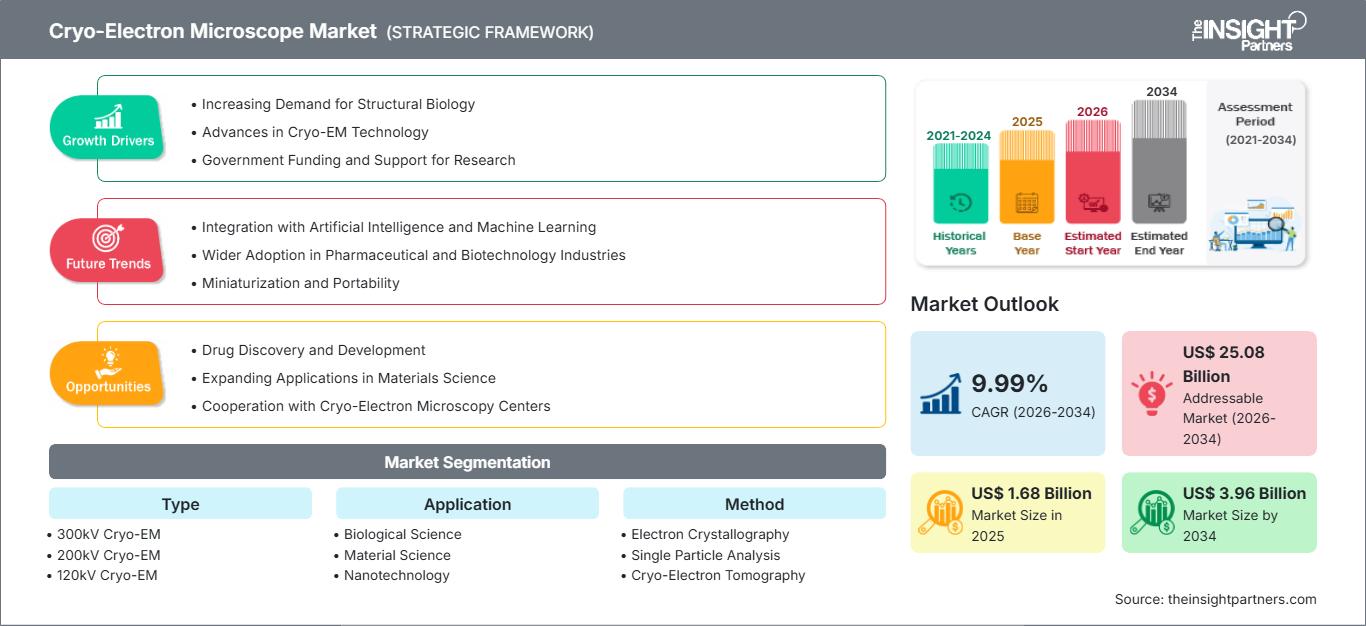
The Cryo-Electron Microscope Market is expanding because of the growing reliance on high-resolution imaging technologies in structural biology, pharmaceuticals, and materials characterization. The global market for cryo-electron microscope is expected to be worth US$ 1.68 Billion in 2025 and is forecast to reach US$ 3.96 Billion by 2034. The growth will be driven by the need for atomic-level resolution, innovation in the field of electron microscopy systems, and increase in the research funding.
North America continues to contribute significantly due to extensive research networks in academic institutions, biotech firms, and advanced infrastructure of life sciences. The Cryo-Electron Microscope Market size in North America is estimated to grow at a CAGR of around 9.2–9.8% over 2026–2034.
Cryo-Electron Microscope Market Assessment and Insights
- North America North America held an estimated share of 35–40% in 2025, supported by advanced research institutions, biotechnology investments, and established microscopy facilities. The region is expected to grow at a CAGR range of 9.2–9.8% during 2026–2034.
- US The US represented approximately 80–84% of North America demand in 2025, driven by strong pharmaceutical research, academic laboratories, and government-supported scientific initiatives. The market is projected to grow at a CAGR range of 9.4–10.0%.
- Europe Europe accounted for an estimated share of 27–31% in 2025, supported by Germany, the UK, France, and other research-intensive economies. The regional market is anticipated to expand at a CAGR range of 8.8–9.4% through 2034.
- Asia Pacific Asia Pacific represented an estimated share of 22–26% in 2025, with China, Japan, South Korea, and India contributing through scientific infrastructure expansion. The region is expected to register a CAGR range of 10.5–11.2% during 2026–2034.
- Largest Segment Single Particle Analysis represented the leading method segment with an estimated market share range of 42–46% in 2025. The segment is expected to grow at a CAGR range of 10.0–10.6% due to structural biology applications.
- High Growth Segment 300kV Cryo-EM represented an estimated share range of 40–44% in 2025 and is expected to expand at a CAGR range of 10.2–10.8% due to high-resolution imaging demand.
- Key companies analyzed in detail: Cordouan Technologies, Delong Holdings Ltd, Gatan, Inc., Hitachi High-Tech Corporation, HORIBA, Ltd., JEOL Ltd., Labomed, Inc., Meiji Techno, Thermo Fisher Scientific, ZEISS Germany.
Source: The Insight Partners' analysis based on proprietary research, government publications, company annual reports, investor presentations, industry databases, and expert interviews.
The Cryo-Electron Microscope Market has undergone changes due to technological innovations in detectors, automations, software processing, and stability of the devices. Nowadays, the cryo electron microscopes have moved away from being a specialized research instrument to become common in pharmaceutical laboratories, biotech companies, and educational institutions. Manufacturers are concerned with high-resolution imaging and better automation and integration with computational tools. Production system includes manufacturers of cryo EMs, components, software, research institutes, and services. All those interlinked parties affect adoption of the technology, making it more accessible, efficient, and flexible for various scientific fields.
Further development of the Cryo-Electron Microscope Market will be facilitated by growing investments in structural biology research, drug discovery, and material science. Developing countries are creating an appropriate scientific infrastructure which will allow for the use of more advanced technologies in microscopy. Growing regulatory interest in pharmaceutical innovations and greater collaboration between research institutes and technology providers will promote further investments in the technology. Another source of growth is going to be partnerships for development of capabilities of cryo EMs, providing greater access to researchers and cost-efficient solutions for laboratory needs.
Cryo-Electron Microscope Market Report Scope
| Report Attribute | Details |
|---|---|
| Market size in 2025 | US$ 1.68 Billion |
| Market Size by 2034 | US$ 3.96 Billion |
| Global CAGR (2026 - 2034) | 9.99% |
| Historical Data | 2021-2024 |
| Forecast period | 2026-2034 |
Cryo-Electron Microscope Market Analysis
Advanced imaging techniques are in high demand as they allow researchers to visualize biological molecules, protein structure, and nanomaterials. The Cryo-Electron Microscope Market share expansion is driven by increasing applications in drug discovery, vaccine research, structural genomics, and materials science. The industry consists of microscope vendors, detectors manufacturers, software providers, research institutes, pharma companies, and academic organizations. The increased importance of precision research is pushing laboratories to use highly sophisticated systems.
The value chain is comprised of instrument development, parts production, system assembly, installation, maintenance, and analysis services. The supply side of the market is affected by the particularities of engineering solutions, semiconductor detectors' availability, and the ongoing software development. Companies increase performance capabilities of the systems via automation, more accurate imaging techniques, and better processes. Increased complexity of research leads to the demand for instruments that can process bigger amounts of data with accuracy and reliability.
Competitive Analysis in the Cryo-Electron Microscope Market Report shows how competition is growing in the field of microscope companies around the world who try to secure their market position by means of differentiating and applying new technologies. Thermo Fisher Scientific, JEOL Ltd., ZEISS Germany, Hitachi High-Tech Corporation, and Gatan, Inc. keep developing highly advanced microscope products for life science and material research. They focus on automation, better detectors, and software platforms that could meet the needs of the researchers.
The strategy here includes investments in extending the range of products, regional expansion, and providing better access to the highly developed microscopic systems. HORIBA, Ltd., Delong Holdings Ltd, Cordouan Technologies, Labomed, Inc., and Meiji Techno provide help through special analytical and imaging products for science.
● REPORT CUSTOMIZATION
Tailor This Report To Align With Your Specific Business Requirements
This report can be customized to align precisely with your business objectives, scope, and target markets. Customization options include tailored segmentation, geography, competitive analysis, and strategic insights to support informed decision-making.
Customize This Report →WHAT YOU CAN ADJUST
- ● Segmentations
- ● Geography
- ● Competitive Analysis
- ● Language Preferences
Cryo-Electron Microscope Market: Strategic Insights
Regional Insights
North America Cryo-Electron Microscope Market
North America accounted for an estimated share of 35–40% in 2025 and remains a major regional contributor due to strong biotechnology research, pharmaceutical development activity, and advanced scientific infrastructure. The region is projected to grow at a CAGR range of 9.2–9.8% during 2026–2034. The United States leads regional demand through extensive adoption of cryo-EM systems in universities, research centers, and pharmaceutical laboratories.
The country participates in the process of growth through investment in the infrastructure of scientific research and growing use of advanced technology. Leading companies that produce microscopy equipment, experienced researchers, and cooperation between researchers are driving force of the market development. Growing use of the equipment for protein research, molecular research, and pharmaceutical research is driving demand for high-resolution microscopes.
U.S. Cryo-Electron Microscope Market
U.S. accounted for roughly 80-84% of the demand in North America, owing to the country's robust pharmaceutical industry and research centers, and biotechnology industry in 2025. The demand in the region will register a CAGR of 9.4–10.0% from 2026–2034. Cryo-EM technology is being adopted by universities, national laboratories, and pharmaceutical industries for their molecular research.
Companies like Thermo Fisher Scientific, Gatan, Inc., JEOL Ltd., and ZEISS Germany have a substantial market presence, owing to their cutting-edge microscopy solutions and collaborations in research. Increasing application areas in protein characterization, drug discovery, and analyzing biological structures are some factors contributing to the market growth. Increased funding and scientific programs are boosting the demand for high-end imaging devices in the country.
Europe Cryo-Electron Microscope Market
Europe is projected to account for a 27-31% share in 2025 and grow at a CAGR rate of 8.8-9.4% from 2025 to 2034. Germany continues to be one of the leading contributors owing to robust scientific infrastructure, superior engineering skills, and microscopy industry in the country. UK is benefitted by research related to life sciences, structural biology initiatives at universities, and biotechnology initiatives.
Germany will continue to focus on regional development owing to research initiatives, industrial presence, and advanced imaging systems. France, Italy, and Spain are contributing in terms of growing scientific infrastructure, research in pharmaceuticals, and investment in analytical instruments. Cryo-EM systems are being used by European organizations for various molecular studies, material studies, and healthcare innovations. Growth in the region is driven by research grants, collaborations, and rising demand for precision imaging solutions in various scientific applications.
APAC Cryo-Electron Microscope Market
APAC had an estimated market share of 22–26% in 2025 and is predicted to report a CAGR of 10.5–11.2% between 2026 and 2034. APAC's leading regional growth is driven by investments in scientific facilities, biotechnology research, and laboratory technologies.
Countries like Japan, South Korea, India, and Australia are improving adoption rates through academic research, healthcare innovations, and industrial usage. Growing investments in research in life sciences and materials development have increased the requirement for advanced microscope systems. Technology upgradation is being promoted in the region by government bodies and other institutions.
Middle East & Africa Cryo-Electron Microscope Market
Middle East & Africa accounted for an estimated share of 5–8% in 2025 and is expected to grow at a CAGR range of 8.5–9.2% during 2026–2034. Saudi Arabia leads regional development through investments in research infrastructure and advanced scientific facilities.
Both the UAE and South Africa are enhancing their lab abilities through health care, educational, and industrial research programs. Rest of MEA regions are slowly becoming adopters of the technology as they enhance their ability to do analysis. Research investments on scientific facilities, biotechnology research, and collaborative researches present an opportunity for high-end microscopes.
Segmentation Analysis
Type
The type segment is a fundamental component of the market, with adoption influenced by resolution requirements, sample complexity, and research application needs. The segment is expected to register a CAGR range of 9.6–10.2% during 2026–2034. High-voltage cryo-EM systems are preferred for advanced structural analysis, while lower-voltage systems support accessibility for laboratories requiring efficient imaging capabilities. Increasing demand for detailed molecular visualization and improved analytical workflows continues to shape purchasing decisions among academic institutions, pharmaceutical companies, and research organizations.
- 300kV Cryo-EM systems maintain strong demand due to their capability to deliver high-resolution imaging for complex biological structures. These systems are widely utilized in advanced structural biology applications requiring detailed molecular characterization and sophisticated analytical performance.
- 200kV Cryo-EM systems support broader adoption by balancing imaging performance, operational requirements, and research flexibility. These platforms are increasingly used by laboratories seeking reliable cryogenic imaging capabilities across diverse scientific applications.
- 120kV Cryo-EM systems provide accessibility for institutions requiring compact and efficient microscopy solutions. Their adoption is supported by expanding research capabilities in emerging facilities and applications requiring routine cryogenic sample analysis.
Application
The application segment demonstrates significant potential as researchers continue expanding cryo-EM utilization beyond traditional structural biology. The Cryo-Electron Microscope Market scope is increasing through applications across biological science, material science, and nanotechnology research areas. The segment is projected to achieve a CAGR range of 9.8–10.4% during 2026–2034. Growing requirements for precise structural information, nanoscale observation, and advanced material characterization are encouraging wider deployment. Research institutions and industrial laboratories are increasingly integrating cryo-EM platforms into their analytical workflows to improve scientific discovery and product development processes.
- Biological Science represents the primary application area due to extensive use in protein structure determination, molecular research, and pharmaceutical development. Demand is supported by advancements in structural biology and increasing investment in biomedical research.
- Material Science applications are expanding as industries require detailed analysis of advanced materials, compounds, and nanoscale structures. Cryo-EM enables researchers to examine material properties and support innovation in technology development.
- Nanotechnology adoption is increasing due to the need for atomic-level observation of nanoscale materials and engineered structures. Researchers use cryo-EM techniques to improve understanding of complex nanomaterials and their performance characteristics.
- Others applications include specialized research activities requiring cryogenic imaging capabilities. These applications support broader scientific exploration by enabling detailed analysis across emerging fields requiring high-resolution microscopy techniques.
Method
The method segment influences system adoption patterns by determining imaging capabilities, research suitability, and analytical outcomes. The segment is expected to grow at a CAGR range of 9.7–10.3% during 2026–2034. Researchers are selecting methods based on sample characteristics, desired resolution levels, and computational requirements. Improvements in image processing, automation, and data analysis are strengthening method adoption across research institutions and industrial laboratories. Increasing scientific complexity is encouraging the development of integrated workflows combining advanced imaging techniques with computational analysis.
- Electron Crystallography supports detailed structural analysis of crystalline samples and remains important for applications requiring precise molecular information. The method continues contributing to scientific research involving complex structures and specialized imaging requirements.
- Single Particle Analysis represents a leading method due to widespread use in biological structure determination and molecular research. Its adoption is supported by advances in image processing, automation, and high-resolution reconstruction capabilities.
- Cryo-Electron Tomography enables three-dimensional visualization of complex biological and material structures. Increasing interest in cellular imaging and structural analysis is supporting demand for tomography-based research approaches.
- Others methods contribute to specialized applications where customized analytical approaches are required. These techniques support research diversity and enable laboratories to address unique imaging challenges across different scientific disciplines.
Opportunity Snapshot
| Method | Revenue Contribution (High/Medium/Low) | Trend Tag | Adoption Stage |
| Biological Science | High | Protein Mapping | Mature |
| Material Science | Medium | Advanced Materials | Scaling |
| Nanotechnology | Medium | Nano Imaging | Scaling |
| Others | Low | Specialized Research | Emerging |
Cryo-Electron Microscope Market Growth Drivers and Impact Analysis
Increasing Demand for Structural Biology Research
An increase in structural biology studies is generating increasing demand for sophisticated imaging technology that will help visualize molecular structures in near-atomic detail. Both pharmaceutical and biotech firms are turning to cryo-EM solutions to study proteins, perform drug discovery, and develop therapeutics. Research institutes are also investing in advanced microscope technology to support basic science research. The second trend is pushing instrument makers to design microscopes with automation features, superior detectors, and better data processing features. With research projects becoming increasingly complicated, scientists need to have equipment that can provide them with reliable structural details quickly. Molecular knowledge's growing significance in healthcare innovation will help sustain investments in advanced microscope technology and research facilities.
Growth of Pharmaceutical and Biotechnology Applications
The adoption of advanced microscopy solutions among pharmaceutical and biotechnology firms is gaining momentum as they look to enhance their research processes and gain better insights into biological processes. Cryo-EM techniques enable various applications, ranging from protein analysis and molecular interactions to therapy development. The growing complexity of drug discovery processes is prompting such organizations to purchase high-performance analytical equipment. This will have an impact on the buying process, as these firms will be seeking platforms that can deal with different samples and deliver precise information about their structure. As the biotech ecosystems expand across the globe, there will be increased demand for advanced microscopy solutions.
Advancements in Imaging and Data Processing Technologies
Continuous improvements in electron detectors, computational algorithms, and automated microscopy workflows are enhancing the capabilities of cryo-EM systems. These technological developments are reducing operational challenges and enabling researchers to process increasingly complex datasets. Improved image reconstruction techniques are allowing laboratories to obtain more detailed structural information from challenging samples. Manufacturers are focusing on integrating hardware and software innovations to simplify operation and improve analytical efficiency. These advancements are expanding adoption among research organizations that previously faced limitations related to complexity and data interpretation. The combination of improved imaging performance and computational support is strengthening the role of cryo-EM as an important research tool across biological science, material science, and nanotechnology applications.
Cryo-Electron Microscope Market Future Trends
Artificial Intelligence Integration in Microscopy Workflows
Artificial intelligence is expected to influence Cryo-Electron Microscope Market Trends by improving image analysis, data interpretation, and workflow automation. AI-based algorithms may assist researchers in identifying structural patterns, reducing manual processing requirements, and accelerating analysis timelines. As microscopy datasets become larger and more complex, computational tools will become increasingly important for efficient research operations. Technology providers are exploring AI integration to enhance usability and support researchers with limited computational expertise. These developments may improve accessibility while enabling laboratories to extract greater value from advanced imaging platforms. The combination of automated microscopy systems and intelligent analysis tools is expected to shape future research workflows across academic, pharmaceutical, and industrial environments.
Expansion of Compact and Accessible Cryo-EM Platforms
Cryo-Electron Microscope Market Trends is expected to include increasing availability of more accessible cryo-EM systems designed for broader institutional adoption. Traditional systems often require significant infrastructure investment and specialized expertise, creating opportunities for solutions that simplify operation and reduce barriers. Manufacturers are exploring approaches to improve system efficiency, automation, and usability for smaller research facilities. These developments could expand adoption beyond major research centers and support wider utilization across universities and emerging laboratories. Increased accessibility may encourage new applications in biological science, materials research, and nanotechnology. As demand for high-resolution imaging continues to grow, compact and user-friendly platforms are likely to become an important area of technological development.
Cryo-Electron Microscope Market Opportunities
Expansion Across Emerging Research Infrastructure
Emerging economies are creating opportunities as governments, universities, and research organizations invest in advanced scientific infrastructure. Increasing focus on biotechnology development, pharmaceutical research, and materials innovation is encouraging demand for sophisticated analytical technologies. Cryo-Electron Microscope Market Forecasts indicate that expanding research capabilities in Asia Pacific, the Middle East, and other developing regions may support broader adoption opportunities. Companies can strengthen market presence through partnerships with institutions, localized support services, and researcher training programs. Investments aimed at improving laboratory capabilities and scientific collaboration networks may accelerate technology deployment. Organizations that address accessibility challenges and provide application-focused solutions are positioned to benefit from growing demand in developing research ecosystems.
Development of Integrated Microscopy Solutions
Opportunities are emerging around integrated solutions that combine advanced imaging hardware, automation capabilities, and computational analysis platforms. Research organizations increasingly require efficient workflows capable of managing complex samples and large datasets. Companies investing in software integration, user-friendly interfaces, and automated processes may strengthen competitive differentiation. Collaboration between technology providers and scientific institutions can support the development of solutions aligned with evolving research needs. Integrated platforms may improve productivity by reducing operational complexity and enabling faster analysis. As laboratories seek comprehensive solutions rather than standalone instruments, manufacturers that develop interconnected ecosystems may gain opportunities across academic, pharmaceutical, and industrial research markets.
Recent Developments
- March 2026: Thermo Fisher Scientific announced continued advancements in its cryogenic electron microscopy ecosystem through technology enhancements designed to improve high-resolution structural analysis workflows. The company continues expanding its microscopy capabilities by integrating automation, advanced detectors, and data processing solutions to support researchers across pharmaceutical, biotechnology, and academic applications requiring detailed molecular visualization.
- November 2025: JEOL Ltd. expanded its electron microscopy technology portfolio with continued development of advanced analytical instruments supporting scientific research and materials characterization. The company focuses on improving imaging performance, operational efficiency, and research accessibility through innovative microscopy solutions used across universities, industrial laboratories, and scientific institutions globally.
- July 2025: ZEISS Germany strengthened its microscopy technology activities by advancing imaging solutions supporting life science and materials research applications. The company continues developing high-performance microscopy platforms and related technologies aimed at enabling precise visualization, improved workflow integration, and enhanced analytical capabilities for researchers studying complex biological structures and advanced materials.
Frequently Asked Questions

- Comprehensive Market Sizing and Forecast Analysis
- Detailed Segmentation Analysis
- In-Depth Market Dynamics Assessment
- Regional and Country-Level Insights
- Competitive Landscape and Company Benchmarking
- Strategic Business Intelligence
Recent Reports
Testimonials

The Insight Partners' SCADA System Market report is comprehensive, with valuable insights on current trends and future forecasts. The team was highly professional, responsive, and supportive throughout. We are very satisfied and highly recommend their services.
RAN KEDEM Partner, Reali Technologies LTDs
I requested a report on a very specific software market and the team produced the report in a few days. The information was very relevant and well presented. I then requested some changes and additions to the report. The team was again very responsive and I got the final report in less than a week.
JEAN-HERVE JENN Chairman, Future Analytica
We worked with The Insight Partners for an important market study and forecast. They gave us clear insights into opportunities and risks, which helped shape our plans. Their research was easy to use and based on solid data. It helped us make smart, confident decisions. We highly recommend them.
PIYUSH NAGPAL Sr. Vice President, High Beam Global
The Insight Partners delivered insightful, well-structured market research with strong domain expertise. Their team was professional and responsive throughout. The user-friendly website made accessing industry reports seamless. We highly recommend them for reliable, high-quality research services
YUKIHIKO ADACHI CEO, Deep Blue, LLC.
This is the first time I have purchased a market report from The Insight Partners.While I was unsure at first, I visited their web site and felt more comfortable to take the risk and purchase a market report.I am completely satisfied with the quality of the report and customer service. I had several questions and comments with the initial report, but after a couple of dialogs over email with their analyst I believe I have a report that I can use as input to our strategic planning process.Thank you so much for taking the extra time and making this a positive experience.I will definitely recommend your service to others and you will be my first call when we need further market data.
JOHN SUZUKI President and Chief Executive Officer, Board Director, BK Technologies
I wish to appreciate your support and the professionalism you displayed in the course of attending to my request for information regarding to infectious disease IVD market in Nigeria. I appreciate your patience, your guidance, and the fact that you were willing to offer a discount, which eventually made it possible for us to close a deal. I look forward to engaging The Insight Partners in the future, all thanks to the impression you have created in me as a result of this first encounter.
DR CHIJIOKE ONYIA MANAGING DIRECTOR, PineCrest Healthcare Ltd.Reason to Buy
- Informed Decision-Making
- Understanding Market Dynamics
- Competitive Analysis
- Identifying Emerging Markets
- Customer Insights
- Market Forecasts
- Risk Mitigation
- Boosting Operational Efficiency
- Strategic Planning
- Investment Justification
- Tracking Industry Innovations
- Aligning with Regulatory Trends





 Get Free Sample for