
Crystals Market Size, Share & Growth by 2034
Coverage: By Crystal Type {Laser and Active Crystals [Nd: YAG, Nd: YVO, Ti: Sapphire, and Others], Nonlinear Optical Crystals [Potassium Titanyl Phosphate (KTP), Barium Borate (BBO), Potassium Dihydrogen Phosphate (KDP), Rubidium Titanyl Phosphate (RTP), and Others], and Others}, By Form (Bulk Single Crystals, Powdered Crystals, and Others), By Application (Laser and Optoelectronics, Telecommunications, Medical and Healthcare, Aerospace and Defense, Consumer Electronics, Research and Academics, and Others), and Geography (North America, Europe, Asia Pacific, Middle East and Africa, and South and Central America)
- Status : Published
- Report Code : TIPRE00042704
- Category : Chemicals and Materials
- No. of Pages : 452
- Available Report Formats :


- Last update date : March 24, 2026


2025 Market Size
US$ 21.80 Bn
Base year value
2034 Forecast
US$ 43.15 Bn
Projected by 2034
CAGR 2026-2034
7.88 %
Growth rate
Addressable Market
US$ 292.21 Bn
(2026-2034)
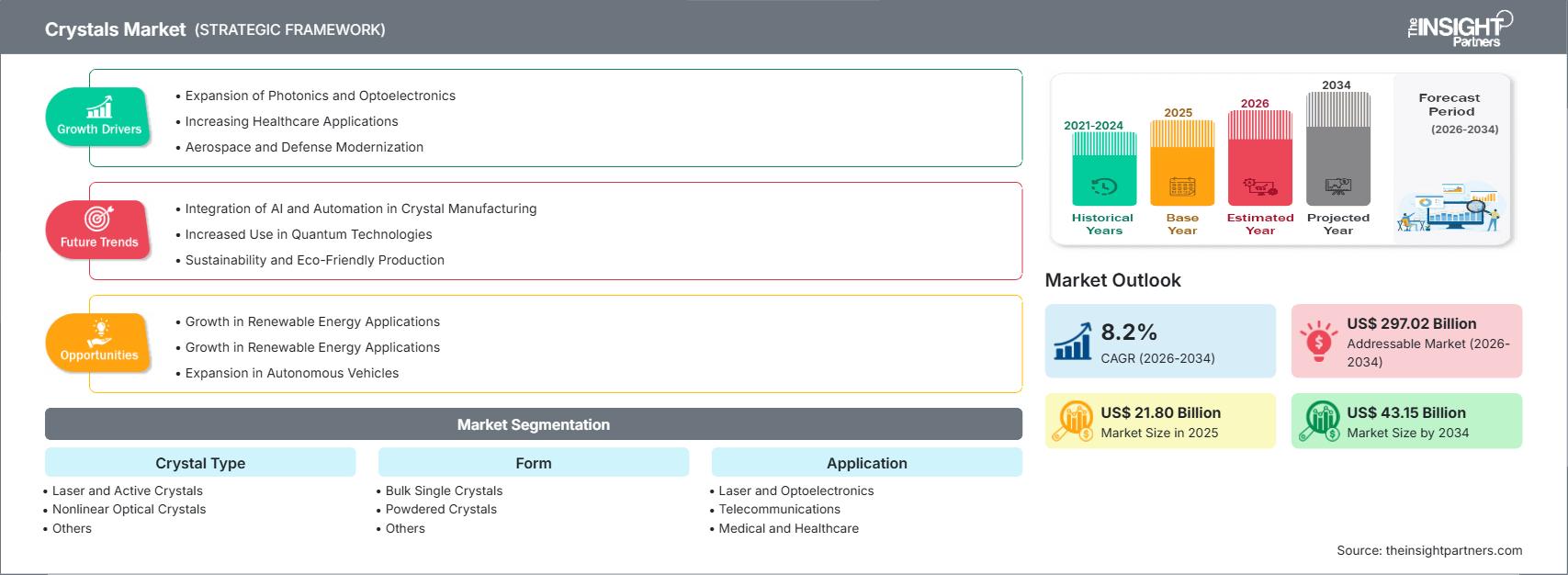
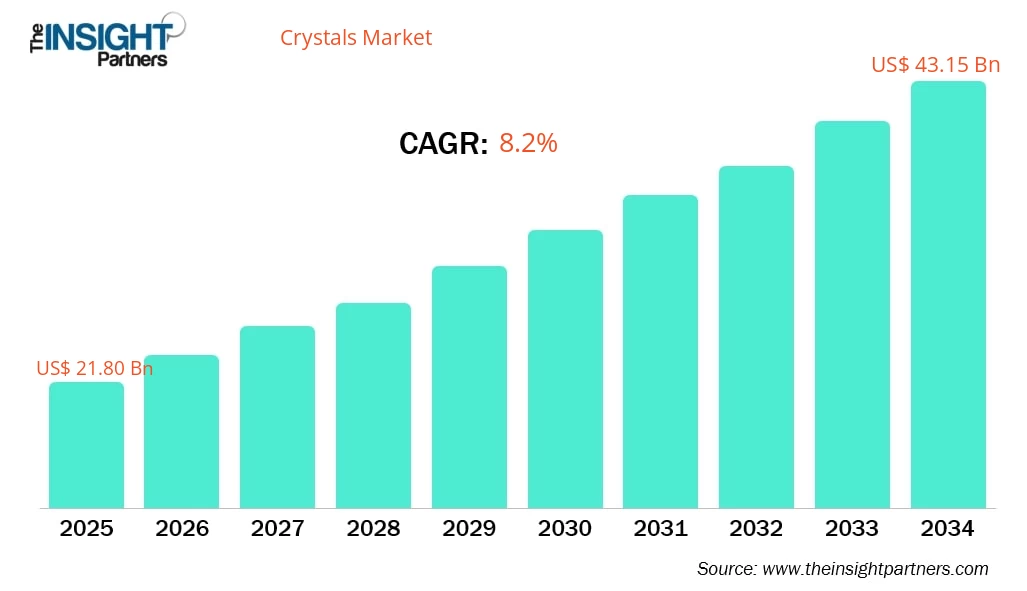
The crystals market was valued at US$ 21.8 billion in 2025 and is expected to reach US$ 43.15 billion by 2034; it is estimated to record a CAGR of 7.88% during 2026-2034.
Crystals Market Analysis
Consumer electronics such as Smartphones, wearable devices, and smart sensors require quartz and other crystals for precise timing, signal control, and device synchronization. The ongoing development of telecommunications infrastructure, especially the rollout of 5G networks and fiber-optic systems, is boosting demand for electro-optic and piezoelectric crystals used in high-frequency signal processing and optical modulation.
There are significant opportunities in photonics, semiconductor technologies, and laser systems. These advances are broadening the use of engineered crystals with better performance. Increased investments in research and development, along with a rise in the use of smaller, more efficient electronic components, strengthen market expansion.
Crystals Market Overview
The crystals market includes a wide range of materials designed for their unique electrical, optical, and mechanical properties. These materials are essential for modern electronic and photonic technologies. One of the most commonly used types is quartz crystals. They have strong piezoelectric properties and are often found in oscillators, frequency control devices, and timing components used in telecommunications and consumer electronics. Optical crystals, including sapphire and yttrium aluminum garnet (YAG), are crucial in laser systems, optical instruments, and imaging technologies because they transmit and manipulate light.
Electro-optic crystals, such as lithium niobate and potassium titanyl phosphate (KTP), are important for modulating and controlling light signals in telecommunications and photonic applications. Nonlinear optical crystals are used to convert laser frequencies, enabling various applications in scientific research, defense systems, and medical devices. Piezoelectric crystals are widely utilized in sensors, actuators, and ultrasound equipment due to their ability to convert mechanical energy into electrical signals and vice versa. The variety of crystal types and their specialized functions make them key components that support technological advancements across multiple high-precision industries.
Market Research Highlights
- Asia Pacific dominated the market with 45.6% share in 2025.
- Asia Pacific is poised to grow at a CAGR of 8.8% over the forecast period.
- United States market is projected to grow at a CAGR of 8.4% over the forecast period.
- By Crystal Type, the Nonlinear Optical Crystals segment accounted for the largest market share of 27.7% in 2025.
- By Form, the Powdered Crystals segment is anticipated to witness the fastest growth, registering a CAGR of 8.8% over the forecast period
- By Application, the Laser and Optoelectronics segment accounted for the largest market share of 24.1% in 2025.
- The report profiles key industry players such as Alfa Chemistry, CRYLIGHT PHOTONICS, INC, Crysmit Photonics, Tianjin Tengteng Optoelectronic Technology Co., Ltd, CASTECH Inc, Altechna, Beijing JIEPU TREND Technology Co., Ltd., Fabrinet, Crystrong Photonics Technology Co., Ltd, 3photon, while also analyzing key developments in novel ideas, disruptive products, and innovative services that could reshape the future market and reveal emerging themes across the industry.
Source: The Insight Partners' analysis based on proprietary research, government publications, company annual reports, investor presentations, industry databases, and expert interviews.
● REPORT CUSTOMIZATION
Tailor This Report To Align With Your Specific Business Requirements
This report can be customized to align precisely with your business objectives, scope, and target markets. Customization options include tailored segmentation, geography, competitive analysis, and strategic insights to support informed decision-making.
Customize This Report →WHAT YOU CAN ADJUST
- ● Segmentations
- ● Geography
- ● Competitive Analysis
- ● Language Preferences
Crystals Market: Strategic Insights
-
Get Top Key Market Trends of this report.This FREE sample will include data analysis, ranging from market trends to estimates and forecasts.
Crystals Market: Drivers and Opportunities
Market Drivers:
Growth in renewable energy applications drives the crystals market because many clean energy technologies depend on specialized crystalline materials. For example, solar photovoltaic systems commonly use crystalline silicon wafers to convert sunlight into electricity with high efficiency. As countries increase solar installations to meet climate goals, the demand for high-purity silicon crystals rises significantly. Similarly, crystals like gallium arsenide and sapphire are used in power electronics and LED lighting systems that support renewable energy infrastructure. Wind turbines and energy storage systems also need crystalline materials for sensors, semiconductors, and control devices.
Additionally, research into next-generation solar technologies, such as perovskite and other crystalline structures, continues to broaden the range of crystal applications in the renewable sector. As governments and companies invest heavily in clean energy to reduce carbon emissions and improve energy security, the need for reliable, high-performance crystalline components grows, accelerating the expansion of the global crystals market.
Market Opportunities:
New technologies increase the demand for electronic and photonic materials. Fast-growing next-generation telecommunications infrastructure, including 5G and future 6G networks, needs stable crystal components for frequency control, signal filtering, and optical modulation. The rise of Internet of Things (IoT) devices, smart sensors, and connected systems creates chances for manufacturers to create compact and precise crystal components that enable efficient data communication and device synchronization.
The increasing demand for modern medical technologies, such as laser-based diagnostic tools, imaging systems, and wearable health monitoring devices, is opening new areas for specialized optical and piezoelectric crystals. The growth of aerospace and satellite technologies, which involves space exploration, satellite communication, and advanced navigation systems, boosts opportunities for high-performance crystals that work in extreme environments. Ongoing innovations in photonics, quantum technologies, and semiconductor manufacturing are driving research into engineered crystals with improved optical and electronic properties. This trend enables manufacturers to develop new products that support next-generation technological applications.
Crystals Market Report Segmentation Analysis
The crystals market is divided into different segments to give a clearer view of how they work, their growth potential, and the latest trends. Below is the standard segmentation approach used in industry reports:
By Crystal Type
- Laser and Active Crystals: These crystals serve as the gain medium in laser systems. They amplify light and help generate laser beams.
- Nonlinear Optical Crystals: These crystals change the frequency, wavelength, or phase of light when exposed to high-intensity laser beams. They are found in photonics, telecommunications, and laser technologies.
- Others: This category includes specialized crystals with unique electrical, optical, or mechanical properties. They are used in niche or emerging applications.
By Form
- Bulk Single Crystals: Bulk single crystals are large, uniform crystals with a continuous and highly organized atomic structure. They are used in high-precision applications.
- Powdered Crystals: Powdered crystals are made up of finely ground crystal particles used in coatings, composite materials, and some optical or electronic applications.
- Others: This segment includes other crystal forms such as thin films, wafers, and engineered crystal structures made for specific uses in electronics, photonics, and advanced research.
By Application
- Laser and Optoelectronics: Crystals play a key role in generating lasers, amplifying light, and modulating optical signals. They are useful in various areas, including industrial processing, imaging systems, optical communication, and scientific instruments.
- Telecommunications: In telecommunications, crystals are found in oscillators, filters, and signal control devices. They help maintain precise frequency regulation and ensure stable signal transmission in communication networks and fiber-optic systems.
- Medical and Healthcare: Crystals are utilized in medical imaging systems, ultrasound devices, and laser surgical equipment.
- Aerospace and Defense: In aerospace and defense, crystals are vital for technologies such as radar, navigation systems, infrared optics, and laser targeting systems.
- Consumer Electronics: Crystals are key components in smartphones, wearable devices, cameras, and various electronics. They ensure accurate timing, frequency control, and effective signal processing.
- Research and Academics: Research institutions and academic labs use crystals in experiments related to photonics, quantum technologies, and materials science.
- Fruits and Vegetables: Biologicals enhance quality, shelf life, pest tolerance, and nutrient content in horticultural crops.
- Others: This category covers emerging or specialized uses of crystals, including advanced sensing technologies, energy systems, and industrial instruments.
By Geography:
- North America
- Europe
- Asia Pacific
- South and Central America
- Middle East and Africa
Crystals Market Report Scope
| Report Attribute | Details |
|---|---|
| Market size in 2025 | US$ 21.80 Billion |
| Market Size by 2034 | US$ 43.15 Billion |
| Global CAGR (2026 - 2034) | 7.88% |
| Historical Data | 2021-2024 |
| Forecast period | 2026-2034 |
| Segments Covered |
By Crystal Type
|
| Regions and Countries Covered |
North America
|
| Market leaders and key company profiles |
|
Crystals Market Players Density: Understanding Its Impact on Business Dynamics
The Crystals Market is growing rapidly, driven by increasing end-user demand due to factors such as evolving consumer preferences, technological advancements, and greater awareness of the product's benefits. As demand rises, businesses are expanding their offerings, innovating to meet consumer needs, and capitalizing on emerging trends, which further fuels market growth.
Crystals Market Share Analysis by Geography
North America dominates the crystals market, driven by the growing demand from various applications. Emerging markets in South and Central America, the Middle East, and Africa have untapped opportunities for crystals providers to expand.
The growth of the crystals market varies by region. The growth of the photonics industry positions crystals in an evolving consumer landscape. Below is a summary of market share and trends by region:
1. North America
- Market Share: Holds a significant market share
- Key Drivers:
- Strong demand from the aerospace, defense, and telecommunications industries.
- Trends: Growing focus on research and commercialization of photonics and quantum technologies.
2. Europe
- Market Share: Holds a significant market share
- Key Drivers:
- The presence of established aerospace, medical device, and industrial laser manufacturers.
- Trends: Rising use of optical communication systems and photonic technologies.
3. Asia Pacific
- Market Share: Dominates the market, with an annually rising market share
- Key Drivers:
- Rapid growth in consumer electronics manufacturing and semiconductor production.
- Trends: Increased investments in 5G infrastructure and optoelectronic technologies.
4. South and Central America
- Market Share: Small market size expanding at a rapid pace
- Key Drivers:
- Expanding telecommunications networks and rising use of electronic devices.
- Trends: Growth of healthcare technologies and diagnostic equipment.
5. Middle East and Africa
- Market Share: A rapidly expanding market with consistent annual growth in market share
- Key Drivers:
- Rising investments in defense systems, satellite communication, and navigation technologies.
- Trends: Soaring focus on modern healthcare infrastructure and research capabilities.
High Market Density and Competition
Competition is intense due to the presence of established players such as Alfa Chemistry, Crysmit Photonics, CRISTAL LASER S.A., and Hangzhou Shalom Electro-optics Technology Co., Ltd.
This high level of competition urges companies to stand out by offering:
- Diverse product offering
- Sustainable and ethical sourcing
- Competitive pricing models
- Strong customer support and easy integration
Opportunities and Strategic Moves
- Companies are focusing on research and development activities to distinguish themselves in the market.
- Leading crystal manufacturers are expanding their global footprint and capabilities through strategic acquisitions of manufacturers in the sector.
- Key players are expanding their production capacity to meet growing demand.
Other companies analyzed during the course of research:
- Shape Optics Technologies Pte Ltd.
- Crystrong Photonics Technology Co., Ltd
- CASTECH Inc.
- CRYLIGHT PHOTONICS, INC.
- Tianjin Tengteng Optoelectronic Technology Co., Ltd
- Altechna
- Beijing JIEPU TREND Technology Co., Ltd.
- Fabrinet
- CRYTUR, spo.
- Sintec Optronics Pte Ltd
Crystals Market: News and Recent Developments
- Alfa Chemistry – Mergers and Acquisitions: In June 2023, Alfa Chemistry started offering nonlinear crystals and precision optical materials for the optical components market. The new products include ND: YAG laser components, various nonlinear and laser crystals, photonic materials, and precision optics. This initiative aims to meet increasing industry demand.
- OXIDE Corporation – Expansion: In January 2023, OXIDE Corporation completed the acquisition of Raicol Crystals, a manufacturer of various crystals, including RTP, KTP, LBO, BBO, PPKTP, PPSLT, PPLN, and CLBO. This acquisition strengthens OXIDE Corporation's market position and product range.
Crystals Market Report Coverage and Deliverables
The "Crystals Market Size and Forecast (2021–2034)" report provides a detailed analysis of the market covering the following areas:
- Crystals Market size and forecast at global, regional, and country levels for all the segments covered under the scope
- Crystals Market trends, as well as dynamics such as drivers, restraints, and key opportunities
- Detailed Porter's five forces and SWOT analysis
- Crystals Market analysis covering key trends, global and regional framework, major players, regulations, and recent developments
- Industry landscape and competition analysis covering market concentration, heat map analysis, prominent players, and recent developments for the crystals market
- Detailed company profiles
Frequently Asked Questions

- Comprehensive Market Sizing and Forecast Analysis
- Detailed Segmentation Analysis
- In-Depth Market Dynamics Assessment
- Regional and Country-Level Insights
- Competitive Landscape and Company Benchmarking
- Strategic Business Intelligence
Recent Reports
Testimonials

The Insight Partners' SCADA System Market report is comprehensive, with valuable insights on current trends and future forecasts. The team was highly professional, responsive, and supportive throughout. We are very satisfied and highly recommend their services.
RAN KEDEM Partner, Reali Technologies LTDs
I requested a report on a very specific software market and the team produced the report in a few days. The information was very relevant and well presented. I then requested some changes and additions to the report. The team was again very responsive and I got the final report in less than a week.
JEAN-HERVE JENN Chairman, Future Analytica
We worked with The Insight Partners for an important market study and forecast. They gave us clear insights into opportunities and risks, which helped shape our plans. Their research was easy to use and based on solid data. It helped us make smart, confident decisions. We highly recommend them.
PIYUSH NAGPAL Sr. Vice President, High Beam Global
The Insight Partners delivered insightful, well-structured market research with strong domain expertise. Their team was professional and responsive throughout. The user-friendly website made accessing industry reports seamless. We highly recommend them for reliable, high-quality research services
YUKIHIKO ADACHI CEO, Deep Blue, LLC.
This is the first time I have purchased a market report from The Insight Partners.While I was unsure at first, I visited their web site and felt more comfortable to take the risk and purchase a market report.I am completely satisfied with the quality of the report and customer service. I had several questions and comments with the initial report, but after a couple of dialogs over email with their analyst I believe I have a report that I can use as input to our strategic planning process.Thank you so much for taking the extra time and making this a positive experience.I will definitely recommend your service to others and you will be my first call when we need further market data.
JOHN SUZUKI President and Chief Executive Officer, Board Director, BK Technologies
I wish to appreciate your support and the professionalism you displayed in the course of attending to my request for information regarding to infectious disease IVD market in Nigeria. I appreciate your patience, your guidance, and the fact that you were willing to offer a discount, which eventually made it possible for us to close a deal. I look forward to engaging The Insight Partners in the future, all thanks to the impression you have created in me as a result of this first encounter.
DR CHIJIOKE ONYIA MANAGING DIRECTOR, PineCrest Healthcare Ltd.Reason to Buy
- Informed Decision-Making
- Understanding Market Dynamics
- Competitive Analysis
- Identifying Emerging Markets
- Customer Insights
- Market Forecasts
- Risk Mitigation
- Boosting Operational Efficiency
- Strategic Planning
- Investment Justification
- Tracking Industry Innovations
- Aligning with Regulatory Trends





 Get Free Sample for