
Deferasirox Market Share, Growth & Demand by 2034
Coverage: By Type (500 mg/Tablet, 250 mg/Tablet, 125 mg/Tablet, Others); Application (Transfusional Iron Overload, NTDT Caused Iron Overload), and Geography (North America, Europe, Asia Pacific, and South and Central America)
- Status : Data Released
- Report Code : TIPRE00008237
- Category : Life Sciences
- No. of Pages : 150
- Available Report Formats :


- Last update date : August 17, 2026


2025 Market Size
US$ 3.14 Bn
Base year value
2034 Forecast
US$ 4.51 Bn
Projected by 2034
CAGR 2026-2034
4.11 %
Growth rate
Addressable Market
US$ 34.75 Bn
(2026-2034)
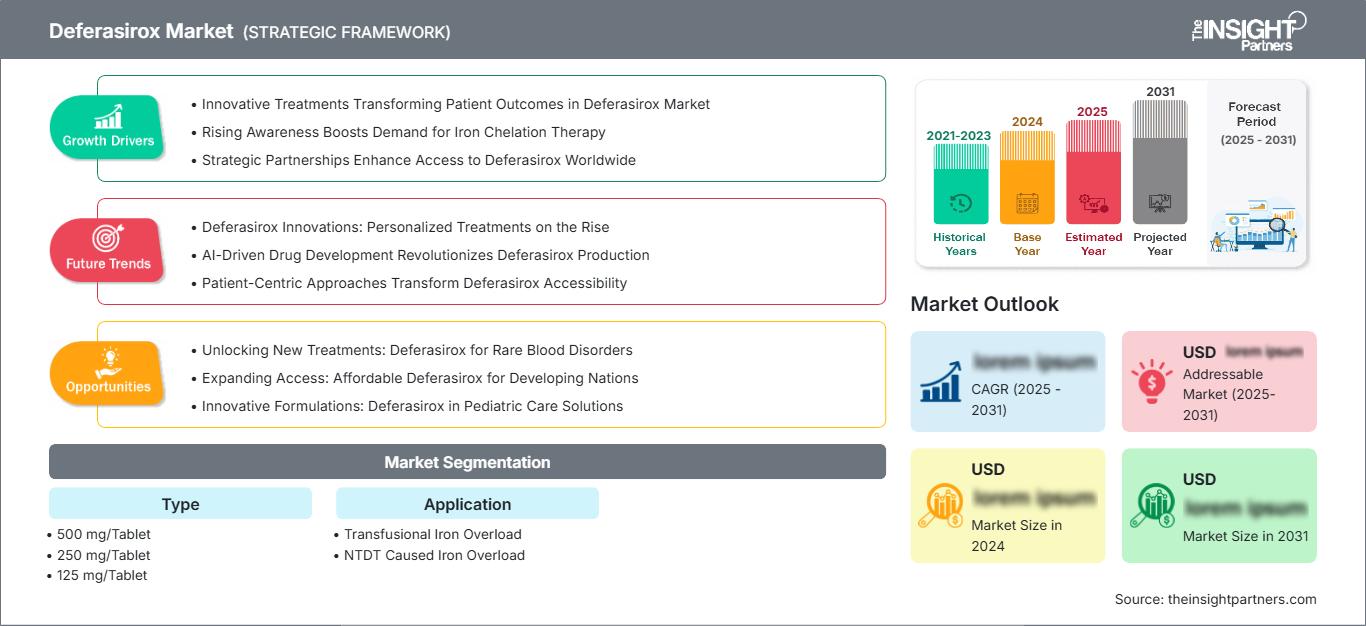
The Deferasirox Market was valued at US$ 3.14 Billion in 2025 and is projected to reach US$ 4.51 Billion by 2034, registering a CAGR of 4.11% during 2026–2034. Market includes oral iron-chelation medicines for the treatment of chronic iron overload caused by recurrent transfusions and certain non-transfusion-dependent thalassemia diseases. Key drivers behind the demand will include factors like treatment duration, the availability of generics, formulation choices, disease prevalence, and hematology care expansion.
North America will continue to remain an important market due to the presence of hematology infrastructure, specialized care, and relatively good availability of transfusion care. Growth of the North America Deferasirox Market Size can be attributed to the persistent demand for transfusion-dependent patients and increased usage of oral chelation. North America will have a CAGR of 3.8–4.2% in the forecast period of 2026–2034.
Deferasirox Market Assessment and Insights
- North America: North America is estimated to account for a 31–35% share in 2025 and grow at a CAGR of 3.8–4.2% between 2026–2034, supported by established hematology infrastructure, long-term transfusion management, and generic drug availability.
- US: The US is estimated to represent 82–86% of North America in 2025 and is expected to grow at a CAGR of 3.7–4.1% during 2026–2034, supported by specialist care and established supply channels.
- Europe: Europe is estimated to hold a 28–32% share in 2025 and expand at a CAGR of 3.7–4.1% during 2026–2034, led by Germany, the UK, France, Italy, and Spain through established hematology services and generic procurement.
- Asia Pacific: Asia Pacific is estimated to represent a 25–29% share in 2025 and grow at a CAGR of 4.8–5.2% during 2026–2034, led by India, China, Japan, South Korea, and Australia.
- Largest Segment: Transfusional Iron Overload holds an estimated 68–72% market share in 2025 and is projected to grow at a CAGR of 3.9–4.2% during 2026–2034, reflecting its broader treatment base.
- High Growth Segment: NTDT Caused Iron Overload represents an estimated 28–32% market share in 2025 and is expected to grow at a CAGR of 4.6–5.0% during 2026–2034 as diagnosis and monitoring improve.
- Key companies analyzed in detail: Alkaloids Pvt. Ltd., Aspire Group, Aurobindo Pharma Limited, Biocon Limited, Cipla Limited, Enaltec Labs Pvt. Ltd., EstechPharma Co., Ltd., NATCO Pharma Limited, Novartis AG, Sun Pharmaceutical Industries Limited.
Source: The Insight Partners' analysis based on proprietary research, government publications, company annual reports, investor presentations, industry databases, and expert interviews.
The supply has moved away from the originator-driven supply chain towards a more diverse one that includes a generic ecosystem for different dose forms and strengths. The economics of manufacturing now revolve around API, bioequivalence compliance, batch uniformity, packaging, and regulatory submissions. This move has increased involvement of suppliers while at the same time emphasizing formulation quality, supply reliability, patient acceptance, and safety.
In the coming years, growth is expected to focus on areas where the services for hematology have been increasing along with the management of transfusion disorders. Priorities in terms of investment can be said to include scalable API capacity, unique oral formulations, regulatory expansion, and supply chain robustness. Volume potential in emerging markets can be expected with better diagnosis, whereas existing markets will be more price sensitive due to generics competition.
Deferasirox Market Report Scope
| Report Attribute | Details |
|---|---|
| Market size in 2025 | US$ 3.14 Billion |
| Market Size by 2034 | US$ 4.51 Billion |
| Global CAGR (2026 - 2034) | 4.11% |
| Historical Data | 2021-2024 |
| Forecast period | 2026-2034 |
Deferasirox Market Analysis
Demand is influenced by constant needs for treatments among patients who are subjected to continuous transfusions and need to regulate their iron levels before organ damage. Consequently, the Deferasirox Market growth will be driven by transfusion volumes, patient survival, compliance with treatment, diagnosing iron overload, and availability of monitoring. Oral delivery further boosts demand in cases where both patients and doctors value treatment convenience.
Value chain activities begin from the production of deferasirox active pharmaceutical ingredient and intermediate chemicals to formulation, tabling, testing, registration, packing, distribution, and medication dispensing at pharmacies and hospitals. The supply structure is influenced by qualification of API, manufacturing capacity, registration dossier, and procurement agreements. Companies that have sound market registrations will be in a position to avoid dependence on any particular market and deal with tenders in a more effective manner.
The Deferasirox Market Report indicates rivalry between an existing originator franchise and various generics in regulated and emerging markets. Novartis AG has a brand name with its Exjade and Jadenu products, whereas Aurobindo Pharma Limited, Cipla Limited, NATCO Pharma Limited, and Sun Pharmaceutical Industries Limited constitute the generics segment. Other authorities in the upstream and formulations value chain include Aspire Group, Enaltec Labs Pvt. Ltd., and EstechPharma Co., Ltd.
Market position becomes more and more determined by regulatory footprint, manufacturing efficiency, API involvement, dosage form portfolio, and distribution coverage than by molecule uniqueness. Biocon Limited, along with other mature Indian drug manufacturers, has an advantage in manufacturing and regulatory competencies, while region-based competitors may use local market access for their competitive advantage. Capital expenditure thus goes into capacity efficiency, product listings, quality management, and production efficiency.
● REPORT CUSTOMIZATION
Tailor This Report To Align With Your Specific Business Requirements
This report can be customized to align precisely with your business objectives, scope, and target markets. Customization options include tailored segmentation, geography, competitive analysis, and strategic insights to support informed decision-making.
Customize This Report →WHAT YOU CAN ADJUST
- ● Segmentations
- ● Geography
- ● Competitive Analysis
- ● Language Preferences
Deferasirox Market: Strategic Insights
Regional Insights
North America Deferasirox Market
North America is estimated to account for a 31–35% of the Deferasirox Market share in 2025 and is expected to grow at a CAGR of 3.8–4.2% through 2034. The region benefits from established hematology practices, specialist transfusion centers, and structured monitoring of patients receiving long-term transfusion therapy. Demand is supported by continued use of oral iron chelation where clinically appropriate and by established generic supply.
The United States is dominant in regional consumption, but the role of Canada lies in the provision of hematology and transfusion specialties. The procurement process has become more dependent on the position in the formulary, generics substitution, availability of the product, and supply continuity. Compliance to regulation and pharmacovigilance is required for manufacturers because of the need for the prolonged treatment.
U.S. Deferasirox Market
In 2025, the US accounts for around 82-86% of the market share in North America, and is expected to grow with a CAGR of 3.7-4.1% from 2025-2034. The demand is driven by specialist hematology, hospital, pediatric, and transfusion clinics addressing chronic iron overload conditions. Generic drug competition has made formulary inclusion, distribution partnerships, and reliable sourcing even more essential.
Novartis AG keeps up with its brand-name products, whereas Sun Pharmaceutical Industries Limited and Aurobindo Pharma Limited, among others, are the generics providers. Application demand is driven by transfusional iron overload condition, but NTDT application offers some potential. The choice of product is driven by dosage availability, formulation properties, regulatory status, purchasing economics, and physicians' confidence in its long-term tolerability.
Europe Deferasirox Market
Europe is expected to have a market share of 28–32% in 2025 and will be experiencing a CAGR of 3.7–4.1% until 2034. Germany is at the forefront of the market because of hematology expertise and distribution of pharmaceuticals. Other countries contributing to the market include UK, France, Italy, and Spain through their respective transfusion organizations, treatment facilities, and procurement processes.
The UK sustains its demand through specialized hematology pathway and existing generic drug procurement. Germany sustains the demand through its strong healthcare network and availability of pharmaceuticals together with specialist centers specializing in chronic diseases in the bloodstream. France has its established treatment network; however, Italy and Spain add additional demand due to regional hematology program.
APAC Deferasirox Market
APAC is estimated to represent a 25–29% share in 2025 and is expected to grow at a CAGR of 4.8–5.2% through 2034. India is the leading country, followed by China, Japan, South Korea, and Australia. Large patient pools, specialist hematology development, and improving access to chronic disease management support regional expansion.
The production capabilities of industrial drugs and the government’s support for healthcare services will definitely increase access, especially in India and China. Japan and Australia have an established regulatory framework, as well as specialists’ facilities, whereas South Korea boasts modern hospitals. It is crucial for the region that generics manufacture be competitive because affordability is key to iron chelation treatment.
Middle East & Africa Deferasirox Market
Middle East and Africa are relatively smaller markets in terms of their global share, although there are growth opportunities in regions where the hematology market is developing. Middle East and Africa markets are expected to witness a CAGR of 3.6–4.2% in 2026–2034, driven by demand from Saudi Arabia because of the presence of specialist hospitals and healthcare advancement.
Further growth opportunities include the UAE owing to private healthcare facilities as well as tertiary healthcare facilities. South Africa continues to be the key hub in the region. There are higher variations in diagnostics, procurement, and pharmaceuticals in the RoMEA markets. Therefore, supply reliability, availability of oral formulation without cold chain, specialty logistics, and healthcare facilities become key commercial factors.
Segmentation Analysis
Type
Type is projected to grow at a CAGR of 3.8–4.2% during 2026–2034. Dosage-strength selection is influenced by patient weight, prescribed dose, titration requirements, age, formulation availability, and physician preference. Generic competition across established strengths keeps pricing competitive while maintaining demand for flexible dosing options.
- 500 mg/Tablet: The 500 mg strength serves patients requiring higher daily doses and supports efficient tablet utilization. Its commercial importance is linked to treatment continuity, prescription flexibility, and the need to reduce pill burden for suitable patients.
- 250 mg/Tablet: The 250 mg strength provides intermediate dosing flexibility and is relevant to titration and weight-adjusted treatment. Its availability supports individualized prescribing and helps manufacturers maintain a comprehensive strength portfolio.
- 125 mg/Tablet: The 125 mg strength supports lower-dose requirements and dose adjustments, particularly in patients requiring more granular treatment. Its strategic value comes from expanding dosing flexibility across diverse patient populations.
Application
Application is expected to expand at a CAGR of 4.0–4.4% during 2026–2034. Treatment demand reflects the underlying cause of iron accumulation, transfusion frequency, disease severity, diagnostic access, and long-term patient management. Transfusional iron overload remains the principal application because repeated transfusions create sustained iron accumulation requiring ongoing chelation.
- Transfusional Iron Overload: This application represents the dominant treatment base because repeated transfusions can produce progressive iron accumulation. Demand depends on transfusion-dependent disease prevalence, survival, monitoring practices, treatment adherence, and continued access to chelation therapy.
- NTDT Caused Iron Overload: This application addresses iron accumulation associated with increased intestinal absorption in non-transfusion-dependent thalassemia. Its strategic importance is rising as diagnosis, iron assessment, and long-term disease management improve across specialist hematology networks.
Opportunity Snapshot
| Application | Revenue Contribution (High/Medium/Low) | Trend Tag (MAX 2 words) | Adoption Stage |
|---|---|---|---|
| Transfusional Iron Overload | High | Chronic Chelation | Mature |
| NTDT Caused Iron Overload | Medium | Earlier Diagnosis | Scaling |
Deferasirox Market Growth Drivers and Impact Analysis
Persistent Need for Long-Term Iron Management
Repeated transfusion therapy creates an enduring requirement for iron management among patients with transfusion-dependent blood disorders. As treatment advances improve survival, patients may require longer periods of supportive care, increasing the importance of consistent iron monitoring and chelation. This supports a recurring pharmaceutical demand model rather than a short-duration treatment cycle. The commercial impact is strongest in countries with established transfusion programs and improving access to specialist hematology services. Manufacturers benefit when healthcare systems prioritize continuity of therapy because interruptions can create clinical and procurement challenges. Generic availability can broaden access by lowering treatment costs, but it also places greater pressure on suppliers to maintain consistent quality and uninterrupted distribution. Consequently, long-term disease management remains a fundamental demand foundation for the market.
Expansion of Generic Pharmaceutical Competition
The availability of multiple generic deferasirox products is reshaping procurement economics across regulated and emerging markets. Generic competition can expand treatment accessibility while reducing reliance on a single branded supplier, particularly after originator exclusivity periods have ended. For manufacturers, this environment creates opportunities to gain volume through competitive pricing, additional registrations, local partnerships, and public procurement channels. However, price competition also compresses margins and increases the importance of manufacturing efficiency. Companies with vertically integrated API operations, diversified production sites, and established regulatory capabilities can protect profitability more effectively than suppliers dependent on narrow sourcing arrangements. The market impact therefore extends beyond lower prices to a structural shift toward scale, supply reliability, regulatory breadth, and efficient working-capital management across the pharmaceutical value chain.
Improving Recognition of Iron Overload Complications
Greater clinical attention to the consequences of untreated iron accumulation can strengthen demand for timely chelation and monitoring. Iron overload may affect organs including the heart, liver, and endocrine system, making treatment continuity an important component of long-term disease management. As hematology services improve, diagnostic evaluation can identify patients who require intervention earlier and support more systematic follow-up. This creates commercial benefits for manufacturers offering multiple strengths and reliable supply because therapy often requires individualized dosing and ongoing adjustment. Healthcare providers also increasingly consider adherence, tolerability, and convenience when selecting oral chelation options. The resulting impact is a broader emphasis on patient-centered treatment rather than simple product substitution. Suppliers that support consistent access across treatment stages can therefore strengthen their position in specialist and public-sector channels.
Deferasirox Market Future Trends
Patient-Centric Oral Formulation Development
Future product development is likely to place greater emphasis on patient-centric formulation characteristics, particularly for children and patients requiring long-term treatment. Developers may pursue improved palatability, easier administration, flexible dosing, and formulations designed to simplify daily treatment routines. Such attributes can influence adherence without changing the active pharmaceutical ingredient itself. Manufacturers may also differentiate through packaging, dose combinations, dispersibility, and patient-support materials where regulatory pathways permit. The Deferasirox Market trends are therefore likely to move beyond basic generic equivalence toward incremental improvements that address practical barriers to consistent therapy. Commercial success will depend on demonstrating meaningful patient or caregiver benefits while maintaining competitive manufacturing economics. This trend could create additional differentiation in markets where several suppliers already offer comparable active-ingredient products.
Digital Monitoring of Chronic Chelation Therapy
Digital health tools could increasingly support long-term monitoring of patients receiving oral chelation therapy. Future care models may connect medication reminders, laboratory schedules, treatment records, and clinician review through integrated digital platforms. Such systems could help identify missed doses, delayed laboratory testing, or changes requiring clinical attention. For manufacturers, digital engagement may create opportunities to support adherence while generating structured real-world evidence, subject to privacy and regulatory requirements. The commercial relevance extends beyond the medicine itself because treatment outcomes depend on sustained use and appropriate monitoring. As specialist care becomes more distributed, remote follow-up could also reduce the burden on tertiary centers. Adoption will depend on interoperability, data protection, clinician acceptance, and evidence that digital interventions improve meaningful treatment outcomes.
Deferasirox Market Opportunities
Emerging-Market Supply Partnerships
The Deferasirox Market Forecasts indicate an opportunity to expand through partnerships with regional distributors, public procurement agencies, and specialist hematology networks in emerging economies. Manufacturers can prioritize countries where transfusion services are expanding but pharmaceutical access remains uneven. A partnership model can reduce the need for extensive standalone commercial infrastructure while improving market intelligence and distribution reach. Companies should evaluate local registration requirements, tender structures, reimbursement policies, and inventory expectations before committing capacity. Strategic agreements with established pharmaceutical distributors can also strengthen last-mile availability and reduce stockout risk. India, Southeast Asia, the Middle East, and selected African markets may offer differentiated opportunities because demand growth can arise from improved diagnosis and treatment access rather than solely from population expansion. Successful execution will require reliable supply, regulatory discipline, and sustainable pricing.
API Integration and Regional Manufacturing
Vertical integration provides another investment opportunity because API availability directly affects finished-dose manufacturing reliability and cost control. Companies with access to dependable deferasirox API production can improve scheduling flexibility, reduce sourcing concentration, and respond more effectively to large procurement contracts. Regional manufacturing can further support market entry by shortening supply routes and aligning production with local regulatory requirements. Strategic investors should assess the economics of captive API capacity against third-party sourcing, including quality systems, utilization rates, regulatory filings, and working-capital requirements. Partnerships between API producers and formulation companies may provide an alternative route to scale without duplicating infrastructure. Over time, supply-chain localization could become particularly valuable in markets where governments increasingly emphasize pharmaceutical security and dependable access to essential or chronic-care medicines.
Recent Developments
- September 2025: Aurobindo Pharma Limited received final US FDA approval for Deferasirox Oral Granules in 90 mg, 180 mg, and 360 mg strengths. The products were approved as AB-rated generic equivalents to Novartis Pharmaceuticals Corporation's Jadenu Sprinkle Granules and carry indications covering transfusional iron overload and chronic iron overload associated with non-transfusion-dependent thalassemia.
- September 2025: Accord Healthcare S.L.U. updated the European product information for Deferasirox Accord following regulatory changes aligned with the reference product information for Exjade 90 mg, 180 mg, and 360 mg film-coated tablets. The update covered dosing, warnings, adverse reactions, pharmacokinetic information, and related product-information sections, supporting continued generic-market compliance.
- January 2025: Novartis AG discontinued Exjade and Jadenu availability through its US Novartis Patient Assistance Foundation program, while continuing support for Jadenu Sprinkle. The change formed part of a broader 2024–2025 program product update and illustrates the continuing transition between originator product configurations and alternative access channels for deferasirox therapy.
Frequently Asked Questions

- Comprehensive Market Sizing and Forecast Analysis
- Detailed Segmentation Analysis
- In-Depth Market Dynamics Assessment
- Regional and Country-Level Insights
- Competitive Landscape and Company Benchmarking
- Strategic Business Intelligence
Recent Reports
Testimonials

The Insight Partners' SCADA System Market report is comprehensive, with valuable insights on current trends and future forecasts. The team was highly professional, responsive, and supportive throughout. We are very satisfied and highly recommend their services.
RAN KEDEM Partner, Reali Technologies LTDs
I requested a report on a very specific software market and the team produced the report in a few days. The information was very relevant and well presented. I then requested some changes and additions to the report. The team was again very responsive and I got the final report in less than a week.
JEAN-HERVE JENN Chairman, Future Analytica
We worked with The Insight Partners for an important market study and forecast. They gave us clear insights into opportunities and risks, which helped shape our plans. Their research was easy to use and based on solid data. It helped us make smart, confident decisions. We highly recommend them.
PIYUSH NAGPAL Sr. Vice President, High Beam Global
The Insight Partners delivered insightful, well-structured market research with strong domain expertise. Their team was professional and responsive throughout. The user-friendly website made accessing industry reports seamless. We highly recommend them for reliable, high-quality research services
YUKIHIKO ADACHI CEO, Deep Blue, LLC.
This is the first time I have purchased a market report from The Insight Partners.While I was unsure at first, I visited their web site and felt more comfortable to take the risk and purchase a market report.I am completely satisfied with the quality of the report and customer service. I had several questions and comments with the initial report, but after a couple of dialogs over email with their analyst I believe I have a report that I can use as input to our strategic planning process.Thank you so much for taking the extra time and making this a positive experience.I will definitely recommend your service to others and you will be my first call when we need further market data.
JOHN SUZUKI President and Chief Executive Officer, Board Director, BK Technologies
I wish to appreciate your support and the professionalism you displayed in the course of attending to my request for information regarding to infectious disease IVD market in Nigeria. I appreciate your patience, your guidance, and the fact that you were willing to offer a discount, which eventually made it possible for us to close a deal. I look forward to engaging The Insight Partners in the future, all thanks to the impression you have created in me as a result of this first encounter.
DR CHIJIOKE ONYIA MANAGING DIRECTOR, PineCrest Healthcare Ltd.Reason to Buy
- Informed Decision-Making
- Understanding Market Dynamics
- Competitive Analysis
- Identifying Emerging Markets
- Customer Insights
- Market Forecasts
- Risk Mitigation
- Boosting Operational Efficiency
- Strategic Planning
- Investment Justification
- Tracking Industry Innovations
- Aligning with Regulatory Trends





 Get Free Sample for