
Dental Anesthesia Market Size, Share & Growth by 2034
Coverage: By Product Type (Lidocaine, Mepivacaine, Prilocaine, Articaine, and Other Products Types); Anesthesia Type (General Anesthesia and Local Anesthesia); Mode of Administration (Mandibular, Maxillary and Other Modes of Administration); End User (Dental Hospitals and Dental Clinics) , and Geography (North America, Europe, Asia Pacific, and South and Central America)
- Status : Data Released
- Report Code : TIPRE00007340
- Category : Life Sciences
- No. of Pages : 150
- Available Report Formats :


- Last update date : August 24, 2026


2025 Market Size
US$ 1.87 Bn
Base year value
2034 Forecast
US$ 2.78 Bn
Projected by 2034
CAGR 2026-2034
4.5 %
Growth rate
Addressable Market
US$ 21.11 Bn
(2026-2034)
The global Dental Anesthesia market was valued at US$ 1.87 billion in 2025 and is expected to reach US$ 2.78 billion by 2034; it is estimated to record a CAGR of 4.5% during 2026-2034.
Dental Anesthesia Market Assessment and Insights
- North America: The region maintained a leading position, with a 2025 share of 38–42% and a CAGR of 4.3–4.8% between 2026–2034, supported by established dental infrastructure, procedure volumes, and adoption of advanced pain-management products.
- US: The US accounted for 82–86% of North America's 2025 share and is projected to grow at a CAGR of 4.2–4.7% during 2026–2034, led by private dental practices and specialist procedures.
- Europe: Europe represented a 2025 share of 27–31%, with a CAGR of 4.8–5.3% between 2026–2034. Germany, the UK, France, Italy, and Spain provide the region's principal demand base through established dental care systems.
- Asia Pacific: Asia Pacific held a 2025 share of 22–26% and is expected to expand at a CAGR of 6.0–6.6% during 2026–2034, with China, Japan, South Korea, India, and Australia supporting procedure growth and infrastructure expansion.
- Largest Segment: Local Anesthesia represented a 2025 market share of 88–92% and is forecast to expand at a CAGR of 4.9–5.3% during 2026–2034, reflecting broad routine use.
- High Growth Segment: Articaine represented a 2025 market share of 18–22% and is projected to record a CAGR of 6.2–6.8% during 2026–2034, supported by increasing clinician preference for predictable infiltration.
- Key companies analyzed in detail: Centrix, Inc.; Cetylite, Inc.; Crosstex International, Inc.; DMG America; Henry Schein, Inc.; Patterson Dental; Pierrel S.p.A.; Primequal; Septodont; GC SHOWAYAKUHIN CORPORATION.
Source: The Insight Partners' analysis based on proprietary research, government publications, company annual reports, investor presentations, industry databases, and expert interviews.
The market has changed from traditional anesthesia products into wider portfolios that incorporate established actives, standard cartridges, topicals, and controlled delivery systems. The production of such products focuses more on producing products through sterile manufacturing processes, consistent dosing, proper packaging, and reliable supply. The Dental Anesthesia Market is also characterized by increased focus on making the administration process easy for patients, as manufacturers come up with innovative products and delivery devices.
The upcoming years will see additional investments directed towards emerging countries because of the growth of dental infrastructure and the prevalence of untreated oral diseases. The regulatory focus on product quality, pharmacovigilance, sterile manufacturing processes, and traceability would make manufacturers with existing compliance systems benefit. Furthermore, demographic ageing and increased availability of treatments may increase the demand for restorative, periodontal, surgical, and preventive procedures.
Dental Anesthesia Market Report Scope
| Report Attribute | Details |
|---|---|
| Market size in 2025 | US$ 1.87 Billion |
| Market Size by 2034 | US$ 2.78 Billion |
| Global CAGR (2026 - 2034) | 4.5% |
| Historical Data | 2021-2024 |
| Forecast period | 2026-2034 |
Dental Anesthesia Market Analysis
Demand is highly dependent on procedure volumes as anesthesia plays a key role in restorative dentistry, endodontic treatments, periodontics, tooth extractions, implantology, and oral surgeries. Dentist density, patient accessibility, affordability of treatments, and invasiveness of procedures affect the Dental Anesthesia Market Trends. The supply chain consists of active pharmaceutical ingredient procurement, formulation, sterile filling, manufacture of cartridges and syringes, quality control, licensing, distribution, and use in dental procedures.
Factors affecting the supply include the amount of sterile production capacity and cartridge availability requirements. Septodont exemplifies the size of special-purpose production capacities, and firms engaged in distribution services help clinics to manage their inventories with fragmented client base. Firms are balancing between localizing production processes and relying on international logistics in order to minimize supply chain risks. High-volume practices' demand is associated with reliability of packaging, standardization of concentration levels, and delivery forms.
Competitive positioning includes drug manufacturing, dental distribution, formulation capabilities, and specific delivery technologies. The Dental Anesthesia Market Report reveals that Centrix, Inc., Cetylite, Inc., Crosstex International, Inc., DMG America, Henry Schein, Inc., Patterson Dental, Pierrel S.p.A., Primequal, Septodont, and GC SHOWAYAKUHIN CORPORATION have different competitive positions based on product, channel, or delivery system.
The strategic focus will include diversity of portfolios, wide distribution, sterile manufacturing, and technology-based integration of workflows. Henry Schein, Inc. and Patterson Dental will leverage their strengths in dental distribution, while Pierrel S.p.A. and Septodont will have relevance in manufacturing. Primequal has a unique competitive advantage in its painless injection systems, and GC SHOWAYAKUHIN CORPORATION has dental pharmaceutical know-how in Japan.
● REPORT CUSTOMIZATION
Tailor This Report To Align With Your Specific Business Requirements
This report can be customized to align precisely with your business objectives, scope, and target markets. Customization options include tailored segmentation, geography, competitive analysis, and strategic insights to support informed decision-making.
Customize This Report →WHAT YOU CAN ADJUST
- ● Segmentations
- ● Geography
- ● Competitive Analysis
- ● Language Preferences
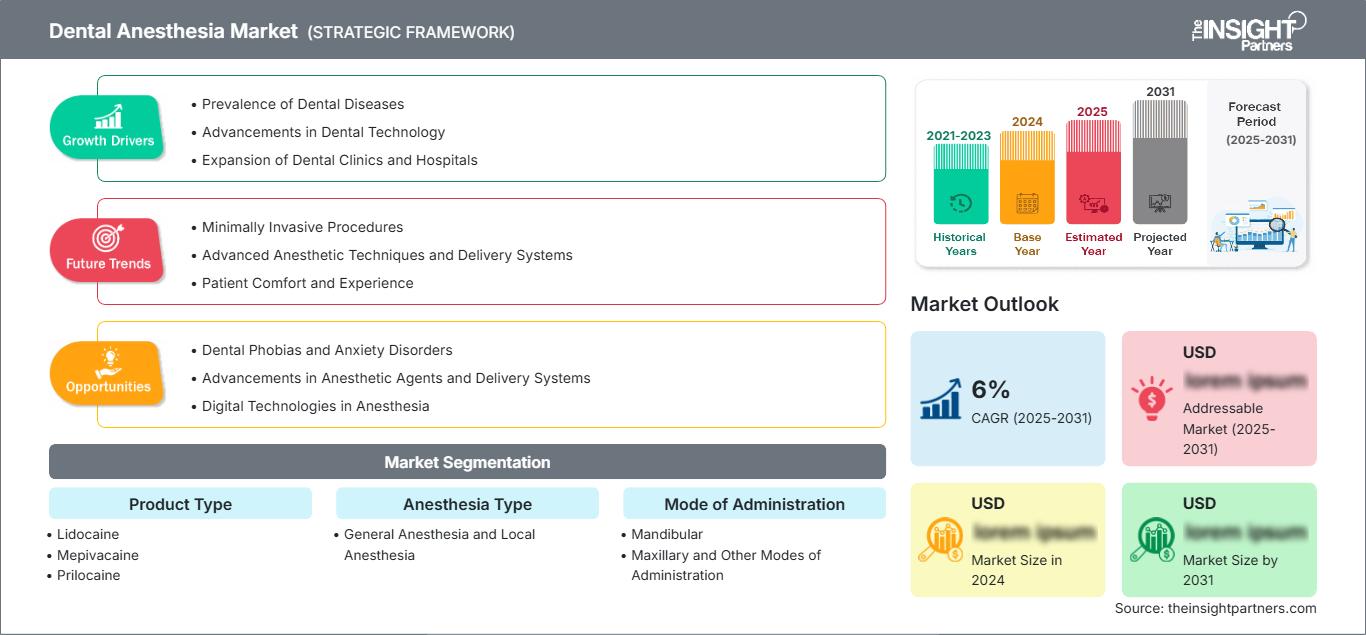
Dental Anesthesia Market: Strategic Insights
Regional Insights
North America Dental Anesthesia Market
North America holds a 38–42% of the Dental Anesthesia Market share of the 2025 global market and is forecast to experience a CAGR of 4.3–4.8% for 2026-2034. This region enjoys a conducive environment due to high spend on dentistry, private practice prevalence, dental specialties, and the use of injectable anesthetics. The US makes the greatest contribution to this market, while Canada supplements it with stable demand through efficient infrastructure and access to standard dental care.
Growth drivers include restoration and surgery procedures, ageing population, and investments in improved practice efficiency. Product choice will increasingly be based on clinician needs for predictable onset, duration, safety, and convenient packaging. North American players will also be favored by advanced distribution network and regulatory capabilities. Dental groups and multiple locations practices can facilitate the development of purchasing consistency, which is beneficial to the companies able to guarantee steady supply, documentation, and training with their anesthetics range.
U.S. Dental Anesthesia Market
The U.S. comprised 82-86% of North America's 2025 market share and is expected to grow at a CAGR of 4.2-4.7% in 2026-2034. Market demand is driven by applications in general dentistry, endodontic procedures, oral surgery, periodontal treatment, and implants. The company presence is widespread through manufacturing firms and national distributors, ensuring product availability in independent clinics, dental service organizations, hospitals, and specialist centers.
Local anesthesia use is gaining traction due to the consciousness of patients during the procedure, with the quickness of their recovery being a key factor in its application trends. Practice consolidation allows for larger volume purchases and consistent choice of the desired products in various locations. Other factors in selecting products include ease of injection, compatibility with cartridges, storage conditions, and familiarity.
Europe Dental Anesthesia Market
Europe held a 27–31% share in 2025 and is expected to grow at a CAGR of 4.8–5.3% during 2026–2034. Germany is the leading country, supported by a large installed base of dental professionals, while the UK, France, Italy, and Spain provide additional demand through established clinical systems and private dental services.
The UK market benefits from a combination of public and private dentistry and high demand for restorative services despite variations in access and reimbursement that affect the volume of procedures performed. Germany benefits from having robust dental facilities in place along with high usage of outpatient services, which translates into regular consumption of anesthetics. Private practices, specialist dentistry, and rising patient awareness about treatment comfort contribute to the French, Italian, and Spanish markets.
APAC Dental Anesthesia Market
APAC represented 22–26% of the 2025 share and is expected to record a CAGR of 6.0–6.6% during 2026–2034, making it the leading regional growth market. China, Japan, South Korea, India, and Australia form the principal demand centers, with China providing the strongest scale opportunity.
Growth is due to increasing infrastructure for dental treatments, urbanization, increased awareness about dental hygiene, and accessibility to restorative treatments. India and China are markets with huge potential in the long run due to large numbers of patients and unequal treatment facilities. Japan and Australia are mature markets, while South Korea has a high level of sophistication in terms of dental treatments and procedures.
Middle East & Africa Dental Anesthesia Market
CAGR for Middle East and Africa region will be estimated at 5.5-6.2% in 2026-2034, with Saudi Arabia acting as a key demand hub along with UAE and South Africa. Growth in the number of healthcare centers and specialized dental units promotes the use of anesthesia.
Healthcare infrastructure, medical cities, and diversified services in the field of private healthcare are available in Saudi Arabia and the UAE; South Africa offers the well-established dental network, whereas other countries in MEA are more dependent on infrastructure presence and its cost. In Gulf economies, revenues from the energy sector allow investments into the healthcare infrastructure, and general infrastructure development may promote access to dental services.
Segmentation Analysis
Product Type
Product Type segment in the Dental Anesthesia Market is divided into Lidocaine, Mepivacaine, Prilocaine, Articaine, Other Products Types and is projected to grow at a CAGR of 5.1–5.5% during 2026–2034. Established formulations continue to provide the volume base, while articaine benefits from clinical adoption and preference for infiltration procedures. Product differentiation increasingly depends on formulation consistency, concentration options, cartridge quality, and regulatory availability across markets.
- Lidocaine: Maintains a foundational position because of extensive clinician familiarity, broad availability, established clinical use, and suitability across routine procedures requiring predictable local anesthesia.
- Mepivacaine: Supports demand where clinicians seek formulations with different vasoconstrictor requirements, making it strategically relevant for selected patient profiles and procedure-specific treatment planning.
- Prilocaine: Retains importance in practices requiring an established alternative local anesthetic, with demand influenced by clinician familiarity, formulation availability, and patient-specific considerations.
- Articaine: Gains strategic importance because of strong infiltration performance and increasing clinician adoption, particularly where predictable diffusion and efficient anesthesia are valued.
- Other Products Types: Provide portfolio breadth for manufacturers, enabling suppliers to address specialized clinical requirements and regional preferences that are not fully served by the principal formulations.
Anesthesia Type
Anesthesia Type segment in the Dental Anesthesia Market comprises General Anesthesia and Local Anesthesia and is forecast to expand at a CAGR of 4.9–5.3% during 2026–2034. Local anesthesia remains dominant because most dental procedures can be performed without loss of consciousness. General anesthesia retains a specialized role in complex procedures, pediatric cases, severe anxiety, and hospital-based interventions where deeper anesthesia is clinically justified.
- General Anesthesia: Serves specialized procedures requiring unconsciousness or deeper control, with utilization concentrated in hospitals, surgical settings, selected pediatric cases, and patients with complex treatment needs.
- Local Anesthesia: Remains central to routine dentistry because targeted pain control allows efficient outpatient treatment, rapid recovery, and broad application across restorative, periodontal, endodontic, and extraction procedures.
Mode of Administration
Mode of Administration segment in the Dental Anesthesia Market includes Mandibular, Maxillary and Other Modes of Administration and is anticipated to grow at a CAGR of 5.0–5.4% during 2026–2034. Administration choices reflect anatomical target, procedure complexity, clinician technique, and required depth of anesthesia. Continued standardization of injection protocols and improved delivery ergonomics should support consistent utilization.
- Mandibular: Remains strategically important for procedures involving lower teeth, with demand closely linked to restorative dentistry, extractions, endodontics, and surgical interventions requiring regional nerve blockade.
- Maxillary: Supports a broad range of upper-jaw procedures, particularly infiltrative techniques where efficient diffusion and localized anesthesia can simplify routine clinical treatment.
- Other Modes of Administration: Address procedure-specific and emerging delivery requirements, offering manufacturers opportunities to differentiate through convenience, precision, patient comfort, and compatibility with evolving clinical workflows.
End User
End User segment in the Dental Anesthesia Market covers Dental Hospitals and Dental Clinics and is projected to grow at a CAGR of 5.2–5.6% during 2026–2034. Dental clinics remain the principal consumption environment because a large proportion of procedures are performed on an outpatient basis. Hospitals retain importance for oral surgery, complex cases, medically compromised patients, and procedures requiring multidisciplinary support.
- Dental Hospitals: Provide demand for anesthesia in complex oral surgery, multidisciplinary care, pediatric treatment, medically complicated cases, and procedures requiring advanced monitoring or deeper anesthesia capabilities.
- Dental Clinics: Represent the principal recurring consumption base, supported by high procedure frequency across restorative, endodontic, periodontal, prosthodontic, and extraction services delivered in outpatient settings.
Opportunity Snapshot
| End User | Revenue Contribution (High/Medium/Low) | Trend Tag (MAX 2 words) | Adoption Stage (Emerging/Scaling/Mature) |
|---|---|---|---|
| Dental Hospitals | Medium | Surgical Care | Mature |
| Dental Clinics | High | Chairside Care | Mature |
Dental Anesthesia Market Growth Drivers and Impact Analysis
Rising Procedure Volumes and Untreated Oral Disease
The global prevalence of oral conditions continues to contribute to a significant need for treatments behind the scenes. According to the World Health Organization, there are about 3.7 billion people affected by oral diseases, whereas untreated dental caries still rank among the leading health conditions around the world. These challenges result in ongoing needs for restorations, periodontal treatments, endodontic treatments, and extractions, all of which might demand effective pain management. With increased access to dentistry, the number of procedures needing anesthetics might grow despite the clinically conventional nature of the treatment protocols in question. Commercially, this trend impacts suppliers of wide range of products, reliable sterile manufacturing, and broad distribution networks.
Expansion of Organized Dental Care Infrastructure
The increasing organization of dental care delivery is changing purchasing behavior from individual product selection toward standardized procurement and inventory management. Multi-location practices, dental service organizations, hospitals, and larger specialty centers can consolidate anesthetic purchasing, establish preferred formulations, and require consistent documentation across facilities. This favors suppliers capable of maintaining quality across high-volume production runs while meeting regulatory and packaging requirements. In developing markets, investments in dental hospitals and private clinics create additional channels for injectable and topical anesthetics. The resulting impact extends beyond unit demand because institutional buyers increasingly evaluate supplier reliability, product availability, training support, and logistics performance. Companies that integrate manufacturing discipline with strong distribution relationships can therefore improve retention as customers move toward centralized procurement and standardized clinical protocols.
Greater Emphasis on Patient Comfort and Injection Experience
Patient anxiety associated with dental injections remains a practical consideration influencing product and delivery-system selection. Greater attention to comfort is encouraging interest in topical pre-anesthesia, controlled injection approaches, ergonomic devices, and formulations designed for predictable onset. This shift creates opportunities for suppliers to compete on the complete administration experience rather than active ingredient alone. Products that reduce discomfort, simplify dosing, or improve clinician control can support workflow efficiency while strengthening patient acceptance of necessary procedures. The commercial effect may be particularly relevant in pediatric dentistry, orthodontics, periodontal care, and practices serving patients with heightened dental anxiety. As patient experience becomes more closely linked to treatment acceptance and practice reputation, manufacturers can differentiate through integrated anesthetic and delivery solutions rather than relying solely on price-based competition.
Dental Anesthesia Market Future Trends
Precision-Oriented Delivery and Workflow Integration
Future development is likely to move toward greater integration between anesthetic products and precision delivery systems. Digital and mechanically controlled injectors can help clinicians manage pressure, dosing consistency, and injection speed while reducing variability between operators. The next stage of adoption should focus on practical interoperability, simplified cartridge handling, ergonomic design, and data-supported clinical workflows rather than technology for its own sake. Manufacturers may increasingly package anesthetic solutions with complementary delivery devices, particularly in specialist and high-volume practices. Pediatric dentistry and anxious-patient care are likely to remain important application areas because predictable delivery can influence patient acceptance. Over time, evidence demonstrating improved workflow efficiency, reduced discomfort, and consistent dosing could strengthen the business case for premium delivery formats alongside conventional anesthetic cartridges.
Formulation Diversification and Patient-Specific Anesthesia
Future portfolios are expected to become more differentiated around patient characteristics, procedure duration, anatomical requirements, and clinician preference as Dental Anesthesia Market Trends. Rather than relying on a limited set of universally used formulations, manufacturers can increasingly emphasize tailored choices covering onset, duration, vasoconstrictor requirements, and administration context. This direction should encourage continued clinical evaluation of established active ingredients alongside incremental formulation improvements. Regulatory requirements will remain central because any modification to concentration, excipients, packaging, or delivery mechanism can affect approval pathways and manufacturing controls. Suppliers with strong pharmacovigilance capabilities and established regulatory infrastructure should therefore be better positioned to commercialize differentiated offerings. In parallel, clinical education will remain important for helping practitioners select formulations appropriately without increasing unnecessary product complexity.
Dental Anesthesia Market Opportunities
Capacity Expansion in High-Growth Asian Markets
The strongest geographic opportunity lies in expanding manufacturing, distribution, and clinical partnerships across Asia Pacific, particularly in China and India. Large patient populations, improving dental infrastructure, and increasing awareness of restorative treatment create favorable conditions for higher anesthetic consumption. Companies can pursue localized strategies involving regional distributors, regulatory registrations, technical support, and packaging adapted to local procurement requirements. Manufacturing partnerships can also reduce lead times and improve resilience where import dependence creates supply exposure. The opportunity of the Dental Anesthesia Market Forecast is not limited to volume expansion; suppliers can develop differentiated portfolios for general dentistry, specialist practices, and institutional hospitals. A staged market-entry strategy combining established products with targeted premium formulations may help companies balance affordability requirements with higher-value product opportunities while building durable clinician relationships.
Integrated Anesthesia Platforms for Group Practices
Consolidation among dental practices creates an opportunity to provide integrated anesthesia programs rather than individual products. Suppliers can combine cartridges, topical anesthetics, syringes, needles, storage systems, education, and inventory services into standardized packages for multi-location customers. Such models can reduce procurement complexity and support consistent clinical protocols across participating practices. Digital ordering and inventory monitoring could further improve replenishment efficiency and reduce stockout risk for high-use formulations. The opportunity is particularly relevant in North America and Europe, where organized dental groups have established purchasing structures and sophisticated supply chains. Companies with strong distribution capabilities can use these relationships to introduce complementary products, while specialist manufacturers can partner with distributors to gain access to broader customer networks without duplicating infrastructure.
Recent Developments
- November 2025: Henry Schein, Inc. announced a collaboration with Amazon Web Services to integrate generative AI capabilities across Dentrix, Dentrix Ascend, and Dentally. The initiative expands digital workflow capabilities covering documentation, charting, scheduling, and patient engagement, strengthening the company's broader technology ecosystem serving dental practices.
- September 2025: DMG America announced the Canadian launch of Ecosite One, a one-shade posterior composite designed to simplify restorative workflows. The launch reflects continued expansion of the company's dental materials portfolio and its focus on reducing chair time through simplified clinical procedures and material selection.
- July 2025: Centrix, Inc. announced the addition of two account representatives to its sales organization, strengthening customer-facing coverage in its dental product business. The development supports broader commercial engagement and complements the company's portfolio of dental products, including LolliCaine topical anesthetic and other chairside solutions.
Frequently Asked Questions

- Comprehensive Market Sizing and Forecast Analysis
- Detailed Segmentation Analysis
- In-Depth Market Dynamics Assessment
- Regional and Country-Level Insights
- Competitive Landscape and Company Benchmarking
- Strategic Business Intelligence
Recent Reports
Testimonials

The Insight Partners provided valuable market intelligence that supported our global go-to-market strategy. Their team was professional, responsive, and attentive to our feedback, providing thoughtful analysis and helpful methodological clarifications throughout the project.
Junmo Kim Chief Financial Officer (CFO), Enertech Co., Ltd.
The Insight Partners' SCADA System Market report is comprehensive, with valuable insights on current trends and future forecasts. The team was highly professional, responsive, and supportive throughout. We are very satisfied and highly recommend their services.
RAN KEDEM Partner, Reali Technologies LTDs
I requested a report on a very specific software market and the team produced the report in a few days. The information was very relevant and well presented. I then requested some changes and additions to the report. The team was again very responsive and I got the final report in less than a week.
JEAN-HERVE JENN Chairman, Future Analytica
We worked with The Insight Partners for an important market study and forecast. They gave us clear insights into opportunities and risks, which helped shape our plans. Their research was easy to use and based on solid data. It helped us make smart, confident decisions. We highly recommend them.
PIYUSH NAGPAL Sr. Vice President, High Beam Global
The Insight Partners delivered insightful, well-structured market research with strong domain expertise. Their team was professional and responsive throughout. The user-friendly website made accessing industry reports seamless. We highly recommend them for reliable, high-quality research services
YUKIHIKO ADACHI CEO, Deep Blue, LLC.
This is the first time I have purchased a market report from The Insight Partners.While I was unsure at first, I visited their web site and felt more comfortable to take the risk and purchase a market report.I am completely satisfied with the quality of the report and customer service. I had several questions and comments with the initial report, but after a couple of dialogs over email with their analyst I believe I have a report that I can use as input to our strategic planning process.Thank you so much for taking the extra time and making this a positive experience.I will definitely recommend your service to others and you will be my first call when we need further market data.
JOHN SUZUKI President and Chief Executive Officer, Board Director, BK Technologies
I wish to appreciate your support and the professionalism you displayed in the course of attending to my request for information regarding to infectious disease IVD market in Nigeria. I appreciate your patience, your guidance, and the fact that you were willing to offer a discount, which eventually made it possible for us to close a deal. I look forward to engaging The Insight Partners in the future, all thanks to the impression you have created in me as a result of this first encounter.
DR CHIJIOKE ONYIA MANAGING DIRECTOR, PineCrest Healthcare Ltd.Reason to Buy
- Informed Decision-Making
- Understanding Market Dynamics
- Competitive Analysis
- Identifying Emerging Markets
- Customer Insights
- Market Forecasts
- Risk Mitigation
- Boosting Operational Efficiency
- Strategic Planning
- Investment Justification
- Tracking Industry Innovations
- Aligning with Regulatory Trends





 Get Free Sample for