
Dental Intraoral Camera Market Size, Share & Trends by 2034
Coverage: by Type (4D Intraoral Camera, 3D Intraoral Camera, Dental Digital Cameras); Applications (Hospital, Dental Clinic), and Geography (North America, Europe, Asia Pacific, and South and Central America)
- Status : Data Released
- Report Code : TIPRE00010459
- Category : Life Sciences
- No. of Pages : 150
- Available Report Formats :


- Last update date : August 21, 2026


2025 Market Size
US$ 2.53 Bn
Base year value
2034 Forecast
US$ 6.19 Bn
Projected by 2034
CAGR 2026-2034
10.45 %
Growth rate
Addressable Market
US$ 38.67 Bn
(2026-2034)
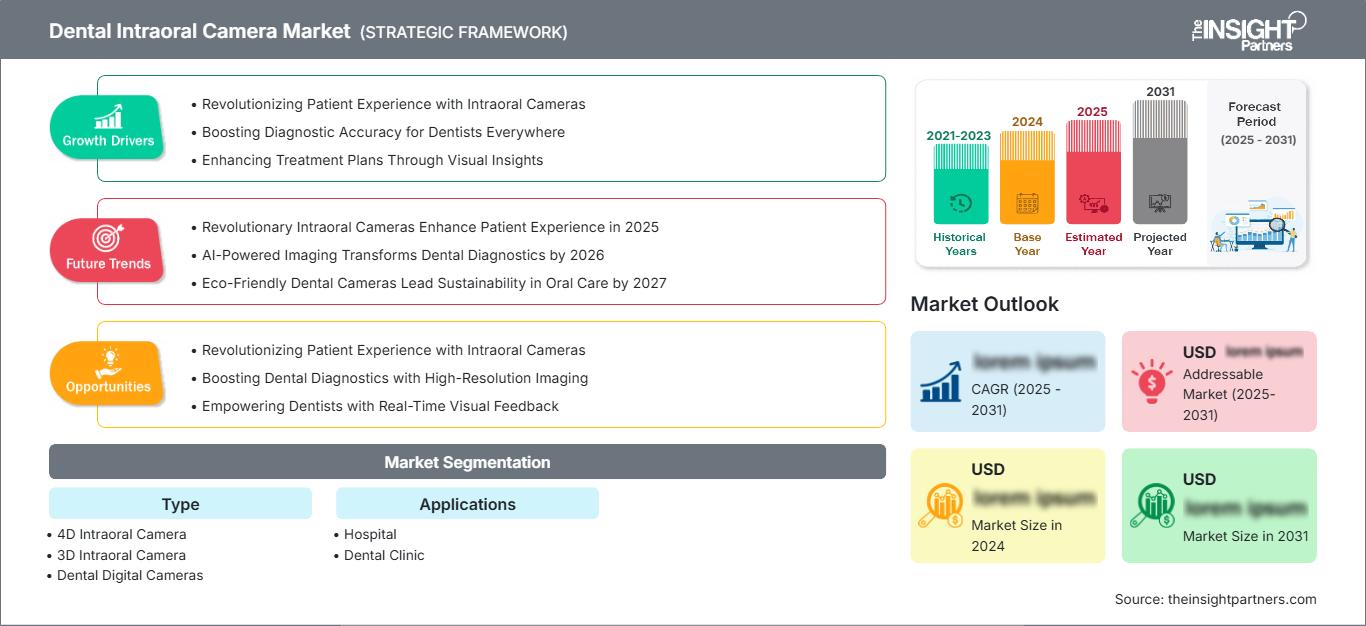
The Dental Intraoral Camera Market is positioned at the intersection of clinical documentation, diagnostic visualization, and digital dentistry workflows. The market value in 2025 was US$ 2.53 Billion and it will have a market worth of US$ 6.19 Billion by 2034, growing at a CAGR of 10.45% from 2026 to 2034. There has been an increased importance attached to minimally invasive procedures, patient interaction, photography, and digitization, thereby driving the demand for specialized intraoral imaging devices.
North America continues to be a technologically rich market owing to its existing dental industry infrastructure, high penetration rate of practice management software in digital format, and huge investments made in clinical equipment. The Dental Intraoral Camera Market size is also affected by replacement demand from upgrading the imaging fleet. Regional CAGR during 2026-2034 will be between 9.2-9.8%.
Dental Intraoral Camera Market Assessment and Insights
- North America: The region held a 2025 share of 32–36% and is projected to expand at a CAGR of 9.2–9.8% between 2026–2034, supported by mature dental infrastructure, digital imaging adoption, and replacement cycles.
- US: The US represented 86–90% of North America's 2025 market and is expected to grow at a CAGR of 9.0–9.6%, driven by private dental practices and technology upgrades.
- Europe: Europe accounted for a 2025 share of 27–31% and is forecast to grow at a CAGR of 9.0–9.6%, led by Germany, the UK, France, Italy, and Spain through digital dentistry investment and equipment modernization.
- Asia Pacific: Asia Pacific represented 22–26% in 2025 and is anticipated to register a CAGR of 11.0–11.8%, with China, Japan, South Korea, and India benefiting from expanding dental capacity and technology adoption.
- Largest Segment: Dental Digital Cameras represented a 2025 market share of 44–48% and is expected to grow at a CAGR of 8.6–9.4%, reflecting established clinical photography applications.
- High Growth Segment: 4D Intraoral Camera held a 2025 market share of 12–16% and is projected to expand at a CAGR of 13.0–15.0%, supported by advanced visualization capabilities.
- Key companies analyzed in detail: Carestream Dental LLC, Dapha Dental Technology Co., Ltd., Dentsply Sirona, DÜRR DENTAL SE, Gendex Dental Systems, PhotoMed International, Polaroid Corporation, Royal Dental Group, Shofu Dental Corporation, Sirona Dental Systems GmbH, TPC Advanced Technology, Inc.
Source: The Insight Partners' analysis based on proprietary research, government publications, company annual reports, investor presentations, industry databases, and expert interviews.
There is a clear trend in technology advancements for dental cameras to go from individual imaging devices to connected clinical visualization devices. Advances in high-resolution sensors, autofocus, ergonomic design, wireless capability, and software capabilities are enhancing the documentation process. Product focus increasingly centers on lightweight construction, consistent image quality, infection control capability, and interoperability with practice management platforms. There is therefore an increasing ecosystem of technology where performance and capability matter in purchasing.
Future market demand will spread from the current dental market to other regions where there is growth in private practices in the Asia-Pacific region and select Middle Eastern countries. In future purchases, manufacturers will be increasingly required to develop products that are compatible with existing digital technologies with minimal infrastructure changes. Electrical safety, cybersecurity, patient data, and medical device standards will be considered in product development due to increased connectivity.
Dental Intraoral Camera Market Report Scope
| Report Attribute | Details |
|---|---|
| Market size in 2025 | US$ 2.53 Billion |
| Market Size by 2034 | US$ 6.19 Billion |
| Global CAGR (2026 - 2034) | 10.45% |
| Historical Data | 2021-2024 |
| Forecast period | 2026-2034 |
Dental Intraoral Camera Market Analysis
The factors driving growth in the Dental Intraoral Camera Market include requirements for enhanced visual clarity at the dentist's chair, standardization of clinical documentation, and effective communication between dentists and patients. The environment includes image sensors, optical lenses, lighting equipment, camera housings, software, distributors, dental equipment suppliers, and practice management systems. In this case, vendors have to differentiate their products both in terms of performance and compatibility of use.
Requirements for devices are created by the prevalence of oral diseases around the world. According to the WHO, oral diseases affect an estimated 3.5 billion people across the globe, whereas untreated caries affects about 2.5 billion individuals. In spite of the fact that cameras do not provide treatment per se, better documentation and patient information generate recurrent clinical applications. In terms of supply, the landscape remains relatively diversified.
Modern positioning goes beyond mere specifications of cameras to ecosystem positioning in the Dental Intraoral Camera Market Report. The company named Carestream Dental LLC uses imaging machines along with software processes, while the firm known as Dentsply Sirona concentrates on connectivity of their digital dentistry. Specialized imaging services are provided by such companies as DÜRR DENTAL SE, Shofu Dental Corporation, TPC Advanced Technology, Inc., and PhotoMed International. Other competitors in equipment and imaging include Dapha Dental Technology Co., Ltd., Gendex Dental Systems, Royal Dental Group, Polaroid Corporation, and Sirona Dental Systems GmbH.
Current investment strategies go beyond design efficiency to software compatibility, image processing, and user-friendliness. Product innovations confirm the current trend as vendors boast high definition, auto focusing, improved lighting, and compatibility with imaging systems. The positioning will become application-oriented, as different vendors specialize in specific areas such as restorative photography, orthodontic imaging, consultation, insurance documentation, and laboratory communication.
● REPORT CUSTOMIZATION
Tailor This Report To Align With Your Specific Business Requirements
This report can be customized to align precisely with your business objectives, scope, and target markets. Customization options include tailored segmentation, geography, competitive analysis, and strategic insights to support informed decision-making.
Customize This Report →WHAT YOU CAN ADJUST
- ● Segmentations
- ● Geography
- ● Competitive Analysis
- ● Language Preferences
Dental Intraoral Camera Market: Strategic Insights
Regional Insights
North America Dental Intraoral Camera Market
The North American region held a market share of 32-36% in 2025 and will witness growth at a CAGR of 9.2-9.8% up till 2034. The U.S. leads in the region, driven by the availability of robust private practice networks, dental imaging systems, and digital record keeping. Canada adds value via clinic upgrades and rising image-based documentations.
It becomes very important to consider replacement needs since existing practices begin to focus on the integration, image uniformity, and user-friendliness of the equipment rather than just image capture. Big dental services groups help speed up standardizations in several facilities, whereas individual practices look for cost-effective systems that are interoperable.
U.S. Dental Intraoral Camera Market
United States held around 86-90% of North America's market in 2025 and is expected to increase at a CAGR of 9.0-9.6%. The demand arises from dental clinics where the use of cameras facilitates the diagnosis, treatment, patient education, insurance purposes, and presentations of cases. Hospitals make up an equally important demand segment.
Carestream Dental LLC, Dentsply Sirona, Gendex Dental Systems, Shofu Dental Corporation, and TPC Advanced Technology, Inc. are some of the competitors. Decisions regarding procurement are influenced by compatibility with existing imaging software and practice management infrastructure. Dental groups with multiple locations are inclined towards purchasing standardized equipment whereas individual practitioners focus on mobility, quickness, easy disinfection, and little training needed.
Europe Dental Intraoral Camera Market
Europe has the current share of 27–31% for the period 2025, and the growth will be at a CAGR of 9.0–9.6%, with Germany being the market leader. The UK and Germany have a very good demand owing to advanced dental practices and equipment channels. France, Italy, and Spain provide additional demand as a result of clinics becoming digitally advanced.
In the UK, there is a focus on efficiency of private practices as well as effective communication. In Germany, there is an advantage because of the presence of an ecosystem for dental technology and equipment sophistication. France and Italy benefit due to clinic modernization and restorative dentistry and specialty practices. Spain has been affected increasingly by private dental practices and technology-based patient services.
APAC Dental Intraoral Camera Market
The APAC region had a 22-26% share in 2025 and is forecasted to grow at a CAGR of 11.0-11.8%, being the fastest-growing among the major regions. The leading markets are China, Japan, South Korea, India, and Australia. Growing numbers of clinics and urban dentistry drive the use of equipment.
The development of the industry in medical electronics, growing distribution network, and government efforts to make healthcare digital have an impact on the demand. Precision and efficiency of workflows matter in Japan, while India and China provide high growth opportunities due to growing number of private dental offices.
Middle East & Africa Dental Intraoral Camera Market
MEA market is estimated to grow at a CAGR of 8.2%–9.0% through 2034. Saudi Arabia accounts for the bulk of regional demand, as it is due to investment in health care systems and improvements, and UAE owes to well-developed private dental clinics. South Africa continues to be an important market for Africa due to the presence of private dental market.
Other MEA represents a long-term growth opportunity due to the development of the healthcare infrastructure and technological progress in the field of dentistry. The income derived from energy production in countries of the Gulf will finance the investments into infrastructure development and thus promote imports of dental technologies.
Segmentation Analysis
Type
The Type segment is expected to expand at a CAGR of 10.0–10.8% during 2026–2034. Product differentiation increasingly centers on image quality, ergonomics, illumination, connectivity, and clinical workflow. Dental Digital Cameras retain broad usage, while 3D and 4D formats address more advanced visualization requirements. The Dental Intraoral Camera Market scope is therefore widening as clinics combine conventional photography with increasingly sophisticated digital imaging.
- 4D Intraoral Camera: Advanced visualization capabilities position this category for specialized applications where clinicians require richer temporal or multidimensional information, creating strategic relevance for technology-forward practices and emerging digital workflows.
- 3D Intraoral Camera: Three-dimensional visualization supports more detailed spatial assessment and complements digital dentistry workflows, making the category strategically important where clinics increasingly connect imaging with treatment planning.
- Dental Digital Cameras: Established photographic workflows sustain demand for documentation, diagnosis, treatment planning, patient education, and laboratory communication, maintaining this category as the principal installed-base opportunity.
Applications
The Applications segment is projected to grow at a CAGR of 9.8–10.6% from 2026–2034. Dental clinics remain the primary setting because imaging is repeatedly used during examinations, treatment planning, follow-up, and patient consultation. Hospitals provide a broader institutional environment where cameras support multidisciplinary documentation, specialist referrals, teaching, and standardized clinical records.
- Hospital: Hospitals use intraoral imaging for specialist consultations, oral examinations, surgical documentation, referrals, teaching, and multidisciplinary records, creating demand for durable equipment compatible with institutional workflows.
- Dental Clinic: Dental clinics represent the core application environment, using cameras repeatedly for clinical documentation, treatment explanation, restorative planning, orthodontic monitoring, insurance records, and patient engagement.
Opportunity Snapshot
| Applications | Revenue Contribution | Trend Tag | Adoption Stage |
|---|---|---|---|
| Hospital | Medium | Clinical Documentation | Scaling |
| Dental Clinic | High | Chairside Imaging | Mature |
Dental Intraoral Camera Market Growth Drivers and Impact Analysis
Digital Clinical Documentation and Patient Visualization
The growing importance of visual documentation is increasing the frequency with which dental practices capture standardized intraoral images. Cameras allow clinicians to present visible evidence of conditions, compare treatment stages, and support communication without relying exclusively on verbal explanations. This changes purchasing criteria from simple image capture toward consistency, speed, ergonomics, and software compatibility. Practices with multiple operators particularly benefit when devices produce reproducible images without extensive photographic expertise. The commercial impact extends beyond hardware sales because integrated imaging can encourage upgrades to monitors, software, storage, and connected practice-management systems. As dental groups standardize workflows across locations, camera specifications increasingly become part of broader procurement programs rather than isolated equipment decisions, strengthening replacement and fleet-expansion opportunities.
Expansion of Digitized Dental Workflows
The continuing digitization of dental practices is creating stronger requirements for imaging devices that can communicate with established software environments. Modern clinics increasingly combine patient records, radiography, scanning, photography, and treatment-planning applications, making interoperability a practical purchasing criterion. Devices that require complex transfers or proprietary workflows can face resistance even when image quality is competitive. The market impact is therefore visible in product design, where manufacturers increasingly emphasize software connectivity, standardized interfaces, cloud compatibility, and simplified image management. Dental service organizations can amplify this effect by deploying standardized imaging systems across multiple sites. For suppliers, the resulting opportunity extends beyond the camera itself because successful integration can create recurring demand for software, support, accessories, training, and replacement hardware.
Growing Demand for Efficient Chairside Workflows
Pressure to improve clinical productivity is encouraging dental practices to reduce the time required for image acquisition, organization, and presentation. Compact camera designs, one-touch capture, autofocus, integrated illumination, and ergonomic handling can shorten routine documentation processes while limiting operator fatigue. These characteristics are especially valuable in busy clinics where staff members capture images repeatedly throughout the day. The resulting market impact favors products that combine adequate image quality with operational simplicity rather than maximizing technical specifications alone. Dental groups may also evaluate equipment through total workflow cost, including staff training, maintenance, software compatibility, and replacement intervals. Vendors capable of demonstrating measurable workflow benefits can therefore gain relevance in procurement decisions even when competing products offer similar sensor performance.
Dental Intraoral Camera Market Future Trends
AI-Assisted Image Interpretation and Workflow Support
Future camera systems are likely to incorporate increasingly sophisticated image-enhancement and decision-support capabilities. Rather than operating solely as capture devices, cameras may automatically optimize exposure, identify relevant anatomical areas, flag image-quality problems, and organize photographs according to clinical episodes. AI could also assist with longitudinal comparisons by highlighting visible changes across appointments. Adoption will depend on validated performance, transparent clinical workflows, data governance, and regulatory clearance where diagnostic claims are involved. The Dental Intraoral Camera Market trends therefore point toward a gradual transition from hardware-centered differentiation to software-enabled clinical utility. Vendors that develop interoperable platforms can potentially create stronger customer retention because imaging data becomes embedded within broader patient-management workflows.
Cloud-Connected Imaging Ecosystems
Cloud connectivity is expected to become more important as dental practices seek centralized access to clinical images across locations, devices, and specialist teams. Secure cloud workflows can simplify image sharing with laboratories, consultants, insurers, and patients while reducing dependence on local storage. Future systems may increasingly support role-based access, automated backup, remote collaboration, and cross-device viewing. The Dental Intraoral Camera Market trends will consequently be influenced by cybersecurity, privacy controls, interoperability standards, and subscription-based software models. Hardware suppliers may increasingly partner with practice-management and imaging-software companies to deliver integrated ecosystems. This transition can also change purchasing economics because clinics may evaluate lifetime software and connectivity costs alongside the initial camera price.
Dental Intraoral Camera Market Opportunities
Expansion Across Emerging Private Dental Networks
Emerging private dental networks in Asia Pacific, Latin America, and selected Middle Eastern markets offer an attractive opportunity for suppliers seeking new equipment demand. These networks often need standardized imaging capabilities as they expand across multiple locations, creating potential for volume procurement and centralized training. The opportunity is not limited to premium systems because mid-range devices with dependable image quality and broad software compatibility can address clinics with tighter capital budgets. The Dental Intraoral Camera Market Forecasts indicate that suppliers can improve market access by developing tiered portfolios, localized service arrangements, and financing partnerships. Distribution strategy will remain important because technical support, installation, and staff education can materially influence the success of equipment deployment in rapidly expanding clinic networks.
Integrated Imaging Platforms for Multi-Site Dentistry
Multi-site dental organizations provide an opportunity to develop imaging platforms that unify hardware, software, storage, and workflow management. Centralized image repositories can help organizations maintain consistent documentation standards while allowing authorized clinicians to review cases across locations. Suppliers can create differentiated offerings through device management, analytics, secure sharing, automated backups, and compatibility with existing patient-record systems. The commercial opportunity extends toward service-based models in which hardware replacement, software updates, training, and technical support are bundled. Vendors entering this space should prioritize interoperability and data portability because multi-site customers are unlikely to accept systems that create significant switching barriers without corresponding workflow benefits. Strategic partnerships with dental software providers could accelerate deployment.
Recent Developments
- March 2026: Carestream Dental LLC launched the CS 1300 intraoral camera, featuring HD 1280 x 720 imaging, a 280° rotating head, autofocus and semi-autofocus modes, nine adjustable LED lights, and integration with CS Imaging version 8 and TWAIN-compatible software. The launch reinforces the industry's movement toward ergonomic, connected chairside imaging.
- March 2025: Dentsply Sirona announced enhancements to Primescan 2 at IDS 2025, including reductions of up to 50% in bandwidth requirements and additional connected-dentistry capabilities. Although focused on scanning, the development demonstrates the broader shift toward lower-infrastructure digital dental workflows relevant to connected imaging ecosystems.
- 2025: Shofu Dental Corporation continued promoting its EyeSpecialSmart dental camera platform, emphasizing nine preset shooting modes, one-touch operation, dental-specific imaging workflows, and features designed for consistent clinical photography. The positioning highlights demand for simplified equipment that can be operated across dental teams without advanced photographic training.
Frequently Asked Questions

- Comprehensive Market Sizing and Forecast Analysis
- Detailed Segmentation Analysis
- In-Depth Market Dynamics Assessment
- Regional and Country-Level Insights
- Competitive Landscape and Company Benchmarking
- Strategic Business Intelligence
Recent Reports
Testimonials

The Insight Partners' SCADA System Market report is comprehensive, with valuable insights on current trends and future forecasts. The team was highly professional, responsive, and supportive throughout. We are very satisfied and highly recommend their services.
RAN KEDEM Partner, Reali Technologies LTDs
I requested a report on a very specific software market and the team produced the report in a few days. The information was very relevant and well presented. I then requested some changes and additions to the report. The team was again very responsive and I got the final report in less than a week.
JEAN-HERVE JENN Chairman, Future Analytica
We worked with The Insight Partners for an important market study and forecast. They gave us clear insights into opportunities and risks, which helped shape our plans. Their research was easy to use and based on solid data. It helped us make smart, confident decisions. We highly recommend them.
PIYUSH NAGPAL Sr. Vice President, High Beam Global
The Insight Partners delivered insightful, well-structured market research with strong domain expertise. Their team was professional and responsive throughout. The user-friendly website made accessing industry reports seamless. We highly recommend them for reliable, high-quality research services
YUKIHIKO ADACHI CEO, Deep Blue, LLC.
This is the first time I have purchased a market report from The Insight Partners.While I was unsure at first, I visited their web site and felt more comfortable to take the risk and purchase a market report.I am completely satisfied with the quality of the report and customer service. I had several questions and comments with the initial report, but after a couple of dialogs over email with their analyst I believe I have a report that I can use as input to our strategic planning process.Thank you so much for taking the extra time and making this a positive experience.I will definitely recommend your service to others and you will be my first call when we need further market data.
JOHN SUZUKI President and Chief Executive Officer, Board Director, BK Technologies
I wish to appreciate your support and the professionalism you displayed in the course of attending to my request for information regarding to infectious disease IVD market in Nigeria. I appreciate your patience, your guidance, and the fact that you were willing to offer a discount, which eventually made it possible for us to close a deal. I look forward to engaging The Insight Partners in the future, all thanks to the impression you have created in me as a result of this first encounter.
DR CHIJIOKE ONYIA MANAGING DIRECTOR, PineCrest Healthcare Ltd.Reason to Buy
- Informed Decision-Making
- Understanding Market Dynamics
- Competitive Analysis
- Identifying Emerging Markets
- Customer Insights
- Market Forecasts
- Risk Mitigation
- Boosting Operational Efficiency
- Strategic Planning
- Investment Justification
- Tracking Industry Innovations
- Aligning with Regulatory Trends





 Get Free Sample for