
Desalting and Buffer Exchange Market Demand, Share & Growth by 2034
Coverage: By Product (Kits, Cassettes and Cartridges, Filter Plates, Spin Columns, Other Consumables and Accessories); Technique (Filtration, Chromatography, Precipitation); Application (Bioprocess Applications, Diagnostic Application), and Geography (North America, Europe, Asia Pacific, and South and Central America)
- Status : Data Released
- Report Code : TIPRE00002851
- Category : Life Sciences
- No. of Pages : 150
- Available Report Formats :


- Last update date : July 06, 2026


2025 Market Size
US$ 1.41 Bn
Base year value
2034 Forecast
US$ 3.25 Bn
Projected by 2034
CAGR 2026-2034
9.71 %
Growth rate
Addressable Market
US$ 20.75 Bn
(2026-2034)
The Desalting and Buffer Exchange Market is gaining strategic importance across biopharmaceutical manufacturing, analytical research, and diagnostic workflows as organizations seek higher purity, improved process efficiency, and scalable downstream processing solutions. The market is valued at US$1.41 billion in 2025 and is projected to reach US$3.25 billion by 2034, advancing at a CAGR of 9.71% during 2026–2034. Growth is supported by expanding biologics pipelines, increasing adoption of protein therapeutics, and continuous investments in bioprocess optimization technologies.
North America remains the most influential regional desalting and buffer exchange market, supported by a strong concentration of biotechnology companies, contract development and manufacturing organizations, and advanced research infrastructure. The regional market is anticipated to expand at an estimated 9.2% CAGR through 2034. Rising investments in monoclonal antibodies, cell and gene therapies, and the modernization of downstream purification platforms continue to strengthen demand for desalting and buffer exchange solutions across commercial and clinical-scale production environments.
Desalting and Buffer Exchange Market Assessment and Insights
- North America: North America accounted for 37–40% of the desalting and buffer exchange market share in 2025 and is projected to expand at a CAGR of 9.2%–10.0% during 2026–2034. Growth is driven by strong biologics manufacturing infrastructure and advanced research activities, which continue to support the region's leadership in desalting and buffer exchange technologies.
- U.S.: The U.S. represented 28–31% of the global desalting and buffer exchange market in 2025 and is anticipated to register a CAGR of 9.4%–10.2% during 2026–2034, supported by the extensive presence of biopharmaceutical innovators, contract manufacturing organizations, and increasing adoption of advanced purification technologies.
- Europe: Europe accounted for 27–30% of the market share in 2025 and is projected to expand at a CAGR of 8.8%–9.6% during 2026–2034. Germany, the United Kingdom, and France continue leading regional growth, driven by biotechnology innovation, ongoing pharmaceutical manufacturing optimization, and increasing desalting and buffer exchange market size demand.
- Asia Pacific: Asia Pacific accounted for 23–26% market share in 2025 and is forecast to expand at a CAGR of 10.5%–11.4% during 2026–2034. China, Japan, India, and South Korea drive regional growth through expanding biologics production capacity and increasing investments in life sciences research and manufacturing.
- Largest Segment – Product: Kits: Kits represented the largest desalting and buffer exchange market segment and are expected to grow at a CAGR of 9.4%–10.2% during 2026–2034, driven by their standardized workflows, rapid processing capabilities, and ease of use in laboratory applications.
- High Growth Segment – Technique: Filtration: The filtration segment is anticipated to record the highest CAGR of 10.4%–11.3% during 2026–2034, driven by wider adoption of scalable membrane technologies, continuous bioprocessing practices, and strengthening desalting and buffer exchange market forecast prospects across biopharmaceutical manufacturing applications.
- Key companies analyzed in detail: Merck KGaA; Danaher Corporation; Thermo Fisher Scientific Inc.; Cytiva (formerly GE Healthcare Life Sciences); Agilent Technologies, Inc.; Bio-Rad Laboratories, Inc.; Sartorius AG; Repligen Corporation; Bio-Works Technologies AB; Avantor, Inc.
Source: The Insight Partners' analysis based on proprietary research, government publications, company annual reports, investor presentations, industry databases, and expert interviews.
The Desalting and Buffer Exchange Market report has evolved from a laboratory-centric activity into a critical component of modern bioprocessing operations. Increasing production volumes of biologics, biosimilars, recombinant proteins, and advanced therapies have elevated the importance of efficient buffer management and impurity removal technologies. Manufacturers increasingly prioritize solutions capable of reducing processing time while maintaining product integrity and regulatory compliance.
Future market expansion is expected to be shaped by process intensification strategies, automation, and the broader adoption of single-use technologies. Vendors are enhancing filtration, chromatography, and membrane-based platforms to improve scalability and operational flexibility. Demand from diagnostic laboratories and therapeutic development programs is also creating opportunities for innovative consumables and integrated workflow solutions that support faster development timelines.
Desalting and Buffer Exchange Market Report Scope
| Report Attribute | Details |
|---|---|
| Market size in 2025 | US$ 1.41 Billion |
| Market Size by 2034 | US$ 3.25 Billion |
| Global CAGR (2026 - 2034) | 9.71% |
| Historical Data | 2021-2024 |
| Forecast period | 2026-2034 |
Desalting and Buffer Exchange Market Analysis
The desalting and buffer exchange market is being driven by the growing complexity of biologic drug development and the need for highly controlled purification processes. Desalting and buffer exchange are essential downstream processing steps that influence product quality, stability, and yield. As therapeutic proteins, antibodies, vaccines, and gene therapies become more sophisticated, manufacturers require advanced technologies capable of delivering reproducible and scalable performance.
The value chain encompasses consumable manufacturers, filtration technology providers, chromatography solution developers, contract manufacturers, biopharmaceutical companies, and research institutions. Consumables such as spin columns, cassettes, cartridges, and filter plates generate recurring demand, creating stable revenue streams for suppliers. Increasing outsourcing of biomanufacturing activities further expands the addressable market for specialized purification technologies.
Competition is characterized by strong technological differentiation and extensive product portfolios. Companies including Merck KGaA, Danaher, Thermo Fisher Scientific Inc, Agilent Technologies Inc, and Sartorius AG focus on expanding purification capabilities while improving workflow integration.
Investment activity increasingly targets continuous manufacturing, process analytical technologies, and advanced membrane systems. Strategic positioning depends on the ability to provide end-to-end bioprocessing solutions that combine consumables, instrumentation, software, and technical support. Companies that can support both research-scale and commercial-scale operations are strengthening their competitive standing across global markets.
● REPORT CUSTOMIZATION
Tailor This Report To Align With Your Specific Business Requirements
This report can be customized to align precisely with your business objectives, scope, and target markets. Customization options include tailored segmentation, geography, competitive analysis, and strategic insights to support informed decision-making.
Customize This Report →WHAT YOU CAN ADJUST
- ● Segmentations
- ● Geography
- ● Competitive Analysis
- ● Language Preferences
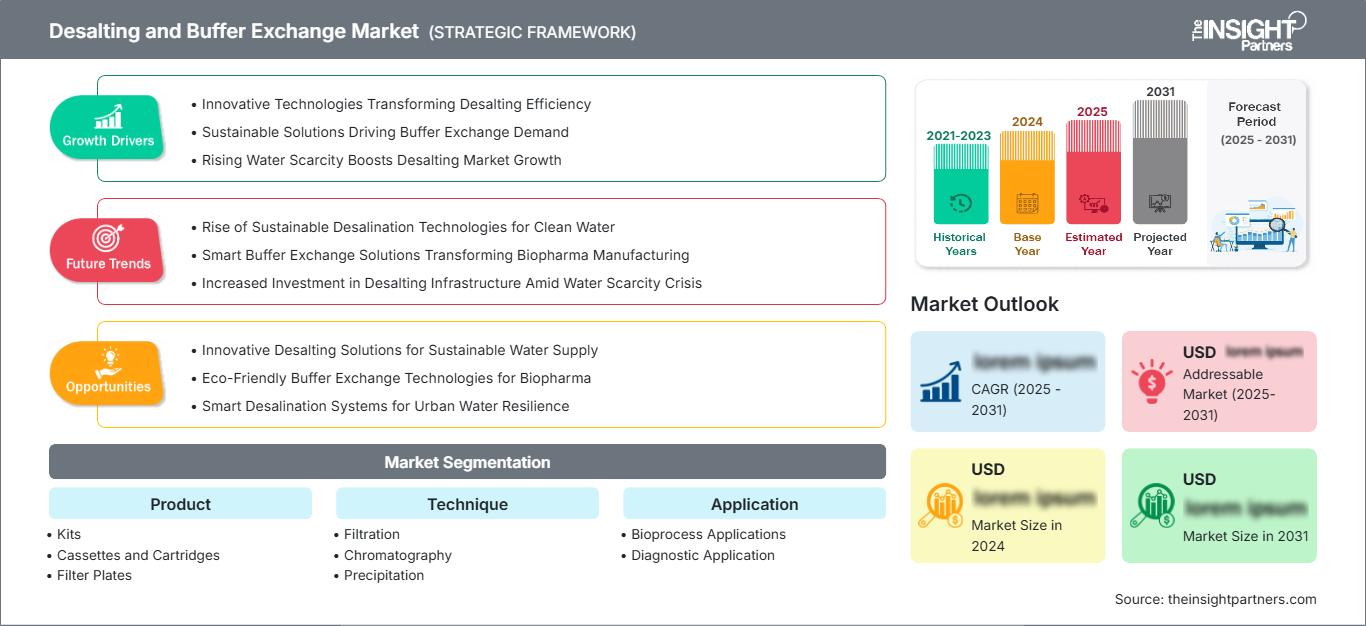
Desalting and Buffer Exchange Market: Strategic Insights
Regional Insights
North America Desalting and Buffer Exchange Market
North America accounts for the largest share of global revenue and is expected to grow at approximately 9.2% CAGR through 2034. The region benefits from a mature biotechnology ecosystem, substantial R&D expenditure, and extensive biologics manufacturing capacity. Demand is particularly strong among pharmaceutical developers pursuing monoclonal antibodies, recombinant proteins, and emerging cell-based therapies.
The presence of leading bioprocess technology suppliers and contract manufacturing organizations supports rapid technology adoption. Continuous investments in advanced purification infrastructure, combined with stringent quality standards governing biologics production, sustain demand for filtration and chromatography-based buffer exchange solutions across commercial and clinical manufacturing environments.
U.S. Desalting and Buffer Exchange Market
The U.S. represents roughly 75–80% of the North American desalting and buffer exchange market and is projected to expand at nearly 9.3% CAGR over the forecast period. Strong federal support for biomedical innovation, a large concentration of biotechnology firms, and growing biologics production volumes contribute to sustained market expansion.
Major industry participants, including Thermo Fisher Scientific Inc, Bio-Rad Laboratories Inc, Repligen Corporation, and Danaher, maintain significant operational footprints in the country. Applications increasingly extend beyond therapeutic protein manufacturing into gene therapy, vaccine development, and precision diagnostics. The growing use of automated purification workflows and single-use technologies continues to strengthen market demand.
Europe Desalting and Buffer Exchange Market
Europe holds an estimated 25–30% share of global revenue and is expected to record a CAGR of approximately 8.8% through 2034. The region benefits from strong pharmaceutical manufacturing capabilities, established academic research networks, and increasing investments in advanced therapy medicinal products. Regulatory emphasis on product quality and process consistency further encourages adoption of sophisticated purification technologies.
The UK continues to expand its biotechnology innovation ecosystem through investments in biologics development and translational research. Demand for scalable desalting and buffer exchange platforms is rising among contract manufacturers and research institutions pursuing next-generation therapeutics.
Germany remains the leading European country due to its strong biopharmaceutical manufacturing base and advanced engineering expertise. Significant investments in downstream processing infrastructure and industrial biotechnology reinforce demand for high-performance filtration and chromatography systems.
France, Italy, and Spain collectively contribute to regional growth through expanding biologics manufacturing capacity and public-private research initiatives. Growing participation in biosimilar production and clinical development activities is increasing demand for efficient purification workflows across multiple application areas.
APAC Desalting and Buffer Exchange Market
Asia Pacific is the fastest-growing regional desalting and buffer exchange market and is projected to achieve a CAGR exceeding 11%. The region currently accounts for approximately 20–25% of global revenue, supported by expanding pharmaceutical production, rising healthcare expenditure, and favorable government policies promoting biotechnology innovation.
China leads regional demand due to substantial investments in biologics manufacturing infrastructure and domestic biopharmaceutical development. Government support for biotechnology self-sufficiency and large-scale manufacturing expansion continues to accelerate technology adoption across purification workflows.
Japan, South Korea, India, and Australia are strengthening their positions through investments in advanced therapeutics, contract manufacturing, and life science research. The combination of expanding production capacity, skilled scientific talent, and supportive regulatory frameworks is expected to sustain strong desalting and buffer exchange market growth throughout the forecast period.
Middle East & Africa Desalting and Buffer Exchange Market
The Middle East & Africa market is developing steadily, supported by healthcare modernization initiatives and growing interest in pharmaceutical manufacturing. Regional demand is expected to expand at a CAGR of approximately 8.1% through 2034 as governments invest in biotechnology capabilities and healthcare infrastructure.
Saudi Arabia represents the leading desalting and buffer exchange market due to ongoing diversification initiatives and investments in domestic pharmaceutical production. Expanding laboratory infrastructure and increasing focus on healthcare localization are creating demand for advanced purification technologies.
The UAE and South Africa are also contributing to desalting and buffer exchange market growth through research collaborations, diagnostic capacity expansion, and biotechnology investments. Improvements in scientific infrastructure and greater participation in pharmaceutical value chains are expected to support long-term adoption of desalting and buffer exchange solutions across the region.
Segmentation Analysis
Product
- Kits: Widely used in research and small-scale bioprocessing environments due to operational simplicity, standardized protocols, and rapid sample preparation capabilities supporting protein purification and analytical workflows.
- Cassettes and Cartridges: Essential for scalable manufacturing operations, offering high throughput, process consistency, and compatibility with continuous bioprocessing environments increasingly adopted across biologics production facilities.
- Filter Plates: Gaining traction in high-throughput screening applications where parallel processing and automation support accelerated drug discovery and biomolecule characterization activities.
- Spin Columns: Preferred in laboratory environments for rapid desalting, sample cleanup, and buffer exchange procedures requiring minimal sample loss and reliable reproducibility.
Technique
- Filtration: Leading technique due to scalability, operational efficiency, compatibility with single-use systems, and widespread deployment in downstream bioprocessing and biologics manufacturing operations.
- Chromatography: Maintains strong demand where high-resolution purification, selective separation, and stringent product quality requirements necessitate advanced processing capabilities.
- Precipitation: Utilized in specific purification workflows requiring cost-effective concentration and impurity removal before subsequent downstream processing stages.
Application
- Bioprocess Applications: Largest application area driven by expanding biologics pipelines, biosimilar development, vaccine production, and increasing demand for efficient downstream purification technologies.
- Diagnostic Application: Experiencing growing adoption as diagnostic laboratories seek reliable sample preparation and purification methods for advanced testing and biomarker analysis.
Opportunity Snapshot
| Application | Revenue Contribution | Trend Tag | Adoption Stage |
| Bioprocess Applications | High | Biologics Scaleup | Mature |
| Diagnostic Application | Medium | Precision Testing | Scaling |
Desalting and Buffer Exchange Market Growth Drivers and Impact Analysis
Expansion of Global Biologics Manufacturing Capacity
The rapid growth of biologics manufacturing remains one of the most influential drivers shaping the market. Biopharmaceutical companies are expanding production capacity to meet increasing demand for monoclonal antibodies, recombinant proteins, vaccines, and advanced therapies. These products require highly controlled purification workflows where desalting and buffer exchange play essential roles in maintaining product quality and stability.
With increased scale in manufacturing operations, there is a need for technologies that can handle higher volumes without reducing process efficiency. This is why filtration technologies, cartridges, and membrane technologies are seeing substantial investments. With increasing emphasis on continuous manufacturing, the need for purification platforms that facilitate continuous processing becomes all the more important. Several advantages desalting and buffer exchange market players can reap from the demand for repeat consumables and process optimization. The resulting impact includes stronger technology adoption across both commercial-scale facilities and emerging biologics manufacturing centers worldwide.
Rising Adoption of Single-Use and Continuous Processing Technologies
There is growing recognition by bioprocessing operations of the importance of single-use systems and continuous manufacturing processes due to their flexibility, reduced contamination risk, and cost. Desalting and buffer exchange systems are part of this trend and are designed to integrate well with such processes.
Single-use filtration cassettes, cartridges, and other single-use processing systems reduce the need for cleaning while enabling faster line changes. Continuous processing demands purification systems that can maintain consistent performance throughout an entire production run. Suppliers are rising to this challenge by developing scalable and automated systems. These changes have significant impacts on facility design, investment decision-making, and supply chain dynamics. Organizations adopting these approaches frequently achieve shorter development timelines and improved manufacturing economics.
Growth of Cell, Gene, and Advanced Therapy Development
New treatments entering the marketplace create novel purification challenges, thus giving rise to demand for buffer exchange methods specifically designed for the unique challenges posed by these new therapeutics. Purification processes for cells, gene therapies, viral vectors, and nucleic acids require specialized conditions due to their complex nature.
Traditional purification techniques may need to be modified to take into account the high degree of sophistication, and thus fragility, of these therapeutic products. As a result, vendors are creating filtration membranes, chromatography media, and integrated systems specifically for these products. This is having a significant impact on the market due to higher processing demand and increased technical challenges of these novel therapies. With many therapeutic products advancing through clinical studies toward commercialization, the need for efficient desalting and buffer exchange technologies in both research and commercial facilities is set to rise rapidly.
Desalting and Buffer Exchange Market Future Trends
Integration of Automation and Digital Process Monitoring
Automation is becoming increasingly central to purification workflows as manufacturers seek greater reproducibility and operational efficiency. Advanced monitoring systems, process analytics, and software-driven controls are being integrated with desalting and buffer exchange operations to reduce variability and improve decision-making.
Digitalization provides real-time insights into process performance, enabling the use of predictive maintenance to deliver better quality assurance. Automating workflow steps can help ease concerns about workforce demands by reducing labor inputs. These desalting and buffer exchange market trends are forecast to culminate in the emergence of a connected factory where purification processes talk directly with process streams upstream and downstream of the unit. This new landscape promises significant gains in process consistency and the speed of scale-up.
Development of High-Performance Membrane and Filtration Platforms
Innovation in filtration is continuing to drive the evolution of biopharmaceutical purification approaches. Increasingly, filtration device manufacturers are faced with demand for membranes that offer greater throughput, selectivity, and robustness while ensuring they are compatible with their customers' valuable biological products.
Emerging membrane chemistries and process intensification strategies are enabling faster buffer exchange and concentration methods. And increasingly, environmental impact is a key decision driver for developers aiming to minimize water use and resource intensity. The market expects further market penetration of filtration technologies throughout purification applications in the next ten years as manufacturers focus on increased throughput, improved yields, scalability, sustainability, and ultimately value.
Desalting and Buffer Exchange Market Opportunities
Expansion Opportunities in Emerging Biopharmaceutical Manufacturing Hubs
Emerging desalting and buffer exchange markets across Asia Pacific, the Middle East, and parts of Latin America are investing heavily in pharmaceutical and biotechnology infrastructure. These regions are developing local manufacturing capabilities to reduce import dependence and support healthcare resilience.
The technology providers could also capitalize on the growing investment trend in such regions by establishing manufacturing, training, and service centers there. Partnerships with biopharmaceutical companies and contract manufacturers in the region could help gain greater market presence. The growing production of biological products and the changing regulatory environment could result in long-term revenue streams from such investments. Early engagement strategies can offer a competitive edge in fast-growing biotech ecosystems.
Customized Solutions for Advanced Therapy Manufacturing
The growing pipeline of cell and gene therapies creates substantial demand for specialized purification technologies. Advanced therapeutic products often require unique processing conditions that differ from conventional biologics manufacturing workflows.
There are high-value opportunities for suppliers able to design bespoke desalting and buffer exchange solutions for viral vectors, nucleic acids, and cell-based products. Investment in application-specific consumables, process analytics, and integrated workflow platforms can enhance differentiation. As commercialization activity increases, companies that offer customized solutions backed by technical expertise will likely develop stronger customer relationships and expand their footprint in emerging therapeutic areas.
Recent Developments
- December, 2025: Repligen Corporation introduced three next-generation chromatography resins, including AVIPure HiPer AAV9, AVIPure HiPer AAV8, and HiPer QA products designed for advanced bioprocessing workflows and new therapeutic modalities. The launch strengthens the company’s downstream processing portfolio and supports more efficient purification processes used alongside buffer exchange operations.
- October, 2025: Sartorius AG reported expansion of its bioprocess portfolio through new process intensification offerings, advanced filtration solutions for monoclonal antibody manufacturing, and software tools supporting bioprocess productivity. These developments reinforce the industry's focus on efficient downstream processing and resource optimization.
- January, 2025: Repligen Corporation commercially launched the CTech SoloVPE PLUS System, a next-generation process analytics platform designed to improve concentration measurement speed and accuracy within biopharmaceutical manufacturing workflows. The technology supports faster process decisions and complements filtration and purification operations used throughout downstream processing.
Frequently Asked Questions

- Comprehensive Market Sizing and Forecast Analysis
- Detailed Segmentation Analysis
- In-Depth Market Dynamics Assessment
- Regional and Country-Level Insights
- Competitive Landscape and Company Benchmarking
- Strategic Business Intelligence
Recent Reports
Testimonials

The Insight Partners provided valuable market intelligence that supported our global go-to-market strategy. Their team was professional, responsive, and attentive to our feedback, providing thoughtful analysis and helpful methodological clarifications throughout the project.
Junmo Kim Chief Financial Officer (CFO), Enertech Co., Ltd.
The Insight Partners' SCADA System Market report is comprehensive, with valuable insights on current trends and future forecasts. The team was highly professional, responsive, and supportive throughout. We are very satisfied and highly recommend their services.
RAN KEDEM Partner, Reali Technologies LTDs
I requested a report on a very specific software market and the team produced the report in a few days. The information was very relevant and well presented. I then requested some changes and additions to the report. The team was again very responsive and I got the final report in less than a week.
JEAN-HERVE JENN Chairman, Future Analytica
We worked with The Insight Partners for an important market study and forecast. They gave us clear insights into opportunities and risks, which helped shape our plans. Their research was easy to use and based on solid data. It helped us make smart, confident decisions. We highly recommend them.
PIYUSH NAGPAL Sr. Vice President, High Beam Global
The Insight Partners delivered insightful, well-structured market research with strong domain expertise. Their team was professional and responsive throughout. The user-friendly website made accessing industry reports seamless. We highly recommend them for reliable, high-quality research services
YUKIHIKO ADACHI CEO, Deep Blue, LLC.
This is the first time I have purchased a market report from The Insight Partners.While I was unsure at first, I visited their web site and felt more comfortable to take the risk and purchase a market report.I am completely satisfied with the quality of the report and customer service. I had several questions and comments with the initial report, but after a couple of dialogs over email with their analyst I believe I have a report that I can use as input to our strategic planning process.Thank you so much for taking the extra time and making this a positive experience.I will definitely recommend your service to others and you will be my first call when we need further market data.
JOHN SUZUKI President and Chief Executive Officer, Board Director, BK Technologies
I wish to appreciate your support and the professionalism you displayed in the course of attending to my request for information regarding to infectious disease IVD market in Nigeria. I appreciate your patience, your guidance, and the fact that you were willing to offer a discount, which eventually made it possible for us to close a deal. I look forward to engaging The Insight Partners in the future, all thanks to the impression you have created in me as a result of this first encounter.
DR CHIJIOKE ONYIA MANAGING DIRECTOR, PineCrest Healthcare Ltd.Reason to Buy
- Informed Decision-Making
- Understanding Market Dynamics
- Competitive Analysis
- Identifying Emerging Markets
- Customer Insights
- Market Forecasts
- Risk Mitigation
- Boosting Operational Efficiency
- Strategic Planning
- Investment Justification
- Tracking Industry Innovations
- Aligning with Regulatory Trends





 Get Free Sample for