
Diagnostic Enzymes Market Size, Trends & Growth by 2034
Diagnostic Enzymes Market Size and Forecasts (2021 - 2034), Global and Regional Share, Trends, and Growth Opportunity Analysis Report Coverage : by Type (Polymerases and Nucleases, Carbohydrases, Proteases, Oxidases, Other Types); Application (Clinical Chemistry, Molecular Diagnostics, Other Applications); End User (Hospitals, Clinical Laboratories, Other End Users); and Geography (North America, Europe, Asia Pacific, and South and Central America)
- Status : Data Released
- Report Code : TIPRE00040130
- Category : Life Sciences
- No. of Pages : 150
- Available Report Formats :


- Last update date : July 08, 2026


2025 Market Size
US$ 5.84 Bn
Base year value
2034 Forecast
US$ 8.72 Bn
Projected by 2034
CAGR 2026-2034
4.56 %
Growth rate
Addressable Market
US$ 66.12 Bn
(2026-2034)
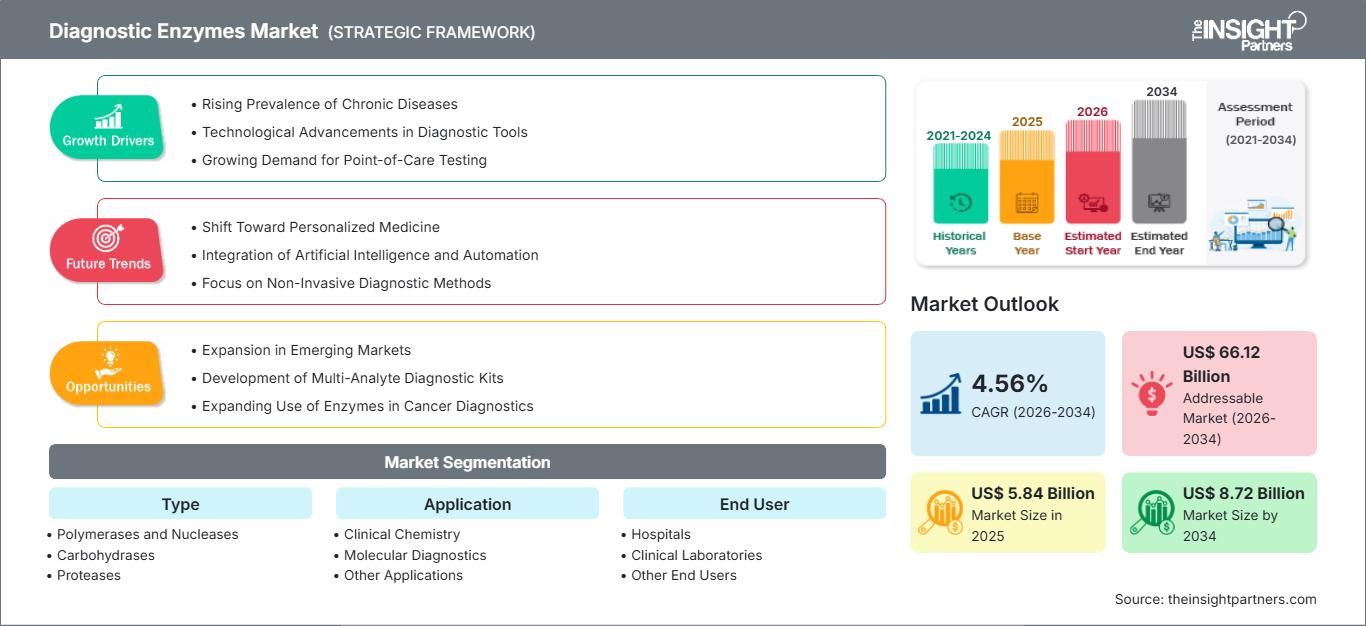
The Diagnostic Enzymes Market is positioned as a critical component of the global in vitro diagnostics ecosystem, supporting clinical testing, molecular analysis, and disease detection workflows across healthcare settings. The market is valued at US$ 5.84 Billion in 2025 and is projected to reach US$ 8.72 Billion by 2034, expanding at a CAGR of 4.56% during 2026–2034. Rising demand for precise diagnostic assays, increasing laboratory automation, and expanding molecular testing applications continue to reinforce market development across established and emerging healthcare systems.
North America remains the most influential regional market, supported by advanced laboratory infrastructure, strong reimbursement mechanisms, and widespread adoption of molecular diagnostic technologies. The region is anticipated to expand at an estimated 4.2% CAGR through 2034. Growth is driven by increasing prevalence of chronic and infectious diseases, rising demand for personalized medicine, and continuous innovation in enzyme-enabled diagnostic platforms used across hospitals, reference laboratories, and research institutions.
Diagnostic Enzymes Market Assessment and Insights
- North America: North America accounted for 36–39% of the diagnostic enzymes market share in 2025 and is anticipated to expand at a CAGR of 4.3–4.9% during 2026–2034. Strong diagnostic infrastructure, high testing volumes, and increasing adoption of advanced laboratory technologies continue to support regional market growth.
- U.S.: The U.S. represented 78–82% of the North American diagnostic enzymes market size in 2025 and is projected to register a CAGR of 4.4–5.0% during 2026–2034, driven by advanced clinical laboratories, expanding molecular diagnostic testing, and growing demand for high-performance diagnostic enzymes.
- Europe: Europe held 27–30% of the diagnostic enzymes market share in 2025 and is expected to grow at a CAGR of 4.0–4.6% during 2026–2034. Germany, France, the United Kingdom, Italy, and Spain remain leading markets, supported by strong hospital networks, widespread laboratory diagnostics adoption, and increasing demand for precision diagnostic testing.
- Asia Pacific: Asia Pacific accounted for 24–27% of the diagnostic enzymes market share in 2025 and is forecast to expand at a CAGR of 5.2–5.8% during 2026–2034. China and India continue to lead regional demand, driven by expanding healthcare infrastructure, rising disease screening programs, and increasing investments in diagnostic laboratories.
- Largest Segment: Type – Polymerases & Nucleases represented the largest diagnostic enzymes market segment and is expected to record a CAGR of 4.8–5.4% during 2026–2034, reflecting their critical role in molecular diagnostics, PCR-based testing, and genetic analysis.
- High Growth Segment: Type – Oxidases is projected to grow at a CAGR of 5.1–5.7% during 2026–2034, driven by increasing use in biosensors, metabolic disorder diagnostics, and clinical chemistry applications.
- Largest Segment: Application – Clinical Chemistry represented the largest application segment and is expected to record a CAGR of 4.5–5.1% during 2026–2034, supported by high-volume routine testing across hospitals, diagnostic laboratories, and healthcare institutions.
- High Growth Segment: Application – Molecular Diagnostics is projected to grow at a CAGR of 5.3–5.9% during 2026–2034, driven by rising adoption of genetic testing, infectious disease diagnostics, and precision medicine initiatives.
- Key companies analyzed in detail: Thermo Fisher Scientific Inc.; F. Hoffmann-La Roche Ltd; Abbott Laboratories; Merck KGaA; Siemens Healthineers AG; Bio-Rad Laboratories, Inc.; Danaher Corporation; PerkinElmer Inc.; QIAGEN N.V.; Agilent Technologies, Inc.
Source: The Insight Partners' analysis based on proprietary research, government publications, company annual reports, investor presentations, industry databases, and expert interviews.
The Diagnostic Enzymes Market report has evolved alongside major advances in molecular biology, immunodiagnostics, and clinical laboratory automation. Diagnostic enzymes have become indispensable in polymerase chain reaction testing, biochemical analysis, infectious disease screening, and biomarker detection. Increasing emphasis on early disease identification and precision medicine has expanded the scope of enzyme-based diagnostic solutions beyond conventional laboratory testing.
Market participants are increasingly focusing on high-performance enzymes that deliver greater sensitivity, specificity, and operational efficiency. Future expansion is expected to be influenced by growing adoption of multiplex assays, decentralized testing models, and digital laboratory workflows. Continued innovation from companies such as Thermo Fisher Scientific, Roche Diagnostics, Abbott Laboratories, Merck Group, Siemens Healthineers, Bio-Rad Laboratories, Danaher Corporation, PerkinElmer, QIAGEN, and Agilent Technologies is expected to shape competitive differentiation.
Diagnostic Enzymes Market Report Scope
| Report Attribute | Details |
|---|---|
| Market size in 2025 | US$ 5.84 Billion |
| Market Size by 2034 | US$ 8.72 Billion |
| Global CAGR (2026 - 2034) | 4.56% |
| Historical Data | 2021-2024 |
| Forecast period | 2026-2034 |
Diagnostic Enzymes Market Analysis
Growing prevalence of cancer, infectious diseases, metabolic disorders, and genetic conditions continues to strengthen demand for enzyme-enabled diagnostic testing. Polymerases, nucleases, oxidases, and proteases form the foundation of numerous diagnostic procedures, enabling accurate sample processing and biomarker detection. Healthcare providers increasingly rely on enzyme-driven assays to improve diagnostic confidence while reducing turnaround times.
The diagnostic enzymes market ecosystem extends from enzyme manufacturers and reagent suppliers to diagnostic kit developers, instrument manufacturers, clinical laboratories, and healthcare providers. Integration of advanced enzymes into automated laboratory workflows has improved operational efficiency and enhanced scalability for high-volume testing environments.
Competition remains centered on technological innovation, assay performance, manufacturing capabilities, and strategic collaborations. Major companies continue to invest in molecular diagnostics, digital pathology, sequencing technologies, and automated testing platforms to strengthen their positions within high-growth diagnostic segments.
Investment activity increasingly targets precision diagnostics, oncology testing, companion diagnostics, and infectious disease surveillance. Strategic partnerships between enzyme developers, diagnostic platform providers, and healthcare organizations are creating opportunities for differentiated product offerings and expanded clinical adoption across global markets.
● REPORT CUSTOMIZATION
Tailor This Report To Align With Your Specific Business Requirements
This report can be customized to align precisely with your business objectives, scope, and target markets. Customization options include tailored segmentation, geography, competitive analysis, and strategic insights to support informed decision-making.
Customize This Report →WHAT YOU CAN ADJUST
- ● Segmentations
- ● Geography
- ● Competitive Analysis
- ● Language Preferences
Diagnostic Enzymes Market: Strategic Insights
Regional Insights
North America Diagnostic Enzymes Market
North America accounts for the largest share of the Diagnostic Enzymes Market and is projected to expand at approximately 4.2% CAGR through 2034. Strong healthcare expenditure, advanced laboratory infrastructure, and extensive use of molecular diagnostic technologies continue to support market leadership. The region also benefits from a robust ecosystem of biotechnology companies, academic institutions, and diagnostic innovators.
Increasing demand for genomic testing, oncology diagnostics, and infectious disease monitoring continues to drive enzyme consumption across clinical laboratories. Regulatory support for advanced diagnostic technologies and sustained investment in precision medicine programs further strengthen regional market prospects.
U.S. Diagnostic Enzymes Market
The U.S. accounts for approximately 75–80% of the North American diagnostic enzymes market and is anticipated to grow at a nearly 4.3% CAGR during the forecast period. The country's extensive network of hospitals, clinical laboratories, and research institutions creates substantial demand for high-performance diagnostic enzymes used in molecular testing and clinical chemistry applications.
The presence of major industry participants, including Thermo Fisher Scientific, Abbott Laboratories, Bio-Rad Laboratories, Danaher Corporation, and Agilent Technologies, supports continuous innovation. Growing utilization of PCR-based testing, liquid biopsy applications, companion diagnostics, and next-generation sequencing workflows further expands demand for advanced polymerases, nucleases, and specialty enzyme formulations.
Europe Diagnostic Enzymes Market
Europe accounts for approximately 25–30% of global diagnostic enzymes market revenue and is expected to record a CAGR near 4.1% through 2034. Strong healthcare systems, increasing adoption of precision diagnostics, and growing investments in laboratory modernization continue to support regional expansion. Germany remains the leading country market owing to its advanced biotechnology sector and strong diagnostic manufacturing base.
The United Kingdom continues to witness growing demand for molecular diagnostic testing and genomic medicine initiatives. The expansion of precision healthcare programs and the increasing integration of advanced laboratory technologies are supporting sustained demand for enzymes across diagnostic applications.
German dominance in Europe is supported by a well-established diagnostics industry, research expertise, and international suppliers of healthcare technology solutions. Growing investments in molecular diagnostics and automation are key factors fueling market growth.
Countries like France, Italy, and Spain are driving demand for diagnostics through the development of healthcare infrastructure and increased usage of advanced diagnostic tests. Various national programs on disease screening and lab upgrades are contributing to increased use of enzyme-based diagnostic systems.
APAC Diagnostic Enzymes Market
Asia Pacific is expected to be the fastest-growing regional diagnostic enzymes market, accounting for approximately 22–27% of global revenue while expanding at an estimated 5.6% CAGR. Growing healthcare investments, increasing disease burden, and expanding access to diagnostic services are accelerating adoption across major economies.
China remains the largest market in the region due to numerous healthcare reforms, biotechnology capabilities, and diagnostic enzyme production. The government’s emphasis on precision medicine and genomics increases the demand for diagnostic enzymes.
Japan, South Korea, India, and Australia still provide a considerable contribution to the growth rate. Increased volumes of molecular diagnostic tests, growth in lab networks, and policy initiatives aimed at monitoring diseases and developing healthcare systems encourage the use of diagnostic technologies throughout the region.
Middle East & Africa Diagnostic Enzymes Market
The Middle East & Africa diagnostic enzymes market is expected to expand steadily at approximately 4.8% CAGR through 2034. Improving healthcare infrastructure, increasing investment in laboratory capabilities, and rising awareness of early disease detection are contributing to regional development.
Saudi Arabia continues to dominate the regional market due to major programs to modernize the healthcare sector, including investments in state-of-the-art diagnostic tools. Increased investment in specialized laboratories is fueling the adoption of enzyme diagnostics.
In addition, the UAE and South Africa are witnessing an increasing use of molecular diagnostics and laboratory automation. Overall, improved healthcare infrastructure in the region will ensure continued market growth in the coming years.
Segmentation Analysis
Type
- Polymerases and Nucleases: Represent the most strategically important enzyme category, supporting PCR amplification, nucleic acid extraction, sequencing workflows, and molecular diagnostic assays used across infectious disease, oncology, and genetic testing applications.
- Carbohydrases: Widely utilized in biochemical assays and specialized diagnostic procedures requiring carbohydrate metabolism analysis, contributing to disease screening and laboratory research workflows.
- Proteases: Essential for sample preparation, protein analysis, and biomarker detection procedures, enabling efficient processing and improved analytical performance in clinical laboratories.
- Oxidases: Frequently employed in clinical chemistry assays involving glucose monitoring, metabolic testing, and disease biomarker quantification, supporting routine diagnostic operations globally.
Application
- Clinical Chemistry: Continues to generate significant demand through routine biochemical testing, metabolic disorder assessment, and high-volume laboratory workflows requiring reliable enzyme performance.
- Molecular Diagnostics: Represents the dominant application segment due to expanding use of PCR, genomic testing, infectious disease detection, and precision medicine initiatives worldwide.
End User
- Hospitals: Increasingly deploy enzyme-based diagnostics to support rapid clinical decision-making, disease monitoring, and integrated laboratory testing capabilities.
- Clinical Laboratories: Account for substantial enzyme consumption owing to large testing volumes, advanced molecular diagnostic services, and centralized laboratory operations.
Opportunity Snapshot
| Application | Revenue Contribution | Trend Tag | Adoption Stage |
| Clinical Chemistry | High | Biomarkers | Mature |
| Molecular Diagnostics | High | Multiplex PCR | Scaling |
| Other Applications | Low | Specialty Testing | Emerging |
Diagnostic Enzymes Market Growth Drivers and Impact Analysis
Expansion of Molecular Diagnostic Testing Worldwide
The increasing adoption of molecular diagnostics has become one of the strongest growth drivers for the Diagnostic Enzymes Market. Healthcare providers are relying more heavily on molecular testing techniques for infectious disease detection, oncology screening, hereditary disease assessment, and companion diagnostics. Polymerases and nucleases are foundational components of PCR-based workflows, sequencing technologies, and nucleic acid amplification methods. As testing complexity increases, laboratories require enzymes with enhanced fidelity, sensitivity, and throughput capabilities.
The effect on the market is not limited to an increased need for enzymes. Special enzyme solutions are being developed for multiplex testing, rapid testing procedures, and automation. This helps increase laboratory efficiency while making it easier for wider clinical use. The rise in the influence of precision medicine underscores the need for enzyme diagnostics.
Rising Burden of Chronic and Infectious Diseases
Healthcare systems worldwide continue to face an increasing incidence of cancer, cardiovascular disorders, diabetes, respiratory diseases, and infectious illnesses. Accurate diagnosis remains essential for effective treatment planning and disease management. Diagnostic enzymes play a critical role in detecting biomarkers, analyzing biological samples, and supporting laboratory testing procedures across diverse clinical applications.
The consequences for the market include more tests being conducted, more clinical chemistry tests, and greater demand for molecular diagnostics services. There are investments in new lab technologies that will make diagnostics more accurate and efficient. This is an environment that supports the continued rise in enzyme usage, as well as innovations aimed at improving performance and clinical outcomes.
Laboratory Automation and High-Throughput Testing Adoption
The use of laboratory automation has revolutionized the diagnostic process by increasing efficiency, reducing human intervention, and enabling high testing throughput. Diagnostic enzymes have become more popular as components of automated systems, enabling high-throughput analysis. Automated systems require highly standardized enzyme products that can operate effectively under difficult conditions.
All of these factors have a considerable impact on the industry players. Producers make efforts to ensure their capacities allow them to produce such diagnostic enzymes efficiently. There is also an incentive to develop new assays based on innovative enzymes. The modernization of laboratory facilities will increase the demand for diagnostic enzymes. As laboratories continue to modernize their infrastructure, demand for specialized diagnostic enzymes is expected to increase steadily across multiple application areas.
Diagnostic Enzymes Market Future Trends
Growth of Multiplex and Syndromic Testing Platforms
Diagnostic laboratories are constantly on the lookout for methods and technologies that would enable the detection of multiple biomarkers or pathogens using a single sample. Multiplex diagnostic technologies are highly dependent on the availability of advanced enzymes that can ensure good analytical performance even under complicated reaction conditions. This becomes especially relevant in the fields of infectious disease diagnostics, oncology, and genomics, since comprehensive information yields better clinical outcomes.
Further advancements in this field are expected to concentrate on engineering approaches that enhance the specificity, stability, and compatibility of reactions used in multiplex diagnostic technologies. Growing pressure to streamline diagnostic workflows and lower costs is accelerating the adoption of multiplex testing, in line with diagnostic enzymes market trends. Companies developing high-performance enzymes will be strongly positioned to secure a significant share of the market.
Integration of AI-Enabled Diagnostics with Advanced Enzyme Technologies
AI is increasingly being incorporated into diagnostic practices, presenting new possibilities for improved test interpretation and lab optimization. Even though AI will mostly affect the data analysis process, its efficiency is contingent on the accuracy of diagnostic results generated by enzyme-based testing.
The synergy between AI and diagnostic technologies is expected to drive the development of testing machines characterized by automation, analytics, and sophisticated biochemical capabilities. This trend is likely to improve the practice's efficiency by helping diagnose diseases in their early stages. Companies that develop diagnostic platforms will benefit from increased demand.
Diagnostic Enzymes Market Opportunities
Emerging Healthcare Infrastructure Across Developing Economies
The fast-growing healthcare markets in Asia, Latin America, the Middle East, and parts of Africa offer great opportunities for manufacturers of diagnostic enzymes. Governments are heavily investing in laboratory modernization, disease surveillance programs, and healthcare accessibility initiatives. These trends drive demand for reliable diagnostic technologies to support large populations with diverse disease burdens.
Organizations that establish regional manufacturing capabilities, localized distribution channels, and a cost-efficient product portfolio can achieve deeper market penetration. Strategic collaborations with healthcare institutions and diagnostic service providers, supported by the diagnostic enzymes market forecast, may further strengthen competitive positioning. Growing emphasis on early disease detection continues to create favorable prospects for long-term investment and sustained commercial expansion.
Advancement of Precision Medicine and Companion Diagnostics
Precision medicine continues to reshape healthcare by enabling treatment strategies tailored to individual patient characteristics. Companion diagnostics play a crucial role in identifying suitable therapies and monitoring treatment responses. Diagnostic enzymes are fundamental to many molecular testing procedures, supporting these applications.
As pharmaceutical companies expand targeted therapy pipelines, demand for highly specialized diagnostic assays is expected to increase. This creates opportunities for enzyme manufacturers to collaborate with diagnostic developers, biotechnology firms, and healthcare providers. Investment in innovative enzyme technologies designed for precision medicine applications may generate significant competitive advantages and long-term revenue growth.
Recent Developments
- June, 2026: TriLink, part of Maravai LifeSciences, announced the opening of its GMP enzyme manufacturing facility in Jupiter, Florida, designed to help RNA therapeutic developers simplify sourcing and scale production more efficiently. The facility supports a coordinated supply of key RNA manufacturing and IVT workflow materials from early research through commercial production.
- April, 2026: Watchmaker Genomics has introduced Stellar RT-qPCR and qPCR Kits alongside its recombinase polymerase amplification (RPA) enzyme suite, expanding its molecular diagnostics tools beyond next-generation sequencing applications. The systems are designed to support both PCR-based and isothermal amplification workflows used in assay development.
- June, 2025: QIAGEN announced a partnership with GENCURIX to develop oncology assays for the QIAcuityDx digital PCR platform. The collaboration expands clinical diagnostic applications and supports broader adoption of digital PCR technologies in oncology testing, reinforcing demand for advanced enzyme-enabled molecular diagnostics.
Frequently Asked Questions

- Comprehensive Market Sizing and Forecast Analysis
- Detailed Segmentation Analysis
- In-Depth Market Dynamics Assessment
- Regional and Country-Level Insights
- Competitive Landscape and Company Benchmarking
- Strategic Business Intelligence
Recent Reports
Testimonials

The Insight Partners provided valuable market intelligence that supported our global go-to-market strategy. Their team was professional, responsive, and attentive to our feedback, providing thoughtful analysis and helpful methodological clarifications throughout the project.
Junmo Kim Chief Financial Officer (CFO), Enertech Co., Ltd.
The Insight Partners' SCADA System Market report is comprehensive, with valuable insights on current trends and future forecasts. The team was highly professional, responsive, and supportive throughout. We are very satisfied and highly recommend their services.
RAN KEDEM Partner, Reali Technologies LTDs
I requested a report on a very specific software market and the team produced the report in a few days. The information was very relevant and well presented. I then requested some changes and additions to the report. The team was again very responsive and I got the final report in less than a week.
JEAN-HERVE JENN Chairman, Future Analytica
We worked with The Insight Partners for an important market study and forecast. They gave us clear insights into opportunities and risks, which helped shape our plans. Their research was easy to use and based on solid data. It helped us make smart, confident decisions. We highly recommend them.
PIYUSH NAGPAL Sr. Vice President, High Beam Global
The Insight Partners delivered insightful, well-structured market research with strong domain expertise. Their team was professional and responsive throughout. The user-friendly website made accessing industry reports seamless. We highly recommend them for reliable, high-quality research services
YUKIHIKO ADACHI CEO, Deep Blue, LLC.
This is the first time I have purchased a market report from The Insight Partners.While I was unsure at first, I visited their web site and felt more comfortable to take the risk and purchase a market report.I am completely satisfied with the quality of the report and customer service. I had several questions and comments with the initial report, but after a couple of dialogs over email with their analyst I believe I have a report that I can use as input to our strategic planning process.Thank you so much for taking the extra time and making this a positive experience.I will definitely recommend your service to others and you will be my first call when we need further market data.
JOHN SUZUKI President and Chief Executive Officer, Board Director, BK Technologies
I wish to appreciate your support and the professionalism you displayed in the course of attending to my request for information regarding to infectious disease IVD market in Nigeria. I appreciate your patience, your guidance, and the fact that you were willing to offer a discount, which eventually made it possible for us to close a deal. I look forward to engaging The Insight Partners in the future, all thanks to the impression you have created in me as a result of this first encounter.
DR CHIJIOKE ONYIA MANAGING DIRECTOR, PineCrest Healthcare Ltd.Reason to Buy
- Informed Decision-Making
- Understanding Market Dynamics
- Competitive Analysis
- Identifying Emerging Markets
- Customer Insights
- Market Forecasts
- Risk Mitigation
- Boosting Operational Efficiency
- Strategic Planning
- Investment Justification
- Tracking Industry Innovations
- Aligning with Regulatory Trends





 Get Free Sample for