
Diethanolamine Market Share, Size & Demand by 2034
Diethanolamine Market Size and Forecasts (2021 - 2034), Global and Regional Growth Opportunity Analysis, and Geography (North America, Europe, Asia Pacific, and South and Central America)
- Status : Data Released
- Report Code : TIPRE00012631
- Category : Chemicals and Materials
- No. of Pages : 150
- Available Report Formats :


- Last update date : July 20, 2026


2025 Market Size
US$ 1.16 Bn
Base year value
2034 Forecast
US$ 1.49 Bn
Projected by 2034
CAGR 2026-2034
3.22 %
Growth rate
Addressable Market
US$ 12.27 Bn
(2026-2034)
The Diethanolamine Market size stood at US$ 1.16 billion in 2025 and will further reach US$ 1.49 billion by 2034, reflecting a CAGR of 3.22% between 2026 and 2034. The demand for this compound will be driven by its use as an intermediate chemical, corrosion inhibitor, metal working fluids additive, and gas treating agents.
North America continues to be an efficient and reliable consumer base for this market. The regional Diethanolamine market size is expected to grow with the CAGR of 2.8%-3.4% between 2026 and 2034 on account of shale gas treating activities, corrosion inhibitors, and personal care formulations.
Diethanolamine Market Assessment and Insights
- North America: Share in 2025 of 23–27% and CAGR between 2.8–3.4%. Gas treatment, metalworking fluids, and established chemical distribution channels support steady regional consumption.
- US: Share in 2025 of 78–82% of North America and CAGR between 2.9–3.5%. Domestic refining, shale gas processing, and agrochemical formulation maintain stable demand.
- Europe: Share in 2025 of 18–22% and CAGR between 2.4–3.0%. Germany, the UK, France, Italy, and Spain lead demand through specialty chemicals, textiles, and regulated personal care formulations.
- Asia Pacific: Share in 2025 of 42–46% and CAGR between 3.6–4.2%. China, Japan, South Korea, and India benefit from agrochemicals, textiles, and chemical intermediate production.
- Largest Segment: Chemical Intermediates held a market share of 36–40% in 2025 and CAGR of 3.0–3.6% during 2026–2034, supported by surfactants and downstream specialty chemicals.
- High Growth Segment: Gas Treatment held a market share of 16–20% in 2025 and CAGR of 3.8–4.4% during 2026–2034, driven by refinery and natural gas sweetening demand.
- Key companies analyzed in detail: BASF SE, Dow Inc., INEOS Group Holdings S.A., Saudi Basic Industries Corporation, HELM AG, Nippon Shokubai Co., Ltd., KH Chemicals B.V., Oriental Union Chemical Corporation, Huntsman Corporation, LyondellBasell Industries N.V.
Source: The Insight Partners' analysis based on proprietary research, government publications, company annual reports, investor presentations, industry databases, and expert interviews.
Process optimization has gradually transformed production economics, with producers optimizing their use of ethylene oxide and ammonia feedstocks while addressing safety considerations. Quality specifications in the Diethanolamine Market are becoming more stringent because customers require low impurity, consistent alkalinity, and dependable handling performance. Formulators from industries like agrochemicals, cosmetics, textiles, coating materials, and gas treatment will judge their suppliers based on these aspects.
Future demand will depend heavily on the growth of industrial capacity, energy production, and consumer goods production. Increased investments in specialty chemicals in Asia-Pacific and increased Indian agrochemical exports will ensure that procurement needs are met. Environmental concerns and employee safety concerns will affect formulations, but grades and closed-handling systems will ensure demand remains unaffected in regulated applications. Procurement trends are also shifting to focus on suppliers that can meet both competitive pricing as well as documentation, logistics management, and technical compatibility.
Diethanolamine Market Report Scope
| Report Attribute | Details |
|---|---|
| Market size in 2025 | US$ 1.16 Billion |
| Market Size by 2034 | US$ 1.49 Billion |
| Global CAGR (2026 - 2034) | 3.22% |
| Historical Data | 2021-2024 |
| Forecast period | 2026-2034 |
Diethanolamine Market Analysis
Diethanolamine market growth is driven by demand for the use of multifunctional amines in surfactants, emulsifiers, corrosion inhibitors and acid gas removal systems. Chemical intermediates are the key application segment, since DEA provides alkalinity, viscosity and functional properties. DEA salts and derivatives are used in agrochemical formulations to enhance the compatibility of herbicides, whereas DEA is valued in industrial applications in metalworking and process fluids.
The supply factors include production integration of ethylene oxide and ethanolamines, logistics and compliance requirements. Companies which have backward integration are better equipped to cope with margins under feedstock price volatility. Suppliers like HELM AG and KH Chemicals B.V. assist in the regional availability, offering services for small formulators in terms of technical grades, flexible deliveries and controlled chemical logistics.
The market analysis reveals that the level of rivalry is high and limited to diversified chemical companies having ethanolamine product lines as well as global customers. BASF SE, Dow Inc., INEOS Group Holdings S.A., Saudi Basic Industries Corporation, Nippon Shokubai Co., Ltd., Huntsman Corporation, and LyondellBasell Industries N.V. compete on factors such as purity, supply availability, service, and broad applications.
Investments tend to focus on efficiency of production processes, reduction of emissions, safe packaging, and resilient regional stockpiling, and not on capacity expansion. Oriental Union Chemical Corporation and other Asian players have the advantage of their proximity to downstream customers in the textiles, agrochemicals, and personal care product sectors. Competitive strategy should be based on a combination of price competitiveness, documentation, and delivery reliability. Another key factor of competition is the diversity of the product line. Those companies that provide monoethanolamine, triethanolamine, and other amine products will have no problem dealing with substitution issues and maintaining customer relationships.
● REPORT CUSTOMIZATION
Tailor This Report To Align With Your Specific Business Requirements
This report can be customized to align precisely with your business objectives, scope, and target markets. Customization options include tailored segmentation, geography, competitive analysis, and strategic insights to support informed decision-making.
Customize This Report →WHAT YOU CAN ADJUST
- ● Segmentations
- ● Geography
- ● Competitive Analysis
- ● Language Preferences
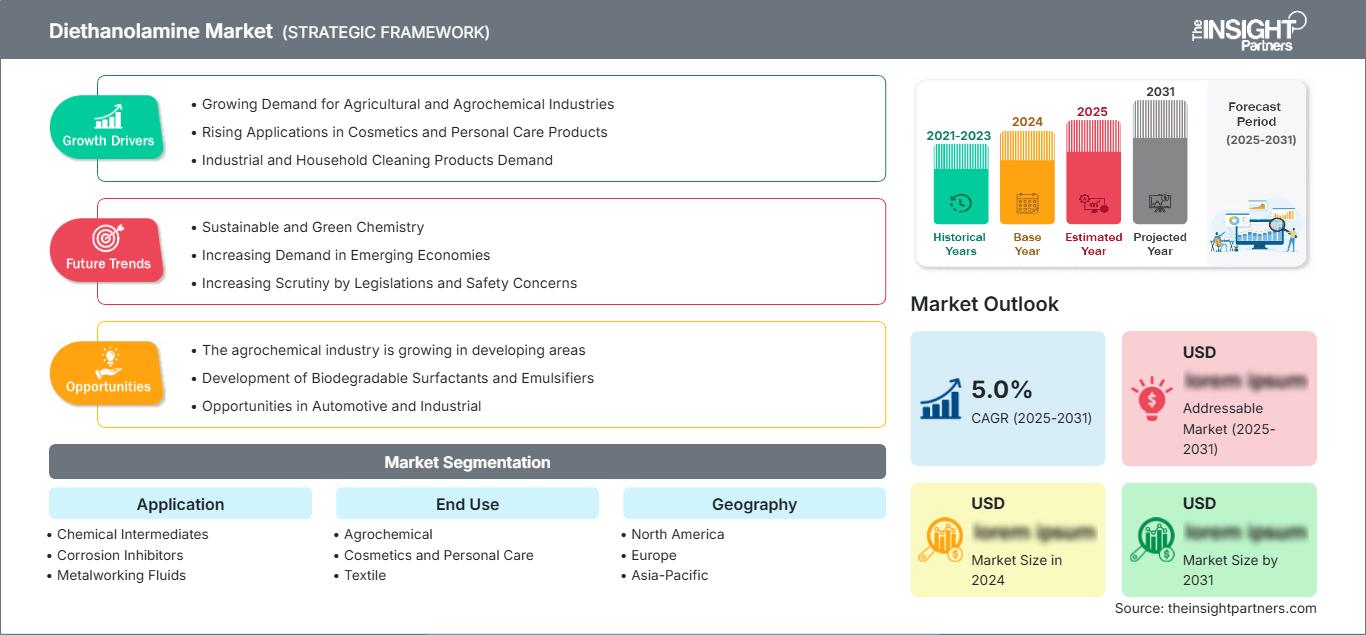
Diethanolamine Market: Strategic Insights
Regional Insights
North America Diethanolamine Market
North America contributed a share of 23-27% to the global market value in 2025 and is estimated to grow at a CAGR of 2.8-3.4% between 2026 and 2034. The growth in the Diethanolamine market share is driven by natural gas processing, refinery turnaround, corrosion inhibition, and specialized chemicals manufacturing. Natural gas extraction and refining activities create structural demand for amine-based systems.
Regional manufacturers cater to agrochemical, textile, and personal care producers who require consistent alkalinity and formulation stability. Growth is constrained by cosmetic regulations as well as by substitution in surfactant systems. Still, industrial-grade material remains important where performance, price, and manufacturing experience outweigh reformulation costs.
Grade-specific differences are observed in import dependency, but North American consumers prefer products with traceable origin, regional stockpiling options, and replacement capabilities. This creates incentives for contractual purchases rather than spot purchases alone, especially for gas processors and industrial formulators who have no room for downtime due to shortages of solvent or additives.
U.S. Diethanolamine Market Market
In 2025, the US was responsible for 78% to 82% of revenues in North America and will have a 2.9% to 3.5% CAGR. Consumption is mostly seen in refineries, shale gas treatment plants, metalworking fluids, and agrochemicals production. Distributors of chemicals help in providing widespread coverage for smaller formulators.
Industry presence is assured by Dow Inc., Huntsman Corporation, and LyondellBasell Industries N.V., and through imports of specialty grades. Trends in applications include gas treatment and corrosion inhibitors since the energy sector needs acid gases to be absorbed and protect equipment from corrosion. Use in personal care is limited due to nitrosamine compliance.
Europe Diethanolamine Market
Europe had 18-22% share of revenue in 2025 and is forecast to have a CAGR of 2.4-3.0%. The major contributor in Europe is Germany, owing to its presence in specialty chemicals, coatings, metalworking, and industrial formulations. BASF SE and HELM AG ensure supply continuity in the region, where product stewardship and workplace safety are important to consumers.
The United Kingdom benefits from gas treatment, industrial maintenance, and the import of formulated chemicals. France, Italy, and Spain provide demand from textiles, coatings, agrochemical distribution, and cosmetics, but due to cautious regulations, the development of the personal care segment will be limited. Growth in Europe will be slower than in the Asia-Pacific.
APAC Diethanolamine Market
The Asia Pacific region had a share of 42-46% in the global market revenue in 2025 and is expected to grow at a CAGR of 3.6-4.2%. China dominates the regional demand owing to the integrated manufacturing of chemicals, textiles, and agrochemicals, whereas Japan and South Korea focus on high purity grades for special applications.
Demand in India is increasing owing to its increasing formulation production facilities for exports and personal care, and the agrochemical manufacturing industry. The Asia Pacific is the dominant regional growth hub because of industrial policies, production networks, and cost-effective downstream manufacturing.
Middle East & Africa Diethanolamine Market
MEA is expected to experience a CAGR growth of 3.0-3.6% until 2034. Saudi Arabia will be the major country, driven by petrochemical integration, refining and gas processing industries which require regular amine purchases. Saudi Basic Industries Corporation boosts regional relevance due to its significant chemical production.
UAE will help the demand due to energy processing, industrial services, and special formulations imported into the country. South Africa will generate demand for metalworking fluids and coatings associated with the development of the mining industry and chemical distribution. The rest of MEA region is going to remain project-driven.
In this respect, regional opportunity will be highest for projects associated with new gas-processing capacities, maintenance operations, and imported special formulations. Buyers are still careful about delivery schedules, storage capacity, and documentation issues. In this respect, suppliers having local partners and technical support in the region will have an advantage over suppliers of transactional shipments.
Segmentation Analysis
Application
The Application segment is forecast to grow at a 3.2–3.8% CAGR during 2026–2034. The Diethanolamine Market scope spans intermediate synthesis, corrosion control, metalworking fluids, and gas treatment, giving suppliers exposure to both process industries and formulated products. Demand is strongest where DEA’s alkalinity, emulsification support, and acid gas absorption properties solve specific technical requirements.
- Chemical Intermediates: This sub-segment holds the largest position because DEA supports surfactants, emulsifiers, herbicide salts, and specialty derivatives used by chemical manufacturers seeking multifunctional reactive building blocks.
- Corrosion Inhibitors: Demand is tied to oilfield chemicals, industrial water systems, and metal protection packages where DEA-based chemistry helps control equipment degradation and improve operating reliability.
- Metalworking Fluids: DEA supports pH control, emulsification, and corrosion protection in cutting fluids and coolants, making it strategically important for automotive, machinery, and precision manufacturing supply chains.
- Gas Treatment: This high-growth application benefits from natural gas sweetening and refinery gas processing, where amine solutions remove acidic gases and support cleaner fuel specifications.
Across applications, suppliers must balance commodity-grade volume with increasingly specific end-user expectations. Product consistency, impurity control, and packaging format are becoming differentiators because each application has different tolerance levels for odor, color, alkalinity, and handling risk. This favors producers that can manage multiple specifications efficiently.
End Use
The End Use segment is projected to expand at a 3.0–3.6% CAGR through 2034. Agrochemical and industrial users provide resilient baseline demand, while cosmetics and personal care use remains more selective because formulators must manage regulatory expectations. Textile, pharmaceutical, paint, and coating users value DEA where formulation stability and functional performance justify compliance management.
- Agrochemical: Agrochemical producers use DEA in herbicide salts and formulation systems, making this sub-segment strategically important as crop protection demand rises with food security pressures.
- Cosmetics and Personal Care: Demand is selective but relevant in emulsifiers, pH adjustment, and surfactant systems, especially where compliant formulations and controlled impurity profiles are maintained.
- Textile: Textile processors use DEA-linked additives for finishing, softening, and lubrication functions, with Asia Pacific production clusters supporting recurring consumption across export-oriented apparel supply chains.
- Pharmaceutical: Pharmaceutical applications are smaller and quality-sensitive, relying on controlled grades for synthesis support, buffering functions, or intermediates where regulatory documentation is critical.
- Paint and Coating: Paint and coating formulators use DEA for pH control, emulsification, and additive compatibility, supporting stable demand in industrial coatings and architectural formulations.
End-use demand is therefore not uniform. Agrochemical and industrial users emphasize cost, supply security, and formulation performance, while personal care and pharmaceutical users place greater weight on quality documentation and regulatory assurance. This segmentation creates opportunities for differentiated pricing and targeted customer support.
Opportunity Snapshot
| Segment Name | Revenue Contribution | Trend Tag | Adoption Stage |
| Agrochemical | High | Herbicide Salts | Mature |
| Cosmetics and Personal Care | Medium | Clean Formulation | Scaling |
| Textile | Medium | Finishing Aids | Mature |
| Pharmaceutical | Low | Quality Grades | Emerging |
| Paint and Coating | Medium | pH Control | Scaling |
Diethanolamine Market Growth Drivers and Impact Analysis
Rising Use in Gas Sweetening and Refinery Operations
Natural gas, refinery gas, and specific industrial gas streams continue to depend on amine treatments to extract carbon dioxide and hydrogen sulfide from the streams. DEA still holds significance where reliable chemistry, absorption, and regeneration are crucial for the operators. In a statement by the International Energy Agency, the future usage of natural gas was emphasized, which means more investments in gas processing plants. As far as suppliers are concerned, there would be consistent sales of bulk products, along with other services. The Diethanolamine Market will see profits where sulfur compliance and stability of the plant are considered more important than solvent changeover.
Agrochemical Formulation Demand Across Crop Protection
Crop protection chemical producers employ DEA as an active ingredient in salt formation of herbicides, surfactants, and formulation additives. World agriculture continues to be affected by increasing population, limited agricultural area, and weather-related risks to harvests, thus promoting further application of crop protection technology systems that work effectively. The Food and Agriculture Organization has stressed the necessity of increases in efficiency to guarantee food security, leading to greater requirement for formulation materials that ensure better application of substances. The market effect will be most apparent in Asia Pacific and Latin-connected export markets, where agrochemical production capacities are being increased.
Industrial Fluids and Corrosion-Control Requirements
Manufacturing, machining, mining, and process industries require reliable fluids that maintain pH, protect metals, and reduce equipment wear. DEA contributes to metalworking fluid performance, corrosion inhibitor packages, and industrial maintenance formulations. As manufacturers extend equipment life and reduce downtime, chemical additives with proven compatibility remain valuable. Demand is supported by automotive production, machinery manufacturing, and infrastructure-linked fabrication activity. Although substitutes can be used in some systems, reformulation requires testing, approvals, and customer acceptance. This creates a practical retention advantage for DEA in established industrial formulations where cost, performance, and operating familiarity align.
The practical market impact is a durable replacement cycle for fluids and additive packages used in operating equipment. Once approved in machining, refinery, or process environments, DEA-containing formulations can remain in use for extended periods because switching requires compatibility testing, worker training, and customer sign-off. This supports recurring demand even when new formulation trials occur.
Diethanolamine Market Future Trends
Shift Toward Lower-Impurity and Safer Handling Grades
Diethanolamine Market trends point toward stronger demand for grades with tighter impurity control, clearer safety documentation, and packaging designed for controlled handling. Cosmetic, pharmaceutical, and specialty chemical customers are expected to favor suppliers that can demonstrate traceability and consistent analytical profiles. This shift will not eliminate commodity technical grades, but it will increase differentiation between suppliers able to support regulated applications and those competing mainly on price. Future procurement decisions are likely to include audit readiness, nitrosamine-risk management, and worker-exposure controls as important supplier selection criteria.
Digitalized Distribution and Regional Inventory Resilience
Supply disruptions in chemicals have encouraged buyers to value visibility, local inventory, and multi-source qualification. Distributors and producers are expected to expand digital ordering, shipment tracking, and documentation platforms for DEA customers. This trend matters because many end users purchase moderate volumes but require reliable delivery and certificates for compliance. Regional tank storage, repackaging capability, and responsive technical service may become as important as base price. Companies that strengthen supply assurance can capture loyalty among formulators seeking reduced procurement risk.
Future supplier advantage will depend on how effectively companies convert distribution reliability into measurable customer value. Faster documentation, predictable lead times, and clearer inventory visibility can reduce safety-stock burdens for formulators. As a result, commercial differentiation may increasingly come from service quality rather than only product availability.
Diethanolamine Market Opportunities
Specialty Grades for Regulated Formulation Markets
Investment opportunities exist in specialty DEA grades aimed at customers with strict documentation, traceability, and impurity requirements. Producers can capture value by offering application-specific specifications for personal care, pharmaceutical, coatings, and high-performance industrial uses. Diethanolamine Market Forecasts suggest that volume growth will remain moderate, so margin expansion depends on differentiated service rather than commodity capacity alone. Technical support, regulatory dossiers, and packaging formats that reduce exposure risk can strengthen customer retention. Companies that build closer formulation partnerships may also identify adjacent demand for ethanolamine derivatives and tailored amine blends.
Gas Treatment Solutions in Emerging Energy Hubs
Emerging energy hubs in the Middle East, Africa, and parts of Asia create opportunities for DEA suppliers linked to gas treatment and refinery operations. New processing assets require solvent supply, operational guidance, and local logistics support. Suppliers that combine bulk availability with technical service can become preferred partners for operators seeking stable acid gas removal performance. Opportunity development should focus on long-term supply agreements, local storage, and collaboration with engineering contractors. This approach can improve demand visibility while reducing exposure to spot-market volatility and import delays.
Suppliers can further strengthen these opportunities by pairing DEA supply with training on solvent handling, storage, and performance monitoring. This approach supports safer operations, improves customer confidence, and creates deeper relationships with engineering and procurement teams. Long-term agreements may also reduce demand volatility for producers and distributors.
Recent Developments
- February 2026: The Dow Chemical Company has announced a price increase for Monoethanolamine (MEA) across North America, effective immediately unless specified otherwise by existing contracts. This change impacts companies using MEA and reflects ongoing market pressures in the chemical industry.
- September 2024: This investment will enhance the BASF’s global alkyl ethanolamines production capacity by nearly 30%, exceeding 140,000 tons per year. The new plant is part of BASF's network across Germany, Belgium, Louisiana, and China. Ketan Joshi, President of BASF's Intermediates division, emphasized the commitment to being a preferred partner in sustainable intermediates. Alkyl ethanolamines serve various applications, including gas treatment, water treatment flocculants, and coatings binders.
Frequently Asked Questions

- Comprehensive Market Sizing and Forecast Analysis
- Detailed Segmentation Analysis
- In-Depth Market Dynamics Assessment
- Regional and Country-Level Insights
- Competitive Landscape and Company Benchmarking
- Strategic Business Intelligence
Recent Reports
Testimonials

The Insight Partners' SCADA System Market report is comprehensive, with valuable insights on current trends and future forecasts. The team was highly professional, responsive, and supportive throughout. We are very satisfied and highly recommend their services.
RAN KEDEM Partner, Reali Technologies LTDs
I requested a report on a very specific software market and the team produced the report in a few days. The information was very relevant and well presented. I then requested some changes and additions to the report. The team was again very responsive and I got the final report in less than a week.
JEAN-HERVE JENN Chairman, Future Analytica
We worked with The Insight Partners for an important market study and forecast. They gave us clear insights into opportunities and risks, which helped shape our plans. Their research was easy to use and based on solid data. It helped us make smart, confident decisions. We highly recommend them.
PIYUSH NAGPAL Sr. Vice President, High Beam Global
The Insight Partners delivered insightful, well-structured market research with strong domain expertise. Their team was professional and responsive throughout. The user-friendly website made accessing industry reports seamless. We highly recommend them for reliable, high-quality research services
YUKIHIKO ADACHI CEO, Deep Blue, LLC.
This is the first time I have purchased a market report from The Insight Partners.While I was unsure at first, I visited their web site and felt more comfortable to take the risk and purchase a market report.I am completely satisfied with the quality of the report and customer service. I had several questions and comments with the initial report, but after a couple of dialogs over email with their analyst I believe I have a report that I can use as input to our strategic planning process.Thank you so much for taking the extra time and making this a positive experience.I will definitely recommend your service to others and you will be my first call when we need further market data.
JOHN SUZUKI President and Chief Executive Officer, Board Director, BK Technologies
I wish to appreciate your support and the professionalism you displayed in the course of attending to my request for information regarding to infectious disease IVD market in Nigeria. I appreciate your patience, your guidance, and the fact that you were willing to offer a discount, which eventually made it possible for us to close a deal. I look forward to engaging The Insight Partners in the future, all thanks to the impression you have created in me as a result of this first encounter.
DR CHIJIOKE ONYIA MANAGING DIRECTOR, PineCrest Healthcare Ltd.Reason to Buy
- Informed Decision-Making
- Understanding Market Dynamics
- Competitive Analysis
- Identifying Emerging Markets
- Customer Insights
- Market Forecasts
- Risk Mitigation
- Boosting Operational Efficiency
- Strategic Planning
- Investment Justification
- Tracking Industry Innovations
- Aligning with Regulatory Trends





 Get Free Sample for