
Digital Microscopes Market Share, Growth & Forecast by 2034
Coverage: By Product Type (Compound Digital Microscopes, Stereo Digital Microscopes, Inverted Digital Microscopes, Surgical Microscopes, Pathology Microscopes, Industrial Inspection Microscopes, Others); Modality (Desktop, Handheld, Portable); Connectivity (Wired, Wireless); Resolution (5–10 MP, More than 10 MP, Less than 5 MP); Magnification (50×–200×, More than 1000×, 200×–1000×, Less than 50×); and Geography (North America, Europe, Asia Pacific, and South and Central America)
- Status : Published
- Report Code : TIPRE00006968
- Category : Life Sciences
- No. of Pages : 150
- Available Report Formats :


- Last update date : August 14, 2026


2025 Market Size
US$ 1,248.23 Mn
Base year value
2034 Forecast
US$ 2,135.76 Mn
Projected by 2034
CAGR 2026-2034
6.1 %
Growth rate
Addressable Market
US$ 15,281.90 Mn
(2026-2034)
The global Digital Microscopes Market was valued at USD 1,248.23 Million in 2025 and is projected to reach USD 2,135.76 Million by 2034, registering a CAGR of 6.1% from 2026 to 2034. Image processing tools use advanced technologies to increase imaging resolution, automate workflows without losing accuracy, and digital fusion with analytical software platforms so that the market is driven by early adoption across medical diagnostics, semiconductor inspection and education and research applications.
North America is a well-established ecosystem that benefits from an advanced healthcare infrastructure, strong local research and development capabilities, and high adoption of digital pathology and industrial inspection technologies. The entire market in the area is predicted to observe a CAGR of five.5–6.5% between 2026–2034, pushed by way of investments to modernize labs, expand semiconductor production potential, and growing call for connected microscopy solution applications throughout educational and industrial environments
Digital Microscopes Market Assessment and Insights
- North America holds a significant position, supported by healthcare digitization and industrial inspection demand. The region accounted for a 32–36% share in 2025 and is expected to grow at a CAGR range of 5.5–6.5% during 2026–2034.
- US remains a leading contributor within North America due to strong adoption in medical research, diagnostics, and semiconductor applications. The country represented a 65–70% share of North America in 2025 and is projected to grow at a CAGR range of 5.8–6.8% from 2026–2034.
- Europe demonstrates steady expansion driven by Germany, the UK, France, Italy, and Spain, with demand from healthcare and industrial sectors. The region held a 25–29% share in 2025 and is anticipated to record a CAGR range of 5.0–6.0% through 2034.
- Asia Pacific is emerging as a high-growth region due to electronics manufacturing, research investments, and healthcare infrastructure development in China, Japan, South Korea, and India. The region captured a 28–32% share in 2025 and is expected to grow at a CAGR range of 6.5–7.5% during 2026–2034.
- Largest Segment is Compound Digital Microscopes, accounting for a 22–27% market share in 2025, supported by extensive usage in medical, research, and educational environments, with a CAGR range of 5.8–6.8% during 2026–2034.
- High Growth Segment is 3D Digital Microscopy under technology, representing a 12–16% market share in 2025 and expanding at a CAGR range of 7.0–8.0% during 2026–2034 due to advanced visualization requirements.
- Key companies analyzed in detail: Vision Engineering Ltd, Leica Microsystems, Keyence Corporation, Carl Zeiss Meditec AG, Thermo Fisher Scientific Inc., Celestron, EVIDENT Corporation, AmScope, Euromex Microscopen BV, Motic Instruments Inc., AnMo Electronics Corporation, Meiji Techno Co., Ltd., PCE Instruments UK Ltd.
Source: The Insight Partners' analysis based on proprietary research, government publications, company annual reports, investor presentations, industry databases, and expert interviews.
The Digital Microscope Market has experienced a shift from traditional optical inspection systems to embedded digital imaging platforms with automated Image analysis, high-resolution sensors and software-driven workflows. Manufacturers are becoming more geared towards compact designs, better connectivity and application based solutions for laboratories, electronics inspection and industrial quality control. This ecosystem encompasses microscope manufacturers, imaging component suppliers, software developers and ultimate users who require high fidelity visualization capabilities. Product development strategies along the value chain are impacted by increasing semiconductor complexity and laboratory automation requirements.
The development of future markets will be aided by the increasing emphasis on healthcare infrastructure in some developing economies, increased investment in research facilities, and/or continued regulatory movement toward digital laboratory workflow. Increasing opportunities through the adoption of artificial intelligence-assisted imaging, cloud-enabled data sharing, and remote microscopy capabilities. Regional distribution networks are being fortified through partnerships within the industry, and an array of dedicated systems designed to meet application-specific diagnostic, educational and manufacturing needs
Digital Microscopes Market Report Scope
| Report Attribute | Details |
|---|---|
| Market size in 2025 | US$ 1,248.23 Million |
| Market Size by 2034 | US$ 2,135.76 Million |
| Global CAGR (2026 - 2034) | 6.1% |
| Historical Data | 2021-2024 |
| Forecast period | 2026-2034 |
Digital Microscopes Market Analysis
Various advantages of advanced microscopy as it has outperformed conventional microscopy with faster analysis, improved documentation and improved accuracy has increased demand fora. Digital imaging platforms are being used by many healthcare laboratories to assist pathology workflows or by industrial end users looking for systems that allow precision inspection of electronic components or manufactured products. The value chain consists of optical components suppliers, sensor manufacturers, imaging software providers, system integrators and distributors. Supply dynamics are impacted by semiconductor availability, component innovations, and expanding implementation of AI-based imaging processing technologies.
Digital Microscope Market : Key Insights A fusion of digitization in healthcare, industrial automation, and research will augment the growth of digital microscope market. Manufacturers are investing in modular platforms that will allow their consumers to mix imaging hardware with analytical software and connectivity functionalities. Universities, diagnostic centers, and manufacturing companies are now estimating the systems on their scalability, compatibility with workflows, management of data. This ecosystem methodology encourages partnerships for product functionality between microscopy companies and technology providers.
The competitive landscape for Digital Microscope Market is quite positive in terms of established microscopy manufacturers and specialized imaging solution providers. Companies like Leica Microsystems, Keyence Corporation, Carl Zeiss Meditec AG, Thermo Fisher Scientific Inc., and EVIDENT Corporation are also continuing to consolidate their positions through product innovation as well as application-specific platforms and the ability to distribute globally. Specialized players like Vision Engineering Ltd, Motic Instruments Inc., AmScope, Euromex Microscopen BV and Meiji Techno Co., Ltd. aid with focussed offerings for education & research, industrial inspection & laboratory applications.
The investment drive is predominantly into imaging performance, automation capabilities and software integrations. In addition to delivering integrated devices, the capability for providing complete microscopy ecosystems alters market positioning. Companies are placing significant importance on partnerships, regional expansion and application-based developments in order to cater to the changing customer needs in medical diagnostics, semiconductor inspection and scientific research sectors.
● REPORT CUSTOMIZATION
Tailor This Report To Align With Your Specific Business Requirements
This report can be customized to align precisely with your business objectives, scope, and target markets. Customization options include tailored segmentation, geography, competitive analysis, and strategic insights to support informed decision-making.
Customize This Report →WHAT YOU CAN ADJUST
- ● Segmentations
- ● Geography
- ● Competitive Analysis
- ● Language Preferences
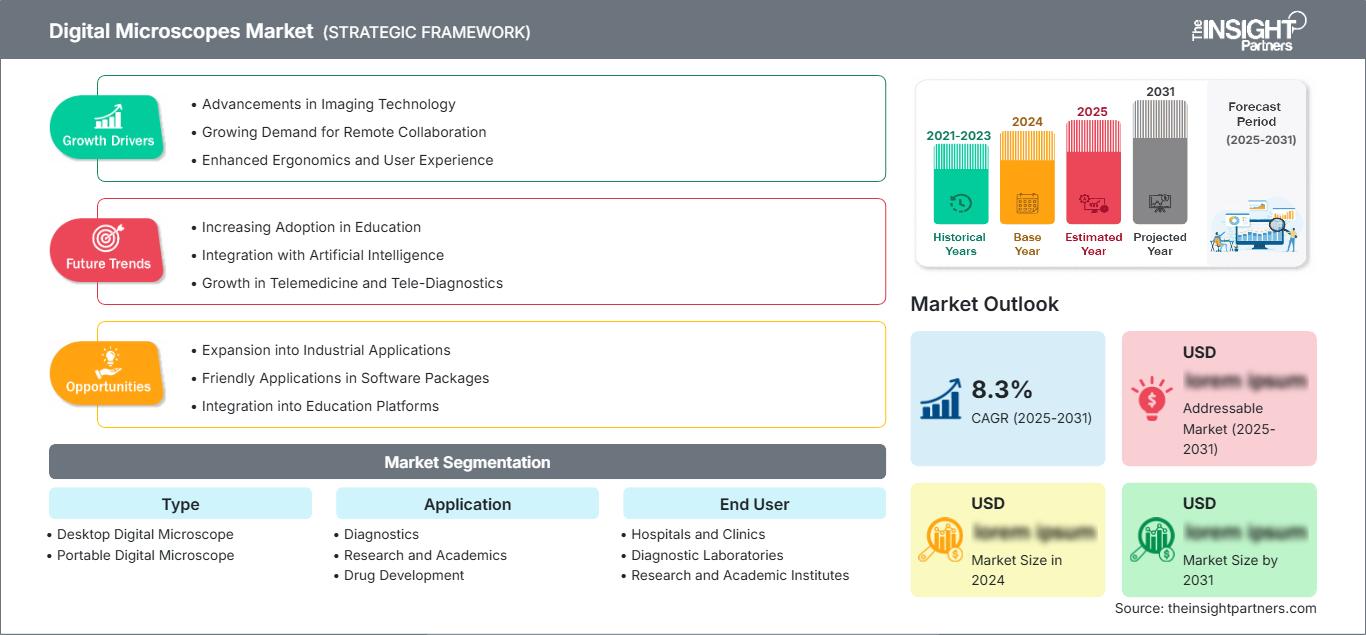
Digital Microscopes Market: Strategic Insights
Regional Insights
North America Digital Microscope Market
In the North America Digital Microscope Market, the region continues to be a strong market player through to 2025 and will have 32, 36 % market segment with the strength of the healthcare system, well-known research centers, the use of digitalization in industries, and the adoption of industrial automation. This particular area expects an annual expansion of 5.5, 6.5 % from 2026 to 2034. The demand for microscopes is driven by the digital pathology trend, investment in semiconductor manufacturing, and the necessity of high-accuracy inspection methods.
One of the main advantages of the North America digital microscope market is that health care providers, universities, and technology developers have been in collaboration with each other. Although the US contributes the highest share, Canada also supports the implementation through research grants as well as laboratory equipment upgrades. And these, further development is to be seen in artificial intelligence, remote imaging capabilities, and a connected microscopic platform intended for enhancing workflow efficiency in all areas namely diagnostics, education, and industrial.
U.S. Digital Microscope Market
North America accounts for a major percentage of the worldwide Digital Microscope Market with the United States alone making approximately half to three-quarters (65, 70%) of the overall volume expected in 2025. The country is estimated to witness a CAGR of 5.8, 6.8% from 2026, 2034 that will be fueled by growth in hospitals, diagnostic labs, biotech firms, and semiconductor factories. Excellent research setups and adoption of new technologies keep the market running smoothly.
Top-tier microscope companies have set up manufacturing units in the country which help in supplying products and developing novel applications. The main applications where microscope technologies are used are digital pathology, studies of new materials through micro- or nanostructures, as well checking components for defects. The rise in automation in laboratories, large investments in research on living systems, and the demand for higher resolution in image quality are the primary drivers leading many to replace their traditional setups with digital ones.
Europe Digital Microscope Market
Europe Digital Microscope Market is supposed to be at a 25, 29% level in 2025 with a CAGR between 5.0, 6.0% between 2026, 2034. Germany plays such a big role in the country that it's really difficult to imagine the whole digital microscopic imaging market without it. Other countries like the UK France Italy, and Spain do Though also contribute through their focus on research and modern health-care infrastructures. The market in the UK is mainly fueled by academic research centers plus the rising use of digital laboratory equipment. It's mainly the industrial inspection area in Germany that is the main driver of the German market, Mainly the automotive, electronics, and manufacturing sectors that benefit greatly. In the countries of France, Italy, and Spain the use of digital microscopes is slowly growing due to the fields of medical diagnostics, biotechnology applications and educational institutions respectively.
European legislation on maintaining laboratory quality and pushing ahead technological change keeps on motivating different companies to switch to digital imaging.
APAC Digital Microscope Market
APAC Digital Microscope Market is anticipated to capture a 28, 32% volume in 2025 and will be on a growth path at the CAGR range of 6.5, 7.5% for the period of 2026, 2034. China is the main regional adopter of this technology driven by semiconductor production rise, expansion of the healthcare sector, and increasing research investments. Japan and South Korea further their contributions through industries producing highly advanced electronic devices and manufacturing highly precise technology components.
India and Australia have started a digital microscope growth story based on healthcare infrastructure enhancement, academic R & D, and industrial applications. Government programs related to manufacturing development, biotechnology, and scientific research are boosting demand in the regions. Industrial needs for inspection plus policies that support technological advancement will keep influencing market development from the region.
Middle East & Africa Digital Microscope Market
The Middle East & Africa Digital Microscope Market is steadily growing with Saudi Arabia, the UAE, and South Africa as the foremost contributors. The region is expected to grow at a CAGR of between 4.5-5.5% in 2026-2034, driven by healthcare investments, lab development, and industrial diversification efforts.
Healthcare systems and research facilities across the region have been enhanced with the help of investments made in the Middle East & Africa. Saudi Arabia and UAE are also expanding the scope of diagnosis and research through their infrastructure development initiatives, whereas South Africa continues to be a hub for academic and medical uses. Industrial modernization initiatives and energy sector diversification programs are also encouraging the use of Inspection technologies. Healthcare is still a work in progress in countries of MEA, which will also lead to market growth.
Segmentation Analysis
Product Type
The Product Type segment includes Compound Digital Microscopes, Stereo Digital Microscopes, Inverted Digital Microscopes, Surgical Microscopes, Pathology Microscopes, Industrial Inspection Microscopes, and Others. The segment is expected to grow at a CAGR range of 5.5–6.5% during 2026–2034. Product demand is shaped by application-specific requirements across healthcare, education, manufacturing, and scientific research. Compound Digital Microscopes maintain strong adoption due to their widespread use in laboratories and educational environments, while industrial and pathology-focused systems are gaining importance through automation and advanced imaging requirements.
- Compound Digital Microscopes remain widely adopted in academic, clinical, and research environments due to their versatility, digital documentation capability, and compatibility with laboratory imaging workflows.
- Stereo Digital Microscopes support industrial inspection and biological observation applications where three-dimensional visualization and depth perception are essential for accurate analysis.
- Inverted Digital Microscopes are increasingly used in cell culture and biotechnology applications, supporting research activities requiring observation from below specimen containers.
- Surgical Microscopes assist medical professionals with enhanced visualization capabilities, supporting precision procedures and improved documentation in specialized healthcare environments.
- Pathology Microscopes are gaining relevance as laboratories adopt digital workflows, enabling improved image sharing, remote consultation, and streamlined diagnostic processes.
- Industrial Inspection Microscopes support quality control requirements across electronics, manufacturing, and material analysis applications where precision examination is required.
Modality
The Modality segment includes Desktop, Handheld, and Portable systems and is projected to grow at a CAGR range of 5.8–6.8% during 2026–2034. Adoption patterns are influenced by mobility requirements, laboratory configurations, and application flexibility. Desktop systems remain important for professional environments, while portable solutions are gaining attention in field inspection and education applications.
- Desktop systems represent a significant adoption category due to their stable performance, higher imaging capabilities, and suitability for laboratories and industrial workstations.
- Handheld systems provide flexibility for inspection activities requiring mobility, particularly in education, field analysis, and preliminary examination applications.
- Portable systems are increasingly preferred where compact design and operational flexibility are required for distributed research and inspection activities.
Connectivity
The Connectivity segment comprises Wired and Wireless solutions and is expected to expand at a CAGR range of 5.7–6.7% during 2026–2034. Connectivity development is becoming increasingly important as users seek efficient data transfer, remote collaboration, and integration with digital platforms. Wired systems continue to support professional applications requiring reliability, while wireless solutions improve flexibility.
- Wired connectivity remains preferred in laboratories and industrial environments where consistent data transmission and stable operational performance are priorities.
- Wireless connectivity supports flexible workflows by enabling remote viewing, device mobility, and easier integration with digital learning and collaboration platforms.
Resolution
The Resolution segment consists of 5–10 MP, More than 10 MP, Less than 5 MP categories and is estimated to grow at a CAGR range of 6.0–7.0% during 2026–2034. Higher resolution imaging demand is increasing due to precision requirements in diagnostics, research, and industrial inspection. More than 10 MP systems are gaining importance for advanced visualization applications.
- 5–10 MP systems provide balanced performance for routine laboratory, educational, and industrial applications requiring reliable image quality.
- More than 10 MP systems support advanced analysis requirements where detailed visualization, documentation, and measurement accuracy are important.
- Less than 5 MP systems continue serving basic educational and entry-level applications requiring cost-effective digital imaging solutions.
Magnification
The Magnification segment includes 50×–200×, More than 1000×, 200×–1000×, and Less than 50× categories. The segment is expected to grow at a CAGR range of 5.9–6.9% during 2026–2034. Different magnification levels support diverse requirements across healthcare, research, and industrial applications, with advanced microscopy applications increasing demand for higher magnification capabilities.
- 50×–200× magnification is widely used for general laboratory observation, education, and industrial inspection activities requiring moderate detail.
- More than 1000× magnification supports specialized scientific and research applications requiring detailed examination of microscopic structures.
- 200×–1000× magnification serves advanced laboratory and diagnostic applications requiring enhanced visualization capabilities.
- Less than 50× magnification remains relevant for larger specimen observation and basic inspection requirements.
Technology
The Technology segment includes 2D Digital Microscopy and 3D Digital Microscopy and is projected to grow at a CAGR range of 6.0–7.5% during 2026–2034. Digital imaging innovation is encouraging adoption of advanced visualization methods. Three-dimensional imaging is gaining importance for applications requiring depth analysis and enhanced specimen understanding.
- 2D Digital Microscopy remains the dominant technology due to broad application acceptance, established workflows, and compatibility across healthcare, education, and industrial sectors.
- 3D Digital Microscopy is gaining strategic importance through improved visualization capabilities for research, inspection, and complex analytical applications.
Application
The Application segment covers Electronics & Semiconductor Inspection, Pharmaceutical Applications, Medical Diagnostics, Education & Training, Forensic Analysis, and Others. The segment is expected to grow at a CAGR range of 6.0–7.0% during 2026–2034. Increasing demand for precise analysis and digital documentation is supporting adoption across multiple sectors. Medical diagnostics and electronics inspection remain key application areas due to workflow digitization.
- Electronics & Semiconductor Inspection supports manufacturing quality requirements through precise component analysis and defect identification capabilities.
- Pharmaceutical Applications utilize digital microscopy for research, development, and quality assessment activities.
- Medical Diagnostics benefits from digital workflows, remote consultation capabilities, and improved diagnostic documentation.
- Education & Training adopts digital systems to enhance interactive learning and laboratory accessibility.
- Forensic Analysis uses advanced imaging technologies for detailed examination and evidence documentation.
End User
The End User segment includes Hospitals & Clinics, Diagnostic Laboratories, Pharmaceutical & Biotech Companies, Research & Academic Institutes, Industrial & Manufacturing Companies, and Others. The segment is expected to grow at a CAGR range of 6.0–7.0% during 2026–2034. Increasing digital transformation across healthcare, research, and manufacturing sectors is strengthening adoption.
- Hospitals & Clinics are adopting digital microscopy for improved diagnostic workflows and clinical collaboration.
- Diagnostic Laboratories use digital imaging platforms to enhance analysis efficiency and reporting capabilities.
- Pharmaceutical & Biotech Companies require advanced microscopy for research and development activities.
- Research & Academic Institutes continue adopting systems for scientific studies and educational applications.
- Industrial & Manufacturing Companies utilize microscopy solutions for quality control, inspection, and production optimization.
Opportunity Snapshot
| End User | Revenue Contribution | Trend Tag | Adoption Stage |
|---|---|---|---|
| Hospitals & Clinics | High | Digital Pathology | Scaling |
| Diagnostic Laboratories | High | Workflow Automation | Scaling |
| Pharmaceutical & Biotech Companies | Medium | Research Imaging | Scaling |
| Research & Academic Institutes | Medium | Smart Learning | Mature |
| Industrial & Manufacturing Companies | High | Precision Inspection | Mature |
Digital Microscopes Market Growth Drivers and Impact Analysis
Expansion of Digital Pathology and Advanced Diagnostic Workflows
Demand for sophisticated imaging platforms is surging due to the digital pathology revolution, as these tools hold great potential for advancing diagnostic procedures and data organization. One of the main reasons is that such advanced solutions can greatly speed up the collaboration between different teams, streamline workflow and, more importantly, help make information accessible to specialized personnel anytime and in any place. Healthcare institutions that are adopting digital microscopy to assist in tele-consultation, standardized reports, and better patient access to expert services are one of the examples that reflect the digital revolution impact. The most noticeable change is in the diagnostic laboratories where they are trying to optimize their work flow and reduce the manual image interpretation. Hospital and research labs are also making their imaging systems connected that will allow data exchange with the laboratory information systems. The market transition toward digital pathology is motivating equipment manufacturers to develop products with very fine detail resolution, highly accurate analysis features and compatible with the existing software. There is a growing trend for digital healthcare systems and its infrastructure which Obviously, will boost the need for the use of such microscopic technologies in a wide variety of clinical contexts.
Growing Semiconductor and Electronics Inspection Requirements
As the scale of semiconductor manufacturing and the production of sophisticated electronics expand, the demand for advanced precision inspection technologies that can detect micro-level defects, as well as help to enhance the quality of production is on the rise. Digital optics are now being used in various production settings to examine items, components, and surface features with greater accuracy. The demand is driven by Truth is nowadays, electronic devices becoming increasingly complex, miniature, and the manufacturers themselves are raising their standards of the product. Semiconductors and components manufacturing companies, PCB makers, or component assembly units require consistent visual quality controls of their product at the production lines. This requirement is encouraging the improvement and diversification of the manufacturers' technical offerings as well the better optical performance, automation functions, and compatibility with industry quality management systems of technology vendors. Because of this the increasing industrial demand plays a major part in shaping the long-term market development.
Integration of Artificial Intelligence in Microscopy Platforms
Artificial intelligence is reshaping the microscopic world by opening the doors to automated tasks like image detection, categorization of objects or regions, measurements, and analytical support. Platforms with AI capabilities assist users greatly in the processing of large amounts of image data while also reducing manual analysis tasks. Academic research labs, medical centers, as well as commercial industrial end users are actively considering solutions that combine modern advanced imaging hardware and intelligent software features. One of the benefits of implementing AI is increased operational efficiency, better reproducibility, and faster decision-making in various fields of application. Vendors are working hard not only to improve image resolution but also to equip users with features for fully automated processes and to provide data-based insights. There will be a shift in product development as laboratory automation becomes a common trend and AI in microscopy systems is expected to bring forth new chances and technologies for the market.
Digital Microscopes Market Future Trends
Remote Microscopy and Cloud-Based Collaboration
With remote microscopy and cloud-based collaboration being used more and more as organizations want access to images data remotely and also get help from experts, these tools will become the new way of working. The next generation of systems will probably focus on secure sharing of data, remote monitoring, and digital workspace integration. Universities, healthcare centers, and global research bodies will start using microscopy platforms that are connected and allow sharing over the internet to support workflows that are spread over multiple locations and teams. This is also going to change the way products are made, pushing manufacturers towards making equipment that is good at getting connected with other devices, is fully compatible with different software packages, and at the same time is easy for the user. Cloud services can handle the centralization and collaboration on research data Because of this opening up a lot of opportunities Mostly to organizations that have their offices all over the world. Digital infrastructure growth will lead to expansion of connectivity microscopy use cases.
Three-Dimensional Imaging and Automated Analysis Development
Future developments in microscopy will likely be driven by 3D imaging and the introduction of automated analytical tools, as these techniques are expected to offer increased visual clarity and a widening of potential uses. There is a growing trend among the research community and industry to look for equipment that can provide a three-dimensional representation of a sample in a matter of seconds. Newer models can be expected to contain better cameras, more sophisticated software for image manipulation, and faster processors. Areas such as biotech, materials science, analysis of semiconductors, and high-tech manufacturing tend to be positively impacted by these technological advancements. As companies are pushing for more detailed analysis reports from microscopy, the suppliers of equipment are working on improvements with depth of field image processing speed, and software enhancements. With these technical advances, people think digital microscopy will become an even more important tool for those specialized applications.
Digital Microscopes Market Opportunities
Expansion Across Emerging Healthcare Infrastructure
The development of new markets in healthcare is an indication of the rising popularity of microscope providers since hospitals, laboratories, and research centers keep enhancing their tools for diagnosis. More funding for laboratories' equipment and the modernization of healthcare are bringing about a demand for digital imaging solutions. Businesses may consider a regional rollout by coming up with low-budget products, building stronger distribution networks, and manufacturing systems that are tailored to certain applications. Technology suppliers may consider the markets where countries focus on medical education, biotechnology research, and diagnostic infrastructure as promising. Maintained demand of healthcare access and laboratory operations improvement is a good opportunity for the expansion of microscopy in non-traditional territories. Besides, manufacturers of the microscopy systems that are able to cover the needs of the local population for the purchase price, the need for technical training, and the availability of the after-sales service can become the leaders in developing economies. At the same time, such efforts contribute to the promotion of the digital healthcare revolution.
Development of Industry-Specific Microscopy Solutions
Microscopy solutions specialized for individual industries have become a channel for companies to stand out through niche applications and workflows tailored to specific customers. The need for systems that are designed exclusively for semiconductor inspection or pharmaceutical R&D, forensic analysis, or cutting-edge manufacturing is growing day by day. Companies need platforms that are a combination of high-resolution imaging equipment and software packages focusing on different application areas, and powerful data analysis tools. Organizations that go for customized offerings are those which will be able to understand the very complex and detailed customer needs, So enabling them to create customer loyalty in particular sectors of industry. Newly launched product forecasts of the Digital Microscope Market have highlighted how further advancements in automatization networkability as well as analytical tools will make a difference in the decisions of future investments. Colligation with partnerships between manufacturers of equipment, developers of software, and customers from different industry groups might cause the faster creation of specialized microscopy ecosystems and, Because of this, be the reason for the sustained development of that part of the market.
Recent Developments
- May 2025: Leica Microsystems introduced advancements in digital microscopy solutions focused on improving imaging workflows, automation capabilities, and research efficiency. The development strengthened Leica Microsystems’ position in high-performance microscopy applications by addressing growing demand for integrated imaging platforms across life sciences, research laboratories, and clinical environments. The company continues to emphasize software-enabled microscopy ecosystems that support advanced visualization and analysis.
- March 2025: Thermo Fisher Scientific Inc. expanded its microscopy technology portfolio with continued investments in advanced imaging and analytical solutions supporting research and industrial applications. The development reflects increasing demand for high-resolution imaging platforms that enable efficient sample analysis, workflow integration, and improved laboratory productivity across biotechnology, healthcare, and scientific research sectors.
- October 2024: EVIDENT Corporation announced developments in microscopy technologies designed to enhance inspection, imaging accuracy, and usability across scientific and industrial applications. The advancement supports users requiring improved visualization, digital documentation, and efficient analysis workflows. EVIDENT continues to focus on combining optical expertise with digital capabilities for diverse microscopy applications.
Frequently Asked Questions

- Comprehensive Market Sizing and Forecast Analysis
- Detailed Segmentation Analysis
- In-Depth Market Dynamics Assessment
- Regional and Country-Level Insights
- Competitive Landscape and Company Benchmarking
- Strategic Business Intelligence
Recent Reports
Testimonials

The Insight Partners' SCADA System Market report is comprehensive, with valuable insights on current trends and future forecasts. The team was highly professional, responsive, and supportive throughout. We are very satisfied and highly recommend their services.
RAN KEDEM Partner, Reali Technologies LTDs
I requested a report on a very specific software market and the team produced the report in a few days. The information was very relevant and well presented. I then requested some changes and additions to the report. The team was again very responsive and I got the final report in less than a week.
JEAN-HERVE JENN Chairman, Future Analytica
We worked with The Insight Partners for an important market study and forecast. They gave us clear insights into opportunities and risks, which helped shape our plans. Their research was easy to use and based on solid data. It helped us make smart, confident decisions. We highly recommend them.
PIYUSH NAGPAL Sr. Vice President, High Beam Global
The Insight Partners delivered insightful, well-structured market research with strong domain expertise. Their team was professional and responsive throughout. The user-friendly website made accessing industry reports seamless. We highly recommend them for reliable, high-quality research services
YUKIHIKO ADACHI CEO, Deep Blue, LLC.
This is the first time I have purchased a market report from The Insight Partners.While I was unsure at first, I visited their web site and felt more comfortable to take the risk and purchase a market report.I am completely satisfied with the quality of the report and customer service. I had several questions and comments with the initial report, but after a couple of dialogs over email with their analyst I believe I have a report that I can use as input to our strategic planning process.Thank you so much for taking the extra time and making this a positive experience.I will definitely recommend your service to others and you will be my first call when we need further market data.
JOHN SUZUKI President and Chief Executive Officer, Board Director, BK Technologies
I wish to appreciate your support and the professionalism you displayed in the course of attending to my request for information regarding to infectious disease IVD market in Nigeria. I appreciate your patience, your guidance, and the fact that you were willing to offer a discount, which eventually made it possible for us to close a deal. I look forward to engaging The Insight Partners in the future, all thanks to the impression you have created in me as a result of this first encounter.
DR CHIJIOKE ONYIA MANAGING DIRECTOR, PineCrest Healthcare Ltd.Reason to Buy
- Informed Decision-Making
- Understanding Market Dynamics
- Competitive Analysis
- Identifying Emerging Markets
- Customer Insights
- Market Forecasts
- Risk Mitigation
- Boosting Operational Efficiency
- Strategic Planning
- Investment Justification
- Tracking Industry Innovations
- Aligning with Regulatory Trends





 Get Free Sample for