
DIGITAL OUT OF HOME (OOH) ADVERTISING Market Demand, Trends & Forecast by 2034
Coverage: By Type (Billboard, Transit, Street Furniture, Place-based, Malls, Other Applications); End User (Retail, Entertainment, Personal Care and Luxury Goods, Finance, Food and Beverage, Automotive, Others) , and Geography (North America, Europe, Asia Pacific, and South and Central America)
- Status : Data Released
- Report Code : TIPRE00009721
- Category : Electronics and Semiconductor
- No. of Pages : 150
- Available Report Formats :


- Last update date : August 06, 2026


2025 Market Size
US$ 23.53 Bn
Base year value
2034 Forecast
US$ 59.45 Bn
Projected by 2034
CAGR 2026-2034
10.85 %
Growth rate
Addressable Market
US$ 367.11 Bn
(2026-2034)
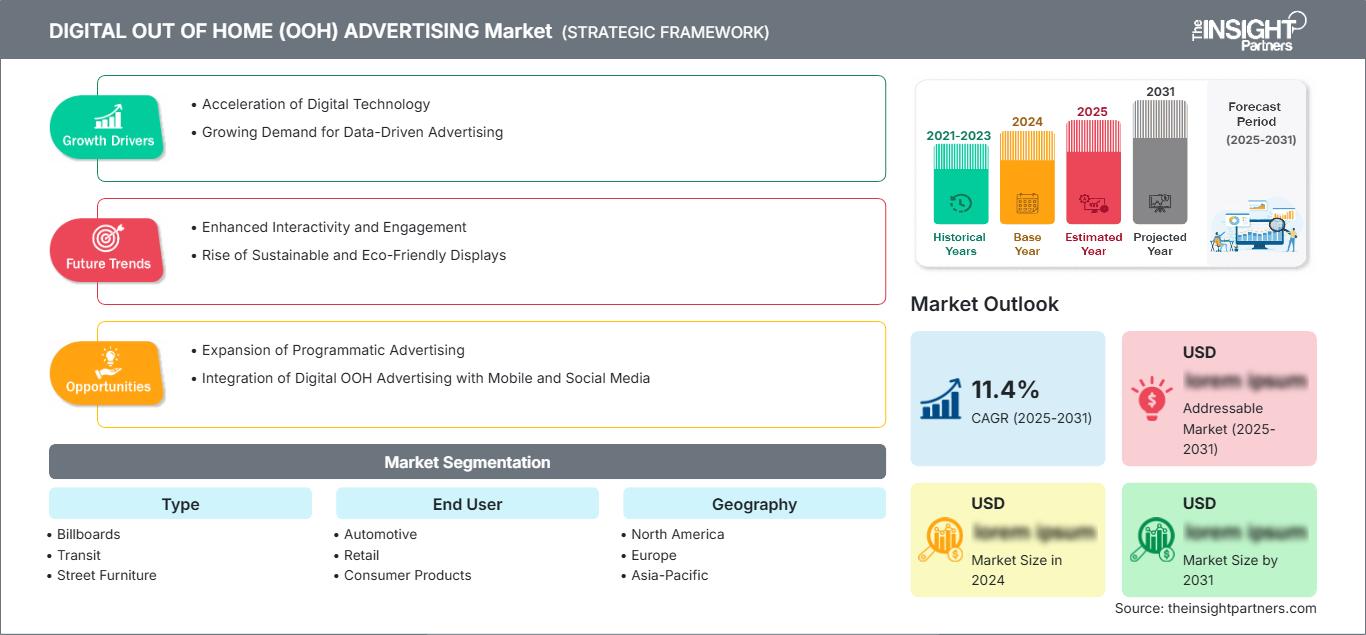
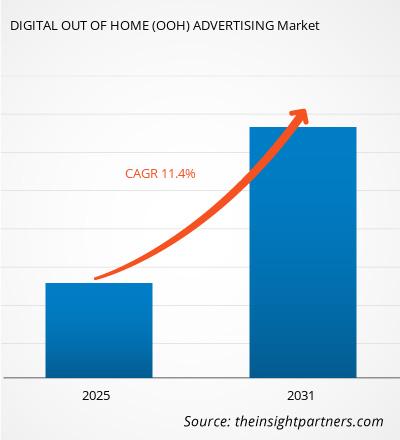
The Digital Out Of Home Advertising Market size is valued at US$ 23.53 Billion in 2025 and it is forecast to reach US$ 59.45 Billion by 2034 with a CAGR of 10.85% during 2026 – 2034 due to technological changes such as connected screens, programmatic, dynamic creative, and audience measurement changing the face of outdoor media planning.
The growth rate of North America in terms of Digital Out Of Home Advertising Market is forecast to be in the range of 9.8 – 10.9% with the reason being that media owners are digitizing their premium roadside, transit, airports, and urban street furniture.
DIGITAL OUT OF HOME (OOH) ADVERTISING Market Assessment and Insights
- North America held 27–30% share in 2025 and is growing at a CAGR range of 9.8–10.9% during 2026–2034, supported by programmatic adoption, airport media recovery, and premium urban screen networks.
- US represented 82–86% of North America in 2025 and is growing at a CAGR range of 10.0–11.1%, led by retail, automotive, BFSI, and telecom campaigns.
- Europe accounted for 24–27% share in 2025 and is advancing at a CAGR range of 9.2–10.2%, with the UK, Germany, France, Italy, and Spain leading screen conversion.
- Asia Pacific captured 33–37% share in 2025 and is expanding at a CAGR range of 11.6–12.8%, led by China, Japan, South Korea, India, and Australia.
- Largest Segment Billboards held 42–46% market share in 2025 and is growing at a CAGR range of 10.1–11.0%, supported by roadside digitization and large-format visibility.
- High Growth Segment Transit held 21–25% market share in 2025 and is growing at a CAGR range of 11.8–13.1%, driven by airport, metro, rail, and commuter network upgrades.
- Key companies analyzed in detail: ADFLOW Networks Inc., Clear Channel Outdoor Holdings, Inc., Daktronics, Inc., DISE International AB, Four Winds Interactive LLC, JCDecaux SE, Lama Advertising Company, Omnivex Corporation, OUTFRONT Media Inc., and YCD Multimedia Ltd.
Source: The Insight Partners' analysis based on proprietary research, government publications, company annual reports, investor presentations, industry databases, and expert interviews.
Outdoor Media has shifted from display schedule-based placements to media networks of screens where creativity can change according to time, weather, location, and audience context. Hardware creation has focused on higher brightness LED screens, energy-efficient screens, robust casings, and remote content management. This evolution is captured by the market analysis where media owners have begun to combine physical presence with digital workflow, verification, and campaign activation capability.
Future growth drivers include mobility recovery in cities, smart city development, airport concession, retail media, and privacy-compliant location intelligence. Premium transport routes, connected street furniture, and programmatic inventory will become areas of investment. Regime tailwinds around safer roadside advertising and standardization of metrics will help operators manage commercial viability with municipal, transport, and environmental needs.
DIGITAL OUT OF HOME (OOH) ADVERTISING Market Report Scope
| Report Attribute | Details |
|---|---|
| Market size in 2025 | US$ 23.53 Billion |
| Market Size by 2034 | US$ 59.45 Billion |
| Global CAGR (2026 - 2034) | 10.85% |
| Historical Data | 2021-2024 |
| Forecast period | 2026-2034 |
DIGITAL OUT OF HOME (OOH) ADVERTISING Market Analysis
The market is propelled by the need for high impact exposure in non-fragmented internet-based environments on the part of advertisers. Branding through the utilization of digital screens involves combining wide public exposure with creativity, dayparting, and contextual advertising. There is particular demand in areas where automotive rollouts, retail promotions, consumer goods, BFSI, and telecom offerings require rapid execution at the market level.
The ecosystem consists of display manufacturers, software platforms, media owners, agencies, data vendors, programmatic marketplaces, measurement providers, landlords, municipalities, and transport authorities. The supply dynamics are contingent upon site permissions, electricity, screen servicing, content management systems, and audience verification. Premium location operators can earn high returns as long as their inventory is integrated into automated purchasing and reporting solutions.
The Digital Out Of Home Advertising Market analysis reveals competition among global media companies, display technology providers, and dedicated signage software vendors. JCDecaux SE, Clear Channel Outdoor Holdings, Inc., OUTFRONT Media Inc., Daktronics, Inc., ADFLOW Networks Inc., DISE International AB, Four Winds Interactive LLC, Lama Advertising Company, Omnivex Corporation, and YCD Multimedia Ltd. compete on the basis of inventory quality, network size, software stability, and level of customer services.
Trends in investments are toward programmatic capabilities, first-party venue data, airport and transit concessions, and replacement of screens with energy-efficient LEDs. Positioning is changing from selling screen time to delivering audience results. National coverage of sales is an advantage for large players, while specializations prevail through enterprise content control, venue-specific networks, regional focus, and synergy with retail, transport, and corporate communication contexts.
● REPORT CUSTOMIZATION
Tailor This Report To Align With Your Specific Business Requirements
This report can be customized to align precisely with your business objectives, scope, and target markets. Customization options include tailored segmentation, geography, competitive analysis, and strategic insights to support informed decision-making.
Customize This Report →WHAT YOU CAN ADJUST
- ● Segmentations
- ● Geography
- ● Competitive Analysis
- ● Language Preferences
DIGITAL OUT OF HOME (OOH) ADVERTISING Market: Strategic Insights
Regional Insights
North America Digital Out Of Home Advertising Market
North America held 27–30% share in 2025 and is forecast to grow at a CAGR range of 9.8–10.9% through 2034. The Digital Out Of Home Advertising Market share is supported by advanced programmatic infrastructure, premium roadside billboards, airport networks, and place-based screens in retail, healthcare, entertainment, and corporate environments. US industry data showed OOH revenue surpassed US$ 9.1 billion in 2024, while digital OOH represented 34% of spend.
Demand is strongest in large metropolitan corridors where advertisers seek measurable reach without cookie dependence. Programmatic DOOH adoption benefits from agency trading desks, verified impressions, and dynamic creative triggers. Canada contributes through transit, retail, and urban street furniture upgrades, while Mexico adds growth through shopping centers, transport hubs, and roadside digitization. The region’s maturity supports higher-yield inventory and faster campaign activation.
U.S. Digital Out Of Home Advertising Market
The US contributed 82–86% to the total North American share in 2025 and will register a compound annual growth rate (CAGR) of 10.0-11.1%. Companies such as Clear Channel Outdoor Holdings, Inc., and OUTFRONT Media Inc. have developed robust nationwide sales platform capabilities, while Daktronics, Inc. supplies display solutions. Auto manufacturers, retail, BFSI, telecom, entertainment, and QSR advertisers utilize the medium for activation via roadside, airport, transit, and venue displays.
Applications in 2025 reflect growing digital billboard usage for product launches, retail promotions, and reaching out to mobile users and Connected TV audiences through programmatic buying. Programmatic buying helps in adapting to shorter campaign windows, weather targeting, and location-based promotions. Airport and transit advertising is rebounding with normalization of business travel and tourism, which is helping premium screen networks with dwell and context advantages.
Europe Digital Out Of Home Advertising Market
Europe’s share was 24–27% in 2025 and it is forecast to grow with a CAGR of 9.2–10.2%. The UK ranks high in terms of digital penetration due to sophisticated roadside, rail, underground, airport, and retail media as well as agency usage of audience planning. Germany is next through urban transport, automotive advertising, and government-regulated city media concessions that select reliable companies for screen deployment.
France stays relevant through street furniture, transit shelters, airport media, and JCDecaux SE's operational footprint. Italy and Spain are improving their situation with retail, metro, tourism, and center city screens. Europe’s growth will be influenced by privacy laws, energy efficiency, and permits at the city level that make quality of assets, measurement, and sustainability key to competitive advantage in the Digital Out Of Home Advertising Market.
APAC Digital Out Of Home Advertising Market
APAC has a share of 33–37% in 2025 and is projected to register a CAGR of 11.6–12.8%. China is the market leader owing to dense network of urban screens, metro systems, retail hubs, and integration with mobile campaigns. The contribution of countries such as Japan and South Korea would be via premium transit, retail, and entertainment media placement. Meanwhile, that of India and Australia will be through airports, malls, roadside, and smart city media placement.
Government policies favoring urban digitization, cashless retail, tourism infrastructure, and improved public transport further help in promoting adoption. Size of the APAC region creates ample demand for billboards and transit screens; however, the penetration of programmatic technology still holds much potential. Operators who can offer localized content production and audience measurement capabilities can monetize these screen estates effectively.
Middle East & Africa Digital Out Of Home Advertising Market
Middle East & Africa is projected to grow at a CAGR range of 8.7–9.8% as Saudi Arabia, the UAE, South Africa, and the rest of MEA invest in tourism, airports, entertainment districts, retail malls, and transport infrastructure. The UAE leads premium urban and airport screen demand, while Saudi Arabia expands large-format media around destination development.
Energy, real estate, telecom, travel, and consumer brands use digital outdoor formats to reach mobile urban audiences. Adoption depends on permitting, power reliability, screen maintenance, and media measurement maturity. Growth is smaller than APAC, but infrastructure programs and international tourism create attractive opportunities for premium digital billboards, transit displays, and place-based networks.
Segmentation Analysis
Type
Type is expected to grow at a CAGR range of 10.2–11.4% from 2026 to 2034 as the Digital Out Of Home Advertising Market scope spans large-format visibility, commuter engagement, street-level utility, and contextual venue media. Format selection depends on location quality, dwell time, creative flexibility, screen brightness, audience verification, and integration with automated campaign planning.
- Billboards remain the largest format because roadside screens deliver broad reach, high visibility, and rapid creative rotation for automotive, retail, telecom, entertainment, and consumer product campaigns.
- Transit is strategically important as airports, metros, buses, rail stations, and commuter corridors offer longer dwell time, journey-based targeting, and premium audience environments.
- Street Furniture supports city-level campaigns through shelters, kiosks, digital panels, and urban utility assets that combine pedestrian reach with regulated municipal concession models.
- Place-Based screens serve malls, offices, gyms, healthcare venues, campuses, and entertainment locations where contextual messaging can influence behavior near purchase or service decisions.
End User
End User is projected to grow at a CAGR range of 10.4–11.6% during 2026–2034 as advertisers allocate outdoor budgets toward measurable reach, local activation, and omnichannel media plans. Adoption is strongest among categories that need geographic flexibility, brand salience, and quick creative updates across commuting, shopping, entertainment, financial, and telecom environments.
- Automotive uses digital outdoor for model launches, dealership offers, electric vehicle education, and regional promotions that benefit from high visibility near commuter and retail corridors.
- Retail depends on dynamic screens for store openings, promotions, seasonal campaigns, and proximity messaging that can connect outdoor exposure with footfall and commerce media activity.
- Consumer Products brands use digital outdoor to reinforce packaged goods, beverages, personal care, and household campaigns where repeated public visibility supports recall and trial.
- BFSI advertisers prioritize trusted, high-traffic formats for credit cards, insurance, banking apps, and wealth messages that require broad reach and local market relevance.
- Telecom operators use digital outdoor for plan launches, handset promotions, 5G coverage messages, and competitive offers that require frequent creative updates across urban markets.
Opportunity Snapshot
| End User | Revenue Contribution | Trend Tag | Adoption Stage |
| Automotive | High | EV Launch | Scaling |
| Retail | High | Store Traffic | Scaling |
| Consumer Products | Medium | Brand Recall | Mature |
| BFSI | Medium | Trust Reach | Scaling |
| Telecom | High | 5G Plans | Mature |
| Others | Low | Public Notices | Emerging |
DIGITAL OUT OF HOME (OOH) ADVERTISING Market Growth Drivers and Impact Analysis
Programmatic Buying Improves Yield and Campaign Flexibility
The development of automated buying is affecting the way advertisers purchase outdoor digital inventory, through shorter planning cycles and more timely scheduling of campaigns. According to global industry research, the budget allocated for DOOH campaigns through programmatic buying reached more than $ 1 billion in 2025, signaling that advertising agencies are becoming more confident using digital methods to purchase outdoor inventory. The results include the higher use of unsold inventory, more accurate dayparting, and greater synchronization of omnichannel media campaigns. Media owners get yield management tools, while advertisers are able to activate campaigns based on the weather, event, shopping calendar, or consumer behavior.
Urban Mobility and Transport Media Rebuild Audience Scale
Transit networks, airports, metro stations, and roadside corridors are regaining importance as travel, commuting, and tourism normalize across major cities. Digital screens in these environments provide strong dwell time, captive viewing, and contextual relevance for retail, banking, telecom, automotive, and travel advertisers. The market impact is increased investment in concession renewals, airport media upgrades, and commuter network digitization. Transport authorities also benefit from improved information displays and commercial revenue streams. As passenger flows stabilize, media owners can package mobility audiences with more confidence, supporting premium pricing and better campaign planning. This driver particularly benefits transit screens, airport networks, and street furniture connected to public transport routes.
Data-Enabled Measurement Strengthens Budget Justification
Advertisers increasingly require proof that outdoor media contributes to reach, store visits, brand lift, and sales outcomes. Audience modeling, mobile location data, traffic counts, camera-free sensors, and campaign attribution tools are improving confidence in screen-level planning. The impact is stronger budget justification for digital billboards, place-based networks, and transit screens within performance-oriented media mixes. Measurement also supports better creative testing because advertisers can compare messages across locations and time periods. Operators that provide transparent reporting can capture larger commitments from national brands and agencies. As privacy expectations rise, compliant aggregated data will become a competitive differentiator rather than an optional service layer.
DIGITAL OUT OF HOME (OOH) ADVERTISING Market Future Trends
AI-Assisted Creative Optimization Expands Dynamic Messaging
Digital Out Of Home Advertising Market trends will increasingly include AI-assisted creative selection, localization, and contextual message sequencing. Advertisers will use weather, traffic, events, inventory status, and audience movement signals to decide which creative appears on each screen. This will not replace human planning, but it will improve responsiveness and reduce production bottlenecks for multi-city campaigns. The future value lies in matching public-screen visibility with relevant, brand-safe content at the right time. Media owners that offer approved creative templates, governance controls, and rapid reporting will attract advertisers seeking both efficiency and creative consistency across distributed screen networks.
Sustainable Screen Operations Become a Procurement Requirement
Energy efficiency, screen brightness control, recyclable materials, and municipal sustainability criteria will influence future concession decisions. Cities and transport authorities are likely to require clearer evidence that digital signage upgrades do not create excessive power use, light pollution, or maintenance waste. This trend will accelerate adoption of lower-energy LED modules, smart dimming, renewable power procurement, and longer-life display components. Advertisers will also favor media owners that can document responsible operations because sustainability commitments increasingly affect media procurement. Operators that align commercial revenue with public benefit, safety, and environmental performance will be better positioned for long-term contracts.
DIGITAL OUT OF HOME (OOH) ADVERTISING Market Opportunities
Retail Media Partnerships Around Physical Store Networks
Digital Out Of Home Advertising Market Forecasts support investment in partnerships between screen operators, retailers, malls, convenience chains, and commerce media platforms. Physical stores generate valuable location context, while digital screens can influence shoppers before, during, and after visits. Operators can create opportunity by linking screen inventory with promotion calendars, footfall analytics, loyalty audiences, and store-level campaign reporting. Retailers gain incremental media revenue and stronger shopper engagement, while brands gain proximity to purchase decisions. The opportunity is strongest in grocery, quick-service restaurants, fuel stations, malls, and high-street retail zones where frequent visits and short decision cycles improve campaign relevance.
Airport and Premium Transit Concessions for Global Brands
Airport and premium transit networks offer investment opportunities because they combine high-value audiences, long dwell time, and strong contextual association with business, tourism, finance, technology, and luxury categories. Media owners can pursue concession renewals, digital screen upgrades, and integrated passenger information displays to improve both public utility and advertising yield. Brands gain access to predictable audience flows and premium environments that support trust and recall. The opportunity requires disciplined capital planning because concession fees, installation costs, and maintenance standards can be high. Operators with strong local partnerships and proven campaign measurement can convert these assets into resilient long-term revenue streams.
Recent Developments
- July 2026: JCDecaux SE the company connected 100% of its DOOH inventory to programmatic platforms across nine Latin American markets, expanding automated access for advertisers and agencies seeking campaign flexibility across regional screen networks.
- February 2026: Clear Channel Outdoor Holdings, Inc. the company announced a definitive agreement to be acquired by Mubadala Capital and TWG Global for US$ 2.43 per share in cash, a transaction expected to close by the end of the third quarter of 2026.
- January 2026: DIRECTV Advertising today announced at CES that it will be bringing more premium CTV video options to the digital out-of-home (DOOH) marketplace with the programmatic enablement of inventory from DIRECTV Remote, making it easier for brands to reach TV audiences on the go.
Frequently Asked Questions

- Comprehensive Market Sizing and Forecast Analysis
- Detailed Segmentation Analysis
- In-Depth Market Dynamics Assessment
- Regional and Country-Level Insights
- Competitive Landscape and Company Benchmarking
- Strategic Business Intelligence
Recent Reports
Testimonials

The Insight Partners' SCADA System Market report is comprehensive, with valuable insights on current trends and future forecasts. The team was highly professional, responsive, and supportive throughout. We are very satisfied and highly recommend their services.
RAN KEDEM Partner, Reali Technologies LTDs
I requested a report on a very specific software market and the team produced the report in a few days. The information was very relevant and well presented. I then requested some changes and additions to the report. The team was again very responsive and I got the final report in less than a week.
JEAN-HERVE JENN Chairman, Future Analytica
We worked with The Insight Partners for an important market study and forecast. They gave us clear insights into opportunities and risks, which helped shape our plans. Their research was easy to use and based on solid data. It helped us make smart, confident decisions. We highly recommend them.
PIYUSH NAGPAL Sr. Vice President, High Beam Global
The Insight Partners delivered insightful, well-structured market research with strong domain expertise. Their team was professional and responsive throughout. The user-friendly website made accessing industry reports seamless. We highly recommend them for reliable, high-quality research services
YUKIHIKO ADACHI CEO, Deep Blue, LLC.
This is the first time I have purchased a market report from The Insight Partners.While I was unsure at first, I visited their web site and felt more comfortable to take the risk and purchase a market report.I am completely satisfied with the quality of the report and customer service. I had several questions and comments with the initial report, but after a couple of dialogs over email with their analyst I believe I have a report that I can use as input to our strategic planning process.Thank you so much for taking the extra time and making this a positive experience.I will definitely recommend your service to others and you will be my first call when we need further market data.
JOHN SUZUKI President and Chief Executive Officer, Board Director, BK Technologies
I wish to appreciate your support and the professionalism you displayed in the course of attending to my request for information regarding to infectious disease IVD market in Nigeria. I appreciate your patience, your guidance, and the fact that you were willing to offer a discount, which eventually made it possible for us to close a deal. I look forward to engaging The Insight Partners in the future, all thanks to the impression you have created in me as a result of this first encounter.
DR CHIJIOKE ONYIA MANAGING DIRECTOR, PineCrest Healthcare Ltd.Reason to Buy
- Informed Decision-Making
- Understanding Market Dynamics
- Competitive Analysis
- Identifying Emerging Markets
- Customer Insights
- Market Forecasts
- Risk Mitigation
- Boosting Operational Efficiency
- Strategic Planning
- Investment Justification
- Tracking Industry Innovations
- Aligning with Regulatory Trends





 Get Free Sample for