
Direct-fed Microbials (DFM) Market Growth, Trends & Forecast by 2034
Coverage: By Type (Lactic acid bacteria, Bacillus, Others); Livestock (Poultry, Swine, Ruminants, Aquatic Animals, Others); Form (Dry, Liquid), and Geography (North America, Europe, Asia Pacific, and South and Central America)
- Status : Data Released
- Report Code : TIPRE00018770
- Category : Life Sciences
- No. of Pages : 150
- Available Report Formats :


- Last update date : July 08, 2026


2025 Market Size
US$ 1.73 Bn
Base year value
2034 Forecast
US$ 2.26 Bn
Projected by 2034
CAGR 2026-2034
3.01 %
Growth rate
Addressable Market
US$ 18.11 Bn
(2026-2034)
The global Direct-fed Microbials (DFM) market was valued at US$ 1.73 billion in 2025 and is expected to reach US$ 2.26 billion by 2034; it is estimated to record a CAGR of 3.01% during 2026-2034.
Direct-fed Microbials (DFM) Market Assessment and Insights
- North America: North America accounted for 35–40% share in 2025 and is anticipated to expand at a CAGR of 3.2%–3.8% during 2026–2034. Livestock intensification, the transition toward antibiotic-free feed, and increasing integration of probiotics in poultry production continue to support regional market leadership.
- U.S.: The U.S. represented 75–80% of the North American Direct-Fed Microbials market size in 2025 and is projected to register a CAGR of 3.3%–3.9% during 2026–2034, supported by expanding commercial livestock production, rising adoption of functional feed additives, and growing demand for antibiotic alternatives.
- Europe: Europe held 28–32% of the Direct-Fed Microbials market share in 2025 and is expected to grow at a CAGR of 3.1%–3.6% during 2026–2034. Germany, France, and the Netherlands remain the leading regional markets due to stringent feed regulations and increasing adoption of sustainable livestock nutrition practices.
- Asia Pacific: Asia Pacific accounted for 25–30% share in 2025 and is forecast to expand at a CAGR of 3.8%–4.5% during 2026–2034. China, India, and Japan continue to drive regional growth through expanding livestock production, increasing aquaculture activities, and rising demand for high-performance animal feed additives.
- Largest Segment: Microbe Type – Bacillus-Based Microbes represented the largest market segment and is expected to record a CAGR of 3.5%–3.9% during 2026–2034, reflecting their high stability, heat resistance during feed processing, and broad applicability across livestock feed formulations.
- High Growth Segment: Animal Type – Aquatic Animals is projected to grow at a CAGR of 4.0%–4.6% during 2026–2034, driven by expanding aquaculture health management practices and increasing emphasis on disease prevention strategies.
- Key companies analyzed in detail: Archer Daniels Midland Company; IFF Health & Biosciences; DSM-Firmenich AG; Novoneses Group A/S; Chr. Hansen Holding A/S; Kemin Industries, Inc.; BIOMIN Holding GmbH; Lallemand Inc.; Novus International, Inc.; and Bio-Vet, Inc.
Source: The Insight Partners' analysis based on proprietary research, government publications, company annual reports, investor presentations, industry databases, and expert interviews.
The Direct-Fed Microbials Market report has moved from being positioned in a general probiotic framework to becoming animal performance solutions based on strain validation. Now, the feed manufacturers are considering their microbial products on the basis of stability, survivability, species-specificity, and impact on feed conversion, immunity, and digestive harmony. This has led the suppliers to focus on fermentation, encapsulation, and application testing in line with the practicalities of commercial livestock production.
Market perspective is pragmatic as opposed to speculative and is driven by the substitution of antibiotics for growth promoters and the necessity to maintain productivity within intensive farming operations. The success in terms of adoption will depend on the ability of producers to correlate their use of direct-fed microbials with decreased mortality rates, higher litter quality, greater nutrient absorption, and superior animal protein characteristics.
Direct-fed Microbials (DFM) Market Report Scope
| Report Attribute | Details |
|---|---|
| Market size in 2025 | US$ 1.73 Billion |
| Market Size by 2034 | US$ 2.26 Billion |
| Global CAGR (2026 - 2034) | 3.01% |
| Historical Data | 2021-2024 |
| Forecast period | 2026-2034 |
Direct-fed Microbials (DFM) Market Analysis
The Direct-Fed Microbials market is influenced by livestock production challenges, antimicrobial stewardship, and increasing demands for residue awareness in animal protein. The industry is looking for additives that enhance gut health without compromising established feeding regimes. Lactic acid bacteria continue to be relevant for digestive balance, whereas Bacillus products are becoming popular due to spore tolerance to pelleting, storage, and varying farm environments.
The ecosystem consists of microbial strain developers, fermentation experts, premix manufacturers, feed mills, integrators, veterinarians, and livestock producers. Creating value involves more than just selecting microorganisms; it also involves protecting viable counts, compatibility with enzymes and organic acids, and delivering systems. Companies able to transfer microbiome research into farm practices are able to secure greater customer loyalty than their competitors who focus solely on price.
Competitors include diversified animal nutrition and bioscience companies such as Archer Daniels Midland Company, IFF Health & Biosciences, DSM-Firmenich AG, Novonesis Group A/S, Chr. Hansen Holding A/S, Kemin Industries, Inc., BIOMIN Holding GmbH, Lallemand Inc., Novus International, Inc., and Bio-Vet, Inc. The competitive positioning varies depending on advantages in terms of scale of fermentation processes, technical services, regional distribution, and species-specific product development.
The investment trends are focused on heat resistance, validation of multi-strains, synbiotics, and compatibility with automatic feeders. Also, there is an increased emphasis on the package of evidence associated with necrotic enteritis prevention, performance of calves, sow productivity, and fish survival. Strategic positioning becomes more favorable for companies that have the ability to perform feed trials, regulatory documents, and regional modifications rather than broad probiotic communication.
● REPORT CUSTOMIZATION
Tailor This Report To Align With Your Specific Business Requirements
This report can be customized to align precisely with your business objectives, scope, and target markets. Customization options include tailored segmentation, geography, competitive analysis, and strategic insights to support informed decision-making.
Customize This Report →WHAT YOU CAN ADJUST
- ● Segmentations
- ● Geography
- ● Competitive Analysis
- ● Language Preferences
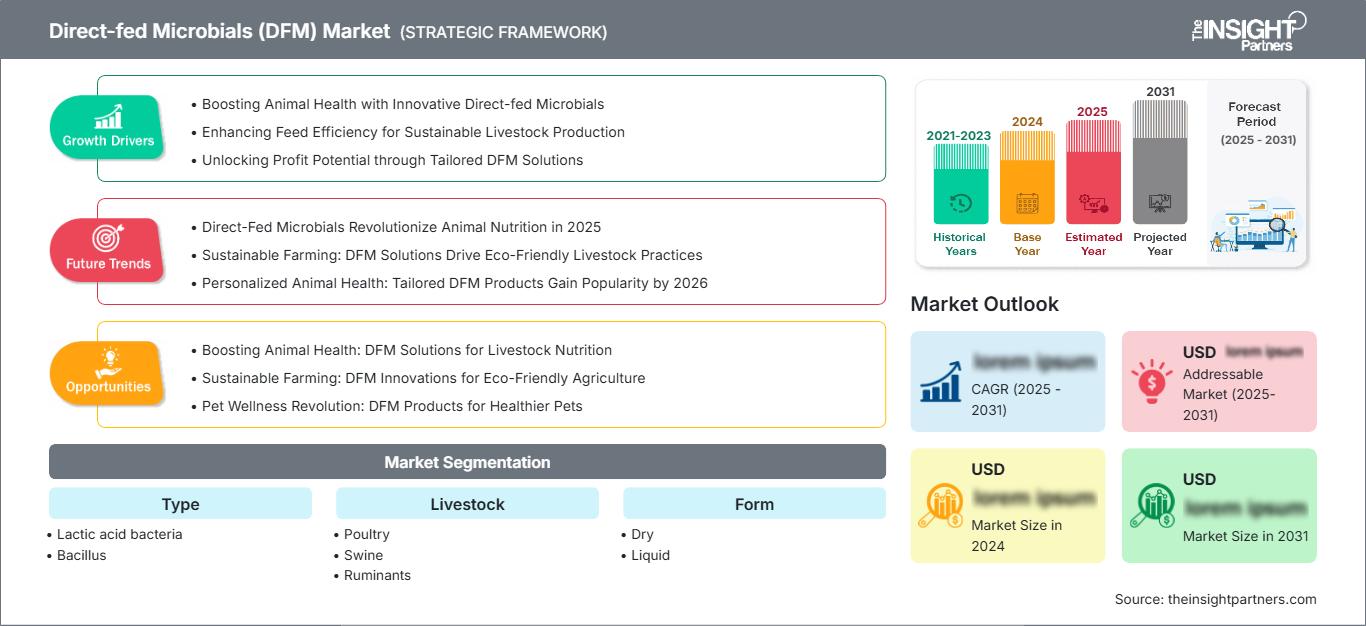
Direct-fed Microbials (DFM) Market: Strategic Insights
Regional Insights
North America Direct-Fed Microbials Market
North America is expected to retain leadership in the Direct-Fed Microbials Market, expanding at roughly 3.1%–3.5%. The region benefits from advanced feed manufacturing, strong veterinary nutrition networks, and producers focused on antibiotic-free or reduced-antibiotic production systems.
Demand is strongest in poultry, swine, and dairy operations where performance variability carries measurable cost. Suppliers gain traction by pairing products with technical support, field-trial data, and integration into premix programs. Structural drivers include large integrated meat systems, higher consumer scrutiny, and adoption of feed technologies that improve resilience without adding pharmaceutical complexity.
U.S Direct-Fed Microbials Market
The U.S. Direct-Fed Microbials Market accounts for an estimated 70%–78% of North American demand and is projected to grow near 3.2%–3.6%. Large poultry complexes, swine integrators, and dairy operations create repeat demand for microbial products that improve digestive stability and reduce performance losses during production stress.
Company presence is broad, with Archer Daniels Midland Company, Kemin Industries, Inc., Novus International, Inc., Bio-Vet, Inc., and Lallemand Inc. active across feed additive channels. Application trends favor Bacillus for pelleted poultry feed, lactic acid bacteria for young animals, and multi-strain approaches in dairy and swine programs seeking consistent gut-health outcomes.
Europe Direct-Fed Microbials Market
Europe holds an estimated 24%–29% share of the Direct-Fed Microbials Market and is expected to advance at about 2.8%–3.3%. Germany is the leading country, supported by established livestock nutrition expertise, strict antimicrobial stewardship, and sophisticated feed additive evaluation practices.
The UK Direct-Fed Microbials Market is shaped by poultry, dairy, and swine producers looking to maintain productivity under welfare-led retail standards. Buyers prioritize documented efficacy, traceable supply, and compatibility with antibiotic-reduction commitments, making technical validation central to supplier selection.
Germany leads European demand due to its large feed sector, dairy base, and science-led approach to animal nutrition. Direct-fed microbials are used in calf, poultry, and swine systems where producers seek digestive resilience, improved nutrient utilization, and compliance with high animal-health expectations.
France, Italy, and Spain contribute through poultry, ruminant, and specialty livestock production. Adoption is supported by Mediterranean dairy systems, broiler integrations, and feed mills seeking additives that manage gut stress during heat events, ration changes, and disease-pressure periods.
APAC Direct-Fed Microbials Market
APAC represents the fastest-growing Direct-Fed Microbials Market, with an estimated CAGR of 3.8%–4.5% and a global share range of 26%–32%. China is the leading country, driven by scale in poultry, swine, aquaculture, and industrial feed production.
China, Japan, and South Korea are strengthening microbial feed adoption through productivity targets, biosecurity upgrades, and precision nutrition. China’s transition toward large-scale farms supports consistent feed additive use, while Japan and South Korea emphasize quality, traceability, and scientifically supported formulations.
India and Australia add different growth profiles. India’s expanding poultry, dairy, and aquaculture sectors are increasing interest in affordable gut-health additives, while Australia’s livestock systems favor performance stability and animal welfare. Policy focus on food safety, domestic protein security, and responsible antimicrobial use supports broader regional adoption.
Middle East & Africa Direct-Fed Microbials Market
The Middle East & Africa Direct-Fed Microbials Market is projected to expand at around 3.0%–3.6%. Saudi Arabia is the leading country, supported by investment in poultry self-sufficiency, feed infrastructure, and controlled-environment livestock production designed to reduce dependence on imported animal protein.
Saudi Arabia and the UAE are using modern feed systems to improve productivity under high-temperature conditions. Energy-intensive cold chains, water constraints, and food-security strategies encourage additives that protect animal performance. Direct-fed microbials fit these priorities by supporting gut stability during heat stress and ration transitions.
South Africa and the rest of MEA show gradual adoption, mainly in poultry, dairy, and aquaculture. Infrastructure gaps and price sensitivity limit rapid uptake, but organized feed manufacturing, regional livestock modernization, and interest in non-antibiotic productivity tools create a practical foundation for long-term market development.
Segmentation Analysis
Type
- Lactic acid bacteria: Lactic acid bacteria remain widely used for digestive balance, competitive exclusion of undesirable microbes, and early-life gut support across poultry, swine, and ruminant programs.
- Bacillus: Bacillus products are gaining preference where pelleting stability, shelf life, and survival through acidic gut conditions are essential for reliable delivery in commercial feed systems.
Livestock
- Poultry: Poultry represents the largest use case, supported by broiler integrators seeking better feed conversion, litter quality, gut integrity, and lower reliance on routine antibiotic interventions.
- Swine: Swine applications focus on piglet transition, sow productivity, and digestive stability during weaning, when microbial balance directly influences growth uniformity and mortality risk.
- Ruminants: Ruminant use centers on rumen efficiency, calf health, milk productivity, and stress resilience, particularly in dairy systems managing ration complexity and high-output performance targets.
- Aquatic Animals: Aquatic animal adoption is increasing as producers use microbial additives to support gut health, survival, and water-quality-linked performance in shrimp and finfish farming.
Form
- Dry: Dry forms dominate commercial feed use because they offer easier blending, better storage stability, compatibility with premix operations, and logistical advantages across bulk distribution.
- Liquid: Liquid forms serve waterline, drench, and specialized on-farm applications where rapid administration, flexible dosing, or targeted support during stress events is required.
Opportunity Snapshot
| Livestock | Revenue Contribution | Trend Tag | Adoption Stage |
| Poultry | High | Gut Integrity | Mature |
| Swine | Medium | Weaning Support | Scaling |
| Ruminants | Medium | Rumen Efficiency | Scaling |
| Aquatic Animals | Low | Survival Gains | Emerging |
Direct-fed Microbials (DFM) Market Growth Drivers and Impact Analysis
Antibiotic-Reduction Strategies in Livestock Production
Antibiotic-reduction strategies are a central driver of the Direct-Fed Microbials Market because producers need practical tools that maintain productivity while addressing retailer, regulator, and consumer expectations. Direct-fed microbials help support gut microbial balance, improve digestive resilience, and reduce performance disruptions that previously encouraged routine antimicrobial use. Their appeal is strongest in poultry and swine, where production cycles are short and small performance losses can affect margins.
The real-world impact is visible in feed programs that combine direct-fed microbials with enzymes, organic acids, and management protocols rather than using them as standalone additives. This creates recurring demand for validated formulations and technical support. Suppliers able to demonstrate consistent outcomes in field conditions gain stronger procurement confidence, especially among integrators building antibiotic-free, no-antibiotics-ever, or reduced-antibiotic animal protein portfolios.
Rising Feed Efficiency and Productivity Pressure
Feed accounts for a large proportion of livestock production costs, making efficiency extremely desirable on commercial farms. Direct-fed microbials enhance nutrient digestion by affecting digestive processes, microbial status, and the intestinal lining. On intensive systems, slight improvements in feed efficiency, survival, or weight uniformity could have a significant effect on profitability, particularly during periods of rising grain costs, disease, and climate-related stresses.
The greatest market potential lies where there is tight performance monitoring, and linkages can be drawn between microbial use and production measures. The poultry integrators, dairy farmers, and swine producers are increasingly considering additives in terms of return on feed costs and not just raw materials. This creates a shift towards purchasing from companies with strong trial methodologies, farm services, and formulations that withstand the feed manufacturing process.
Expansion of Species-Specific Microbial Solutions
The Direct-Fed Microbials Market evolves as producers move beyond probiotics as a general term and venture into specialized strains for specific species and life stages. The guts of poultry, swine, ruminants, and aquatic species have unique features, feeding habits, and stressors that necessitate strain tailoring for performance, such as early establishment in chicks, weaning in piglets, rumen function, or shrimp adaptation to varied water conditions.
From a commercial perspective, the resulting market is one of differentiated products, with technical claims backed by proof of concept through strain-specific data. Strains that companies develop from their libraries and fermentation techniques offer greater defense against margin erosion. Furthermore, it enables collaboration between bioscience companies and feed producers through the effectiveness of custom formulations.
Direct-fed Microbials (DFM) Market Future Trends
Growth of Synbiotic and Multi-Functional Feed Platforms
A key development shaping Direct-Fed Microbials market trends is the adoption of synbiotic and multifunctional feed platforms that combine live microorganisms with enzymes, prebiotics, yeast fractions, minerals, and organic acids. The manufacturers prefer integrated systems that not only improve one aspect of animal productivity but also address other issues, such as digestive efficiency, immune response, litter quality, and nutrient absorption.
Future demand in this market will be driven by programs that can be customized to the production phase, diet, and disease challenges faced by livestock producers. Instead of purchasing single product-based additives, integrators may start using nutrition programs based on performance monitoring of additives. This leaves scope for high-end product development but also raises the bar for evidence. Companies that prove synergistic effects without overcomplicating feed mill operations will be better positioned.
Greater Use of Data-Backed Strain Validation
Another important trend is the increased reliance on scientific evidence of strain validation, through development and customer experience with the product. Buyers seek information on strain identification, survival, mode of action, and field performance under commercial conditions. This lowers tolerance for generic claims and places greater emphasis on science, quality control, and standardized probiotic formulation.
Prospective producers of feed additives will use farm data, microbiome profiling, and controlled trials to develop formulations tailored to specific animal species and regions. Digital feed management systems can be useful in linking the consumption of microbe-based products to productive outcomes. With growing demand for proof of efficacy, small producers may find themselves under pressure to form strategic alliances or focus on regional markets.
Direct-fed Microbials (DFM) Market Opportunities
Aquaculture Nutrition and Health Programs
Aquaculture presents significant growth opportunities, strengthening the Direct-Fed Microbials market forecast as shrimp and finfish producers face disease, water-quality variability, and feed-efficiency challenges. Direct-fed microbials can support gut health, survival, and nutrient utilization while fitting into broader farm management programs. The segment remains less mature than poultry, leaving room for formulation innovation, species-specific trials, and partnerships with aquafeed manufacturers.
Action-driven investments must consider heat-stable microbes, water-suitable delivery systems, and test results using shrimp, tilapia, salmon, and tropical fish. Companies capable of considering regional conditions in Asia, Latin America, and the Middle East will discover many good opportunities to enter. Education is critical because buyers in the aquaculture industry need evidence that using microbes increases survival rates and reduces production losses.
Customized Programs for Emerging Livestock Markets
The increasing demand in emerging livestock markets presents an opportunity for firms that can deliver efficacy, affordability, and technical support. The increase in protein consumption in Asia, the Middle East, and Africa is prompting firms to invest in feed mills, poultry farms, dairy farms, and aquaculture. Direct-fed microbials can help farmers manage livestock stress and improve performance in young livestock.
Investment plans must consider adapting local formulations, distributor training, and demonstration tests to the region's dietary habits and agricultural practices. Companies can secure market share by offering dry formulation options, varied package sizes, and technical support for feed mills. Companies will have to demonstrate that their products reduce variability and costs by providing technical support to feed mills.
Recent Developments
- June, 2025: Novonesis Group A/S completed the acquisition of dsm-firmenich’s share of the Feed Enzyme Alliance, taking over sales and distribution activities after regulatory approvals. The move expands Novonesis across the animal biosolutions value chain and supports a broader animal nutrition offering that includes enzymes and probiotics.
- June, 2025: DSM-Firmenich AG announced the completion of the sale of its stake in the Feed Enzymes Alliance to Novonesis for €1.5 billion. The transaction reshapes its animal nutrition portfolio while maintaining a long-term commercial relationship for feed enzymes through its Animal Nutrition & Health premix network.
- February, 2026: IFF announced the launch of Enviva DUO, a groundbreaking direct-fed microbial (DFM) solution for poultry production. The solution constitutes an innovative blend of two non-spore-forming bacterial strains designed to address challenging conditions by supporting the growth of beneficial gut bacteria. The solution also encourages a favorable nutribiotic state and promotes optimal bird performance. Its direct dosing strategy ensures that challenged birds receive the microbiome-boosting benefits of Enviva DUO, despite a decrease in feed intake.
Frequently Asked Questions

- Comprehensive Market Sizing and Forecast Analysis
- Detailed Segmentation Analysis
- In-Depth Market Dynamics Assessment
- Regional and Country-Level Insights
- Competitive Landscape and Company Benchmarking
- Strategic Business Intelligence
Recent Reports
Testimonials

The Insight Partners provided valuable market intelligence that supported our global go-to-market strategy. Their team was professional, responsive, and attentive to our feedback, providing thoughtful analysis and helpful methodological clarifications throughout the project.
Junmo Kim Chief Financial Officer (CFO), Enertech Co., Ltd.
The Insight Partners' SCADA System Market report is comprehensive, with valuable insights on current trends and future forecasts. The team was highly professional, responsive, and supportive throughout. We are very satisfied and highly recommend their services.
RAN KEDEM Partner, Reali Technologies LTDs
I requested a report on a very specific software market and the team produced the report in a few days. The information was very relevant and well presented. I then requested some changes and additions to the report. The team was again very responsive and I got the final report in less than a week.
JEAN-HERVE JENN Chairman, Future Analytica
We worked with The Insight Partners for an important market study and forecast. They gave us clear insights into opportunities and risks, which helped shape our plans. Their research was easy to use and based on solid data. It helped us make smart, confident decisions. We highly recommend them.
PIYUSH NAGPAL Sr. Vice President, High Beam Global
The Insight Partners delivered insightful, well-structured market research with strong domain expertise. Their team was professional and responsive throughout. The user-friendly website made accessing industry reports seamless. We highly recommend them for reliable, high-quality research services
YUKIHIKO ADACHI CEO, Deep Blue, LLC.
This is the first time I have purchased a market report from The Insight Partners.While I was unsure at first, I visited their web site and felt more comfortable to take the risk and purchase a market report.I am completely satisfied with the quality of the report and customer service. I had several questions and comments with the initial report, but after a couple of dialogs over email with their analyst I believe I have a report that I can use as input to our strategic planning process.Thank you so much for taking the extra time and making this a positive experience.I will definitely recommend your service to others and you will be my first call when we need further market data.
JOHN SUZUKI President and Chief Executive Officer, Board Director, BK Technologies
I wish to appreciate your support and the professionalism you displayed in the course of attending to my request for information regarding to infectious disease IVD market in Nigeria. I appreciate your patience, your guidance, and the fact that you were willing to offer a discount, which eventually made it possible for us to close a deal. I look forward to engaging The Insight Partners in the future, all thanks to the impression you have created in me as a result of this first encounter.
DR CHIJIOKE ONYIA MANAGING DIRECTOR, PineCrest Healthcare Ltd.Reason to Buy
- Informed Decision-Making
- Understanding Market Dynamics
- Competitive Analysis
- Identifying Emerging Markets
- Customer Insights
- Market Forecasts
- Risk Mitigation
- Boosting Operational Efficiency
- Strategic Planning
- Investment Justification
- Tracking Industry Innovations
- Aligning with Regulatory Trends





 Get Free Sample for